


2 Samuel 19:35
Bible text: King James Version (1769 Blayney text) · Public domain
Bible text: King James Version with Strong's numbers · Public domain
Bible text: Berean Standard Bible · Public domain
Bible text: American Standard Version (1901) · Public domain
Bible text: World English Bible, Messianic edition · Public domain
Bible text: Geneva Bible (1599) · Public domain
Bible text: Young's Literal Translation · Public domain
- בֶּןben[am] a son ofH1121N-mscNoun Singular Masculine Construct
- שְׁמֹנִיםshe·mo·NimeightyH8084N-mpNoun Plural Masculine Absolute
- שָׁנָהsha·Nahyear[s]H8141N-fsNoun Singular Feminine Absolute
- אָנֹכִי'a·no·KhiIH595Pro-1csPronoun Personal 1st Singular common gender
- הַיּוֹםhai·Yomthis dayH3117Art ¦ N-msNoun Singular Masculine Absoluteהַthisיּוֹםday
- הַאֵדַעha·'e·Da'¿ do I knowH3045Interrog ¦ V-Qal-Imperf-1csVerb Qal Imperfect 1st Singular common genderהַ¿אֵדַעdo I know
- בֵּיןbeinbetweenH996Adj-mscAdjective Numerical Singular Masculine Construct
- טוֹבTovgoodH2896Adj-msAdjective Singular Masculine Absolute
- לְרָעle·Ra'and evilH7451Prep-l ¦ Adj-msAdjective Singular Masculine Absoluteלְandרָעevil
- אִם'imor?H518PrtParticle Conditional
- יִטְעַםyit·'Amwill he tasteH2938V-Qal-Imperf-3msVerb Qal Imperfect 3rd Singular Masculine
- עַבְדְּךָ'av·de·Khayour servantH5650N-msc ¦ 2msNoun Singular Masculine Constructעַבְדְּservantךָyour
- אֶת'et<obj.>H853DirObjMParticle Object Indicator
- אֲשֶׁר'a·Sher[that] whichH834RelParticle Relative
- אֹכַל'o·KhalI will eatH398V-Qal-Imperf-1csVerb Qal Imperfect 1st Singular common gender
- וְאֶתve·'Etand <obj.>H853Conj-w ¦ DirObjMParticle Object Indicatorוְandאֶת<obj.>
- אֲשֶׁר'a·Sher[that] whichH834RelParticle Relative
- אֶשְׁתֶּה'esh·TehI will drinkH8354V-Qal-Imperf-1csVerb Qal Imperfect 1st Singular common gender
- אִם'imor?H518PrtParticle Conditional
- אֶשְׁמַע'esh·Ma'will I hearH8085V-Qal-Imperf-1csVerb Qal Imperfect 1st Singular common gender
- עוֹדodstillH5750Adj-msAdjective Numerical Singular Masculine Absolute
- בְּקוֹלbe·Kol<in> [the] voice ofH6963Prep-b ¦ N-mscNoun Singular Masculine Constructבְּ<in>קוֹל[the] voice of
- שָׁרִיםsha·Rim[male] singersH7891V-Qal-Prtcpl-mpVerb Qal Participle Plural Masculine Absolute
- וְשָׁרוֹתve·sha·Rotand female singersH7891Conj-w ¦ V-Qal-Prtcpl-fpVerb Qal Participle Plural Feminine Absoluteוְandשָׁרוֹתfemale singers
- וְלָמָּהve·la·Mahand <to> why?H4100Conj-w ¦ Prep-l ¦ InterrogPronoun Interrogativeוְandלָ<to>מָּהwhy?
- יִהְיֶהyih·Yehwill he becomeH1961V-Qal-Imperf-3msVerb Qal Imperfect 3rd Singular Masculine
- עַבְדְּךָ'av·de·Khayour servantH5650N-msc ¦ 2msNoun Singular Masculine Constructעַבְדְּservantךָyour
- עוֹד'OdstillH5750Adj-msAdjective Numerical Singular Masculine Absolute
- לְמַשָּׂאle·ma·Sa'<into> a burdenH4853Prep-l ¦ N-msNoun Singular Masculine Absoluteלְ<into>מַשָּׂאa burden
- אֶל'eltoH413PrepPreposition
- אֲדֹנִי'a·do·Nimy lordH113N-msc ¦ 1csNoun Singular Masculine Constructאֲדֹנִlordיmy
- הַמֶּלֶךְha·Me·lekhthe kingH4428Art ¦ N-msNoun Singular Masculine Absoluteהַtheמֶּלֶךְking
English is a literal word-by-word gloss of the Hebrew, not the KJV's wording. Why?
This is the original text the KJV's translators worked from — each Hebrew word with its own literal English meaning in this verse, prepared by scholars at Tyndale House, Cambridge. The KJV translates whole sentences, not word by word, so its wording differs: one Hebrew word can become several English words, and the KJV may choose “the LORD” where the gloss reads “Yahweh”. Both are faithful — they answer different questions. For the KJV's own rendering, switch to the KJV text.
Details
See on the biblical-era maps
Study this verse
Public-domain commentary
Matthew Henry
From his Commentary on the Whole Bible. Henry comments on passages, not single verses — this entry covers 2 Samuel 19:31–39. His three-level outline is real structure in the source text, so it is rendered as structure.
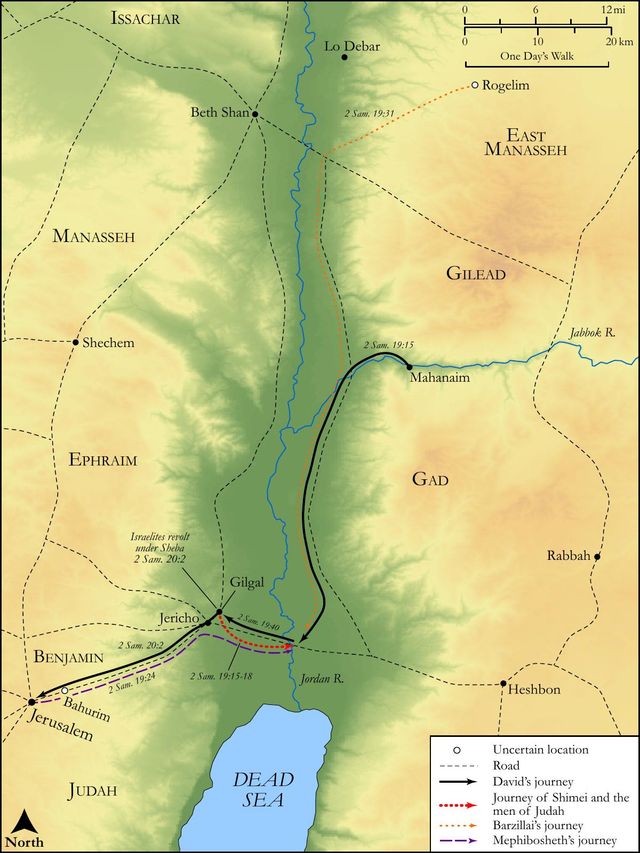
David had already graced the triumphs of his restoration with the generous remission of the injuries that had been done to him; we have him here gracing them with a no less generous reward of the kindnesses that had been shown to him. Barzillai, the Gileadite, who had a noble seat at Rogelim, not far from Mahanaim, was the man who, of all the nobility and gentry of that country, had been most kind to David in his distress. If Absalom had prevailed, it is likely he would have suffered for his loyalty; but now he and his shall be no losers by it. Here is,
I.Barzillai's great respect to David, not only as a good man, but as his righteous sovereign:
He provided him with much sustenance, for himself and his family, while he lay at Mahanaim, Sa2 19:32. God had given him a large estate, for he was a very great man, and, it seems, he had a large heart to do good with it: what else but that is a large estate good for? To reduced greatness generosity obliges us, and to oppressed goodness piety obliges us, to be in a particular manner kind, to the utmost of our power. Barzillai, to show that he was not weary of David, though he was so great a charge to him, attended him to Jordan, and went over with him, Sa2 19:31. Let subjects learn hence to render tribute to whom tribute is due and honour to whom honour, Rom 13:7.
II.The kind invitation David gave to him to court (Sa2 19:33): Come thou over with me. He invited him,
1.That he might have the pleasure of his company and the benefit of his counsel; for we may suppose that he was very wise and good, as well as very rich, otherwise he would not have been called here a very great man; for it is what a man is, more than what he has, that renders him truly great.
2.That he might have an opportunity of returning his kindness: "I will feed thee with me; thou shalt fare as sumptuously as I fare, and this at Jerusalem, the royal and holy city." David did not take Barzillai's kindness to him as a debt (he was not one of those arbitrary princes who think that whatever their subjects have is theirs when they please), but accepted it and rewarded it as a favour. We must always study to be grateful to our friends, especially to those who have helped us in distress.
III.Barzillai's reply to this invitation, wherein,
1.He admires the king's generosity in making him this offer, lessening his service, and magnifying the king's return for it: Why should the king recompense it with such a reward? Sa2 19:36. Will the master thank that servant who only does what was his duty to do? He though he had done himself honour enough in doing the king any service. Thus, when the saints shall be called to inherit the kingdom in consideration of what they have done for Christ in this world, they will be amazed at the disproportion between the service and the recompence. Mat 25:37, Lord, when saw we thee hungry, and fed thee?
2.He declines accepting the invitation. He begs his majesty's pardon for refusing so generous an offer: he should think himself very happy in being near the king, but,
(1.)He is old, and unfit to remove at all, especially to court. He is old, and unfit for the business of the court: "Why should I go up with the king to Jerusalem? I can do him no service there, in the council, the camp, the treasury, or the courts of justice; for how long have I to live? Sa2 19:34. Shall I think of going into business, now that I am going out of this world?" He is old and unfit for the diversions of the court, which will be ill-bestowed, and even thrown away, upon one that can relish them so little, Sa2 19:35. As it was in Moses's time, so it was in barzillai's and it is not worse now, that, if men be so strong that they come to fourscore years, their strength then is labour and sorrow, Psa 90:10. These were then, and are still, years of which men say they have no pleasure in them, Ecc 12:1. Dainties are insipid when desire fails, and songs to the aged ear are little better than those sung to a heavy heart, very disagreeable: how should they be otherwise when the daughters of music are brought low? Let those that are old learn of Barzillai to be dead to the delights of sense; let grace second nature, and make a virtue of the necessity. Nay, Barzillai, being old, thinks he shall be a burden to the king, rather than any credit to him; and a good man would not go any where to be burdensome, or, if he must be so, will rather be so to his own house than to another's.
(2.)He is dying, and must begin to think of his long journey, his removal out of the world, Sa2 19:37. It is good for us all, but it especially becomes old people to think and speak much of dying. "Talk of going to court!" says Barzillai; "Let me go home and die in my own city, the place of my father's sepulchre; let me die by the grave of my father, that my bones may be quietly carried to the place of their rest. The grave is ready for me, let me go and get ready for it, go and die in my nest."
3.He desires the king to be kind to his son Chimham: Let him go over with my lord the king, and have preferment at court. What favour is done to him Barzillai will take as done to himself. Those that are old must not grudge young people those delights which they themselves are past the enjoyment of, nor confine them to their retirements. Barzillai will go back himself, but he will not make Chimham go back with him; though he could ill spare Chimham, yet, thinking it would gratify and advance him, he is willing to do it.
IV.David's farewell to Barzillai.
1.He sends him back into his country with a kiss and a blessing (Sa2 19:39), signifying that in gratitude for his kindnesses he would love him and pray for him, and with a promise that whatever request he should at any time make to him he would be ready to oblige him (Sa2 19:38): Whatsoever thou shalt think of, when thou comest home, to ask of me, that will I do for thee. What is the chief excellency of power but this, that it gives men a capacity of doing the more good?
2.He takes Chimham forward with him, and leaves it to Barzillai to choose him his preferment. I will do to him what shall seem good to thee, Sa2 19:38. And, it should seem, Barzillai, who had experienced the innocency and safety of retirement, begged a country seat for him near Jerusalem, but not in it; for, long after, we read of a place near Beth-lehem, David's city, which is called the habitation of Chimham, allotted to him, probably, not out of the crown-lands or the forfeited estates, but out of David's paternal estate.
Continue studying 2 Samuel 19:35 across the web’s major study libraries — every link below opens this exact verse, chapter, or book on the destination site.
Read & Compare
 BibleGatewayThis verse in more than 200 translations and 70 languages.
 Bible.comThe YouVersion reader — hundreds of translations, reading plans, and highlights.
 ESV.orgCrossway's official English Standard Version reader.
 NET BibleThe NET translation with 60,000+ translators' notes on every rendering decision.
 STEP BibleTyndale House's free study tool — original text, vocabulary, and scholarly resources.
 BibliaLogos Bible Software's free web reader.
 USCCBThe New American Bible (Revised Edition) with the U.S. bishops' study notes.
Commentaries
 BibleHub CommentariesDozens of classic commentaries on this verse, gathered on one page.
 StudyLightMore than 100 commentary sets — the largest collection on the web.
 BibleRefPlain-English commentary on what this verse means, verse by verse.
 Enduring WordDavid Guzik's free commentary on this chapter, widely used by Bible teachers.
 Bible Study ToolsVerse commentary alongside Greek and Hebrew study aids.
Original Language & Research
- BibleHub InterlinearThe verse word by word — original language, transliteration, and English.
- BibleHub LexiconEvery word's original-language definition and Strong's entry.
 Blue Letter BibleDeep-study tools — Strong's numbers, concordance, and word studies.
 SefariaThe Hebrew text with Rashi and centuries of Jewish commentary.
Sermons, Hymns & Audio


TrulyRandomVerse is not affiliated with these sites and doesn’t control their content. They’re linked because they’re genuinely useful.
Summary
In 2 Samuel 19:35, Barzillai the Gileadite, an eighty-year-old loyal supporter of King David, humbly declines the king's generous invitation to reside in Jerusalem. Having provided crucial aid to David during Absalom's rebellion, Barzillai articulates his advanced age and the natural decline of his physical senses, explaining that he would be a liability rather than an asset in the vibrant court life, thus preferring not to become a burden to his lord. His words reflect profound self-awareness, wisdom, and continued deference to the king.
Context
ShowHideLiterary Context
This verse is situated at a pivotal moment in the narrative of King David's return to Jerusalem following the suppression of Absalom's rebellion. David, having crossed the Jordan River, is met by various factions and individuals, including those who had remained loyal and those who had defected. Barzillai had been a significant figure of support and provision for David and his weary men during their exile in Mahanaim, supplying them with essential food, beds, and vessels, as detailed in 2 Samuel 17:27-29. Out of deep gratitude, David extends a personal invitation to Barzillai to accompany him to Jerusalem, promising to provide for him there. Barzillai's response in this verse is a testament to his character, demonstrating a self-sacrificing wisdom that contrasts with the political maneuvering and self-interest seen elsewhere in the book of 2 Samuel.
Historical & Cultural Context
The period immediately following a civil war, such as Absalom's rebellion, was often marked by efforts to consolidate power, reward loyalty, and reconcile factions. David's invitation to Barzillai was not merely an act of personal kindness but also a strategic move to honor a prominent figure from Gilead, thereby strengthening his standing across the kingdom. In ancient Israel, old age was generally revered, seen as a sign of God's blessing and a source of wisdom, as seen in Proverbs 16:31. However, the physical realities of aging, including the decline of senses, were also acknowledged. Court life in Jerusalem would have been dynamic and demanding, involving banquets, music, and political discussions, activities that Barzillai wisely recognized he could no longer fully participate in or appreciate. His concern about being a "burden" reflects a cultural value placed on contributing to the community and avoiding becoming a drain on resources.
Key Themes
ShowHideBarzillai's words in this verse encapsulate several significant themes. Firstly, it highlights wisdom in old age, demonstrating a profound understanding of one's limitations and the appropriate time to transition from active service. Barzillai exemplifies a mature self-awareness that prioritizes the king's welfare over personal prestige. Secondly, the passage underscores the transience of physical life and earthly pleasures. Barzillai's lament about his failing senses serves as a poignant reminder that even the most delightful aspects of human experience—taste, hearing, social engagement—are subject to decay. This resonates with the broader biblical theme of the fleeting nature of life, as expressed in Psalm 90:10. Thirdly, the verse subtly touches upon gratitude and loyalty, as Barzillai, despite declining the offer, maintains an attitude of deep respect and continued allegiance to David, whom he consistently refers to as "my lord the king." His actions speak to a genuine, selfless devotion that had characterized his support during David's darkest hour.
Exposition and Analysis
ShowHideKey Word Analysis
ShowHideThis word directly states Barzillai's advanced age of eighty years. In Israel, this was considered a very old age, beyond the "threescore years and ten" of man's days, signifying the natural decline of physical and sensory faculties, which forms the basis for Barzillai's humble refusal of David's invitation.
While yâdaʻ broadly means "to know" or "to perceive," in this context, Barzillai uses it to express his diminished capacity for sensory perception and appreciation. He implies that his ability to "know" or "distinguish" between the pleasant ("good") and unpleasant ("evil") aspects of life, particularly through taste and hearing, has faded with age, rendering the delights of court life meaningless to him.
This term signifies a load, a weight, or something that is troublesome. Barzillai's use of massâʼ reveals his deep humility and selflessness. He fears that his advanced age and declining faculties would make him an imposition on the king, requiring care and attention rather than being able to contribute meaningfully to the royal court. His desire is to avoid becoming a liability.
Verse Breakdown
ShowHide"I [am] this day fourscore years old:"
Barzillai opens by stating his advanced age, laying the foundation for his argument. This is a factual declaration that immediately establishes the premise for his physical limitations.
"[and] can I discern between good and evil?"
This rhetorical question refers to his diminished capacity to appreciate and distinguish between pleasant and unpleasant sensory experiences, particularly in the context of the king's court. He implies that his senses are dull, making the "good" things of life less enjoyable.
"can thy servant taste what I eat or what I drink?"
This further specifies the decline of his senses, focusing on the sense of taste. The rich foods and fine wines of the king's table would be wasted on him, as his palate is no longer capable of full appreciation.
"can I hear any more the voice of singing men and singing women?"
This vividly illustrates the loss of his hearing, particularly for the music and entertainment that would be a prominent feature of royal court life. The inability to enjoy music underscores his detachment from the vibrant social scene.
"wherefore then should thy servant be yet a burden unto my lord the king?"
This is the culminating rhetorical question, drawing a logical conclusion from his preceding statements. Given his physical decline and inability to fully participate in or enjoy court life, he concludes that his presence would only serve as an imposition or a drain on the king, rather than a benefit. This reveals his profound respect and selfless concern for David.
Literary Devices
ShowHideThe verse is rich with literary devices that amplify Barzillai's message. The most prominent is the use of Rhetorical Questions. Barzillai poses a series of questions ("can I discern...?", "can thy servant taste...?", "can I hear...?", "wherefore then should...?") not to solicit answers, but to powerfully assert his physical limitations and the logical conclusion that follows. This technique makes his argument undeniable and deeply personal. There is also clear Parallelism and Repetition in the structure of the questions, particularly the repeated "can I...?" which emphasizes the comprehensive nature of his sensory decline. The mention of "singing men and singing women" provides Vivid Imagery, painting a picture of the lively court life that Barzillai can no longer fully participate in, making his loss more tangible to the listener. Finally, Barzillai's self-description as a "burden" can be seen as a form of Understatement or Humility, as he downplays his significant past contributions and focuses solely on his present perceived inadequacy, demonstrating a profound lack of self-importance.
Theological and Thematic Connections
ShowHideBarzillai's humble refusal in 2 Samuel 19:35 offers a profound theological reflection on the nature of wisdom, aging, and selfless service. His self-awareness and willingness to accept his limitations, rather than clinging to prestige or comfort, exemplify a mature understanding of one's place before God and others. This stands in stark contrast to many biblical figures who grasped for power or overextended themselves. The passage implicitly reminds us of the temporary nature of our physical bodies and the fleeting quality of earthly pleasures, prompting a deeper consideration of what truly endures. It encourages a posture of humility, recognizing that true strength often lies in acknowledging weakness and knowing when to gracefully yield. Barzillai's concern about being a "burden" highlights the biblical value of contribution and the desire to be a blessing rather than a drain on others, especially those in authority.
Reflection and Application
ShowHideBarzillai's example in 2 Samuel 19:35 provides timeless lessons for all stages of life. His profound self-awareness challenges us to honestly assess our own capacities and limitations, especially as we age or face changing circumstances. True wisdom often involves knowing when to step back, delegate, or adjust our roles, rather than clinging to positions we can no longer effectively fulfill. This isn't about resignation, but about responsible stewardship of our remaining years and energies, ensuring we remain a blessing to others. His humility reminds us that our value is not solely tied to our productivity or what we can gain, but in our character and our willingness to serve according to our current ability. For younger generations, it's a call to honor and learn from the wisdom of elders, recognizing that their experiences, even in decline, offer invaluable insights. For elders, it's an encouragement to embrace the natural process of aging with grace, finding new ways to contribute and receive care without shame, always prioritizing the well-being of the community over personal pride.
Questions for Reflection
ShowHideFAQ
ShowHideWhat is the meaning of "discern between good and evil" in this verse?
ShowHideIn 2 Samuel 19:35, Barzillai's phrase "discern between good and evil" primarily refers to his diminished ability to distinguish and appreciate sensory pleasures and experiences, not moral judgment. He is lamenting that he can no longer fully enjoy the "good" things of life, such as delicious food, fine drink, and beautiful music, which would be part of the king's court. His senses have dulled to the point where these delights would be lost on him, making him unable to truly participate in or benefit from the royal hospitality. While the phrase "discern good and evil" can have a moral or ethical meaning elsewhere in Scripture (e.g., Genesis 2:17 or 1 Kings 3:9), in Barzillai's mouth, it speaks to the physical realities of aging and the loss of sensory enjoyment.
Christ-Centered Fulfillment
ShowHideBarzillai's humble acknowledgement of his limitations and his fear of becoming a "burden" to the king finds a profound Christ-centered fulfillment. Unlike Barzillai, who recognized his inability to fully participate in earthly courtly life, Jesus Christ perfectly discerned all things—not merely sensory pleasures, but the very depths of good and evil, truth and falsehood, as seen in his teachings and confrontations, for example, in John 8:44-47. More significantly, while Barzillai sought to avoid being a burden, Jesus willingly became the ultimate burden-bearer. He took upon Himself the immense weight of humanity's sin and suffering, becoming a "man of sorrows, acquainted with grief" (Isaiah 53:3). He did not fear becoming a burden; rather, He invited the weary and heavy-laden to come to Him, promising rest (Matthew 11:28-30). Through His sacrifice on the cross, He bore the ultimate "burden" of God's wrath against sin, offering us freedom from our own spiritual burdens. Furthermore, while Barzillai's physical senses were failing, Christ offers a new spiritual discernment and new senses to those who believe, enabling us to taste that the Lord is good (Psalm 34:8) and to hear His voice, even the "new song" of redemption (Revelation 5:9). In Christ, our ultimate "burden" is lifted, and our true capacity for discerning and enjoying the eternal good is restored.