


Numbers 24:25
Bible text: King James Version (1769 Blayney text) · Public domain
Bible text: Berean Standard Bible · Public domain
Bible text: American Standard Version (1901) · Public domain
Bible text: World English Bible, Messianic edition · Public domain
Bible text: Geneva Bible (1599) · Public domain
Bible text: Young's Literal Translation · Public domain
- וַיָּקָםvai·Ya·komand he aroseH6965Conj-w ¦ V-Qal-ConsecImperf-3msVerb Qal Consecutive Imperfect 3rd Singular Masculineוַandיָּקָםhe arose
- בִּלְעָםbil·'AmBalaamH1109N-proper-mNoun Proper Masculine
- וַיֵּלֶךְvai·Ye·lekhand he wentH1980Conj-w ¦ V-Qal-ConsecImperf-3msVerb Qal Consecutive Imperfect 3rd Singular Masculineוַandיֵּלֶךְhe went
- וַיָּשָׁבvai·Ya·shovand he returnedH7725Conj-w ¦ V-Qal-ConsecImperf-3msVerb Qal Consecutive Imperfect 3rd Singular Masculineוַandיָּשָׁבhe returned
- לִמְקֹמוֹlim·ko·Moto his placeH4725Prep-l ¦ N-msc ¦ 3msNoun Singular Masculine Constructלִtoמְקֹמplaceוֹhis
- וְגַםve·gamand alsoH1571Conj-w ¦ AdvAdverbוְandגַםalso
- בָּלָקba·LakBalakH1111N-proper-mNoun Proper Masculine
- הָלַךְha·Lakhhe wentH1980V-Qal-Perf-3msVerb Qal Perfect 3rd Singular Masculine
- לְדַרְכּוֹle·dar·Koto his wayH1870Prep-l ¦ N-csc ¦ 3msNoun Singular common gender Constructלְtoדַרְכּwayוֹhis
English is a literal word-by-word gloss of the Hebrew, not the KJV's wording. Why?
This is the original text the KJV's translators worked from — each Hebrew word with its own literal English meaning in this verse, prepared by scholars at Tyndale House, Cambridge. The KJV translates whole sentences, not word by word, so its wording differs: one Hebrew word can become several English words, and the KJV may choose “the LORD” where the gloss reads “Yahweh”. Both are faithful — they answer different questions. For the KJV's own rendering, switch to the KJV text.
Details
See on the biblical-era map
Study this verse
Public-domain commentary
Matthew Henry
From his Commentary on the Whole Bible. Henry comments on passages, not single verses — this entry covers Numbers 24:15–25. His three-level outline is real structure in the source text, so it is rendered as structure.
The office of prophets was both to bless and to prophesy in the name of the Lord. Balaam, as a prophet, per force had blessed Israel; here he foretels future events.
I.His preface is much the same as that, Num 24:3, Num 24:4.
He personates a true prophet admirably well, God permitting and directing him to do so, because, whatever he was, the prophecy itself was a true prophecy. He boasts,
1.That his eyes are open (Num 24:15), for prophets were in old time called seers (Sa1 9:9), because they must speak what they had seen, and therefore, before they opened their lips, it was necessary that they should have their eyes open.
2.That he has heard the words of God, which many do that do not heed them, nor hear God in them.
3.That he knew the knowledge of the Most High; this is added here. A man may be full of the knowledge of God and yet utterly destitute of the grace of God, may receive the truth in the light of it and yet be a stranger to the love of it.
4.That he saw the vision of the Almighty, but not so as to be changed into the same image. He calls God the Most High, and the Almighty; no man could speak more honourably of him, nor seem to put a greater value upon his acquaintance with him, and yet he had no true fear of him, love to him, or faith in him, so far may a man go towards heaven, and yet come short.
II.Here is his prophecy concerning him that should be the crown and glory of his people Israel, who is,
1.David in the type, who not now, not quickly, but in process of time, should smite the corners of Moab. (Num 24:17), and take possession of Mount Seir, and under whom the forces of Israel should do valiantly, Num 24:18. This was fulfilled when David smote Moab, and measured them with a line, so that the Moabites became David' servants, Sa2 8:2. And at the same time the Edomites likewise were brought into obedience to Israel, Num 24:14. But,
2.Our Lord Jesus, the promised Messiah, is chiefly pointed at in the antitype, and of him it is an illustrious prophecy; it was the will of God that notice should thus be given of his coming, a great while before, not only to the people of the Jews, but to other nations, because his gospel and kingdom were to extend themselves so far beyond the borders of the land of Israel. It is here foretold,
(1.)That while: "I shall see him, but not now; I do see him in vision, but at a very great distance, through the interposing space of 1500 years at least." Or understand it thus: - Balaam, a wicked man, shall see Christ, but shall not see him nigh, nor see him as Job, who saw him as his Redeemer, and saw him for himself, Job 19:25, Job 19:27. When he comes in the clouds every eye shall see him, but many will see him (as the rich man in hell saw Abraham) afar off.
(2.)That he shall come out of Jacob, and Israel, as a star and a sceptre, the former denoting his glory and lustre, and the bright and morning star, the latter his power and authority; it is he that shall have dominion. Perhaps this prophecy of Balaam (one of the children of the east) concerning a star that should arise out of Jacob, as the indication of a sceptre arising in Israel, being preserved by a tradition of that country, gave occasion to the wise men, who were of the east too, upon the sight of an unusual star over the land of Judea, to enquire for him that was born king of the Jews, Mat 2:2.
(3.)That his kingdom shall be universal, and victorious over all opposition, which was typified by David's victories over Moab and Edom. But the Messiah shall destroy, or, as some read it, shall rule over, all the children of Seth. (Num 24:17), that is, all the children of men, who descend from Seth, the son of Adam, the descendants of the rest of Adam's sons being cut off by the deluge. Christ shall be king, not only of Jacob and Israel, but of all the world; so that all the children of Seth shall be either governed by his golden sceptre or dashed in pieces by his iron rod. He shall set up a universal rule, authority, and power, of his own, and shall put down all opposing rule, Co1 15:24. He shall unwall all the children of Seth; so some read it. He shall take down all their defences and carnal confidences, so that they shall either admit his government or lie open to his judgments.
(4.)That his Israel shall do valiantly; the subjects of Christ, animated by his might, shall maintain a spiritual was with the powers of darkness, and be more than conquerors. The people that do know their God shall be strong, and do exploits, Dan 11:32.
III.Here is his prophecy concerning the Amalekites and Kenites, part of whose country, it is probable, he had now in view.
1.The Amalekites were now the chief of the nations (Num 24:20), therefore Agag was spoken of (Num 24:7) as an eminent prince, and they were the first that engaged Israel when they came out of Egypt; but the time will come when that nation, as great as it looks now, will be totally ruined and rooted out: His latter end shall be that he perish for ever. Here Balaam confirms that doom of Amalek which Moses had read (Exo 17:14, Exo 17:16), where God had sworn that he would have perpetual war with Amalek. Note, Those whom God is at war with will certainly perish for ever; for when God judges he will overcome.
2.The Kenites were now the securest of the nations; their situation was such as that nature was their engineer, and had strongly fortified them: "Thou puttest thy nest (like the eagle) in a rock, Num 24:21. Thou thinkest thyself safe, and yet the Kenites shall be wasted (Num 24:22) and gradually brought to decay, till they be carried away captive by the Assyrians," which was done at the captivity of the ten tribes. Note, Bodies politic, like natural bodies, though of the strongest constitutions, will gradually decay, and come to ruin at last; even a nest in a rock will be no perpetual security.
IV.Here is a prophecy that looks as far forward as the Greeks and Romans, for theirs is supposed to be meant by the coast of Chittim, v. 24.
1.The introduction to this parable; this article of his prophecy is very observable (v. 23): Alas! who shall live when God doeth this? Here he acknowledges all the revolutions of states and kingdoms to be the Lord's doing: God doeth this; whoever are the instruments, he is the supreme director. But he speaks mournfully concerning them, and has a very melancholy prospect of these events: Who shall live? Either,
(1.)These events are so distant, and so far off to come, that it is hard to say who shall live till they come; but, whoever shall live to see them, there will be amazing turns. Or,
(2.)They will be so dismal, and make such desolations, that scarcely any will escape or be left alive; who shall live when death rides in triumph? Rev 6:8. Those that live then will be as brands plucked out of the fire, and will have their lives given them as a prey. God fit us for the worst of times!
2.The prophecy itself is observable. Both Greece and Italy lie much upon the sea, and therefore their armies were sent forth mostly in ships. Now he seems here to foretell, (2.) That the forces of the Grecians should humble and bring down the Assyrians, who were united with the Persians, which was fulfilled when the eastern country was overcome, or overrun rather, by Alexander. (2.) That theirs and the Roman forces should afflict the Hebrews, or Jews, who were called the children of Eber; this was fulfilled in part when the Grecian empire was oppressive to the Jewish nation, but chiefly when the Roman empire ruined it and put a period to it. But, (3.) That Chittim, that is, the Roman empire, in which the Grecian was at length swallowed up, should itself perish for ever, when the stone cut out of the mountain without hands shall consume all these kingdoms, and particularly the feet of iron and clay, Dan 2:34. Thus (says Dr. Lightfoot) Balaam, instead of cursing the church, curses Amalek the first, and Rome the last, enemy of the church. And so let all thy enemies perish, O Lord!
Continue studying Numbers 24:25 across the web’s major study libraries — every link below opens this exact verse, chapter, or book on the destination site.
Read & Compare
 BibleGatewayThis verse in more than 200 translations and 70 languages.
 Bible.comThe YouVersion reader — hundreds of translations, reading plans, and highlights.
 ESV.orgCrossway's official English Standard Version reader.
 NET BibleThe NET translation with 60,000+ translators' notes on every rendering decision.
 STEP BibleTyndale House's free study tool — original text, vocabulary, and scholarly resources.
 BibliaLogos Bible Software's free web reader.
 USCCBThe New American Bible (Revised Edition) with the U.S. bishops' study notes.
Commentaries
 BibleHub CommentariesDozens of classic commentaries on this verse, gathered on one page.
 StudyLightMore than 100 commentary sets — the largest collection on the web.
 BibleRefPlain-English commentary on what this verse means, verse by verse.
 Enduring WordDavid Guzik's free commentary on this chapter, widely used by Bible teachers.
 Bible Study ToolsVerse commentary alongside Greek and Hebrew study aids.
Original Language & Research
- BibleHub InterlinearThe verse word by word — original language, transliteration, and English.
- BibleHub LexiconEvery word's original-language definition and Strong's entry.
 Blue Letter BibleDeep-study tools — Strong's numbers, concordance, and word studies.
 SefariaThe Hebrew text with Rashi and centuries of Jewish commentary.
Sermons, Hymns & Audio


TrulyRandomVerse is not affiliated with these sites and doesn’t control their content. They’re linked because they’re genuinely useful.
Summary
Numbers 24:25 provides a succinct and conclusive end to the dramatic confrontation between Balak, the king of Moab, and Balaam, the prophet of Pethor. After a series of divinely compelled oracles where Balaam, contrary to Balak's fervent desires, could only pronounce blessings upon Israel, this verse records the mutual departure of both principal figures, signifying the definitive cessation of their direct engagement and the resounding failure of Balak's elaborate scheme to curse God's chosen people.
Context
ShowHideLiterary Context
This verse serves as the immediate and decisive conclusion to the extensive Balaam narrative, which spans from Numbers 22 through Numbers 24. It directly follows Balaam's fourth and most profound oracle (found in Numbers 24:15-24), which culminates in a powerful messianic prophecy of a "Star out of Jacob" and a "Scepter out of Israel" (Numbers 24:17). The entire preceding narrative meticulously details Balak's repeated, desperate attempts to induce Balaam to curse Israel, only for God to miraculously intervene each time, transforming every intended curse into a blessing. Numbers 24:25 brings this intense, multi-chapter interaction to an abrupt yet significant close, underscoring the finality of God's protective hand over Israel and the utter futility of human opposition to His divine will.
Historical & Cultural Context
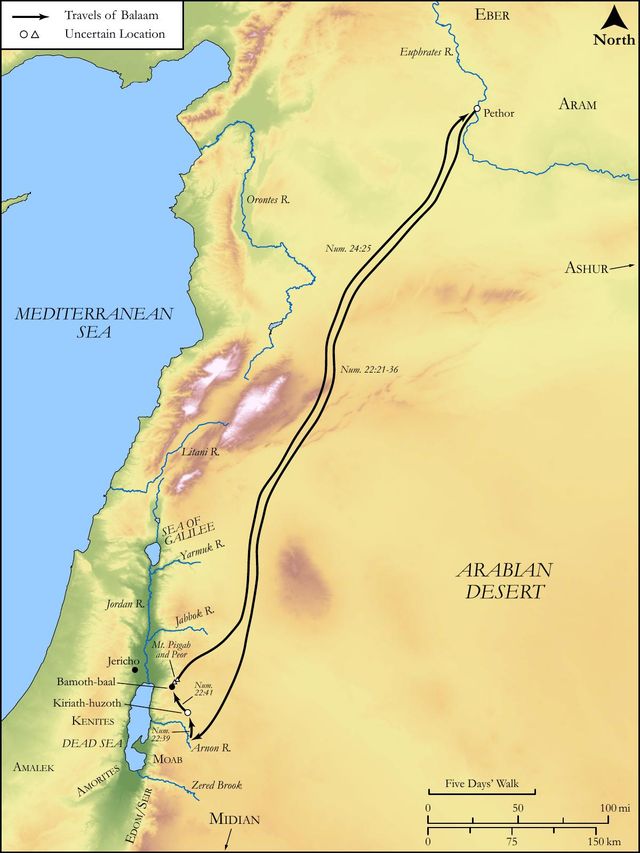
The events of the Balaam narrative unfold as the Israelites are encamped in the plains of Moab, on the cusp of entering the Promised Land. Their vast numbers and recent victories instilled considerable fear in the surrounding nations, particularly Moab. Balak, as the king of Moab, sought to counter this perceived threat through supernatural means, a common practice among the nations of that day, where diviners, seers, and sorcerers were routinely consulted for military advantage and national security. Balaam, hailing from Pethor near the Euphrates, was renowned for his potent prophetic abilities, believed to hold significant power over blessings and curses. His journey to Moab, the elaborate sacrifices, and the repeated attempts at divination reflect the deeply ingrained cultural belief in the efficacy of such rituals. The narrative, culminating in this verse, highlights the stark contrast between pagan divination and the absolute sovereignty of Yahweh, demonstrating God's supreme control even over those who do not acknowledge or serve Him.
Key Themes
ShowHideThe overarching theme of the Balaam narrative, brought to a definitive close in Numbers 24:25, is God's Unstoppable Sovereignty. No human or demonic force, no matter how powerful, cunning, or well-resourced, can ultimately thwart God's divine purposes for His chosen people. This is powerfully illustrated by God's consistent ability to turn every intended curse into a blessing, reinforcing His Divine Protection and Covenant Faithfulness to Israel, a principle explicitly stated later in Deuteronomy 23:5. Another crucial theme, particularly relevant to Balaam's character, is the Peril of Compromise and Greed. Despite Balaam's genuine prophetic gift and his forced pronouncements of blessing, his underlying desire for "unrighteous gain" (as later highlighted in 2 Peter 2:15) ultimately corrupted his integrity. This corrupt desire led him to seek alternative, insidious ways to undermine Israel, giving rise to the "doctrine of Balaam" mentioned in Revelation 2:14, which involved enticing God's people into idolatry and immorality.
Exposition and Analysis
ShowHideKey Word Analysis
ShowHideA primitive root meaning "to rise (in various applications, literal, figurative, intensive and causative)." In this context, it signifies Balaam's decisive action of standing up and preparing to depart. It marks the termination of his prophetic pronouncements and his physical presence before Balak, indicating a definitive end to their direct interaction.
A primitive root meaning "to turn back (hence, away) transitively or intransitively, literally or figuratively (not necessarily with the idea of return to the starting point); generally to retreat; often adverbial, again." For Balaam, this word denotes his physical movement away from Balak and the plains of Moab, but it also subtly foreshadows his eventual "return" to his own wicked counsel, leading to his demise.
Properly "a standing, i.e., a spot; but used widely of a locality (general or specific); also (figuratively) of a condition (of body or mind)." Balaam's return "to his place" implies not merely a geographical destination but a return to his own established practices and disposition, which, as subsequent events reveal, were still driven by self-interest and opposition to God's people.
Meaning "a road (as trodden); figuratively, a course of life or mode of action." Balak's "went his way" literally means he went on his road or journey. Figuratively, it speaks to his return to his own affairs and his own "course of action," which was marked by the failure of his scheme and the frustration of his desires.
Verse Breakdown
ShowHide"And Balaam rose up, and went and returned to his place:"
This clause describes Balaam's immediate and final action after delivering his unwelcome, divinely compelled blessings. The phrase "rose up" indicates a decisive movement, marking the end of his prophetic role in this confrontation and his departure from Balak's presence. His return "to his place" (his homeland) suggests a retreat from the immediate conflict. However, as later biblical accounts reveal (Numbers 31:8), this return was not to repentance or safety, but ultimately led to his death at the hands of the Israelites, having previously advised Balak on how to corrupt them.
"and Balak also went his way."
This parallel clause details Balak's corresponding action. His departure signifies the complete and utter failure of his elaborate and costly enterprise. His grand scheme, involving significant expense and effort to curse Israel, had come to naught. The simplicity of the statement underscores the finality of his defeat and the undeniable triumph of God's sovereign will over human machinations. There is no mention of further attempts or negotiations, only a definitive cessation of hostilities from his side, at least for the moment.
Literary Devices
ShowHideThe brevity and parallel structure of Numbers 24:25 effectively employ several literary devices. Parallelism is prominently featured in the symmetrical description of both characters' departures, emphasizing the mutual and definitive conclusion of their encounter. The phrases "returned to his place" for Balaam and "went his way" for Balak provide a strong sense of closure, marking the end of the direct conflict. The entire narrative, culminating in this verse, is steeped in Irony: Balak hired Balaam to curse Israel, but God consistently turned every intended curse into a blessing, powerfully demonstrating the futility of human opposition to divine will. For Balaam, his departure also carries a subtle sense of Foreshadowing; while he leaves the immediate scene, his return "to his place" hints at his ultimate fate and the consequences of his continued rebellion against God's purposes, which would later manifest in his counsel to corrupt Israel. The stark simplicity of the verse, following the dramatic and profound oracles, provides a powerful Anticlimax, underscoring that God's will, not human machinations or dramatic pronouncements, is the true and ultimate force at play.
Theological and Thematic Connections
ShowHideNumbers 24:25, though concise, powerfully encapsulates the profound theological truth that God's sovereign will cannot be thwarted by any human or demonic opposition. It stands as an enduring testament to the Lord's unwavering commitment to His covenant people, demonstrating His unparalleled ability to transform even the most malicious intentions into instruments of blessing. The mutual departure of both Balak and Balaam signifies the utter and complete failure of their combined efforts against Israel, reinforcing the foundational biblical principle that "the counsel of the Lord stands forever, the plans of his heart to all generations" (Psalm 33:11). This verse serves as a definitive concluding statement to a narrative that profoundly illustrates divine protection, the futility of seeking to curse those whom God has blessed, and the ultimate triumph of God's purposes.
Reflection and Application
ShowHideThe quiet and definitive departure of Balak and Balaam in Numbers 24:25 offers profound and enduring lessons for believers today. It serves as a powerful reminder that God's plans for His people are unassailable, regardless of the strength, cunning, or resources of the opposition. In moments of personal or collective struggle, when it feels as though hostile forces are arrayed against us, this verse encourages unwavering trust in God's sovereign control and His benevolent purposes. Just as He miraculously turned curses into blessings for ancient Israel, He continues to orchestrate all circumstances for the ultimate good of those who love Him and are called according to His purpose (Romans 8:28). Furthermore, Balaam's tragic story serves as a stark and sobering warning about the insidious nature of greed, compromise, and the corruption of spiritual gifts. Possessing spiritual abilities or holding positions of influence does not inherently guarantee spiritual integrity. We must constantly guard our hearts against the allure of worldly gain, personal ambition, and anything that can corrupt our motives and lead us astray, even when we appear to be operating within God's will. Our ultimate allegiance must be to God's truth and His kingdom, not to personal advantage.
Questions for Reflection
ShowHideFAQ
ShowHideWhat is the significance of Balaam and Balak both "going their way" in this verse?
ShowHideThe mutual departure of Balaam and Balak signifies the definitive conclusion of their direct confrontation and, more importantly, the complete and utter failure of Balak's scheme to curse Israel. For Balak, it marks the end of his costly and futile attempts to thwart God's will and the frustration of his desires. For Balaam, while it ends his compelled blessings, it also subtly foreshadows his ultimate return to his own wicked ways, which later involved advising the Moabites and Midianites on how to corrupt Israel through idolatry and immorality (Revelation 2:14). This counsel led to the sin at Peor (Numbers 25:1-9) and ultimately to Balaam's demise at the hands of the Israelites (Numbers 31:8).
Did Balaam truly repent or change his ways after these events?
ShowHideThe biblical record indicates that Balaam did not genuinely repent or undergo a fundamental change of heart. Although God miraculously forced him to bless Israel, his underlying character remained inclined towards "unrighteous gain" (2 Peter 2:15). After his departure from Balak, he later advised the Moabites and Midianites to entice the Israelites into idolatry and sexual immorality, a strategy that led to the devastating sin at Peor and a plague among Israel (Numbers 25:1-9). This "counsel of Balaam" (Numbers 31:16) demonstrates his persistent, albeit indirect, opposition to God's people, even after being used as an unwilling instrument of divine blessing.
Christ-Centered Fulfillment
ShowHideNumbers 24:25, marking the definitive conclusion of the Balaam narrative, finds its ultimate Christ-centered fulfillment in the triumphant and irreversible nature of God's redemptive plan through Jesus Christ. The most profound prophecy within this narrative, the "Star out of Jacob" and "Scepter out of Israel" (Numbers 24:17), directly points to the glorious advent of the Messiah. Jesus is the true King, the "bright Morning Star" (Revelation 22:16), who has risen from Jacob to conquer all of God's enemies, not with a physical sword but through His perfect sacrificial death and victorious resurrection. Just as God miraculously turned Balak's intended curses into blessings for ancient Israel, Christ, through His finished work on the cross, has definitively disarmed and triumphed over all spiritual principalities and powers (Colossians 2:15), transforming the ultimate curse of sin and death into the ultimate blessing of eternal life and reconciliation with God. His unparalleled victory ensures that no scheme of the enemy, no power of darkness, can ultimately prevail against His church, the new Israel (Matthew 16:18). The departure of Balak and Balaam, signifying the failure of their opposition, foreshadows the ultimate and eternal defeat of all those who oppose God's kingdom, as Christ's reign is eternal and His blessings are irreversible for all who are united with Him (Ephesians 1:3).