


Numbers 24:24
Bible text: King James Version (1769 Blayney text) · Public domain
Bible text: Berean Standard Bible · Public domain
Bible text: American Standard Version (1901) · Public domain
Bible text: World English Bible, Messianic edition · Public domain
Bible text: Geneva Bible (1599) · Public domain
Bible text: Young's Literal Translation · Public domain
- וְצִיםve·Tzimand shipsH6716Conj-w ¦ N-mpNoun Plural Masculine Absoluteוְandצִיםships
- מִיַּדmi·Yad[will be] from [the] hand ofH3027Prep-m ¦ N-cscNoun Singular common gender Constructמִ[will be] fromיַּד[the] hand of
- כִּתִּיםki·TimKittimH3794N-properNoun Proper Location
- וְעִנּוּve·'i·Nuand they will afflictH6031Conj-w ¦ V-Piel-ConsecPerf-3cpVerb Piel Consecutive Perfect 3rd Plural common genderוְandעִנּוּthey will afflict
- אַשּׁוּר'a·ShurAsshurH804N-properNoun Proper Location
- וְעִנּוּve·'i·nuand they will afflictH6031Conj-w ¦ V-Piel-ConsecPerf-3cpVerb Piel Consecutive Perfect 3rd Plural common genderוְandעִנּוּthey will afflict
- עֵבֶר'E·verEberH5677N-proper-mNoun Proper Masculine
- וְגַםve·gamand alsoH1571Conj-w ¦ AdvAdverbוְandגַםalso
- הוּאhu'itH1931Pro-3msPronoun Personal 3rd Singular Masculine
- עֲדֵי'a·Dei[will be] toH5704PrepPreposition
- אֹבֵד'o·VeddestructionH8V-Qal-Prtcpl-msVerb Qal Participle Singular Masculine Absolute
English is a literal word-by-word gloss of the Hebrew, not the KJV's wording. Why?
This is the original text the KJV's translators worked from — each Hebrew word with its own literal English meaning in this verse, prepared by scholars at Tyndale House, Cambridge. The KJV translates whole sentences, not word by word, so its wording differs: one Hebrew word can become several English words, and the KJV may choose “the LORD” where the gloss reads “Yahweh”. Both are faithful — they answer different questions. For the KJV's own rendering, switch to the KJV text.
Details
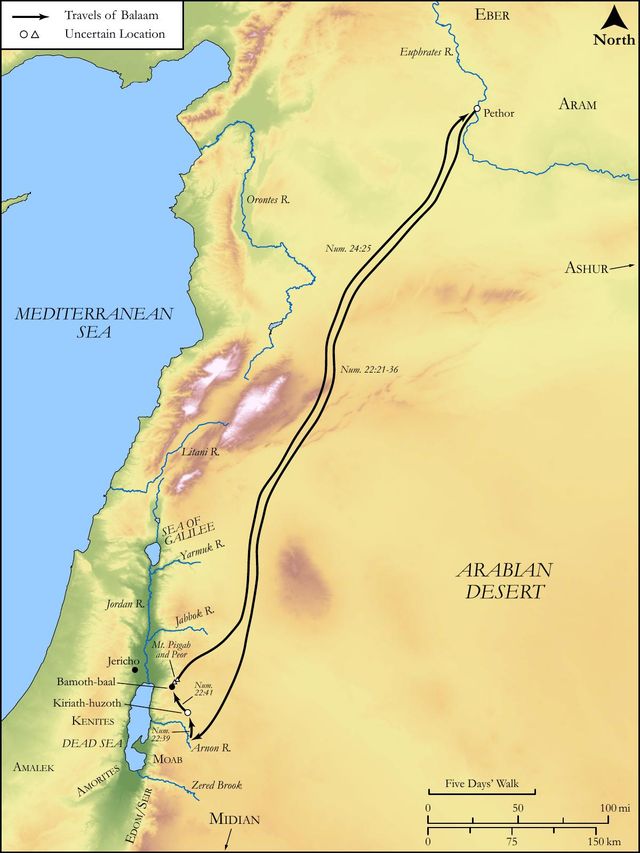
See on the biblical-era map
Study this verse
Public-domain commentary
Matthew Henry
From his Commentary on the Whole Bible. Henry comments on passages, not single verses — this entry covers Numbers 24:15–25. His three-level outline is real structure in the source text, so it is rendered as structure.
The office of prophets was both to bless and to prophesy in the name of the Lord. Balaam, as a prophet, per force had blessed Israel; here he foretels future events.
I.His preface is much the same as that, Num 24:3, Num 24:4.
He personates a true prophet admirably well, God permitting and directing him to do so, because, whatever he was, the prophecy itself was a true prophecy. He boasts,
1.That his eyes are open (Num 24:15), for prophets were in old time called seers (Sa1 9:9), because they must speak what they had seen, and therefore, before they opened their lips, it was necessary that they should have their eyes open.
2.That he has heard the words of God, which many do that do not heed them, nor hear God in them.
3.That he knew the knowledge of the Most High; this is added here. A man may be full of the knowledge of God and yet utterly destitute of the grace of God, may receive the truth in the light of it and yet be a stranger to the love of it.
4.That he saw the vision of the Almighty, but not so as to be changed into the same image. He calls God the Most High, and the Almighty; no man could speak more honourably of him, nor seem to put a greater value upon his acquaintance with him, and yet he had no true fear of him, love to him, or faith in him, so far may a man go towards heaven, and yet come short.
II.Here is his prophecy concerning him that should be the crown and glory of his people Israel, who is,
1.David in the type, who not now, not quickly, but in process of time, should smite the corners of Moab. (Num 24:17), and take possession of Mount Seir, and under whom the forces of Israel should do valiantly, Num 24:18. This was fulfilled when David smote Moab, and measured them with a line, so that the Moabites became David' servants, Sa2 8:2. And at the same time the Edomites likewise were brought into obedience to Israel, Num 24:14. But,
2.Our Lord Jesus, the promised Messiah, is chiefly pointed at in the antitype, and of him it is an illustrious prophecy; it was the will of God that notice should thus be given of his coming, a great while before, not only to the people of the Jews, but to other nations, because his gospel and kingdom were to extend themselves so far beyond the borders of the land of Israel. It is here foretold,
(1.)That while: "I shall see him, but not now; I do see him in vision, but at a very great distance, through the interposing space of 1500 years at least." Or understand it thus: - Balaam, a wicked man, shall see Christ, but shall not see him nigh, nor see him as Job, who saw him as his Redeemer, and saw him for himself, Job 19:25, Job 19:27. When he comes in the clouds every eye shall see him, but many will see him (as the rich man in hell saw Abraham) afar off.
(2.)That he shall come out of Jacob, and Israel, as a star and a sceptre, the former denoting his glory and lustre, and the bright and morning star, the latter his power and authority; it is he that shall have dominion. Perhaps this prophecy of Balaam (one of the children of the east) concerning a star that should arise out of Jacob, as the indication of a sceptre arising in Israel, being preserved by a tradition of that country, gave occasion to the wise men, who were of the east too, upon the sight of an unusual star over the land of Judea, to enquire for him that was born king of the Jews, Mat 2:2.
(3.)That his kingdom shall be universal, and victorious over all opposition, which was typified by David's victories over Moab and Edom. But the Messiah shall destroy, or, as some read it, shall rule over, all the children of Seth. (Num 24:17), that is, all the children of men, who descend from Seth, the son of Adam, the descendants of the rest of Adam's sons being cut off by the deluge. Christ shall be king, not only of Jacob and Israel, but of all the world; so that all the children of Seth shall be either governed by his golden sceptre or dashed in pieces by his iron rod. He shall set up a universal rule, authority, and power, of his own, and shall put down all opposing rule, Co1 15:24. He shall unwall all the children of Seth; so some read it. He shall take down all their defences and carnal confidences, so that they shall either admit his government or lie open to his judgments.
(4.)That his Israel shall do valiantly; the subjects of Christ, animated by his might, shall maintain a spiritual was with the powers of darkness, and be more than conquerors. The people that do know their God shall be strong, and do exploits, Dan 11:32.
III.Here is his prophecy concerning the Amalekites and Kenites, part of whose country, it is probable, he had now in view.
1.The Amalekites were now the chief of the nations (Num 24:20), therefore Agag was spoken of (Num 24:7) as an eminent prince, and they were the first that engaged Israel when they came out of Egypt; but the time will come when that nation, as great as it looks now, will be totally ruined and rooted out: His latter end shall be that he perish for ever. Here Balaam confirms that doom of Amalek which Moses had read (Exo 17:14, Exo 17:16), where God had sworn that he would have perpetual war with Amalek. Note, Those whom God is at war with will certainly perish for ever; for when God judges he will overcome.
2.The Kenites were now the securest of the nations; their situation was such as that nature was their engineer, and had strongly fortified them: "Thou puttest thy nest (like the eagle) in a rock, Num 24:21. Thou thinkest thyself safe, and yet the Kenites shall be wasted (Num 24:22) and gradually brought to decay, till they be carried away captive by the Assyrians," which was done at the captivity of the ten tribes. Note, Bodies politic, like natural bodies, though of the strongest constitutions, will gradually decay, and come to ruin at last; even a nest in a rock will be no perpetual security.
IV.Here is a prophecy that looks as far forward as the Greeks and Romans, for theirs is supposed to be meant by the coast of Chittim, v. 24.
1.The introduction to this parable; this article of his prophecy is very observable (v. 23): Alas! who shall live when God doeth this? Here he acknowledges all the revolutions of states and kingdoms to be the Lord's doing: God doeth this; whoever are the instruments, he is the supreme director. But he speaks mournfully concerning them, and has a very melancholy prospect of these events: Who shall live? Either,
(1.)These events are so distant, and so far off to come, that it is hard to say who shall live till they come; but, whoever shall live to see them, there will be amazing turns. Or,
(2.)They will be so dismal, and make such desolations, that scarcely any will escape or be left alive; who shall live when death rides in triumph? Rev 6:8. Those that live then will be as brands plucked out of the fire, and will have their lives given them as a prey. God fit us for the worst of times!
2.The prophecy itself is observable. Both Greece and Italy lie much upon the sea, and therefore their armies were sent forth mostly in ships. Now he seems here to foretell, (2.) That the forces of the Grecians should humble and bring down the Assyrians, who were united with the Persians, which was fulfilled when the eastern country was overcome, or overrun rather, by Alexander. (2.) That theirs and the Roman forces should afflict the Hebrews, or Jews, who were called the children of Eber; this was fulfilled in part when the Grecian empire was oppressive to the Jewish nation, but chiefly when the Roman empire ruined it and put a period to it. But, (3.) That Chittim, that is, the Roman empire, in which the Grecian was at length swallowed up, should itself perish for ever, when the stone cut out of the mountain without hands shall consume all these kingdoms, and particularly the feet of iron and clay, Dan 2:34. Thus (says Dr. Lightfoot) Balaam, instead of cursing the church, curses Amalek the first, and Rome the last, enemy of the church. And so let all thy enemies perish, O Lord!
Continue studying Numbers 24:24 across the web’s major study libraries — every link below opens this exact verse, chapter, or book on the destination site.
Read & Compare
 BibleGatewayThis verse in more than 200 translations and 70 languages.
 Bible.comThe YouVersion reader — hundreds of translations, reading plans, and highlights.
 ESV.orgCrossway's official English Standard Version reader.
 NET BibleThe NET translation with 60,000+ translators' notes on every rendering decision.
 STEP BibleTyndale House's free study tool — original text, vocabulary, and scholarly resources.
 BibliaLogos Bible Software's free web reader.
 USCCBThe New American Bible (Revised Edition) with the U.S. bishops' study notes.
Commentaries
 BibleHub CommentariesDozens of classic commentaries on this verse, gathered on one page.
 StudyLightMore than 100 commentary sets — the largest collection on the web.
 BibleRefPlain-English commentary on what this verse means, verse by verse.
 Enduring WordDavid Guzik's free commentary on this chapter, widely used by Bible teachers.
 Bible Study ToolsVerse commentary alongside Greek and Hebrew study aids.
Original Language & Research
- BibleHub InterlinearThe verse word by word — original language, transliteration, and English.
- BibleHub LexiconEvery word's original-language definition and Strong's entry.
 Blue Letter BibleDeep-study tools — Strong's numbers, concordance, and word studies.
 SefariaThe Hebrew text with Rashi and centuries of Jewish commentary.
Sermons, Hymns & Audio


TrulyRandomVerse is not affiliated with these sites and doesn’t control their content. They’re linked because they’re genuinely useful.
Summary
Numbers 24:24 serves as the climactic conclusion to Balaam's fourth and final oracle, a remarkable series of prophecies delivered by a diviner initially hired by Balak, king of Moab, to curse Israel. Defying Balak's intentions, Balaam was divinely compelled to pronounce blessings upon Israel and profound insights into the future destinies of various nations. This particular verse extends the prophetic gaze far into the future, foretelling the emergence of a powerful maritime force from the West (Chittim) that would conquer formidable Eastern empires (Asshur and Eber), only to eventually face its own inevitable demise, powerfully underscoring God's absolute sovereignty over all earthly kingdoms and the temporary nature of human power.
Context
ShowHideLiterary Context
Numbers 24:24 stands as the culmination of Balaam's final prophetic utterance (Numbers 24:20-24), which strategically shifts focus from Israel's immediate neighbors to more distant and powerful entities. Following concise but potent prophecies concerning Amalek (Numbers 24:20), the Kenites (Numbers 24:21-22), and the enigmatic "Kain" (likely a direct reference to the Kenites' eventual destruction), Balaam's vision expands dramatically to encompass mighty empires and their ultimate fates. This progression within the oracles demonstrates the expansive reach of God's sovereign plan, which extends far beyond His chosen people to encompass the entire sweep of human history and the destiny of all nations, culminating in the far-reaching prophecy of this verse. The structure emphasizes the comprehensive nature of divine foresight.
Historical & Cultural Context
Balaam's prophecies belong to the close of Israel's forty years in the wilderness after the Exodus. The explicit mention of "Asshur" (Assyria) points to a powerful empire that would dominate the surrounding nations for centuries after Balaam's time, highlighting the extraordinary foresight embedded in these oracles. "Chittim" initially referred to the island of Cyprus, a significant maritime hub, but in later biblical and historical contexts, it evolved into a broader term for Western maritime powers, often interpreted as the Greeks (specifically, the Macedonian empire) or the Romans. The practice of hiring a prophet or diviner to curse or bless was common among the nations of that day, but Balaam's unique situation—compelled by God to speak blessings instead of curses—underscores the Lord's supreme authority over human will and pagan divination, as explicitly stated in Deuteronomy 23:4-5. The geographical scope of the prophecy, reaching from the Mediterranean to Mesopotamia, illustrates the vastness of God's dominion over all peoples and lands.
Key Themes
ShowHideThe overarching theme woven throughout Balaam's oracles, and particularly prominent in this verse, is Divine Sovereignty Over Nations. God's absolute control over the rise and fall of empires is unequivocally declared; even the most formidable nations are subject to His will and ultimate judgment. This echoes the profound truth articulated by Nebuchadnezzar in Daniel 4:17 that "the Most High is sovereign over the kingdoms of men and gives them to anyone he wishes." Secondly, the passage highlights Prophetic Foresight, demonstrating the authenticity and far-reaching scope of divine revelation. Balaam, despite his personal moral failings and mercenary motivations, is used as a vessel to unveil future historical developments centuries in advance, affirming God's comprehensive knowledge of history. Finally, the verse illustrates the Cycles of Power and Judgment, a recurring biblical pattern where dominant powers rise, exert influence, but inevitably face their own demise, serving as a stark reminder that no earthly kingdom possesses eternal dominion, a truth powerfully reiterated in Psalm 33:10-11.
Exposition and Analysis
ShowHideKey Word Analysis
ShowHideThis term (H3794) originally referred to the city of Kition on the island of Cyprus, a key maritime center. However, in later biblical and post-biblical usage, it expanded to denote a broader geographical area encompassing the islands and coastal lands of the Mediterranean Sea, particularly those associated with powerful Western maritime nations. In prophetic literature (e.g., Daniel 11:30), "Chittim" often refers to the Greeks (specifically, the Macedonian empire of Alexander the Great and his successors) or, even later, the Roman Empire. The emphasis on "ships" (H6716, tsîy) strongly suggests a dominant naval power as the source of this future affliction.
The verb (H6031) carries the primary meaning "to depress literally or figuratively." Its various applications include "abase self, chasten self, deal hardly with, defile, exercise, force, humble (self), hurt, ravish, submit self, weaken." In this context, it signifies a forceful subjugation, military conquest, or severe oppression brought upon Asshur and Eber by the invading power from Chittim. It speaks to the devastating impact of this future military encounter.
This active participle (H8) is derived from a root meaning "to be lost, to vanish, to be destroyed." It can denote concrete wretchedness or abstract destruction. Here, it indicates the complete and permanent demise of the conquering power from Chittim. Despite its initial success, this mighty empire will not endure, but will face ultimate and irreversible destruction, emphasizing the transient nature of all human dominion.
Verse Breakdown
ShowHide"And ships [shall come] from the coast of Chittim"
This initial clause prophesies the emergence and arrival of a powerful naval force originating from the Western Mediterranean region. The explicit mention of "ships" highlights the maritime nature of this invading power, suggesting a distant, technologically advanced, and militarily formidable entity capable of projecting power across vast distances. This is widely understood to refer to the Greek (Macedonian) empire under Alexander the Great, which swept eastward over the Persian empire, or potentially the Roman Empire, both of which were dominant naval powers in their respective eras.
"and shall afflict Asshur"
This part of the prophecy indicates that the invading force from Chittim will conquer, severely impact, or subjugate Assyria. Historically, the Assyrian Empire had fallen by the late 7th century BCE, long before the rise of the Greeks. Therefore, "Asshur" here might represent the successor empires that occupied the former Assyrian territories (e.g., the Neo-Babylonian or Persian empires), or it could be a general reference to the dominant power in Mesopotamia at the time of Chittim's arrival. Alexander the Great certainly afflicted and conquered the Persian Empire, which controlled the former Assyrian lands.
"and shall afflict Eber"
This clause suggests that the power from Chittim will also bring suffering, subjugation, or military defeat to the peoples of "Eber." As discussed in the Key Word Analysis, "Eber" (H5677) likely refers to a broader Semitic population or other groups of the east, possibly those living "beyond the river" Euphrates. This implies a widespread conquest affecting not just the primary empire (Asshur/its successors) but also other indigenous peoples and lands of the east, extending the scope of the Western power's dominion.
"and he also shall perish for ever"
This concluding and highly significant phrase declares the ultimate fate of the conquering power from Chittim. Despite its initial success in afflicting Asshur and Eber, this mighty Western empire itself will eventually face complete and permanent destruction. The phrase "for ever" (H5703, ‘ad) emphasizes the finality and irreversibility of its demise. This powerful statement underscores the transient nature of all human empires, no matter how dominant, and reaffirms God's ultimate and eternal sovereignty over all earthly powers. It serves as a stark reminder that even the mightiest human achievements and dominions are finite and subject to divine judgment.
Literary Devices
ShowHideNumbers 24:24 primarily employs Prophecy and Foreshadowing. The entire verse is a direct prophetic utterance, revealing future historical events centuries before their occurrence, thereby demonstrating God's omniscient control over the timeline of human history. The specific mention of "Chittim," "Asshur," and "Eber" serves as a form of Symbolism, where these specific entities represent broader categories of Western and Eastern powers, or the dominant empires of their respective eras. "Chittim" symbolizes a powerful, distant maritime force, while "Asshur" and "Eber" represent the established, formidable powers of the east. The phrase "and he also shall perish for ever" is a powerful instance of Irony, as the seemingly invincible conquering power is itself destined for ultimate destruction, highlighting the transient nature of all earthly dominion in stark contrast to God's eternal reign. The structure of the prophecy, moving from the rise of a new power to its conquests and then its inevitable downfall, creates a sense of Dramatic Arc, emphasizing the cyclical nature of imperial power under divine oversight and the ultimate triumph of God's purposes.
Theological and Thematic Connections
ShowHideNumbers 24:24 powerfully articulates the profound biblical truth that God is not merely the God of Israel, but the sovereign Lord of all history and all nations. He orchestrates the rise and fall of empires, using them as instruments of His will, whether for judgment, for the advancement of His purposes, or to demonstrate His supreme authority. This verse reminds us that no human power, no matter how vast, technologically advanced, or militarily formidable, can ultimately withstand the divine decree. The temporary nature of even the greatest earthly kingdoms stands in stark contrast to the eternal and unshakeable kingdom of God. This truth provides immense comfort and a proper, God-centered perspective for believers living amidst geopolitical shifts and uncertainties, reminding us that our ultimate allegiance and hope must rest in the King of kings, whose dominion is everlasting and whose plans can never be thwarted.
Reflection and Application
ShowHideNumbers 24:24 offers profound lessons for believers today, inviting us to recalibrate our perspective on power, history, and our ultimate hope. In a world characterized by shifting geopolitical landscapes, the rise and fall of nations, and constant anxieties about global stability, this ancient prophecy serves as a powerful anchor. It reminds us that behind the chaos and complexity of human affairs stands an omnipotent God, actively involved in orchestrating the destinies of nations according to His divine purpose. This truth should cultivate a deep sense of peace and trust, knowing that God's grand plan will ultimately prevail, regardless of the current turmoil. Furthermore, the verse serves as a sober reminder of the transient nature of all human power and achievements. It encourages humility, warning against placing ultimate trust in earthly governments, military might, or economic prowess. Our ultimate hope and allegiance should never be misplaced in temporary earthly structures but firmly rooted in the enduring reality of God's eternal kingdom. This perspective liberates us from the despair that can accompany the decline of human empires and directs our focus toward the only truly enduring reign.
Questions for Reflection
ShowHideFAQ
ShowHideWho are Chittim, Asshur, and Eber, and what do they represent in this prophecy?
ShowHideChittim (Hebrew, Kittîy', H3794) initially referred to the island of Cyprus but in later biblical usage, it expanded to represent powerful Western maritime nations. It is most commonly interpreted as the Greek (Macedonian) empire of Alexander the Great or, in some interpretations, the Roman Empire, both of which were dominant naval forces that profoundly impacted the kingdoms of the east. Asshur (Hebrew, 'Ashshur', H804) unequivocally refers to Assyria, a formidable and brutal empire of Mesopotamia that dominated the nations round about for centuries. In this prophecy, it likely represents the dominant power of Mesopotamia in the days to come, which would be conquered by the power from Chittim (e.g., the Persian Empire, which controlled former Assyrian lands and was conquered by Alexander). Eber (Hebrew, ‘Êbêr', H5677) means "beyond" or "across" and can refer to the eponymous ancestor of the Hebrews or, more broadly, to peoples living "beyond the river" (Euphrates). In this context, it likely signifies other Semitic populations or regions of the east that would also suffer under the Western power's conquest, distinct from Israel, who is generally blessed in Balaam's prophecies.
Does "and he also shall perish for ever" refer to the power from Chittim?
ShowHideYes, the most widely accepted interpretation among biblical scholars is that the pronoun "he" in "and he also shall perish for ever" refers to the conquering power from Chittim. After afflicting Asshur and Eber, this mighty Western power, despite its initial dominance, is itself prophesied to face ultimate and permanent destruction. This concluding statement emphasizes the transient nature of all human empires, no matter how powerful, and reinforces the overarching biblical theme that only God's kingdom is eternal and will never perish, as seen in the vision of the Son of Man's dominion in Daniel 7:14.
How does this ancient prophecy relate to God's broader plan for humanity and the ultimate triumph of His kingdom?
ShowHideNumbers 24:24, like many other Old Testament prophecies concerning the rise and fall of nations, serves to highlight God's absolute sovereignty over human history. It demonstrates that He is actively involved in orchestrating events, using even pagan empires to fulfill His purposes. By showing that no earthly power lasts forever, the prophecy implicitly points to the only truly enduring kingdom—God's own. This provides a foundation of hope for believers, assuring them that despite the turmoil and shifting powers of the world, God's ultimate plan for redemption and the establishment of His eternal kingdom will prevail. This theme finds its ultimate fulfillment in the person and work of Jesus Christ and the establishment of His everlasting reign, which will one day encompass all things.
Christ-Centered Fulfillment
ShowHideNumbers 24:24, while seemingly focused on the rise and fall of nations, finds its ultimate and profound fulfillment in the person and work of Jesus Christ. The prophecy's declaration that even the mightiest earthly empires—those that afflict and conquer—will ultimately "perish for ever" powerfully foreshadows the transient nature of all human dominion in contrast to the eternal, unshakeable kingdom inaugurated by Christ. The rise and fall of Chittim, Asshur, and Eber, and indeed all subsequent empires throughout history, serve as a historical canvas against which the enduring reign of the "star out of Jacob" and the "scepter out of Israel" (Numbers 24:17) is painted. Jesus Christ is the promised King whose kingdom "will never be destroyed, nor will it be left to another people. It will crush all those kingdoms and bring them to an end, but it will itself endure forever" (Daniel 2:44). His victory on the cross disarmed the powers and authorities, triumphing over them (Colossians 2:15), and His resurrection established His universal Lordship, a reign that transcends all earthly governments and will culminate in the final subjugation of every enemy (1 Corinthians 15:25). Thus, the impermanence of earthly powers in Numbers 24:24 points forward to the eternal dominion of Christ, who is the true "Lamb of God, who takes away the sin of the world!" (John 1:29) and the King of kings, whose reign will have no end (Revelation 11:15).