


Genesis 10:4
Bible text: King James Version (1769 Blayney text) · Public domain
Bible text: Berean Standard Bible · Public domain
Bible text: American Standard Version (1901) · Public domain
Bible text: World English Bible, Messianic edition · Public domain
Bible text: Geneva Bible (1599) · Public domain
Bible text: Young's Literal Translation · Public domain
- וּבְנֵיu·ve·Neiand [the] sons ofH1121Conj-w ¦ N-mpcNoun Plural Masculine Constructוּandבְנֵי[the] sons of
- יָוָןya·VanJavanH3120N-proper-mNoun Proper Masculine
- אֱלִישָׁה'e·li·Shah[were] ElishahH473N-proper-mNoun Proper Masculine
- וְתַרְשִׁישׁve·tar·Shishand TarshishH8659Conj-w ¦ N-proper-mNoun Proper MasculineוְandתַרְשִׁישׁTarshish
- כִּתִּיםki·TimKittimH3794N-properNoun Proper Location
- וְדֹדָנִיםve·do·da·Nimand DodanimH1721Conj-w ¦ N-proper-mNoun Proper MasculineוְandדֹדָנִיםDodanim
English is a literal word-by-word gloss of the Hebrew, not the KJV's wording. Why?
This is the original text the KJV's translators worked from — each Hebrew word with its own literal English meaning in this verse, prepared by scholars at Tyndale House, Cambridge. The KJV translates whole sentences, not word by word, so its wording differs: one Hebrew word can become several English words, and the KJV may choose “the LORD” where the gloss reads “Yahweh”. Both are faithful — they answer different questions. For the KJV's own rendering, switch to the KJV text.
Details
See on the biblical-era maps


Study this verse
Public-domain commentary
Matthew Henry
From his Commentary on the Whole Bible. Henry comments on passages, not single verses — this entry covers Genesis 10:1–5.
Moses begins with Japheth's family, either because he was the eldest, or because his family lay remotest from Israel and had least concern with them at the time when Moses wrote, and therefore he mentions that race very briefly, hastening to give an account of the posterity of Ham, who were Israel's enemies and of Shem, who were Israel's ancestors; for it is the church that the scripture is designed to be the history of, and of the nations of the world only as they were some way or other related to Israel and interested in the affairs of Israel. Observe, 1. Notice is taken that the sons of Noah had sons born to them after the flood, to repair and rebuild the world of mankind which the flood had ruined. He that had killed now makes alive. 2. The posterity of Japheth were allotted to the isles of the Gentiles (Gen 10:5), which were solemnly, by lot, after a survey, divided among them, and probably this island of ours among the rest; all places beyond the sea from Judea are called isles (Jer 25:22), and this directs us to understand that promise (Isa 42:4), the isles shall wait for his law, of the conversion of the Gentiles to the faith of Christ.
Historical interpretation
Three Centuries of Reception
2 surviving comments on this verse. Each one is dated, so this reads as a timeline rather than a list.
Select a marker to jump to its quote. Markers stagger vertically where authors wrote within a few decades of each other.
(Ver. 4.) The sons of Javan were Elisha and Tarshish, Kittim and Dodanim. From them were divided the islands of the nations in their lands, each according to its language, its kindred, and its people. From the Ionians, that is, the Greeks, were born the Aeolians, who are called Aeolians: hence the fifth language of Greece is called Aeolian, which they call 'the fifth dialect.' Josephus considers Tarshish to be Cilicia, stating that the letter θ was mistakenly corrupted by later generations into τ: hence their metropolis is called the city of Tarsus, glorious to the Apostle Paul. Cethim, they are the Cetians, from whom even today the city of Cyprus is also called Citium. Dodanim, the Rhodians: for so the Septuagint translators have rendered it. Let us read the books of Varro on Antiquities, and those of Sisinnius Capito, and the Greek Phlegon, and other most learned men: and we will see almost all the islands, and the shores of the whole world, and the lands near the sea, occupied by Greek settlers: who, as we have said, possess all the coastal areas from the mountains of Amanus and Taurus to the British Ocean.
"The sons of Javan were Elishah, Tarshish, Kittim, and Dodanim. From the Ionians, that is, the Greeks, are born the Elishah, who are called Elishites, hence also the fifth language of Greece is called Aeolic, which they call 'penten dialecton.' Josephus assumes Tharsis to be Cilicia, saying that the letter 'h' has been corruptly omitted in 'Thar' by later generations; hence also their metropolis city is called Tarsus, glorious in the apostle Paul's time. (Some think that Tharsis, from where gold was brought to Solomon, refers to the region of India.) Kittim is from Kittim, from whom to this day the city of Cyprus is named. Dodanim is identified as the Rhodians, for it is better read as Rodanim, or Rodim, as the Septuagint translators rendered it, and even our translator placed it in the book of Hebrew names. For the similarity of the letters Daleth and Resh often causes this error among the Hebrews, so that one is read for the other. But Rhodes is the largest of the Cyclades, and once the most powerful city in the Ionian Sea, glorious in naval combat, and a refuge for all merchants because of its very safe harbor.
Continue studying Genesis 10:4 across the web’s major study libraries — every link below opens this exact verse, chapter, or book on the destination site.
Read & Compare
 BibleGatewayThis verse in more than 200 translations and 70 languages.
 Bible.comThe YouVersion reader — hundreds of translations, reading plans, and highlights.
 ESV.orgCrossway's official English Standard Version reader.
 NET BibleThe NET translation with 60,000+ translators' notes on every rendering decision.
 STEP BibleTyndale House's free study tool — original text, vocabulary, and scholarly resources.
 BibliaLogos Bible Software's free web reader.
 USCCBThe New American Bible (Revised Edition) with the U.S. bishops' study notes.
Commentaries
 BibleHub CommentariesDozens of classic commentaries on this verse, gathered on one page.
 StudyLightMore than 100 commentary sets — the largest collection on the web.
 BibleRefPlain-English commentary on what this verse means, verse by verse.
 Enduring WordDavid Guzik's free commentary on this chapter, widely used by Bible teachers.
 Bible Study ToolsVerse commentary alongside Greek and Hebrew study aids.
Original Language & Research
- BibleHub InterlinearThe verse word by word — original language, transliteration, and English.
- BibleHub LexiconEvery word's original-language definition and Strong's entry.
 Blue Letter BibleDeep-study tools — Strong's numbers, concordance, and word studies.
 SefariaThe Hebrew text with Rashi and centuries of Jewish commentary.
Sermons, Hymns & Audio


TrulyRandomVerse is not affiliated with these sites and doesn’t control their content. They’re linked because they’re genuinely useful.
Summary
A pivotal verse within the "Table of Nations," meticulously enumerating the four sons of Javan—Elishah, Tarshish, Kittim, and Dodanim—who are recognized as the progenitors of significant peoples and regions primarily associated with "the isles of the Gentiles" named in the next verse. This genealogical record provides a foundational understanding of the early spread and diversification of humanity, particularly the Hellenic peoples, across the earth, highlighting God's sovereign hand in the formation of nations.
Context
ShowHideLiterary Context
Genesis 10 stands as a unique and crucial genealogical register, often referred to as the "Table of Nations." It systematically details the descendants of Noah's three sons—Shem, Ham, and Japheth—who repopulated the earth after the global flood. This chapter follows the account of the flood and Noah's covenant with God, serving as a bridge between the renewed humanity and the subsequent dispersion and formation of distinct nations. Genesis 10:4 specifically falls within the section dedicated to the descendants of Japheth, who are generally understood to have settled in the northern and western regions relative to Canaan. The preceding verses, Genesis 10:2-3, introduce Japheth's sons, including Javan, setting the immediate stage for the enumeration of Javan's own progeny. The meticulous listing underscores the biblical narrative's attention to historical and geographical detail in tracing the origins of humanity.
Historical & Cultural Context
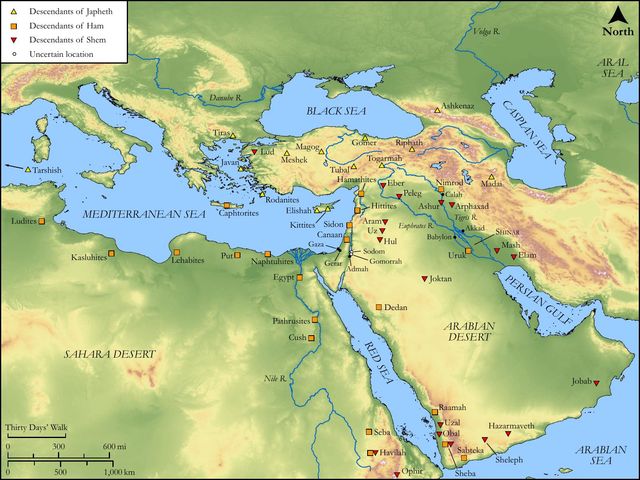
The "Table of Nations" reflects Israel's understanding of ethnography and geography, categorizing peoples based on their perceived ancestral lines and geographical distribution. Javan, the father of the individuals listed in Genesis 10:4, is widely identified with the Ionians, the ancient Greeks. Thus, his sons represent the early branches of Hellenic peoples and their expansion across the Mediterranean Sea. This period, following the flood, would have seen significant migrations and the establishment of new settlements, particularly along coastlines and islands, as humanity began to spread out. The names Elishah, Tarshish, Kittim, and Dodanim are not merely abstract names but correspond to known regions, cities, or peoples among the isles of the Gentiles, including Cyprus, southern Spain, and Rhodes. This suggests a historical context of nascent maritime trade, exploration, and the formation of distinct cultural identities in the post-flood world.
Key Themes
ShowHideThis verse, as part of the broader Table of Nations, contributes to several overarching themes. Firstly, it powerfully illustrates Divine Sovereignty over Nations, demonstrating God's intentional plan for the distribution and development of humanity, as highlighted in passages like Acts 17:26. Secondly, it underscores the Common Origin of Humanity, reinforcing the biblical truth that all people, despite their subsequent diversification into distinct nations and cultures, share a common lineage from Noah, emphasizing our shared heritage and interconnectedness. Thirdly, it provides a Foundation for Future Interactions, particularly for the Greek and Mediterranean peoples who would play significant roles in later biblical history and the broader unfolding of God's redemptive plan, setting the stage for the spread of the Gospel to "every nation, tribe, people and language" (Revelation 7:9).
Exposition and Analysis
ShowHideGenesis 10:4 specifically names the four sons of Javan, Japheth's fourth son, whose descendants formed key populations in the Mediterranean basin. These names are not merely genealogical entries but represent the foundational groups that would shape the early history and geography of the region, particularly influencing maritime trade and cultural exchange.
Key Word Analysis
ShowHideFrom the root bānāh (to build), this term denotes a son as a "builder of the family name." In its broadest sense, it encompasses literal and figurative relationships, including grandsons, subjects, nations, or even qualities. Here, it signifies direct lineage, emphasizing the foundational role these individuals played in establishing distinct family lines that would grow into nations.
Likely derived from a root meaning "effervescing" or "hot and active," Javan is the name of a son of Japheth and the progenitor of the race known as the Ionians, or ancient Greeks. His name thus links this biblical genealogy directly to the historical peoples of the Hellenic world, signifying the origin point for a significant cultural and geographical sphere.
This name is presented as a plural of uncertain derivation, referring to the "Dodanites" or descendants of a son of Javan. Notably, the Strong's data mentions an orthographical error leading to "Rodanim" in 1 Chronicles 1:7. This textual variant highlights the challenges and nuances of ancient manuscript transmission, while still pointing to a specific people group, often associated with the island of Rhodes.
Verse Breakdown
ShowHide"And the sons of Javan;"
This opening phrase establishes the immediate genealogical context, identifying the lineage being described. Javan, already introduced in Genesis 10:2, is presented as the patriarch whose direct descendants are about to be named. This sets the stage for understanding the subsequent names as branches of the broader Japhetic family tree, specifically those associated with the Hellenic world.
"Elishah, and Tarshish,"
These are the first two sons listed. Elishah is often associated with Alashiya (Cyprus) or parts of southern Greece, suggesting early maritime settlements. Tarshish is widely identified with Tartessos in southern Spain, a renowned ancient port known for its wealth and extensive trade routes, as seen in references like Isaiah 23:1 and Jonah 1:3. The inclusion of these names indicates the significant geographical reach and maritime activity of Javan's descendants.
"Kittim, and Dodanim."
These are the final two sons. Kittim is generally identified with Kition on Cyprus, but the term later broadened to include Cypriots, other Mediterranean islanders, and even the Romans in prophetic contexts (e.g., Numbers 24:24 and Daniel 11:30). Dodanim, as noted, is often linked to Rhodes, a strategically important Greek island. The naming of these figures further solidifies the connection of Javan's lineage to the islands and coastal regions of the Mediterranean, emphasizing their role in the early peopling and cultural development of the region.
Literary Devices
ShowHideThe primary literary device at play in Genesis 10:4 and the broader "Table of Nations" is Genealogy. This is a foundational biblical literary form, meticulously tracing lineage to establish identity, inheritance, and historical continuity. The verse employs Enumeration, a simple but effective technique of listing names, which provides a clear and systematic record of descendants. Each name within this enumeration also functions as a Geographical Allusion, pointing beyond mere individuals to the peoples and regions they would eventually inhabit or represent. This allows the concise genealogical record to simultaneously convey vast historical and geographical information, mapping the early spread of humanity across the known world.
Theological and Thematic Connections
ShowHideGenesis 10:4, as part of the "Table of Nations," offers profound theological insights into God's providential ordering of human history. It reveals that the dispersion of humanity into distinct nations and geographical regions was not a chaotic accident but part of a divine plan, demonstrating God's sovereign control over the earth and its inhabitants. This meticulous record underscores the Bible's claim to historical accuracy and its unique perspective on the origins of diverse peoples, all stemming from a common ancestor. It lays the groundwork for understanding the subsequent interactions between these nations and God's chosen people, Israel, and ultimately, the universal scope of God's redemptive plan for all humanity.
Reflection and Application
ShowHideGenesis 10:4 serves as a powerful reminder of God's meticulous design in the formation of nations and the spread of humanity across the earth. For believers, this passage reinforces the truth that our diverse backgrounds and cultural identities are not random but are part of God's grand tapestry, stemming from a common origin. It encourages us to appreciate the rich variety of cultures and peoples while recognizing the underlying unity of all humanity under God's sovereign hand. This understanding should foster a spirit of understanding, respect, and shared purpose among all human beings, moving us beyond ethnic or nationalistic divides to embrace our common heritage and the universal call to worship the one true God. It challenges us to see every person, regardless of their background, as part of God's creation, worthy of dignity and respect, and ultimately, as a potential recipient of God's grace.
Questions for Reflection
ShowHideFAQ
ShowHideWhy are these ancient names still relevant today?
ShowHideThese names are profoundly relevant today because they provide the biblical framework for understanding the origins and early migrations of distinct people groups, particularly those who would become significant players in ancient and even modern history, such as the Greeks and other Mediterranean civilizations. They underscore the Bible's historical depth and its claim to accurately record the foundational events of human civilization, offering insights into the diverse tapestry of humanity. Furthermore, understanding these origins helps us trace the geographical and cultural spread of peoples, which informs our study of subsequent biblical narratives and the unfolding of God's plan for all nations.
Christ-Centered Fulfillment
ShowHideWhile Genesis 10:4 primarily details the geographical and ethnic dispersion of humanity, it implicitly points towards Christ's universal redemptive work. The "Table of Nations" reveals the origin of all peoples, demonstrating that every tribe, tongue, and nation, including the descendants of Javan (the Hellenic peoples), are part of God's creation and subsequent fall. This grand narrative of human dispersion sets the stage for the ultimate gathering of all peoples in Christ. Through the Abrahamic Covenant, God promised that in Abraham's seed, "all the families of the earth would be blessed" (Genesis 12:3). This promise finds its ultimate fulfillment in Jesus Christ, who transcends all ancient divisions and calls all peoples back to God. The Great Commission, given by Christ, commands His followers to "go and make disciples of all nations" (Matthew 28:19-20), echoing the mandate to be "witnesses unto the uttermost part of the earth" (Acts 1:8). Ultimately, the vision of the redeemed in heaven includes a "great multitude, which no man could number, of all nations, and kindreds, and people, and tongues" (Revelation 7:9), all brought together by the atoning sacrifice of the Lamb of God.