


Genesis 10:2
Bible text: King James Version (1769 Blayney text) · Public domain
Bible text: Berean Standard Bible · Public domain
Bible text: American Standard Version (1901) · Public domain
Bible text: World English Bible, Messianic edition · Public domain
Bible text: Geneva Bible (1599) · Public domain
Bible text: Young's Literal Translation · Public domain
- בְּנֵיbe·Nei[the] sons ofH1121N-mpcNoun Plural Masculine Construct
- יֶפֶתYe·fetJaphethH3315N-proper-mNoun Proper Masculine
- גֹּמֶרGo·mer[were] GomerH1586N-proper-mNoun Proper Masculine
- וּמָגוֹגu·ma·Gogand MagogH4031Conj-w ¦ N-proper-mNoun Proper MasculineוּandמָגוֹגMagog
- וּמָדַיu·ma·Daiand MadaiH4074Conj-w ¦ N-proper-mNoun Proper MasculineוּandמָדַיMadai
- וְיָוָןve·ya·Vanand JavanH3120Conj-w ¦ N-proper-mNoun Proper MasculineוְandיָוָןJavan
- וְתֻבָלve·tu·Valand TubalH8422Conj-w ¦ N-proper-mNoun Proper MasculineוְandתֻבָלTubal
- וּמֶשֶׁךְu·Me·shekhand MeshechH4902Conj-w ¦ N-proper-mNoun Proper MasculineוּandמֶשֶׁךְMeshech
- וְתִירָסve·ti·Rasand TirasH8494Conj-w ¦ N-proper-mNoun Proper MasculineוְandתִירָסTiras
English is a literal word-by-word gloss of the Hebrew, not the KJV's wording. Why?
This is the original text the KJV's translators worked from — each Hebrew word with its own literal English meaning in this verse, prepared by scholars at Tyndale House, Cambridge. The KJV translates whole sentences, not word by word, so its wording differs: one Hebrew word can become several English words, and the KJV may choose “the LORD” where the gloss reads “Yahweh”. Both are faithful — they answer different questions. For the KJV's own rendering, switch to the KJV text.
Details
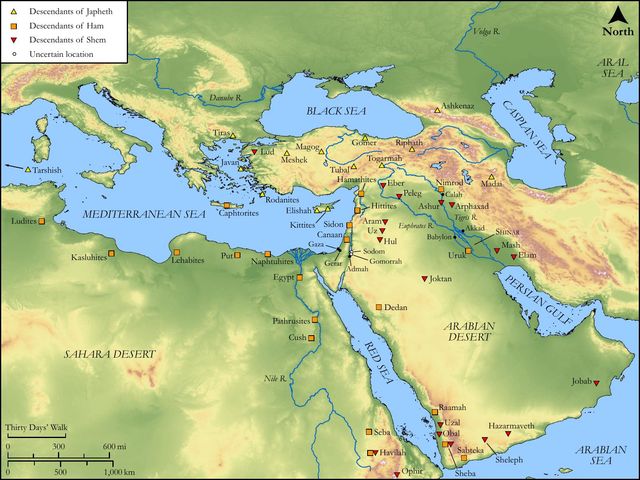
See on the biblical-era maps


Study this verse
Public-domain commentary
Matthew Henry
From his Commentary on the Whole Bible. Henry comments on passages, not single verses — this entry covers Genesis 10:1–5.
Moses begins with Japheth's family, either because he was the eldest, or because his family lay remotest from Israel and had least concern with them at the time when Moses wrote, and therefore he mentions that race very briefly, hastening to give an account of the posterity of Ham, who were Israel's enemies and of Shem, who were Israel's ancestors; for it is the church that the scripture is designed to be the history of, and of the nations of the world only as they were some way or other related to Israel and interested in the affairs of Israel. Observe, 1. Notice is taken that the sons of Noah had sons born to them after the flood, to repair and rebuild the world of mankind which the flood had ruined. He that had killed now makes alive. 2. The posterity of Japheth were allotted to the isles of the Gentiles (Gen 10:5), which were solemnly, by lot, after a survey, divided among them, and probably this island of ours among the rest; all places beyond the sea from Judea are called isles (Jer 25:22), and this directs us to understand that promise (Isa 42:4), the isles shall wait for his law, of the conversion of the Gentiles to the faith of Christ.
Historical interpretation
Historical reception
1 surviving comment on this verse from the historical church.
(Chapter 10, Verse 2.) The sons of Japheth were Gomer, Magog, Madai, Javan, Tubal, Meshech, and Tiras. Japheth, son of Noah, had seven sons who possessed the land in Asia from Mount Amanus and Mount Taurus to the mountains of Syria Coele and Cilicia, all the way to the River Tanais. In Europe, they journeyed as far as Gades, leaving names to places and tribes: many of these were later changed, but others remain as they were. Gomer became the Galatians, Magog became the Scythians, Madai became the Medes, Javan became the Ionians, also known as the Greeks, hence the Ionian Sea. Thubal the Iberians, who are also called Hispani, from whom the Celtiberi, although some suspect they are Italians. Mosoch, the Cappadocians, from whom the city is still called Mazaca among them. (Furthermore, the Septuagint interpreters consider the Cappadocians to be the Caphthorim.) Thiras, the Thracians, whose name has not been sufficiently changed. I know that someone named Gog and Magog, both from present location and from Ezekiel, recently related a story of the Goths who were recently reveling in our land, which is demonstrated to be true by the end of the battle itself. And certainly all the educated Goths, more accustomed to call the Getae than Gog and Magog. Therefore, these seven nations, which I mentioned came from the line of Japheth, inhabit the northern part.
Continue studying Genesis 10:2 across the web’s major study libraries — every link below opens this exact verse, chapter, or book on the destination site.
Read & Compare
 BibleGatewayThis verse in more than 200 translations and 70 languages.
 Bible.comThe YouVersion reader — hundreds of translations, reading plans, and highlights.
 ESV.orgCrossway's official English Standard Version reader.
 NET BibleThe NET translation with 60,000+ translators' notes on every rendering decision.
 STEP BibleTyndale House's free study tool — original text, vocabulary, and scholarly resources.
 BibliaLogos Bible Software's free web reader.
 USCCBThe New American Bible (Revised Edition) with the U.S. bishops' study notes.
Commentaries
 BibleHub CommentariesDozens of classic commentaries on this verse, gathered on one page.
 StudyLightMore than 100 commentary sets — the largest collection on the web.
 BibleRefPlain-English commentary on what this verse means, verse by verse.
 Enduring WordDavid Guzik's free commentary on this chapter, widely used by Bible teachers.
 Bible Study ToolsVerse commentary alongside Greek and Hebrew study aids.
Original Language & Research
- BibleHub InterlinearThe verse word by word — original language, transliteration, and English.
- BibleHub LexiconEvery word's original-language definition and Strong's entry.
 Blue Letter BibleDeep-study tools — Strong's numbers, concordance, and word studies.
 SefariaThe Hebrew text with Rashi and centuries of Jewish commentary.
Sermons, Hymns & Audio


TrulyRandomVerse is not affiliated with these sites and doesn’t control their content. They’re linked because they’re genuinely useful.
Summary
Genesis 10:2 is a pivotal verse within the "Table of Nations," a comprehensive genealogical record in Genesis 10 that meticulously documents the descendants of Noah's three sons—Shem, Ham, and Japheth—following the Great Flood. This particular verse specifically enumerates the immediate seven sons of Japheth, serving as the foundational list of progenitors for various peoples and nations that would subsequently spread across the earth, laying the groundwork for understanding the early distribution of humanity.
Context
ShowHideLiterary Context
Genesis 10, often referred to as the "Table of Nations," immediately follows the account of the Great Flood and Noah's covenant with God in Genesis 9. It serves as a crucial bridge between the universal judgment of the Flood and the subsequent dispersion and development of humanity, leading up to the call of Abraham in Genesis 12. This chapter systematically fulfills God's post-Flood command to Noah and his sons to "be fruitful and multiply, and fill the earth" (Genesis 9:1). Genesis 10:2 initiates the section dedicated to Japheth's lineage, providing a foundational list before detailing the descendants of Ham and Shem, thus establishing an ordered and comprehensive record of early human populations.
Historical & Cultural Context
The "Table of Nations" reflects Israel's understanding of ethnography and geography, presenting a divinely ordered framework for the origins of various peoples known to the biblical authors. While not a modern geographical treatise, it broadly maps out the known world from the perspective of early Israel. Japheth's descendants are generally associated with peoples to the north and west of Canaan, encompassing regions of Anatolia, the Aegean, and parts of Europe. This genealogical record would have been vital for ancient Israelites to understand their place in the world, their relationship to surrounding nations, and the common ancestry of all humanity, countering any notion of isolated or independent origins for different ethnic groups.
Key Themes
ShowHideGenesis 10, and specifically Genesis 10:2, contributes to several overarching themes within Genesis and the broader biblical narrative. A primary theme is the unity and common origin of humanity, emphasizing that all peoples descended from Noah, and ultimately from Adam, as seen in the broader genealogies of Genesis 5. Another significant theme is God's sovereignty over history and human demographics, as He orchestrates the repopulation and distribution of the earth's inhabitants in fulfillment of His divine purposes. The meticulous listing of nations also foreshadows the future interactions between Israel and these peoples, setting the stage for later historical accounts and prophetic pronouncements, such as those concerning Ezekiel 38, Ezekiel 39.
Exposition and Analysis
ShowHideKey Word Analysis
ShowHideFrom the root meaning "to build," this term (H1121) signifies a male offspring, but in its widest sense, it refers to a builder of the family name. Here, it denotes the direct male descendants of Japheth who would become the progenitors of distinct family lines and, by extension, entire nations, emphasizing their foundational role in establishing future peoples.
Derived from a root meaning "expansion" (H3315), Japheth is one of Noah's three sons, whose name prophetically hints at the future expansion and widespread settlement of his descendants. As the patriarch of a significant branch of humanity, his name here introduces the lineage that will spread across vast geographical regions, fulfilling the divine command to fill the earth.
Probably from a root suggesting "effervescing" or "hot and active" (H3120), Javan is listed as one of Japheth's sons. Historically and linguistically, Javan is widely recognized as the progenitor of the Ionians, a major group of ancient Greeks, thus representing the Hellenic peoples and their expansive cultural and geographical influence among the nations.
Verse Breakdown
ShowHide"The sons of Japheth;"
This introductory phrase immediately establishes the focus of the verse, identifying the lineage being presented. Japheth, one of Noah's three sons, is the patriarch whose direct male offspring are about to be enumerated, marking the beginning of the Japhetic branch of the "Table of Nations."
"Gomer, and Magog, and Madai, and Javan, and Tubal, and Meshech, and Tiras."
This is a comprehensive list of Japheth's seven sons. Each name represents not only an individual but also an eponymous ancestor from whom distinct peoples and nations descended. Gomer: Often identified with the Cimmerians, a nomadic people who migrated into Anatolia and the borders of Assyria. Magog: A name with significant prophetic implications, later associated with a powerful northern nation or confederation in Ezekiel 38, Ezekiel 39, often linked to Scythian tribes. Madai: Clearly corresponds to the Medes, a powerful ancient Iranian people who, with the Persians, formed a dominant empire. Javan: Recognized as the progenitor of the Ionians, representing the Greek peoples and their widespread influence. Tubal and Meshech: Frequently mentioned together in ancient texts, associated with peoples in eastern Anatolia, known for metalworking. Tiras: Sometimes linked to the Thracians, ancient peoples of Southeastern Europe. This enumeration highlights the diverse origins of humanity's early populations, all stemming from a common patriarchal source.
Literary Devices
ShowHideGenesis 10:2 primarily employs Genealogy and Enumeration. The entire "Table of Nations" is a genealogical record, systematically tracing the lineage of Noah's descendants. Within this, the verse uses Enumeration by listing each of Japheth's sons sequentially. This precise listing serves not just as a historical record but also as an act of Eponymous Ancestry, where each individual name functions as the progenitor and namesake for an entire people group or nation. This device efficiently conveys the broad scope of human distribution from a single family source, providing a foundational understanding of the world's early inhabitants.
Theological and Thematic Connections
ShowHideGenesis 10:2, as part of the "Table of Nations," profoundly underscores the biblical truth of the common origin of all humanity, tracing every people group back to Noah's family. This foundational unity is a crucial theological concept, demonstrating God's singular creation and sovereign oversight of all peoples, not just a select few. It sets the stage for a universal understanding of sin, redemption, and God's ultimate plan for all nations. The orderly dispersion, guided by divine providence, reveals a God who is intimately involved in the unfolding of human history, meticulously establishing the diverse tapestry of cultures and nations.
Reflection and Application
ShowHideWhile Genesis 10:2 is a historical and genealogical record, it offers profound insights for contemporary reflection and application. It serves as a powerful reminder of our shared human heritage, emphasizing that all peoples, regardless of their diverse cultures, languages, or geographical locations, trace their lineage back to a common source through Noah. This foundational unity should inspire mutual respect, foster empathy, and actively counter divisive ideologies based on race, ethnicity, or national origin, promoting a sense of global kinship. Furthermore, the meticulous detailing of nations reflects God's sovereign hand guiding the development and distribution of humanity, assuring believers that His divine plan unfolds purposefully through generations, even amidst the complexities and conflicts of world history. This understanding encourages trust in God's overarching providence and His ultimate purpose for all peoples.
Questions for Reflection
ShowHideFAQ
ShowHideAre the names in Genesis 10:2 literal individuals or progenitors of nations?
ShowHideThe names listed in Genesis 10:2, while representing literal individuals (the immediate sons of Japheth), also function as eponymous ancestors. This means they are the foundational progenitors from whom entire peoples and nations descended. This dual function is common in ancient genealogies, where individuals often embody the collective identity of their future descendants, linking a people group directly to its named founder.
How do the descendants of Japheth relate to modern nations?
ShowHideScholars widely associate the names in Genesis 10:2 with ancient peoples whose descendants contributed to the formation of many modern nations, particularly across Europe and parts of Asia. For example, Javan is historically linked to the Greeks (Ionians), Madai to the Medes (ancestors of some Iranian peoples), and Gomer to the Cimmerians, whose influence spread across parts of Anatolia and Eastern Europe. While direct, unbroken lines are challenging to trace precisely over millennia, the "Table of Nations" provides a foundational biblical framework for understanding the broad distribution and origins of humanity's diverse ethnic groups.
Why is Magog singled out for prophetic significance?
ShowHideMagog, alongside Gog, is prominently featured in the prophecies of Ezekiel 38, Ezekiel 39 as a powerful, distant northern nation or confederation that will rise against Israel in the end times. This specific prophetic focus distinguishes Magog from other names in the "Table of Nations," elevating its significance beyond mere historical lineage to a future eschatological role, symbolizing a formidable adversary to God's people in the latter days.
Christ-Centered Fulfillment
ShowHideWhile Genesis 10:2 primarily details the historical dispersion of humanity into distinct nations, it implicitly sets the stage for the universal scope of God's redemptive plan, which finds its ultimate fulfillment in Jesus Christ. The division of humanity into diverse nations, originating from Noah's sons, underscores the profound necessity of a Savior whose work transcends all ethnic, linguistic, and geographical boundaries. Christ's Great Commission, to "make disciples of all nations" (Matthew 28:19), directly addresses this global diversity, demonstrating that His atoning sacrifice and the call to salvation are for every people group listed in the "Table of Nations" and beyond. Indeed, the New Testament consistently portrays the church as a new humanity, where in Christ "there is neither Jew nor Gentile, neither slave nor free, nor is there male and female, for you are all one in Christ Jesus" (Galatians 3:28). Thus, the spread of humanity in Genesis foreshadows the eventual ingathering of believers from "every tribe and language and people and nation" (Revelation 5:9) into God's eternal kingdom, united in Christ, the ultimate heir of all nations.