


Ezekiel 38:2
Bible text: King James Version (1769 Blayney text) · Public domain
Bible text: Berean Standard Bible · Public domain
Bible text: American Standard Version (1901) · Public domain
Bible text: World English Bible, Messianic edition · Public domain
Bible text: Geneva Bible (1599) · Public domain
Bible text: Young's Literal Translation · Public domain
- בֶּןbenO son ofH1121N-mscNoun Singular Masculine Construct
- אָדָם'a·DamhumankindH120N-msNoun Singular Masculine Absolute
- שִׂיםsimsetH7760V-Qal-Imp-2msVerb Qal Imperative 2nd Singular Masculine
- פָּנֶיךָpa·Nei·khayour faceH6440N-mpc ¦ 2msNoun Plural Masculine Constructפָּנֶיfaceךָyour
- אֶל'eltoH413PrepPreposition
- גּוֹגgoyGGogH1463N-properNoun Proper Location
- אֶרֶץ'E·retz[the] land ofH776N-fscNoun Singular Feminine Construct
- הַמָּגוֹגha·ma·Gog<the> MagogH4031Art ¦ N-properNoun Proper Locationהַ<the>מָּגוֹגMagog
- נְשִׂיאne·Si'[the] prince ofH5387N-mscNoun Singular Masculine Construct
- רֹאשׁrosh[the] head ofH7218N-mscNoun Singular Masculine Construct
- מֶשֶׁךְMe·shekhMeshechH4902N-properNoun Proper Location
- וְתֻבָלve·tu·Valand TubalH8422Conj-w ¦ N-properNoun Proper LocationוְandתֻבָלTubal
- וְהִנָּבֵאve·hi·na·Ve'and prophesyH5012Conj-w ¦ V-Niphal-Imp-2msVerb Niphal Imperative 2nd Singular Masculineוְandהִנָּבֵאprophesy
- עָלָיו'a·Lavon himH5921Prep ¦ 3msPrepositionעָלָיonוhim
English is a literal word-by-word gloss of the Hebrew, not the KJV's wording. Why?
This is the original text the KJV's translators worked from — each Hebrew word with its own literal English meaning in this verse, prepared by scholars at Tyndale House, Cambridge. The KJV translates whole sentences, not word by word, so its wording differs: one Hebrew word can become several English words, and the KJV may choose “the LORD” where the gloss reads “Yahweh”. Both are faithful — they answer different questions. For the KJV's own rendering, switch to the KJV text.
Details
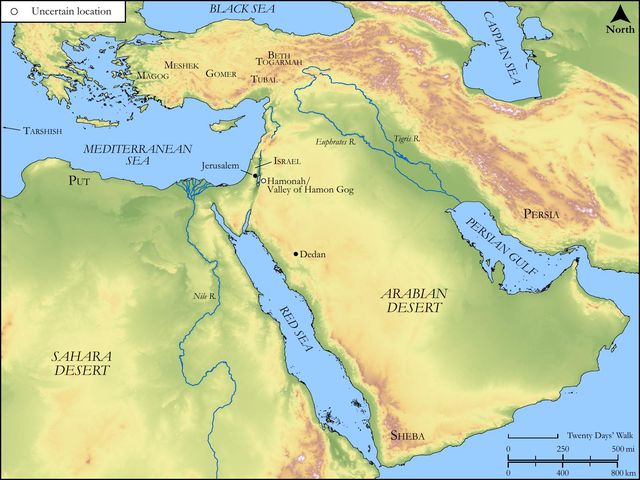
See on the biblical-era map
Study this verse
Public-domain commentary
Matthew Henry
From his Commentary on the Whole Bible. Henry comments on passages, not single verses — this entry covers Ezekiel 38:1–13. His two-level outline is real structure in the source text, so it is rendered as structure.
The critical expositors have enough to do here to enquire out Gog and Magog. We cannot pretend either to add to their observations or to determine their controversies. Gog seems to be the king and Magog the kingdom; so that Gog and Magog are like Pharaoh and the Egyptians. Some think they find them afar off, in Scythia, Tartary, and Russia. Others think they find them nearer the land of Israel, in Syria, and Asia the Less. Ezekiel is appointed to prophesy against Gog, and to tell him that God is against him, Eze 38:2, Eze 38:3. Note, God does not only see those that are now the enemies of his church and set himself against them, but he foresees those that will be so and lets them know by his word that he is against them too, and yet is pleased to make use of them to serve his own purposes, for the glory of his own name; surely their wrath shall praise him, and the remainder thereof he will restrain, Psa 76:10. Let us observe here,
I.The confusion which God designed to put this enemy to.
It is remarkable that this is put first in the prophecy; before it is foretold that God will bring him forth against Israel it is foretold that God will put hooks into his jaws and turn him back (Eze 38:4), that they might have assurance of their deliverance before they had the prospect given them of their danger. Thus tender is God of the comfort of his people, thus careful that they may not be frightened; even before the trouble begins he tells them it will end well.
II.The undertaking which he designed to engage him in, in order to this defeat and disappointment.
1.The nations that shall be confederate in this enterprise against Israel are many, and great, and mighty (Eze 38:5, Eze 38:6), Persia, Ethiopia, etc. Antiochus had an army made up of all the nations here named, and many others. These people had been at variance with one another, and yet in combination against Israel. How are those increased that trouble God's people!
2.They are well furnished with arms and ammunition, and bring a good train of artillery into the field - horses and horsemen (Eze 38:4) bravely equipped with all sorts of armour, bucklers and shields for defence, and all handling swords for offence. Orders are given to make all imaginable preparation for this expedition (Eze 38:7): "Be thou prepared, and do thou prepare. See what warlike preparations thou hast already in store, and, lest that should not suffice, make further preparation, thou and all thy company," Let Gog himself be a guard to the rest of the confederates. As commander-in-chief, let him engage to take care of them and their safety; let him pass his word for their security, and take them under his particular protection. The leaders of an army, instead of exposing their soldiers needlessly and presumptuously, and throwing away their lives upon desperate undertakings, should study to be a guard to them, and, whenever they send them forth in danger, should contrive to support and cover them. This call to prepare seems to be ironical - Do thy worst, but I will turn thee back; like that Isa 8:9. Gird yourselves, and you shall be broken in pieces.
3.Their design is against the mountains of Israel (Eze 38:8), against the land that is brought back from the sword. It is not long since it was harassed with the sword of war, and it has been always wasted, more or less, with one judgment or other; it is but newly gathered out of many people, and brought forth out of the nations; it has enjoyed comparatively but a short breathing-time, has scarcely recovered any strength since it was brought down by war and captivity; and therefore its neighbours need not fear its being too great, nay, and therefore it is very barbarous to pick a quarrel with it so soon. It is a people that dwell safely, all of them, in unwalled villages, very secure, and having neither bars nor gates, Eze 38:11. It is a certain sign that they intend no mischief to their neighbours, for they fear no mischief from them. It cannot be thought that those will offend others who do not take care to defend themselves; and this aggravates the sin of these invaders. It is base and barbarous to devise evil against thy neighbour while he dwells securely by thee, and has no distrust of thee, Pro 3:29. But see here how the clouds return after the rain in this world, and what little reason we have ever to be secure till we come to heaven. It is not long since Israel was brought back from the sword of one enemy, and behold the sword of another is drawn against it. Former troubles will not excuse us from further troubles; but when we think we have put off the harness, at least for some time, by a fresh and sudden alarm we may be called to gird it on again; and therefore we must never boast nor be off our guard.
4.That which the enemy has in view, in forming this project, is to enrich himself and to make himself master, not of the country, but of the wealth of it, to spoil and plunder it, and make a prey of it: At the same time that God intends to bring this matter about things shall come into the mind of this enemy, and he shall think an evil thought, Eze 38:10. Note, All the mischief men do, and particularly the mischief they do to the church of God, arises from evil thoughts that come into their mind, ambitious thoughts, covetous thoughts, spiteful thoughts against those that are good, for the sake of their goodness. It came into Antiochus's mind what a singular people these religious Jews were, and how their worship witnessed against and condemned the idolatries of their neighbours, and therefore, in enmity to their religion, he would plague them. It came into his mind what a wealthy people they were, that they had gotten cattle and goods in the midst of the land (Eze 38:12), and withal how weak they were, how unable to make any resistance, how easy it would be to carry off what they had, and how much glory this rapine would add to his victorious sword; these things coming into his mind, and one evil thought drawing on another, he came at last to this resolve (Eze 38:11, Eze 38:12): "I will go up to the land of unwalled villages; yea, that I will; it will cost me nothing to make them all my own. I will go and disturb those that are at rest, without giving them any notice, not to crush their growing greatness, or chastise their insolence, or make reprisals upon them for any wrong they have done us (they had none of these pretences to make war upon them), but purely to take a spoil and to take a prey" (Eze 38:12), in open defiance to all the laws of justice and equity, as much as the highwayman's killing the traveller that he may take his money. These were the thoughts that came into the mind of this wicked prince, and God knew them; nay, he knew them before they came into his mind, for he understands our thoughts afar off, Psa 139:2.
5.According to the project thus formed he pours in all his forces upon the land of Israel, and finds those that are ready to come in to his assistance with the same prospects (Eze 38:9): "Thou shalt ascent and come like a storm, with all the force, and fury, and fierceness imaginable, and thou shalt be like a cloud to cover the land, to darken it, and to threaten it, thou and not only all thy bands, all the force thou canst bring into the field, but many people with thee" (such as are spoken of Eze 38:13), "Sheba and Dedan, the Arabians and the Edomites, and the merchants of Tarshish, of Tyre and Sidon and other maritime cities, they and their young lions that are greedy of spoil and live upon it, shall say, Hast thou come to take the spoil of this land?" Yes he has; and therefore they wish him success. Or perhaps they envy him, or grudge it to him. "Hast thou come for riches who art thyself so rich already?" Or, knowing that God was on Israel's side, they thus ridicule his attempts, foreseeing that they would be baffled and that he would be disappointed of the prey he promised himself. Or, if he come to take the prey, they will come and join with him, and add to his forces. When Lysias, who was general of Antiochus's army, came against the Jews, the neighbouring nations joined with him (1 Macc. 3:41), to share in the guilt, in hopes to share in the prey. When thou sawest a thief then thou consentedst with him.
Historical interpretation
Historical reception
1 surviving comment on this verse from the historical church.
(Chapter XXXVIII.) "And the word of the Lord came to me, saying: Son of man, set your face against Gog, the land of Magog, the prince of the head (or head of) Meshech and Tubal, and prophesy against him. And you shall say to him: Thus says the Lord God: Behold, I am against you, O Gog, prince of the head (or head of) Meshech and Tubal. And I will turn you around, and put hooks into your jaws, and bring you out, and all your army, horses and horsemen, all clothed in armor, a great multitude, with bucklers and shields, wielding swords (or bucklers and helmets, and swords): Persians, Ethiopians, and Libyans, all with shields and helmets; Gomer and all his hordes; the house of Togarmah from the far north, and all his troops, and many peoples with you. Prepare and equip yourself, and your entire multitude which has gathered to you, and be a commandment to them (or you will be to me a custodian). After many days you will be visited: in the last years you will come to a land which has turned (or perverted) from the sword: and it has been gathered from many peoples to the mountain (or land) of Israel, who have been continuously deserted: this has been brought out from the peoples and they will confidently dwell (or have dwelt) in it. But when the storms come and the clouds cover the earth, you and all your armies, and many peoples (or nations) with you, will ascend. Thus says the Lord God: On that day, thoughts will arise in your heart, etc., and you will devise a wicked plan, and say: I will ascend to the land (or above the land) without a wall (or abject): I will go to those who dwell securely (or in peace): all ((Vulgate adds these)) dwell without a wall, bars and gates are not for them: to plunder spoils, and seize prey: to lay your hand upon those who were forsaken, and later restored, and upon the people who are gathered from the nations, who have begun to possess and inhabit the belly button of the earth. The people of Sheba and Dedan, and the merchants of Tarshish (or the Carthaginians and all the lion-like cities) will say to you: Have you come to gather spoils? Look, you have gathered your multitude to take silver and gold, and to take away possessions and spoil endless treasures. Therefore, prophesy, son of man, and say to Gog: Thus says the Lord God: Will you not know (or arise) on that day when my people Israel dwell confidently (or in peace)? And you will come from your place on the sides (or from the far north), you and many peoples with you, all mounted on horses, a great gathering and a mighty army. And you will come up over my people Israel like a cloud, to cover the land. In the latter days you will come (or he will come) and I will bring you against my land, so that all the nations may know me, when I shall be sanctified in you in their sight, O Gog. Thus says the Lord God: So you are the one of whom I spoke in the days of old by the hand of my servants, the prophets of Israel, who prophesied in those days and years (or times), that I would bring you against them? And it shall come to pass in that day, in the day of the coming of Gog against the land of Israel, says the Lord God, that my fury will arise in my anger. And in my zeal, in the fire of my wrath, I have spoken, because on that day there will be a great commotion over the land of Israel, and the fish of the sea, and the birds of the sky, and the beasts of the field (or the countryside), and every creeping creature that moves on the earth will be shaken. And all the men who are on the face of the earth will be overturned (or split) and the mountains will be overturned (or torn down), and the hedges (or valleys) will fall, and every wall on the land will collapse. And I will summon against him on all my mountains a sword (or every terror of the sword), says the Lord God. The sword of each (or every) man will be directed against his brother. And I will judge him with pestilence (or death), and blood, and severe rain and immense stones (or hailstones). I will rain fire and sulfur on him, and on his army (or on all those who are with him), and on many peoples who are with him. And I will be magnified, and sanctified, and I will be known in the sight (or eyes) of many nations, and they will know that I am the Lord." The foundations of the first history must be laid, and it must be known that this final discourse of the Lord is to the prophet Ezekiel. For after this we can find nothing similar, except that which is written in the twenty-fifth year of the transmigration of Jehoiachin: The hand of the Lord was upon me, and he brought me there, that is, to the land of Israel, when the building of the temple is described, and the order of its ceremonies is narrated. Then it is to be noted that the face of the prophet is set or hardened against the land of Gog, or the land of Magog. For it requires firmness and much consideration of countenance, so that we may understand the things that are spoken, according to the saying of the Apostle: But we all, with open face beholding as in a glass the glory of the Lord, are changed into the same image from glory to glory, even as by the Spirit of the Lord (1 Corinthians 3:18). Therefore, the Jews and those of us who follow Jewish customs believe that the Gentiles mentioned as Gog are the Scythians, who are savage and countless in number, stretching from beyond the Caucasus mountains and the Maeotis swamp to near the Caspian Sea and as far as India. And they believe that after a thousand years, these nations stirred up by the devil will come to the land of Israel to fight against the saints, gathering many other peoples with them. First, Mosoch, whom Josephus interprets as Cappadocians, then Tubal, whom the same interprets as Iberians, or Spaniards, Hebrews suspect to be Italians, having with them in their army Persians, Ethiopians, and Libyans: also Gomer and Thogorma, whom they interpret as Gauls and Phrygians: also the Sabaeans and Dedan, and the Carthaginians, or Tharsis, and this is what John also puts in his Apocalypse: 'And when the thousand years are finished, Satan will be released from his prison, and will come out to deceive the nations that are at the four corners of the earth, Gog and Magog, to gather them for battle; their number is like the sand of the sea. And they marched up over the broad plain of the earth and surrounded the camp of the saints and the beloved city.' And fire came down from God out of heaven, and devoured them: and the devil, that seduced them, was cast into the pool of fire and brimstone, where both the beast and the false prophet shall be tormented day and night for ever and ever (Rev. 20:9-10). They do not understand that the entire volume of John, which is titled Revelation, is mystical, and that we need revelation in order to be able to say with the prophet: Open my eyes, and I will behold wondrous things out of thy law (Ps. 119:18). But others, forsaking earthly sensibilities and harmful Judaic and elderly fables (I Tim. IV), and content with themselves, delve into the depths, ascend too high, and invent much worse things, in order to describe wars of the devil and all his host in the heavenly Jerusalem, and they interpret spiritual wickedness in celestial matters under the guise of the topologies of individual nations. We, conceding all these things to the judgment of the reader, will strive not so much to condemn foreign ideas as to affirm the ecclesiastical explanation. In the Greek language, a gift is called δόμα, and in Latin it is called tectum. Furthermore, Magog is interpreted as being uncovered. Therefore, all pride and false knowledge of name, which raises itself against the knowledge of truth, is demonstrated by these names. These are the roofs, about which Isaiah speaks in a vision against the Valley of Zion: What has happened to you now, since you have all gone up to empty roofs? (Isa. XXII, 1) And we will interpret the roofs as the leaders of heretics: and we will call those who have received their teachings from the roofs. And beautifully after many mystical prophecies in this volume, the final prophecy is against Gog and Magog. For if it is the time of judgment, according to Peter, that it begins with the house of God, and according to this same Ezekiel, who says: 'And begin with My holy ones' (above IX, 6), and the last enemy will be destroyed, death (1 Peter IV): in Isaiah also the first discourse is against Judah, in which the confession of the Lord is, and the last against the quadrupeds that are in the desert (Isaiah II): rightly here too the final discourse is against Gog and Magog, who attack the city of God, which the flow of the river delights (Psalm XLV). And what Isaiah says: 'I am the first city which is attacked' (Isaiah XXVII, 10). And concerning which it is written in the Gospel: A city that is set on a hill cannot be hid (Matthew 5:14). And more fully in the Psalm: Jerusalem is built as a city that is at unity in itself (Psalm 122:3). The mountains are round about it; and the LORD is round about his people (Psalm 125:2). Furthermore, in the army of Gog, or Magog, who according to the Septuagint, Symmachus, and Theodotion, is chief of Ros, Mosoch, and Thubal: the first nation is interpreted by Aquila as the head, which we also follow, so that the sense is: The prince of the head of Mosoch and Thubal. And indeed, neither in Genesis, nor in any other place in Scripture, nor even in Josephus, who in his first book of Antiquities explains the names of all the Hebrew nations, could we find this nation. From this it is clear that 'ros' does not mean nation, but head. It should also be briefly noted that in Ezekiel, Gog is said to be the prince of the land of Magog. And in the Apocalypse, it is mentioned that Gog and Magog are nations that come forth from the four corners of the earth. And just as Jacob, who was later called Israel, received the name of all the Hebrew people, and Aram received the name of Syria, and Mesraim received the name of Egypt, whose names are written in Genesis: so too, all those who are subject to the prince Gog are called Magog. However, Mosoch is interpreted as madness, and Thubal as everything or all. Therefore, the prince and the head of arrogant madness and of all evils are called Gog and Magog, according to what is written: The world is set in the evil one (1 John 5:19). These hostile and opposing nations of the saints come forth from the corners of the earth, deviating from the straight line and the arrangement of God's camp, as is recounted in Numbers, and not realizing this testimony: Many will come from the east and the west, from the north and the south, and will recline at the table with Abraham, Isaac, and Jacob in the kingdom of God (Matthew 8:11). And in another place: I will say to the North, give up; and to the South, do not withhold. Bring my sons from far away, and my daughters from the end of the earth, everyone who is called by my name (Isa. XLIII, 6). But not such the corners of the earth from which Gog and Magog come forth: next to these corners stands the harlot in Proverbs (Prov. XXIII), who, passing by, hastens to deceive foolish young men through the streets, that is, through the broad and spacious road that leads to death. The scribes and Pharisees also pray in the corners of the streets, so that they may be seen by men, who have received their reward (Matthew 6). So what is the curse against Gog? I will turn you around and put a bit in your jaws. First, I will make you waver from your opinion and be converted. And I will put a bit in your jaws, as it is written: 'With bit and bridle bind fast their jaws, who come not near Thee' (Psalm 32:9); so that the untamed and unruly horse, who falls down precipices, may be subject to the bridle of the Lord: to whom the prophet says: 'Ride upon thy horses, and thy riding shall be salvation' (Habakkuk 3:8). And it is said of Job, through a cloud and whirlwind: You have surrounded the horse with strength (Job. XXXIX, 19). Such were the horses and horsemen; whose multitude John saw in heaven (Apoc. VI). Therefore, he says to Gog: I will lead out, or gather you, and all the army, or your strength. He who is led out and gathered from dispersion is brought back to salvation, according to what is promised in the law: If your dispersion shall be from the top of the sky to its summit, from there I will gather you (Deut. XXX, 3). They also have horses and cavalry clad in armor, who imitate the apostle's equipment and boast of having the breastplate of righteousness (Ephesians 6): the multitude is excessive, and all seize the shield and sword against the Church, and they are the most savage and hostile nations, including the Persians, Ethiopians, and Libyans: their wars against the people of God are recounted in the Holy Scriptures. Also Gomer and the house of Thogorma, who come from the sides of the North, which is a very cold wind and is called the East wind, and the whole strength of Magog, and all the peoples who are subject to him, will come with him to battle. To whom it is said ironically: prepare yourself, make ready, and gather to yourself all your multitude that obeys your commands; and know that after many days you shall be visited, according to what is written: I will visit their iniquities with a rod and their sins with stripes (Psalm 88:33). In the last days, he says, you will come. Hence John also says: My little children, it is the last hour (1 John 2:18). And the people of the nations are hired at the eleventh hour to work in the vineyard (Matthew 20), to whose land, that is, the land of mildness, and the land of the saints, which brings forth one hundred, and sixty, and thirty fruits, Gog has come to conquer, which has turned away, or turned its back, from the sword. For it is written: Scatter, O Lord, the nations that desire war (Psalm 68:32). And it shall come to pass that, when the people and nations have been gathered together, and the error of the nations has been despised, it shall come to the mountains of Israel, namely the patriarchs and prophets, who once wandered in the desert without the law and commandments of God. To whom it is afterwards said: 'More are the children of the desolate, than of her that hath a husband.' (Isa. LIV, 1) These are the deserted and waterless places, in which the devil could not find a place, because they were called to salvation, and afterwards he, having taken seven other, more wicked spirits, returned to his house, namely to the people of Israel. (Matth. XI) These things, he says, are spoken of the people, understood as the earth; or, it is spoken of the nations, so that it may be understood as the people of believers who dwelt in peace and trusted in the Lord. But Gog, together with all his army, will come up like a storm and like a cloud, to cover the land of the believers. For what heretics, whose leader is the devil, do not come against the Church like a storm, and in a cloud of their words, they hasten to oppress and cover the simple believers? Therefore it is said to him: As much as it is within you, you will cover all things and all your armies, and many peoples with you. Gog, ascending proudly, does not have voluntary rain, nor temporary and late rain, which would rejoice the dry fields, but rather storm and darkness, so that it may confuse everything with darkness and error. Therefore, the Lord God speaks these words to him: At that time, that is, in the last days, evil thoughts will arise in your heart, and you will ponder a wicked plan, as the Scripture says: If the spirit of the one having power desires to rise against you, do not leave your place (Ecclesiastes 10:4). On the other hand, God ascends into the holy heart, about which it is written: He established his ascents in his heart (Ps. 83:6). And Gog says: I will ascend to the land without a wall, or a projecting one, that is, which is deprived of God's help, and not fortified by dialectical argumentation; I will come to those who are at rest and dwell securely, that is, in peace. For our King is peaceful, and his place is in peace (Psalm 75). All, he says, dwell without a wall, and there are no bars or gates for them. This prince of heretics speaks, having no defenses of the Church; nor secular wisdom, which is foolishness before God, in order to plunder the spoils and invade the prey of the Church, and lay his hand upon those who were deserted when they did not have knowledge of God; and then, restored through Christ, come to the Father, to whom he speaks in the Gospel: Father, I have revealed your name to men (John 17:6). And so that we may know that the people who were deserted and then restored signify the Christian people, it follows: And over the people who are gathered from the nations (Psalm 74:12). The people who began to possess the inheritance of Christ and to be inhabitants of the navel of the earth, of which it is written: He has worked salvation in the midst of the earth. For truth has risen from the earth (Ibid. LXXXIV, 1); who says in the Gospel: I am the way and the life, and the truth (John XIV, 6). While he was thinking and saying this, and eagerly trying to snatch the possession of the Church, the nations that had been converted from their ancient error to salvation, Sabah and Dedan, and the merchants of Tarshish, Carthage, or the sea, who seek merchandise in the waves of this world through good works, and all their cities, whether lions or lion cubs as it is contained in Hebrew, will speak to him what follows. But as for the cubs of lions, which are called Caphir in Hebrew (), both the Seventy and Theodotio translate as 'villas', it is a clear mistake. For if you write it with the letter chi, it is called a lion cub; but if you write it with ce, which is called Coph in Hebrew, it is called a field and a village. Hence, Capharnaum is said to be a beautiful field. Therefore, Saba and Dedan will say, and the merchants of Tharsis, and all the holy ones who are called lion cubs, or certainly the villages and dwellings of the believers: O Gog, do you come for this reason, to seize the spoils of the Church, and therefore have you gathered a multitude, so that the possession of Christ may become your inheritance? Or do you think that the silver and gold, which is understood in speech and meaning, will be possessed by the Church, so that you may take away all the furnishings and all the wealth, and plunder the countless spoils gathered by the victories of Christ? Therefore, O Prophet Ezekiel, who is called the son of man in the type of Christ, speak to Gog and say to him: Thus says the Lord God, when the error of the whole world is removed, my people Israel, who discern God with their minds, will dwell confidently in the Church, either in peace. Then you will know, whether you rise up or come from your place. However, the following discourse shows the place of heretical wickedness: From the sides of the North, which endeavors to cool down all the heat of believers. And many people will come with him, all riders on horses, of whom it is written: He threw horse and rider into the sea (Exodus 15:1): a great multitude and a powerful army, with whom he ascends, saying, 'Upon my people Israel, you shall come like a cloud and cover my land, as it is written: In the last days, you shall be, when the Gospel preaching: and I will bring you upon my land. For heresies must exist, so that those who are approved may be made manifest (1 Corinthians 11:19), and by God's will the devil, the fighter, and all perversions of doctrine have been abandoned: so that all nations may know and understand me, when I am sanctified in you in their eyes, o Gog, that is, when they understand me as their judge through your punishments. And he addresses Gog himself; Are you not the one of whom I spoke in ancient times, through the hands of my servants the prophets of Israel? Namely, Moses, who said in the book of Numbers, specifically in the Septuagint: A man will come forth from his seed, and he will rule over many nations, and his kingdom will be exalted, and his kingdom will grow (Num. 24:7). Moreover, according to the Hebrew text, I found it written as follows: Therefore, his king Agag (translated as Gog in the Latin Vulgate) will be removed, and his kingdom will be taken away, because the kingdom of Israel was destroyed by Agag, the king of Amalek, during the time of Saul. And in another place: He will cleanse the land of his people (Joel 3). Joel also describes the gathering of people in the valley of Josaphat, which is the judgement of God. And Isaiah and all the prophets, in whose hands the word of the Lord is made manifest through good works. So when my wrath and fury come upon the land of Israel, my indignation will rise against you, and my zeal for my people. In the fire of my anger, I have spoken, to consume all the wickedness of your actions. At that time, he says, there will be a great upheaval upon the land of Israel. For with the Devil unleashed, frequent persecution against the Church will occur: and when it has been suppressed and overcome by God's help, then the fish of the sea, the birds of the sky, the animals of the field, and all reptiles that move upon the land, and all the men who are upon the face of the earth will be shaken. This is clearly demonstrated concerning the inhabitants of the Church: some are like fish of the sea, others like birds of the sky, others like animals of the field and all creeping things that move on the earth, others like those who retain human dignity and dwell upon the face of the earth. And as for the diversity of character, which is designated by various names, the Apostle writes to the Corinthians that there are heavenly bodies and earthly bodies after the resurrection, and that one body is of a fish, another of a bird, another of animals, another of creeping things, and another of humans who have retained their original name. In the actions of the apostles, that linen cloth, which is shown to the third Apostle Peter with four principles (Acts X), also signifies the diversity of believers, which is also contained in the Ark of the flood. Then, indeed, the mountains will be overturned by the face of the Lord, and by the sight of His majesty, which were rising up against the knowledge of God; and the hedges or valleys, which were sunk to the lowest depths by the lowliness of their understanding, or certainly the fortifications, which promise something, in order to imitate the Church of God, of whose hedges it is said: 'He who breaks a hedge, a snake will bite him' (Sirach X, 8). And all the walls will fall to the ground. For when the strength of Ecclesiastical discourse appears, all the fortifications of the heretics will fall. And I will call, he says, him against them, that is, the leader of the heretics Gog, a sword in all his mountains, so that the leaders of his army may be defeated by the sword of the Lord. Then heresy will fight against heresy, their struggle is our victory. And I will judge him, saith the Lord, with death, or with plague, and blood, and severe rain, and immense stones, or hailstones. But Gog is judged with his own death, and with the blood which he shed, and with the severe rain, by the words of learned and perfect men, and with immense stones, which bury him with testimonies of the Scriptures, or with hailstones, which make his heat grow cold: For all who commit adultery, their hearts are like an oven. (Hosea 7:4). I will rain fire and sulfur upon him, whereby the punishment of eternal judgment is shown. And not only above him who was the author of wickedness, but even above his entire army and multitude, and above many nations who are with him. For heretics have many accomplices, indeed the devil himself, their prince, is surrounded by an infinite number. With every error removed, and with the leaders of the heretics punished and destroyed, the Lord is magnified and sanctified among the believers, and is known in the eyes of many nations who have believed in his faith; and both from the blessedness of his followers and from the punishment of his adversaries, it is understood and known that he is the Lord. We have interpreted these things as best as we could, obeying that precept: Neither shall you turn aside to the right hand, nor to the left, but shall walk in the royal way (Deut. XXVIII, 14). But if someone criticizes our work, let them either propose better things for us to follow, or if they have nothing to say, let them leave perfect knowledge of God behind; as long as they understand that we have no power, but the judgment of our mind.
Continue studying Ezekiel 38:2 across the web’s major study libraries — every link below opens this exact verse, chapter, or book on the destination site.
Read & Compare
 BibleGatewayThis verse in more than 200 translations and 70 languages.
 Bible.comThe YouVersion reader — hundreds of translations, reading plans, and highlights.
 ESV.orgCrossway's official English Standard Version reader.
 NET BibleThe NET translation with 60,000+ translators' notes on every rendering decision.
 STEP BibleTyndale House's free study tool — original text, vocabulary, and scholarly resources.
 BibliaLogos Bible Software's free web reader.
 USCCBThe New American Bible (Revised Edition) with the U.S. bishops' study notes.
Commentaries
 BibleHub CommentariesDozens of classic commentaries on this verse, gathered on one page.
 StudyLightMore than 100 commentary sets — the largest collection on the web.
 BibleRefPlain-English commentary on what this verse means, verse by verse.
 Enduring WordDavid Guzik's free commentary on this chapter, widely used by Bible teachers.
 Bible Study ToolsVerse commentary alongside Greek and Hebrew study aids.
Original Language & Research
- BibleHub InterlinearThe verse word by word — original language, transliteration, and English.
- BibleHub LexiconEvery word's original-language definition and Strong's entry.
 Blue Letter BibleDeep-study tools — Strong's numbers, concordance, and word studies.
 SefariaThe Hebrew text with Rashi and centuries of Jewish commentary.
Sermons, Hymns & Audio


TrulyRandomVerse is not affiliated with these sites and doesn’t control their content. They’re linked because they’re genuinely useful.
Summary
Ezekiel 38:2 inaugurates a critical prophetic oracle from the Lord to the prophet Ezekiel, issuing a divine command to confront a formidable future antagonist identified as "Gog, of the land of Magog, the chief prince of Meshech and Tubal." This foundational verse meticulously establishes the setting for a climactic, divinely orchestrated invasion of the restored land of Israel by a powerful northern confederacy, thereby underscoring God's absolute sovereignty over all nations and His ultimate, redemptive purpose to manifest His glory and holiness through the unfolding of historical events and the execution of righteous judgment.
Context
ShowHideLiterary Context
This verse functions as the precise commencement of the extensive prophecy concerning Gog and Magog, which encompasses Ezekiel chapters 38 and 39. It immediately follows the profound vision of the Valley of Dry Bones in Ezekiel 37, a powerful symbolic representation of Israel's spiritual and physical restoration, their miraculous regathering from global dispersion, and their re-establishment as a unified nation in their ancestral land under a single shepherd. Consequently, the prophecy of Gog's invasion is presented as an event that transpires after this period of national restoration, when Israel is dwelling in a state of perceived security and prosperity. This deliberate chronological placement emphasizes that even subsequent to God's gracious and miraculous restoration, a final, decisive confrontation with hostile global powers is destined to occur, meticulously orchestrated by God Himself to unequivocally demonstrate His omnipotence and unblemished holiness to the entire world.
Historical & Cultural Context
The enigmatic names "Gog," "Magog," "Meshech," and "Tubal" refer to ancient peoples and geographical regions predominantly situated in the northern extremities of the known world from the Israelite perspective. Magog is genealogically listed in Genesis 10:2 as a son of Japheth, alongside Meshech and Tubal, indicating their common descent from Noah. Historically, Meshech and Tubal were recognized as significant kingdoms located in Anatolia (modern-day Turkey), renowned for their formidable military capabilities and their active participation in the trade of metals (particularly copper) and slaves. The term "Gog" is widely understood as either a regal title or a symbolic designation for the preeminent leader of this formidable northern confederacy, while "Magog" denotes his specific land or the collective people he commands. The consistent biblical motif of existential threats emanating from the "north" (e.g., Assyria, Babylon) would have historically evoked a profound and deeply ingrained apprehension within the Israelite consciousness, rendering this prophecy exceptionally potent and resonant. While the precise modern identification of these nations remains a subject of considerable scholarly debate, their consistent geographical orientation unequivocally points to a powerful, distant northern threat poised against Israel.
Key Themes
ShowHideEzekiel 38:2 introduces several profound and overarching theological themes that permeate the entirety of the Gog and Magog prophecy. Firstly, Divine Sovereignty and Orchestration stands as paramount; God unequivocally commands Ezekiel to "set thy face against Gog," thereby indicating that this future conflict is not a random geopolitical occurrence but a divinely purposed and meticulously planned event. God explicitly declares that He will "turn [Gog] around and put hooks in [his] jaws" (Ezekiel 38:4), compelling him to advance against Israel for the Lord's own transcendent purposes. Secondly, the theme of Prophetic Judgment Against Hostile Nations is central to this oracle; Gog and his myriad allies represent archetypal forces inherently hostile to God and His chosen people, and this prophecy serves as a powerful, declarative pronouncement of God's impending and decisive judgment upon all who dare to oppose His divine plan and His covenant nation. Finally, and arguably most significantly, the ultimate, overarching purpose of this dramatic divine intervention is the Revelation of God's Glory and Holiness to all the nations of the earth. As explicitly articulated in Ezekiel 38:23 and reiterated in Ezekiel 39:7, God's decisive actions will undeniably demonstrate His unparalleled greatness and unblemished holiness, ensuring that every nation will ultimately acknowledge and know that He alone is the Lord.
Exposition and Analysis
ShowHideKey Word Analysis
ShowHideThis compound phrase, a direct translation of H1121 (bên) meaning "son" (as a builder of the family name, encompassing a wide spectrum of literal and figurative relationships, including quality or condition) and H120 (ʼâdâm) meaning "ruddy, i.e., a human being" (an individual or the species, mankind), serves as Ezekiel's most frequent designation, appearing over ninety times throughout the book. It profoundly underscores Ezekiel's inherent humanity, mortality, and finite nature, standing in stark contrast to the infinite majesty and transcendent power of the divine speaker. This appellation emphasizes Ezekiel's role as a humble representative of humanity, chosen to receive and convey a profound divine revelation. It highlights the vast chasm between the finite prophet and the infinite God, yet simultaneously illustrates God's gracious condescension and willingness to communicate His sovereign will through a human vessel.
This potent idiomatic expression is formed from H7760 (sûwm), "to put" or "to set" (used in a great variety of applications), and H6440 (pânîym), "the face" (as the part that turns, often used figuratively for presence, attention, or resolute determination). To "set one's face against" someone or something conveys a posture of unwavering resolve, unyielding determination, and often, direct confrontation or opposition. In this context, it signifies a divine imperative for Ezekiel to adopt a solemn and resolute stance of prophetic opposition and impending judgment against Gog. This command conveys the gravity, certainty, and divine authority of the impending confrontation, implying an unyielding and direct declaration of God's authoritative word against this formidable adversary.
This significant phrase, a focal point of scholarly discourse, comprises H7218 (rôʼsh), meaning "the head" (as most easily shaken, whether literal or figurative, often indicating leadership, rank, or beginning), and H5387 (nâsîyʼ), meaning "an exalted one," "a king or sheik," or "prince" (properly, an exalted one). The KJV renders it as "chief prince," suggesting a superlative rank or preeminence. However, a prominent alternative interpretation among many scholars posits rôʼsh not merely as an adjective "chief," but as a proper noun, "Rosh," thereby identifying an additional nation alongside Meshech and Tubal. If interpreted as "prince of Rosh, Meshech, and Tubal," it would further specify Gog's dominion as the ruler of a distinct confederacy of northern peoples, enhancing the specificity of the prophecy. Irrespective of this interpretive nuance, the phrase unequivocally denotes Gog's supreme authority, preeminent leadership, and regal dominion over the aforementioned regions.
Verse Breakdown
ShowHide"Son of man,"
This direct address serves as an immediate and personal invocation to Ezekiel, grounding the transcendent divine message within the realm of human experience. It underscores Ezekiel's unique human role as the chosen recipient and faithful conveyor of God's profound prophetic utterance.
"set thy face against Gog, the land of Magog,"
This constitutes a clear and unequivocal divine command, instructing Ezekiel to adopt a posture of resolute opposition and to deliver a solemn prophetic declaration directly against Gog, identified as the leader, and Magog, representing his land or people. This imperative signifies the formal initiation of a weighty pronouncement of divine judgment.
"the chief prince of Meshech and Tubal,"
This clause meticulously provides further identification of Gog's specific sphere of influence and authoritative dominion. Meshech and Tubal are explicitly named as the primary geographical regions and peoples over which Gog exercises his leadership, thereby precisely situating the nature of the threat both geographically and ethnically within the northern territories familiar to Ezekiel's original audience.
"and prophesy against him,"
This concluding imperative powerfully reiterates and reinforces the core mission entrusted to Ezekiel: to deliver a divinely inspired message of impending judgment and condemnation directly to Gog. It emphatically underscores that the ensuing detailed prophecy is not a mere human prediction or general warning, but the authoritative and certain word of God Himself, specifically directed against this particular adversary.
Literary Devices
ShowHideEzekiel 38:2 is rich with several potent literary devices that amplify its prophetic impact. The immediate and direct address, "Son of man," functions as a powerful Apostrophe, drawing the reader into the intimate divine-human encounter and emphasizing Ezekiel's singular role as God's chosen messenger. The phrase "set thy face against" is a vivid Idiom, transforming a physical action into a profound spiritual and prophetic stance of resolute opposition and unwavering determination. The naming of "Gog, the land of Magog, the chief prince of Meshech and Tubal" masterfully employs Metonymy and Synecdoche, where the leader (Gog) and specific geographical regions (Magog, Meshech, Tubal) stand representatively for a broader, formidable confederacy of nations destined to align against Israel. This also serves as powerful Symbolism, where Gog transcends a mere historical figure to become an archetypal representation of all forces hostile to God and His people in the eschatological future. The entire verse, framed as a direct Divine Command, powerfully underscores God's absolute sovereignty, His active engagement in human history, and His meticulous orchestration of future events, even those involving seemingly autonomous human adversaries.
Theological and Thematic Connections
ShowHideEzekiel 38:2 functions as a profound theological anchor, firmly establishing God's absolute and unassailable sovereignty over all nations and the entirety of human history. It reveals a foundational truth: even the most formidable human powers, seemingly operating according to their own autonomous will, are ultimately instruments within God's grand, overarching redemptive plan. This prophecy offers profound assurance to believers, affirming that God is not merely a passive observer reacting to global events, but is actively and meticulously directing them towards His ultimate purposes—the resplendent revelation of His holiness and the ultimate vindication of His covenant people. The climactic confrontation with Gog is thus not merely a geopolitical conflict but a divinely orchestrated spiritual battle, designed by God to demonstrate His unparalleled power and to ensure that His holy name is glorified among all peoples. It powerfully highlights the recurring biblical theme of divine judgment against all who defiantly oppose God's kingdom and His chosen nation.
Reflection and Application
ShowHideEzekiel 38:2, while delineating a future, dramatic eschatological event, offers profound and enduring spiritual nourishment for believers in the present age. It issues a compelling call to cultivate an unwavering trust in God's sovereign and meticulous control over all global affairs, even amidst escalating geopolitical turmoil, rising international tensions, and the emergence of overtly hostile powers. This prophecy serves as a powerful reminder that no human force, regardless of its perceived might or ambition, possesses the capacity to thwart God's ultimate and perfect plan for His people and His eternal kingdom. It fosters a posture of confident and hopeful expectation, grounded in the certainty that God will ultimately vindicate His righteous name and bring about His perfect will. Furthermore, the prophecy's ultimate purpose—that God's glory might be known among all the nations—underscores the enduring and urgent call for believers to actively participate in His global mission, faithfully sharing the gospel so that all people might come to know the one true God before these climactic events unfold. This understanding cultivates a profound sense of urgency, purpose, and spiritual intentionality, reminding us that our present actions contribute meaningfully to God's eternal purposes.
Questions for Reflection
ShowHideFAQ
ShowHideWho are Gog and Magog, and what is their significance in biblical prophecy?
ShowHideGog is specifically identified in Ezekiel 38:2 as the "chief prince of Meshech and Tubal" and the preeminent leader of the "land of Magog." Magog, Meshech, and Tubal are listed within the Table of Nations (Genesis 10:2) as descendants of Japheth, and historically, they are associated with ancient peoples and regions located in Anatolia and the Caucasus, generally situated to the north of Israel. While their precise modern identity remains a subject of considerable scholarly debate, they consistently represent a formidable, distant northern power in prophetic literature. Their significance in biblical prophecy is immense and multifaceted: they symbolize the ultimate, climactic opposition to God and His miraculously restored people Israel in the eschatological end times. The detailed prophecy in Ezekiel 38-39 describes a massive, multi-national invasion of Israel by this confederacy, an event divinely orchestrated by God Himself to unequivocally demonstrate His omnipotence, unblemished holiness, and absolute sovereignty to all nations through their decisive and catastrophic defeat. The symbolic names "Gog and Magog" also reappear in Revelation 20:8, where they describe a final, global rebellion against God's people at the conclusion of the millennium, indicating a broader, archetypal representation of ultimate evil and rebellion against the divine order.
Christ-Centered Fulfillment
ShowHideWhile Ezekiel 38:2 directly pertains to a future, geopolitical event involving the formidable figures of Gog and Magog, its deeper theological currents and underlying principles find profound Christ-centered fulfillment. The prophecy fundamentally speaks to God's absolute and unassailable sovereignty over all nations and His ultimate, decisive triumph over every opposing force. This overarching theme culminates supremely in the person and work of Jesus Christ, who unequivocally declared, "All authority in heaven and on earth has been given to me" (Matthew 28:18). Just as God meticulously puts "hooks in Gog's jaws" (Ezekiel 38:4) and sovereignly brings him to judgment, so too did Christ, through His sacrificial death and triumphant resurrection, utterly disarm "the principalities and powers" (Colossians 2:15), thereby demonstrating His decisive and ultimate victory over all spiritual and earthly opposition. The ultimate purpose of the Gog and Magog prophecy is for God's glory to be known among the nations (Ezekiel 38:23), a purpose supremely and perfectly fulfilled in the global proclamation of the gospel of Jesus Christ, through whom God's glory, boundless love, and perfect justice are perfectly and redemptively revealed. Christ's glorious second coming will inaugurate the final and complete subjugation of all hostile forces, culminating in the establishment of His eternal kingdom where righteousness perpetually dwells (Revelation 19:11-21; Revelation 20:1-10). Thus, Gog and Magog, representing the epitome of human rebellion and opposition against God, ultimately serve to highlight the invincible power, unyielding authority, and ultimate sovereign reign of the Lamb of God, who alone is found worthy to open the scrolls of history and execute both divine judgment and eternal salvation (Revelation 5:5-7).