


Genesis 10:3
Bible text: King James Version (1769 Blayney text) · Public domain
Bible text: Berean Standard Bible · Public domain
Bible text: American Standard Version (1901) · Public domain
Bible text: World English Bible, Messianic edition · Public domain
Bible text: Geneva Bible (1599) · Public domain
Bible text: Young's Literal Translation · Public domain
- וּבְנֵיu·ve·Neiand [the] sons ofH1121Conj-w ¦ N-mpcNoun Plural Masculine Constructוּandבְנֵי[the] sons of
- גֹּמֶרGo·merGomerH1586N-proper-mNoun Proper Masculine
- אַשְׁכֲּנַז'ash·ka·Naz[were] AshkenazH813N-proper-mNoun Proper Masculine
- וְרִיפַתve·ri·Fatand RiphathH7384Conj-w ¦ N-proper-mNoun Proper MasculineוְandרִיפַתRiphath
- וְתֹגַרְמָהve·to·gar·Mahand TogarmahH8425Conj-w ¦ N-proper-mNoun Proper MasculineוְandתֹגַרְמָהTogarmah
English is a literal word-by-word gloss of the Hebrew, not the KJV's wording. Why?
This is the original text the KJV's translators worked from — each Hebrew word with its own literal English meaning in this verse, prepared by scholars at Tyndale House, Cambridge. The KJV translates whole sentences, not word by word, so its wording differs: one Hebrew word can become several English words, and the KJV may choose “the LORD” where the gloss reads “Yahweh”. Both are faithful — they answer different questions. For the KJV's own rendering, switch to the KJV text.
Details
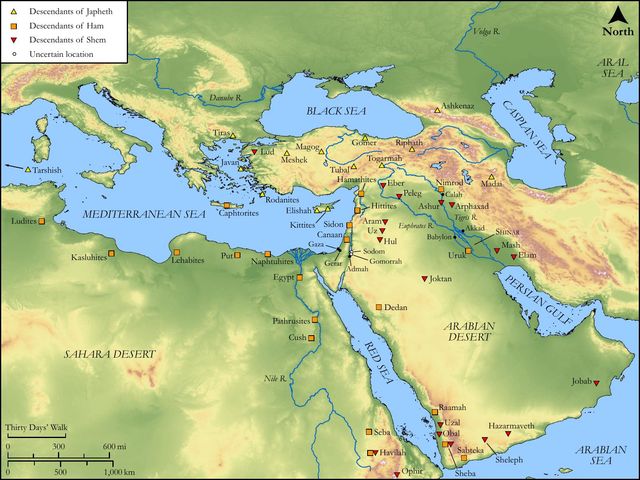
See on the biblical-era maps


Study this verse
Public-domain commentary
Matthew Henry
From his Commentary on the Whole Bible. Henry comments on passages, not single verses — this entry covers Genesis 10:1–5.
Moses begins with Japheth's family, either because he was the eldest, or because his family lay remotest from Israel and had least concern with them at the time when Moses wrote, and therefore he mentions that race very briefly, hastening to give an account of the posterity of Ham, who were Israel's enemies and of Shem, who were Israel's ancestors; for it is the church that the scripture is designed to be the history of, and of the nations of the world only as they were some way or other related to Israel and interested in the affairs of Israel. Observe, 1. Notice is taken that the sons of Noah had sons born to them after the flood, to repair and rebuild the world of mankind which the flood had ruined. He that had killed now makes alive. 2. The posterity of Japheth were allotted to the isles of the Gentiles (Gen 10:5), which were solemnly, by lot, after a survey, divided among them, and probably this island of ours among the rest; all places beyond the sea from Judea are called isles (Jer 25:22), and this directs us to understand that promise (Isa 42:4), the isles shall wait for his law, of the conversion of the Gentiles to the faith of Christ.
Historical interpretation
Three Centuries of Reception
2 surviving comments on this verse. Each one is dated, so this reads as a timeline rather than a list.
Select a marker to jump to its quote. Markers stagger vertically where authors wrote within a few decades of each other.
(Verse 3) The sons of Gomer are Ashkenaz, Riphath, and Togarmah. The Greeks call Ashkenaz 'Reginos', Riphath is the ancestor of the Paphlagonians, and Togarmah is the ancestor of the Phrygians.
Furthermore, the sons of Gomer: Ashkenaz, Riphath, and Togarmah. Ashkenaz are the Sarmatians whom the Greeks call the Medes. Riphath the Paphlagonians, Togarmah the Phrygians.
Continue studying Genesis 10:3 across the web’s major study libraries — every link below opens this exact verse, chapter, or book on the destination site.
Read & Compare
 BibleGatewayThis verse in more than 200 translations and 70 languages.
 Bible.comThe YouVersion reader — hundreds of translations, reading plans, and highlights.
 ESV.orgCrossway's official English Standard Version reader.
 NET BibleThe NET translation with 60,000+ translators' notes on every rendering decision.
 STEP BibleTyndale House's free study tool — original text, vocabulary, and scholarly resources.
 BibliaLogos Bible Software's free web reader.
 USCCBThe New American Bible (Revised Edition) with the U.S. bishops' study notes.
Commentaries
 BibleHub CommentariesDozens of classic commentaries on this verse, gathered on one page.
 StudyLightMore than 100 commentary sets — the largest collection on the web.
 BibleRefPlain-English commentary on what this verse means, verse by verse.
 Enduring WordDavid Guzik's free commentary on this chapter, widely used by Bible teachers.
 Bible Study ToolsVerse commentary alongside Greek and Hebrew study aids.
Original Language & Research
- BibleHub InterlinearThe verse word by word — original language, transliteration, and English.
- BibleHub LexiconEvery word's original-language definition and Strong's entry.
 Blue Letter BibleDeep-study tools — Strong's numbers, concordance, and word studies.
 SefariaThe Hebrew text with Rashi and centuries of Jewish commentary.
Sermons, Hymns & Audio


TrulyRandomVerse is not affiliated with these sites and doesn’t control their content. They’re linked because they’re genuinely useful.
Summary
Genesis 10:3, a concise yet profound verse within the "Table of Nations," meticulously lists Ashkenaz, Riphath, and Togarmah as the three sons of Gomer, a descendant of Japheth. This enumeration serves as a foundational genealogical record, tracing the early dispersion of humanity after the Great Flood and identifying the progenitors of significant ancient peoples and regions, particularly those associated with Anatolia and the Pontic Steppe. The verse underscores God's sovereign orchestration in establishing diverse nations and provides a historical bedrock for subsequent biblical narratives and prophecies.
Context
ShowHideLiterary Context
Genesis 10, famously known as the "Table of Nations," functions as a pivotal genealogical bridge between the universal judgment of the Great Flood in Genesis 6-9 and the specific call of Abraham in Genesis 12. It systematically details the descendants of Noah's three sons—Shem, Ham, and Japheth—thereby charting the initial repopulation and dispersion of the earth. This chapter is unique in its comprehensive scope, providing a global ethnographic survey from a biblical perspective. Genesis 10:3 specifically narrows the focus to a branch of Japheth's lineage, following the introduction of Japheth's sons in Genesis 10:2. This precise listing of Gomer's sons continues the narrative's meticulous record-keeping, laying the groundwork for understanding the origins of various peoples who would later interact with Israel.
Historical & Cultural Context
The "Table of Nations" reflects Israel's understanding of ethnography and geography, mapping out the known world from the perspective of the biblical authors. The peoples mentioned, including the descendants of Gomer, correspond to historical groups that inhabited regions relevant to the ancient Israelites. Gomer is widely identified with the Cimmerians, an Indo-European people known for their migrations and military activities in Anatolia and on the borders of Assyria during the 8th-7th centuries BC. Ashkenaz and Togarmah are similarly linked to historically identifiable groups in or near Anatolia and the Caucasus. This context highlights the Bible's grounding in real-world history and geography, presenting a divinely ordered account of human settlement. The meticulous nature of these genealogies was culturally significant, establishing lineage, identity, and claims to territory in Israel.
Key Themes
ShowHideGenesis 10:3 contributes to several overarching themes within Genesis and the broader biblical narrative. Firstly, it reinforces the theme of divine blessing and the fulfillment of the creation mandate given in Genesis 1:28 and reiterated to Noah in Genesis 9:1. The proliferation of Noah's descendants demonstrates God's ongoing work in creation and His faithfulness to His commands. Secondly, the verse, as part of the Table of Nations, profoundly speaks to the unity and diversity of humanity. All peoples, despite their vast cultural and linguistic differences, trace their lineage back to a common ancestor, Noah, and ultimately to Adam. This foundational truth undergirds the biblical understanding of universal human dignity and the potential for a unified, albeit diverse, humanity. Lastly, it establishes a historical and geographical framework for future redemptive history, identifying nations that will play roles in Israel's story and in later biblical prophecies, such as those found in Ezekiel 38.
Exposition and Analysis
ShowHideKey Word Analysis
ShowHideThis term (H1121) is derived from a root meaning "to build" (בָּנָה), signifying a son as a "builder of the family name." In its broadest sense, it encompasses literal and figurative relationships, including grandsons, subjects, nations, or even qualities. In Genesis 10:3, it specifically denotes direct male offspring, emphasizing the continuation of a lineage and the establishment of new family branches that would grow into distinct people groups.
Derived from a root meaning "completion," Gomer is the name of a son of Japheth and, by extension, his descendants. This name is widely associated with the Cimmerians, an ancient Indo-European people. The etymological connection to "completion" might subtly hint at the fulfillment of God's command for humanity to spread and fill the earth, as Gomer's lineage represents a significant branch of this early dispersion.
Likely of foreign derivation, Togarmah is identified as a son of Gomer and his posterity. This name is frequently linked to Til-Garimmu, an ancient city-state in eastern Anatolia, known for its trade in horses and mules. Its inclusion here highlights the specific geographical and ethnic associations of Gomer's lineage, providing concrete historical anchors for the biblical narrative.
Verse Breakdown
ShowHide"And the sons of Gomer;"
This initial clause establishes the direct paternal lineage, identifying Gomer as the father of the subsequent names. It signals a shift in focus within the broader Japhethite genealogy, narrowing the scope to a specific branch. The use of "sons" (bên) here emphasizes the generational continuity and the foundational role of these individuals in the formation of distinct people groups.
"Ashkenaz, and Riphath, and Togarmah."
This clause provides the specific enumeration of Gomer's three male descendants. Each name represents a distinct ancient people group or region that would emerge from this lineage. Ashkenaz is often linked to the Scythians or related groups in the region of ancient Armenia. Riphath's identification is less certain but points to a people in northern Anatolia or the Carpathian mountains. Togarmah is strongly associated with Til-Garimmu in eastern Anatolia. This precise listing underscores the biblical narrative's detailed historical and geographical claims, presenting a foundational record of human diversification and settlement.
Literary Devices
ShowHideGenesis 10:3, as part of the "Table of Nations," primarily employs Genealogy and Enumeration. The systematic listing of names and their familial relationships serves to trace the lineage of humanity from Noah, establishing a comprehensive family tree. This Enumeration is not merely a dry list but functions as a historical and ethnographic record, mapping out the known world through its inhabitants. The chapter also utilizes Historical-Geographical Referencing, as the names of Gomer's sons are widely understood to correspond to actual ancient peoples and regions (e.g., Cimmerians, Scythians, Til-Garimmu). This grounding in identifiable historical entities lends credibility to the biblical account and demonstrates its engagement with the real world. The concise, declarative style of the verse, typical of genealogical records, also serves to convey authority and factual precision.
Theological and Thematic Connections
ShowHideGenesis 10:3, nestled within the "Table of Nations," profoundly illustrates the biblical truth of humanity's common origin and subsequent diversification under divine providence. It affirms that all peoples, regardless of their geographical location or cultural distinctives, trace their lineage back to Noah's family, and ultimately to Adam. This foundational unity underscores the inherent dignity of every human being and provides the theological basis for a universal understanding of God's redemptive plan. The meticulous detailing of these lineages highlights God's sovereign hand in shaping human history, orchestrating the spread of nations not by chance, but according to His purposeful design. This divine ordering of the nations also lays the groundwork for future interactions between Israel and these emerging peoples, many of whom would play significant roles in the unfolding drama of redemptive history.
Reflection and Application
ShowHideGenesis 10:3, though seemingly a simple list of names, invites profound reflection on our shared humanity and God's expansive plan. It reminds us that every person, from every tribe and nation, belongs to the same human family, originating from a common ancestor. This truth should dismantle any inclination towards ethnocentrism or racial prejudice, fostering a deep respect for the intrinsic worth of all individuals, created in God's image. Recognizing this common heritage compels us to embrace diversity as a beautiful expression of God's creative design, rather than a source of division. Furthermore, understanding God's sovereign hand in the dispersion of nations encourages a global perspective on mission. If God meticulously ordered the spread of peoples, then surely He cares for each one, and His call to salvation extends to "every tongue, tribe, people, and nation" (Revelation 7:9). This verse challenges us to participate in God's global redemptive work, sharing the good news of Christ with all, recognizing them as fellow heirs of humanity and potential co-heirs in Christ.
Questions for Reflection
ShowHideFAQ
ShowHideWhy does the Bible meticulously list these ancient peoples, and what is their significance beyond mere genealogy?
ShowHideThe detailed genealogies, particularly the "Table of Nations" in Genesis 10, serve several crucial purposes beyond simply tracing lineage. Firstly, they establish the historical and geographical context for the unfolding biblical narrative, demonstrating the fulfillment of God's command to Noah to "be fruitful and multiply, and fill the earth" (Genesis 9:1). Secondly, they provide a common ancestry for all humanity, emphasizing the inherent unity of humankind despite its vast diversity, laying the theological groundwork for universal human dignity. Thirdly, these lists are not exhaustive but selective, highlighting nations that would later interact with Israel, often appearing in prophetic contexts (e.g., Togarmah in Ezekiel 38:6). This meticulous record underscores God's sovereign hand in shaping human history and the spread of peoples, demonstrating His purposeful design in the world.
Christ-Centered Fulfillment
ShowHideWhile Genesis 10:3 primarily details the physical dispersion of nations, it implicitly points towards the universal scope of God's redemptive plan, ultimately fulfilled in Jesus Christ. The diversity of peoples stemming from Noah's sons sets the stage for a salvation that transcends ethnic and national boundaries. The divisions among nations, which became more pronounced after the incident at Babel (narrated in Genesis 11), are ultimately overcome in Christ. The Gospel, commissioned to be preached to "all nations" (Matthew 28:19), directly addresses the descendants of these very peoples, gathering a new spiritual family from "every tribe and language and people and nation" (Revelation 5:9) into one body. Christ's atoning work on the cross breaks down the "dividing wall of hostility" (Ephesians 2:14) between peoples, fulfilling God's ancient promise to Abraham that through his seed, "all the families of the earth shall be blessed" (Genesis 12:3). Thus, the genealogical record of Genesis 10:3, by charting humanity's origins, foreshadows the glorious reality of a unified, redeemed humanity in Christ.