


Numbers 24:11
Bible text: King James Version (1769 Blayney text) · Public domain
Bible text: Berean Standard Bible · Public domain
Bible text: American Standard Version (1901) · Public domain
Bible text: World English Bible, Messianic edition · Public domain
Bible text: Geneva Bible (1599) · Public domain
Bible text: Young's Literal Translation · Public domain
- וְעַתָּהve·'a·Tahand thereforeH6258Conj-w ¦ AdvAdverbוְandעַתָּהtherefore
- בְּרַחbe·rachfleeH1272V-Qal-Imp-2msVerb Qal Imperative 2nd Singular Masculine
- לְךָle·Khafor <the> yourselfPrep-l ¦ 2msSuffix Personal 2nd Singular Masculineלְfor <the>ךָyourself
- אֶל'eltoH413PrepPreposition
- מְקוֹמֶךָme·ko·Me·chayour placeH4725N-msc ¦ 2msNoun Singular Masculine Constructמְקוֹמֶplaceךָyour
- אָמַרְתִּי'a·Mar·tiI saidH559V-Qal-Perf-1csVerb Qal Perfect 1st Singular common gender
- כַּבֵּדka·Bedsurely <honor>H3513V-Piel-InfVerb Piel Infinitive Construct
- אֲכַבֶּדְךָ'a·kha·bed·KhaI will honor youH3513V-Piel-Imperf-1cs ¦ 2msVerb Piel Imperfect 1st Singular common genderאֲכַבֶּדְI will honorךָyou
- וְהִנֵּהve·hi·Nehand here!H2009Conj-w ¦ PrtParticle Interjectionוְandהִנֵּהhere!
- מְנָעֲךָme·na·'a·Khahe has withheld youH4513V-Qal-Perf-3ms ¦ 2msVerb Qal Perfect 3rd Singular Masculineמְנָעֲhe has withheldךָyou
- יְהוָהYah·wehYahwehH3068N-properNoun Proper Title
- מִכָּבוֹדmi·ka·Vodfrom honorH3519Prep-m ¦ N-msNoun Singular Masculine Absoluteמִfromכָּבוֹדhonor
English is a literal word-by-word gloss of the Hebrew, not the KJV's wording. Why?
This is the original text the KJV's translators worked from — each Hebrew word with its own literal English meaning in this verse, prepared by scholars at Tyndale House, Cambridge. The KJV translates whole sentences, not word by word, so its wording differs: one Hebrew word can become several English words, and the KJV may choose “the LORD” where the gloss reads “Yahweh”. Both are faithful — they answer different questions. For the KJV's own rendering, switch to the KJV text.
Details
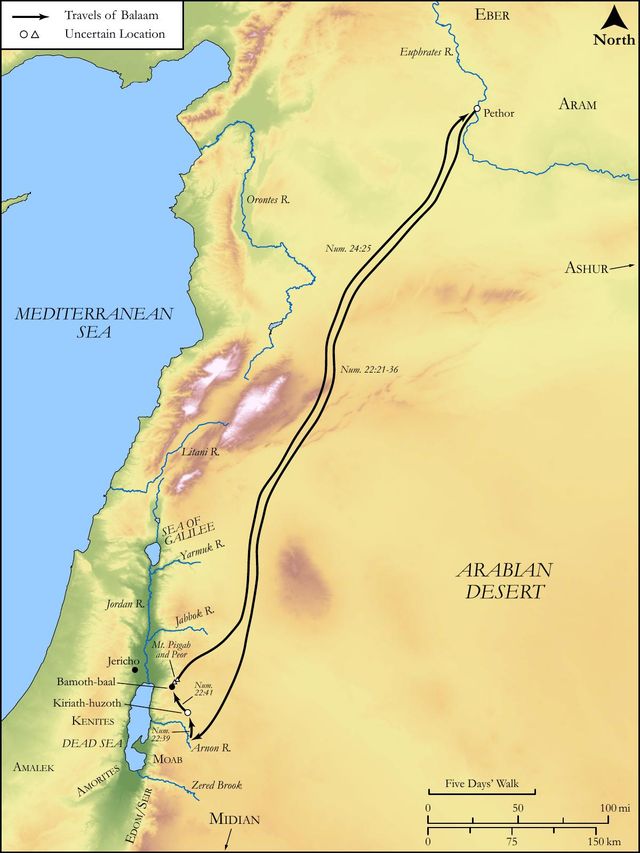
See on the biblical-era map
Study this verse
Public-domain commentary
Matthew Henry
From his Commentary on the Whole Bible. Henry comments on passages, not single verses — this entry covers Numbers 24:10–14.
We have here the conclusion of this vain attempt to curse Israel, and the total abandonment of it. 1. Balak made the worst of it. He broke out into a rage against Balaam (Num 24:10), expressed both in words and gesture the highest degree of vexation at the disappointment; he smote his hands together, for indignation, to see all his measures thus broken, and his project baffled. He charged Balaam with putting upon him the basest affront and cheat imaginable: "I called thee to curse my enemies, and thou hast shown thyself in league with them, and in their interests, for thou hast blessed them these three times, though, by appointing the altars to be built and sacrifices to be offered, thou madest be believe thou wouldest certainly curse them." Hereupon he forbade him his presence, expelled him his country, upbraided him with the preferments he had designed to bestow upon him, but now would not (Num 24:11): "The Lord hath kept thee back from honour. See what thou gettest by pleasing the Lord, instead of pleasing me; thou has hindered thy preferment by it." Thus those who are any way losers by their duty are commonly upbraided with it, as fools, for preferring it before their interest in the world. Whereas, if Balaam had been voluntary and sincere in his adherence to the word of the Lord, though he lost the honour Balak designed him by it, God would have made that loss up to him abundantly to his advantage. 2. Balaam made the best if it. (1.) He endeavours to excuse the disappointment. And a very good excuse he has for it, that God restrained him from saying what he would have said, and constrained him to say what he would not; and that this was what Balak ought not to be displeased at, not only because he could not help it, but because he had told Balak before what he must depend upon, Num 24:12, Num 24:13. Balak could not say that he had cheated him, since he had given him fair notice of the check he found himself under. (2.) He endeavours to atone for it, Num 24:14. Though he cannot do what Balak would have him do, yet, [1.] He will gratify his curiosity with some predictions concerning the nations about him. It is natural to us to be pleased with prophecy, and with this he hopes to pacify the angry prince. [2.] He will satisfy him with an assurance that, whatever this formidable people should do to his people, it should not be till the latter days; so that he, for his part, needed not to fear any mischief or molestation from them; the vision was for a great while to come, but in his days there should be peace. [3.] He will put him into a method of doing Israel a mischief without the ceremonies of enchantment and execration. This seems to be implied in that word: I will advertise thee; for it properly signifies, I will counsel thee. What the counsel was is not set down here, because it was given privately, but we are told afterwards what it was, Num 31:16. He counselled him to entice the Israelites to idolatry, Rev 2:14. Since he could not have leave from God to curse them, he puts him in a way of getting help from the devil to tempt them. Flectere si nequeo superos, Acheronta movebo - If I cannot move heaven, I will solicit hell.
Continue studying Numbers 24:11 across the web’s major study libraries — every link below opens this exact verse, chapter, or book on the destination site.
Read & Compare
 BibleGatewayThis verse in more than 200 translations and 70 languages.
 Bible.comThe YouVersion reader — hundreds of translations, reading plans, and highlights.
 ESV.orgCrossway's official English Standard Version reader.
 NET BibleThe NET translation with 60,000+ translators' notes on every rendering decision.
 STEP BibleTyndale House's free study tool — original text, vocabulary, and scholarly resources.
 BibliaLogos Bible Software's free web reader.
 USCCBThe New American Bible (Revised Edition) with the U.S. bishops' study notes.
Commentaries
 BibleHub CommentariesDozens of classic commentaries on this verse, gathered on one page.
 StudyLightMore than 100 commentary sets — the largest collection on the web.
 BibleRefPlain-English commentary on what this verse means, verse by verse.
 Enduring WordDavid Guzik's free commentary on this chapter, widely used by Bible teachers.
 Bible Study ToolsVerse commentary alongside Greek and Hebrew study aids.
Original Language & Research
- BibleHub InterlinearThe verse word by word — original language, transliteration, and English.
- BibleHub LexiconEvery word's original-language definition and Strong's entry.
 Blue Letter BibleDeep-study tools — Strong's numbers, concordance, and word studies.
 SefariaThe Hebrew text with Rashi and centuries of Jewish commentary.
Sermons, Hymns & Audio


TrulyRandomVerse is not affiliated with these sites and doesn’t control their content. They’re linked because they’re genuinely useful.
Summary
Numbers 24:11 encapsulates the apex of King Balak's escalating frustration and the undeniable triumph of divine sovereignty over human machinations. Following three failed attempts to coerce Balaam into cursing Israel, Balak vehemently dismisses the diviner, acknowledging with bitter resignation that it was "the LORD" who supernaturally prevented Balaam from receiving the promised honor and substantial rewards. This pivotal verse powerfully underscores God's absolute control over the intentions and outcomes of human endeavors, demonstrating His unwavering commitment to protect His covenant people by turning intended curses into blessings.
Context
ShowHideLiterary Context
Numbers 24:11 is strategically placed at the climax of the extended narrative concerning Balaam, which spans Numbers 22-24. This verse immediately follows Balaam's third divinely compelled oracle, a profound blessing upon Israel (Numbers 24:1-9), which directly contradicted Balak's fervent desire for a curse. Balak had meticulously brought Balaam to three distinct vantage points, hoping a change of location might alter the divine pronouncement, but each time, God sovereignly compelled Balaam to utter blessings. This verse represents Balak's exasperated and final dismissal of Balaam, marking the complete failure of his objective to harm Israel through supernatural means. It serves as a dramatic precursor to Balaam's final, unsolicited prophecy concerning the future of Israel and the messianic "Star out of Jacob" (Numbers 24:15-19), further solidifying the overarching theme of God's unthwartable redemptive plan.
Historical & Cultural Context
The events described in Numbers 24 unfold as the vast Israelite encampment rests on the plains of Moab, poised on the brink of entering the Promised Land (Numbers 22:1). King Balak of Moab, in alliance with the Midianites, perceived the immense Israelite multitude as an existential threat to his kingdom and people. Among the nations of that day, it was a widespread and deeply ingrained practice for kings and nations to engage diviners, sorcerers, or seers to invoke curses upon their adversaries or blessings upon themselves, believing such pronouncements held tangible spiritual power and could influence the course of battles and destinies. Balaam, originating from Pethor in Mesopotamia, was widely renowned for his potent ability to either bless or curse, as explicitly stated by Balak himself (Numbers 22:6). Balak's repeated promise of "great honour" (Numbers 22:17) refers to the substantial financial emoluments, elevated prestige, and significant political favor he intended to lavish upon Balaam for successfully cursing Israel. The prevailing cultural expectation was that a powerful diviner could manipulate spiritual forces to achieve desired outcomes; however, this narrative powerfully subverts that expectation by unequivocally demonstrating the God of Israel's absolute supremacy over all human and spiritual powers, including those of pagan diviners.
Key Themes
ShowHideThis verse profoundly contributes to several overarching theological themes woven throughout the book of Numbers and the broader biblical narrative. Foremost among these is the theme of Divine Sovereignty, which is emphatically demonstrated as God's will proves utterly unthwartable by human schemes, political maneuvering, or even pagan spiritual practices. Balak's frustrated outburst, though begrudging, implicitly acknowledges that it was "the LORD" who directly intervened, not Balaam's lack of skill or desire, powerfully underscoring the truth that "Many are the plans in a person's heart, but it is the LORD's purpose that prevails." Secondly, the verse highlights God's Unwavering Protection of His Covenant People. Despite Balak's persistent and elaborate efforts to inflict harm upon Israel, God meticulously turned every intended curse into a blessing, thereby faithfully fulfilling His ancient covenant promises to Abraham, Isaac, and Jacob. This divine intervention is explicitly affirmed elsewhere in Scripture, as in Deuteronomy 23:5, which recounts how "the LORD your God turned the curse into a blessing for you, because the LORD your God loved you." Finally, Numbers 24:11 vividly illustrates the Futility of Opposing God's Plan. Balak's palpable anger and his unceremonious dismissal of Balaam underscore the complete and utter failure of any attempt to work against the divine will, reinforcing the biblical truth that "The LORD brings the counsel of the nations to nothing; he frustrates the plans of the peoples" (Psalm 33:10).
Exposition and Analysis
ShowHideKey Word Analysis
ShowHideThis primitive root verb (H1272) carries a strong sense of urgency and rapid movement, typically implying an escape or flight from danger, an undesirable situation, or an immediate departure. In this context, it is an imperative command issued by Balak, signifying his utter exasperation and his demand for Balaam to depart immediately and permanently. It conveys a complete and angry severance of their professional relationship, driven by Balak's intense disappointment and frustration.
Derived from the root H3513, this noun (H3519) properly signifies "weight," but is used figuratively in a positive sense to denote splendor, glory, dignity, reputation, and often, in a material sense, wealth and copiousness. Here, it specifically refers to the substantial financial rewards, elevated prestige, and political favor that Balak had repeatedly promised Balaam (Numbers 22:17). The repetition of the word "honour" in the verse emphasizes both what Balaam eagerly anticipated and what was ultimately and divinely withheld.
This primitive root verb (H4513) means "to debar," "to withhold," "to restrain," "to keep back," or "to prevent." Its usage in this verse is critically important because it directly attributes Balaam's failure to receive the promised "honour" not to his own inability, lack of effort, or choice, but to a direct, sovereign, and active intervention by "the LORD." It highlights divine action as the sole and active agent in frustrating Balak's plans and Balaam's aspirations for worldly gain.
Verse Breakdown
ShowHide"Therefore now flee thou to thy place:"
This opening clause represents Balak's furious, immediate, and definitive dismissal of Balaam. The conjunction "Therefore" directly links this command to Balaam's preceding, unwelcome third blessing upon Israel. Balak, having exhausted all his options and his patience, commands Balaam to return to his homeland, signaling the abrupt and unceremonious termination of their arrangement and Balak's profound disappointment. It is a harsh and final severance.
"I thought to promote thee unto great honour;"
In this clause, Balak articulates his original intention and the lavish promises he had extended to Balaam. He pointedly reminds Balaam of the significant rewards—including wealth, prestige, and elevated status—that were explicitly offered. This phrase serves to highlight the stark and bitter contrast between Balak's generous expectations and the current, unfulfilled reality, thereby underscoring the immense depth of his frustration and anger.
"but, lo, the LORD hath kept thee back from honour."
This final clause constitutes the theological and narrative crux of the verse. The interjection "lo" (or "behold") serves to draw immediate attention to a surprising, significant, or grudging revelation. Balak, a pagan king, is compelled to acknowledge the direct and sovereign intervention of "the LORD" (Yahweh, the covenant God of Israel) as the sole and decisive reason Balaam did not receive the promised rewards. This is a reluctant, yet undeniable, confession of God's supreme power and His absolute control over all events, even those meticulously orchestrated by powerful human figures. It was not chance, nor Balaam's will, but God's deliberate and active intervention that prevented Balaam from attaining the "honour" he sought.
Literary Devices
ShowHideNumbers 24:11 is replete with several potent literary devices that amplify its theological and narrative impact. Irony is profoundly prominent, as Balak, who meticulously hired Balaam with the explicit purpose of cursing Israel, is ultimately forced to acknowledge that the very God he sought to oppose is the one who decisively prevented his plan's success and Balaam's promised reward. The entire narrative of Balaam serves as a masterful study in situational irony, where human intent and elaborate schemes are consistently and dramatically overturned by divine will. There is also an element of Anthropomorphism in the phrase "the LORD hath kept thee back," which attributes a human-like action (restraining, withholding, preventing) to God, thereby emphasizing His active, personal, and direct engagement in human affairs. The powerful Repetition of the word "honour" underscores the central conflict of the verse: Balak's fervent desire to bestow it versus God's sovereign and unyielding decision to withhold it. Finally, the verse functions as a subtle yet significant form of Foreshadowing, hinting at the broader biblical theme that no power, whether human or spiritual, can ultimately thwart God's immutable plans for His chosen people, a theme that finds its ultimate and glorious fulfillment in the person and work of Jesus Christ.
Theological and Thematic Connections
ShowHideNumbers 24:11 stands as an enduring and powerful testament to the absolute sovereignty of God, demonstrating His unassailable control over all circumstances, including the deepest intentions and most elaborate actions of those who actively oppose Him. It underscores the profound futility of human efforts to thwart divine purposes and unequivocally highlights God's unwavering faithfulness to His covenant promises. This verse reveals that God is not merely a passive observer of history but an active, decisive participant, meticulously orchestrating events to ensure the ultimate well-being, protection, and blessing of His people. The "honour" that was deliberately withheld from Balaam by divine decree serves as a stark and potent reminder that true and lasting honor, along with genuine blessing, emanates from God alone, not from fleeting worldly gain, human recognition, or the accumulation of material wealth.
Reflection and Application
ShowHideNumbers 24:11 offers profoundly rich and enduring lessons for believers in every age, primarily reinforcing the foundational and comforting truth of God's ultimate and unshakeable control. In a world often characterized by pervasive chaos, profound uncertainty, and seemingly overwhelming opposition, this verse provides immense spiritual comfort and a compelling call to radical trust in divine providence. It serves as a powerful reminder that no human scheme, no political maneuver, no spiritual attack, no matter how formidable or cunningly devised, can ultimately thwart God's sovereign and good will for His people. We are invited to rest securely in the assurance that even when our own meticulously laid plans are frustrated, or when we encounter what appear to be insurmountable obstacles, God is actively at work, often behind the scenes, meticulously turning what was intended for harm into ultimate good. This profound truth should lead us to cultivate a posture of deep humility, recognizing that our "honour" and perceived success are ultimately held securely in God's hands. It should also foster a spirit of profound contentment, knowing that His withholding of certain things is often His divine protection or a loving redirection towards a greater, more glorious, and eternally significant divine purpose.
Questions for Reflection
ShowHideFAQ
ShowHideWhy did Balak, a pagan king, acknowledge "the LORD" (Yahweh) instead of his own gods?
ShowHideBalak's acknowledgment of "the LORD" (Yahweh) in Numbers 24:11 is best understood as a grudging, forced confession rather than a genuine conversion or act of worship. Throughout the entire narrative, Balaam consistently refers to the God of Israel as "the LORD" (Yahweh) and repeatedly emphasizes that he can only speak precisely what the LORD puts into his mouth (e.g., Numbers 22:18). Balaam's divinely compelled blessings, which directly and powerfully contradicted Balak's fervent desires, demonstrated a supernatural power far superior to any deity Balak worshipped within his pagan pantheon. Balak, witnessing this undeniable and repeated divine intervention, was compelled by the sheer force of circumstances to recognize the supreme authority and unchallengeable power of Israel's God, even if his recognition was steeped in profound frustration and anger. It was an acknowledgment of overwhelming power, not necessarily an embrace of worship or allegiance.
Did Balaam truly want to curse Israel, or was he merely a passive instrument of God?
ShowHideBalaam's motivations were complex and deeply conflicted. While he was indeed a passive instrument when God directly put words into his mouth, compelling him to utter blessings, his underlying desires and actions reveal a heart inclined towards personal gain. His initial eagerness to accompany Balak's envoys despite God's initial prohibition (Numbers 22:7), his repeated attempts to find a way to curse Israel even after God's clear commands (Numbers 22:19), and especially his later insidious counsel to Balak to entice Israel into idolatry and immorality (Numbers 31:16; Revelation 2:14) strongly suggest that he coveted the "honour" and substantial rewards offered by Balak. His will was constrained by God's sovereign power to speak only blessings, but his underlying character and true desires for worldly profit were ultimately revealed in his subsequent and destructive actions against God's people.
Christ-Centered Fulfillment
ShowHideThe profound divine sovereignty so powerfully displayed in Numbers 24:11, where God miraculously turns an intended curse into an undeniable blessing and utterly frustrates the malevolent plans of His adversaries, finds its ultimate, most profound, and glorious fulfillment in the person and work of Jesus Christ. The very scheme orchestrated by fallen humanity and the dark forces of evil to "curse" God's people through sin and the finality of death was utterly subverted and transformed by God's magnificent plan of redemption. The crucifixion of Jesus, meticulously intended by His enemies as the ultimate defeat, public shame, and a final curse, was precisely the divinely ordained means by which God accomplished the greatest blessing for all humanity—salvation, reconciliation, and eternal life. As Peter boldly declared on the day of Pentecost, Jesus was "delivered up according to the definite plan and foreknowledge of God" (Acts 2:23), thereby turning the ultimate act of human rebellion and injustice into the ultimate expression of divine love and grace. Christ is the true "Star out of Jacob" and the mighty "Scepter out of Israel" prophesied by Balaam (Numbers 24:17), who has come to crush the enemies of God and establish an eternal, unshakable kingdom. He is the Lamb of God, who takes away the sin of the world!, transforming the curse of the law into the boundless blessing of grace and righteousness for all who believe. Through Him, the fleeting earthly "honour" that was withheld from Balaam is replaced by an eternal, spiritual "honour" and immeasurable blessing that is freely bestowed upon all who place their faith in Him, for we are truly "blessed in Christ with every spiritual blessing in the heavenly places" (Ephesians 1:3). God's protective hand over ancient Israel in the wilderness powerfully prefigures His ultimate, unwavering protection and abundant blessing for His church, the new Israel, secured eternally through the finished, redemptive work of Christ.