


Numbers 22:17
Bible text: King James Version (1769 Blayney text) · Public domain
Bible text: Berean Standard Bible · Public domain
Bible text: American Standard Version (1901) · Public domain
Bible text: World English Bible, Messianic edition · Public domain
Bible text: Geneva Bible (1599) · Public domain
Bible text: Young's Literal Translation · Public domain
- כִּיkiforH3588PrtParticle Conditional
- כַבֵּדkha·Bedsurely <honor>H3513V-Piel-InfVerb Piel Infinitive Construct
- אֲכַבֶּדְךָ'a·kha·bed·KhaI will honor youH3513V-Piel-Imperf-1cs ¦ 2msVerb Piel Imperfect 1st Singular common genderאֲכַבֶּדְI will honorךָyou
- מְאֹדme·'OdexceedinglyH3966Adj-msAdjective Numerical Singular Masculine Absolute
- וְכֹלve·Kholand allH3605Conj-w ¦ N-msNoun Singular Masculine Absoluteוְandכֹלall
- אֲשֶׁר'a·SherthatH834RelParticle Relative
- תֹּאמַרto·Maryou will sayH559V-Qal-Imperf-2msVerb Qal Imperfect 2nd Singular Masculine
- אֵלַי'e·Laito meH413Prep ¦ 1csPreposition Definiteאֵלַtoיme
- אֶעֱשֶׂה'e·'e·SehI will doH6213V-Qal-Imperf-1csVerb Qal Imperfect 1st Singular common gender
- וּלְכָהu·le·khahand come !H1980Conj-w ¦ V-Qal-Imp-2ms ¦ SfxVerb Qal Imperative 2nd Singular Masculineוּandלְכָcomeה!
- נָּאna'pleaseH4994PrtParticle Interjection
- קָבָהka·vahcurse !H6895V-Qal-Imp-2ms ¦ SfxVerb Qal Imperative 2nd Singular Masculineקָבָcurseה!
- לִּיLifor <the> mePrep-l ¦ 1csSuffix Personal 1st Singular common genderלִּfor <the>יme
- אֵת'et<obj.>H853DirObjMParticle Object Indicator
- הָעָםha·'Amthe peopleH5971Art ¦ N-msNoun Singular Masculine Absoluteהָtheעָםpeople
- הַזֶּהha·Zeh<the> thisH2088Art ¦ PrtParticle Demonstrativeהַ<the>זֶּהthis
English is a literal word-by-word gloss of the Hebrew, not the KJV's wording. Why?
This is the original text the KJV's translators worked from — each Hebrew word with its own literal English meaning in this verse, prepared by scholars at Tyndale House, Cambridge. The KJV translates whole sentences, not word by word, so its wording differs: one Hebrew word can become several English words, and the KJV may choose “the LORD” where the gloss reads “Yahweh”. Both are faithful — they answer different questions. For the KJV's own rendering, switch to the KJV text.
Details
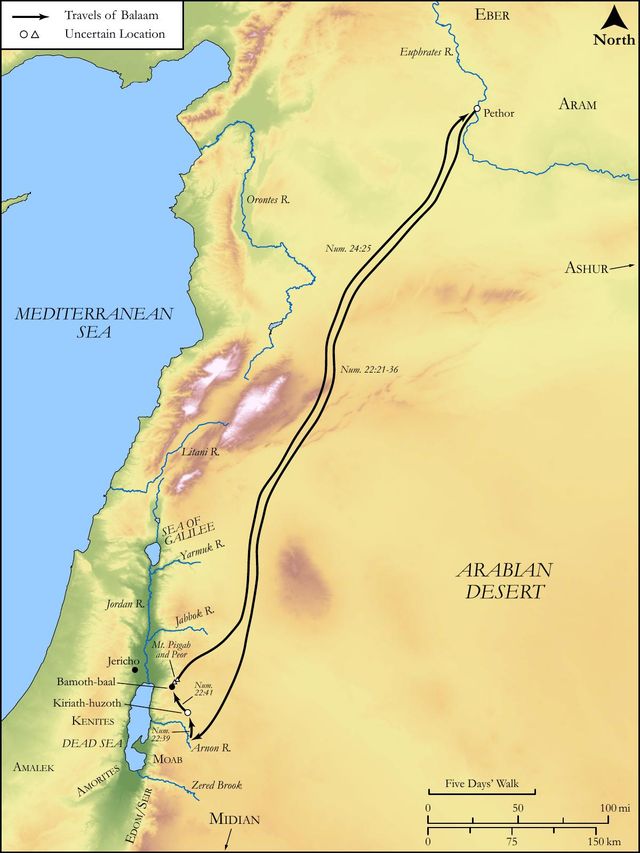
See on the biblical-era map
Study this verse
Public-domain commentary
Matthew Henry
From his Commentary on the Whole Bible. Henry comments on passages, not single verses — this entry covers Numbers 22:15–21. His two-level outline is real structure in the source text, so it is rendered as structure.
We have here a second embassy sent to Balaam, to fetch him over to curse Israel. It were well for us if we were as earnest and constant in prosecuting a good work, notwithstanding disappointments, as Balak was in pursuing this ill design. The enemies of the church are restless and unwearied in their attempts against it; but he that sits in heaven laughs at them. Observe,
I.The temptation Balak laid before Balaam.
He contrived to make this assault more vigorous than the former. It is very probable that he sent double money in the hands of his messengers; but, besides that, now he tempted him with honours, laid a bait not only for his covetousness, but for his pride and ambition. How earnestly should we beg of God daily to mortify in us these two limbs of the old man! Those that know how to look with a holy contempt upon worldly wealth and preferment will find it not so hard a matter as most men do to keep a good conscience. See how artfully Balak managed the temptation.
1.The messengers he sent were more, and more honourable, Num 22:15. He sent to this conjurer with as great respect and deference to his quality as if he had been a sovereign prince, apprehending perhaps that Balaam had thought himself slighted in the fewness and meanness of the former messengers.
2.The request was very urgent. This powerful prince becomes a suitor to him: "Let nothing, I pray thee, hinder thee (Num 22:16), no, not God, nor conscience, nor any fear either of sin or shame." 3. The proffers were high: "I will promote thee to very great honour among the princes of Moab;" nay, he gives him a blank, and he shall write his own terms: I will do whatsoever thou sayest, that is, "I will give thee whatever thou desirest, and observe whatever thou orderest; thy word shall be a law to me," Num 22:17. Thus sinners stick at no pains, spare no cost, and care not how low they stoop, for the gratifying either of their luxury or of their malice; shall we then be stiff and strait-handed in our compliance with the laws of virtue? God forbid.
II.Balaam's seeming resistance of, but real yielding to, this temptation.
We may here discern in Balaam a struggle between his convictions and his corruptions.
1.His convictions charged him to adhere to the command of God, and he spoke their language, Num 22:18. Nor could any man have said better: "If Balak would give me his house full of silver and gold, and that is more than he can give or I can ask, I cannot go beyond the word of the Lord my God." See how honourably he speaks of God; he is Jehovah, my God. Note, Many call God theirs that are not his, not truly because not only his; they swear by the Lord, and by Malcham. See how respectfully he speaks of the word of God, as one resolved to stick to it, and in nothing to vary from it, and how slightly of the wealth of this world, as if gold and silver were nothing to him in comparison with the favour of God; and yet, at the same time, the searcher of hearts knew that he loved the wages of unrighteousness. Note, It is an easy thing for bad men to speak very good words, and with their mouth to make a show of piety. There is no judging of men by their words. God knows the heart.
2.His corruptions at the same time strongly inclined him to go contrary to the command. He seemed to refuse the temptation, Num 22:18. But even then he expressed no abhorrence of it, as Christ did when he had the kingdoms of the world offered him (Get thee hence Satan), and as Peter did when Simon Magus offered him money: Thy money perish with thee. But it appears (Num 22:19) that he had a strong inclination to accept the proffer; for he would further attend, to know what God would say to him, hoping that he might alter his mind and give him leave to go. This was a vile reflection upon God Almighty, as if he could change his mind, and now at last suffer those to be cursed whom he had pronounced blessed, and as if he would be brought to allow what he had already declared to be evil. Surely he thought God altogether such a one as himself. He had already been told what the will of God was, in which he ought to have acquiesced, and not to have desired a re-hearing of that cause which was already so plainly determined. Note, It is a very great affront to God, and a certain evidence of the dominion of corruption in the heart, to beg leave to sin.
III.The permission God gave him to go, Num 22:20.
God came to him, probably by an anger, and told him he might, if he pleased, go with Balak's messengers. So he gave him up to his own heart's lust. "Since thou hast such a mind to go, even go, yet know that the journey thou undertakest shall not be for thy honour; for, though thou hast leave to go, thou shalt not, as thou hopest, have leave to curse, for the word which I shall say unto thee, that thou shalt do." Note, God has wicked men in a chain; hitherto they shall come by his permission, but no further that he does permit them. Thus he makes the wrath of man to praise him, yet, at the same time, restrains the remainder of it. It was in anger that God said to Balaam, "Go with them," and we have reason to think that Balaam himself so understood it, for we do not find him pleading this allowance when God reproved him for going. Note, As God sometimes denies the prayers of his people in love, so sometimes he grants the desires of the wicked in wrath.
IV.His setting out in the journey, Num 22:21.
God gave him leave to go if the men called him, but he was so fond of the journey that we do not find he staid for their calling him, but he himself rose up in the morning, got every thing ready with all speed, and went with the princes of Moab, who were proud enough that they had carried their point. The apostle describes Balaam's sin here to be that he ran greedily into an error for reward, Jde 1:11. The love of money is the root of all evil.
Historical interpretation
Historical reception
1 surviving comment on this verse from the historical church.
Love of money then is an old and ancient vice, which showed itself even at the declaration of the divine law; for a law was given to check it. On account of love of money Balak thought Balaam could be tempted by rewards to curse the people of our fathers. Love of money would have won the day too, had not God bidden him hold back from cursing.
Continue studying Numbers 22:17 across the web’s major study libraries — every link below opens this exact verse, chapter, or book on the destination site.
Read & Compare
 BibleGatewayThis verse in more than 200 translations and 70 languages.
 Bible.comThe YouVersion reader — hundreds of translations, reading plans, and highlights.
 ESV.orgCrossway's official English Standard Version reader.
 NET BibleThe NET translation with 60,000+ translators' notes on every rendering decision.
 STEP BibleTyndale House's free study tool — original text, vocabulary, and scholarly resources.
 BibliaLogos Bible Software's free web reader.
 USCCBThe New American Bible (Revised Edition) with the U.S. bishops' study notes.
Commentaries
 BibleHub CommentariesDozens of classic commentaries on this verse, gathered on one page.
 StudyLightMore than 100 commentary sets — the largest collection on the web.
 BibleRefPlain-English commentary on what this verse means, verse by verse.
 Enduring WordDavid Guzik's free commentary on this chapter, widely used by Bible teachers.
 Bible Study ToolsVerse commentary alongside Greek and Hebrew study aids.
Original Language & Research
- BibleHub InterlinearThe verse word by word — original language, transliteration, and English.
- BibleHub LexiconEvery word's original-language definition and Strong's entry.
 Blue Letter BibleDeep-study tools — Strong's numbers, concordance, and word studies.
 SefariaThe Hebrew text with Rashi and centuries of Jewish commentary.
Sermons, Hymns & Audio


TrulyRandomVerse is not affiliated with these sites and doesn’t control their content. They’re linked because they’re genuinely useful.
Summary
Numbers 22:17 unveils King Balak's desperate and intensified strategy to manipulate the prophet Balaam, offering him immense honor and complete subservience in exchange for a potent curse against the formidable Israelite nation. This verse powerfully highlights Balak's escalating bribery and his profound fear of Israel's presence on the plains of Moab, thereby setting the dramatic stage for a confrontation between human will, worldly temptation, and unwavering divine sovereignty.
Context
ShowHideLiterary Context
This verse is deeply embedded within the larger narrative of Balak's persistent attempts to secure Balaam's services to curse Israel. Following Israel's decisive victories over the Amorites and Og of Bashan, vividly recounted in Numbers 21:21-35, the Moabites and Midianites are gripped by overwhelming fear. Balak's initial delegation of elders and princes was dispatched, but Balaam, after consulting with God, refused to go, stating unequivocally that the Lord had forbidden him from cursing His people, as detailed in Numbers 22:12. Undeterred and increasingly desperate, Balak sends a second, even more prestigious and numerous delegation, promising unprecedented rewards, which are explicitly laid out in this verse. This dramatic escalation underscores Balak's profound desperation and his misguided belief that Balaam's spiritual power, if sufficiently incentivized, could somehow override or circumvent divine command. The verse thus marks a critical turning point, intensifying the moral dilemma for Balaam and setting the stage for God's direct intervention.
Historical & Cultural Context
The setting for this pivotal encounter is the plains of Moab, situated directly east of the Jordan River, where the vast Israelite multitude is encamped, poised to enter the land of Canaan. Among the nations, it was a widespread and deeply held belief that curses and blessings pronounced by powerful diviners, prophets, or spiritual mediators carried immense supernatural efficacy. Kings and nations frequently employed such figures to influence the outcome of conflicts, secure divine favor, or debilitate their enemies. Balak's fear was not merely of Israel's formidable military might but also, crucially, of their God, whom he perceived as a powerful and potentially hostile deity whose favor could be turned against His own people through a potent curse. His lavish and unprecedented offers, including the astonishing promise of complete subservience, vividly reflect the immense value placed on such spiritual services and the extraordinary lengths to which rulers would go to secure a perceived supernatural advantage in times of existential threat.
Key Themes
ShowHideNumbers 22:17 powerfully introduces and amplifies several key theological and narrative themes that permeate the entire Balaam narrative. Firstly, it starkly highlights the theme of Temptation and Bribery, as Balak's offer is a blatant and extravagant attempt to entice Balaam with worldly riches, prestige, and power, explicitly designed to override divine instruction and Balaam's own stated commitment to God's word. Secondly, the verse dramatically sets up the profound tension between Human Manipulation vs. Divine Sovereignty. Balak's elaborate and increasingly desperate scheme underscores the human desire to control outcomes and even manipulate spiritual forces against God's chosen people. However, the subsequent narrative will emphatically demonstrate that God's sovereign will cannot be thwarted by any human designs, magical incantations, or political machinations, ultimately turning intended curses into divine blessings, as explicitly stated in Deuteronomy 23:5. Lastly, it touches upon The Power of Words (and God's Control Over Them). In this cultural context, words spoken by a powerful prophet were believed to carry immense weight and effect. Balak desired a curse, believing it would supernaturally weaken Israel, but the unfolding story reveals that only words sanctioned and empowered by God truly hold ultimate power, and He can redirect, nullify, or transform any human utterance to serve His divine purposes.
Exposition and Analysis
ShowHideKey Word Analysis
ShowHideThis word (H3513), a primitive root, literally means "to be heavy" or "to make weighty." In a good sense, as here, it signifies not just an increase in reputation or status but a substantial increase in material wealth, influence, and honor. Balak is promising Balaam a weighty, significant position, likely involving vast riches, land, and political power, far beyond mere verbal commendation. It implies a complete and significant elevation of Balaam's social and economic standing, making him "heavy" with importance and substance.
This word (H3966) signifies vehemence, intensity, or a superlative degree. When combined with "great honour," it emphasizes the extraordinary, unparalleled nature of Balak's offer. It's not just "great" honor, but "exceedingly," "mightily," "utterly" great honor, designed to overwhelm Balaam's resolve and appeal to the deepest levels of his ambition and covetousness.
This specific Hebrew term (H6895), a primitive root, means "to scoop out," and figuratively, "to malign or execrate," implying to "stab with words." It refers to a binding spell or malediction, often involving a formal, ritualistic pronouncement intended to invoke divine disfavor or harm upon an enemy. It is a potent, active word, implying a supernatural act meant to debilitate, destroy, or bring ruin upon the target. Balak seeks a definitive, divinely-sanctioned judgment against Israel, believing Balaam's words could achieve this.
Verse Breakdown
ShowHide"For I will promote thee unto very great honour"
This opening clause reveals the core of Balak's enticement. It is a promise of unprecedented worldly gain, designed to appeal directly to Balaam's potential covetousness and ambition. The inclusion of "very great" (Hebrew mᵉʼôd kâbad) emphasizes the extraordinary nature of the offer, signifying not just a slight improvement in status but a complete and profound elevation of Balaam's social standing, wealth, and influence, making him a figure of immense importance in Balak's kingdom.
"and I will do whatsoever thou sayest unto me"
This astonishing concession highlights Balak's extreme desperation and his willingness to humble himself before a diviner. For a king to promise to obey a prophet or diviner in all matters is an extraordinary relinquishment of royal authority and a sign of profound fear. It signifies that Balak is willing to place himself and his kingdom under Balaam's direction, provided Balaam delivers the desired curse. This demonstrates the depth of Balak's terror and his absolute conviction in Balaam's supernatural power.
"come therefore, I pray thee, curse me this people"
This is the direct, urgent plea, the ultimate objective of Balak's lavish promises and astonishing concessions. The phrase "I pray thee" (or "please") adds a tone of earnest, almost pleading supplication, despite the king's elevated position. It encapsulates Balak's singular, overriding focus: to neutralize the perceived existential threat of Israel through a potent, supernatural malediction, believing that Balaam's words, once spoken, hold the key to his kingdom's survival.
Literary Devices
ShowHideNumbers 22:17 employs several literary devices to heighten the drama, underscore the intensity of the situation, and illuminate its theological implications. Hyperbole is strikingly evident in Balak's extravagant promises of "very great honour" and the astonishing pledge, "I will do whatsoever thou sayest unto me." This over-the-top language emphasizes the king's profound desperation and the overwhelming nature of the temptation presented to Balaam, setting a dramatic stage for the subsequent divine intervention. There is also a strong element of Persuasion and Bribery at play, as Balak attempts to sway Balaam's will not through reasoned argument or divine mandate, but through material and social incentives, directly challenging Balaam's stated commitment to God's word. This highlights the narrative's exploration of moral choices, the allure of worldly gain, and the corrupting influence of avarice. Furthermore, the verse subtly introduces Foreshadowing, as Balak's desperate, human-centric attempt to manipulate divine power sets up the ultimate futility of his efforts. The reader anticipates that God's unwavering sovereignty will inevitably override Balak's schemes, turning the intended curse into a blessing, which becomes a central and recurring theme throughout the Balaam oracles.
Theological and Thematic Connections
ShowHideNumbers 22:17 serves as a powerful illustration of the persistent allure of worldly temptation and the unwavering, unthwartable sovereignty of God. Balak's escalating offers reveal the lengths to which human beings will go to achieve their own ends, even attempting to coerce or manipulate divine power for their own benefit or protection. However, the broader narrative, initiated by this desperate plea, ultimately reinforces the profound truth that God's purposes for His chosen people cannot be thwarted by human schemes, no matter how influential, well-funded, or strategically planned. This narrative arc powerfully demonstrates God's active, vigilant protection of Israel and His divine ability to turn even the most malicious intentions and potent curses into instruments of His blessing and glorification. It stands as a profound testament to the fact that God's word, not human pronouncements, magical incantations, or political maneuvering, holds ultimate authority, power, and efficacy.
Reflection and Application
ShowHideNumbers 22:17 confronts us with the timeless and universal challenge of prioritizing divine obedience over worldly gain. Balak's extravagant offer to Balaam represents the seductive power of prestige, wealth, and influence, tempting us to compromise our integrity, deviate from God's revealed will, or abandon our convictions for personal advantage. In our own lives, we often face similar, albeit perhaps less dramatic, enticements that promise "great honor" or an easier path if we bend our principles or ignore God's commands. This verse calls believers to a radical and uncompromising faithfulness, reminding us that true honor and lasting reward come from God alone, and that His protection, provision, and approval are infinitely more valuable than any earthly recompense. It encourages us to cultivate a heart that is so deeply devoted to God's word and His character that no amount of external pressure, material incentive, or social allure can sway us from our commitment. Furthermore, the ultimate outcome of this narrative offers profound comfort and assurance, reminding us that God sovereignly oversees all circumstances, turning even the malicious intentions and schemes of others into opportunities to display His power, faithfulness, and unwavering love on behalf of His people.
Questions for Reflection
ShowHideFAQ
ShowHideWhy was Balak so persistent in trying to get Balaam to curse Israel?
ShowHideBalak's persistence stemmed from a profound, paralyzing fear and a deep-seated belief in the potent efficacy of curses. Israel's recent overwhelming victories over the Amorites and Og, vividly detailed in Numbers 21:21-35, had terrified the Moabites. Balak saw the vast Israelite multitude encamped on his border and believed that a supernatural curse from a renowned diviner like Balaam was his only hope to weaken, debilitate, or defeat them. His offers became increasingly lavish and desperate, demonstrating his conviction that Balaam's spiritual power could override any obstacle, even divine command, and his willingness to sacrifice anything to avert the perceived threat.
What does "very great honour" imply in this context?
ShowHide"Very great honour" (Hebrew: kâbad combined with mᵉʼôd) in this context implies far more than mere reputation or social standing. It signifies immense material wealth, a position of high status, and substantial influence within Balak's kingdom. Balak was promising Balaam a complete transformation of his life, offering him a role of immense power, vast riches, and perhaps even a place within the Moabite royal court, far beyond what any ordinary diviner or prophet might expect. It was an offer meticulously designed to appeal to avarice and ambition, promising a life of unprecedented worldly gain and prestige.
Did Balaam eventually curse Israel?
ShowHideNo, despite Balak's persistent, escalating bribes and intense pressure, Balaam was ultimately unable to curse Israel. Each time he attempted to speak a curse, God sovereignly intervened, putting words in his mouth that compelled him to bless Israel instead. He delivered four distinct oracles, each a blessing, much to Balak's profound frustration, as seen in passages like Numbers 23:8, Numbers 23:11-12, and Numbers 24:10. This demonstrated God's absolute sovereignty over human intentions and the power of words. While Balaam did not curse them directly, he later advised Balak on how to entice Israel into sin through idolatry and immorality, leading to a devastating plague (Numbers 31:16), revealing his underlying covetousness and ultimately earning him condemnation in the New Testament as one who "loved the wages of wickedness" (2 Peter 2:15).
Christ-Centered Fulfillment
ShowHideThe narrative of Balaam, initiated by Balak's desperate plea in Numbers 22:17, profoundly foreshadows the ultimate triumph of God's redemptive plan in Jesus Christ. Balak sought to employ a curse to thwart God's purposes for His chosen people, but God sovereignly turned every intended curse into a blessing. This divine reversal finds its ultimate and most glorious fulfillment in Jesus Christ, who, in an astonishing act of divine love and substitution, became a curse for us. As the Apostle Paul declares, "Christ redeemed us from the curse of the law by becoming a curse for us—for it is written, 'Cursed is everyone who hangs on a tree'" (Galatians 3:13). Through His agonizing crucifixion, Jesus absorbed the full weight of the curse of sin and death, transforming it into the greatest blessing of salvation, reconciliation, and eternal life for all who believe. Just as Balaam, despite his intentions and Balak's immense bribes, could only utter blessings over Israel because God controlled his words, so too, all human and demonic attempts to curse, condemn, or destroy God's new covenant people, the Church, are ultimately rendered impotent by the finished, perfect, and all-sufficient work of Christ. He is the true Prophet, far greater than Balaam, who perfectly speaks God's word and whose sacrificial death ensures that "there is therefore now no condemnation for those who are in Christ Jesus" (Romans 8:1). The story of Balak's utter futility in cursing God's people points directly to the unbreakable covenant God has established through the precious blood of the Lamb of God, who takes away the sin of the world, turning all curses into eternal blessings for those who are found in Him.