


Numbers 22:15
Bible text: King James Version (1769 Blayney text) · Public domain
Bible text: Berean Standard Bible · Public domain
Bible text: American Standard Version (1901) · Public domain
Bible text: World English Bible, Messianic edition · Public domain
Bible text: Geneva Bible (1599) · Public domain
Bible text: Young's Literal Translation · Public domain
- וַיֹּסֶףvai·Yo·sefand he repeatedH3254Conj-w ¦ V-Hiphil-ConsecImperf-3msVerb Hiphil Consecutive Imperfect 3rd Singular Masculineוַandיֹּסֶףhe repeated
- עוֹדodagainH5750Adj-msAdjective Numerical Singular Masculine Absolute
- בָּלָקba·LakBalakH1111N-proper-mNoun Proper Masculine
- שְׁלֹחַshe·Lo·achto sendH7971V-Qal-InfVerb Qal Infinitive Construct
- שָׂרִיםsa·RimleadersH8269N-mpNoun Plural Masculine Absolute
- רַבִּיםra·BimmanyH7227Adj-mpAdjective Plural Masculine Absolute
- וְנִכְבָּדִיםve·nikh·ba·Dimand honoredH3513Conj-w ¦ V-Niphal-Prtcpl-mpVerb Niphal Participle Plural Masculine Absoluteוְandנִכְבָּדִיםhonored
- מֵאֵלֶּהme·'E·lehmore than theseH428Prep-m ¦ PrtParticle Demonstrativeמֵmore thanאֵלֶּהthese
English is a literal word-by-word gloss of the Hebrew, not the KJV's wording. Why?
This is the original text the KJV's translators worked from — each Hebrew word with its own literal English meaning in this verse, prepared by scholars at Tyndale House, Cambridge. The KJV translates whole sentences, not word by word, so its wording differs: one Hebrew word can become several English words, and the KJV may choose “the LORD” where the gloss reads “Yahweh”. Both are faithful — they answer different questions. For the KJV's own rendering, switch to the KJV text.
Details
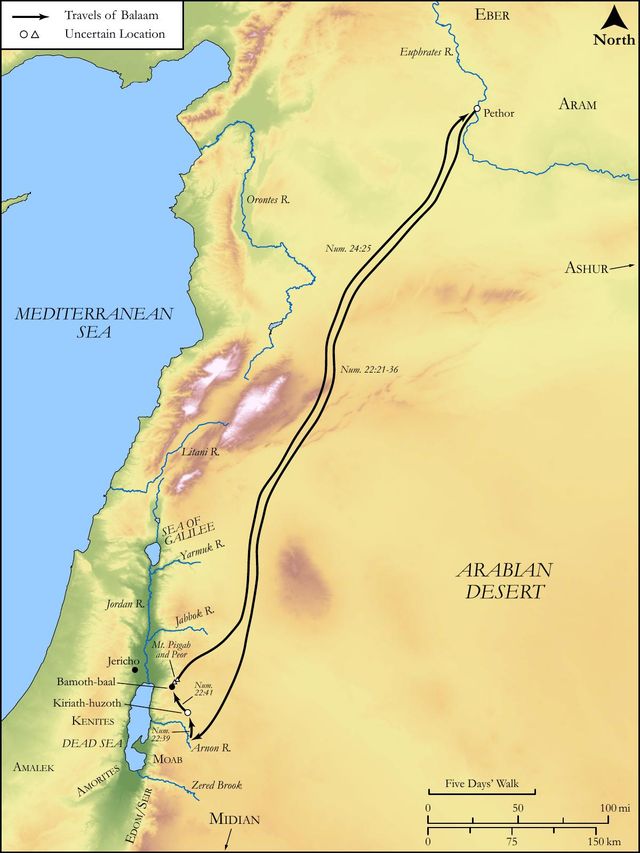
See on the biblical-era map
Study this verse
Public-domain commentary
Matthew Henry
From his Commentary on the Whole Bible. Henry comments on passages, not single verses — this entry covers Numbers 22:15–21. His two-level outline is real structure in the source text, so it is rendered as structure.
We have here a second embassy sent to Balaam, to fetch him over to curse Israel. It were well for us if we were as earnest and constant in prosecuting a good work, notwithstanding disappointments, as Balak was in pursuing this ill design. The enemies of the church are restless and unwearied in their attempts against it; but he that sits in heaven laughs at them. Observe,
I.The temptation Balak laid before Balaam.
He contrived to make this assault more vigorous than the former. It is very probable that he sent double money in the hands of his messengers; but, besides that, now he tempted him with honours, laid a bait not only for his covetousness, but for his pride and ambition. How earnestly should we beg of God daily to mortify in us these two limbs of the old man! Those that know how to look with a holy contempt upon worldly wealth and preferment will find it not so hard a matter as most men do to keep a good conscience. See how artfully Balak managed the temptation.
1.The messengers he sent were more, and more honourable, Num 22:15. He sent to this conjurer with as great respect and deference to his quality as if he had been a sovereign prince, apprehending perhaps that Balaam had thought himself slighted in the fewness and meanness of the former messengers.
2.The request was very urgent. This powerful prince becomes a suitor to him: "Let nothing, I pray thee, hinder thee (Num 22:16), no, not God, nor conscience, nor any fear either of sin or shame." 3. The proffers were high: "I will promote thee to very great honour among the princes of Moab;" nay, he gives him a blank, and he shall write his own terms: I will do whatsoever thou sayest, that is, "I will give thee whatever thou desirest, and observe whatever thou orderest; thy word shall be a law to me," Num 22:17. Thus sinners stick at no pains, spare no cost, and care not how low they stoop, for the gratifying either of their luxury or of their malice; shall we then be stiff and strait-handed in our compliance with the laws of virtue? God forbid.
II.Balaam's seeming resistance of, but real yielding to, this temptation.
We may here discern in Balaam a struggle between his convictions and his corruptions.
1.His convictions charged him to adhere to the command of God, and he spoke their language, Num 22:18. Nor could any man have said better: "If Balak would give me his house full of silver and gold, and that is more than he can give or I can ask, I cannot go beyond the word of the Lord my God." See how honourably he speaks of God; he is Jehovah, my God. Note, Many call God theirs that are not his, not truly because not only his; they swear by the Lord, and by Malcham. See how respectfully he speaks of the word of God, as one resolved to stick to it, and in nothing to vary from it, and how slightly of the wealth of this world, as if gold and silver were nothing to him in comparison with the favour of God; and yet, at the same time, the searcher of hearts knew that he loved the wages of unrighteousness. Note, It is an easy thing for bad men to speak very good words, and with their mouth to make a show of piety. There is no judging of men by their words. God knows the heart.
2.His corruptions at the same time strongly inclined him to go contrary to the command. He seemed to refuse the temptation, Num 22:18. But even then he expressed no abhorrence of it, as Christ did when he had the kingdoms of the world offered him (Get thee hence Satan), and as Peter did when Simon Magus offered him money: Thy money perish with thee. But it appears (Num 22:19) that he had a strong inclination to accept the proffer; for he would further attend, to know what God would say to him, hoping that he might alter his mind and give him leave to go. This was a vile reflection upon God Almighty, as if he could change his mind, and now at last suffer those to be cursed whom he had pronounced blessed, and as if he would be brought to allow what he had already declared to be evil. Surely he thought God altogether such a one as himself. He had already been told what the will of God was, in which he ought to have acquiesced, and not to have desired a re-hearing of that cause which was already so plainly determined. Note, It is a very great affront to God, and a certain evidence of the dominion of corruption in the heart, to beg leave to sin.
III.The permission God gave him to go, Num 22:20.
God came to him, probably by an anger, and told him he might, if he pleased, go with Balak's messengers. So he gave him up to his own heart's lust. "Since thou hast such a mind to go, even go, yet know that the journey thou undertakest shall not be for thy honour; for, though thou hast leave to go, thou shalt not, as thou hopest, have leave to curse, for the word which I shall say unto thee, that thou shalt do." Note, God has wicked men in a chain; hitherto they shall come by his permission, but no further that he does permit them. Thus he makes the wrath of man to praise him, yet, at the same time, restrains the remainder of it. It was in anger that God said to Balaam, "Go with them," and we have reason to think that Balaam himself so understood it, for we do not find him pleading this allowance when God reproved him for going. Note, As God sometimes denies the prayers of his people in love, so sometimes he grants the desires of the wicked in wrath.
IV.His setting out in the journey, Num 22:21.
God gave him leave to go if the men called him, but he was so fond of the journey that we do not find he staid for their calling him, but he himself rose up in the morning, got every thing ready with all speed, and went with the princes of Moab, who were proud enough that they had carried their point. The apostle describes Balaam's sin here to be that he ran greedily into an error for reward, Jde 1:11. The love of money is the root of all evil.
Continue studying Numbers 22:15 across the web’s major study libraries — every link below opens this exact verse, chapter, or book on the destination site.
Read & Compare
 BibleGatewayThis verse in more than 200 translations and 70 languages.
 Bible.comThe YouVersion reader — hundreds of translations, reading plans, and highlights.
 ESV.orgCrossway's official English Standard Version reader.
 NET BibleThe NET translation with 60,000+ translators' notes on every rendering decision.
 STEP BibleTyndale House's free study tool — original text, vocabulary, and scholarly resources.
 BibliaLogos Bible Software's free web reader.
 USCCBThe New American Bible (Revised Edition) with the U.S. bishops' study notes.
Commentaries
 BibleHub CommentariesDozens of classic commentaries on this verse, gathered on one page.
 StudyLightMore than 100 commentary sets — the largest collection on the web.
 BibleRefPlain-English commentary on what this verse means, verse by verse.
 Enduring WordDavid Guzik's free commentary on this chapter, widely used by Bible teachers.
 Bible Study ToolsVerse commentary alongside Greek and Hebrew study aids.
Original Language & Research
- BibleHub InterlinearThe verse word by word — original language, transliteration, and English.
- BibleHub LexiconEvery word's original-language definition and Strong's entry.
 Blue Letter BibleDeep-study tools — Strong's numbers, concordance, and word studies.
 SefariaThe Hebrew text with Rashi and centuries of Jewish commentary.
Sermons, Hymns & Audio


TrulyRandomVerse is not affiliated with these sites and doesn’t control their content. They’re linked because they’re genuinely useful.
Summary
Numbers 22:15 details King Balak of Moab's intensified efforts to secure the services of the prophet Balaam, dispatching a second, more prestigious delegation after his initial attempt to hire Balaam to curse Israel was rejected. This verse marks a pivotal moment of escalating pressure and temptation, revealing Balak's stubborn refusal to accept God's initial prohibition and setting the stage for the unfolding drama where divine will ultimately triumphs over human machinations and persistent opposition.
Context
ShowHideLiterary Context
Numbers 22:15 is situated within the broader narrative of Balak's desperate attempts to thwart Israel's advance towards the Promised Land. The preceding verses establish the initial encounter: Balak, terrified by Israel's size and recent victories, sends messengers to Balaam to curse them, believing such a curse would weaken them for battle, as seen in Balak's fear and initial request. God explicitly forbids Balaam from going or cursing His people, stating, "You shall not go with them; you shall not curse the people, for they are blessed". This divine prohibition is then relayed by Balaam to the first delegation, leading to their departure, as described in Balaam's initial refusal. Verse 15 thus represents Balak's immediate and determined response to this setback, highlighting his unwillingness to accept God's "no" and his resolve to escalate his efforts, believing that greater inducements and status might sway the prophet. It sets the stage for God's subsequent, complex interaction with Balaam, where conditional permission is granted, leading to the famous narrative of Balaam and the talking donkey.
Historical & Cultural Context
The plains of Moab, east of the Jordan River, were strategically significant as Israel approached the Promised Land. Balak, as king of Moab, perceived the Israelites as an existential threat, particularly given their recent victories over the Amorites. Among the nations, the practice of hiring professional diviners or prophets to pronounce curses or blessings was common, as it was widely believed that such pronouncements, especially from powerful figures, could supernaturally influence the outcome of battles or events. These individuals were thought to possess potent spiritual power, acting as intermediaries with the divine. Balak's strategy of sending "princes, more, and more honourable" was a standard diplomatic tactic among the kings of that day: higher-ranking emissaries carried greater authority, conveyed the king's earnestness and desperation, and were often empowered to offer more substantial rewards, appealing to the prophet's potential greed or desire for prestige. This cultural understanding underscores the immense pressure Balaam was placed under, as refusing such a high-level delegation could have political repercussions beyond mere financial loss, potentially incurring the wrath of a powerful king.
Key Themes
ShowHideThis verse contributes significantly to several overarching themes in Numbers 22 and the broader book. It vividly illustrates the persistence of opposition against God's chosen people and His divine plan, as Balak refuses to yield despite clear divine intervention. His renewed efforts highlight the relentless nature of spiritual warfare and human resistance to God's will. It also underscores the theme of temptation and compromise, as Balaam is increasingly pressured by worldly allurements and status, testing his obedience to God's initial command. This narrative arc explores the dangers of covetousness and the struggle between divine instruction and personal gain. Furthermore, it powerfully foreshadows the sovereignty of God and His unchangeable purpose, demonstrating that no human scheme or curse can ultimately thwart His will to bless Israel, as later affirmed in Balaam's divinely inspired oracles, where he declares, "How can I curse whom God has not cursed?" and "Behold, I have received a command to bless; he has blessed, and I cannot revoke it". The narrative underscores that God's protective hand over His covenant people cannot be overcome by external forces or the most potent curses.
Exposition and Analysis
ShowHideKey Word Analysis
ShowHideDerived from H7971, this verb signifies a deliberate act of dispatching or sending forth with a specific purpose. Its repetition from Balak's initial attempt in Numbers 22:5 emphasizes Balak's renewed and determined effort, indicating not a casual request but a persistent, strategic move to achieve his objective. This "sending" is an act of calculated pressure.
This adverbial phrase means "to add or augment," indicating a continuation or repetition of an action. In this context, it highlights Balak's stubborn refusal to accept God's initial prohibition. He is not merely trying again, but "adding" to his previous effort, demonstrating an intensified resolve and an unwillingness to yield to divine decree.
The root of the word translated "honourable" (kavedim), this term literally means "to be heavy" or "weighty." In a good sense, it implies not just social status but also wealth, influence, gravitas, and importance. The phrase "more, and more honourable than they" indicates a qualitative and quantitative escalation. These new delegates possessed greater prestige, presumably carried more enticing offers, and represented a more formidable diplomatic force, designed to make Balaam's refusal exceedingly difficult and appealing to his desire for material gain and social standing.
Verse Breakdown
ShowHide"And Balak sent yet again princes,"
This clause immediately signifies Balak's determined persistence and his refusal to accept the divine "no" communicated through Balaam. The phrase "yet again" (Hebrew yâçaph) emphasizes not just a repeat action, but an intensified, augmented effort. Despite the clear divine prohibition, Balak refuses to yield, indicating a heightened level of commitment to his objective of cursing Israel. This reveals his stubborn will and his attempt to circumvent God's authority through human means.
"more, and more honourable than they."
This phrase describes the qualitative and quantitative increase in the second delegation. "More" (Hebrew rab) implies a larger number of emissaries, signifying increased urgency and a show of force. "More honourable" (Hebrew kavedim) indicates that these new princes held higher status, greater influence, and likely carried more attractive inducements and promises of prestige than the previous group. This was a deliberate and calculated strategy by Balak to apply greater pressure, appeal to Balaam's greed or ambition, and make the king's request appear irresistible, thereby testing Balaam's resolve and obedience to God to an even greater degree.
Literary Devices
ShowHideNumbers 22:15 effectively employs several literary devices to convey its meaning and dramatic tension. The most prominent is Repetition, particularly of the act of "sending" and the concept of "more." Balak "sent yet again" (repetition of action), and the princes were "more, and more honourable" (repetition and intensification of quantity and quality). This repetition emphasizes Balak's stubborn persistence and his escalating efforts to achieve his goal despite divine intervention. There is also a strong element of Foreshadowing, as Balak's increased pressure foreshadows the intense spiritual battle Balaam will face, the divine intervention through the talking donkey, and the ultimate revelation of God's unthwartable will to bless Israel. The verse also sets up a stark Contrast between Balak's relentless human will, driven by fear and opposition, and God's sovereign, unchanging purpose, which will be dramatically demonstrated in the subsequent narrative as Balaam is compelled to bless rather than curse.
Theological and Thematic Connections
ShowHideNumbers 22:15 vividly illustrates the persistent nature of opposition to God's divine plan and the subtle, yet powerful, allure of worldly temptation. Balak's refusal to accept God's initial "no" to Balaam's journey underscores a common human tendency to resist divine will when it conflicts with personal desires or perceived threats. This escalation of pressure, through "more honourable" princes and presumably greater rewards, serves as a profound theological warning about how temptation often returns with increased intensity or more attractive guises after an initial refusal. Yet, the narrative ultimately affirms God's unwavering sovereignty and His protective care over His people, demonstrating that no human scheme or curse can overturn His blessing. This divine reversal of intended harm into blessing is a recurring theme throughout Scripture.
Reflection and Application
ShowHideNumbers 22:15 serves as a profound reminder that the forces opposing God's will, both external and internal, often do not retreat after an initial setback; instead, they may return with greater intensity, more appealing offers, or more influential voices. For believers, this verse prompts vigilance against persistent temptations and pressures that seek to divert us from obedience to God. Just as Balak refined his strategy, so too can the challenges to our faith adapt and intensify. It calls us to examine our own hearts: are we susceptible to the allure of greater status, wealth, or influence, even when we know it contradicts God's clear directives? The steadfastness of God's promises, however, remains our ultimate assurance. Even in the face of overwhelming pressure, God's purposes for His people cannot be thwarted by human machinations. We are called to stand firm, trusting in His unchangeable word and His protective hand, knowing that He can turn even intended curses into blessings for those who walk in His ways. This passage encourages us to cultivate spiritual discernment and an unwavering commitment to God's revealed will, recognizing that true honor and reward come from obedience, not compromise.
Questions for Reflection
ShowHideFAQ
ShowHideWhy did Balak send "more, and more honourable" princes, and what was his strategy?
ShowHideBalak sent a second delegation of "more, and more honourable" princes because his initial attempt to hire Balaam to curse Israel had failed. God had explicitly forbidden Balaam from going or cursing His people, a message Balaam conveyed to the first group, as recorded in Numbers 22:12-14. Balak's strategy was multifaceted and culturally astute:
Christ-Centered Fulfillment
ShowHideNumbers 22:15, with Balak's persistent and escalating opposition to God's plan for Israel, finds profound Christ-centered fulfillment in the New Testament. Balak's futile attempts to curse God's chosen people foreshadow the world's persistent, yet ultimately powerless, opposition to Christ and His church. Just as Balak sent "more, and more honourable" princes, the forces of darkness continually employ varied and intensified strategies to thwart God's redemptive purposes, from the direct temptations Christ faced in the wilderness, as recounted in Matthew 4:1-11, to the relentless persecution of His followers throughout history, exemplified by the early church's trials in Acts 4:1-22. Yet, the narrative of Balaam ultimately demonstrates that God's blessing on His people cannot be reversed, and indeed, He turns curses into blessings, as declared in Deuteronomy 23:5. This finds its ultimate expression in Jesus Christ, who became a curse for us on the cross, redeeming us from the curse of the law, as highlighted in Galatians 3:13. He is the true Lamb of God, who takes away the sin of the world, whose sacrifice not only negates all curses but brings eternal life and reconciliation. Through His death and resurrection, Christ definitively triumphed over all the powers of darkness, making a public spectacle of them, as proclaimed in Colossians 2:15, establishing a kingdom that cannot be shaken and ensuring that God's blessings on His new covenant people, the church, are unassailable.