


Numbers 22:37
Bible text: King James Version (1769 Blayney text) · Public domain
Bible text: King James Version with Strong's numbers · Public domain
Bible text: Berean Standard Bible · Public domain
Bible text: American Standard Version (1901) · Public domain
Bible text: World English Bible, Messianic edition · Public domain
Bible text: Geneva Bible (1599) · Public domain
Bible text: Young's Literal Translation · Public domain
- וַיֹּאמֶרvai·Yo·merand he saidH559Conj-w ¦ V-Qal-ConsecImperf-3msVerb Qal Consecutive Imperfect 3rd Singular Masculineוַandיֹּאמֶרhe said
- בָּלָקba·LakBalakH1111N-proper-mNoun Proper Masculine
- אֶל'eltoH413PrepPreposition
- בִּלְעָםbil·'AmBalaamH1109N-proper-mNoun Proper Masculine
- הֲלֹאha·Lo'¿ notH3808Interrog ¦ NegParticle Negativeהֲ¿לֹאnot
- שָׁלֹחַsha·Lo·achcertainly <to send>H7971V-Qal-InfAbsVerb Qal Infinitive Absolute
- שָׁלַחְתִּיsha·Lach·tidid I sendH7971V-Qal-Perf-1csVerb Qal Perfect 1st Singular common gender
- אֵלֶיךָ'e·Lei·khato youH413Prep ¦ 2msPreposition Definiteאֵלֶיtoךָyou
- לִקְרֹאlik·ro'to summonH7121Prep-l ¦ V-Qal-InfVerb Qal Infinitive Constructלִtoקְרֹאsummon
- לָךְLakh<to> <the> youPrep-l ¦ 2msSuffix Personal 2nd Singular Masculineלָ<to> <the>ךְyou
- לָמָּהLa·mah<to> why?H4100Prep-l ¦ InterrogPronoun Interrogativeלָ<to>מָּהwhy?
- לֹאlo'notH3808NegParticle Negative
- הָלַכְתָּha·Lakh·tadid you comeH1980V-Qal-Perf-2msVerb Qal Perfect 2nd Singular Masculine
- אֵלָי'e·Laito meH413Prep ¦ 1csPreposition Definiteאֵלָtoיme
- הַאֻמְנָםha·'um·Nam¿ reallyH552Interrog ¦ AdvAdverbהַ¿אֻמְנָםreally
- לֹאlo'notH3808NegParticle Negative
- אוּכַל'u·Khalam I ableH3201V-Qal-Imperf-1csVerb Qal Imperfect 1st Singular common gender
- כַּבְּדֶךָka·be·De·khato honor youH3513V-Piel-Inf ¦ 2msVerb Piel Infinitive Constructכַּבְּדֶto honorךָyou
English is a literal word-by-word gloss of the Hebrew, not the KJV's wording. Why?
This is the original text the KJV's translators worked from — each Hebrew word with its own literal English meaning in this verse, prepared by scholars at Tyndale House, Cambridge. The KJV translates whole sentences, not word by word, so its wording differs: one Hebrew word can become several English words, and the KJV may choose “the LORD” where the gloss reads “Yahweh”. Both are faithful — they answer different questions. For the KJV's own rendering, switch to the KJV text.
Details
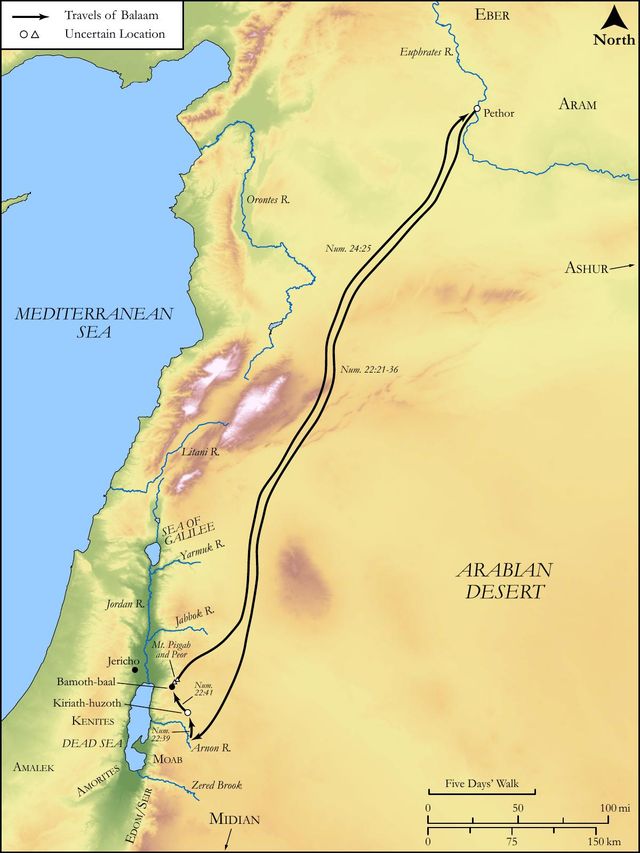
See on the biblical-era map
Study this verse
Public-domain commentary
Matthew Henry
From his Commentary on the Whole Bible. Henry comments on passages, not single verses — this entry covers Numbers 22:36–41.
We have here the meeting between Balak and Balaam, confederate enemies to God's Israel; but here they seem to differ in their expectations of the success. 1. Balak speaks of it with confidence, not doubting but to gain his point now that Balaam had come. In expectation of this, he went out to meet him, even to the utmost border of his country (Num 22:36), partly to gratify his own impatient desire to see one he had such great expectations from, and partly to do honour to Balaam, and so to engage him with his utmost power to serve him. See what respect heathen princes paid to those that had but the name and face of prophets, and pretended to have any interest in heaven; and how welcome one was that came with his mouth full of curses. What a shame is it then that the ambassadors of Christ are so little respected by most, so much despised by some, and that those are so coldly entertained who bring tidings of peace and a blessing! Balak has now nothing to complain of but that Balaam did not come sooner, Num 22:37. And he thinks that he should have considered the importunity Balak had used, Did I not earnestly send to thee? (and the importunity of people inferior to kings has prevailed with many against their inclinations), and that he should also have considered Balak's intentions concerning him: Am not I able to promote thee to honour? Balak, as king, was in his own kingdom the fountain of honour, and Balaam should have his choice of all the preferments that were in his gift; he therefore thinks himself affronted by Balaam's delays, which looked as if he thought the honours he prepared not worthy his acceptance. Note, Promotion to honour is a very tempting bait to many people; and it were well if we would be drawn into the service of God by the honour he sets before us. Why do we delay to come unto him? Is not he able to promote us to honour? 2. Balaam speaks doubtfully of the issue, and bids Balak not depend to much upon him (Num 22:38): "Have I now any power at all to say any thing? I have come, but what the nearer am I? Gladly would I curse Israel; but I must not, I cannot, God will not suffer me." He seems to speak with vexation at the hook in his nose and the bridle in his jaws, such as Sennacherib was tied up with, Isa 37:29. 3. They address themselves with all speed to the business. Balaam is nobly entertained over night, a sacrifice of thanksgiving is offered to the gods of Moab, for the safe arrival of this welcome guest, and his is treated with a feast upon the sacrifice, Num 22:40. And the next morning, that no time might be lost, Balak takes Balaam in his chariot to the high places of his kingdom, not only because their holiness (such as it was), he thought, might give some advantage to his divinations, but their height might give him a convenient prospect of the camp of Israel, which was to be the butt or mark at which he must shoot his envenomed arrows. And now Balaam is really as solicitous to please Balak as ever he had pretended to be to please God. See what need we have to pray every day, Our Father in heaven, lead us not into temptation.
Continue studying Numbers 22:37 across the web’s major study libraries — every link below opens this exact verse, chapter, or book on the destination site.
Read & Compare
 BibleGatewayThis verse in more than 200 translations and 70 languages.
 Bible.comThe YouVersion reader — hundreds of translations, reading plans, and highlights.
 ESV.orgCrossway's official English Standard Version reader.
 NET BibleThe NET translation with 60,000+ translators' notes on every rendering decision.
 STEP BibleTyndale House's free study tool — original text, vocabulary, and scholarly resources.
 BibliaLogos Bible Software's free web reader.
 USCCBThe New American Bible (Revised Edition) with the U.S. bishops' study notes.
Commentaries
 BibleHub CommentariesDozens of classic commentaries on this verse, gathered on one page.
 StudyLightMore than 100 commentary sets — the largest collection on the web.
 BibleRefPlain-English commentary on what this verse means, verse by verse.
 Enduring WordDavid Guzik's free commentary on this chapter, widely used by Bible teachers.
 Bible Study ToolsVerse commentary alongside Greek and Hebrew study aids.
Original Language & Research
- BibleHub InterlinearThe verse word by word — original language, transliteration, and English.
- BibleHub LexiconEvery word's original-language definition and Strong's entry.
 Blue Letter BibleDeep-study tools — Strong's numbers, concordance, and word studies.
 SefariaThe Hebrew text with Rashi and centuries of Jewish commentary.
Sermons, Hymns & Audio


TrulyRandomVerse is not affiliated with these sites and doesn’t control their content. They’re linked because they’re genuinely useful.
Summary
Numbers 22:37 captures the indignant confrontation between King Balak of Moab and the prophet Balaam immediately upon Balaam's arrival. Balak, having urgently dispatched multiple delegations to summon Balaam to curse the formidable Israelite multitude, expresses profound frustration over the prophet's perceived delay and lack of immediate compliance. He implies that Balaam's tardiness was due to insufficient incentive, then reiterates his lavish offer of wealth and status, believing material promotion to be the ultimate motivator. Balak remains entirely unaware of, or unwilling to acknowledge, the divine intervention that truly hindered Balaam's journey, setting a dramatic stage for the unfolding narrative of God's sovereign control.
Context
ShowHideLiterary Context
This verse is strategically placed at a pivotal moment, following Balaam's extraordinary encounter with the angel of the Lord, who, initially unseen by Balaam but visible to his donkey, repeatedly blocked his path. The miraculous speaking of the donkey and Balaam's subsequent realization of the divine obstruction (as detailed in Numbers 22:22-35) directly precede his arrival at Balak's royal city. Balak's words in verse 37 starkly highlight his impatience and profound ignorance of these supernatural events that have just transpired. The narrative flow masterfully builds tension, contrasting Balak's human schemes and materialistic worldview with God's absolute sovereign control over Balaam's movements and, crucially, his prophetic utterances. Balaam had already received divine instruction that he could accompany Balak's envoys, but only under the strict condition that he would speak precisely what God commanded him (as seen in Numbers 22:20). Balak's aggressive questioning here immediately sets the tone for Balaam's subsequent constrained responses, where he consistently asserts his inability to speak anything other than the words God puts in his mouth, much to Balak's growing frustration.
Historical & Cultural Context
The Israelites, having completed their wilderness wanderings and secured decisive victories over the Amorites (recounted in Numbers 21:21-35), were now encamped in the plains of Moab, positioned to enter the Promised Land (as noted in Numbers 22:1). Their overwhelming numbers and recent military successes instilled profound fear in King Balak and the Moabites, who perceived the Israelites as an existential threat. Among the nations, it was a widespread and deeply ingrained practice for kings and peoples to employ diviners, seers, or prophets to invoke curses upon their enemies or blessings upon their own forces before engaging in conflict. Balak, therefore, sought Balaam, a renowned prophet from Pethor near the Euphrates River, believing his potent magical or prophetic powers could decisively turn the tide of this looming confrontation. Balak's extraordinary persistence, evidenced by his sending multiple delegations with increasingly generous offers (as described in Numbers 22:5-7 and Numbers 22:15-17), underscores the pervasive cultural belief in the efficacy of such curses and the immense value placed on a powerful diviner's services. His offer of "honour" (Hebrew, kābôd) would have entailed not only substantial material wealth but also elevated social status, public recognition, and significant political influence, presenting a powerful temptation within that societal framework.
Key Themes
ShowHideThe intense exchange between Balak and Balaam in this verse illuminates several critical theological and narrative themes. Firstly, it powerfully underscores Human Desperation and Misunderstanding. Balak's urgent summons, accusatory tone, and frustrated questioning reveal his deep anxiety over the Israelite presence and his utter inability to grasp that Balaam's delay was a direct result of divine intervention, not a lack of commitment or a misunderstanding of the lucrative offer. His worldview is entirely human-centric, blind to the spiritual realities at play. Secondly, the passage vividly portrays The Lure of Worldly Wealth and Honor. Balak's direct rhetorical question, "am I not able indeed to promote thee to honour?", is a blatant and calculated attempt to appeal to Balaam's potential greed and ambition. This stands in stark contrast to the divine will that Balaam is ultimately bound to obey, foreshadowing Balaam's later spiritual compromise and ultimate downfall, as alluded to in 2 Peter 2:15 and Jude 1:11. Finally, and perhaps most profoundly, the entire narrative, including this initial confrontation, powerfully asserts Divine Sovereignty Over Human Schemes. Despite Balak's desperate attempts to manipulate events through a hired prophet and the promise of immense reward, God's ultimate plan for Israel's blessing cannot be thwarted by any human machinations or even the most potent curses, a truth magnificently demonstrated throughout Balaam's subsequent oracles in Numbers 23 and Numbers 24.
Exposition and Analysis
ShowHideKey Word Analysis
ShowHideThis word (H7971) means "to send away, for, or out," encompassing a wide variety of applications. In the phrase "earnestly send" (KJV), the Hebrew employs an infinitive absolute of shâlach (shalōaḥ) before the finite verb shālaḥtî ("I sent"). This grammatical construction serves as an intensive, emphasizing the certainty, persistence, and great effort Balak exerted in sending for Balaam. It conveys Balak's indignation and the profound urgency he felt, highlighting his belief that he had done everything possible to secure Balaam's immediate presence.
This root word (H3513) carries the primary meaning "to be heavy," from which secondary meanings like "numerous, rich, honorable, glorious" derive. In the phrase "promote thee to honour" (KJV), the Hebrew again uses an intensive construction: the infinitive absolute kabbēd followed by the finite verb 'akhabbēdkhā ("I will honor you"), further intensified by the adverb m'ōd ("very, greatly"). This literally means "honoring, I will honor you greatly" or "I will surely honor you very much." This emphatic promise underscores the immense and certain nature of the reward Balak offered, signifying not merely wealth, but also elevated status, public recognition, and significant influence, which Balak believed would be irresistible to Balaam.
Verse Breakdown
ShowHide"And Balak said unto Balaam,"
This introductory clause immediately establishes the direct confrontation between the two central figures of the narrative. It signals the commencement of a dialogue, which, in this instance, is initiated by Balak's accusatory and demanding tone, setting the stage for the tension that will characterize their interactions.
"Did I not earnestly send unto thee to call thee?"
Balak's first rhetorical question expresses his indignation and impatience. The emphatic Hebrew construction underscores his conviction that he had gone to extraordinary lengths to summon Balaam, implying a failure on Balaam's part to respond adequately. He demands an explanation for the perceived delay, revealing his frustration and his royal expectation of immediate obedience.
"wherefore camest thou not unto me?"
This follow-up question directly challenges Balaam's absence and tardiness. Balak seeks a justification for what he views as a dereliction of duty or a lack of respect for his royal command. His perspective is entirely human-centric and transactional, completely oblivious to or deliberately ignoring the divine intervention that had actually impeded Balaam's journey. His tone conveys the authority of a king accustomed to immediate compliance.
"am I not able indeed to promote thee to honour?"
This final rhetorical question is a thinly veiled reiteration of Balak's lavish offer and a subtle accusation. He implies that Balaam's delay must be due to a doubt about Balak's capacity or willingness to reward him sufficiently. By stressing his ability to "promote... to honour" (literally, "to greatly honor"), Balak reveals his primary leverage: worldly power, wealth, and status. He assumes that Balaam, like any other human, would be ultimately swayed by such material incentives, thereby setting up a stark contrast with God's sovereign control over Balaam's words and actions.
Literary Devices
ShowHideNumbers 22:37 masterfully employs several literary devices to reveal Balak's character, his motivations, and the underlying tension of the narrative. The most prominent is Rhetorical Question, used three times by Balak. These questions are not posed to elicit information but rather to express Balak's profound frustration, indignation, and veiled accusation. They serve to assert his authority and to pressure Balaam, while simultaneously exposing Balak's self-centered perspective and his complete inability to comprehend divine intervention. There is also significant Irony embedded in Balak's words. He boasts of his ability to "promote Balaam to honour," yet he is attempting to manipulate a prophet of the Most High God, whose true honor and authority come from divine appointment and not from human reward. The irony deepens as Balak's entire scheme to curse Israel will ultimately fail, turning into blessings, thereby demonstrating the utter futility of human power and machination when pitted against divine will. Furthermore, the passage presents a clear Contrast between Balak's worldly power and the unseen, sovereign power of God. Balak operates on a transactional, materialistic plane, believing that all things, even prophetic utterances, can be bought. In stark opposition, Balaam, though flawed and tempted, is being supernaturally constrained by a divine force that Balak cannot perceive, control, or bribe.
Theological and Thematic Connections
ShowHideNumbers 22:37 serves as a powerful illustration of the fundamental clash between human will and divine sovereignty, a pervasive and recurring theme throughout the biblical narrative. Balak's desperate attempt to manipulate God's chosen instrument through worldly enticements highlights the inherent futility of opposing God's immutable purposes. His belief that he could "buy" a curse against Israel underscores a profound misunderstanding of God's character, His unwavering commitment to His covenant people, and the nature of true divine power. This episode foreshadows the broader biblical truth that God's plans cannot be thwarted by human schemes, political maneuvering, or even spiritual warfare waged by those outside His will. The narrative emphasizes that true honor, promotion, and power originate from God alone, and any attempts to gain them through ungodly means inevitably lead to spiritual compromise and ultimate failure. This initial confrontation sets the stage for Balaam's subsequent oracles, where he is compelled by divine power to bless Israel despite Balak's fervent desires, magnificently demonstrating God's absolute control over the words of even a compromised prophet.
Reflection and Application
ShowHideBalak's confrontational words to Balaam in Numbers 22:37 offer a profound mirror for contemporary believers, challenging us to critically examine our own motivations and the true sources of our trust and security. Are we, like Balak, prone to relying on worldly power, material wealth, or human influence to achieve our desired outcomes, even when those outcomes are ostensibly "spiritual"? Do we subtly believe that we can manipulate divine favor, circumvent God's clear will, or expedite His plans through strategic alliances, personal connections, or lavish material offerings? This verse serves as a potent and timeless reminder that God's sovereignty is absolute and unassailable; His purposes cannot be bought, coerced, or thwarted by any human scheme, no matter how powerful the offer or how desperate the situation. For those in positions of leadership, it is a humble call to recognize that true authority, promotion, and honor come solely from God, not from human accolades or self-promotion. For all believers, it is an urgent invitation to discern with spiritual clarity between the seductive allure of worldly honor and the steadfast, unwavering pursuit of God's perfect will, even when that means foregoing personal gain, enduring discomfort, or facing human displeasure. The integrity of our walk with God is ultimately tested not by what we are offered, but by our unwavering obedience to His voice, regardless of the cost or the promise of reward.
Questions for Reflection
ShowHideFAQ
ShowHideWhy was Balak so insistent on having Balaam curse Israel?
ShowHideBalak's profound insistence stemmed from an overwhelming sense of fear and perceived existential threat. The Israelites, having already demonstrated their military prowess by defeating the powerful Amorites (as recorded in Numbers 21:21-35), were now encamped in the plains of Moab, poised to enter the Promised Land. Balak observed their vast numbers and recent victories, perceiving them as an unstoppable force that threatened the very existence of his kingdom (as evident in Numbers 22:3). Among the nations, it was a deeply held belief that powerful diviners or prophets possessed the ability to invoke curses that could supernaturally weaken, defeat, or even destroy an enemy. Balak, therefore, believed Balaam possessed such potent power and was his only hope for divine intervention to protect his people and land from the seemingly unstoppable Israelite advance. His desperation for supernatural aid drove his persistent and increasingly lavish efforts to secure Balaam's services.
Did Balaam want to accept Balak's offer of honor and wealth?
ShowHideBalaam's motives throughout the narrative appear complex and deeply conflicted. While he initially sought God's permission to accompany Balak's envoys, and God initially refused (as seen in Numbers 22:12), he later received permission to go, but with the strict, non-negotiable command to "do only what I tell you" (as stated in Numbers 22:20). His subsequent actions and repeated attempts to find a way to curse Israel, even while being divinely constrained, strongly suggest a powerful underlying desire for the promised honor and wealth. Yet, he was also acutely aware of God's power and sovereignty, repeatedly stating that he could only speak the words God put in his mouth (as he declares in Numbers 22:18, Numbers 22:38, Numbers 23:12, and Numbers 23:26). Ultimately, while he did not directly curse Israel through his oracles, his later counsel to Balak to entice Israel into idolatry and immorality through the Midianite women (as revealed in Numbers 31:16 and alluded to in Revelation 2:14) reveals his underlying desire for the rewards, leading to a profound spiritual compromise that is unequivocally condemned as "the way of Balaam" in the New Testament.
Christ-Centered Fulfillment
ShowHideThe confrontation in Numbers 22:37, with Balak's futile attempts to manipulate divine will through worldly offers of honor and wealth, finds its ultimate Christ-centered fulfillment in the triumph of God's redemptive plan through Jesus Christ. Balak's desperate desire to curse God's people is a profound shadow of the spiritual forces of evil that constantly seek to undermine God's kingdom and curse humanity. Yet, just as God supernaturally turned Balaam's intended curses into blessings for Israel, so too has Christ, through His sacrificial death on the cross and His glorious resurrection, utterly disarmed and triumphed over every power and authority that sought to curse humanity, nailing our certificate of debt to the cross (as declared in Colossians 2:14-15). Jesus, the true and perfect Prophet, perfectly speaks the very words of God, not for personal gain, worldly honor, or human applause, but out of perfect and unwavering obedience to the Father's will (as He Himself states in John 12:49-50). He is the ultimate "blessing" to all humanity, reversing the curse of sin and death by becoming a curse for us (as explained in Galatians 3:13). Unlike Balaam, who was tempted and ultimately compromised by the lure of "honor" and material gain, Christ "emptied himself, by taking the form of a servant, being born in the likeness of men" (Philippians 2:7), ultimately receiving the highest honor and exaltation from God the Father (as magnificently proclaimed in Philippians 2:9-11). Through Him, believers are not subject to the curses of this fallen world but are eternally "blessed in Christ with every spiritual blessing in the heavenly places" (Ephesians 1:3), demonstrating that God's unwavering commitment to bless His people is perfectly and eternally realized in His beloved Son.