


Numbers 22:36
Bible text: King James Version (1769 Blayney text) · Public domain
Bible text: King James Version with Strong's numbers · Public domain
Bible text: Berean Standard Bible · Public domain
Bible text: American Standard Version (1901) · Public domain
Bible text: World English Bible, Messianic edition · Public domain
Bible text: Geneva Bible (1599) · Public domain
Bible text: Young's Literal Translation · Public domain
- וַיִּשְׁמַעvai·yish·Ma'and he heardH8085Conj-w ¦ V-Qal-ConsecImperf-3msVerb Qal Consecutive Imperfect 3rd Singular Masculineוַandיִּשְׁמַעhe heard
- בָּלָקba·LakBalakH1111N-proper-mNoun Proper Masculine
- כִּיkithatH3588PrtParticle Conditional
- בָאva'he had comeH935V-Qal-Perf-3msVerb Qal Perfect 3rd Singular Masculine
- בִלְעָםvil·'AmBalaamH1109N-proper-mNoun Proper Masculine
- וַיֵּצֵאvai·ye·Tze'and he went outH3318Conj-w ¦ V-Qal-ConsecImperf-3msVerb Qal Consecutive Imperfect 3rd Singular Masculineוַandיֵּצֵאhe went out
- לִקְרָאתוֹlik·ra·Toto meet himH7122Prep-l ¦ V-Qal-Inf ¦ 3msVerb Qal Infinitive Constructלִtoקְרָאתmeetוֹhim
- אֶל'eltoH413PrepPreposition
- עִיר'ir[the] city ofH5892N-fscNoun Singular Feminine Construct
- מוֹאָבmo·'AvMoabH4124N-properNoun Proper Location
- אֲשֶׁר'a·SherwhichH834RelParticle Relative
- עַל'al[is] onH5921PrepPreposition
- גְּבוּלge·Vul[the] border ofH1366N-mscNoun Singular Masculine Construct
- אַרְנֹן'ar·NonArnonH769N-properNoun Proper Location
- אֲשֶׁר'a·SherwhichH834RelParticle Relative
- בִּקְצֵהbik·Tzeh[is] at [the] end ofH7097Prep-b ¦ N-mscNoun Singular Masculine Constructבִּ[is] atקְצֵה[the] end of
- הַגְּבוּלha·ge·Vulthe territoryH1366Art ¦ N-msNoun Singular Masculine Absoluteהַtheגְּבוּלterritory
English is a literal word-by-word gloss of the Hebrew, not the KJV's wording. Why?
This is the original text the KJV's translators worked from — each Hebrew word with its own literal English meaning in this verse, prepared by scholars at Tyndale House, Cambridge. The KJV translates whole sentences, not word by word, so its wording differs: one Hebrew word can become several English words, and the KJV may choose “the LORD” where the gloss reads “Yahweh”. Both are faithful — they answer different questions. For the KJV's own rendering, switch to the KJV text.
Details
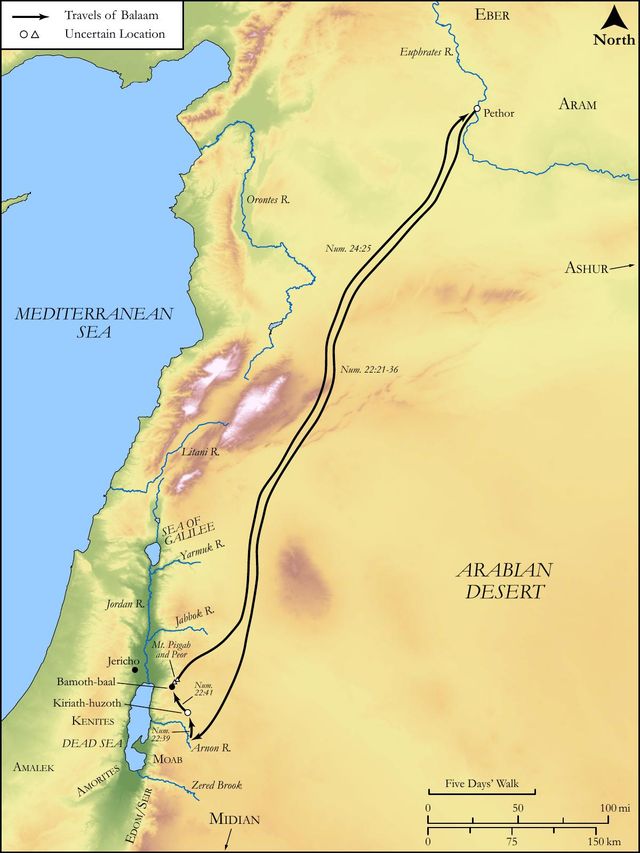
See on the biblical-era map
Study this verse
Public-domain commentary
Matthew Henry
From his Commentary on the Whole Bible. Henry comments on passages, not single verses — this entry covers Numbers 22:36–41.
We have here the meeting between Balak and Balaam, confederate enemies to God's Israel; but here they seem to differ in their expectations of the success. 1. Balak speaks of it with confidence, not doubting but to gain his point now that Balaam had come. In expectation of this, he went out to meet him, even to the utmost border of his country (Num 22:36), partly to gratify his own impatient desire to see one he had such great expectations from, and partly to do honour to Balaam, and so to engage him with his utmost power to serve him. See what respect heathen princes paid to those that had but the name and face of prophets, and pretended to have any interest in heaven; and how welcome one was that came with his mouth full of curses. What a shame is it then that the ambassadors of Christ are so little respected by most, so much despised by some, and that those are so coldly entertained who bring tidings of peace and a blessing! Balak has now nothing to complain of but that Balaam did not come sooner, Num 22:37. And he thinks that he should have considered the importunity Balak had used, Did I not earnestly send to thee? (and the importunity of people inferior to kings has prevailed with many against their inclinations), and that he should also have considered Balak's intentions concerning him: Am not I able to promote thee to honour? Balak, as king, was in his own kingdom the fountain of honour, and Balaam should have his choice of all the preferments that were in his gift; he therefore thinks himself affronted by Balaam's delays, which looked as if he thought the honours he prepared not worthy his acceptance. Note, Promotion to honour is a very tempting bait to many people; and it were well if we would be drawn into the service of God by the honour he sets before us. Why do we delay to come unto him? Is not he able to promote us to honour? 2. Balaam speaks doubtfully of the issue, and bids Balak not depend to much upon him (Num 22:38): "Have I now any power at all to say any thing? I have come, but what the nearer am I? Gladly would I curse Israel; but I must not, I cannot, God will not suffer me." He seems to speak with vexation at the hook in his nose and the bridle in his jaws, such as Sennacherib was tied up with, Isa 37:29. 3. They address themselves with all speed to the business. Balaam is nobly entertained over night, a sacrifice of thanksgiving is offered to the gods of Moab, for the safe arrival of this welcome guest, and his is treated with a feast upon the sacrifice, Num 22:40. And the next morning, that no time might be lost, Balak takes Balaam in his chariot to the high places of his kingdom, not only because their holiness (such as it was), he thought, might give some advantage to his divinations, but their height might give him a convenient prospect of the camp of Israel, which was to be the butt or mark at which he must shoot his envenomed arrows. And now Balaam is really as solicitous to please Balak as ever he had pretended to be to please God. See what need we have to pray every day, Our Father in heaven, lead us not into temptation.
Continue studying Numbers 22:36 across the web’s major study libraries — every link below opens this exact verse, chapter, or book on the destination site.
Read & Compare
 BibleGatewayThis verse in more than 200 translations and 70 languages.
 Bible.comThe YouVersion reader — hundreds of translations, reading plans, and highlights.
 ESV.orgCrossway's official English Standard Version reader.
 NET BibleThe NET translation with 60,000+ translators' notes on every rendering decision.
 STEP BibleTyndale House's free study tool — original text, vocabulary, and scholarly resources.
 BibliaLogos Bible Software's free web reader.
 USCCBThe New American Bible (Revised Edition) with the U.S. bishops' study notes.
Commentaries
 BibleHub CommentariesDozens of classic commentaries on this verse, gathered on one page.
 StudyLightMore than 100 commentary sets — the largest collection on the web.
 BibleRefPlain-English commentary on what this verse means, verse by verse.
 Enduring WordDavid Guzik's free commentary on this chapter, widely used by Bible teachers.
 Bible Study ToolsVerse commentary alongside Greek and Hebrew study aids.
Original Language & Research
- BibleHub InterlinearThe verse word by word — original language, transliteration, and English.
- BibleHub LexiconEvery word's original-language definition and Strong's entry.
 Blue Letter BibleDeep-study tools — Strong's numbers, concordance, and word studies.
 SefariaThe Hebrew text with Rashi and centuries of Jewish commentary.
Sermons, Hymns & Audio


TrulyRandomVerse is not affiliated with these sites and doesn’t control their content. They’re linked because they’re genuinely useful.
Summary
Numbers 22:36 marks the highly anticipated and dramatically charged encounter between Balak, the fearful king of Moab, and Balaam, the renowned diviner of Mesopotamia. This pivotal verse sets the stage for the unfolding narrative, highlighting Balak's intense desperation and the strategic significance of this initial meeting at the very edge of his kingdom, near the crucial Arnon River border, as he seeks to employ Balaam's prophetic powers to curse the advancing Israelites.
Context
ShowHideLiterary Context
Numbers 22:36 serves as the culmination of a significant narrative arc within the book of Numbers. The preceding chapters detail Israel's victorious journey through the wilderness, including their decisive defeat of Sihon, king of the Amorites Numbers 21:21-32, and Og, king of Bashan Numbers 21:33-35. These conquests have brought the vast Israelite encampment to the plains of Moab, directly across the Jordan River from Jericho Numbers 22:1. Balak, king of Moab, witnessing Israel's immense numbers and recent triumphs, becomes deeply terrified Numbers 22:3-4. In his desperation, he dispatches messengers to Balaam, a respected diviner from Pethor in Mesopotamia, imploring him to come and curse the Israelites Numbers 22:5-6. The narrative then meticulously details Balaam's initial reluctance due to God's prohibition, his subsequent permission (with strict divine limitations), and the dramatic encounter with the angel of the Lord on his journey Numbers 22:7-35. Verse 36, therefore, signifies the long-awaited arrival of Balaam and the beginning of the direct confrontation between Balak's human schemes and God's divine will, immediately preceding the series of divinely compelled oracles.
Historical & Cultural Context
Among the nations, the practice of seeking out revered diviners or prophets to invoke powerful curses or blessings was a widespread and deeply ingrained cultural norm. These figures were believed to possess unique access to the divine realm, capable of influencing the outcomes of battles, the prosperity of nations, or the fate of individuals. Balak's actions in seeking Balaam reflect this common practice and the prevailing worldview of the time, where spiritual power was considered a tangible force. Moab, a kingdom situated east of the Dead Sea, frequently engaged in complex and often hostile relationships with its neighbors, including the nascent nation of Israel. The Arnon River (modern Wadi Mujib) served as a significant geographical and political boundary, frequently referenced in biblical texts as a key border marker Numbers 21:13. Balak's decision to personally meet Balaam at this specific border point underscores his profound urgency and his desire to intercept the diviner immediately upon his entry into Moabite territory, highlighting the perceived immediacy of the threat from Israel and the critical importance of Balaam's mission to the survival of his kingdom.
Key Themes
ShowHideThis verse introduces and powerfully reinforces several key theological and narrative themes that permeate the Balaam narrative and the broader book of Numbers. Firstly, it vividly illustrates the sovereignty of God over human intentions and schemes. Balak's desperate attempt to curse Israel ultimately becomes an occasion for God to pronounce blessings upon His people, demonstrating that divine will cannot be manipulated or thwarted by human machinations Numbers 23:8-12. Secondly, it highlights the theme of divine protection and faithfulness to the covenant with Israel, demonstrating that no human or spiritual force can successfully thwart God's purposes for His chosen nation Numbers 23:23. Thirdly, the narrative explores the nature of true prophecy, contrasting Balaam's initial mercenary motives with the divine compulsion that forces him to speak God's word, even against his own will and Balak's desires Numbers 24:13. Finally, Balak's palpable fear and desperation serve as a stark foil to God's calm and unwavering control, emphasizing that human fear often leads to futile attempts to manipulate divine power, which God ultimately overrules for His glory and the good of His people.
Exposition and Analysis
ShowHideKey Word Analysis
ShowHideDerived from a root meaning "waster," Balak is identified as the Moabitish king. His name, perhaps ironically, suggests destruction, which he attempts to bring upon Israel through Balaam. His actions in this narrative are driven by intense fear and a desire to "waste" or destroy the Israelite threat, underscoring his role as the primary human antagonist who seeks to oppose God's plan for His people.
Probably meaning "not (of the) people" or "foreigner," Balaam is a prophet or diviner of Mesopotamia. His foreign origin is significant, as he is not an Israelite prophet, yet God chooses to speak through him. His character is complex: he acknowledges God's authority but is also tempted by Balak's rewards, representing the tension between divine will and human ambition, and foreshadowing his eventual downfall due to his counsel to Israel to sin Numbers 31:16.
This term, appearing twice in the verse, signifies a "boundary," "limit," or "territory enclosed." Its repetition emphasizes the precise geographical location of the meeting—at the very edge of Moabite territory. This detail highlights Balak's extreme eagerness and the critical nature of the meeting; he is so desperate that he personally travels to the furthest accessible point of his kingdom to intercept Balaam, underscoring the perceived immediacy of the threat and the strategic importance of this initial encounter.
Verse Breakdown
ShowHide"And when Balak heard that Balaam was come"
This opening clause immediately establishes the king's active anticipation and the profound significance of Balaam's arrival. The news of Balaam's presence in Moabite territory triggers Balak's immediate and decisive response, demonstrating his deep concern and the high stakes he perceived in this encounter. It highlights the culmination of Balak's persistent efforts to bring Balaam to curse Israel, following his initial messengers and their repeated requests, underscoring the king's unwavering focus on this objective.
"he went out to meet him unto a city of Moab"
This phrase emphasizes Balak's personal initiative and urgency. Rather than waiting for Balaam to come to him in the capital, the king himself travels to the border. This extraordinary action signifies the paramount importance Balak placed on this meeting and his desperation to secure Balaam's services. It reflects a royal gesture of both honor and urgency, indicating that the king considered this matter critical to the immediate security and future of his kingdom, willing to humble himself to ensure the meeting occurred without delay.
"which [is] in the border of Arnon"
This precise geographical detail locates the meeting point. The Arnon River was a well-known and significant boundary, often marking the northern extent of Moabite territory. Meeting Balaam at this specific border city underscores Balak's eagerness to intercept him as soon as he crossed into Moab, signifying his desire to immediately engage the diviner for his intended purpose. It also subtly highlights the proximity of the Israelite encampment, which would have been south of the Arnon, further emphasizing Balak's fear and the perceived immediacy of the threat.
"which [is] in the utmost coast"
This final descriptive phrase reiterates and intensifies the previous geographical marker. The "utmost coast" (Hebrew: qâtseh for utmost, gᵉbûwl for coast/border) signifies the extreme edge or furthest point of the territory. This repetition emphasizes Balak's extraordinary effort and the strategic significance of the meeting location. It paints a vivid picture of a king so consumed by fear and urgency that he would personally journey to the very periphery of his kingdom to welcome the man he believed could save his nation from the perceived Israelite threat, underscoring the depth of his anxiety and the lengths he would go to.
Literary Devices
ShowHideThe narrative in Numbers 22:36 employs several literary devices to enhance its impact and convey Balak's intense state. The immediate and personal action of Balak, "he went out to meet him," serves as a powerful instance of Foreshadowing, signaling the high stakes and the dramatic events that are about to unfold, particularly the confrontation between human will and divine purpose. Balak's journey to the "utmost coast" and "border of Arnon" is a form of Hyperbole or Emphasis, exaggerating his eagerness and desperation, thereby amplifying the perceived threat of Israel and the critical importance of Balaam's mission. The detailed geographical markers provide a strong sense of Setting and Realism, grounding the supernatural events that follow in a tangible, historical context. Furthermore, the king's personal journey to the border, rather than waiting in his capital, acts as a form of Characterization, revealing Balak as a ruler consumed by fear and willing to go to extraordinary lengths to protect his kingdom, contrasting sharply with the divine control that will soon be revealed.
Theological and Thematic Connections
ShowHideNumbers 22:36, though seemingly a simple logistical detail, serves as a crucial theological hinge. It marks the moment where human fear and cunning, embodied by Balak's desperate scheme, directly confront divine sovereignty and protection. The king's elaborate efforts to secure a curse against Israel underscore Balak's belief in the efficacy of such pronouncements, yet the subsequent narrative powerfully demonstrates that God's plan for His people cannot be manipulated or thwarted by human or demonic forces. This verse initiates a profound lesson in God's unwavering faithfulness to His covenant promises, illustrating that even when adversaries plot harm, the Lord can turn intended curses into blessings, thereby affirming His ultimate control over all circumstances and His steadfast commitment to His chosen nation.
Reflection and Application
ShowHideNumbers 22:36, while describing an ancient encounter, offers timeless principles for reflection and application in our lives. Balak's overwhelming fear of the Israelites led him to desperate measures, seeking supernatural intervention to control a situation he perceived as uncontrollable. This mirrors our own human tendency to react to perceived threats with anxiety, attempting to manipulate circumstances or seek solutions outside of God's sovereign will. The subsequent narrative, initiated by this meeting, reveals that Balak's elaborate plans were ultimately futile because God's purposes for His people are unshakeable. For us, this means that even when we face formidable opposition, overwhelming challenges, or the schemes of adversaries, our ultimate trust must rest in God's unfailing protection and His ability to turn what is intended for harm into good. It encourages us to surrender our fears and anxieties to the One who holds all power, recognizing that His faithfulness is far greater than any human or spiritual opposition. This story calls us to cultivate a posture of trust, knowing that God is actively working on behalf of His people, even when we cannot see His hand, and that His blessings cannot be overturned by any curse.
Questions for Reflection
ShowHideFAQ
ShowHideWhy was Balak so desperate to meet Balaam at the border?
ShowHideBalak's desperation stemmed from his immense fear of the Israelites, who had just defeated powerful kingdoms like the Amorites and Bashan and were encamped on his border Numbers 21:21-35. He perceived their vast numbers as an existential threat to his kingdom Numbers 22:3-4. Among the nations, it was believed that a powerful diviner or prophet could invoke curses that would weaken or defeat an enemy. By meeting Balaam at the "utmost coast" of Arnon, Balak demonstrated his extreme urgency and his desire to immediately engage Balaam's services upon his entry into Moabite territory, hoping to prevent any further advance of the Israelites. His personal journey to the border underscored the critical importance he placed on this mission.
What is the significance of the Arnon River in this context?
ShowHideThe Arnon River (Wadi Mujib) was a major geographical feature and a well-known natural boundary in the Transjordan region. It often served as a border between different territories, including Moab, Ammon, and the Amorites. In the context of Numbers, it is specifically identified as the border of Moab Numbers 21:13. Meeting Balaam at a city "in the border of Arnon" meant Balak intercepted him at the very edge of his kingdom, emphasizing the strategic location and the king's eagerness. It also highlighted the proximity of the Israelite encampment, which was typically south of the Arnon, making the threat feel immediate and pressing to Balak and underscoring the urgency of the situation from his perspective.
Christ-Centered Fulfillment
ShowHideNumbers 22:36, depicting Balak's desperate attempt to curse Israel, finds its ultimate Christ-centered fulfillment in the New Testament's revelation of God's unassailable plan of redemption through Jesus Christ. Just as Balak's schemes to curse God's chosen people were utterly thwarted and turned into blessings by divine intervention, so too were all the forces of sin, death, and the devil ultimately defeated by Christ's sacrificial work on the cross. The "curse" of sin and the Law, which humanity could not overcome, was absorbed and nullified by Jesus, who "became a curse for us" Galatians 3:13. The Balaam narrative foreshadows the truth that no weapon formed against God's people will ultimately prosper Isaiah 54:17, culminating in the victory of Christ, who disarmed principalities and powers, triumphing over them by the cross Colossians 2:15. Furthermore, Balaam's unwilling prophecy of a "star out of Jacob" and a "scepter out of Israel" Numbers 24:17 directly points to the coming Messiah, Jesus, the "bright morning star" Revelation 22:16, whose kingdom and reign are eternal and against whom no curse, human scheme, or spiritual opposition can prevail. Thus, Balak's futile efforts serve as a powerful Old Testament testament to the invincible sovereignty of God, perfectly fulfilled in the triumph of His Son, Jesus Christ, who secures eternal blessing for all who believe.