


Judges 12:1
- וַיִּצָּעֵקvai·yi·tza·'Ekand it was summonedH6817Conj-w ¦ V-Niphal-ConsecImperf-3msVerb Niphal Consecutive Imperfect 3rd Singular Masculineוַandיִּצָּעֵקit was summoned
- אִישׁ'ish[the] man ofH376N-mscNoun Singular Masculine Construct
- אֶפְרַיִם'ef·Ra·yimEphraimH669N-proper-mNoun Proper Masculine
- וַיַּעֲבֹרvai·ya·'a·Vorand it passed overH5674Conj-w ¦ V-Qal-ConsecImperf-3msVerb Qal Consecutive Imperfect 3rd Singular Masculineוַandיַּעֲבֹרit passed over
- צָפוֹנָהtza·Fo·nahZaphon towardsH6828N-proper ¦ SfxNoun Proper LocationצָפוֹנָZaphonהtowards
- וַיֹּאמְרוּvai·yo·me·Ruand they saidH559Conj-w ¦ V-Qal-ConsecImperf-3mpVerb Qal Consecutive Imperfect 3rd Plural Masculineוַandיֹּאמְרוּthey said
- לְיִפְתָּחle·yif·Tachto JephthahH3316Prep-l ¦ N-proper-mNoun Proper MasculineלְtoיִפְתָּחJephthah
- מַדּוּעַma·Du·a'why?H4069InterrogParticle Interrogative
- עָבַרְתָּ'a·Var·tadid you pass overH5674V-Qal-Perf-2msVerb Qal Perfect 2nd Singular Masculine
- לְהִלָּחֵםle·hi·la·Chemto wage warH3898Prep-l ¦ V-Niphal-InfVerb Niphal Infinitive Constructלְtoהִלָּחֵםwage war
- בִּבְנֵיbiv·neiagainst [the] people ofH1121Prep-b ¦ N-mpcNoun Plural Masculine Constructבִּagainstבְנֵי[the] people of
- עַמּוֹןa·MonAmmonH5983N-proper-mNoun Proper Masculine
- וְלָנוּve·La·nuand <to> <the> usConj-w ¦ Prep-l ¦ 1cpSuffix Personal 1st Plural common genderוְandלָ<to> <the>נוּus
- לֹאlo'notH3808NegParticle Negative
- קָרָאתָka·Ra·tayou summonedH7121V-Qal-Perf-2msVerb Qal Perfect 2nd Singular Masculine
- לָלֶכֶתla·Le·khetto goH1980Prep-l ¦ V-Qal-InfVerb Qal Infinitive Constructלָtoלֶכֶתgo
- עִמָּךְ'i·Makhwith youH5973Prep ¦ 2msPreposition Definiteעִמָּwithךְyou
- בֵּיתְךָbei·te·Khayour houseH1004N-msc ¦ 2msNoun Singular Masculine Constructבֵּיתְhouseךָyour
- נִשְׂרֹףnis·Rofwe will burnH8313V-Qal-Imperf-1cpVerb Qal Imperfect 1st Plural common gender
- עָלֶיךָ'a·Lei·khaover youH5921Prep ¦ 2msPreposition Definiteעָלֶיoverךָyou
- בָּאֵשׁba·'Eshwith <the> fireH784Prep-b ¦ N-csNoun Singular common gender Absoluteבָּwith <the>אֵשׁfire
English is a literal word-by-word gloss of the Hebrew, not the KJV's wording. Why?
This is the original text the KJV's translators worked from — each Hebrew word with its own literal English meaning in this verse, prepared by scholars at Tyndale House, Cambridge. The KJV translates whole sentences, not word by word, so its wording differs: one Hebrew word can become several English words, and the KJV may choose “the LORD” where the gloss reads “Yahweh”. Both are faithful — they answer different questions. For the KJV's own rendering, switch to the KJV text.
Details
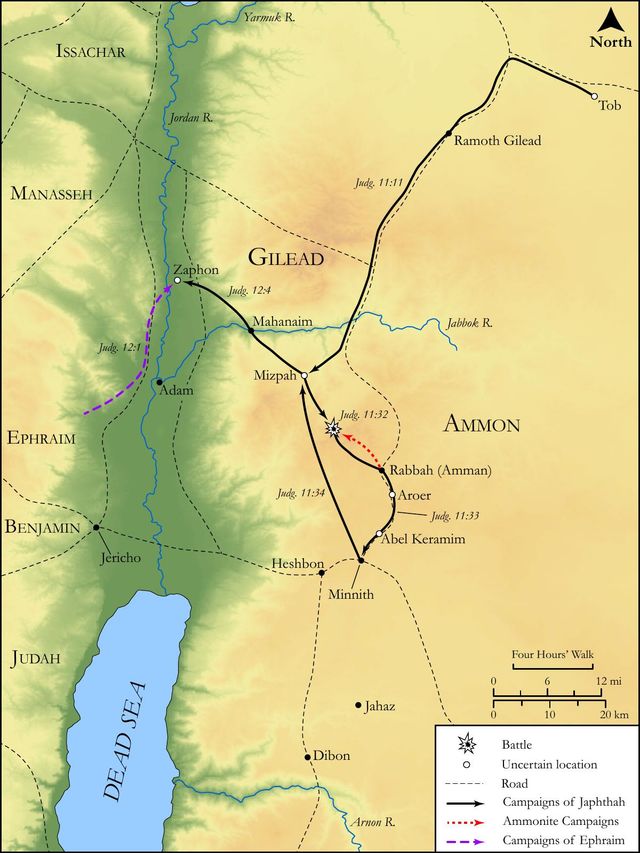
See on the biblical-era map

Study this verse
Public-domain commentary
Matthew Henry
From his Commentary on the Whole Bible. Henry comments on passages, not single verses — this entry covers Judges 12:1–7. His four-level outline is real structure in the source text, so it is rendered as structure.
Here Is, I. The unreasonable displeasure of the men of Ephraim against Jephthah, because he had not called them in to his assistance against the Ammonites, that they might share in the triumphs and spoils, Jdg 12:1. Pride was at the bottom of the quarrel. Only by that comes contention. Proud men think all the honours lost that go beside themselves, and then who can stand before envy? The Ephraimites had the same quarrel with Gideon (Jdg 8:1), who was of Manasseh on their side Jordan, as Jephthah was of Manasseh on the other side Jordan. Ephraim and Manasseh were hearer akin than any other of the tribes, being both the sons of Joseph, and yet they were more jealous one of another than any other of the tribes. Jacob having crossed hands, and given Ephraim the preference, looking as far forward as the kingdom of the ten tribes, which Ephraim was the head of, after the revolt from the house of David, that tribe, not content with that honour in the promise, was displeased if Manasseh had any honour done it in the mean time. It is a pity that kindred or relationship, which should be an inducement to love and peace, should be ever an occasion (as it often proves) of strife and discord. A brother offended is harder to be won than a strong city, and contentions among brethren are as the bars of a castle. The anger of the Ephraimites at Jephthah was, 1. Causeless and unjust. Why didst thou not call us to go with thee? For a good reason. Because it was the men of Gilead that had made him their captain, not the men of Ephraim, so that he had no authority to call them. Had his attempt miscarried for want of their help, they might justly have blamed him for not desiring it. But when the work was done, and done effectually, the Ammonites being subdued and Israel delivered, there was no harm done, though their hands were not employed in it. 2. It was cruel and outrageous. They get together in a tumultuous manner, pass over Jordan as far as Mizpeh in Gilead, where Jephthah lived, and no less will satisfy their fury but they will burn his house and him in it. Cursed be their anger, for it was fierce. Those resentments that have the least reason for them have commonly the most rage in them. Jephthah was now a conqueror over the common enemies of Israel, and they should have come to congratulate him, and return him the thanks of their tribe for the good services he had done; but we must not think it strange if we receive ill from those from whom we deserve well. Jephthah was now a mourner for the calamity of his family upon his daughter's account, and they should have come to condole with him and comfort him; but barbarous men take a pleasure in adding affliction to the afflicted. In this world, the end of one trouble often proves the beginning of another; nor must we ever boast as though we had put off the harness.
II.Jephthah's warm vindication of himself.
He did not endeavour to pacify them, as Gideon had done in the like case; the Ephraimites were now more outrageous than they were them, and Jephthah had not so much of a meek and quiet spirit as Gideon had. Whether they would be pacified or no, Jephthah takes care,
1.To justify himself, Jdg 12:2, Jdg 12:3. He makes it out that they had no cause at all to quarrel with him, for,
(1.)It was not in pursuit of glory that he had engaged in this war, but for the necessary defence of his country, with which the children of Ammon greatly strove.
(2.)He had invited the Ephraimites to come and join with him, though he neither needed them nor was under any obligation to pay that respect to them, but they had declined the service: I called you, and you delivered me not out of their hands. Had that been true which they charged him with, yet it would not have been a just ground of quarrel; but it seems it was false, and, as the matter of fact now appears, he had more cause to quarrel with them for deserting the common interests of Israel in a time of need. It is no new thing for those who are themselves most culpable to be most clamorous in accusing the innocent.
(3.)The enterprise was very hazardous, and they had more reason to pity him than to be angry with him: I put my life in my hands, that is, "exposed myself to the utmost peril in what I did, having so small an army," The honour they envied was bought dearly enough; they needed not to grudge it to him; few of them would have ventured so far for it.
(4.)He does not take the glory of the success to himself (that would have been invidious), but gives it all to God: "The Lord delivered them into my hands. If God was pleased so far to make use of me for his glory, why should you be offended at that? Have you any reason to fight against me? Is not that in effect to fight against God, in whose hand I have been only an unworthy instrument?"
2.When this just answer (though not so soft an answer as Gideon's) did not prevail to turn away their wrath, he took care both to defend himself from their fury and to chastise their insolence with the sword, by virtue of his authority as Israel's judge.
(1.)The Ephraimites had not only quarrelled with Jephthah, but, when his neighbours and friends appeared to take his part, they had abused them, and given them foul language; for I adhere to our translation, and so take it, Jdg 12:4. They said in scorn, "You Gileadites that dwell here on the other side Jordan are but fugitives of Ephraim, the scum and dregs of the tribes of Joseph, of which Ephraim is the chief, the refuse of the family, and are so accounted among the Ephraimites and among the Manassites. Who cares for you? All your neighbours know what you are, no better than fugitives and vagabonds, separated from your brethren, and driven hither into a corner." The Gileadites were as true Israelites as any other, and at this time had signalized themselves, both in the choice of Jephthah and in the war with Ammon, above all the families of Israel, and yet are most basely and unjustly called fugitives. It is an ill thing to fasten names or characters of reproach upon persons or countries, as is common, especially upon those that lie under outward disadvantages: it often occasions quarrels that prove of ill consequence, as it did here. See likewise what a mischievous thing an abusive tongue is, that calls ill names, and gives scurrilous language: it sets on fire the course of nature, and is set on fire of hell (Jam 3:6), and many a time cuts the throat of him that uses it, as it did here, Psa 64:8. If these Ephraimites could have denied themselves the poor satisfaction of calling the Gileadites fugitives, they might have prevented a great deal of bloodshed; for grievous words stir up anger, and who knows how great a matter a little of that fire may kindle?
(2.)This affront raises the Gileadites' blood, and the indignity done to themselves, as well as to their captain, must be revenged.
[1.]They routed them in the field, Jdg 12:4. They fought with Ephraim, and, Ephraim being but a rude unheaded rabble, smote Ephraim, and put them to flight.
[2.]They cut off their retreat, and so completed their revenge, Jdg 12:5, Jdg 12:6. The Gileadites, who perhaps were better acquainted with the passages of Jordan than the Ephraimites were, secured them with strong guards, who were ordered to slay every Ephraimite that offered to pass the river. Here was, First, Cruelty enough in the destruction of them. Sufficient surely was the punishment which was inflicted by many; when they were routed in the field, there needed not this severity to cut off all that escaped. Shall the sword devour for ever? Whether Jephthah is to be praised for this I know not; perhaps he saw it to be a piece of necessary justice. Secondly, Cunning enough in the discovery of them. It seems the Ephraimites, though they spoke the same language with other Israelites, yet had got a custom in the dialect of their country to pronounce the Hebrew letter Shin like Samech, and they had so strangely used themselves to it that they could not do otherwise, no, not to save their lives. We learn to speak by imitation; those that first used s for sh, did it either because it was shorter or because it was finer, and their children learnt to speak like them, so that you might know an Ephraimite by it; as in England we know a west-country man or a north-country man, nay, perhaps a Shropshire man, and a Cheshire man, by his pronunciation. Thou art a Galilean, and thy speech betrays thee. By this the Ephraimites were discovered. If they took a man that they suspected to be an Ephraimite, but he denied it, they bade him say Shibboleth; but either he could not, as our translation reads it, or he did not heed, or frame, or direct himself, as some read, to pronounce it aright, but said Sibboleth, and so was known to be an Ephraimite, and was slain immediately. Shibboleth signifies a river or stream: "Ask leave to go over Shibboleth, the river." Those that were thus cut off made up the whole number of slaughtered Ephraimites forty-two thousand, Jdg 12:6. Thus another mutiny of that angry tribe was prevented.
3.Now let us observe the righteousness of God in the punishment of these proud and passionate Ephraimites, which in several instances answered to their sin.
(1.)They were proud of the honour of their tribe, gloried in this, that they were Ephraimites; but how soon were they brought to be ashamed or afraid to own their country! Art thou an Ephraimite? No, now rather of any tribe than that.
(2.)They had gone in a rage over Jordan to burn Jephthah's house with fire, but now they came back to Jordan as sneakingly as they had passed it furiously, and were cut off from ever returning to their own houses.
(3.)They had upbraided the Gileadites with the infelicity of their country, lying at such a distance, and now they suffered by an infirmity peculiar to their own country, in not being able to pronounce Shibboleth.
(4.)They had called the Gileadites, unjustly, fugitives, and now they really and in good earnest became fugitives themselves; and in the Hebrew the same word (Jdg 12:5) is used of the Ephraimites that escaped, or that fled, which they had used in scorn of the Gileadites, calling them fugitives. He that rolls the stone of reproach unjustly upon another, let him expect that it will justly return upon himself.
III.Here is the end of Jephthah's government.
He judged Israel but six years, and then died, Jdg 12:7. Perhaps the death of his daughter sunk him so that he never looked up afterwards, but it shortened his days, and he went to his grave mourning.
Continue studying Judges 12:1 across the web’s major study libraries — every link below opens this exact verse, chapter, or book on the destination site.
Read & Compare
 BibleGatewayThis verse in more than 200 translations and 70 languages.
 Bible.comThe YouVersion reader — hundreds of translations, reading plans, and highlights.
 ESV.orgCrossway's official English Standard Version reader.
 NET BibleThe NET translation with 60,000+ translators' notes on every rendering decision.
 STEP BibleTyndale House's free study tool — original text, vocabulary, and scholarly resources.
 BibliaLogos Bible Software's free web reader.
 USCCBThe New American Bible (Revised Edition) with the U.S. bishops' study notes.
Commentaries
 BibleHub CommentariesDozens of classic commentaries on this verse, gathered on one page.
 StudyLightMore than 100 commentary sets — the largest collection on the web.
 BibleRefPlain-English commentary on what this verse means, verse by verse.
 Enduring WordDavid Guzik's free commentary on this chapter, widely used by Bible teachers.
 Bible Study ToolsVerse commentary alongside Greek and Hebrew study aids.
Original Language & Research
- BibleHub InterlinearThe verse word by word — original language, transliteration, and English.
- BibleHub LexiconEvery word's original-language definition and Strong's entry.
 Blue Letter BibleDeep-study tools — Strong's numbers, concordance, and word studies.
 SefariaThe Hebrew text with Rashi and centuries of Jewish commentary.
Sermons, Hymns & Audio


TrulyRandomVerse is not affiliated with these sites and doesn’t control their content. They’re linked because they’re genuinely useful.
Summary
Judges 12:1 marks a dramatic and tragic turning point in the narrative of Jephthah, shifting abruptly from his external triumph over the Ammonites to a perilous internal conflict within Israel. The formidable tribe of Ephraim, driven by wounded pride and a deeply ingrained sense of entitlement, confronts Jephthah with a hostile accusation: he dared to fight against the Ammonites without summoning them to battle. Their aggressive posture escalates quickly into a severe threat to burn his house, underscoring the pervasive tribal jealousies, the profound disunity, and the lack of central authority that characterized the tumultuous period of the Judges, thereby setting the stage for a devastating civil war.
Context
ShowHideLiterary Context
Judges 12:1 immediately follows Jephthah's hard-won victory against the Ammonites, a triumph secured through a controversial vow that resulted in the sacrifice of his daughter (Judges 11). The narrative abruptly pivots from an external threat to an internal one, starkly highlighting the cyclical nature of chaos and disunity within Israel during the Judges period. This confrontation with Ephraim is not unprecedented; it mirrors a similar incident involving Gideon in Judges 8:1-3, establishing a recurring pattern of Ephraim's arrogant assertion of preeminence in military affairs. The verse thus serves as a critical narrative hinge, setting the stage for the tragic civil war between Gilead and Ephraim, demonstrating that even divine deliverance from external foes could not overcome the deep-seated tribal animosities and the profound lack of central, unifying authority in Israel.
Historical & Cultural Context
The period of the Judges (approximately 12th-11th century BC) was characterized by a decentralized tribal confederacy in Israel, lacking a unified monarchy or strong central government. Each tribe largely operated independently, leading to frequent internal disputes and struggles for dominance. Ephraim, as a descendant of Joseph and geographically situated in the central highlands, often asserted a leadership role, viewing itself as the preeminent tribe among the northern confederation. Gilead, located east of the Jordan River, was frequently perceived as peripheral or less significant. The accusation that Jephthah "passedst thou over to fight" without them was a profound insult to Ephraim's tribal honor, military prestige, and perceived right to be consulted and to lead in any national military endeavor. The chilling threat, "we will burn thine house upon thee with fire," was not merely a threat of property damage but a declaration of intent to utterly annihilate Jephthah's household, lineage, and authority, representing a severe act of vengeance and a complete erasure of his standing in ancient Near Eastern culture.
Key Themes
ShowHideThis verse powerfully introduces and amplifies several critical themes prevalent in the book of Judges. First, Tribal Pride and Jealousy are paramount, as Ephraim's wounded ego and sense of entitlement overshadow the shared victory and God's deliverance. Their self-centeredness reveals a profound spiritual blindness, prioritizing their own perceived honor over national unity and God's glory. Second, Internal Disunity and Anarchy are starkly displayed; immediately after a common triumph, Israel teeters on the brink of civil war, illustrating how internal strife can be more destructive than external enemies, a theme tragically revisited in the devastating war against Benjamin in Judges 20. Third, the verse highlights the Consequences of Unchecked Anger and Grievance, demonstrating how pride, when left unaddressed, can rapidly escalate into destructive rage and violence. Finally, it underscores the Challenges of Leadership in a fragmented society, as Jephthah, a newly established judge and deliverer, immediately faces a formidable internal challenge to his authority and wisdom, revealing the precarious nature of leadership without divine and communal cohesion.
Exposition and Analysis
ShowHideKey Word Analysis
ShowHideThis verb (H6817), from the root צָעַק (ṣâʻaq), often means "to cry out," "to call," or "to assemble." Here, in the Niphal stem, it signifies an active, deliberate, and often agitated gathering or mobilization. It conveys a sense of a summoned assembly, implying not a casual meeting but a purposeful, even hostile, convergence of forces, emphasizing the aggressive and confrontational intent of the Ephraimites.
From the root עָבַר (H5674, ʻâbar), meaning "to cross over" or "to pass through." In this context, it specifically refers to Jephthah's crossing of the Jordan River from Gilead into Ammonite territory to engage in battle. Ephraim's use of this word underscores their grievance: Jephthah, from the "other side" of the Jordan, dared to undertake a major military campaign without consulting or involving them, thereby bypassing their perceived authority and military prowess.
While referring to the act of setting on fire (H8313, sâraph), this word, in the context of the full threat "we will burn thine house upon thee with fire" (which also uses H1004 bayith for "house" and H784 ʼêsh for "fire"), signifies total annihilation. In ancient Near Eastern culture, burning a house was not merely property damage but a declaration of intent to utterly destroy a person's entire existence – their family, their lineage, their name, and their standing. The phrase "upon thee" (עָלֶיךָ - ʿālêḵā) further suggests a personal, immediate, and potentially fatal threat to Jephthah himself, implying he would be consumed along with his household.
Verse Breakdown
ShowHide"And the men of Ephraim gathered themselves together, and went northward,"
This opening clause immediately establishes the antagonists and their aggressive posture. The Ephraimites, a powerful and often arrogant tribe, are not merely voicing a complaint but actively mobilizing ("gathered themselves together") and moving geographically ("went northward") from their central territory towards Gilead. This organized movement signals a direct, intentional, and confrontational challenge to Jephthah's authority and the Gileadites.
"and said unto Jephthah, Wherefore passedst thou over to fight against the children of Ammon, and didst not call us to go with thee?"
This is the core of Ephraim's accusation, revealing their wounded pride and sense of entitlement. They challenge Jephthah's independent decision-making and demand an explanation for his failure to summon them for a major military undertaking. Their grievance stems from a perceived slight to their tribal honor and their expectation of being the primary military force, highlighting their self-importance and resentment that a leader from a less prominent region achieved such a victory without their "indispensable" assistance.
"we will burn thine house upon thee with fire."
This final clause is a chilling and unequivocal threat, escalating the verbal confrontation to a declaration of extreme violence and total destruction. As analyzed above, it implies not just the destruction of Jephthah's physical dwelling but the complete obliteration of his family, his legacy, and potentially his very life. This demonstrates the profound depth of their rage and their intent to utterly destroy Jephthah's standing and existence.
Literary Devices
ShowHideThe verse is rich in Foreshadowing, immediately signaling the tragic and bloody civil war that will unfold in the subsequent verses, highlighting the deep internal decay of Israel. There is a profound Irony in the fact that immediately after a victory over an external enemy, Israel plunges into a more destructive internal conflict, demonstrating the nation's spiritual and social brokenness and its inability to maintain unity even in success. The Ephraimites' threat, "we will burn thine house upon thee with fire," employs Hyperbole to convey the extreme nature of their anger and their intent to utterly destroy Jephthah, though it also carries a terrifying literal weight in the context of ancient warfare and the severity of their intent. The verse also presents a stark Contrast between the unified effort required to defeat the Ammonites and the immediate disunity that threatens to tear Israel apart from within, emphasizing the self-destructive nature of tribalism and pride.
Theological and Thematic Connections
ShowHideJudges 12:1 serves as a powerful theological commentary on the destructive nature of pride, envy, and unchecked tribalism when not submitted to God's authority and a commitment to communal unity. It vividly illustrates how human ego and self-interest can quickly derail divine deliverance, transforming a moment of triumph into profound tragedy. The Ephraimites' focus on their own perceived honor and preeminence, rather than the glory of God or the well-being of the entire nation, reveals a profound spiritual immaturity and a failure to grasp the communal identity of Israel as God's covenant people. This passage underscores the constant biblical tension between individual/group autonomy and the call to corporate unity, demonstrating how easily internal divisions can become more perilous than external threats. It is a stark reminder that true strength and flourishing for God's people lie not in tribal dominance or self-assertion, but in humble cooperation, mutual respect, and a shared devotion to God's will and purposes.
Reflection and Application
ShowHideJudges 12:1 offers a sobering mirror for individuals and communities today, particularly within the church. It challenges us to deeply examine the roots of our grievances and the ways we respond to perceived slights or the successes of others. Are we quick to assert our own importance, demand credit, or harbor resentment when God uses others in ways that don't involve us or align with our expectations? This passage implores us to cultivate genuine humility, recognizing that God is sovereign and uses diverse people and methods for His purposes, and that true spiritual success is found in collaborative effort and selfless service, not in personal glory or tribal dominance. It calls us to prioritize unity over ego, to engage in constructive communication rather than aggressive confrontation, and to earnestly seek reconciliation over retaliation. When pride and envy are allowed to fester, they can rapidly escalate into destructive conflict, undermining the very fabric of healthy relationships, families, and communities. We are powerfully reminded that internal divisions can be far more damaging than external pressures, requiring constant vigilance, self-examination, and a commitment to Christ-like love and mutual respect.
Questions for Reflection
ShowHideFAQ
ShowHideWhy was Ephraim so angry with Jephthah, even after he won a great victory?
ShowHideEphraim's anger stemmed from a deep-seated sense of tribal pride and a profound perceived slight to their honor and preeminence. As a powerful and central tribe, they believed they held a preeminent right to be consulted and to lead in major military campaigns that involved the entire nation. Jephthah, a Gileadite from a less prominent region east of the Jordan, had achieved a significant victory without summoning them, which Ephraim viewed as a profound act of disrespect and a direct challenge to their established authority and military prestige. This was not an isolated incident; Ephraim had a strikingly similar confrontation with Gideon after his victory over Midian, as recorded in Judges 8:1. Their anger was less about the victory itself and more about their exclusion and the perceived diminishing of their status and importance within Israel.
Does this passage suggest a pattern of behavior for the tribe of Ephraim in the book of Judges?
ShowHideYes, Judges 12:1 certainly highlights a recurring and problematic pattern of behavior for the tribe of Ephraim throughout the book of Judges. Their aggressive confrontation with Jephthah is strikingly similar to their earlier complaint against Gideon in Judges 8:1. In both instances, Ephraim expresses indignation and threatens violence because they were not called upon to participate in a significant military victory, believing their involvement was essential and their exclusion an insult. This consistent pattern reveals a profound tribal arrogance, a relentless desire for preeminence among the tribes, and a readiness to resort to aggressive confrontation and even violence when their pride is wounded. This behavior contributes significantly to the overall theme of internal disunity, moral decay, and political fragmentation that characterizes the period of the Judges, where "everyone did what was right in his own eyes" (Judges 21:25).
Christ-Centered Fulfillment
ShowHideThe tragic disunity, self-serving pride, and destructive violence displayed in Judges 12:1 vividly underscore the desperate need for a true King and a perfect High Priest who could genuinely unite God's people. Jephthah, a flawed human judge, could not overcome the deep-seated tribalism and pervasive human sin that led to such devastating internal conflict. The chaos and bloodshed that immediately follow this verse reveal the ultimate failure of human leadership and the inadequacy of the Old Covenant system to bring lasting peace and spiritual cohesion. In stark contrast, Jesus Christ is the ultimate fulfillment of Israel's longing for a unifying leader and a perfect deliverer. He is the one who breaks down "the dividing wall of hostility" (Ephesians 2:14) not through force, tribal dominance, or the assertion of personal honor, but through His humble obedience and self-sacrificial love on the cross (Philippians 2:5-8). Unlike the Ephraimites, who sought their own glory and preeminence, Christ "did not come to be served, but to serve, and to give his life as a ransom for many" (Matthew 20:28). He calls His followers to a new kind of unity, one rooted in love for God and for one another (John 13:34-35), profound humility (Colossians 3:12-14), and active peacemaking (Matthew 5:9). Through the indwelling power of His Spirit, He empowers believers to live out the unity for which He prayed (John 17:20-23), transforming hearts from tribal pride and self-interest to humble, Christ-like love and a shared commitment to His kingdom.