


Jeremiah 33:21
Bible text: King James Version (1769 Blayney text) · Public domain
Bible text: King James Version with Strong's numbers · Public domain
Bible text: Berean Standard Bible · Public domain
Bible text: American Standard Version (1901) · Public domain
Bible text: World English Bible, Messianic edition · Public domain
Bible text: Geneva Bible (1599) · Public domain
Bible text: Young's Literal Translation · Public domain
- גַּםgamalsoH1571AdvAdverb
- בְּרִיתִיbe·ri·Timy covenantH1285N-fsc ¦ 1csNoun Singular Feminine Constructבְּרִיתִcovenantיmy
- תֻפַרtu·Farit will be brokenH6565V-Hophal-Imperf-3fsVerb Hophal Imperfect 3rd Singular Feminine
- אֶת'etwithH854PrepPreposition
- דָּוִדda·VidDavidH1732N-proper-mNoun Proper Masculine
- עַבְדִּי'av·Dimy servantH5650N-msc ¦ 1csNoun Singular Masculine Constructעַבְדִּservantיmy
- מִהְיוֹתmih·yotfrom belongingH1961Prep-m ¦ V-Qal-InfVerb Qal Infinitive Constructמִfromהְיוֹתbelonging
- לוֹloto <the> himPrep-l ¦ 3msSuffix Personal 3rd Singular Masculineלto <the>וֹhim
- בֵןvena sonH1121N-msNoun Singular Masculine Absolute
- מֹלֵךְmo·Lekh[who] reignsH4427V-Qal-Prtcpl-msVerb Qal Participle Singular Masculine Absolute
- עַל'alonH5921PrepPreposition
- כִּסְאוֹkis·'Ohis throneH3678N-msc ¦ 3msNoun Singular Masculine Constructכִּסְאthroneוֹhis
- וְאֶתve·'Etand withH854Conj-w ¦ PrepPrepositionוְandאֶתwith
- הַלְוִיִּםhal·vi·Yimthe LevitesH3881Art ¦ N-mpNoun Gentilic Plural Masculine AbsoluteהַtheלְוִיִּםLevites
- הַכֹּהֲנִיםha·ko·ha·Nimthe priestsH3548Art ¦ N-mpNoun Plural Masculine Absoluteהַtheכֹּהֲנִיםpriests
- מְשָׁרְתָיme·sha·re·Taimy servantsH8334V-Piel-Prtcpl-mp ¦ 1csVerb Piel Participle Plural Masculine Constructמְשָׁרְתָservantsיmy
English is a literal word-by-word gloss of the Hebrew, not the KJV's wording. Why?
This is the original text the KJV's translators worked from — each Hebrew word with its own literal English meaning in this verse, prepared by scholars at Tyndale House, Cambridge. The KJV translates whole sentences, not word by word, so its wording differs: one Hebrew word can become several English words, and the KJV may choose “the LORD” where the gloss reads “Yahweh”. Both are faithful — they answer different questions. For the KJV's own rendering, switch to the KJV text.
Details
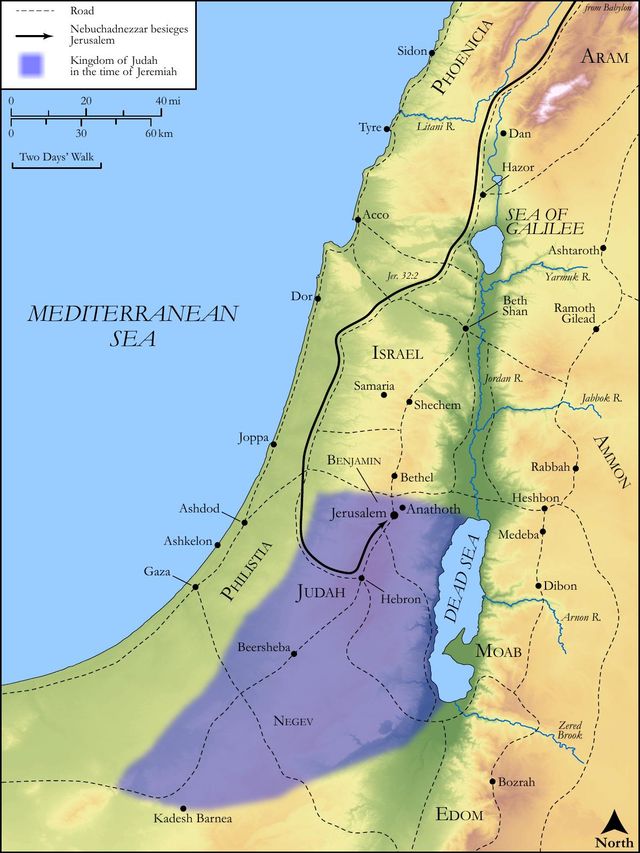
See on the biblical-era map
Study this verse
Public-domain commentary
Matthew Henry
From his Commentary on the Whole Bible. Henry comments on passages, not single verses — this entry covers Jeremiah 33:17–26. His two-level outline is real structure in the source text, so it is rendered as structure.
Three of God's covenants, that of royalty with David and his seed, that of the priesthood with Aaron and his seed, and that of Peculiarity with Abraham and his seed, seemed to be all broken and lost while the captivity lasted; but it is here promised that, notwithstanding that interruption and discontinuance for a time, they shall all three take place again, and the true intents and meaning of them all shall be abundantly answered in the New Testament blessings, typified by those conferred on the Jews after their return out of captivity.
I.The covenant of royalty shall be secured and the promises of it shall have their full accomplishment in the kingdom of Christ, the Son of David, Jer 33:17. The throne of Israel was overturned in the captivity; the crown had fallen from their head; there was not a man to sit on the throne of Israel; Jeconiah was written childless. After their return the house of David made a figure again; but it in the Messiah that this promise is performed that David shall never want a man to sit on the throne of Israel, and that David shall have always a son to reign upon his throne. For as long as the man Christ Jesus sits on the right hand of the throne of God, rules the world, and rules it for the good of the church, to which he is a quickening head, and glorified head over all things, as long as he is King upon the holy hill of Zion, David does not want a successor, nor is the covenant with him broken. When the first-begotten was brought into the world it was declared concerning him, The Lord God shall give him the throne of his father David and he shall reign over the house of Jacob for ever, Luk 1:32, Luk 1:33. For the confirmation of this it is promised,
1.That the covenant with David shall be as firm as the ordinances of heaven, to the stability of which that of God's promise is compared, Jer 31:35, Jer 31:36. There is a covenant of nature, by which the common course of providence is settled and on which it is founded, here called a covenant of the day and the night (Jer 33:20, Jer 33:25), because this is one of the articles of it, That there shall be day and night in their season, according to the distinction put between them in the creation, when God divided between the light and the darkness, and established their mutual succession, and a government to each, that the sun should rule by day and the moon and stars by night (Gen 1:4, Gen 1:5, Gen 1:16), which establishment was renewed after the flood (Gen 8:22), and has continued ever since, Psa 19:2. The morning and the evening have both of them their regular outgoings (Psa 65:8); the day-spring knows its place, knows its time, and keeps both, so do the shadows of the evening; and, while the world stands, this course shall not be altered, this covenant shall not be broken. The ordinances of heaven and earth (of this communication between heaven and earth, the dominion of these ordinances of heaven upon the earth), which God has appointed (Jer 33:25; compare Job 38:33), shall never be disappointed. Thus firm shall the covenant of redemption be with the Redeemer - God's servant, but David our King, Jer 33:21. This intimates that Christ shall have a church on earth to the world's end; he shall see a seed in which he shall prolong his days till time and day shall be no more. Christ's kingdom is an everlasting kingdom; and when the end cometh, and not till then, it shall be delivered up to God, even the Father. But it intimates that the condition of it in this world shall be intermixed and counterchanged, prosperity and adversity succeeding each other, as light and darkness, day and night. But this is plainly taught us, that, as sure as we may be that, though the sun will set tonight, it will rise again tomorrow morning, whether we live to see it or no, so sure we may be that, though the kingdom of the Redeemer in the world may for a time be clouded and eclipsed by corruptions and persecutions, yet it will shine forth again, and recover its lustre, in the time appointed.
2.That the seed of David shall be as numerous as the host of heaven, that is, the spiritual seed of the Messiah, that shall be born to him by the efficacy of his gospel and his Spirit working with it. From the womb of the morning he shall have the dew of their youth, to be his willing people, Psa 110:3. Christ's seed are not, as David's were, his successors, but his subjects; yet the day is coming when they also shall reign with him (Jer 33:22): As the host of heaven cannot be numbered, so will I multiply the seed of David, so that there shall be no danger of the kingdom's being extinct, or extirpated, for want of heirs. The children are numerous; and, if children, then heirs.
II.The covenant of priesthood shall be secured, and the promises of that also shall have their full accomplishment.
This seemed likewise to be forgotten during the captivity, when there was no altar, no temple service, for the priests to attend upon; but this also shall revive. It did so; immediately upon their coming back to Jerusalem there were priests and Levites ready to offer burnt-offerings and to do sacrifice continually (Ezr 3:2, Ezr 3:3), as is here promised, Jer 33:18. But that priesthood soon grew corrupt; the covenant of Levi was profaned (as appears Mal 2:8), and in the destruction of Jerusalem by the Romans it came to a final period. We must therefore look elsewhere for the performance of this word, that the covenant with the Levites, the priests, God's ministers, shall be as firm, and last as long, as the covenant with the day and the night. And we find it abundantly performed,
1.In the priesthood of Christ, which supersedes that of Aaron, and is the substance of that shadow. While that great high priest of our profession is always appearing in the presence of God for us, presenting the virtue of his blood by which he made atonement in the incense of his intercession, it may truly be said that the Levites do not want a man before God to offer continually, Heb 7:3, Heb 7:17. He is a priest for ever. The covenant of the priesthood is called a covenant of peace (Num 25:12), of life and peace, Mal 2:5. Now we are sure that this covenant is not broken, nor in the least weakened, while Jesus Christ is himself our life and our peace. This covenant of priesthood is here again and again joined with that of royalty, for Christ is a priest upon his throne, as Melchizedek.
2.In a settled gospel ministry. While there are faithful ministers to preside in religious assemblies, and to offer up the spiritual sacrifices of prayer and praise, the priests, the Levites, do not want successors, and such as have obtained a more excellent ministry. The apostle makes those that preach the gospel to come in the room of those that served at the altar, Co1 9:13, Co1 9:14.
3.In all true believers, who are a holy priesthood, a royal priesthood (Pe1 2:5, Pe1 2:9), who are made to our God kings and priests (Rev 1:6); they offer up spiritual sacrifices, acceptable to God, and themselves, in the first place, living sacrifices. Of these Levites this promise must be understood (Jer 33:22), that they shall be as numerous as the sand of the sea, the same that is promised concerning Israel in general (Gen 22:17); for all God's spiritual Israel are spiritual priests, Rev 5:9, Rev 5:10; Rev 7:9, Rev 7:15.
III.The covenant of peculiarity likewise shall be secured and the promises of that covenant shall have their full accomplishment in the gospel Israel. Observe,
1.How this covenant was looked upon as broken during the captivity, Jer 33:24. God asks the prophet, "Hast though not heard, and dost thou not consider, what this people have spoken?" either the enemies of Israel, who triumphed in the extirpation of a people that had made such a noise in the world, or the unbelieving Israelites themselves, "this people among whom thou dwellest;" they have broken covenant with God, and then quarrel with him as if he had not dealt faithfully with them. The two families which the Lord hath chosen, Israel and Judah, whereas they were but one when he chose them, he hath even cast them off. "Thus have they despised my people, that is, despised the privilege of being my people as if it were a privilege of no value at all." The neighbouring nations despised them as now no more a nation, but the ruins of a nation, and looked upon all their honour as laid in the dust; but,
2.See how firm the covenant stands notwithstanding, as firm as that with day and night; sooner will God suffer day and night to cease then he will cast away the seed of Jacob. This cannot refer to the seed of Jacob according to the flesh, for they are cast away, but to the Christian church, in which all these promises were to be lodged, as appears by the apostle's discourse, Rom 11:1, etc. Christ is that seed of David that is to be perpetual dictator to the seed of Abraham, Isaac, and Jacob; and, as this people shall never want such a king, so this king shall never want such a people. Christianity shall continue in the dominion of Christ, and the subjection of Christians to him, till day and night come to an end. And, as a pledge of this, that promise is again repeated, I will cause their captivity to return; and, having brought them back, I will have mercy on them. To whom this promise refers appears Gal 6:16, where all that walk according to the gospel rule are made to be the Israel of God, on whom peace and mercy shall be.
Historical interpretation
Historical reception
2 surviving comments on this verse. Each one is dated, so this reads as a timeline rather than a list.
Select a marker to jump to its quote. Markers stagger vertically where authors wrote within a few decades of each other.
We see the fulfillment of this prophecy as well. When the new covenant was given, in keeping with the divine promise, the priesthood was also given according to the order of Melchizedek, and those to whom it was promised offer the spiritual sacrifice to God continually. Then he says, as it is impossible for day to become night, so it is impossible for the Davidic monarchy to be destroyed. The fulfillment of this prophecy is also clear: Christ, who is of David according to the flesh, does not occupy the throne here below. He does, however, govern all things as he sits next to the Father. This is precisely what he also says about the priests and the Levites, noting that their line will be compared with the host of heaven and the sand of the sea. The facts confirm what is said: the whole land and sea are full of high priests and the deacons performing the liturgy of the Levites.
“But the counsel of the Lord stands forever. The thoughts of his heart are for all time.” Just as he said that the debased plans of people are to be made vain, so now he says that the dispositions of the Lord remain forever. While the sinner and the mortal person experience transient things, the eternal Lord established what will never be blameworthy. As Isaiah says, “All my counsel shall be enduring, and all that I meditated I shall achieve.” Jeremiah too says the same thing: “If my covenant were not under guard day and night, I should not have issued the laws of heaven and earth.”
Continue studying Jeremiah 33:21 across the web’s major study libraries — every link below opens this exact verse, chapter, or book on the destination site.
Read & Compare
 BibleGatewayThis verse in more than 200 translations and 70 languages.
 Bible.comThe YouVersion reader — hundreds of translations, reading plans, and highlights.
 ESV.orgCrossway's official English Standard Version reader.
 NET BibleThe NET translation with 60,000+ translators' notes on every rendering decision.
 STEP BibleTyndale House's free study tool — original text, vocabulary, and scholarly resources.
 BibliaLogos Bible Software's free web reader.
 USCCBThe New American Bible (Revised Edition) with the U.S. bishops' study notes.
Commentaries
 BibleHub CommentariesDozens of classic commentaries on this verse, gathered on one page.
 StudyLightMore than 100 commentary sets — the largest collection on the web.
 BibleRefPlain-English commentary on what this verse means, verse by verse.
 Enduring WordDavid Guzik's free commentary on this chapter, widely used by Bible teachers.
 Bible Study ToolsVerse commentary alongside Greek and Hebrew study aids.
Original Language & Research
- BibleHub InterlinearThe verse word by word — original language, transliteration, and English.
- BibleHub LexiconEvery word's original-language definition and Strong's entry.
 Blue Letter BibleDeep-study tools — Strong's numbers, concordance, and word studies.
 SefariaThe Hebrew text with Rashi and centuries of Jewish commentary.
Sermons, Hymns & Audio


TrulyRandomVerse is not affiliated with these sites and doesn’t control their content. They’re linked because they’re genuinely useful.
Summary
Jeremiah 33:21 serves as a profound declaration of God's unwavering faithfulness, asserting the absolute certainty and perpetual nature of His divine covenants with King David and with the Levitical priesthood. Delivered during a period of intense national distress and impending exile, this verse offers a powerful reassurance that just as the order of day and night cannot be broken, neither can God's solemn promises concerning a perpetual Davidic heir on the throne and an enduring Levitical ministry be annulled. It powerfully underscores the immutability of God's word and His steadfast commitment to His redemptive plans for His people, even amidst their deepest despair.
Context
ShowHideLiterary Context
Jeremiah 33:21 is situated within a larger prophetic section (Jeremiah 33:14-26) that dramatically pivots from pronouncements of judgment and impending exile to glorious promises of restoration and hope for both Israel and Judah. This verse immediately follows a rhetorical question in Jeremiah 33:20, which establishes the unchangeable nature of the natural order (the covenant of day and night). By linking the stability of the order of day and night to the stability of His covenants with David and the Levites, God employs a powerful rhetorical device to underscore their absolute, unshakeable certainty. The preceding verses (Jeremiah 33:14-18) speak of the coming "Righteous Branch" from David, further emphasizing the Messianic hope inherent in the Davidic covenant, setting the stage for the reaffirmation of its eternal nature.
Historical & Cultural Context
The prophecies in Jeremiah 33 were delivered during a time of extreme national crisis for Judah, specifically when Jerusalem was under siege by the Babylonians (circa 588-586 BC). The city was on the brink of destruction, the monarchy was failing, and the temple was soon to be desecrated. In such a bleak and desperate cultural milieu, the people of Judah might have felt that God had abandoned them or that His promises had failed. The very idea of a perpetual Davidic king or an enduring priesthood seemed utterly impossible given the political and spiritual collapse. Jeremiah's message, therefore, served as a counter-narrative to the prevailing despair, reminding a disbelieving generation of God's sovereign control and His unbreakable word, even when all human institutions appeared to be crumbling.
Key Themes
ShowHideThe central theme of Jeremiah 33:21 is the unbreakable nature of God's covenants. The rhetorical structure, "Then may also my covenant be broken," highlights the utter impossibility of these divine arrangements being annulled, paralleling the steadfastness of the natural order established in Jeremiah 33:20. This speaks profoundly to God's steadfastness and perfect faithfulness (Hebrew hesed). Secondly, the verse explicitly reaffirms the Davidic Covenant, first established in 2 Samuel 7:12-16, promising an eternal dynasty and throne for David's descendants. This covenant points forward to the Messiah. Thirdly, it underscores the Levitical Covenant, ensuring the continuity of a consecrated priesthood to minister before God. While the Old Testament sacrificial system would eventually be fulfilled and superseded, the spiritual reality of a perpetual priesthood serving God remains, finding its ultimate expression in the new covenant. These themes collectively reinforce God's sovereign plan for salvation and worship, even amidst human failure and historical upheaval.
Exposition and Analysis
ShowHideKey Word Analysis
ShowHideDefined as "a compact (because made by passing between pieces of flesh)." This term emphasizes a solemn, binding agreement, often initiated by God Himself, highlighting the divine origin and unalterable nature of the promises made to David and the Levites. It is not a mere contract but a divinely sworn oath, underscoring God's sovereignty and unwavering commitment to His word.
Meaning "to break up (usually figuratively), i.e., to violate, frustrate." In this context, its use in a rhetorical question emphasizes the absolute impossibility of God's covenants being violated or rendered void. Just as the laws governing day and night cannot be frustrated, neither can God's sacred promises to His chosen lines of leadership.
Defined as "a son (as a builder of the family name), in the widest sense (of literal and figurative relationship, including grandson, subject, nation, quality or condition, etc.)." Here, it specifically refers to a male descendant of David who would reign upon his throne, ensuring the continuity of the Davidic line. This word is crucial for understanding the dynastic promise of the Davidic covenant, which anticipates a perpetual lineage culminating in the Messiah.
Verse Breakdown
ShowHide"[Then] may also my covenant be broken with David my servant,"
This opening clause establishes the premise of the rhetorical question, directly linking back to the preceding verse. The word "Then" (Hebrew gam) implies a direct comparison: "If the covenant of day and night can be broken, then my covenant with David can also be broken." The phrase "my covenant" highlights God as the initiator and guarantor of this solemn agreement. David is identified as "my servant," emphasizing his chosen status and obedience, which formed the basis for God's promise to him.
"that he should not have a son to reign upon his throne;"
This clause specifies the content of the Davidic covenant being discussed—the promise of a perpetual heir to David's throne. The negative phrasing ("should not have a son to reign") underscores the impossibility of this outcome. It asserts that God's promise of a continuous royal line from David, ensuring a king to sit on his throne, is as immutable as the natural order. This promise was especially vital during a time when the Davidic monarchy was on the verge of collapse.
"and with the Levites the priests, my ministers."
This final clause extends the same unbreakable certainty to the covenant with the Levites, specifically those designated as "the priests." These were the descendants of Aaron from the tribe of Levi, consecrated to serve God in the temple. They are called "my ministers," signifying their divinely appointed role in mediating between God and His people through sacrificial worship and instruction. The inclusion of the Levitical covenant alongside the Davidic covenant emphasizes God's commitment to both the political/royal and the spiritual/religious leadership of His people, assuring their continued function despite national apostasy and impending exile.
Literary Devices
ShowHideJeremiah 33:21 powerfully employs Rhetorical Question and Hyperbole to emphasize the absolute certainty of God's covenants. The verse functions as the conclusion to the rhetorical question posed in Jeremiah 33:20, where God asks if His covenant with day and night can be broken. The implied answer is a resounding "No," which then leads to the hyperbolic statement in verse 21: "Then may also my covenant be broken..." This is a form of reductio ad absurdum, where an absurd or impossible condition (the breaking of the order of day and night) is presented to demonstrate the utter impossibility of the alternative (the breaking of God's covenants). The effect is to magnify God's Faithfulness and the Immutability of His promises, providing profound assurance to a people facing seemingly insurmountable despair. The parallel structure between the Davidic and Levitical covenants also highlights the comprehensive nature of God's enduring commitment to His people's governance and spiritual life.
Theological and Thematic Connections
ShowHideJeremiah 33:21 is a profound testament to the steadfastness of God's covenant faithfulness, particularly in times of national upheaval and perceived divine silence. It underscores that God's promises are not contingent upon human performance or historical circumstances, but upon His own immutable character. The unbreakable nature of the Davidic and Levitical covenants, presented as being as certain as the order of day and night, provides a bedrock of hope that God's redemptive plan for His people will ultimately prevail. This truth is foundational to understanding the continuity of God's work from the Old Testament to the New, where these ancient promises find their ultimate and eternal fulfillment in Jesus Christ.
Reflection and Application
ShowHideJeremiah 33:21 offers immense comfort and profound assurance to believers in every generation. In a world marked by constant change, broken promises, and uncertain futures, this verse stands as an unwavering beacon of God's absolute reliability. It reminds us that our hope is not placed in fleeting human institutions or fallible leaders, but in the faithful God who keeps His word, even when circumstances seem to contradict His promises. This truth should inspire deep trust, enabling us to rest in His sovereign plan even amidst personal trials or global turmoil. Just as God ensured a perpetual line for David and an enduring priesthood, He continues to uphold His promises to us, providing a secure foundation for our faith and a living hope for our future. This passage calls us to look beyond immediate difficulties and fix our gaze on the unchanging character of God, whose covenants are eternally secure.
Questions for Reflection
ShowHideFAQ
ShowHideWhat is the significance of God's covenant with David in this verse?
ShowHideThe covenant with David, first established in 2 Samuel 7, promised that David would always have a descendant on his throne, establishing an eternal dynasty. In Jeremiah 33:21, God reaffirms the absolute certainty of this promise, even when the Davidic monarchy was on the verge of collapse and the future seemed hopeless. This promise is crucial because it foreshadows the coming of the Messiah, Jesus Christ, who is the ultimate "Son of David" and whose kingdom is eternal. It assures God's people that His plan for a righteous king will never fail, regardless of human failure or historical upheaval.
What is the significance of God's covenant with the Levites in this verse?
ShowHideThe covenant with the Levites refers to God's ordination of the tribe of Levi, specifically the line of Aaron, to serve as priests and ministers before Him (see Numbers 25:13). This covenant ensured a perpetual priesthood to mediate between God and His people through sacrifices and worship. Jeremiah 33:21 guarantees that this priestly ministry would never cease, emphasizing God's commitment to the spiritual life of His people. While the Old Testament sacrificial system was completed in Christ, the spiritual reality of a priesthood offering spiritual sacrifices continues through all believers (as a "royal priesthood" in 1 Peter 2:9), and ultimately in Christ's eternal high priesthood.
How does Jeremiah 33:21 relate to the New Testament?
ShowHideJeremiah 33:21 finds its ultimate fulfillment in the New Testament through Jesus Christ. The promise of a perpetual "son to reign upon his throne" from David's line is perfectly fulfilled in Jesus, who is explicitly identified as the "Son of David" (e.g., Matthew 1:1). The angel Gabriel announces to Mary that Jesus "will reign over the house of Jacob forever, and of his kingdom there will be no end" (Luke 1:32-33). Similarly, the promise of a perpetual priesthood is fulfilled in Christ's eternal high priesthood, as described in the book of Hebrews. He is the perfect High Priest who offered a single, sufficient sacrifice for all time, rendering the Levitical sacrifices obsolete yet fulfilling their purpose. Thus, both ancient covenants find their perfect and eternal reality in Christ.
Christ-Centered Fulfillment
ShowHideJeremiah 33:21, with its declaration of God's unbreakable covenants with David and the Levites, finds its glorious and ultimate fulfillment in the person and work of Jesus Christ. The promise of a perpetual "son to reign upon his throne" from David's lineage is perfectly realized in Jesus, who is the "Son of David" par excellence, the Messiah whose kingdom is eternal and whose reign knows no end, as proclaimed by the angel Gabriel in Luke 1:32-33. He is the righteous Branch (Jeremiah 33:15) who perfectly embodies the Davidic kingship, establishing a spiritual kingdom that transcends earthly boundaries and endures forever. Furthermore, the covenant with the Levites, ensuring a perpetual priesthood, is fulfilled in Christ's eternal high priesthood. The book of Hebrews extensively details how Jesus, as a priest after the order of Melchizedek, offered a single, perfect, and definitive sacrifice that forever atoned for sin, thereby superseding the temporary and repetitive sacrifices of the Levitical system. Through His finished work on the cross and His resurrection, Jesus became both the perfect King and the perfect Priest, uniting both offices in Himself and establishing a new covenant (as prophesied in Jeremiah 31:31-34) that is truly unbreakable and eternally effective, inviting all believers into a royal priesthood (as seen in 1 Peter 2:9) to minister before God.