


Joshua 22:25
Bible text: King James Version (1769 Blayney text) · Public domain
Bible text: King James Version with Strong's numbers · Public domain
Bible text: Berean Standard Bible · Public domain
Bible text: American Standard Version (1901) · Public domain
Bible text: World English Bible, Messianic edition · Public domain
Bible text: Geneva Bible (1599) · Public domain
Bible text: Young's Literal Translation · Public domain
- וּגְבוּלu·ge·Vuland a borderH1366Conj-w ¦ N-msNoun Singular Masculine Absoluteוּandגְבוּלa border
- נָתַןna·tanhe has putH5414V-Qal-Perf-3msVerb Qal Perfect 3rd Singular Masculine
- יְהוָהYah·wehYahwehH3068N-properNoun Proper Title
- בֵּינֵנוּbei·Ne·nubetween usH996Adj-msc ¦ 1cpAdjective Numerical Singular Masculine Constructבֵּינֵbetweenנוּus
- וּבֵינֵיכֶםu·vei·nei·Khemand between youH996Conj-w ¦ Adj-mpc ¦ 2mpAdjective Numerical Plural Masculine Constructוּandבֵינֵיbetweenכֶםyou
- בְּנֵיbe·nei[the] descendants ofH1121N-mpcNoun Plural Masculine Construct
- רְאוּבֵןre·'u·VenReubenH7205N-proper-mNoun Proper Masculine
- וּבְנֵיu·ve·neiand [the] descendants ofH1121Conj-w ¦ N-mpcNoun Plural Masculine Constructוּandבְנֵי[the] descendants of
- גָדgadGadH1410N-proper-mNoun Proper Masculine
- אֶת'et<obj.>H853DirObjMParticle Object Indicator
- הַיַּרְדֵּןhai·yar·Denthe JordanH3383Art ¦ N-properNoun Proper LocationהַtheיַּרְדֵּןJordan
- אֵין'einnotH369N-mscNoun Singular Masculine Construct
- לָכֶםla·Khem[belongs] to <the> youPrep-l ¦ 2mpSuffix Personal 2nd Plural Masculineלָ[belongs] to <the>כֶםyou
- חֵלֶקChe·leka portionH2506N-msNoun Singular Masculine Absolute
- בַּיהוָהba·Yah·wehin YahwehH3068Prep-b ¦ N-properNoun Proper TitleבַּinיהוָהYahweh
- וְהִשְׁבִּיתוּve·hish·Bi·tuand they will cause to ceaseH7673Conj-w ¦ V-Hiphil-ConsecPerf-3cpVerb Hiphil Consecutive Perfect 3rd Plural common genderוְandהִשְׁבִּיתוּthey will cause to cease
- בְנֵיכֶםve·nei·Khemyour descendantsH1121N-mpc ¦ 2mpNoun Plural Masculine Constructבְנֵיdescendantsכֶםyour
- אֶת'et<obj.>H853DirObjMParticle Object Indicator
- בָּנֵינוּba·Nei·nuour descendantsH1121N-mpc ¦ 1cpNoun Plural Masculine Constructבָּנֵיdescendantsנוּour
- לְבִלְתִּיle·vil·Tito notH1115Prep-l ¦ N-csNoun Singular common gender Absoluteלְtoבִלְתִּיnot
- יְרֹאye·Ro'to fearH3372V-Qal-InfVerb Qal Infinitive Construct
- אֶת'et<obj.>H853DirObjMParticle Object Indicator
- יְהוָהYah·wehYahwehH3068N-properNoun Proper Title
English is a literal word-by-word gloss of the Hebrew, not the KJV's wording. Why?
This is the original text the KJV's translators worked from — each Hebrew word with its own literal English meaning in this verse, prepared by scholars at Tyndale House, Cambridge. The KJV translates whole sentences, not word by word, so its wording differs: one Hebrew word can become several English words, and the KJV may choose “the LORD” where the gloss reads “Yahweh”. Both are faithful — they answer different questions. For the KJV's own rendering, switch to the KJV text.
Details
See on the biblical-era map
Study this verse
Historical interpretation
Historical reception
1 surviving comment on this verse from the historical church.
But let us see what sacrament lies within this deed. The former people of the circumcision are represented in Reuben, who was the firstborn; but also in Gad, who also is the firstborn out of Zilpah; and Manasseh, no less a firstborn. But insofar as I say “firstborn,” I speak chronologically. Therefore, these things are said not that it might be evident some division and separation is between us and those who were righteous before the coming of Christ, but that they might reveal themselves to still be our brothers even if they existed before the coming of Christ. For although they possessed an altar then before the coming of the Savior, nevertheless, they knew and perceived that it was not that true altar but that it was a form and figure of what would be the true altar. Those persons knew this because the true victims and those who were able to take away sins were not offered on that altar that the firstborn people possessed but on this one where Jesus was. Here the heavenly victims, here the true sacrifices are consumed. Therefore, they are made “one flock and one shepherd,” those former righteous ones and those who are now Christians.
Continue studying Joshua 22:25 across the web’s major study libraries — every link below opens this exact verse, chapter, or book on the destination site.
Read & Compare
 BibleGatewayThis verse in more than 200 translations and 70 languages.
 Bible.comThe YouVersion reader — hundreds of translations, reading plans, and highlights.
 ESV.orgCrossway's official English Standard Version reader.
 NET BibleThe NET translation with 60,000+ translators' notes on every rendering decision.
 STEP BibleTyndale House's free study tool — original text, vocabulary, and scholarly resources.
 BibliaLogos Bible Software's free web reader.
 USCCBThe New American Bible (Revised Edition) with the U.S. bishops' study notes.
Commentaries
 BibleHub CommentariesDozens of classic commentaries on this verse, gathered on one page.
 StudyLightMore than 100 commentary sets — the largest collection on the web.
 BibleRefPlain-English commentary on what this verse means, verse by verse.
 Enduring WordDavid Guzik's free commentary on this chapter, widely used by Bible teachers.
 Bible Study ToolsVerse commentary alongside Greek and Hebrew study aids.
Original Language & Research
- BibleHub InterlinearThe verse word by word — original language, transliteration, and English.
- BibleHub LexiconEvery word's original-language definition and Strong's entry.
 Blue Letter BibleDeep-study tools — Strong's numbers, concordance, and word studies.
 SefariaThe Hebrew text with Rashi and centuries of Jewish commentary.
Sermons, Hymns & Audio


TrulyRandomVerse is not affiliated with these sites and doesn’t control their content. They’re linked because they’re genuinely useful.
Summary
Joshua 22:25 articulates the profound anxiety of the western Israelite tribes regarding the perceived spiritual separation of the Transjordanian tribes (Reuben, Gad, and half of Manasseh). This verse, spoken during a tense confrontation, expresses a deep-seated fear that the Jordan River, now a geographical divider, would become a spiritual chasm, leading to the eastern tribes' exclusion from the covenant community and, more critically, causing future generations on both sides to abandon their reverence and obedience to the Lord. It powerfully highlights how misunderstanding, if left unaddressed, could threaten the very unity and spiritual integrity of the nascent nation of Israel.
Context
ShowHideLiterary Context
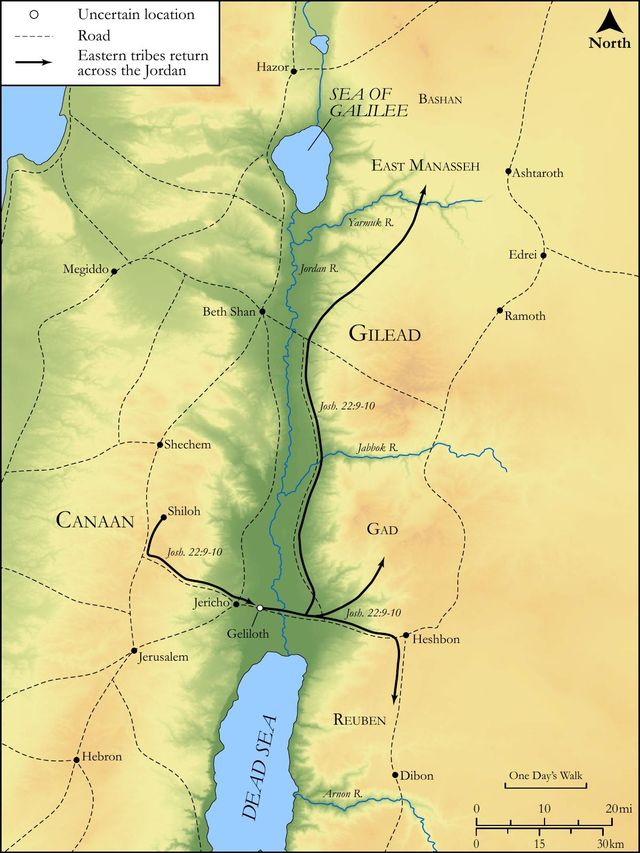
This verse is a pivotal moment within the larger narrative of Joshua chapter 22. Following the successful conquest and division of Canaan, the Transjordanian tribes (Reuben, Gad, and half of Manasseh) are dismissed by Joshua to return to their inheritance east of the Jordan River, having faithfully assisted their brethren in the west. As they journey, they construct a large, imposing altar by the Jordan. Upon hearing this, the western tribes, without seeking clarification, immediately interpret this act as a grave apostasy—a rival altar to the one established at Shiloh, where the Tabernacle of the Lord resided. Their immediate response is one of righteous indignation and a readiness for military confrontation, fearing a repetition of past sins like the incident at Peor. Verse 25 articulates the core of their theological concern and the severity of their initial misinterpretation.
Historical & Cultural Context
The ancient Israelite worldview placed immense importance on centralized worship and covenant fidelity. The Mosaic Law, particularly as detailed in Deuteronomy 12, mandated a single, designated place for sacrifice to Yahweh, preventing syncretism or the proliferation of unauthorized cultic sites. The Tabernacle, and later the Temple, served as the focal point of Israel's national and spiritual identity, symbolizing God's presence among His people. The Jordan River, while a natural geographical feature, also represented a significant boundary. For the western tribes, the construction of an altar on the "other side" of this boundary carried the grave implication of secession from the unified covenant community and a direct violation of God's commands regarding worship. Their fear was rooted in a genuine, albeit misguided, zeal for the purity of Israel's worship and their covenant relationship with Yahweh.
Key Themes
ShowHideThe passage powerfully underscores several critical themes. Firstly, it highlights the danger of misunderstanding and the vital importance of clear communication. The entire crisis in Joshua 22 stems from a hasty judgment based on incomplete information, demonstrating how assumptions can lead to severe conflict within God's people. Secondly, the western tribes' passionate reaction reveals a profound concern for the unity of God's people. They understood that Israel's strength and identity were intrinsically linked to their shared worship and singular covenant with the Lord, echoing later calls for unity among brethren. Thirdly, and most poignantly in verse 25, is the theme of preserving faith for future generations. The fear that "your children make our children cease from fearing the LORD" demonstrates a deep commitment to the spiritual heritage and the continuity of covenant faithfulness across time, a concern central to the Deuteronomic vision of Israel's future (e.g., Deuteronomy 6:6-7).
Exposition and Analysis
ShowHideKey Word Analysis
ShowHideThis word properly refers to a cord or boundary, by extension the territory enclosed. In this context, "border" takes on a profound spiritual and theological dimension. The western tribes perceive the Jordan not merely as a geographical divide but as a barrier that threatens to sever the eastern tribes from unified worship and covenant relationship with Yahweh, effectively creating a spiritual schism.
Meaning an allotment or portion. To "have no part in the LORD" (as in "ye have no part in the LORD") is a severe accusation implying disinheritance or exclusion from the covenant blessings, the divine presence, and the salvific relationship with Yahweh. It suggests a complete severance from the community of faith and its privileges, a terrifying prospect for any Israelite.
A primitive root meaning to fear, morally to revere, or causatively to frighten. The phrase "fearing the LORD" (יִרְאַת יְהוָה, yir'at YHWH) is a foundational concept in the Old Testament, signifying not servile dread but a profound reverence, awe, and obedient submission to God's will and commands. The western tribes' ultimate fear was that the perceived schism would lead to spiritual apathy, disobedience, and a complete abandonment of true worship and devotion to Yahweh by future generations on both sides of the Jordan.
Verse Breakdown
ShowHide"For the LORD hath made Jordan a border between us and you, ye children of Reuben and children of Gad;"
This opening clause reveals the western tribes' interpretation of the Jordan River. They attribute the Jordan's role as a "border" to God's design, but they project their own fear onto this divine arrangement. They see the physical boundary as a divinely sanctioned spiritual separation, implying that the eastern tribes, by establishing their inheritance there, are inherently distanced from the central covenant community and its worship.
"ye have no part in the LORD:"
This is the direct, theological accusation leveled against the Transjordanian tribes. It is a declaration of their perceived exclusion from the covenant. This statement, born of fear and misinterpretation, is the gravest possible charge, suggesting that the eastern tribes have forfeited their relationship with Yahweh and are no longer considered part of His chosen people.
"so shall your children make our children cease from fearing the LORD."
This final clause articulates the ultimate and most devastating fear: the intergenerational impact of the perceived schism. The western tribes are not only concerned for the present generation but are deeply anxious that the eastern tribes' actions will lead to a spiritual decline in their own descendants, causing both sets of children to abandon the reverent obedience and devotion to Yahweh that defines Israel's covenant identity.
Literary Devices
ShowHideThe verse employs several potent literary devices to convey the gravity of the western tribes' concern. Hyperbole is evident in the accusation "ye have no part in the LORD," which, while expressing genuine fear, is an overstatement born of misunderstanding rather than an accurate theological judgment of the eastern tribes' status. The Jordan River, a geographical feature, is elevated to a symbolic "border" that threatens to create a spiritual chasm, effectively personifying the river as an agent of division. The entire verse functions as a powerful rhetorical accusation, designed to confront the eastern tribes and elicit an explanation for their actions. Furthermore, the concern for future generations "ceasing from fearing the LORD" introduces a subtle foreshadowing of later periods in Israel's history where genuine apostasy and division did indeed lead to spiritual decline, even though this specific conflict was ultimately resolved.
Theological and Thematic Connections
ShowHideJoshua 22:25 serves as a powerful reminder of the fragility of unity within God's people and the critical importance of maintaining covenant fidelity. The western tribes' profound concern, though misdirected in its initial judgment, stemmed from a genuine zeal for the purity of Israel's worship and their shared identity as God's chosen nation. Their fear of the eastern tribes having "no part in the LORD" underscores the Old Testament emphasis on communal belonging and the dire consequences of spiritual separation from Yahweh and His covenant. This passage implicitly calls for discernment, open communication, and a commitment to preserving the spiritual heritage for future generations, recognizing that true faith is not merely individual but deeply communal and intergenerational.
Reflection and Application
ShowHideThe intense drama of Joshua 22:25 offers enduring lessons for believers today. It challenges us to examine our own tendencies to make hasty judgments or to assume ill intent when faced with actions we do not immediately understand. Just as the western tribes almost plunged Israel into civil war due to a misunderstanding, so too can miscommunication and unverified assumptions sow discord within families, communities, and the church. This verse calls us to prioritize open dialogue, patient inquiry, and a spirit of grace when differences arise, remembering that our unity in Christ is a precious testimony to the world. Furthermore, the deep concern for future generations "ceasing from fearing the LORD" compels us to consider our spiritual legacy. Are we actively discipling, modeling, and teaching the "fear of the Lord"—a reverent awe and obedient submission—to the children and youth in our lives and churches? Our faith is not meant to terminate with us but to be faithfully transmitted, ensuring that the light of Christ continues to shine brightly through successive generations.
Questions for Reflection
ShowHideFAQ
ShowHideWhat was the "altar" built by the eastern tribes, and why did it cause such alarm?
ShowHideThe "altar" built by the tribes of Reuben, Gad, and half of Manasseh was not intended for sacrifice, but as a "witness" (Hebrew: עֵד, ed) to their shared identity and covenant with Yahweh. As explained later in Joshua 22:27, it was a memorial to ensure that future generations on both sides of the Jordan would remember their common heritage and right to worship the Lord. However, the western tribes, operating under the Mosaic Law's strict prohibition against multiple altars (e.g., Deuteronomy 12:5-6), immediately assumed it was a rival altar for illicit sacrifices. This misunderstanding caused extreme alarm because it implied apostasy, a direct violation of God's commands, and a schism that threatened the spiritual and national unity of Israel.
Christ-Centered Fulfillment
ShowHideThe intense concern over the Jordan River as a potential spiritual "border" and the fear of "no part in the LORD" finds its ultimate fulfillment and resolution in Jesus Christ. In the Old Covenant, geographical boundaries and tribal distinctions often defined access to God's presence and covenant blessings. The Tabernacle, and later the Temple, served as the singular, fixed point of worship. However, Jesus, through His atoning sacrifice, definitively breaks down all such dividing walls and renders physical borders irrelevant to spiritual access. As the true Lamb of God who takes away the sin of the world, He is the ultimate altar and the perfect sacrifice, making it possible for all who believe, regardless of their geographical location or ethnic background, to have "part in the Lord" (Ephesians 2:13-14). The "fear of the Lord" under the New Covenant is transformed into a reverent love and obedient devotion to Christ, who has brought us near to God, not through ritual or location, but through His blood (Hebrews 10:19-22). In Him, all believers are united into one body, transcending all former divisions, ensuring that no one is cut off from the true worship of God (Galatians 3:28).