


Joshua 22:24
Bible text: King James Version (1769 Blayney text) · Public domain
Bible text: King James Version with Strong's numbers · Public domain
Bible text: Berean Standard Bible · Public domain
Bible text: American Standard Version (1901) · Public domain
Bible text: World English Bible, Messianic edition · Public domain
Bible text: Geneva Bible (1599) · Public domain
Bible text: Young's Literal Translation · Public domain
- וְאִםve·'imand ifH518Conj-w ¦ PrtParticle Conditionalוְandאִםif
- לֹאlo'notH3808NegParticle Negative
- מִדְּאָגָהmi·de·'a·Gahfrom anxietyH1674Prep-m ¦ N-fsNoun Singular Feminine Absoluteמִfromדְּאָגָהanxiety
- מִדָּבָרmi·da·Varfrom a matterH1697Prep-m ¦ N-msNoun Singular Masculine Absoluteמִfromדָּבָרa matter
- עָשִׂינוּ'a·Si·nuwe have doneH6213V-Qal-Perf-1cpVerb Qal Perfect 1st Plural common gender
- אֶת'et<obj.>H853DirObjMParticle Object Indicator
- זֹאתzotthisH2063PrtParticle Demonstrative
- לֵאמֹרle·Mor<to> sayingH559Prep-l ¦ V-Qal-InfVerb Qal Infinitive Constructלֵ<to>אמֹרsaying
- מָחָרma·ChartomorrowH4279N-msNoun Singular Masculine Absolute
- יֹאמְרוּyo·me·Ruthey will sayH559V-Qal-Imperf-3mpVerb Qal Imperfect 3rd Plural Masculine
- בְנֵיכֶםve·nei·Khemyour descendantsH1121N-mpc ¦ 2mpNoun Plural Masculine Constructבְנֵיdescendantsכֶםyour
- לְבָנֵינוּle·va·Nei·nuto our descendantsH1121Prep-l ¦ N-mpc ¦ 1cpNoun Plural Masculine Constructלְtoבָנֵיdescendantsנוּour
- לֵאמֹרle·Mor<to> sayingH559Prep-l ¦ V-Qal-InfVerb Qal Infinitive Constructלֵ<to>אמֹרsaying
- מַהmahwhat?H4100InterrogPronoun Interrogative
- לָּכֶםla·Khem[is] to youPrep-l ¦ 2mpSuffix Personal 2nd Plural Masculineלָּ[is] toכֶםyou
- וְלַיהוָהve·la·Yah·wehand to YahwehH3068Conj-w ¦ Prep-l ¦ N-properNoun Proper TitleוְandלַtoיהוָהYahweh
- אֱלֹהֵי'e·lo·Hei[the] God ofH430N-mpcNoun Plural Masculine Construct
- יִשְׂרָאֵלYis·ra·'ElIsraelH3478N-properNoun Proper Location
English is a literal word-by-word gloss of the Hebrew, not the KJV's wording. Why?
This is the original text the KJV's translators worked from — each Hebrew word with its own literal English meaning in this verse, prepared by scholars at Tyndale House, Cambridge. The KJV translates whole sentences, not word by word, so its wording differs: one Hebrew word can become several English words, and the KJV may choose “the LORD” where the gloss reads “Yahweh”. Both are faithful — they answer different questions. For the KJV's own rendering, switch to the KJV text.
Details
See on the biblical-era map
Study this verse
Historical interpretation
Historical reception
1 surviving comment on this verse from the historical church.
But let us see what sacrament lies within this deed. The former people of the circumcision are represented in Reuben, who was the firstborn; but also in Gad, who also is the firstborn out of Zilpah; and Manasseh, no less a firstborn. But insofar as I say “firstborn,” I speak chronologically. Therefore, these things are said not that it might be evident some division and separation is between us and those who were righteous before the coming of Christ, but that they might reveal themselves to still be our brothers even if they existed before the coming of Christ. For although they possessed an altar then before the coming of the Savior, nevertheless, they knew and perceived that it was not that true altar but that it was a form and figure of what would be the true altar. Those persons knew this because the true victims and those who were able to take away sins were not offered on that altar that the firstborn people possessed but on this one where Jesus was. Here the heavenly victims, here the true sacrifices are consumed. Therefore, they are made “one flock and one shepherd,” those former righteous ones and those who are now Christians.
Continue studying Joshua 22:24 across the web’s major study libraries — every link below opens this exact verse, chapter, or book on the destination site.
Read & Compare
 BibleGatewayThis verse in more than 200 translations and 70 languages.
 Bible.comThe YouVersion reader — hundreds of translations, reading plans, and highlights.
 ESV.orgCrossway's official English Standard Version reader.
 NET BibleThe NET translation with 60,000+ translators' notes on every rendering decision.
 STEP BibleTyndale House's free study tool — original text, vocabulary, and scholarly resources.
 BibliaLogos Bible Software's free web reader.
 USCCBThe New American Bible (Revised Edition) with the U.S. bishops' study notes.
Commentaries
 BibleHub CommentariesDozens of classic commentaries on this verse, gathered on one page.
 StudyLightMore than 100 commentary sets — the largest collection on the web.
 BibleRefPlain-English commentary on what this verse means, verse by verse.
 Enduring WordDavid Guzik's free commentary on this chapter, widely used by Bible teachers.
 Bible Study ToolsVerse commentary alongside Greek and Hebrew study aids.
Original Language & Research
- BibleHub InterlinearThe verse word by word — original language, transliteration, and English.
- BibleHub LexiconEvery word's original-language definition and Strong's entry.
 Blue Letter BibleDeep-study tools — Strong's numbers, concordance, and word studies.
 SefariaThe Hebrew text with Rashi and centuries of Jewish commentary.
Sermons, Hymns & Audio


TrulyRandomVerse is not affiliated with these sites and doesn’t control their content. They’re linked because they’re genuinely useful.
Summary
Joshua 22:24 captures the profound and preventative motivation of the Transjordanian tribes—Reuben, Gad, and half-Manasseh—who, upon their return to their inheritance, erected a large altar by the Jordan River. This act, initially misinterpreted by the western tribes as a challenge to the central sanctuary and an act of rebellion or idolatry, nearly precipitated a civil war. This verse articulates the eastern tribes' earnest defense: a deep-seated fear that their geographical separation from the main body of Israel would lead to spiritual estrangement for their descendants, who might eventually be denied their rightful place in the worship and covenant relationship with the LORD God of Israel.
Context
ShowHideLiterary Context
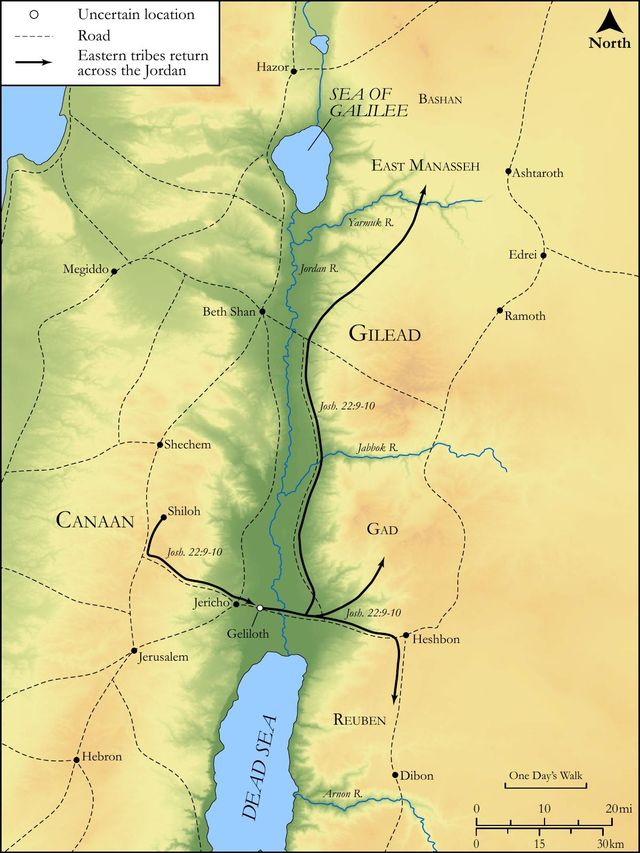
Joshua 22 serves as a critical bridge in the book, transitioning from the successful conquest and division of the land to the ongoing challenges of maintaining national and spiritual unity within Israel. Following the completion of the military campaigns and the allocation of tribal inheritances, Joshua blesses and dismisses the Transjordanian tribes, acknowledging their faithful assistance to their brethren in the conquest of Canaan, as detailed in Joshua 22:1-6. As these tribes journey eastward towards their allotted territory, they construct a large, conspicuous altar near the Jordan River (Joshua 22:10). This act immediately ignites alarm and outrage among the western tribes, who interpret it as a grave act of apostasy or rebellion against the singular, divinely appointed place of worship at Shiloh, prompting them to gather for war (Joshua 22:12). Phinehas, the zealous priest, leads a delegation to confront the eastern tribes, reminding them of past idolatries and their devastating consequences (Joshua 22:17-20). Joshua 22:24 is a pivotal part of the Transjordanian tribes' earnest and eloquent defense, revealing their true, preventative motivation and ultimately averting a devastating inter-tribal conflict.
Historical & Cultural Context
The period immediately following the conquest of Canaan was foundational for establishing Israel's national identity and solidifying its religious practices. The Mosaic Law, particularly as articulated in Deuteronomy, placed immense emphasis on the singularity of God and the centralized nature of worship, typically at a designated sanctuary (which was Shiloh at this time). Building an altar outside this central place could be perceived as a direct and egregious violation of this covenant principle, akin to idolatry or the establishment of a rival cult, which carried severe penalties and the threat of divine judgment. The Jordan River, while a clear geographical boundary, also held significant symbolic weight, potentially signifying a spiritual or cultural separation. The eastern tribes' profound concern for their children's future spiritual heritage reflects the strong emphasis in ancient Israelite culture on generational continuity of faith, as seen in the repeated commands to diligently teach God's laws to offspring (Deuteronomy 6:7). The swift, almost violent reaction of the western tribes underscores the deep-seated fear of apostasy and the high stakes involved in maintaining covenant fidelity and national purity.
Key Themes
ShowHideThis narrative powerfully illuminates several crucial themes. Firstly, the preservation of spiritual legacy is paramount; the eastern tribes' primary motivation was to ensure their descendants would not be spiritually estranged from the LORD God of Israel, fearing that geographical separation might lead to spiritual exclusion. Secondly, the passage highlights the dangers of misunderstanding and miscommunication; the conflict arose from assumptions about motives rather than direct inquiry, underscoring the vital need for clear dialogue before judgment, a principle echoed throughout Scripture. Thirdly, it speaks to the profound importance of unity within the covenant community; despite geographical divisions, the tribes were fundamentally one people under one God, and the threat of schism was deeply concerning, echoing the call for unity found in Psalm 133:1. Finally, the eastern tribes' actions, though initially alarming, ultimately demonstrated a fervent zeal for God's covenant, driven by a pure desire to ensure their children's continued participation in the worship of the LORD, thus reinforcing the overarching theme of faithfulness to Yahweh and the importance of preventing spiritual decline for future generations, as seen in Judges 2:10.
Exposition and Analysis
ShowHideKey Word Analysis
ShowHideThis term signifies anxiety, care, heaviness, or sorrow. In Joshua 22:24, it is not merely a sense of terror, but a profound and responsible apprehension. It encapsulates the eastern tribes' earnest anxiety and foresight regarding the spiritual well-being of their future generations. Their "fear" is rooted in a proactive desire to prevent spiritual alienation and ensure covenant continuity, reflecting a deep, anticipatory concern for their offspring's relationship with Yahweh.
This word denotes a son, but in a wider sense, it refers to descendants, offspring, or future generations. The repeated mention of "your children" and "our children" underscores the intergenerational nature of the eastern tribes' concern. Their primary motivation for building the altar was not for themselves, but for the spiritual inheritance and legitimate belonging of their future progeny within the covenant community of Israel.
This is the personal, covenantal name of God, signifying "the self-Existent or Eternal." The phrase "the LORD God of Israel" emphasizes the unique relationship between Yahweh and His chosen people. The eastern tribes' deepest dread was that their descendants would be cut off from this specific, covenantal relationship, implying a loss of identity, inheritance, and access to the one true God of Israel. Their actions were a desperate attempt to safeguard this vital connection for generations to come.
Verse Breakdown
ShowHide"And if we have not [rather] done it for fear of [this] thing"
This clause introduces the eastern tribes' earnest and emphatic denial of any rebellious or idolatrous intent. The phrase "for fear of [this] thing" clarifies their true, preventative motivation: a profound apprehension and concern, not about human retribution, but about the potential spiritual consequences for future generations. They are asserting that their action was a proactive measure, born out of a genuine and responsible foresight regarding a potential future spiritual crisis.
"saying, In time to come your children might speak unto our children"
This segment reveals the specific, hypothetical scenario the eastern tribes envisioned. They are looking generations ahead, anticipating a future dialogue between the descendants of the western tribes and their own. This highlights their long-term vision and their deep commitment to the spiritual heritage of their offspring, underscoring the intergenerational nature of the covenant and their concern for its continuity.
"saying, What have ye to do with the LORD God of Israel?"
This concluding rhetorical question is the core of their profound fear. It articulates the ultimate spiritual exclusion they dreaded. The phrase "What have ye to do with" is an idiom implying a denial of legitimate connection, shared purpose, or belonging. Their concern was that their children would be told they had no share or inheritance in the worship, covenant, or identity of the God of Israel, effectively being cut off from the true community of faith due to their geographical distance from the central sanctuary.
Literary Devices
ShowHideJoshua 22:24 employs several powerful literary devices to convey the eastern tribes' earnest plea. The most prominent is Rhetorical Question, found in "What have ye to do with the LORD God of Israel?" This question is not posed to elicit an answer, but to express a strong emotional concern and to highlight the profound pain and absurdity of the potential spiritual exclusion. Anticipation is also key, as the eastern tribes project their fears into a future scenario, vividly imagining a dialogue between future generations. This use of Foreshadowing (albeit a hypothetical one of a dreaded outcome) emphasizes their proactive and preventative motivation. The entire defense is a form of Apologia, a formal and impassioned justification of their actions, aimed at clarifying their intentions and preserving national unity. The vivid imagery of "your children" speaking "unto our children" underscores the deep intergenerational nature of their concern for the covenant and their desire to protect their descendants' spiritual heritage.
Theological and Thematic Connections
ShowHideJoshua 22:24 profoundly underscores the Old Testament's emphasis on the preservation of spiritual heritage across generations and the vital importance of unity within the covenant community. The eastern tribes' fear of their descendants being cut off from the LORD God of Israel reflects the deep-seated concern for covenant fidelity and the diligent transmission of faith, a theme central to Israelite identity and divine instruction. Their actions, though initially misunderstood, ultimately demonstrate a profound zeal for God's honor and the spiritual well-being of their people, highlighting that true worship and belonging extend beyond mere geographical proximity to the sanctuary. This incident serves as a powerful reminder that genuine faith seeks to bridge divides and ensure that all God's people have access to Him and their rightful place within the community of believers.
Reflection and Application
ShowHideThe profound concern of the Transjordanian tribes for their children's spiritual future in Joshua 22:24 resonates deeply with believers today, challenging us to consider the legacy of faith we are actively building for the next generation. Are we diligently nurturing an environment where our children and future generations feel a strong, legitimate, and undeniable connection to the "LORD God of Israel," or are we inadvertently creating barriers—whether geographical, cultural, relational, or doctrinal—that might lead them to feel estranged from the covenant community? This passage also serves as a poignant reminder of the critical importance of clear communication and charitable interpretation within the body of Christ. Many conflicts and divisions arise not from malicious intent, but from assumptions about motives rather than patient inquiry and understanding. Just as Phinehas's delegation sought to understand before condemning, we are called to prioritize dialogue, humility, and the preservation of unity, ensuring that our actions and intentions are clearly understood and that we do not allow misunderstandings to fracture the fellowship of believers. Our zeal for God's truth must always be accompanied by a love that seeks to build up, not tear down, fostering an atmosphere where all feel they have "to do with the LORD God of Israel."
Questions for Reflection
ShowHideFAQ
ShowHideWhy did the western tribes initially react so strongly to the altar's construction?
ShowHideThe western tribes reacted with intense alarm and prepared for war because the construction of a large, prominent altar outside the designated central sanctuary (Shiloh at this time) was perceived as a direct violation of God's covenant commands. The Mosaic Law, particularly as articulated in Deuteronomy 12, strictly prohibited building altars for sacrifice elsewhere, primarily to prevent idolatry and maintain the unity of worship around the one true God. They feared it was an act of rebellion or apostasy, potentially bringing divine judgment upon the entire nation, as seen in previous instances of unfaithfulness like the incident at Peor (Numbers 25). Their strong reaction, though based on a misunderstanding, stemmed from a zealous desire to uphold God's law and protect the spiritual purity and covenant fidelity of Israel.
What was the significance of the Jordan River in this narrative?
ShowHideThe Jordan River served as a significant geographical boundary, physically separating the Transjordanian tribes (Reuben, Gad, and half-Manasseh) from the other nine and a half tribes who settled west of the Jordan. While a physical barrier, it also held profound symbolic weight, potentially representing a spiritual or cultural divide. The eastern tribes feared that this geographical separation would lead to their descendants being perceived as distinct or even alienated from the main body of Israel, thus losing their rightful inheritance in the worship of the LORD God of Israel. Their altar was intended to be a "witness" (Joshua 22:27) across this divide, affirming their shared identity and right to worship the same God as their western brethren, ensuring their children would not be denied access to the covenant.
How was the conflict ultimately resolved?
ShowHideThe conflict was resolved through open and honest communication, facilitated by the delegation led by Phinehas. Instead of immediately attacking, the western tribes sent representatives to inquire about the eastern tribes' intentions. When the eastern tribes explained that the altar was not for sacrifice but as a "witness" to their shared identity and right to worship the LORD, the delegation was satisfied. They praised God and returned to the western tribes with the explanation, successfully averting civil war. The altar was subsequently named "Ed" (meaning "Witness"), signifying that it was a testimony to the fact that "the LORD is God" for all the tribes of Israel (Joshua 22:34). This resolution highlights the power of dialogue, understanding, and the shared commitment to God's covenant in preserving unity within the community.
Christ-Centered Fulfillment
ShowHideJoshua 22:24, with its deep concern for generational spiritual continuity and the unity of God's people, finds its ultimate and glorious fulfillment in Christ Jesus. The eastern tribes' fear of their children being asked, "What have ye to do with the LORD God of Israel?" speaks to humanity's inherent longing for belonging and legitimate access to God, a longing that sin had tragically severed. Jesus, through His sacrificial death on the cross, became the ultimate "witness" and the perfect bridge that overcomes all geographical, cultural, and spiritual divides, granting full and unhindered access to God. He is the true altar, not made with human hands, through whom we now offer spiritual sacrifices of praise and worship (Hebrews 13:10). In Christ, the old distinctions and dividing walls are abolished; there is no longer "Jew nor Greek, slave nor free, male nor female, for you are all one in Christ Jesus" (Galatians 3:28). He breaks down the "dividing wall of hostility" (Ephesians 2:14), ensuring that all who believe, regardless of their earthly location or background, have full access to the Father through one Spirit (Ephesians 2:18). The New Covenant, established in His precious blood, guarantees that all generations who believe in Him are irrevocably part of the family of God, with an eternal inheritance and an undeniable right to call upon the "LORD God of Israel," who is now our Heavenly Father, forever united in Him.