


Joshua 22:23
Bible text: King James Version (1769 Blayney text) · Public domain
Bible text: King James Version with Strong's numbers · Public domain
Bible text: Berean Standard Bible · Public domain
Bible text: American Standard Version (1901) · Public domain
Bible text: World English Bible, Messianic edition · Public domain
Bible text: Geneva Bible (1599) · Public domain
Bible text: Young's Literal Translation · Public domain
- לִבְנוֹתliv·Notto buildH1129Prep-l ¦ V-Qal-InfVerb Qal Infinitive Constructלִtoבְנוֹתbuild
- לָנוּla·nufor <the> ourselvesPrep-l ¦ 1cpSuffix Personal 1st Plural common genderלָfor <the>נוּourselves
- מִזְבֵּחַmiz·Be·achan altarH4196N-msNoun Singular Masculine Absolute
- לָשׁוּבla·Shuvto turn backH7725Prep-l ¦ V-Qal-InfVerb Qal Infinitive Constructלָtoשׁוּבturn back
- מֵאַחֲרֵיme·'a·cha·Reifrom afterH310Prep-m ¦ Adj-mpcAdjective Numerical Plural Masculine Constructמֵfromאַחֲרֵיafter
- יְהוָהYah·wehYahwehH3068N-properNoun Proper Title
- וְאִםve·'imand ifH518Conj-w ¦ PrtParticle Conditionalוְandאִםif
- לְהַעֲלוֹתle·ha·'a·Lotto offer upH5927Prep-l ¦ V-Hiphil-InfVerb Hiphil Infinitive Constructלְtoהַעֲלוֹתoffer up
- עָלָיו'a·Lavon itH5921Prep ¦ 3msPreposition Definiteעָלָיonוit
- עוֹלָהo·Laha burnt offeringH5930N-fsNoun Singular Feminine Absolute
- וּמִנְחָהu·min·Chahand a grain offeringH4503Conj-w ¦ N-fsNoun Singular Feminine Absoluteוּandמִנְחָהa grain offering
- וְאִםve·'imand ifH518Conj-w ¦ PrtParticle Conditionalוְandאִםif
- לַעֲשׂוֹתla·'a·Sotto makeH6213Prep-l ¦ V-Qal-InfVerb Qal Infinitive Constructלַtoעֲשׂוֹתmake
- עָלָיו'a·Lavon itH5921Prep ¦ 3msPreposition Definiteעָלָיonוit
- זִבְחֵיziv·Cheisacrifices ofH2077N-mpcNoun Plural Masculine Construct
- שְׁלָמִיםshe·la·Mimpeace offeringsH8002N-mpNoun Plural Masculine Absolute
- יְהוָהYah·wehYahwehH3068N-properNoun Proper Title
- הוּאhu'heH1931Pro-3msPronoun Personal 3rd Singular Masculine
- יְבַקֵּשׁye·va·Keshmay he requireH1245V-Piel-Imperf-3msVerb Piel Imperfect 3rd Singular Masculine
English is a literal word-by-word gloss of the Hebrew, not the KJV's wording. Why?
This is the original text the KJV's translators worked from — each Hebrew word with its own literal English meaning in this verse, prepared by scholars at Tyndale House, Cambridge. The KJV translates whole sentences, not word by word, so its wording differs: one Hebrew word can become several English words, and the KJV may choose “the LORD” where the gloss reads “Yahweh”. Both are faithful — they answer different questions. For the KJV's own rendering, switch to the KJV text.
Details
See on the biblical-era map
Study this verse
Historical interpretation
Historical reception
1 surviving comment on this verse from the historical church.
But let us see what sacrament lies within this deed. The former people of the circumcision are represented in Reuben, who was the firstborn; but also in Gad, who also is the firstborn out of Zilpah; and Manasseh, no less a firstborn. But insofar as I say “firstborn,” I speak chronologically. Therefore, these things are said not that it might be evident some division and separation is between us and those who were righteous before the coming of Christ, but that they might reveal themselves to still be our brothers even if they existed before the coming of Christ. For although they possessed an altar then before the coming of the Savior, nevertheless, they knew and perceived that it was not that true altar but that it was a form and figure of what would be the true altar. Those persons knew this because the true victims and those who were able to take away sins were not offered on that altar that the firstborn people possessed but on this one where Jesus was. Here the heavenly victims, here the true sacrifices are consumed. Therefore, they are made “one flock and one shepherd,” those former righteous ones and those who are now Christians.
Continue studying Joshua 22:23 across the web’s major study libraries — every link below opens this exact verse, chapter, or book on the destination site.
Read & Compare
 BibleGatewayThis verse in more than 200 translations and 70 languages.
 Bible.comThe YouVersion reader — hundreds of translations, reading plans, and highlights.
 ESV.orgCrossway's official English Standard Version reader.
 NET BibleThe NET translation with 60,000+ translators' notes on every rendering decision.
 STEP BibleTyndale House's free study tool — original text, vocabulary, and scholarly resources.
 BibliaLogos Bible Software's free web reader.
 USCCBThe New American Bible (Revised Edition) with the U.S. bishops' study notes.
Commentaries
 BibleHub CommentariesDozens of classic commentaries on this verse, gathered on one page.
 StudyLightMore than 100 commentary sets — the largest collection on the web.
 BibleRefPlain-English commentary on what this verse means, verse by verse.
 Enduring WordDavid Guzik's free commentary on this chapter, widely used by Bible teachers.
 Bible Study ToolsVerse commentary alongside Greek and Hebrew study aids.
Original Language & Research
- BibleHub InterlinearThe verse word by word — original language, transliteration, and English.
- BibleHub LexiconEvery word's original-language definition and Strong's entry.
 Blue Letter BibleDeep-study tools — Strong's numbers, concordance, and word studies.
 SefariaThe Hebrew text with Rashi and centuries of Jewish commentary.
Sermons, Hymns & Audio


TrulyRandomVerse is not affiliated with these sites and doesn’t control their content. They’re linked because they’re genuinely useful.
Summary
Joshua 22:23 captures the fervent and solemn denial of the Transjordanian tribes (Reuben, Gad, and the half-tribe of Manasseh) regarding the purpose of the large altar they constructed upon their return to their inheritance. Accused by the other Israelite tribes of rebellion against the Lord and His prescribed worship at the central sanctuary in Shiloh, these eastern tribes invoke a powerful oath, calling upon God Himself to bring judgment upon them if their intent was to turn away from Him, establish an unauthorized place of worship, or offer any form of illicit sacrifice, whether burnt, grain, or peace offerings. This verse is a pivotal moment in the narrative, highlighting the gravity of the misunderstanding and the eastern tribes' desperate plea for their unwavering loyalty to the covenant to be recognized.
Context
ShowHideLiterary Context
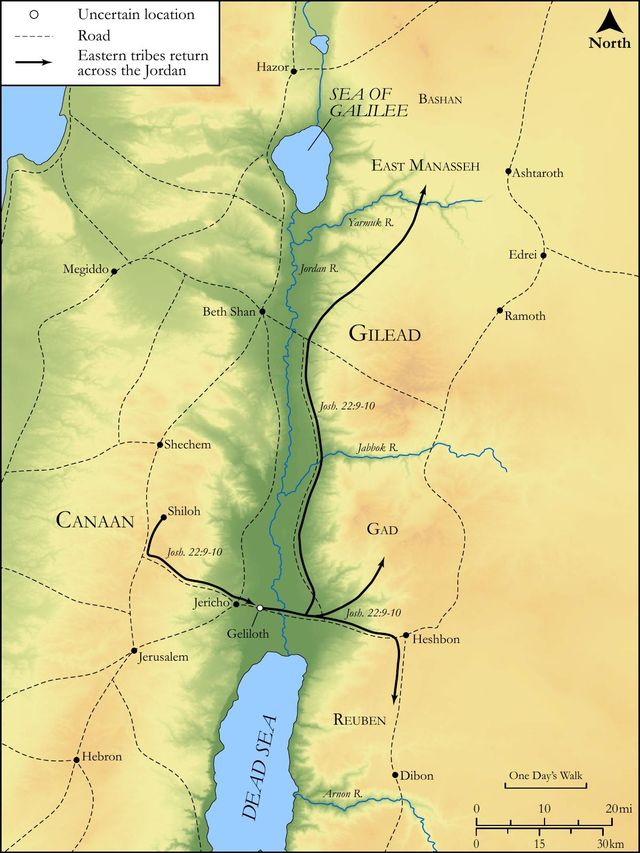
Joshua 22:23 is situated within a dramatic and potentially catastrophic confrontation between the Israelite tribes. The narrative immediately preceding this verse details the alarm of the western tribes (those settled west of the Jordan River) upon hearing that Reuben, Gad, and half-Manasseh had built a large, imposing altar in their territory (see Joshua 22:10-12). This act was perceived as a direct violation of God's command for a single, central place of worship and sacrifice for all Israel, as stipulated in Deuteronomy 12. In response, Phinehas, the son of Eleazar the priest, leads a delegation to confront the eastern tribes, reminding them of past communal sins, such as the apostasy at Peor, which brought divine judgment upon the entire community (see Joshua 22:17). Joshua 22:23 is a crucial part of the eastern tribes' impassioned defense, where they vehemently deny any rebellious intent, culminating in a powerful oath that underscores their innocence and unwavering commitment to the Lord. The resolution of this conflict, where the true, non-sacrificial purpose of the altar as a "witness" is revealed, follows in Joshua 22:24-34.
Historical & Cultural Context
The period immediately following the conquest of Canaan was a foundational time for the nascent Israelite nation, characterized by the establishment of their covenant identity and the implementation of Mosaic Law. God had explicitly commanded that all sacrifices and corporate worship be conducted at a single, divinely chosen place, initially the tabernacle in Shiloh (see Deuteronomy 12:5-7). This command was vital for maintaining Israel's theological purity, preventing syncretism with pagan practices prevalent in Canaan, and ensuring the unity of the twelve tribes under Yahweh alone. Building an unauthorized altar was considered an act of grave apostasy, threatening to break the covenant and incur divine wrath upon the entire nation, as tragically demonstrated by the Achan incident (see Joshua 7). Oaths, like the one invoked in Joshua 22:23, were extremely serious in Israel, often calling upon the LORD to witness and enforce the truthfulness of a statement, with severe consequences for perjury. The fear of divine judgment for collective sin was a deeply ingrained cultural and theological reality for the Israelites.
Key Themes
ShowHideThis passage profoundly explores several key themes central to Israel's identity and relationship with God. Faithfulness to God's Covenant is paramount, as both the western tribes' zealous concern and the eastern tribes' fervent denial revolve around strict adherence to God's commands regarding worship and sacrifice. The potential for civil war highlights the critical importance of Unity and Preventing Schism within the twelve tribes, emphasizing that internal division could be as destructive as external enemies. The entire episode serves as a powerful lesson in Misunderstanding and Communication, demonstrating how easily intentions can be misconstrued and how vital clear, open dialogue is to avert conflict and preserve communal harmony. Finally, the verse implicitly touches upon The Nature of True Worship, underscoring that genuine devotion is not merely about external rituals but about the heart's intent and unwavering obedience to God's revealed will, a principle echoed throughout the Old Testament (e.g., 1 Samuel 15:22) and later affirmed in the New Testament.
Exposition and Analysis
ShowHideKey Word Analysis
ShowHideFrom the root zâbach (to slaughter, sacrifice), this term (H4196) refers to a raised structure used for offering sacrifices to God. In Israelite worship, altars were central to communion with God, atonement, and expressing devotion. The very presence of an altar, especially one of such "great size" (as mentioned in Joshua 22:10), immediately signaled a place of worship and sacrifice. The western tribes' alarm stemmed from the fact that only one altar, at the central sanctuary, was authorized for corporate Israelite worship, making any other altar a potential rival and a symbol of apostasy.
This primitive root (H7725) means "to turn back (hence, away) transitively or intransitively, literally or figuratively." In this context, "to turn from following the LORD" carries the profound theological weight of apostasy or rebellion. It signifies a deliberate turning away from covenant loyalty and obedience to Yahweh. The eastern tribes' vehement denial using this word underscores their assertion that their actions were not a rejection of God's authority or a departure from His prescribed worship.
This primitive root (H1245) means "to search out (by any method, specifically in worship or prayer); by implication, to strive after; ask, beg, beseech, desire, enquire, get, make inquisition, procure, (make) request, require, seek (for)." In this solemn oath, bâqash carries the strong connotation of divine visitation for judgment or punishment. By saying "let the LORD himself require [it]," the Transjordanian tribes are invoking God as the ultimate judge, asking Him to bring severe consequences upon them if their intentions were indeed rebellious or if they were to use the altar for unauthorized sacrifices. It is a powerful declaration of their innocence and a terrifying appeal to divine justice.
Verse Breakdown
ShowHide"That we have built us an altar to turn from following the LORD"
This opening clause directly addresses the core accusation of the western tribes. The eastern tribes emphatically deny that their construction of the altar was motivated by a desire to abandon their allegiance to Yahweh, to establish a rival religious center, or to commit an act of apostasy. This sets the stage for their true explanation, which is revealed later in the chapter, demonstrating their commitment to the covenant.
"or if to offer thereon burnt offering or meat offering, or if to offer peace offerings thereon"
This specifies the types of sacrifices that were central to Israelite worship, covering the major categories of offerings. The "burnt offering" (ʿôlâh) symbolized complete dedication and atonement (see Leviticus 1). The "meat offering" (more accurately, grain or meal offering, minchâh) was an offering of produce, often accompanying other sacrifices, symbolizing gratitude and dependence (see Leviticus 2). The "peace offerings" (shĕlāmîm) were offerings of fellowship and communion, shared by the worshipper, priest, and God (see Leviticus 3). By explicitly denying the intention to offer any of these on their new altar, the eastern tribes underscore their commitment to the prescribed worship at Shiloh and their understanding of the gravity of unauthorized sacrifice.
"let the LORD himself require [it];"
This is the solemn invocation of the oath, a powerful imprecation. The Transjordanian tribes call upon God to act as judge and to bring swift and decisive punishment upon them if their preceding denials are false. This phrase emphasizes the depth of their sincerity and their willingness to submit to divine judgment, demonstrating the gravity with which they viewed the accusations and their own covenant loyalty. It is an appeal to the highest authority, Yahweh Himself, to vindicate their truthfulness.
Literary Devices
ShowHideJoshua 22:23 is rich in Rhetorical Denial and Solemn Invocation. The Transjordanian tribes employ a strong negative construction to emphatically reject the accusations leveled against them, stating their innocence in no uncertain terms. This denial is immediately followed by a Solemn Invocation or Imprecation, where they call upon the Lord Himself to "require it" (i.e., exact punishment) if their denial is false. This literary device underscores the gravity of their oath and their profound commitment to the truth of their statement, appealing to divine justice as the ultimate arbiter. The very structure of their defense, moving from comprehensive denial to a self-cursing oath, is a form of Dramatic Irony for the reader, who, knowing the true, non-rebellious purpose of the altar, experiences the tension created by the western tribes' misjudgment. The repetition of "or if to offer thereon" creates a sense of Emphasis, stressing the comprehensive nature of their denial regarding illicit sacrifices, leaving no room for ambiguity in their stated intentions.
Theological and Thematic Connections
ShowHideJoshua 22:23 powerfully illustrates the tension between outward appearance and inward intention, a recurring theme in biblical theology. The western tribes, driven by zeal for God's law and a legitimate fear of corporate judgment for apostasy, correctly understood the gravity of unauthorized worship. However, they misjudged the eastern tribes' hearts and intentions. This highlights the theological principle that while obedience to God's revealed will is paramount, true worship also involves the right heart attitude and motive, a concept later emphasized by the prophets (e.g., Isaiah 1:11-17) and Jesus himself (e.g., Matthew 15:8). The potential for schism underscores the divine value of unity within the covenant community, a unity that hinges on clear communication and a willingness to understand rather than immediately condemn. The resolution of this conflict, where dialogue prevents bloodshed, serves as a model for resolving disputes within God's people, prioritizing understanding and reconciliation over hasty judgment.
Reflection and Application
ShowHideJoshua 22:23 offers profound lessons for contemporary believers and the church, serving as a potent reminder of the dangers of presumption and the vital importance of clear, empathetic communication. In our zeal for theological purity or adherence to tradition, we can sometimes be quick to judge others' actions or motives, leading to unnecessary conflict and division within the body of Christ. This passage calls us to pause, to inquire, and to listen before accusing, fostering a culture of grace and understanding. It encourages us to cultivate a spirit of discernment and humility, seeking to understand the "why" behind actions, rather than simply reacting to the "what." Furthermore, it reinforces that true worship is not merely about external conformity to rules, but about a heart genuinely devoted to God and His revealed will. Our actions should flow from sincere obedience and love, and when misunderstood, we are called to patiently explain our intentions, trusting that God, who sees the heart, will ultimately vindicate the righteous.
Questions for Reflection
ShowHideFAQ
ShowHideWhat was the true purpose of the altar built by the Transjordanian tribes?
ShowHideThe altar was not built for illicit sacrifices or to establish a rival worship center, as the western tribes feared. Instead, its true purpose was revealed to be a "witness" (Hebrew: ed) between the tribes that they, too, were part of the Lord's people and served Him. They feared that in future generations, the western tribes might deny their eastern brethren a share in the Lord, simply because of the geographical barrier of the Jordan River. The altar was a tangible reminder and a sign that both sides of the Jordan belonged to the one covenant God of Israel, ensuring their descendants would not be cut off from the worship of Yahweh (see Joshua 22:24-28).
Why were the western tribes so quick to assume the worst and prepare for war?
ShowHideThe western tribes' reaction, while extreme, stemmed from a deep-seated fear of apostasy and a zealous commitment to God's covenant laws. They had witnessed the devastating consequences of corporate sin, such as the sin of Peor (see Joshua 22:17), where unauthorized worship led to a plague that killed thousands. God had explicitly commanded a single place of worship for all Israel to prevent idolatry and maintain national unity (see Deuteronomy 12:5). Therefore, the construction of another large altar was perceived as a direct challenge to God's authority and a grave threat to the spiritual purity and very existence of the nation, prompting their immediate and severe response. Their zeal, though misguided in its initial interpretation, was rooted in a genuine desire to honor God and protect the community from divine judgment.
Christ-Centered Fulfillment
ShowHideThe dramatic confrontation in Joshua 22, culminating in the solemn oath of Joshua 22:23, finds its ultimate resolution and fulfillment in Christ. The Old Testament's concern for a unified people devoted to God, free from division and apostasy, points to the new covenant reality established by Jesus. Where the altar in Joshua served as a witness to a shared identity and a means to prevent separation, Christ himself is the ultimate "witness" and the true unifying force for all who believe. He broke down the "dividing wall of hostility" between Jew and Gentile (see Ephesians 2:14), creating one new humanity reconciled to God through His cross. The concern for proper worship and sacrifice, so central to the Old Testament, is fully realized in Christ, who is both the perfect sacrifice and the true High Priest (see Hebrews 9:11-14). We no longer need physical altars or specific geographic locations for worship, for true worship is now "in spirit and truth" through Christ (see John 4:23-24). The misunderstanding and reconciliation in Joshua 22 foreshadow the greater reconciliation Christ achieves, not only between God and humanity but also among believers, calling us to unity, humility, and mutual understanding under His headship (see Colossians 3:12-14).