


Joshua 21:2
Bible text: King James Version (1769 Blayney text) · Public domain
Bible text: King James Version with Strong's numbers · Public domain
Bible text: Berean Standard Bible · Public domain
Bible text: American Standard Version (1901) · Public domain
Bible text: World English Bible, Messianic edition · Public domain
Bible text: Geneva Bible (1599) · Public domain
Bible text: Young's Literal Translation · Public domain
- וַיְדַבְּרוּvay·da·be·Ruand they spokeH1696Conj-w ¦ V-Piel-ConsecImperf-3mpVerb Piel Consecutive Imperfect 3rd Plural Masculineוַandיְדַבְּרוּthey spoke
- אֲלֵיהֶם'a·lei·Hemto themH413Prep ¦ 3mpPreposition Definiteאֲלֵיtoהֶםthem
- בְּשִׁלֹהbe·shi·Lohat ShilohH7887Prep-b ¦ N-properNoun Proper LocationבְּatשִׁלֹהShiloh
- בְּאֶרֶץbe·'E·retzin [the] land ofH776Prep-b ¦ N-fscNoun Singular Feminine Constructבְּinאֶרֶץ[the] land of
- כְּנַעַןke·Na·'anCanaanH3667N-properNoun Proper Location
- לֵאמֹרle·Mor<to> sayingH559Prep-l ¦ V-Qal-InfVerb Qal Infinitive Constructלֵ<to>אמֹרsaying
- יְהוָהYah·wehYahwehH3068N-properNoun Proper Title
- צִוָּהtzi·Vahhe commandedH6680V-Piel-Perf-3msVerb Piel Perfect 3rd Singular Masculine
- בְיַדve·yadby [the] hand ofH3027Prep-b ¦ N-cscNoun Singular common gender Constructבְbyיַד[the] hand of
- מֹשֶׁהmo·ShehMosesH4872N-proper-mNoun Proper Masculine
- לָתֶתla·tetto giveH5414Prep-l ¦ V-Qal-InfVerb Qal Infinitive Constructלָtoתֶתgive
- לָנוּLa·nuto <the> usPrep-l ¦ 1cpSuffix Personal 1st Plural common genderלָto <the>נוּus
- עָרִים'a·RimcitiesH5892N-mpNoun Plural Masculine Absolute
- לָשָׁבֶתla·Sha·vetto dwell inH3427Prep-l ¦ V-Qal-InfVerb Qal Infinitive Constructלָtoשָׁבֶתdwell in
- וּמִגְרְשֵׁיהֶןu·mig·re·shei·Henand their pasture landsH4054Conj-w ¦ N-mpc ¦ 3fpNoun Plural Masculine Constructוּandמִגְרְשֵׁיpasture landsהֶןtheir
- לִבְהֶמְתֵּנוּliv·hem·Te·nufor our livestockH929Prep-l ¦ N-fsc ¦ 1cpNoun Singular Feminine Constructלִforבְהֶמְתֵּlivestockנוּour
English is a literal word-by-word gloss of the Hebrew, not the KJV's wording. Why?
This is the original text the KJV's translators worked from — each Hebrew word with its own literal English meaning in this verse, prepared by scholars at Tyndale House, Cambridge. The KJV translates whole sentences, not word by word, so its wording differs: one Hebrew word can become several English words, and the KJV may choose “the LORD” where the gloss reads “Yahweh”. Both are faithful — they answer different questions. For the KJV's own rendering, switch to the KJV text.
Details
See on the biblical-era maps
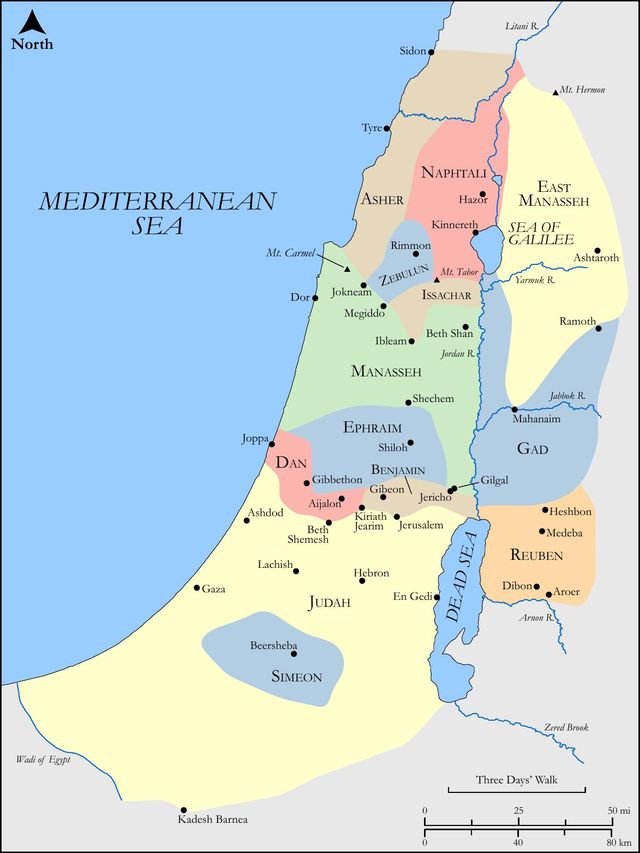
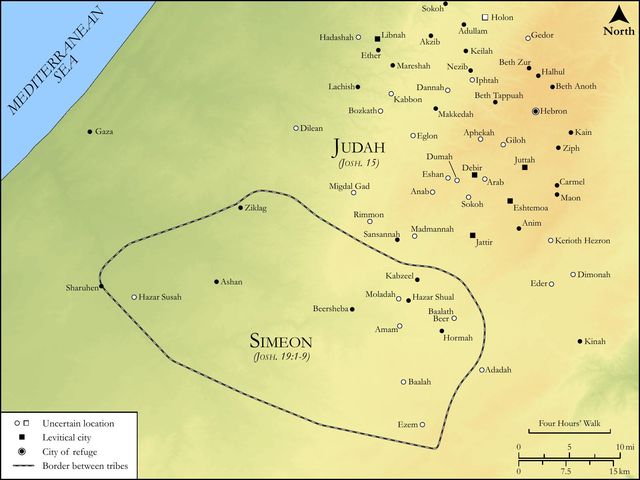
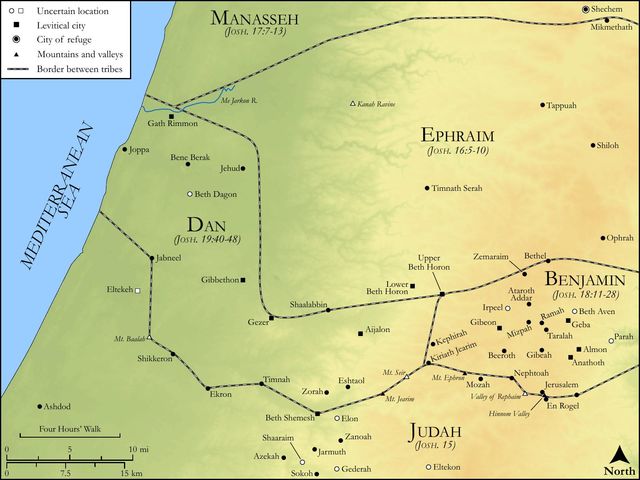
Study this verse
Public-domain commentary
Matthew Henry
From his Commentary on the Whole Bible. Henry comments on passages, not single verses — this entry covers Joshua 21:1–8. His three-level outline is real structure in the source text, so it is rendered as structure.
Here is, I. The Levites' petition presented to this general convention of the states, now sitting at Shiloh, Jos 21:1, Jos 21:2. Observe, 1. They had not their lot assigned them till they made their claim. There is an inheritance provided for all the saints, that royal priesthood, but then they must petition for it. Ask, and it shall be given you. Joshua had quickened the rest of the tribes who were slack to put in their claims, but the Levites, it may be supposed, knew their duty and interest better than the rest, and were therefore forward in this matter, when it came to their turn, without being called upon. They build their claim upon a very good foundation, not their own merits nor services, but the divine precept: "The Lord commanded by the hand of Moses to give us cities, commanded you to grant them, which implied a command to us to ask them." Note, The maintenance of ministers is not an arbitrary thing, left purely to the good-will of the people, who may let them starve if they please; no, as the God of Israel commanded that the Levites should be well provided for, so has the Lord Jesus, the King of the Christian church, ordained, and a perpetual ordinance it is that those who preach the gospel should live of the gospel (Co1 9:14), and should live comfortably. 2. They did not make their claim till all the rest of the tribes were provided for, and then they did it immediately. There was some reason for it; every tribe must first know their own, else they would not know what they gave the Levites, and so it could not be such a reasonable service as it ought to be. But it is also an instance of their humility, modesty, and patience (and Levites should be examples of these and other virtues), that they were willing to be served last, and they fared never the worse for it. Let not God's ministers complain if at any time they find themselves postponed in men's thoughts and cares, but let them make sure of the favour of God and the honour that comes from him, and then they may well enough afford to bear the slights and neglects of men.
II.The Levites' petition granted immediately, without any dispute, the princes of Israel being perhaps ashamed that they needed to be called upon in this matter, and that the motion had not been made among themselves for the settling of the Levites.
1.The children of Israel are said to give the cities for the Levites. God had appointed how many they should be in all, forty-eight. It is probable that Joshua and the princes, upon consideration of the extent and value of the lot of each tribe as it was laid before them, had appointed how many cities should be taken out of each; and then the fathers of the several tribes themselves agreed which they should be, and therefore are said to give them, as an offering, to the Lord; so God had appointed. Num 35:8, Every one shall give of his cities to the Levites. Here God tried their generosity, and it was found to praise and honour, for it appears by the following catalogue that the cities they gave to the Levites were generally some of the best and most considerable in each tribe. And it is probable that they had an eye to the situation of them, taking care they should be so dispersed as that no part of the country should be too far distant from a Levites' city.
2.They gave them at the commandment of the Lord, that is, with an eye to the command and in obedience to it, which was it that sanctified the grant. They gave the number that God commanded, and it was well this matter was settled that the Levites might not ask more nor the Israelites offer less. They gave them also with their suburbs, or glebe-lands, belonging to them, so many cubits by measure from the walls of the city, as God had commanded (Num 35:4, Num 35:5), and did not go about to cut them short.
3.When the forty-eight cities were pitched upon, they were divided into four lots, as they lay next together, and then by lot were determined to the four several families of the tribe of Levi. When the Israelites had surrendered the cities into the hand of God, he would himself have the distributing of them among his servants.
(1.)The family of Aaron, who were the only priests, had for their share the thirteen cities that were given by the tribes of Judah, Simeon, and Benjamin, Jos 21:4. God in wisdom ordered it thus, that though Jerusalem itself was not one of their cities, it being as yet in the possession of the Jebusites (and those generous tribes would not mock the Levites, who had another warfare to mind, with a city that must be recovered by the sword before it could be enjoyed), yet the cities that fell to their lot were those which lay next to Jerusalem, because that was to be, in process of time, the holy city, where their business would chiefly lie.
(2.)The Kohathite-Levites (among whom were the posterity of Moses, though never distinguished from them) had the cities that lay in the lot of Dan, which lay next to Judah, and in that of Ephraim, and the half-tribe of Manasseh, which lay next to Benjamin. So those who descended from Aaron's father joined nearest to Aaron's sons.
(3.)Gershon was the eldest son of Levi, and therefore, though the younger house of the Kohathites was preferred before his, yet his children had the precedency of the other family of Merari, Jos 21:6.
(4.)The Merarites, the youngest house, had their lot last, and it lay furthest off, Jos 21:7. The rest of the sons of Jacob had a lot for every tribe only, but Levi, God's tribe, had a lot for each of its families; for there is a particular providence directing and attending the removals and settlements of ministers, and appointing where those shall fix who are to be the lights of the world.
Historical interpretation
Historical reception
2 surviving comments on this verse. Each one is dated, so this reads as a timeline rather than a list.
Who will explain the diverse sites of the encampments, how this distribution must be retained in the resurrection for each priestly or levitical order of the saints, so that, just as the apostle says, nothing is done haphazardly in the resurrection, but everyone comes "in his own order, Christ first, then those who belong to Christ who have believed in his coming, when he will hand the kingdom over to our God and Father, when he will subject to him every principality and power"?On that occasion, without doubt, there will be some such observances of encampments and priestly distributions and ranks and signals of trumpets.
It was fitting that there be a drawing of lots even regarding the suburbs and cities so that perhaps the renowned division among the Levites might not seem perhaps indiscriminate and accidental. Therefore, the distribution by lot that took place among the sons of Israel was characterized by reason, by which someone was considered worthy of the first lot, and someone else the second, as we have already previously examined to the extent we were able. This was true in regard to both those who receive through Moses beyond the Jordan and those who receive from Jesus [Joshua] in the land of promise, where the first lot fell to Benjamin and afterwards to the rest, among whom Dan was the last. Even so it is necessary that there be some reason also in the order of priestly and levitical lots. Thus the first is drawn for someone, the second for someone else, and the third for another, through which these or those places are determined for each one.
Continue studying Joshua 21:2 across the web’s major study libraries — every link below opens this exact verse, chapter, or book on the destination site.
Read & Compare
 BibleGatewayThis verse in more than 200 translations and 70 languages.
 Bible.comThe YouVersion reader — hundreds of translations, reading plans, and highlights.
 ESV.orgCrossway's official English Standard Version reader.
 NET BibleThe NET translation with 60,000+ translators' notes on every rendering decision.
 STEP BibleTyndale House's free study tool — original text, vocabulary, and scholarly resources.
 BibliaLogos Bible Software's free web reader.
 USCCBThe New American Bible (Revised Edition) with the U.S. bishops' study notes.
Commentaries
 BibleHub CommentariesDozens of classic commentaries on this verse, gathered on one page.
 StudyLightMore than 100 commentary sets — the largest collection on the web.
 BibleRefPlain-English commentary on what this verse means, verse by verse.
 Enduring WordDavid Guzik's free commentary on this chapter, widely used by Bible teachers.
 Bible Study ToolsVerse commentary alongside Greek and Hebrew study aids.
Original Language & Research
- BibleHub InterlinearThe verse word by word — original language, transliteration, and English.
- BibleHub LexiconEvery word's original-language definition and Strong's entry.
 Blue Letter BibleDeep-study tools — Strong's numbers, concordance, and word studies.
 SefariaThe Hebrew text with Rashi and centuries of Jewish commentary.
Sermons, Hymns & Audio


TrulyRandomVerse is not affiliated with these sites and doesn’t control their content. They’re linked because they’re genuinely useful.
Summary
Joshua 21:2 records the pivotal moment when the Levites, through their representatives at Shiloh, formally petitioned Joshua, Eleazar, and the tribal leaders. Their appeal was not a new request but a solemn reminder of the Lord's specific, ancient command given through Moses: that they be allocated cities for their dwelling and surrounding pasturelands for their livestock. This interaction marks the critical initiation of God's meticulous provision for the tribe consecrated entirely to His service, ensuring their strategic dispersion throughout Israel to fulfill their unique spiritual and judicial ministry.
Context
ShowHideLiterary Context
This verse serves as the immediate precursor to the detailed enumeration of the Levitical cities in Joshua 21, following the extensive accounts of land distribution to the other Israelite tribes in Joshua 13-20. With the territorial inheritances settled for the other tribes, the narrative now shifts to address the unique situation of the Levites, who, by divine decree, did not receive a consolidated tribal land portion. Joshua 21:2 thus establishes the legal and theological basis for the subsequent allocation, emphasizing that this provision is not a concession but the meticulous fulfillment of God's prior commands, thereby demonstrating the completion of Israel's inheritance and the establishment of its societal structure in the Promised Land.
Historical & Cultural Context
The setting, Shiloh, was of immense historical and cultural significance, having been established as the central location for the tabernacle and Israel's worship, as detailed in Joshua 18:1. This choice of venue underscores the formal, public, and sacred nature of the Levites' petition, addressed to the highest spiritual (Eleazar the high priest) and civil (Joshua, the tribal heads) authorities. Unlike the other tribes, the Levites were consecrated for priestly and tabernacle service, and therefore, the LORD Himself was their inheritance. Their sustenance was divinely ordained to come from the tithes and offerings of the other tribes, and their dwelling places were specifically commanded in Numbers 35. This context highlights God's comprehensive care for His ministers and the communal responsibility of the entire nation to uphold divine decrees.
Key Themes
ShowHideJoshua 21:2 powerfully articulates several foundational themes. Foremost is Divine Faithfulness and Obedience, as the Levites' request is not a new demand but a direct appeal to a command given through Moses decades earlier. This demonstrates God's unwavering commitment to His covenant promises and the imperative for Israel to finally obey these ancient divine decrees, bringing God's plan to fruition. Another crucial theme is Provision for Ministry. God's command to provide the Levites with cities and pasturelands ensured that those dedicated to His service were adequately cared for, allowing them to focus on their spiritual duties—teaching the law, administering justice, and ministering at the tabernacle—without the burden of agricultural labor. This divine provision is further elaborated in Leviticus 25:32-34. Finally, the concept of Scattered Spiritual Influence is paramount. By receiving cities distributed throughout all the tribal territories, the Levites were strategically positioned to be a pervasive spiritual presence, offering instruction, judgment, and priestly service to the entire nation, fostering unity and adherence to the covenant.
Exposition and Analysis
ShowHideKey Word Analysis
ShowHideThis primitive root, dâbar, signifies not merely uttering words but often implies an arrangement, a declaration, or even a command. In this context, it conveys the formal and authoritative nature of the Levites' address to the leaders. Their "speaking" was a solemn declaration, reminding the recipients of a divine mandate that required action, underscoring the weight and legitimacy of their petition.
This is the proper name of God, Yᵉhôvâh, often rendered "Jehovah" or "the LORD" in English translations, signifying "the Self-Existent" or "the Eternal One." Its use here emphasizes the ultimate divine authority behind the command. The Levites are not appealing to human tradition or a personal preference, but to the direct, authoritative word of the covenant-keeping God of Israel, highlighting the non-negotiable nature of the instruction.
While literally meaning "hand," yâd is used here figuratively to denote agency, means, or authority. "By the hand of Moses" signifies that Moses was the divinely appointed instrument or agent through whom the LORD's command was delivered. This phrase reinforces the authenticity and divine origin of the instruction, linking the present request directly to the foundational covenant established at Sinai through God's chosen leader.
Verse Breakdown
ShowHide"And they spake unto them at Shiloh in the land of Canaan"
This opening clause identifies the petitioners ("they," the Levites, represented by their heads of families) and the recipients of the petition ("them," Joshua, Eleazar the high priest, and the heads of the tribes). The specific location, Shiloh, is crucial, as it was the spiritual and administrative center of Israel at that time, where the tabernacle rested. This setting establishes the formal, public, and sacred context of the request, lending it immense weight and legitimacy.
"saying, The LORD commanded by the hand of Moses"
This phrase immediately establishes the authoritative basis of the Levites' request. They are not asking for a new favor but are reminding the leaders of a pre-existing, direct divine mandate. By appealing to "The LORD commanded by the hand of Moses," they invoke the highest authority in Israelite law and tradition, underscoring the imperative for the nation to fulfill God's explicit instructions concerning the Levites' provision, as detailed in Numbers 35.
"to give us cities to dwell in, with the suburbs thereof for our cattle"
This specifies the precise nature of the divine command and the Levites' petition. They required not only cities for their residence but also surrounding pasturelands ("suburbs") for their livestock. This dual provision was essential for their livelihood, as they had no agricultural land, ensuring they could focus entirely on their sacred duties—teaching, judging, and ministering at the tabernacle—without economic hardship. This demonstrates God's holistic and meticulous care for His servants.
Literary Devices
ShowHideThe verse effectively employs several literary devices to convey its profound message. Allusion is central, as the Levites' statement directly alludes to the Mosaic Law, specifically the detailed instructions in Numbers 35 regarding the provision of cities and pasturelands for the Levites. This device firmly grounds the immediate narrative in the broader covenant history of Israel and underscores the continuity of God's commands. There is also an element of Foreshadowing, as the request for scattered cities anticipates the Levites' future role as geographically dispersed spiritual guides, teachers, and judicial figures throughout the land, ensuring that every tribe had access to those who understood and taught God's law. Finally, the verse uses Emphasis through the repeated invocation of "The LORD commanded." This repetition underscores the unwavering nature of God's promises and the imperative for Israel to obey them, highlighting the meticulous fulfillment of God's overarching plan for His people.
Theological and Thematic Connections
ShowHideJoshua 21:2 serves as a powerful testament to God's meticulous faithfulness and His detailed provision for those He calls to serve Him. It underscores the profound theological principle that divine calling is always accompanied by divine provision. The Levites, set apart for sacred duties, were not left to fend for themselves but were sustained through a communal effort mandated by God Himself. This act of remembering and acting upon an ancient command highlights the importance of covenant fidelity, not just on God's part, but also on the part of His people. It teaches that God's plans unfold over time, and obedience, even when delayed, is ultimately required. The dispersion of the Levites throughout the land also signifies God's desire for His truth and spiritual guidance to permeate every corner of society, ensuring that all Israel had access to instruction in the Law and opportunities for worship.
Reflection and Application
ShowHideJoshua 21:2 offers profound lessons for believers today concerning God's unwavering provision, the sacred nature of ministry, and our communal responsibility within the Body of Christ. Just as God meticulously planned for the Levites' sustenance and strategic placement, He continues to provide for those He calls into service, ensuring they have the necessary resources to fulfill their mission. This verse challenges us to consider how we, as the church, actively support those dedicated to full-time spiritual ministry, recognizing their vital role in teaching, guiding, and nurturing the faith of the community. It also reminds us that God's commands, though ancient in their origin, remain eternally relevant and require our active obedience and diligent remembrance. Furthermore, like the Levites who were scattered to influence all Israel, every believer is called to be a spiritual influence in their respective spheres—families, workplaces, communities—living out their faith and sharing God's truth, demonstrating His presence and principles wherever they are placed.
Questions for Reflection
ShowHideFAQ
ShowHideWhy didn't the Levites receive a tribal land inheritance like the other tribes?
ShowHideThe Levites were uniquely set apart for sacred service to the Lord, primarily for ministry at the tabernacle and later the temple. Their inheritance was not a territorial portion of the land, but rather the LORD Himself. This distinct status meant they were to be supported by the tithes and offerings of the other tribes, allowing them to dedicate themselves fully to their spiritual duties without the burden of agricultural labor or land management. Their dispersion among all the tribes also ensured that spiritual instruction and priestly service were accessible throughout the entire nation.
What was the significance of Shiloh in this context?
ShowHideShiloh was the central religious and administrative hub for Israel during the period of the judges, serving as the location where the tabernacle was set up after the conquest of Canaan, as recorded in Joshua 18:1. The Levites' petition at Shiloh signifies that their request was made to the highest authorities (Joshua, Eleazar the high priest, and the tribal heads) at the most sacred and authoritative place in Israel. This formal setting lent immense legitimacy and solemnity to their appeal for the fulfillment of God's command.
What does "suburbs" mean in the context of Levitical cities?
ShowHideIn this context, "suburbs" (Hebrew: migrash) refers specifically to the designated pasturelands surrounding the Levitical cities, not merely residential outskirts. These lands were essential for the Levites' cattle, which provided a means of livelihood and sustenance. Numbers 35:2-5 provides detailed instructions regarding the size and purpose of these pasturelands, emphasizing that they were for the Levites' livestock and not for cultivation, thus ensuring their economic stability while maintaining their focus on spiritual ministry.
Christ-Centered Fulfillment
ShowHideThe meticulous provision for the Levites in Joshua 21:2, ensuring their sustenance and strategic dispersion throughout Israel, finds its ultimate and perfect fulfillment in Jesus Christ. The Levites, whose inheritance was the Lord Himself and whose ministry involved mediating between God and His people, powerfully foreshadow Jesus. He is the true and ultimate inheritance of His people, the one who fully embodies the presence of God among humanity as Immanuel. Just as the Levitical cities were scattered to bring spiritual instruction and a reminder of God's law to every corner of Israel, so too are New Covenant believers, empowered by Christ, dispersed throughout the world as a "royal priesthood" (1 Peter 2:9) to proclaim the excellencies of Him who called them out of darkness into His marvelous light. Christ, the great High Priest, provides for His ministers in the New Covenant, commanding that those who proclaim the gospel should get their living from the gospel (1 Corinthians 9:14), echoing the divine principle of provision for those set apart for His service. Ultimately, the meticulous fulfillment of God's command to Moses concerning the Levites points to the perfect and complete fulfillment of all God's promises in Jesus Christ, who provides for His church and commissions them to go into all the world, making disciples of all nations.