


Ezekiel 48:9
Bible text: King James Version (1769 Blayney text) · Public domain
Bible text: Berean Standard Bible · Public domain
Bible text: American Standard Version (1901) · Public domain
Bible text: World English Bible, Messianic edition · Public domain
Bible text: Geneva Bible (1599) · Public domain
Bible text: Young's Literal Translation · Public domain
- הַתְּרוּמָהha·te·ru·Mahthe contributionH8641Art ¦ N-fsNoun Singular Feminine Absoluteהַtheתְּרוּמָהcontribution
- אֲשֶׁר'a·SherwhichH834RelParticle Relative
- תָּרִימוּta·Ri·muyou will contributeH7311V-Hiphil-Imperf-2mpVerb Hiphil Imperfect 2nd Plural Masculine
- לַיהוָהla·Yah·wehto YahwehH3068Prep-l ¦ N-properNoun Proper TitleלַtoיהוָהYahweh
- אֹרֶךְ'O·rekh[the] lengthH753N-mscNoun Singular Masculine Construct
- חֲמִשָּׁהcha·mi·Shah[will be] fiveH2568Adj-csAdjective Numerical Singular common gender Absolute
- וְעֶשְׂרִיםve·'es·Rimand twentyH6242Conj-w ¦ Adj-mpAdjective Numerical Plural Masculine Absoluteוְandעֶשְׂרִיםtwenty
- אֶלֶף'E·lefthousand [cubits]H505Adj-csAdjective Numerical Singular common gender Absolute
- וְרֹחַבve·Ro·chavand [the] breadthH7341Conj-w ¦ N-msNoun Singular Masculine Absoluteוְandרֹחַב[the] breadth
- עֲשֶׂרֶת'a·Se·ret[will be] tenH6235N-fsNoun Singular Feminine Absolute
- אֲלָפִים'a·la·Fimthousand [cubits]H505Adj-cpAdjective Numerical Plural common gender Absolute
English is a literal word-by-word gloss of the Hebrew, not the KJV's wording. Why?
This is the original text the KJV's translators worked from — each Hebrew word with its own literal English meaning in this verse, prepared by scholars at Tyndale House, Cambridge. The KJV translates whole sentences, not word by word, so its wording differs: one Hebrew word can become several English words, and the KJV may choose “the LORD” where the gloss reads “Yahweh”. Both are faithful — they answer different questions. For the KJV's own rendering, switch to the KJV text.
Details
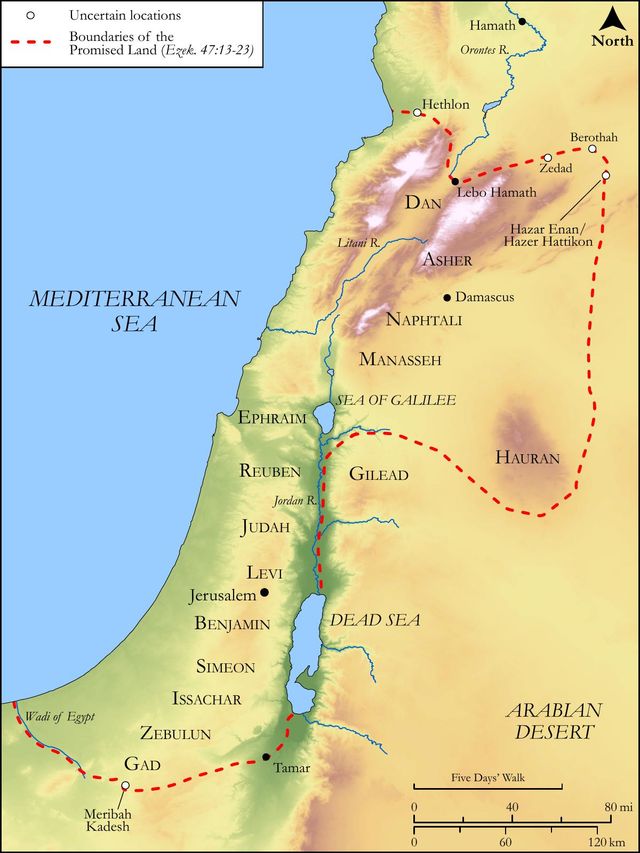
See on the biblical-era map
Study this verse
Historical interpretation
Historical reception
1 surviving comment on this verse from the historical church.
(Verse 8, 9.) And over the border of Judah from the east side to the west side shall be the portion which you shall offer, twenty-five thousand cubits in breadth and in length, like one of the portions from the east side to the west side; and the sanctuary shall be in the midst of it. The portion which you shall offer to the Lord shall be twenty-five thousand cubits in length, and ten thousand in breadth. It is unnecessary to go into detail about what has already been discussed, and to labor again on the same points as if they had not been said. After the boundaries of the seven tribes, the firstfruits are described from east to west; the width of which is twenty-five thousand reeds: but the length, as each tribe holds from east to the sea, has an uncertain number. For the measurement of each tribe's description is not recorded. But if the width is twenty-five thousand reeds, it is given that the number of length is much greater, which is always greater than the width. But in the middle of the sanctuary is placed, next to the firstfruits that are separated for the Lord, a length of twenty-five thousand reeds and a width of ten thousand: reading which I can say nothing other than what the Apostle said: O the depth of the riches of wisdom and knowledge of God! How inscrutable are His judgments and how unsearchable His ways! (Rom. XI, 33)! And in another place: That you may be able to comprehend with all the saints what is the breadth and length, and height and depth: to know also the surpassing knowledge of the charity of Christ, that you may be filled unto all the fullness of God (Eph. III, 18): But the number twenty-five refers to the senses, of which it is said: You shall possess divine sense, and ten thousand refers to perfect and complete virtue, which reaches from the Ten Commandments of the Old Testament to the sacrament of the Gospel, and we have explained this briefly earlier and will remind you of it in part here. For if you add one to the number, you will reach four, and you will fill the number with a ten; and thus it will happen, that both the old Testament may be contained in the new, and the new may be extended in the old.
Continue studying Ezekiel 48:9 across the web’s major study libraries — every link below opens this exact verse, chapter, or book on the destination site.
Read & Compare
 BibleGatewayThis verse in more than 200 translations and 70 languages.
 Bible.comThe YouVersion reader — hundreds of translations, reading plans, and highlights.
 ESV.orgCrossway's official English Standard Version reader.
 NET BibleThe NET translation with 60,000+ translators' notes on every rendering decision.
 STEP BibleTyndale House's free study tool — original text, vocabulary, and scholarly resources.
 BibliaLogos Bible Software's free web reader.
 USCCBThe New American Bible (Revised Edition) with the U.S. bishops' study notes.
Commentaries
 BibleHub CommentariesDozens of classic commentaries on this verse, gathered on one page.
 StudyLightMore than 100 commentary sets — the largest collection on the web.
 BibleRefPlain-English commentary on what this verse means, verse by verse.
 Enduring WordDavid Guzik's free commentary on this chapter, widely used by Bible teachers.
 Bible Study ToolsVerse commentary alongside Greek and Hebrew study aids.
Original Language & Research
- BibleHub InterlinearThe verse word by word — original language, transliteration, and English.
- BibleHub LexiconEvery word's original-language definition and Strong's entry.
 Blue Letter BibleDeep-study tools — Strong's numbers, concordance, and word studies.
 SefariaThe Hebrew text with Rashi and centuries of Jewish commentary.
Sermons, Hymns & Audio


TrulyRandomVerse is not affiliated with these sites and doesn’t control their content. They’re linked because they’re genuinely useful.
Summary
Ezekiel 48:9 details the precise dimensions of the "holy oblation," a significant and consecrated land parcel within Ezekiel's visionary blueprint for a restored Israel. This designated area, measuring twenty-five thousand by ten thousand (likely reeds), was to be exclusively set apart for the sanctuary, the priests, and the Levites, profoundly emphasizing the divine order, sanctity, and the absolute centrality of worship in God's future plans for His covenant people.
Context
ShowHideLiterary Context
This verse is intricately woven into the final, highly detailed section of the book of Ezekiel, spanning chapters 40-48. This extensive prophetic vision, received by Ezekiel during the Babylonian exile, meticulously describes a new temple, a re-division of the land among the twelve tribes, and a new city, serving as a powerful message of hope, restoration, and God's enduring faithfulness to His covenant. Ezekiel 48 specifically outlines the tribal land distribution, with a central focus on the sacred district. The preceding chapters, from Ezekiel 40 through Ezekiel 47, provide a comprehensive description of the temple's architecture, its ordinances, and the life-giving river flowing from it, all culminating in the establishment of God's tangible presence among His people. Verse 9, therefore, is a pivotal detail, specifying the exact measurements of the central, consecrated area, underscoring the divine precision and meticulous order of God's future plans for His people and their worship.
Historical & Cultural Context
Ezekiel prophesied during one of Israel's most traumatic periods: the Babylonian exile (c. 597-538 BC). The loss of their land, the destruction of the Temple, and the absence of a king plunged the people into deep despair and raised fundamental questions about God's covenant promises. In this context of national desolation, Ezekiel's vision offered a radical counter-narrative of divine restoration, portraying a future characterized by God's renewed presence and perfect order. The concept of setting apart land or portions of produce as an "oblation" or "heave offering" (Hebrew: terumah) was deeply ingrained in Israelite cultic practice, as mandated by the Mosaic Law (e.g., Numbers 18:8-19). This practice underscored God's ultimate ownership of all things and the people's responsibility to dedicate the first and best to Him. The meticulous measurements, though vast, recall the tabernacle, which Moses was told to make "after their pattern, which was shewed thee in the mount," where the sacred place was precisely defined. For the exiled Israelites, the vision's emphasis on a clearly demarcated holy district would have resonated deeply with their longing for a return to a pure, ordered, and undefiled worship of Yahweh, free from the sins that led to their displacement.
Key Themes
ShowHideThe meticulous dimensions presented in Ezekiel 48:9 powerfully convey the theme of Divine Order and Precision. This exactness signifies a divine blueprint where nothing is left to chance in God's future kingdom, emphasizing His sovereignty and His careful, intentional planning for the restoration of His people. The designation of this land as an "oblation" or "holy district" highlights the Sanctification of Space, where a substantial portion of territory is set apart exclusively for sacred purposes, distinct from secular land, and dedicated entirely to God's presence and worship. This echoes earlier divine commands for holiness, such as the instructions for the tabernacle in Exodus 25:8. Furthermore, this consecrated land serves as the central locus for the new temple, signifying the Centrality of Worship in the restored community. God's presence, the source of spiritual life, and the pure worship of Him are positioned at the absolute core of this future reality, reflecting God's ultimate desire to dwell among His people, a profound theme that permeates the entire biblical narrative from Genesis 1 to Revelation 22.
Exposition and Analysis
ShowHideKey Word Analysis
ShowHideThis term (H8641), derived from the root rûwm (to raise or lift up), refers to a "present (as offered up), especially in sacrifice or as tribute." In the context of Ezekiel's vision, it specifically denotes a "heave offering" or a "contribution" that is lifted up or set aside for sacred use. When applied to a dedicated portion of land, it emphasizes its consecrated nature—it is a gift or offering set apart for God's exclusive use, signifying its sacred elevation above common territory.
The verb "offer" (H7311, appearing in its Hophal participle form, H8686, in the KJV text) is directly related to the noun "oblation." Its root meaning is "to be high actively, to rise or raise." In this passive sense ("that ye shall offer"), it refers to that which "shall be lifted up" or "set apart" by the people. This reinforces the idea of dedication and elevation, indicating that this land is not merely designated but consecrated and elevated to a sacred status by divine command and human action.
This is the sacred covenant name of God (H3068), "Jehovah," meaning "the self-Existent or Eternal One." The land is not merely for a temple or priests but is specifically offered "unto the LORD," emphasizing that its ultimate purpose is for the dwelling and worship of the sovereign, covenant-keeping God of Israel. This highlights the divine recipient and ultimate authority behind the vision, underscoring that the entire arrangement is for His glory and presence.
Verse Breakdown
ShowHide"The oblation that ye shall offer unto the LORD"
This opening clause immediately establishes the sacred nature and divine purpose of the land being described. It is not just any territory, but a consecrated "heave offering" or "contribution" that is to be set apart and dedicated specifically to Yahweh, the covenant God of Israel. This underscores the idea of divine ownership and the exclusive use of this territory for holy purposes, distinct from all other land.
"[shall be] of five and twenty thousand in length"
This specifies the first dimension of the holy district. "Five and twenty thousand" (25,000) refers to a unit of measurement, understood from the broader context of Ezekiel's vision (e.g., Ezekiel 40:5) to be "reeds." A reed was six cubits long, making this a substantial length (approximately 8.5 miles or 13.7 kilometers). This immense scale signifies the profound importance and significance of this dedicated territory as God's sacred dwelling place.
"and of ten thousand in breadth"
This provides the second dimension, specifying the width of the holy district as "ten thousand" (10,000) reeds (approximately 3.4 miles or 5.5 kilometers). Together with the length, this defines a large rectangular area, emphasizing the meticulous precision and grand scale of God's plans for His dwelling place and the surrounding consecrated land in the restored kingdom. The exactness of these measurements speaks to divine intentionality and order.
Literary Devices
ShowHideEzekiel 48:9 employs several literary devices to convey its profound message of divine order and holiness. The most prominent is Symbolism, where the meticulously described dimensions of the "holy oblation" symbolize God's precise blueprint for the future, His absolute sovereignty, and the centrality of His presence and worship in the restored kingdom. The very act of specifying such exact measurements for a sacred space is a form of Precision/Detailing, which serves to underscore the divine architect's meticulous planning and the absolute importance of holiness and separation in God's kingdom. This level of detail also creates a sense of Anticipation, building a vivid and tangible picture of a perfectly ordered future reality where God's presence is tangibly established. Furthermore, the concept of an "oblation" itself is a Metonymy, where the term for a sacred offering stands in for the sacred land itself, highlighting its consecrated status and purpose as something "lifted up" to God, set apart from the common.
Theological and Thematic Connections
ShowHideEzekiel's vision of the holy oblation in Ezekiel 48:9 is deeply rooted in the biblical theology of God dwelling among His people and the absolute necessity of holiness in His presence. The precise dimensions and the designation of this land as an "oblation" echo the meticulous instructions for the Tabernacle and Temple in earlier biblical books, emphasizing that God's presence demands separation, consecration, and purity. This vision points to a future where God's ideal for His people and His dwelling place is perfectly realized, free from the defilement that led to the exile. It speaks profoundly to God's enduring commitment to restore His relationship with humanity and establish His kingdom on earth in perfect order and holiness. The detailed blueprint for this sacred space underscores the importance of intentionality and divine design in all matters pertaining to God's worship and His people's life.
Reflection and Application
ShowHideWhile the precise fulfillment of Ezekiel's temple vision is a subject of ongoing theological discussion—whether it is to be understood literally, symbolically, or eschatologically—the underlying principles embedded in Ezekiel 48:9 remain profoundly relevant for believers today. The concept of a vast, precisely measured "holy oblation" dedicated entirely to the LORD challenges us to consider what "holy space" means in our lives. Just as a physical territory was set apart for God's presence and worship, we are called to consecrate our lives—our bodies, minds, time, talents, and resources—as a living offering to God. This means intentionally setting aside areas of our lives for His exclusive use, ensuring that God and His worship are truly central. It reminds us that our spiritual lives are not haphazard but should reflect God's divine order and purpose, striving for holiness and intentional dedication in all we do. This vision ultimately points to God's perfect order and His enduring desire to dwell among His people, a promise that finds its ultimate fulfillment in Christ and is anticipated in the eternal kingdom.
Questions for Reflection
ShowHideFAQ
ShowHideWhat unit of measurement is implied by "thousand" in Ezekiel 48:9?
ShowHideWhile not explicitly stated within Ezekiel 48:9 itself, the broader context of Ezekiel's temple vision, particularly Ezekiel 40:5, clarifies that the units of measurement throughout these chapters are "reeds." A reed was a standard measuring rod, typically six cubits long (approximately 10.5 feet or 3.2 meters). Therefore, "twenty-five thousand in length" would mean 25,000 reeds, and "ten thousand in breadth" would mean 10,000 reeds, indicating a vast and significant area consecrated for divine purposes.
Christ-Centered Fulfillment
ShowHideEzekiel's vision of the holy oblation, with its precise measurements and dedication to the LORD, finds its ultimate Christ-centered fulfillment not in a literal, earthly temple, but profoundly in the person and redemptive work of Jesus Christ and His spiritual body, the Church. The entire Old Testament temple system, including its holy spaces, offerings, and meticulous regulations, served as a shadow pointing to the substantive reality found in Christ (Colossians 2:17). Jesus Himself declared, "Destroy this temple, and in three days I will raise it up," clearly referring to the temple of His own body (John 2:19-21). He is the true and ultimate "oblation," the perfect, once-for-all sacrifice "offered unto the LORD" (Hebrews 10:10-14), through whom we now gain direct and unhindered access to God's holy presence. Moreover, the New Testament reveals that believers, individually and corporately, are now the "temple of the Holy Spirit" (1 Corinthians 6:19) and a "spiritual house" (1 Peter 2:5), built upon Christ as the cornerstone. The meticulous dimensions of Ezekiel's holy district thus symbolize the perfect order, absolute holiness, and unmediated divine presence that are fully realized in Christ and His redeemed people. In the new heavens and new earth, the ultimate reality will be that there is no longer a need for a physical temple, "for the Lord God Almighty and the Lamb are its temple" (Revelation 21:22), signifying that God's presence, mediated through Christ, will be the ultimate and all-encompassing reality for eternity.