


Ezekiel 48:8
Bible text: King James Version (1769 Blayney text) · Public domain
Bible text: King James Version with Strong's numbers · Public domain
Bible text: Berean Standard Bible · Public domain
Bible text: American Standard Version (1901) · Public domain
Bible text: World English Bible, Messianic edition · Public domain
Bible text: Geneva Bible (1599) · Public domain
Bible text: Young's Literal Translation · Public domain
- וְעַלve·'Aland atH5921Conj-w ¦ PrepPrepositionוְandעַלat
- גְּבוּלge·Vul[the] border ofH1366N-mscNoun Singular Masculine Construct
- יְהוּדָהye·hu·DahJudahH3063N-properNoun Proper Location
- מִפְּאַתmi·pe·'Atfrom [the] side ofH6285Prep-m ¦ N-fscNoun Singular Feminine Constructמִfromפְּאַת[the] side of
- קָדִיםka·Dim[the] eastH6921N-msNoun Singular Masculine Absolute
- עַד'adtoH5704PrepPreposition
- פְּאַתpe·'at[the] side ofH6285N-fscNoun Singular Feminine Construct
- יָמָּהYa·mahwest -wardH3220N-ms ¦ SfxNoun Singular Masculine Absoluteיָמָּwestה-ward
- תִּהְיֶהtih·Yehit will beH1961V-Qal-Imperf-3fsVerb Qal Imperfect 3rd Singular Feminine
- הַתְּרוּמָהha·te·ru·Mahthe contributionH8641Art ¦ N-fsNoun Singular Feminine Absoluteהַtheתְּרוּמָהcontribution
- אֲשֶׁר'asherwhichH834RelParticle Relative
- תָּרִימוּta·Ri·muyou will offer upH7311V-Hiphil-Imperf-2mpVerb Hiphil Imperfect 2nd Plural Masculine
- חֲמִשָּׁהcha·mi·Shah[will be] fiveH2568Adj-csAdjective Numerical Singular common gender Absolute
- וְעֶשְׂרִיםve·'es·Rimand twentyH6242Conj-w ¦ Adj-mpAdjective Numerical Plural Masculine Absoluteוְandעֶשְׂרִיםtwenty
- אֶלֶף'E·lefthousand [cubits]H505Adj-csAdjective Numerical Singular common gender Absolute
- רֹחַבRo·chav[the] breadthH7341N-msNoun Singular Masculine Absolute
- וְאֹרֶךְve·'O·rekhand [the] lengthH753Conj-w ¦ N-msNoun Singular Masculine Absoluteוְandאֹרֶךְ[the] length
- כְּאַחַדke·'a·Chad[will be] like one ofH259Prep-k ¦ Adj-fscAdjective Numerical Singular Feminine Constructכְּ[will be] likeאַחַדone of
- הַחֲלָקִיםha·cha·la·Kimthe portionsH2506Art ¦ N-mpNoun Plural Masculine Absoluteהַtheחֲלָקִיםportions
- מִפְּאַתmi·pe·'Atfrom [the] side ofH6285Prep-m ¦ N-fscNoun Singular Feminine Constructמִfromפְּאַת[the] side of
- קָדִימָהka·Di·maheast -wardH6921N-ms ¦ SfxNoun Singular Masculine Absoluteקָדִימָeastה-ward
- עַד'adtoH5704PrepPreposition
- פְּאַתpe·'at[the] side ofH6285N-fscNoun Singular Feminine Construct
- יָמָּהYa·mahwest -wardH3220N-ms ¦ SfxNoun Singular Masculine Absoluteיָמָּwestה-ward
- וְהָיָהve·ha·Yahand it will beH1961Conj-w ¦ V-Qal-ConsecPerf-3msVerb Qal Consecutive Perfect 3rd Singular Masculineוְandהָיָהit will be
- הַמִּקְדָּשׁha·mik·Dashthe sanctuaryH4720Art ¦ N-msNoun Singular Masculine Absoluteהַtheמִּקְדָּשׁsanctuary
- בְּתוֹכוֹbe·to·Khoin [the] middle of itH8432Prep-b ¦ N-msc ¦ 3msNoun Singular Masculine Constructבְּinתוֹכ[the] middle ofוֹit
English is a literal word-by-word gloss of the Hebrew, not the KJV's wording. Why?
This is the original text the KJV's translators worked from — each Hebrew word with its own literal English meaning in this verse, prepared by scholars at Tyndale House, Cambridge. The KJV translates whole sentences, not word by word, so its wording differs: one Hebrew word can become several English words, and the KJV may choose “the LORD” where the gloss reads “Yahweh”. Both are faithful — they answer different questions. For the KJV's own rendering, switch to the KJV text.
Details
See on the biblical-era map
Study this verse
Historical interpretation
Historical reception
1 surviving comment on this verse from the historical church.
(Verse 8, 9.) And over the border of Judah from the east side to the west side shall be the portion which you shall offer, twenty-five thousand cubits in breadth and in length, like one of the portions from the east side to the west side; and the sanctuary shall be in the midst of it. The portion which you shall offer to the Lord shall be twenty-five thousand cubits in length, and ten thousand in breadth. It is unnecessary to go into detail about what has already been discussed, and to labor again on the same points as if they had not been said. After the boundaries of the seven tribes, the firstfruits are described from east to west; the width of which is twenty-five thousand reeds: but the length, as each tribe holds from east to the sea, has an uncertain number. For the measurement of each tribe's description is not recorded. But if the width is twenty-five thousand reeds, it is given that the number of length is much greater, which is always greater than the width. But in the middle of the sanctuary is placed, next to the firstfruits that are separated for the Lord, a length of twenty-five thousand reeds and a width of ten thousand: reading which I can say nothing other than what the Apostle said: O the depth of the riches of wisdom and knowledge of God! How inscrutable are His judgments and how unsearchable His ways! (Rom. XI, 33)! And in another place: That you may be able to comprehend with all the saints what is the breadth and length, and height and depth: to know also the surpassing knowledge of the charity of Christ, that you may be filled unto all the fullness of God (Eph. III, 18): But the number twenty-five refers to the senses, of which it is said: You shall possess divine sense, and ten thousand refers to perfect and complete virtue, which reaches from the Ten Commandments of the Old Testament to the sacrament of the Gospel, and we have explained this briefly earlier and will remind you of it in part here. For if you add one to the number, you will reach four, and you will fill the number with a ten; and thus it will happen, that both the old Testament may be contained in the new, and the new may be extended in the old.
Continue studying Ezekiel 48:8 across the web’s major study libraries — every link below opens this exact verse, chapter, or book on the destination site.
Read & Compare
 BibleGatewayThis verse in more than 200 translations and 70 languages.
 Bible.comThe YouVersion reader — hundreds of translations, reading plans, and highlights.
 ESV.orgCrossway's official English Standard Version reader.
 NET BibleThe NET translation with 60,000+ translators' notes on every rendering decision.
 STEP BibleTyndale House's free study tool — original text, vocabulary, and scholarly resources.
 BibliaLogos Bible Software's free web reader.
 USCCBThe New American Bible (Revised Edition) with the U.S. bishops' study notes.
Commentaries
 BibleHub CommentariesDozens of classic commentaries on this verse, gathered on one page.
 StudyLightMore than 100 commentary sets — the largest collection on the web.
 BibleRefPlain-English commentary on what this verse means, verse by verse.
 Enduring WordDavid Guzik's free commentary on this chapter, widely used by Bible teachers.
 Bible Study ToolsVerse commentary alongside Greek and Hebrew study aids.
Original Language & Research
- BibleHub InterlinearThe verse word by word — original language, transliteration, and English.
- BibleHub LexiconEvery word's original-language definition and Strong's entry.
 Blue Letter BibleDeep-study tools — Strong's numbers, concordance, and word studies.
 SefariaThe Hebrew text with Rashi and centuries of Jewish commentary.
Sermons, Hymns & Audio


TrulyRandomVerse is not affiliated with these sites and doesn’t control their content. They’re linked because they’re genuinely useful.
Summary
Ezekiel 48:8 meticulously details a specific, sacred land allotment within the visionary restoration of Israel, known as the "holy oblation." This precisely measured territory, twenty-five thousand reeds in breadth and extending from east to west like other tribal portions, is designated to border the tribe of Judah. Its paramount feature is the explicit placement of the sanctuary—the future temple—at its very center, underscoring the divine centrality of God's presence and worship in the restored community.
Context
ShowHideLiterary Context
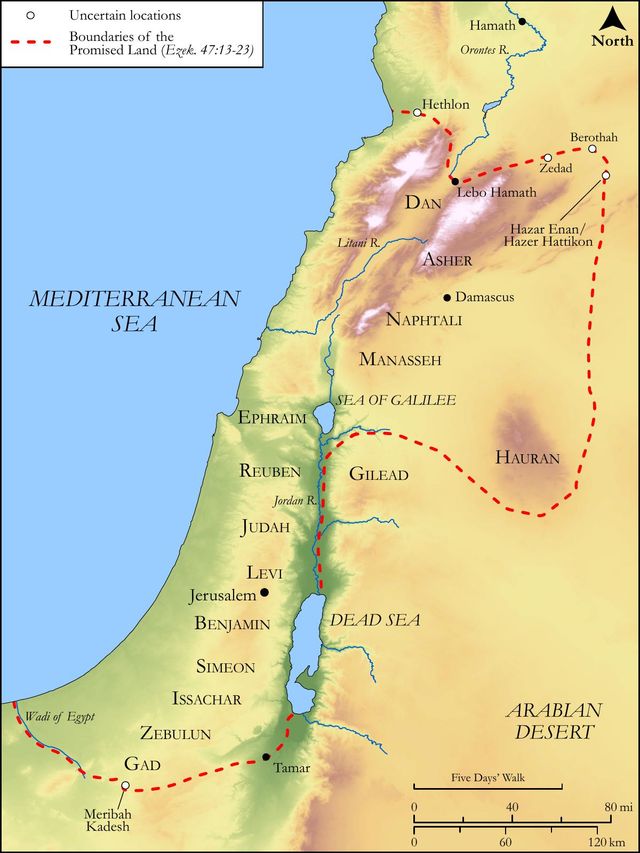
Ezekiel 48:8 is situated within the climactic section of Ezekiel's prophecy (chapters 40-48), which unveils a detailed, visionary blueprint for a restored temple and a reordered land for Israel. Following the intricate architectural descriptions of the new temple complex found in Ezekiel 40-42, and the awe-inspiring return of God's glory to it in Ezekiel 43:1-5, the prophet transitions in Ezekiel 45 to describe the sacred land divisions. Specifically, Ezekiel 48:1 commences the precise allocation of territories to the twelve tribes, with a distinct and central focus on this "holy oblation" (also called the "holy portion" in Ezekiel 45:1), which serves as the consecrated heart of the restored nation, encompassing the temple, the priests' and Levites' portions, and the city. The verse thus provides critical dimensions for this sacred core, emphasizing its deliberate and central placement within the reordered land.
Historical & Cultural Context
Ezekiel's prophecy was delivered during the Babylonian exile, a period of profound national despair, displacement, and spiritual questioning for the Jewish people. The destruction of the first temple in Jerusalem (c. 586 BC) and the loss of their land were catastrophic, leading to deep doubts about God's faithfulness and their future as a covenant people. In this context, Ezekiel's elaborate vision of a new temple and a redivided, restored land offered a powerful message of hope, divine faithfulness, and future renewal. The meticulous details, including precise measurements and land divisions, served to reassure the exiles of the certainty and tangibility of God's promised restoration. Culturally, the temple was the epicenter of Israelite life, representing God's dwelling among His people, and its destruction was a profound theological crisis. The vision of a new, even more glorious temple, centrally located in a divinely ordered land, would have resonated deeply with their longing for return, purity, and renewed communion with God. This vision provided a divine counter-narrative to their present desolation, promising a future of divine presence and order.
Key Themes
ShowHideThis verse contributes significantly to several overarching themes within Ezekiel. Firstly, it highlights Divine Order and Precision, as evidenced by the exact measurements and specified boundaries, underscoring God's meticulous planning and the absolute certainty of His prophetic word concerning the future. This precision contrasts sharply with the chaos of exile and destruction. Secondly, it powerfully emphasizes the Holiness and Centrality of God's Dwelling. The explicit statement "the sanctuary shall be in the midst of it" reveals God's desire for His presence to be the absolute core of the restored community, ensuring purity, prominence, and unhindered worship. This aligns with the theme of God's glory returning to the temple in Ezekiel 43, where the divine presence re-establishes itself as the lifeblood of the nation. Thirdly, the verse contributes to the overarching theme of Future Restoration of Israel, painting a vivid picture of a future era where the land is perfectly re-allocated, and God's presence is unequivocally re-established among His people, fulfilling covenant promises that extend beyond the immediate return from exile to a glorious, eschatological reality.
Exposition and Analysis
ShowHideKey Word Analysis
ShowHideThis term (H8641), derived from a root meaning "to be high" or "to lift up," signifies a "heave offering" or something "lifted up" or "set apart" as a contribution, particularly for sacred purposes. In this context, it emphasizes that the designated land portion for the temple, priests, and Levites is not merely an allocation but a sacred, consecrated portion dedicated to God, elevated in status and purpose. It underscores the holiness and divine ownership of this central district, indicating it is a gift presented to the Lord.
This word (H4720) refers to a consecrated thing or place, specifically a holy place or temple. Its placement "in the midst" (H8432) of the offering highlights its supreme importance as the focal point of God's presence and the site of worship. The use of this term reinforces the sacred, set-apart nature of the entire "holy oblation" and its ultimate purpose: facilitating communion with a holy God. The sanctuary is the very heart of the divine-human encounter.
This term (H8432) literally means "a bisection" or "the center." Its application to the sanctuary's placement within the holy oblation is profoundly significant. It signifies not just a geographical center, but a theological and existential core. God's dwelling is not peripheral but foundational to the entire restored community, implying that all life, order, and blessing flow from His central presence. This centrality ensures that God remains the absolute focal point of their existence and worship.
Verse Breakdown
ShowHide"And by the border of Judah, from the east side unto the west side, shall be the offering"
This clause establishes the precise location and initial dimension of the sacred land portion. It is strategically positioned adjacent to the territory of Judah (H3063), indicating its prominence and connection to the royal and spiritual lineage. The phrase "from the east side unto the west side" (H6921, H6285, H3220) specifies that this "offering" (H8641) spans the entire width of the land, emphasizing its comprehensive and expansive nature, mirroring the full extent of the tribal allotments.
"which ye shall offer of five and twenty thousand [reeds in] breadth, and [in] length as one of the [other] parts, from the east side unto the west side"
This provides the specific measurements of the "holy oblation." The "five and twenty thousand" (H2568, H6242, H505) reeds in breadth (H7341) denotes a vast, substantial area (approximately 66 miles or 106 kilometers), far exceeding any typical land grant, underscoring its immense significance and capacity to house the temple, priestly and Levitical cities, and the prince's portion. The phrase "in length (H753) as one (H259) of the [other] parts (H2506)" indicates that its length matches the north-south dimension of the tribal territories, making it a perfectly square or rectangular block. The repetition of "from the east side unto the west side" (H6921, H6285, H3220) for both its breadth and length (or consistent orientation) reinforces the idea of a complete, divinely ordained territory that spans the entire width of the land, ensuring its integrity and distinction.
"and the sanctuary shall be in the midst of it"
This culminating phrase reveals the ultimate purpose and theological heart of this entire arrangement. The temple (H4720), as the dwelling place of God, is not merely within the holy oblation but centrally located "in the midst" (H8432), signifying that God's presence and worship are the absolute core and driving force of the restored community and the entire land. This centrality ensures that God remains the focal point of their existence, the source of all order, blessing, and spiritual vitality.
Literary Devices
ShowHideThe verse employs several significant literary devices that underscore its message. Precision and Detail are paramount, evident in the meticulous measurements ("five and twenty thousand reeds") and specific directional markers ("from the east side unto the west side"). This numerical and spatial exactitude lends an air of divine authority and certainty to the vision, contrasting sharply with the chaos and destruction of the exile and assuring the reader of the tangibility of God's future plan. Symbolism is also heavily at play; the "offering" (Hebrew: terumah) is not just land but a consecrated portion, symbolizing the entire community's dedication and setting apart for God. The "sanctuary" itself is the ultimate symbol of God's presence, holiness, and covenant faithfulness. The phrase "in the midst of it" utilizes Centrality as a powerful symbolic motif, emphasizing that God's dwelling is not peripheral but the absolute core and life-giving center of the restored nation, from which all order and blessing emanate. The Repetition of "from the east side unto the west side" reinforces the comprehensive and divinely established nature of this sacred territory, emphasizing its complete and divinely ordained boundaries.
Theological and Thematic Connections
ShowHideEzekiel 48:8 powerfully articulates the enduring theological truth of God's desire to dwell among His people in holiness and order. It highlights that true restoration, whether for a nation or an individual, is predicated upon the centrality of God's presence. The meticulous measurements and the explicit placement of the sanctuary in the "midst" signify that God's dwelling is not an afterthought but the foundational element around which all life and community are to be organized. This vision speaks to God's faithfulness to His covenant promises, even in the face of human failure and exile, providing profound hope for a future where His glory is not only present but paramount. The "holy oblation" serves as a tangible representation of a community wholly consecrated to the Lord, where His worship and presence define its very existence and from which all blessings flow.
Reflection and Application
ShowHideEzekiel 48:8 serves as a profound spiritual anchor, reminding us that God's ultimate desire is to dwell intimately among His people, and that His presence brings order, holiness, and purpose. In a world often characterized by chaos, competing priorities, and spiritual displacement, this verse calls us to examine what truly occupies the "midst" of our own lives. Just as a vast, sacred portion of land was meticulously set apart with the sanctuary at its heart, we are invited to consecrate our lives—our time, talents, resources, relationships, and aspirations—to God, allowing His presence to be the defining center of all we are and do. This means intentionally prioritizing worship, seeking His will in all decisions, and living in a manner that reflects His holiness and purpose. The meticulous detail in the vision encourages us to trust in God's perfect plan, even when circumstances seem bleak or uncertain, and to actively participate in building communities where Christ's presence is truly central, celebrated, and transformative.
Questions for Reflection
ShowHideFAQ
ShowHideIs the "holy oblation" and its measurements in Ezekiel 48:8 meant to be taken literally or symbolically?
ShowHideThis is a widely debated question among scholars. Some interpret the vision, including the "holy oblation" and its precise measurements, as a literal blueprint for a future earthly temple and land division during a millennial reign of Christ. They emphasize the meticulous detail as evidence of its literal intent, suggesting a future fulfillment that will be as tangible as the original temple. Others view it as primarily symbolic, representing the spiritual realities of God's restored presence among His people, the perfect order of His kingdom, and the centrality of worship in the New Covenant era. They argue that the immense scale and certain features are difficult to reconcile with a literal fulfillment in a physical land, and point to the ultimate fulfillment in the church as God's dwelling place (Ephesians 2:19-22) and the New Jerusalem (Revelation 21:1-27). A balanced approach might see elements of both: a literal vision that also carries profound spiritual truths and symbolic implications for God's ultimate plan of redemption, which transcends a purely physical manifestation.
What is the significance of the "sanctuary" being "in the midst of it"?
ShowHideThe phrase "the sanctuary shall be in the midst of it" is profoundly significant. It signifies that God's presence is the absolute theological, spiritual, and functional center of the restored community and land. This is not merely a geographical placement but a declaration of divine priority. It implies that all aspects of life—social, political, and religious—are to revolve around God's dwelling and His worship. This centrality ensures purity, order, and blessing, as God's holiness permeates and sanctifies the entire "offering." It reflects God's ultimate desire to dwell intimately with His people, a theme consistent throughout biblical history, from the tabernacle in the wilderness (Exodus 25:8) to the ultimate dwelling of God with humanity in the New Jerusalem (Revelation 21:3). It underscores that true life and flourishing stem from God's central presence.
Christ-Centered Fulfillment
ShowHideEzekiel 48:8, with its vision of a meticulously measured "holy oblation" and the sanctuary at its "midst," finds its ultimate and profound fulfillment in Jesus Christ. While Ezekiel's vision describes a physical temple and land, the New Testament reveals that Christ Himself is the true temple, the ultimate dwelling place of God among humanity. John 2:19-21 records Jesus declaring, "Destroy this temple, and in three days I will raise it up," referring to His own body. Through His incarnation, death, and resurrection, Jesus became the living sanctuary, the very embodiment of God's presence "in the midst" of His people. Furthermore, through Christ, believers are incorporated into this spiritual temple, becoming "living stones" built into a "spiritual house" (1 Peter 2:5) and a "dwelling place for God by the Spirit" (Ephesians 2:21-22). The precise measurements of Ezekiel's vision, symbolizing divine order and holiness, are fulfilled in the perfect righteousness and order established by Christ's redemptive work, which makes it possible for God to truly dwell among a holy people, not in a physical structure, but in the hearts of believers and in the gathered church, the body of Christ (1 Corinthians 3:16). Ultimately, the vision points to the New Jerusalem, where God's presence is so complete that there is "no temple in the city, because the Lord God Almighty and the Lamb are its temple" (Revelation 21:22), signifying Christ as the eternal, central sanctuary and the focal point of all creation.