


Joshua 18:2
Bible text: King James Version (1769 Blayney text) · Public domain
Bible text: Berean Standard Bible · Public domain
Bible text: American Standard Version (1901) · Public domain
Bible text: World English Bible, Messianic edition · Public domain
Bible text: Geneva Bible (1599) · Public domain
Bible text: Young's Literal Translation · Public domain
- וַיִּוָּתְרוּvai·yi·va·te·Ruand they remainedH3498Conj-w ¦ V-Niphal-ConsecImperf-3mpVerb Niphal Consecutive Imperfect 3rd Plural Masculineוַandיִּוָּתְרוּthey remained
- בִּבְנֵיbiv·Neiamong [the] people ofH1121Prep-b ¦ N-mpcNoun Plural Masculine Constructבִּamongבְנֵי[the] people of
- יִשְׂרָאֵלYis·ra·'ElIsraelH3478N-properNoun Proper Location
- אֲשֶׁר'a·SherwhichH834RelParticle Relative
- לֹאlo'notH3808NegParticle Negative
- חָלְקוּchal·Kuthey had dividedH2505V-Qal-Perf-3cpVerb Qal Perfect 3rd Plural common gender
- אֶת'et<obj.>H853DirObjMParticle Object Indicator
- נַחֲלָתָםna·cha·la·Tamtheir inheritanceH5159N-fsc ¦ 3mpNoun Singular Feminine Constructנַחֲלָתָinheritanceםtheir
- שִׁבְעָהshiv·'AhsevenH7651Adj-csAdjective Numerical Singular common gender Absolute
- שְׁבָטִיםshe·va·TimtribesH7626N-mpNoun Plural Masculine Absolute
English is a literal word-by-word gloss of the Hebrew, not the KJV's wording. Why?
This is the original text the KJV's translators worked from — each Hebrew word with its own literal English meaning in this verse, prepared by scholars at Tyndale House, Cambridge. The KJV translates whole sentences, not word by word, so its wording differs: one Hebrew word can become several English words, and the KJV may choose “the LORD” where the gloss reads “Yahweh”. Both are faithful — they answer different questions. For the KJV's own rendering, switch to the KJV text.
Details
See on the biblical-era maps
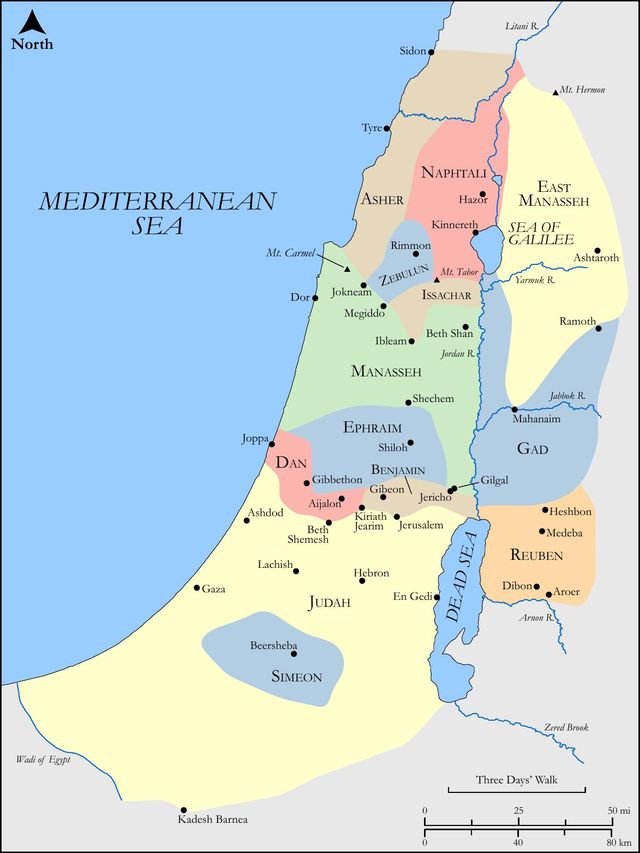
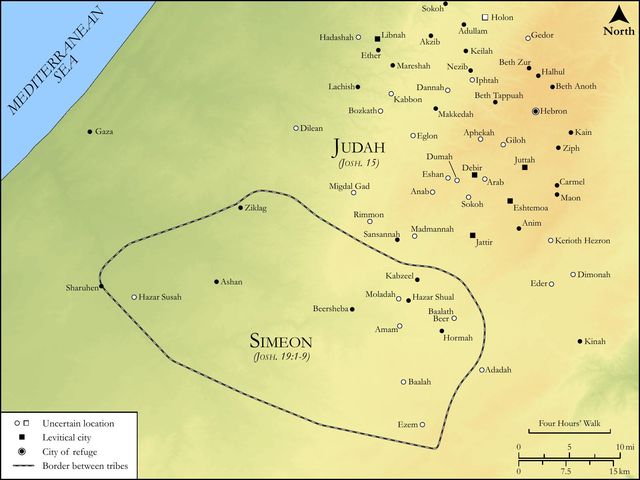
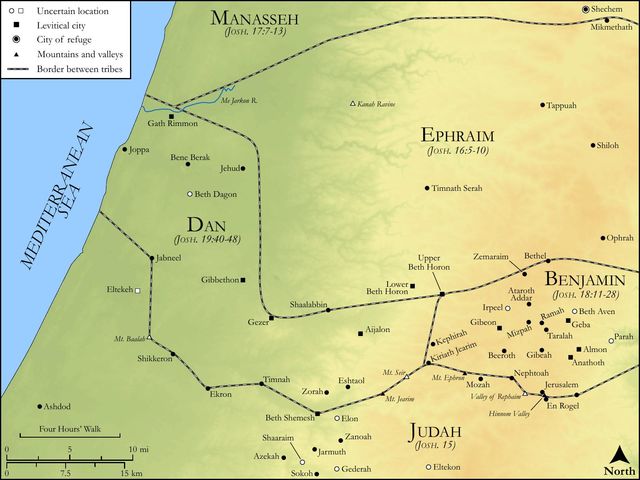
Study this verse
Public-domain commentary
Matthew Henry
From his Commentary on the Whole Bible. Henry comments on passages, not single verses — this entry covers Joshua 18:2–10. His four-level outline is real structure in the source text, so it is rendered as structure.
Here, I. Joshua reproves those tribes which were yet unsettled that they did not bestir themselves to gain a settlement in the land which God had given them. Seven tribes were yet unprovided for, though sure of an inheritance, yet uncertain where it should be, and it seems in no great care about it, Jos 18:2. And with them Joshua reasons (Jos 18:3): How long are you slack? 1. They were too well pleased with their present condition, liked well enough to live in a body together, the more the merrier, and, like the Babel-builders, had no mind to be scattered abroad and break good company. The spoil of the cities they had taken served them to live plentifully upon for the present, and they banished the thoughts of time to come. Perhaps the tribes of Judah and Joseph, who had already received their inheritance in the countries next adjoining, were generous in entertaining their brethren who were yet unprovided for, so that they went from one good house to another among their friends, with which, instead of grudging that they were postponed, they were so well pleased that they cared not for going to houses of their own. 2. They were slothful and dilatory. It may be they wished the thing done, but had not spirit to stir in it, or move towards the doing of it, though it was so much for their own advantage; like the sluggard, that hides his hand in his bosom, and it grieves him to bring it to his mouth again. The countries that remained to be divided lay at a distance, and some parts of them in the hands of the Canaanites. If they go to take possession of them, the cities must be rebuilt or repaired, they must drive their flocks and herds a great way, and carry their wives and children to strange places, and this will not be done without care and pains, and breaking through some hardships; thus he that observes the wind shall not sow, and he that regards the clouds shall not reap, Ecc 11:4. Note, Many are diverted from real duties, and debarred from real comforts, by seeming difficulties. God by his grace has given us a title to a good land, the heavenly Canaan, but we are slack to take possession; we enter not into that rest, as we might by faith, and hope, and holy joy; we live not in heaven, as we might by setting our affections on things above and having our conversation there. How long shall it be thus with us? How long shall we thus stand in our own light, and forsake our own mercies for lying vanities? Joshua was sensible of the inconveniences of this delay, that, while they neglected to take possession of the land that was conquered, the Canaanites were recovering strength and spirit, and fortifying themselves in the places that were yet in their hands, which would make the total expulsion of them the more difficult. They would lose their advantages by not following their blow; and therefore, as an eagle stirreth up her nest, so Joshua stirs them up to take possession of their lot. He is ready to do his part, if they will but do theirs.
II.He puts them in a way to settle themselves.
1.The land that remained must be surveyed, an account taken of the cities, and the territories belonging to them, Jos 18:4. These must be divided into seven equal parts, as near as they could guess at their true value, which they must have an eye to, and not merely to the number of the cities and extent of the country. Judah is fixed on the south and Joseph on the north of Shiloh, to protect the tabernacle (Jos 18:5), and therefore they need not describe their country, but those countries only that were yet undisposed of. He gives a reason (Jos 18:7) why they must divide it into seven parts only, because the Levites were to have no temporal estate (as we say), but their benefices only, which were entailed upon their families: The priesthood of the Lord is their inheritance, and a very honourable, comfortable, plentiful inheritance it was. Gad and Reuben, with half of the tribe of Manasseh, were already fixed, and needed not to have any further care taken of them. Now,
(1.)The surveyors were three men out of each of the seven tribes that were to be provided for (Jos 18:4), one-and-twenty in all, who perhaps for greater expedition, because they had already lost time, divided themselves into three companies, one of each tribe in each company, and took each their district to survey. The matter was thus referred equally, that there might be neither any partiality used in making up the seven lots, nor any shadow of suspicion given, but all might be satisfied that they had right done them.
(2.)The survey was accordingly made, and brought in to Joshua, Jos 18:8, Jos 18:9. Josephus says it was seven months in the doing. And we must in it observe,
[1.]The faith and courage of the persons employed: abundance of Canaanites remained in the land, and all raging against Israel, as a bear robbed of her whelps; the business of these surveyors would soon be known, and what could they expect but to be way-laid, and have their brains knocked out by the fierce observers? But in obedience to Joshua's command, and in dependence upon God's power, they thus put their lives in their hands to serve their country.
[2.]The good providence of God in protecting them from the many deaths they were exposed to, and bringing them all safely again to the host at Shiloh. When we are in the way of our duty we are under the special protection of the Almighty.
2.When it was surveyed, and reduced to seven lots, then Joshua would, by appeal to God, and direction from him, determine which of these lots should belong to each tribe (Jos 18:6): That I may cast lots for you here at the tabernacle (because it was a sacred transaction) before the Lord our God, to whom each tribe must have an eye, with thankfulness for the conveniences and submission to the inconveniences of their allotment. What we have in the world we must acknowledge God's property in, and dispose of it as before him, with justice, and charity, and dependence upon Providence. The heavenly Canaan is described to us in a book, the book of the scriptures, and there are in it mansions and portions sufficient for all God's spiritual Israel. Christ is our Joshua that divides it to us. On him we must attend, and to him we must apply for an inheritance with the saints in light. See Joh 17:2, Joh 17:3.
Continue studying Joshua 18:2 across the web’s major study libraries — every link below opens this exact verse, chapter, or book on the destination site.
Read & Compare
 BibleGatewayThis verse in more than 200 translations and 70 languages.
 Bible.comThe YouVersion reader — hundreds of translations, reading plans, and highlights.
 ESV.orgCrossway's official English Standard Version reader.
 NET BibleThe NET translation with 60,000+ translators' notes on every rendering decision.
 STEP BibleTyndale House's free study tool — original text, vocabulary, and scholarly resources.
 BibliaLogos Bible Software's free web reader.
 USCCBThe New American Bible (Revised Edition) with the U.S. bishops' study notes.
Commentaries
 BibleHub CommentariesDozens of classic commentaries on this verse, gathered on one page.
 StudyLightMore than 100 commentary sets — the largest collection on the web.
 BibleRefPlain-English commentary on what this verse means, verse by verse.
 Enduring WordDavid Guzik's free commentary on this chapter, widely used by Bible teachers.
 Bible Study ToolsVerse commentary alongside Greek and Hebrew study aids.
Original Language & Research
- BibleHub InterlinearThe verse word by word — original language, transliteration, and English.
- BibleHub LexiconEvery word's original-language definition and Strong's entry.
 Blue Letter BibleDeep-study tools — Strong's numbers, concordance, and word studies.
 SefariaThe Hebrew text with Rashi and centuries of Jewish commentary.
Sermons, Hymns & Audio


TrulyRandomVerse is not affiliated with these sites and doesn’t control their content. They’re linked because they’re genuinely useful.
Summary
Joshua 18:2 serves as a critical interlude in the division of the Promised Land, revealing that despite God's faithfulness in delivering the territory, a significant portion of the Israelite nation—specifically seven tribes—had not yet actively taken possession of their divinely allotted inheritance. This verse highlights a state of unfinished business, setting the stage for Joshua's subsequent challenge to overcome their complacency and fully occupy the land promised to them by God.
Context
ShowHideLiterary Context
This verse immediately follows the initial, significant distributions of land to the prominent tribes of Judah, Ephraim, and Manasseh, as detailed in Joshua 15 and Joshua 16-17. The preceding verse, Joshua 18:1, notes the assembly of the whole congregation at Shiloh and the setting up of the tabernacle there, signifying a period of relative peace and the establishment of a central religious and administrative hub. Joshua 18:2 thus interrupts the flow of land distribution narratives, drawing attention to a crucial delay. It functions as a narrative pivot, explaining why Joshua needed to issue the challenge found in Joshua 18:3, urging the remaining tribes to survey and claim their portions.
Historical & Cultural Context
The period described is post-conquest, where the major Canaanite strongholds had been broken, but much of the land still required active occupation and the driving out of residual inhabitants. The concept of "inheritance" (Hebrew: nachălâh) was deeply embedded in Israelite culture, signifying a permanent, divinely apportioned family possession, often tied to ancestral rights and the covenant promises made to Abraham, Isaac, and Jacob. The establishment of the tabernacle at Shiloh marked it as the spiritual and administrative center, making it the logical place for such an inventory and challenge. The tribes' inaction, despite God's clear command and provision, reflects a common human tendency towards complacency or fear, even in the face of divine blessing and opportunity.
Key Themes
ShowHideJoshua 18:2 powerfully underscores several key themes. First, the theme of unclaimed inheritance highlights the tension between God's sovereign faithfulness in providing the land (Joshua 21:45) and human responsibility to actively possess what has been given. Second, it subtly introduces the theme of delay and indecision among the people. Despite having the right and the means to claim their land, these seven tribes had procrastinated, perhaps due to comfort, apathy, or fear of further conflict. This inaction stands in contrast to the proactive faith demonstrated by Caleb in Joshua 14:6-15. Finally, the verse implicitly emphasizes the principle of divine promise requiring human action. God had fulfilled His part of the covenant; now it was the people's turn to step out in faith and effort to fully realize the blessing.
Exposition and Analysis
ShowHideKey Word Analysis
ShowHideThis verb (H3498) signifies "to jut over or exceed," and by implication, "to excel," or "to remain or be left." In this context, it highlights a state of incompleteness—a significant portion of the task of land distribution was still "remaining" or unfinished. It implies a lingering situation that needed resolution, not a finality, emphasizing that a substantial part of the nation's divinely appointed task was yet undone.
The specific number "seven" (H7651), while often associated with completeness or perfection in biblical numerology, here ironically points to a major incompleteness in the task of national settlement. It underscores that a majority of the tribes were still in a state of unfulfilled possession, making the situation urgent and highlighting the widespread nature of the problem.
This is a crucial theological term (H5159). It refers to something inherited, specifically a divinely allotted possession—a permanent and inalienable portion of land that was passed down through generations. More than mere property, nachălâh was intrinsically linked to God's covenant promises, representing the tangible fulfillment of His faithfulness and the foundation of Israel's identity and future in the land. Its "unreceived" status indicates a failure to fully appropriate God's promised blessing and step into their covenantal destiny.
Verse Breakdown
ShowHide"And there remained among the children of Israel"
This opening clause immediately establishes the context of an incomplete task within the entire nation. It signals that a significant portion of the people had not yet settled into their designated territories, indicating a collective challenge rather than an isolated incident. The use of "remained" (yâthar) highlights a lingering state of unfulfilled potential.
"seven tribes"
This specifies the exact number of tribes that were in this state of unfulfilled possession. The majority of the twelve tribes (excluding Judah, Ephraim, and Manasseh, who had already received their portions) had not yet taken their land, highlighting the scale of the problem and the widespread complacency or reluctance.
"which had not yet received their inheritance"
This final clause clearly states the core issue. The land had been promised and, in principle, allocated by God, but these tribes had not actively "received" or taken physical possession of their portions. This implies a lack of initiative, faith, or courage on their part to fully appropriate what God had already provided, leaving a significant portion of God's promise unexperienced.
Literary Devices
ShowHideThe verse primarily employs Understatement and Anticipation. By simply stating the factual observation that "seven tribes... had not yet received their inheritance," the text understates the profound implications of this inaction. It doesn't explicitly condemn or explain the reasons for the delay, but the mere statement of this fact, especially after the initial triumphs and the establishment of Shiloh, implies a significant lack of initiative, faith, or courage on the part of these tribes. This factual declaration also serves as a powerful device of Anticipation, setting the stage for Joshua's direct challenge and exhortation in the very next verse (Joshua 18:3), where he confronts their complacency head-on. The verse also implicitly uses Contrast by juxtaposing the proactive tribes who had already claimed their land (Judah, Ephraim, Manasseh) with the seven who had not.
Theological and Thematic Connections
ShowHideJoshua 18:2 serves as a poignant reminder that divine promises, while absolutely certain in God's faithfulness, often require human cooperation, initiative, and active faith to be fully realized. God had delivered the land to Israel, fulfilling His covenant, yet the people were still required to "possess" it—to drive out remaining inhabitants, survey the territory, and settle it. This verse highlights a critical spiritual principle: God's blessings are not always passively received but frequently demand active engagement and perseverance. The delay of these seven tribes underscores the danger of spiritual complacency, apathy, or fear that can prevent believers from stepping into the fullness of God's provision and purpose for their lives. It's a call to move beyond mere entitlement to active appropriation of God's gifts.
Reflection and Application
ShowHideJoshua 18:2 presents a timeless challenge to believers today. Just as the seven tribes hesitated to claim their physical inheritance, we too can fall into the trap of spiritual procrastination, failing to fully embrace the spiritual inheritance and promises God has graciously provided for us in Christ. This might manifest as a reluctance to step into a calling, to overcome a persistent sin, to forgive, to serve, or to fully trust God in a difficult situation. The land was theirs, but they had to take it. Similarly, God has given us "every spiritual blessing in the heavenly places in Christ" (Ephesians 1:3), but we are called to actively walk in them, to appropriate them by faith, obedience, and perseverance. This verse urges us to examine our lives: Are there areas where God's clear will or promise remains "unclaimed" due to our comfort, fear, or spiritual laziness? It's a call to move from passive waiting to active, courageous faith, diligently pursuing and possessing all that God has already made available to us.
Questions for Reflection
ShowHideFAQ
ShowHideWhy had these seven tribes not yet received their inheritance, despite God's promise and provision?
ShowHideThe text itself does not explicitly state the reasons for their delay, but it strongly implies a combination of factors. After the initial major conquests, a sense of complacency may have set in; they might have become comfortable in their encampment at Shiloh. There could have been a reluctance to engage in further, localized battles to fully drive out the remaining Canaanite inhabitants in their allotted territories. Fear of the remaining strong adversaries, or simply a lack of initiative and spiritual apathy, are also plausible reasons. Joshua's subsequent challenge in Joshua 18:3—"How long will you neglect to go in to possess the land which the Lord, your God, has given you?"—suggests that their inaction was a matter of choice and negligence rather than an insurmountable obstacle.
What was the significance of "inheritance" (nachălâh) for the Israelites beyond just owning land?
ShowHideThe "inheritance" (Hebrew: nachălâh) for the Israelites was profoundly significant, extending far beyond mere property ownership. It was a divinely allotted, permanent possession, intrinsically linked to God's covenant promises to Abraham, Isaac, and Jacob (Genesis 12:7). This land was the tangible fulfillment of God's faithfulness and the foundation for their national identity, security, and worship. It represented their place of belonging, their means of sustenance, and the physical space where they could establish their families, build communities, and live out their covenant relationship with God. To "receive their inheritance" was to fully step into God's provision and purpose for their lives as a nation.
Christ-Centered Fulfillment
ShowHideJoshua 18:2, with its depiction of an unpossessed inheritance, profoundly foreshadows the spiritual inheritance available to believers in Christ. Just as the physical land was a promised gift to Israel, the New Testament reveals that in Christ, we have received "every spiritual blessing in the heavenly places" (Ephesians 1:3). Our ultimate "inheritance" is not a plot of land but salvation, eternal life, the indwelling Holy Spirit, and co-heirship with Christ Himself (Ephesians 1:11; Colossians 1:12; Romans 8:17). The reluctance of the seven tribes to claim their land serves as a powerful spiritual analogy for believers who, despite having been granted immense spiritual riches through Christ's finished work, may fail to "possess" them in their daily lives due to apathy, fear, or a lack of faith. Jesus, the true Joshua, has already secured our victory and provided the means for us to enter into God's rest and enjoy our full spiritual inheritance (Hebrews 4:9-10). The call to "go in to possess the land" in Joshua's day finds its fulfillment in the New Covenant believer's call to walk by faith, to live out their new identity in Christ, and to actively appropriate the blessings and power of the Holy Spirit, thereby experiencing the fullness of the inheritance secured by the Lamb of God (John 1:29).