


Judges 13:2
Bible text: King James Version (1769 Blayney text) · Public domain
Bible text: Berean Standard Bible · Public domain
Bible text: American Standard Version (1901) · Public domain
Bible text: World English Bible, Messianic edition · Public domain
Bible text: Geneva Bible (1599) · Public domain
Bible text: Young's Literal Translation · Public domain
- וַיְהִיvay·Hiand he wasH1961Conj-w ¦ V-Qal-ConsecImperf-3msVerb Qal Consecutive Imperfect 3rd Singular Masculineוַandיְהִיhe was
- אִישׁ'isha manH376N-msNoun Singular Masculine Absolute
- אֶחָד'e·ChadoneH259N-fsNoun Singular Feminine Absolute
- מִצָּרְעָהmi·tza·re·'Ahfrom ZorahH6881Prep-m ¦ N-properNoun Proper LocationמִfromצָּרְעָהZorah
- מִמִּשְׁפַּחַתmi·mish·Pa·chatfrom [the] clan ofH4940Prep-m ¦ N-fscNoun Singular Feminine Constructמִfromמִּשְׁפַּחַת[the] clan of
- הַדָּנִיha·da·Nithe Danite[s]H1839Art ¦ N-msNoun Gentilic Singular Masculine AbsoluteהַtheדָּנִיDanite[s]
- וּשְׁמוֹu·she·Moand his nameH8034Conj-w ¦ N-msc ¦ 3msNoun Singular Masculine Constructוּandשְׁמnameוֹhis
- מָנוֹחַma·No·ach[was] ManoahH4495N-proper-mNoun Proper Masculine
- וְאִשְׁתּוֹve·'ish·Toand his wifeH802Conj-w ¦ N-fsc ¦ 3msNoun Singular Feminine Constructוְandאִשְׁתּwifeוֹhis
- עֲקָרָה'a·ka·Rah[was] barrenH6135Adj-fsAdjective Singular Feminine Absolute
- וְלֹאve·Lo'and notH3808Conj-w ¦ NegParticle Negativeוְandלֹאnot
- יָלָדָהya·La·dahshe had borne childrenH3205V-Qal-Perf-3fsVerb Qal Perfect 3rd Singular Feminine
English is a literal word-by-word gloss of the Hebrew, not the KJV's wording. Why?
This is the original text the KJV's translators worked from — each Hebrew word with its own literal English meaning in this verse, prepared by scholars at Tyndale House, Cambridge. The KJV translates whole sentences, not word by word, so its wording differs: one Hebrew word can become several English words, and the KJV may choose “the LORD” where the gloss reads “Yahweh”. Both are faithful — they answer different questions. For the KJV's own rendering, switch to the KJV text.
Details
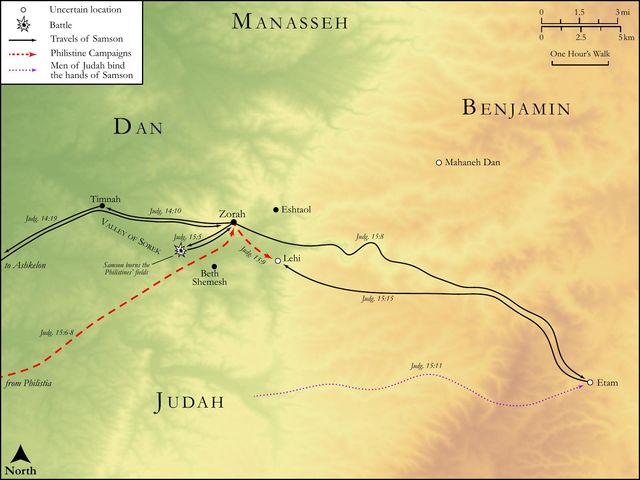
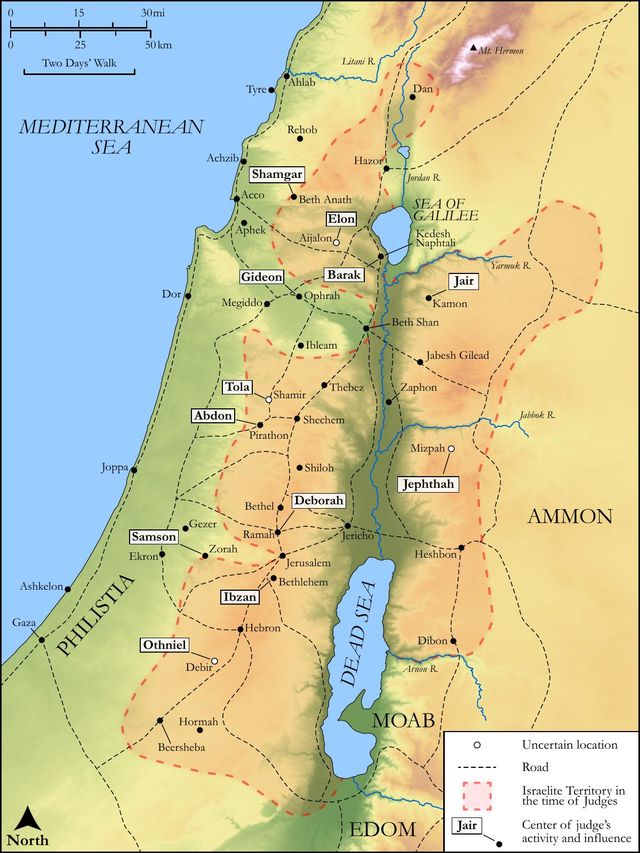
See on the biblical-era maps
Study this verse
Public-domain commentary
Matthew Henry
From his Commentary on the Whole Bible. Henry comments on passages, not single verses — this entry covers Judges 13:1–7. His two-level outline is real structure in the source text, so it is rendered as structure.
The first verse gives us a short account, such as we have too often met with already, of the great distress that Israel was in, which gave occasion for the raising up of a deliverer. They did evil, as they had done, in the sight of the Lord, and then God delivered them, as he had done, into the hands of their enemies. If there had been no sin, there would have needed no Saviour; but sin was suffered to abound, that grace might much more abound. The enemies God now sold them to were the Philistines, their next neighbours, that lay among them, the first and chief of the nations which were devoted to destruction, but which God left to prove them (Jdg 3:1, Jdg 3:3), the five lords of the Philistines, an inconsiderable people in comparison with Israel (they had but five cities of any note), and yet, when God made use of them as the staff in his hand, they were very oppressive and vexatious. And this trouble lasted longer than any yet: it continued forty years, though probably not always alike violent. When Israel was in this distress Samson was born; and here we have his birth foretold by an angel. Observe,
I.His extraction.
He was of the tribe of Dan, Jdg 13:2. Dan signifies a judge or judgment, Gen 30:6. And probably it was with an eye to Samson that dying Jacob foretold, Dan shall judge his people, that is, "he shall produce a judge for his people, though one of the sons of the handmaids, as one, as well as any one, of the tribes of Israel," Gen 49:16. The lot of the tribe of Dan lay next to the country of the Philistines, and therefore one of that tribe was most fit to be made a bridle upon them. His parents had been long childless. Many eminent persons were born of mothers that had been kept a great while in the want of the blessing of children, as Isaac, Joseph, Samuel, and John Baptist, that the mercy might be the more acceptable when it did come. Sing, O barren! thou that didst not bear, Isa 54:1. Note, Mercies long waited for often prove signal mercies, and it is made to appear that they were worth waiting for, and by them others may be encouraged to continue their hope in God's mercy.
II.The glad tidings brought to his mother, that she should have a son.
The messenger was an angel of the Lord (Jdg 13:3), yet appearing as a man, with the aspect and garb of a prophet, or man of God. And this angel (as the learned bishop Patrick supposes, on Jdg 13:18) was the Lord himself, that is, the Word of the Lord, who was to be the Messiah, for his name is called Wonderful, Jdg 13:18, and Jehovah, Jdg 13:19. The great Redeemer did in a particular manner concern himself about this typical redeemer. It was not so much for the sake of Manoah and his wife, obscure Danites, that this extraordinary message was sent, but for Israel's sake, whose deliverer he was to be, and not only so (his services to Israel not seeming to answer to the grandeur of his entry) but for the Messiah's sake, whose type he was to be, and whose birth must be foretold by an angel, as his was. The angel, in the message he delivers, 1. Takes notice of her affliction: Behold now, thou art barren and bearest not. Hence she might gather he was a prophet, that though a stranger to her, and one she had never seen before, yet he knew this to be her grievance. He tells her of it, not to upbraid her with it, but because perhaps at this time she was actually thinking of this affliction and bemoaning herself as one written childless. God often sends in comfort to his people very seasonably, when they feel most from their troubles. "Now thou art barren, but thou shalt not be always so," as she feared, "nor long so." 2. He assures her that she should conceive and bear a son (Jdg 13:3) and repeats the assurance, Jdg 13:5. To show the power of a divine word, the strongest man that ever was was a child of promise, as Isaac, born by force and virtue of a promise, and faith in that promise, Heb 11:11; Gal 4:23. Many a woman, after having been long barren, has borne a son by providence, but Samson was by promise, because a figure of the promised seed, so long expected by the faith of the Old Testament saints, 3. He appoints that the child should be a Nazarite from his birth, and therefore that the mother should be subject to the law of the Nazarites (though not under the vow of a Nazarite) and should drink no wine or strong drink so long as this child was to have its nourishment from her, either in the womb or at the breast, Jdg 13:4, Jdg 13:5. Observe, This deliverer of Israel must be in the strictest manner devoted to God and an example of holiness. It is spoken of as a kindness to the people that God raised up of their young men for Nazarites, Amo 2:11. Other judges had corrected their apostasies from God, but Samson must appear as one, more than any of them, consecrated to God; and, notwithstanding what we read of his faults, we have reason to think that being a Nazarite of God's making he did, in the course of his conversation, exemplify, not only the ceremony, but the substance of that separation to the Lord in which the Nazariteship did consist, Num 6:2. Those that would save others must by singular piety distinguish themselves. Samuel, who carried on Israel's deliverance from the Philistines, was a Nazarite by his mother's vow (Sa1 1:11), as Samson by the divine appointment. The mother of this deliverer must therefore deny herself, and not eat any unclean thing; what was lawful at another time was now to be forborne. As the promise tried her faith, so this precept tried her obedience; for God requires both from those on whom he will bestow his favours. Women with child ought conscientiously to avoid whatever they have reason to think will be any way prejudicial to the health or good constitution of the fruit of their body. And perhaps Samson's mother was to refrain from wine and strong drink, not only because he was designed for a Nazarite, but because he was designed for a man of great strength, which his mother's temperance would contribute to. 4. He foretels the service which this child should do to his country: He shall begin to deliver Israel. Note, It is very desirable that our children may be not only devoted entirely to God themselves, but instrumental for the good of others, and the service of their generation - not recluses, candles under a bushel, but on a candlestick. Observe, He shall begin to deliver Israel. This intimated that the oppression of the Philistines should last long, for Israel's deliverance from it should not so much as begin, not one step be taken towards it, till this child, who was now unborn, should have grown up to a capacity of beginning it. And yet he must not complete the deliverance: he shall only begin to deliver Israel, which intimates that the trouble should still be prolonged. God chooses to carry on his work gradually and by several hands. One lays the foundation of a good work, another builds, and perhaps a third brings forth the top stone. Now herein Samson was a type of Christ, (1.) As a Nazarite to God, a Nazarite from the womb. For, though our Lord Jesus was not a Nazarite himself, yet he was typified by the Nazarites, as being perfectly pure from all sin, not so much as conceived in it, and entirely devoted to his Father's honour. Of the Jewish church, as concerning the flesh, Christ came, because to them pertained the promise of him, Rom 9:4, Rom 9:5. By virtue of that promise,. he long lay as it were in the womb of that church, which for many ages was pregnant of him, and therefore, like Samson's mother, during that pregnancy was made a holy nation and a peculiar people, and strictly forbidden to touch any unclean thing for his sake, who in the fulness of time was to come from them. (2.) As a deliverer of Israel; for he is Jesus a Saviour, who saves his people from their sins. But with this difference: Samson did only begin to deliver Israel (David was afterwards raised up to complete the destruction of the Philistines), but our Lord Jesus is both Samson and David too, both the author and finisher of our faith.
III.The report which Manoah's wife, in a transport of joy, brings in all haste to her husband, of this surprising message Jdg 13:6, Jdg 13:7.
The glad tidings were brought her when she was alone, perhaps religiously employed in meditation or prayer; but she could not, she would not, conceal them from her husband, but gives him an account,
1.Of the messenger. It was a man of God, Jdg 13:6. His countenance she could describe; it was very awful: he had such a majesty in his looks, such a sparkling eye, such a shining face, so powerfully commanding reverence and respect, that according to the idea she had of an angel he had the very countenance of one. But his name she can give no account of, nor to what tribe or city of Israel he belonged, for he did not think fit to tell her, and, for her part, the very sight of him struck such an awe upon her that she durst not ask him. She was abundantly satisfied that he was a servant of God; his person and message she thought carried their own evidence along with them, and she enquired no further.
2.Of the message. She gives him a particular account both of the promise and of the precept (Jdg 13:7), that he also might believe the promise and might on all occasions be a monitor to her to observe the precept. Thus should yoke-fellows communicate to each other their experiences of communion with God, and their improvements in acquaintance with him, that they may be helpful to each other in the way that is called holy.
Historical interpretation
Three Centuries of Reception
2 surviving comments on this verse. Each one is dated, so this reads as a timeline rather than a list.
Select a marker to jump to its quote. Markers stagger vertically where authors wrote within a few decades of each other.
After the spirit of the Hebrews had been so subdued by the pressure of a long subjection that no one dared with a manly spirit to rouse them to liberty, Samson, fore-ordained by the Divine oracle, was raised up to them. A great man he was, not one of the multitude, but first among the few, and beyond controversy far excelling all in bodily strength. And he is to be regarded by us with great admiration from the beginning, not because in his early abstinence from vice he gave signal proofs of temperance and sobriety, nor on account of his long preserving as a Nazarite his locks unshorn, but because from his very youth, which in others is an age of softness, he achieved illustrious deeds of virtue, perfect beyond the measure of human nature. By these he gained credence to the Divine prophecy, that it was not for nothing that such grace had gone before upon him, that an Angel came down by whom his birth beyond their hopes was announced to his parents, to be the leader and protector of his countrymen, now for a length of years harassed by the tyranny of the Philistines.
His father was of the tribe of Dan, a man fearing God, born of no mean rank, and eminent above others, his mother was barren of body, but in virtues of the mind not unfruitful; seeing that in the sanctuary of her soul she was counted worthy to receive the visit of an Angel, obeyed his command and fulfilled his prophecy. Not enduring however to know the secrets even of God apart from her husband she mentioned to him that she had seen a man of God, of beautiful form, bringing her the Divine promise of future offspring, and that she, confiding in this promise, was led to share with her husband her faith in the heavenly promises.
Thus Jacob, the patriarch Joseph, Samson, [who was] the bravest of the chieftains, and Samuel, [who was] the most distinguished of the prophets, [all] had as their progenitors [mothers who were] for a long time barren in body but always fruitful in virtues. In this way their dignity would be known from the miraculous nativity of those who were born, and it might be proven that they would be famous in their lives, since at the very outset of their lives they transcended the norms of the human condition.
Continue studying Judges 13:2 across the web’s major study libraries — every link below opens this exact verse, chapter, or book on the destination site.
Read & Compare
 BibleGatewayThis verse in more than 200 translations and 70 languages.
 Bible.comThe YouVersion reader — hundreds of translations, reading plans, and highlights.
 ESV.orgCrossway's official English Standard Version reader.
 NET BibleThe NET translation with 60,000+ translators' notes on every rendering decision.
 STEP BibleTyndale House's free study tool — original text, vocabulary, and scholarly resources.
 BibliaLogos Bible Software's free web reader.
 USCCBThe New American Bible (Revised Edition) with the U.S. bishops' study notes.
Commentaries
 BibleHub CommentariesDozens of classic commentaries on this verse, gathered on one page.
 StudyLightMore than 100 commentary sets — the largest collection on the web.
 BibleRefPlain-English commentary on what this verse means, verse by verse.
 Enduring WordDavid Guzik's free commentary on this chapter, widely used by Bible teachers.
 Bible Study ToolsVerse commentary alongside Greek and Hebrew study aids.
Original Language & Research
- BibleHub InterlinearThe verse word by word — original language, transliteration, and English.
- BibleHub LexiconEvery word's original-language definition and Strong's entry.
 Blue Letter BibleDeep-study tools — Strong's numbers, concordance, and word studies.
 SefariaThe Hebrew text with Rashi and centuries of Jewish commentary.
Sermons, Hymns & Audio


TrulyRandomVerse is not affiliated with these sites and doesn’t control their content. They’re linked because they’re genuinely useful.
Summary
Judges 13:2 introduces Manoah, a man from the Danite tribe residing in Zorah, alongside his wife, whose barrenness is explicitly stated. This seemingly simple detail is profoundly significant, immediately signaling that the impending birth of their son, Samson, will be a miraculous act of divine intervention rather than a natural occurrence. The verse masterfully sets the stage for God's sovereign plan to raise a deliverer for Israel during a period of intense Philistine oppression, highlighting His unique ability to work through human impossibility to accomplish His redemptive purposes.
Context
ShowHideLiterary Context
Judges 13 initiates the final major narrative cycle within the Book of Judges, focusing on the enigmatic figure of Samson. This chapter immediately follows a protracted period of renewed Israelite apostasy and subsequent twenty-year oppression by the Philistines, as vividly described in Judges 10:6-16. The book's overarching cyclical pattern of Israel's disobedience, divine judgment, repentance, and God's provision of a deliverer (a judge) finds its concluding, and often complex, expression in Samson's story. Unlike previous judges who led unified armies, Samson's deliverance is portrayed as more individualistic, often ambiguous, and marked by personal failings, setting a unique and somber tone for the end of the Judges period, which culminates in the profound moral and spiritual decline depicted in Judges 17-21. The introduction of Manoah and his barren wife immediately establishes a familiar biblical motif that prepares the reader for a divinely appointed birth, echoing the miraculous conceptions of patriarchs and prophets like Isaac, Samuel, and John the Baptist, thereby underscoring the supernatural nature of the upcoming events and Samson's unique destiny.
Historical & Cultural Context
The geographical and tribal setting of Judges 13 is critically important for understanding the unfolding narrative. Zorah was a town strategically located in the Shephelah, a low-lying region of foothills that served as a natural buffer zone between the Judean mountains and the Philistine coastal plain. This placement meant Manoah and his family lived directly on the frontier with Israel's primary oppressors at this time, the Philistines. The Danite tribe, to which Manoah belonged, was one of the tribes that struggled significantly to secure its allotted territory, as evidenced by their later migration northward described in Judges 18. This immediate and pressing need for deliverance from Philistine domination underscores the urgency of God's intervention. Culturally, barrenness in ancient Israelite society was a source of profound personal sorrow, social stigma, and often perceived as a sign of divine disfavor. However, within the biblical narrative, it frequently serves as a powerful literary and theological device to highlight God's miraculous power to open the womb, ensuring that the child born is clearly understood as a divine gift and an instrument of His sovereign will, rather than a natural outcome. This emphasis on divine intervention elevates the child's status and destiny, preparing the audience for a figure of unique importance.
Key Themes
ShowHideThe introduction of Manoah and his barren wife in Judges 13:2 immediately introduces several pivotal themes that will permeate the narrative of Samson and the broader book. Firstly, it powerfully establishes Divine Intervention and Providence, signaling that Samson's birth is not accidental but a direct, supernatural act of God's will. This prepares the reader for a child with a unique, divinely ordained destiny, chosen specifically to address Israel's dire situation. Secondly, the theme of Hope in Despair is prominently featured; the human impossibility of barrenness becomes the very stage upon which God demonstrates His power and faithfulness, foreshadowing the hope He brings into seemingly hopeless situations, both for individuals and for the nation of Israel under crushing Philistine oppression. This motif reinforces God's ability to act when human resources are exhausted. Finally, the verse sets the stage for Preparation for a Special Purpose, detailing the parents and their marital status to prepare the audience for the arrival of a Nazirite, a figure consecrated to God from birth, whose life would be dedicated to God's specific plan for Israel's deliverance, even if that deliverance unfolds through unconventional and often flawed means.
Exposition and Analysis
ShowHideKey Word Analysis
ShowHideMeaning "united, i.e. one; or (as an ordinal) first; a, alike, alone, altogether, and, any(-thing), apiece, a certain, (dai-) ly, each (one), [phrase] eleven, every, few, first, [phrase] highway, a man, once, one, only, other, some, together." In this context, "a certain man" emphasizes that he was a specific, individual man, not just any man, setting him apart as the chosen father for the miraculous birth to come. It highlights the particularity of God's choice.
Meaning "rest." This name, meaning "rest" or "resting place," presents a striking irony when contrasted with the tumultuous, restless, and often violent life of his son, Samson. Samson, though intended to bring deliverance and "rest" from Philistine oppression, personally experienced little peace or tranquility. This linguistic detail subtly highlights the contrast between the father's aspiration for peace and the son's chaotic reality, foreshadowing the complex and often paradoxical nature of Samson's character and mission.
Meaning "sterile (as if extirpated in the generative organs); ([idiom] male or female) barren (woman)." This term is consistently used throughout the Old Testament to describe women who are unable to conceive children naturally. Its inclusion here is not merely a biological detail but a profound theological statement. In biblical narratives, the barrenness of a significant woman (e.g., Sarah, Rebekah, Rachel, Hannah, Elizabeth) invariably precedes a miraculous birth, underscoring God's sovereign power to override natural limitations and to initiate His redemptive plans through seemingly impossible circumstances. It emphasizes that the child to be born is entirely a gift from God, chosen and empowered for a specific divine purpose, ensuring that the glory belongs solely to Him.
Verse Breakdown
ShowHide"And there was a certain man of Zorah, of the family of the Danites, whose name [was] Manoah;"
This initial clause meticulously introduces the father of the future judge, providing essential details about his identity, tribal affiliation, and geographical origin. The specificity of "Zorah, of the family of the Danites" grounds the narrative in a particular historical and socio-political context. The Danites, as noted, were a tribe that experienced significant challenges in securing their inheritance, and Zorah's location near the Philistine border immediately sets the stage for the intense conflict that Samson is destined to address. Manoah's name, meaning "rest," adds a layer of subtle irony that will become more apparent as Samson's turbulent story unfolds, contrasting with the peace he might have desired for his family and people.
"and his wife [was] barren, and bare not."
This is the pivotal statement of the verse, serving as the narrative's central theological anchor. The repetition of "barren, and bare not" serves to emphatically underscore the absolute nature of her infertility, leaving no ambiguity about her inability to conceive naturally. This detail is not incidental but foundational to the entire narrative that follows. It immediately establishes a context of human impossibility, thereby highlighting that the impending birth will be a direct, supernatural intervention by God. This sets up the miraculous nature of Samson's conception and birth, underscoring that his existence and subsequent mission are entirely dependent on divine will and power, ensuring that his life is recognized as a divine gift and a testament to God's sovereign hand in Israel's history.
Literary Devices
ShowHideJudges 13:2 masterfully employs several literary devices to set the stage for Samson's narrative and to immediately convey its profound theological implications. Foreshadowing is prominently featured through the mention of Manoah's wife's barrenness. This immediately signals to the biblically literate reader that a miraculous birth is imminent, as this motif consistently precedes the arrival of divinely appointed figures in Scripture, establishing a pattern of divine intervention in human impossibility. The impossibility of natural conception thus powerfully foreshadows God's supernatural intervention. Irony is present in the name "Manoah," meaning "rest" or "resting place," which stands in stark contrast to the turbulent, restless, and often chaotic life of his son, Samson, who brought anything but personal peace to himself. This ironic naming convention subtly hints at the complex and often paradoxical nature of Samson's character and mission. Furthermore, the phrase "barren, and bare not" utilizes Repetition (specifically, a form of pleonasm) to emphatically underscore the wife's complete and undeniable inability to conceive. This redundancy serves to heighten the sense of human impossibility, thereby magnifying the divine power that will soon manifest. Finally, the entire setup functions as a Type-Scene, drawing upon the well-established biblical motif of the barren matriarch whose womb is supernaturally opened by God, thereby linking Samson's birth to the lineage of other significant figures in salvation history whose lives were marked by divine appointment from their very inception.
Theological and Thematic Connections
ShowHideJudges 13:2 serves as a profound theological statement about God's sovereignty and His unparalleled ability to work through human limitations to achieve His divine purposes. The barrenness of Manoah's wife is not merely a biological condition but a theological canvas upon which God paints a vivid picture of His power to bring life out of death, hope out of despair, and deliverance out of oppression. It underscores the timeless principle that God's plans are not contingent upon human ability, natural circumstances, or societal expectations, but solely on His omnipotence and unwavering faithfulness. This recurring motif in Scripture consistently demonstrates that when human efforts reach their absolute limit, God's power is most clearly displayed, ensuring that the glory for any miraculous outcome belongs solely to Him. It reminds us that God often chooses the weak, the overlooked, or the seemingly impossible situations to manifest His greatest works, thereby magnifying His glory and demonstrating His unfailing providence over all of creation and history, particularly in the unfolding of His redemptive narrative.
Reflection and Application
ShowHideJudges 13:2 offers a powerful and enduring message for believers today: God's ability to act is never constrained by human limitations or seemingly impossible circumstances. The "barrenness" described in this verse can serve as a profound metaphor for any area of our lives—personal, spiritual, relational, or societal—where we experience a lack of fruitfulness, hope, or progress, or where our own efforts have reached their end. In such seasons of perceived impossibility, this verse calls us to remember that God specializes in bringing life where there is none, and purpose where there seems to be only emptiness. It encourages us to cultivate a deep, unwavering trust in God's sovereignty and perfect timing, recognizing that our moments of greatest weakness, inability, or despair can be the very stages upon which He chooses to display His most profound power and bring forth something new, significant, and divinely ordained. Our call is not to generate the outcome through our own strength, but to remain faithful, prayerful, and expectant, knowing that God can, and often does, work miraculously beyond what we can imagine or achieve on our own, always for His glory and our ultimate good.
Questions for Reflection
ShowHideFAQ
ShowHideWhy is the wife's barrenness so important to the story of Samson?
ShowHideThe barrenness of Manoah's wife is critically important because it immediately establishes the miraculous nature of Samson's impending birth. In biblical narratives, the inability of a significant woman to conceive often serves as a divine signal that the child to be born will be a special gift from God, conceived not through natural means but by direct divine intervention. This emphasizes that Samson's existence and his future role as a deliverer are entirely a result of God's sovereign will and power, not human capability. It removes any doubt that he is a divinely appointed instrument, setting him apart from birth for a unique purpose in God's plan for Israel's deliverance from the Philistines, as further detailed by the angel's visit in Judges 13:3-5.
What is the significance of Manoah being a Danite from Zorah?
ShowHideThe specific details of Manoah's identity are highly significant. Being "of the family of the Danites" places Samson within a tribe that historically struggled to secure its inheritance and was often in direct conflict with the Philistines, as recounted in Judges 1:34. Zorah, the town of his origin, was located in the Shephelah, a strategically important border region between the Israelite highlands and the Philistine coastal plain. This geographical and tribal context immediately highlights the pressing need for deliverance from Philistine oppression and positions Samson's family directly in the crucible of this conflict. It underscores that God was raising a deliverer from within the very heart of the oppressed territory, directly addressing the national crisis described earlier in Judges 10:7.
Christ-Centered Fulfillment
ShowHideJudges 13:2, with its profound emphasis on a miraculous birth from a barren woman to introduce a divinely appointed deliverer, finds its ultimate and perfect fulfillment in the person and redemptive work of Jesus Christ. While Samson was a flawed and temporary deliverer for a single nation, his miraculous conception from a humanly impossible situation powerfully foreshadows the truly unique and unprecedented virgin birth of Jesus. Just as Samson's birth was a direct act of God to address Israel's oppression, so too was Jesus's birth a divine intervention, not merely to deliver a nation from political enemies, but to deliver all humanity from the ultimate oppressors: sin and death. The name Manoah, meaning "rest," takes on profound and eternal significance in Christ, for Jesus is the one who truly offers spiritual rest to the weary and heavy-laden, inviting all to find solace in Him, as promised in Matthew 11:28. Unlike Samson, whose strength was external and often tragically misdirected, Jesus is the perfect Nazirite, consecrated entirely to God's will from conception, living a life of perfect obedience and ultimately offering Himself as the spotless Lamb of God who takes away the sin of the world. His birth from the spiritual barrenness of humanity's fallen state brought forth the true and everlasting deliverance, establishing a kingdom that will never end, thereby fulfilling the deepest longings for a deliverer that the stories of the judges, including Samson, could only imperfectly point toward.