


Joshua 19:43
Bible text: King James Version (1769 Blayney text) · Public domain
Bible text: King James Version with Strong's numbers · Public domain
Bible text: American Standard Version (1901) · Public domain
Bible text: World English Bible, Messianic edition · Public domain
Bible text: Geneva Bible (1599) · Public domain
Bible text: Young's Literal Translation · Public domain
- וְאֵילוֹןve·'ei·Lonand ElonH356Conj-w ¦ N-properNoun Proper LocationוְandאֵילוֹןElon
- וְתִמְנָתָהve·tim·Na·tahand Timnah <towards>H8553Conj-w ¦ N-proper ¦ SfxNoun Proper LocationוְandתִמְנָתָTimnahה<towards>
- וְעֶקְרוֹןve·'ek·Ronand EkronH6138Conj-w ¦ N-properNoun Proper LocationוְandעֶקְרוֹןEkron
English is a literal word-by-word gloss of the Hebrew, not the KJV's wording. Why?
This is the original text the KJV's translators worked from — each Hebrew word with its own literal English meaning in this verse, prepared by scholars at Tyndale House, Cambridge. The KJV translates whole sentences, not word by word, so its wording differs: one Hebrew word can become several English words, and the KJV may choose “the LORD” where the gloss reads “Yahweh”. Both are faithful — they answer different questions. For the KJV's own rendering, switch to the KJV text.
Details
See on the biblical-era maps
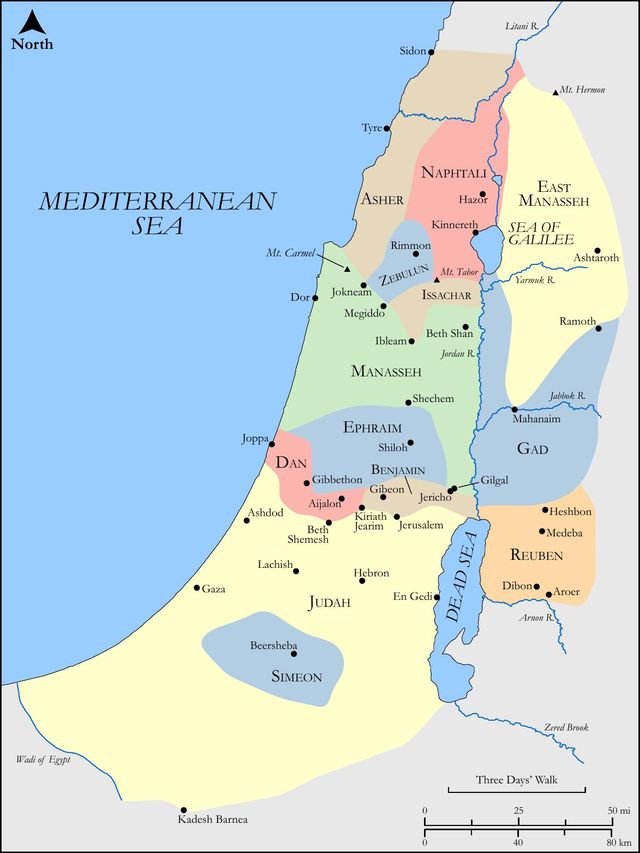
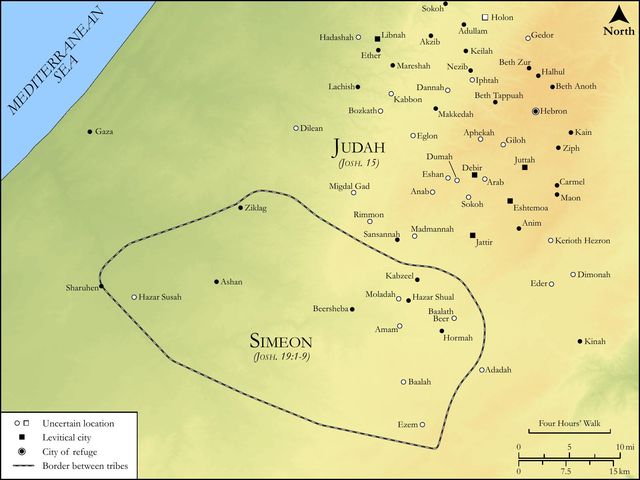
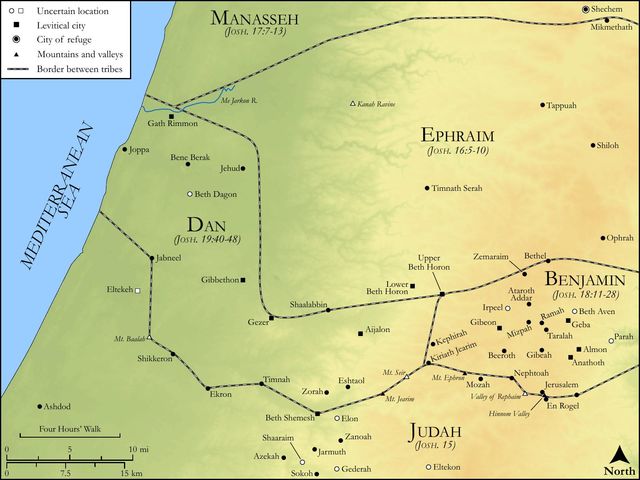
Study this verse
Public-domain commentary
Matthew Henry
From his Commentary on the Whole Bible. Henry comments on passages, not single verses — this entry covers Joshua 19:40–48.
Dan, though commander of one of the four squadrons of the camp of Israel, in the wilderness, that which brought up the rear, yet was last provided for in Canaan, and his lot fell in the southern part of Canaan, between Judah on the east and the land of the Philistines on the west, Ephraim on the north and Simeon on the south. Providence ordered this numerous and powerful tribe into a post of danger, as best able to deal with those vexatious neighbours the Philistines, and so it was found in Samson. Here is an account, 1. Of what fell to this tribe by lot, Zorah, and Eshtaol, and the camp of Dan thereabouts, of which we read in the story of Samson. And near there was the valley of Eshcol, whence the spies brought the famous bunch of grapes. Japho, or Joppa was in this lot. 2. Of what they got by their own industry and valour, which is mentioned here (Jos 19:47), but related at large, Jdg 18:7, etc.
Continue studying Joshua 19:43 across the web’s major study libraries — every link below opens this exact verse, chapter, or book on the destination site.
Read & Compare
 BibleGatewayThis verse in more than 200 translations and 70 languages.
 Bible.comThe YouVersion reader — hundreds of translations, reading plans, and highlights.
 ESV.orgCrossway's official English Standard Version reader.
 NET BibleThe NET translation with 60,000+ translators' notes on every rendering decision.
 STEP BibleTyndale House's free study tool — original text, vocabulary, and scholarly resources.
 BibliaLogos Bible Software's free web reader.
 USCCBThe New American Bible (Revised Edition) with the U.S. bishops' study notes.
Commentaries
 BibleHub CommentariesDozens of classic commentaries on this verse, gathered on one page.
 StudyLightMore than 100 commentary sets — the largest collection on the web.
 BibleRefPlain-English commentary on what this verse means, verse by verse.
 Enduring WordDavid Guzik's free commentary on this chapter, widely used by Bible teachers.
 Bible Study ToolsVerse commentary alongside Greek and Hebrew study aids.
Original Language & Research
- BibleHub InterlinearThe verse word by word — original language, transliteration, and English.
- BibleHub LexiconEvery word's original-language definition and Strong's entry.
 Blue Letter BibleDeep-study tools — Strong's numbers, concordance, and word studies.
 SefariaThe Hebrew text with Rashi and centuries of Jewish commentary.
Sermons, Hymns & Audio


TrulyRandomVerse is not affiliated with these sites and doesn’t control their content. They’re linked because they’re genuinely useful.
Summary
Joshua 19:43, a concise listing of three cities—Elon, Thimnathah, and Ekron—within the inheritance of the tribe of Dan, serves as a pivotal detail in the broader narrative of Israel's territorial allotment. Far from a mere geographical notation, this verse subtly underscores the tension between God's faithful promise of land and the formidable challenges the Danites faced in fully possessing their inheritance, particularly due to the powerful Philistine presence in cities like Ekron. It foreshadows the tribe's subsequent struggles and incomplete conquest, setting the stage for significant themes explored later in the biblical narrative concerning obedience, faith, and the ongoing spiritual battles faced by God's people.
Context
ShowHideLiterary Context
Joshua 19:43 is situated within the extensive section of the Book of Joshua (chapters 13-21) that meticulously details the division of the Promised Land among the twelve tribes of Israel. Following the initial conquests led by Joshua, this phase represents the fulfillment of God's covenant promise to Abraham, Isaac, and Jacob. Specifically, Joshua 19:40-48 delineate the boundaries and cities allotted to the tribe of Dan. The precise naming of cities like Elon, Thimnathah, and Ekron, though seemingly a dry list, emphasizes the divine precision and thoroughness in the distribution, while also subtly hinting at the practical realities and future challenges that would confront the Danites in securing their assigned territory. This verse, therefore, is not isolated but is an integral part of the detailed record of Israel's inheritance and the subsequent responsibilities tied to it.
Historical & Cultural Context
The period immediately following the initial conquest of Canaan was one of transition, where Israel was establishing itself in a land already inhabited by various peoples, including the powerful Philistines. Ekron, mentioned in this verse, was one of the five principal cities of the Philistine pentapolis, a formidable military and political entity. Its inclusion in Dan's allotted territory meant that the Danites were assigned land bordering, or even encompassing, areas controlled by a strong, un-dispossessed, and often hostile pagan power. Culturally, the concept of "inheritance" (נַחֲלָה, nachalah') was deeply significant, representing not just land ownership but also a divine gift and a secure future tied to covenant faithfulness. The challenge for the Danites, and indeed for all Israel, was to fully dispossess the inhabitants as commanded by God, a task that proved difficult and often incomplete, leading to centuries of conflict and cultural assimilation pressures.
Key Themes
ShowHideThis verse, though brief, contributes to several overarching themes in Joshua and the broader Old Testament narrative. Firstly, it highlights the theme of Divine Allotment and Inheritance, underscoring God's faithfulness in meticulously fulfilling His covenant promises by giving the land to Israel as a perpetual possession. Secondly, it subtly introduces the theme of Challenges in Possession and Incomplete Conquest. The presence of Ekron, a known Philistine stronghold, within Dan's inheritance immediately signals that the "promised land" was not a fully secured territory but one requiring ongoing effort and faith to fully occupy. This foreshadows the significant struggles the Danites would face, as vividly detailed in Judges 1:34, where they were confined to the hill country. Finally, it speaks to the tension between God's Sovereignty and Human Responsibility. God sovereignly grants the land, but its full enjoyment and secure possession are contingent upon Israel's faithful obedience and active engagement in dispossessing the inhabitants. The listing of these cities, particularly Ekron, serves as a poignant reminder of Israel's recurring failure to fully obey God's command, which would have long-term consequences for the nation.
Exposition and Analysis
ShowHideKey Word Analysis
ShowHideThis city name likely derives from the Hebrew word for "oak" or "terebinth," suggesting a place characterized by significant trees. While not carrying specific theological weight in itself, its inclusion as part of Dan's inheritance signifies a specific geographical marker within their allotted territory. Its mention here, alongside other cities, contributes to the detailed and precise nature of the land distribution, emphasizing the meticulous fulfillment of God's promise to Israel.
Often identified with Timnah, this city holds particular significance due to its later prominence in the narratives concerning Samson, a judge from the tribe of Dan. It was near Timnah that Samson encountered a Philistine woman whom he desired to marry, leading to a series of events that highlight the ongoing interaction and conflict between Israel and the Philistines (Judges 14:1). Its inclusion in Dan's inheritance in Joshua 19:43 thus serves as a subtle foreshadowing of the future struggles and entanglements the Danites would face with their powerful Philistine neighbors.
This is the most significant name in the list. Ekron was one of the five major Philistine city-states (the Philistine Pentapolis: Gaza, Ashdod, Ashkelon, Gath, and Ekron). It was a powerful, fortified city and a center of Philistine worship and military strength. Its inclusion in Dan's allotment is crucial, as it represents a formidable, unconquered stronghold within the very territory God had designated for them. The fact that Ekron remained under Philistine control for centuries, despite being part of Dan's inheritance, powerfully illustrates the theme of incomplete conquest and Israel's failure to fully dispossess the inhabitants, a failure that would plague them throughout the period of the Judges and beyond.
Verse Breakdown
ShowHide"And Elon"
This phrase introduces the first of three specific cities allotted to the tribe of Dan. The simple conjunction "And" continues the detailed enumeration of the Danite inheritance, emphasizing the meticulous nature of the land distribution. Elon, a specific geographical point, marks a portion of the territory designated by divine decree.
"and Thimnathah"
The addition of Thimnathah further specifies the boundaries and key locations within Dan's inheritance. Its mention highlights the proximity of the Danite territory to areas that would later become significant in the ongoing conflicts with the Philistines, particularly through the narrative of Samson. This city's inclusion subtly points to the strategic and often contested nature of Dan's assigned land.
"and Ekron"
The final and most significant city listed, Ekron, represents a major Philistine stronghold. Its inclusion in Dan's inheritance is a stark reminder that while the land was divinely allotted, it was not yet fully possessed. This clause underscores the formidable challenge facing the Danites and foreshadows their subsequent inability to fully dislodge the Philistines, leading to their eventual migration and the long-term consequences of an incomplete conquest. The presence of Ekron in this list is a key indicator of the tension between God's promise and Israel's human failure.
Literary Devices
ShowHideJoshua 19:43 primarily employs Listing or Cataloging, a common literary device in biblical texts, especially in genealogical or geographical sections. This meticulous enumeration of cities emphasizes the thoroughness and divine order with which the land was distributed, underscoring the fulfillment of God's covenant promises. However, within this seemingly dry list, there is profound Foreshadowing. The inclusion of Ekron, a prominent Philistine city, within Dan's inheritance subtly but powerfully foreshadows the future struggles of the Danite tribe and the broader Israelite failure to fully dispossess the inhabitants of the land. This sets the stage for the narratives in the Book of Judges, where the consequences of incomplete obedience become painfully evident. There is also a subtle Irony at play: the land is "given" to Dan, yet the presence of a powerful, unconquered city like Ekron within that gift highlights the gap between divine provision and human possession, a tension that would shape much of Israel's early history.
Theological and Thematic Connections
ShowHideJoshua 19:43, though a concise geographical detail, powerfully illustrates the recurring biblical themes of divine promise, human responsibility, and the consequences of incomplete obedience. God faithfully provided the land as an inheritance, meticulously delineating each tribe's portion. Yet, the presence of unconquered strongholds like Ekron within Dan's allotment highlights that God's provision, while perfect, often requires active faith and sustained obedience for its full realization. This tension between divine sovereignty and human agency is a foundational theological concept. The failure of the Danites, and Israel as a whole, to fully dispossess the inhabitants of the land, as detailed in subsequent books, demonstrates that a mere "allotment" does not equate to full "possession" without faithful action. This pattern of God's perfect provision met by human imperfection and struggle sets the stage for the unfolding narrative of redemption, ultimately pointing to a greater King and a more complete inheritance.
Reflection and Application
ShowHideThe seemingly innocuous list of cities in Joshua 19:43 offers profound insights for contemporary believers. Just as the tribe of Dan received a divine inheritance but faced formidable, unconquered "Ekrons" within their allotted territory, so too do believers receive a rich spiritual inheritance in Christ, yet often encounter "unconquered" areas in their lives. These may be persistent sins, areas of unbelief, or spiritual strongholds that prevent us from fully experiencing the abundant life and freedom God has promised. This verse serves as a powerful reminder that while God's promises are absolutely sure and His provision is complete, our full experience and enjoyment of these blessings often require active faith, perseverance, and obedience in confronting and dispossessing the spiritual enemies that seek to hinder us. It calls us to examine our own lives: are we settling for less than God's full provision because of fear, complacency, or a reluctance to engage in spiritual battle? The Danites' story is a sober warning against an incomplete conquest, urging us to press into every aspect of our spiritual inheritance through the power of the Holy Spirit.
Questions for Reflection
ShowHideFAQ
ShowHideWhy are these specific cities listed for Dan?
ShowHideThese cities are listed to precisely define the boundaries and key strategic points of the territory allotted to the tribe of Dan. Their inclusion, particularly Ekron, highlights the challenging nature of Dan's inheritance, as it bordered the powerful Philistines. This detailed listing underscores the meticulous fulfillment of God's promise to give the land to Israel, while also subtly foreshadowing the future struggles of the Danites to fully dispossess the inhabitants of these areas, leading to their subsequent migration as recounted in Judges 18.
What happened to the tribe of Dan after receiving this inheritance?
ShowHideThe tribe of Dan faced significant challenges in securing their allotted territory, particularly against the Amorites and Philistines, as vividly detailed in Judges 1:34-35. Unable to fully dispossess the inhabitants and facing constant pressure, a significant portion of the tribe eventually migrated north to Laish (which they renamed Dan), establishing a new settlement far from their original inheritance. This tragic story, recounted in Judges 18, serves as a powerful example of the consequences of incomplete obedience and failure to fully trust God for victory over the land's inhabitants.
Christ-Centered Fulfillment
ShowHideThe narrative of Israel's incomplete conquest, subtly highlighted by the presence of unconquered cities like Ekron in Dan's inheritance, finds its ultimate resolution and fulfillment in Jesus Christ. While Israel struggled to fully possess their physical inheritance due to their own failures and lack of faith, Christ, the true Israel, perfectly fulfills all righteousness and accomplishes what Israel could not. He is the ultimate inheritor of all things, through whom believers receive a spiritual inheritance that is secure, eternal, and not dependent on human strength or conquest (Ephesians 1:11 and Colossians 1:12). Jesus' victory on the cross disarmed and triumphed over all spiritual principalities and powers, effectively conquering every "Ekron" that stands against God's people (Colossians 2:15). Through His finished work, we are granted access to a spiritual "promised land"—the kingdom of God and eternal life—a rest that Israel never fully entered (Hebrews 4:1-11). Our "possession" of this inheritance is not by our might or power, but by faith in Him who has already secured the victory, enabling us to live in the freedom and abundance of His grace.