


Hosea 8:14
Bible text: King James Version (1769 Blayney text) · Public domain
Bible text: King James Version with Strong's numbers · Public domain
Bible text: Berean Standard Bible · Public domain
Bible text: American Standard Version (1901) · Public domain
Bible text: World English Bible, Messianic edition · Public domain
Bible text: Geneva Bible (1599) · Public domain
Bible text: Young's Literal Translation · Public domain
- וַיִּשְׁכַּחvai·yish·Kachand he has forgottenH7911Conj-w ¦ V-Qal-ConsecImperf-3msVerb Qal Consecutive Imperfect 3rd Singular Masculineוַandיִּשְׁכַּחhe has forgotten
- יִשְׂרָאֵלYis·ra·'ElIsraelH3478N-properNoun Proper Location
- אֶת'et<obj.>H853DirObjMParticle Object Indicator
- עֹשֵׂהוּ'o·Se·huhis makerH6213V-Qal-Prtcpl-ms ¦ 3msVerb Qal Participle Singular Masculine Constructעֹשֵׂmakerהוּhis
- וַיִּבֶןvai·Yi·venand he has builtH1129Conj-w ¦ V-Qal-ConsecImperf-3msVerb Qal Consecutive Imperfect 3rd Singular Masculineוַandיִּבֶןhe has built
- הֵיכָלוֹתhei·kha·LotpalacesH1964N-fpNoun Plural Feminine Absolute
- וִיהוּדָהvi·hu·Dahand JudahH3063Conj-w ¦ N-properNoun Proper LocationוִandיהוּדָהJudah
- הִרְבָּהhir·Bahhe has multipliedH7235V-Hiphil-Perf-3msVerb Hiphil Perfect 3rd Singular Masculine
- עָרִים'a·RimcitiesH5892N-mpNoun Plural Masculine Absolute
- בְּצֻרוֹתbe·tzu·RotfortifiedH1219Adj-fpAdjective Plural Feminine Absolute
- וְשִׁלַּחְתִּיve·shi·lach·tiand I will sendH7971Conj-w ¦ V-Piel-ConsecPerf-1csVerb Piel Consecutive Perfect 1st Singular common genderוְandשִׁלַּחְתִּיI will send
- אֵשׁ'eshfireH784N-csNoun Singular common gender Absolute
- בְּעָרָיוbe·'a·Ravon his citiesH5892Prep-b ¦ N-mpc ¦ 3msNoun Plural Masculine Constructבְּonעָרָיcitiesוhis
- וְאָכְלָהve·'a·khe·Lahand it will consumeH398Conj-w ¦ V-Qal-ConsecPerf-3fsVerb Qal Consecutive Perfect 3rd Singular Feminineוְandאָכְלָהit will consume
- אַרְמְנֹתֶיהָ'ar·me·no·Tei·hahis fortressesH759N-fpc ¦ 3fsNoun Plural Feminine Constructאַרְמְנֹתֶיfortressesהָhis
English is a literal word-by-word gloss of the Hebrew, not the KJV's wording. Why?
This is the original text the KJV's translators worked from — each Hebrew word with its own literal English meaning in this verse, prepared by scholars at Tyndale House, Cambridge. The KJV translates whole sentences, not word by word, so its wording differs: one Hebrew word can become several English words, and the KJV may choose “the LORD” where the gloss reads “Yahweh”. Both are faithful — they answer different questions. For the KJV's own rendering, switch to the KJV text.
Details
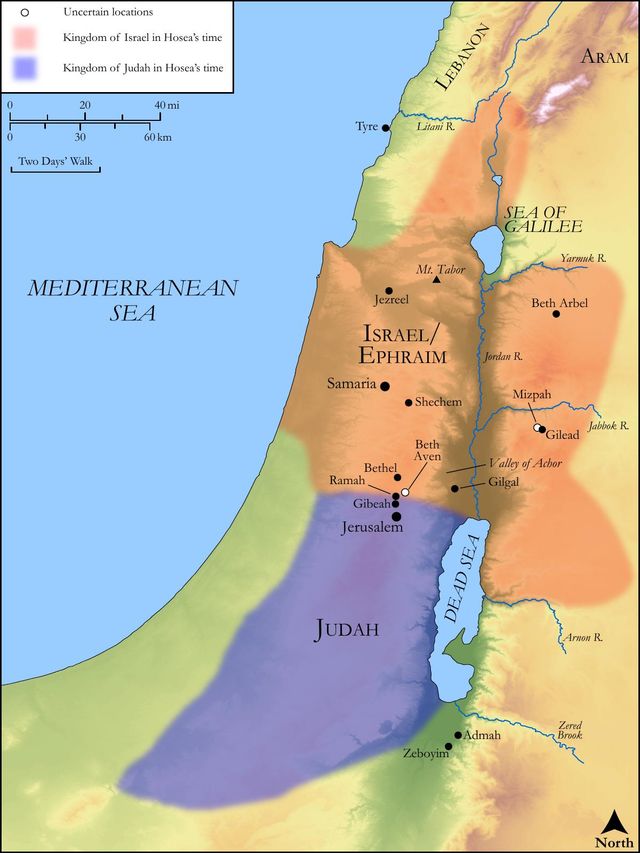
See on the biblical-era map
Study this verse
Public-domain commentary
Matthew Henry
From his Commentary on the Whole Bible. Henry comments on passages, not single verses — this entry covers Hosea 8:8–14. His four-level outline is real structure in the source text, so it is rendered as structure.
It was the honour and happiness of Israel that they had but one God to trust to and he all-sufficient in every strait, and but one God to serve, and he well worthy of all their devotions. But it was their sin, and folly, and shame, that they knew not when they were well off, that they forsook their own mercies for lying vanities; for,
I.They multiplied their alliances (Hos 8:9):
They have hired lovers, or (as the margin reads it) they have hired loves. They were at great expense to purchase the friendship of the nations about them, that otherwise had no value nor affection at all for them, nor cared for having any thing to do with them but only upon the Shechemites' principles - Shall not their cattle and their substance be ours? Gen 34:23. Had Israel maintained the honour of their peculiarity, the surrounding nations would have continued to admire them as a wise and understanding people; but, when they profaned their own crown, their neighbours despised them, and they had no interest in them further than they paid dearly for it. But those surely have behaved ill among their neighbours who have no loves, no lovers, but what they hire. See here,
1.The contempt that Israel lay under among the nations (Hos 8:8): Israel is swallowed up, devoured by strangers, their land eaten up (Hos 8:7), and themselves too, and, being impoverished, they have quite lost their credit and reputation, like a merchant that has become a bankrupt, so that they are among the Gentiles as a vessel wherein is no pleasure, a vessel of dishonour (Ti2 2:20), a despised broken vessel, Jer 22:28. None of their neighbours have any value for them, nor care to have any thing to do with them. Note, Those that have professed religion, if they degenerate and grow profane, are of all men the most contemptible. If the salt have lost its savour, it is fit for nothing but to be trodden under foot of men. Or it denotes their dispersion and captivity among the Gentiles; they shall be among them poor and prisoners; and who has pleasure in such?
2.The court that Israel made to the nations notwithstanding (Hos 8:9): They have gone to Assyria, to engage the king of Assyria to help them; and herein they are as a wild ass alone by himself, foolish, headstrong, and unruly; they will have their way, and nothing shall hold them in, no, not the bridle of God's laws, nothing shall turn them back, no, not the sword of God's wrath. They take a course by themselves, and the effect will be that, like a wild ass by himself, they will be the easier and surer prey to the lion. See Job 11:12; Jer 2:24. Note, Man is in nothing more like the wild ass's colt than in seeking for that succour and that satisfaction in the creature which are to be had in God only.
3.The crosses that they were likely to meet with in their alliances with the neighbouring nations (Hos 8:10): Though they have hired among the nations, and hoped thereby to prevent their own ruin, yet now will I gather them, as the sheaves in the floor (Mic 4:12); so that what they provided for their own safety shall but make them the easier prey to their enemies. Note, There is no fence against the judgments of God, when they come with commission; nay, that which men hire for their own preservation often contributes to their own destruction. See Isa 7:20. The king of Assyria, whose friendship they courted, called himself a king of princes, Isa 10:8. Are not my princes altogether kings? He laid burdens upon Israel, levied taxes upon them, Kg2 15:19, Kg2 15:20. And for these they shall sorrow a little; this shall be but a little burden to them in comparison of what they may further expect; or they will be but little sensible of this grievance, will not lay it to heart, and therefore may expect heavier judgments. They have begun to be diminished (so some read it), by the burden of the king of princes; but this is only the beginning of sorrows (Mat 24:8), the beginning of revenges, Deu 32:42. Note, God often comes gradually with his judgments upon a provoking people, that he may show how slow he is to wrath, and may awaken them to repentance; but those that are made to sorrow a little, if they are not thereby brought to sorrow after a godly sort, will, another day, be made to sorrow a great deal, to sorrow everlastingly.
II.They multiplied their altars and temples. Observe,
1.How they denied the power of godliness, and wholly cast that off (Hos 8:12): I have written to him the great things of my law; this intimates the privilege they enjoyed, as having God's statutes and judgments made known to them, and being entrusted with the lively oracles. Note,
(1.)The things of God's law are magnalia Dei - the great things of God. They are things that proclaim the greatness of the Law-maker, and things of great use and great importance to us; they are our life, and our eternal welfare depends upon our observance of them and obedience to them; they will make us great if we make a right use of them; and they are things which God will magnify and make honourable.
(2.)It is a great privilege to have the things of God's law written; thus they are reduced to a greater certainty, spread the further, and last the longer, with much less danger of being embezzled and corrupted than if they were transmitted by word of mouth only.
(3.)The things of God's law are of his own writing; for Moses and the prophets were his amanuenses, and holy men wrote as they were moved by the Holy Ghost.
(4.)It is the advantage of those that are members of the visible church that these great things are written to them, are intended for their direction, and so they must receive them; what things were written in former ages were written for our learning, and are profitable for us. And, if those were happy who had the great things of God's law written to them, how much happier are we who have the gospel written to us! But see how this privilege was slighted; these great things of the law were counted as a strange thing, as unintelligible and unreasonable (which might therefore be slighted, because not to be fathomed, not to be accounted for), or as foreign, and things of no concernment to them, things that they had nothing to do with nor were to be governed by; they used those things as strangers, which they were shy of, and knew not how to bid welcome. We desire not the knowledge of thy ways. Note,
[1.]God having written to us the great things of his law, we ought to make them familiar to us, as our nearest relations (Pro 7:3, Pro 7:4); for therefore we have them written, that they may talk with us, Pro 6:22.
[2.]We make nothing of the things of God's law if we make strange of them, as if they did not affect us and therefore we need not be affected with them.
2.How they kept up the form of godliness notwithstanding, and to what little purpose they did so.
(1.)They multiplied their altars (Hos 8:11): Ephraim made many altars to sin. God appointed that there should be but one altar for sacrifice (Deu 12:3, Deu 12:5); but the ten tribes, having forsaken that, would still be thought very devout, and zealous for the honour of God, and, as if they would make amends for the affront they put on God's altar, they made many altars, dedicated to the God of Israel, whom hereby they intended, or at least pretended, to give glory to; but that would not justify their violation of God's express command, nor would the example of the patriarchs, who before the law of Moses had many altars. No, they made many altars to sin (that is, they did that which turned into sin to them), and therefore these altars shall be unto them to sin, that is, God will charge it upon them as a heinous sin, and put that upon the score of their crimes which they designed to be for the expiation of their crimes. Or they shall be to them an occasion of further sin. Their multiplying of altars dedicated to the God of Israel would introduce altars dedicated to other gods. Note, It is a great sin to corrupt the worship of God, and it will be charged as sin upon those that do it, how plausible soever their pretensions may be. And the way of this, as other sins, is down-hill; those that once deviate from the fixed rule of God's commands will wander endlessly.
(2.)They multiplied their sacrifices, Hos 8:13. Their altars were smoking altars: They sacrificed flesh for the sacrifices of God's offerings, and they celebrated their feasts upon their sacrifices; they were at a great expense upon their devotions, and (as those commonly are who set up their own inventions in the room of divine institutions) were very zealous in their way; as if they hoped by their impositions on themselves to atone for the contempt of the great atonement, and by their observing a ceremonial law of their own to excuse themselves from the obligation of all God's moral precepts. But how did they speed?
[1.]God makes no reckoning of their services: The Lord accepts them not. How should he, when they did not offer their sacrifice upon that altar which alone sanctified the gift, and when they only sacrificed flesh, but not the spiritual sacrifice of a penitent believing heart? Note, Those services only are acceptable to God which are performed according to the rule of his word, and through Jesus Christ, Pe1 2:5.
[2.]He takes that occasion to reckon with them for their sins; now will he, instead of pardoning their iniquity and blotting out their sins, as they expected, remember their iniquity and visit their sins. Such an abomination to the Lord are the sacrifices of the wicked that they provoke him to call them to an account for all their other abominations. When they think by their sacrifices to bribe the Judge of heaven and earth into a connivance at their wickedness he will resent that as the highest affront they can put upon him, and it shall be the measure-filling sin. Note, A petition for leave to sin amounts to an imprecation of the curse for sin, and so it shall be answered, according to the multitude of the idols. "I will punish their sins, for they shall return to Egypt;" they shall be carried captive into Assyria, which shall be to them a house of bondage, as Egypt was to their fathers. Or it refers to Deu 28:68, where returning to Egypt is made to close and complete the miseries of that sinful nation.
(3.)They multiplied their temples, and these also in honour of the true God, as they pretended, but really in contempt of the choice he had made of Jerusalem to put his name there. Israel has forgotten his Maker, Hos 8:14. They pretended to know him, and yet forgot him, for they liked not to retain God in their knowledge, when the remembrance of him would give check to their lusts. It was an aggravation of their sin in forgetting God that he was their Maker (Deu 32:15, Deu 32:18; Job 35:10), as nothing obliges us more to remember him than that he is our Creator, Ecc 12:1. "He has forgotten his Maker, and builds temples; he seems by the temples he builds to me mindful of his Maker, and to be desirous still to keep him in mind, and yet really he has forgotten him, because he has cast off the fear of him." Some by temples here understand palaces, for so the word sometimes signifies. "He has forgotten his Maker, and yet is so secure and haughty that he sets his judgments at defiance, as Nebuchadnezzar did when he said, Is not this great Babylon that I have built?" Judah is likewise charged with multiplying fenced cities, and trusting in them for safety, when the judgments of God were abroad. To fortify their cities in subjection and subordination to God was well enough; but to fortify them in opposition to God, and without any regard to him or his providence (Isa 22:11), shows their hearts to be desperately hardened through the deceitfulness of sin. But none ever hardened his heart against God and prospered, nor shall they. God will send a fire upon his cities, upon the cities both of Judah and Israel, not only the head-cities of Jerusalem and Samaria, but all the other cities of those two kingdoms, and it shall devour not only the cottages, but the palaces thereof; though ever so strong, the fire shall master them; though ever so stately and sumptuous, the fire shall not spare them. This was fulfilled when all the cities of Israel were laid in ashes by the king of Assyria, and all the cities of Judah by the king of Babylon. The fires they both kindled were of his sending; and when he judges he will overcome.
Historical interpretation
Historical reception
1 surviving comment on this verse from the historical church.
"Now their iniquities will be remembered, and their sins will be punished: they themselves will be turned into Egypt, and Israel, their maker, has forgotten them, and has built shrines, and Judah has multiplied fortified cities, and I will send a fire into its cities, and it will devour their houses." LXX: "Now their iniquities will be remembered, and their injustices will be avenged. They themselves turned into Egypt, and forgot him who made them, and they built shrines, and Judah multiplied fortified cities, and I will send fire into their cities, and it will devour their foundations." Between lawlessness, which means "iniquity and sin," this is the difference: iniquity is before the law, sin is after the law, and those who persist in their sins will be remembered for their iniquities committed before the law by the Lord. However, their sins will not be remembered, but vengeance will be taken. Therefore, he will remember the iniquity of the ancients, and will visit the former sins: because they returned to Egypt, either asking for help, or worshipping the same gods in which they had previously erred, ἄπιν and μνεῦιν. For Israel has forgotten his Maker, and built shrines on high hills, and under shady trees, consecrating to Baal and Astarte, and to other idols as well. Judah also, understanding that Israel had turned away from the love of God, and that their sins had been visited upon them, did not turn back to the Lord, but instead relied on fortified cities, which the Lord said He would destroy, devouring them down to their foundations. "His," no doubt, means Judah ("Al." Judah): though some read the foundations of "those," that is, cities, instead of "his." According to the spiritual sense, however, iniquities, that is, ἀνομίαι and ἀδικίαι, are called those which we committed before baptism, and which were forgiven us in baptism; but sins that we committed after baptism, concerning which it is written in the psalm, "Blessed are they whose iniquities are forgiven, and whose sins are covered" (Ps. XXXI). All of which shall be imputed to the heretics, so that both their ancient iniquities and their new sins may be accounted for. For those who had left Egypt by confessing Christ, they returned to perfidy in Egypt. Israel has forgotten its maker, and rejecting its Creator, has devised another master for itself. Judas also, that is, the Ecclesiastical man, in evil deeds, or in perverse interpretation of the Holy Scriptures, built fortified cities for himself, not by the help of God, but by an artisan’s lie: which the Lord says he will enflame with the fire of his spirit, and devour their burdens, that is, the great houses built up like towers, and he will upset the ill-laid foundations, so that they may not be able to build sacrilegious shrines against God. Certain cities fortified by the Jews are received in good faith, and they try to temper that which seemed contrary to this view: "I will send fire upon its cities, and it shall devour the houses thereof," so that when what is perfect has come, that which is partly destroyed. What we read according to the LXX interpretation, "they have eaten unclean things among the Assyrians," is not found in the Hebrew, and therefore must be marked with an obelus. We may say, however, that the Israelites, desiring Egypt, were captured by the Assyrians and ate unclean food there, according to Ezekiel, who describes them as eating food sacrificed to idols in Chaldea (Ezek. IV): and polluted to such an extent with the filth of idols, that they are compared to human excrement. The heretics also, whose leaders are Assyrians (of whom we have spoken frequently), eat unclean things among them, while they themselves are polluted by their filth.
Continue studying Hosea 8:14 across the web’s major study libraries — every link below opens this exact verse, chapter, or book on the destination site.
Read & Compare
 BibleGatewayThis verse in more than 200 translations and 70 languages.
 Bible.comThe YouVersion reader — hundreds of translations, reading plans, and highlights.
 ESV.orgCrossway's official English Standard Version reader.
 NET BibleThe NET translation with 60,000+ translators' notes on every rendering decision.
 STEP BibleTyndale House's free study tool — original text, vocabulary, and scholarly resources.
 BibliaLogos Bible Software's free web reader.
 USCCBThe New American Bible (Revised Edition) with the U.S. bishops' study notes.
Commentaries
 BibleHub CommentariesDozens of classic commentaries on this verse, gathered on one page.
 StudyLightMore than 100 commentary sets — the largest collection on the web.
 BibleRefPlain-English commentary on what this verse means, verse by verse.
 Enduring WordDavid Guzik's free commentary on this chapter, widely used by Bible teachers.
 Bible Study ToolsVerse commentary alongside Greek and Hebrew study aids.
Original Language & Research
- BibleHub InterlinearThe verse word by word — original language, transliteration, and English.
- BibleHub LexiconEvery word's original-language definition and Strong's entry.
 Blue Letter BibleDeep-study tools — Strong's numbers, concordance, and word studies.
 SefariaThe Hebrew text with Rashi and centuries of Jewish commentary.
Sermons, Hymns & Audio


TrulyRandomVerse is not affiliated with these sites and doesn’t control their content. They’re linked because they’re genuinely useful.
Summary
Hosea 8:14 delivers a severe prophetic indictment against both the Northern Kingdom of Israel and the Southern Kingdom of Judah, pinpointing their spiritual apostasy and misplaced trust. Israel is condemned for abandoning their divine Creator and erecting idolatrous shrines, while Judah is rebuked for relying on military fortifications rather than God's protection. The verse culminates in a declaration of imminent divine judgment, symbolized by a consuming fire that will devastate their cities and palaces, signifying the complete destruction of their false securities and centers of power.
Context
ShowHideLiterary Context
Hosea 8:14 stands as a climactic declaration of judgment within a broader section of Hosea (chapters 7-10) that meticulously details Israel's pervasive sin and the inevitable consequences. Following a series of accusations regarding their political instability, reliance on foreign alliances, and rampant idolatry (e.g., Hosea 7:8-16), this verse sharply contrasts Israel's forgetfulness of God with their zealous construction of "temples" and Judah's confidence in "fenced cities." It serves as a summary indictment, directly preceding further pronouncements of their impending downfall and exile at the hands of Assyria, emphasizing that their destruction is a direct result of their covenant infidelity. The "fire" foreshadows the complete desolation described in subsequent chapters, such as the scattering of Israel and the destruction of their altars (Hosea 10:1-8).
Historical & Cultural Context
Hosea prophesied during the tumultuous 8th century BCE, a period marked by political intrigue, moral decay, and the looming threat of the Assyrian Empire. The Northern Kingdom of Israel (often called Ephraim in Hosea) was particularly unstable, experiencing a rapid succession of kings, many of whom were assassinated. Spiritually, they had embraced a syncretistic religion, blending the worship of Yahweh with Baal worship and other Canaanite fertility cults, often centered around the golden calves established by Jeroboam I at Bethel and Dan (1 Kings 12:28-30). Judah, though generally more stable and maintaining the Jerusalem temple, also faced the Assyrian threat and often sought security through military buildup and alliances with foreign powers like Egypt or Assyria, rather than trusting in the Lord. The "fenced cities" reflect a common practice of fortifying urban centers for defense, but in Judah's case, this reliance became a symbol of their misplaced trust, diverting their faith from divine protection to human strength.
Key Themes
ShowHideThis verse powerfully encapsulates several core themes prevalent throughout Hosea and the prophetic literature. Firstly, Spiritual Amnesia and Idolatry is central, as Israel's "forgetting his Maker" underscores a profound covenant breach and ingratitude towards the God who delivered them from slavery and established them as a nation (Deuteronomy 8:11-14). Their construction of "temples" for false gods is the tangible manifestation of this forgetfulness. Secondly, False Security and Misplaced Trust is highlighted by Judah's multiplication of "fenced cities," illustrating a reliance on human ingenuity and military might rather than the sovereign power and protection of Yahweh (Psalm 20:7). Both kingdoms sought security in human constructs rather than divine faithfulness. Finally, the theme of Divine Judgment is starkly presented through the imagery of "fire" devouring "palaces." This fire symbolizes God's righteous wrath and the inevitable consequences of covenant infidelity, often executed through foreign invaders who would dismantle their societal structures and centers of power (Jeremiah 17:27).
Exposition and Analysis
ShowHideKey Word Analysis
ShowHideA primitive root; to mislay, i.e. to be oblivious of, from want of memory or attention; [idiom] at all, (cause to) forget. This word signifies more than a simple lapse of memory; it implies a deliberate neglect or abandonment of God, His covenant, and His commands, stemming from a lack of attention or an active turning away. It speaks to a profound spiritual apathy and disloyalty.
Probably from יָכֹל (in the sense of capacity); a large public building, such as a palace or temple; palace, temple. While the word can refer to the Jerusalem Temple, in the context of Israel's idolatry, it almost certainly refers to pagan shrines or altars, particularly those dedicated to Baal or the golden calves, which rivaled the true worship of Yahweh. It highlights their misplaced devotion and the physical structures of their apostasy.
A primitive root; to eat (literally or figuratively); [idiom] at all, burn up, consume, devour(-er, up), dine, eat(-er, up), feed (with), food, [idiom] freely, [idiom] in...wise(-deed, plenty), (lay) meat, [idiom] quite. In this context, "devour" is used figuratively to describe the complete and destructive consumption by fire, indicating the utter obliteration of the cities and palaces. It conveys the totality and intensity of God's judgment.
Verse Breakdown
ShowHide"For Israel hath forgotten his Maker,"
This opening clause lays the primary charge against the Northern Kingdom. "Israel" refers to the ten northern tribes. "Forgotten his Maker" signifies a profound spiritual amnesia and an intentional forsaking of Yahweh, the God who created them as a nation, delivered them from Egypt, and established a covenant with them. It implies a rejection of their identity as God's chosen people and a failure to acknowledge His sovereignty and benevolence.
"and buildeth temples;"
This phrase details the practical manifestation of Israel's spiritual forgetfulness. Instead of worshipping their true Maker, they are actively constructing "temples" (likely pagan shrines or altars to false gods like Baal, or the idolatrous calf-worship centers) as rival places of worship. This act is a direct violation of the first commandment and a clear demonstration of their idolatry and covenant infidelity.
"and Judah hath multiplied fenced cities:"
The indictment then shifts to the Southern Kingdom, Judah. While not accused of the same overt idolatry in this specific verse, Judah's sin is presented as a misplaced reliance. "Fenced cities" refers to fortified urban centers, built for military defense and security. Multiplying them indicates an excessive confidence in human strength, strategic planning, and material resources for protection, rather than trusting in the Lord as their ultimate refuge and defender.
"but I will send a fire upon his cities,"
This clause introduces the divine response to their unfaithfulness. "I will send a fire" signifies God's active, intentional judgment. "Fire" is a common biblical metaphor for divine wrath, purification, and destructive power. This fire will be directed "upon his cities," encompassing both Israel's and Judah's urban centers, which represent their centers of life, commerce, and false security.
"and it shall devour the palaces thereof."
The final clause intensifies the judgment, specifying that the fire will "devour the palaces." "Palaces" represent the strongholds of power, wealth, and authority – the most secure and prestigious structures within the cities. Their destruction signifies a complete and devastating judgment that will dismantle the very foundations of their societal and political structures, leaving nothing untouched.
Literary Devices
ShowHideHosea 8:14 employs several powerful Literary Devices to convey its message of divine judgment. Personification is evident in "Israel hath forgotten his Maker," attributing the human action of forgetting to the entire nation, highlighting their collective spiritual amnesia. The phrase also contains a subtle Metonymy where "Maker" stands for the covenant relationship and the obligations that come with it. The imagery of "fire" is a potent Metaphor for God's consuming wrath and destructive judgment, often associated with purification and divine presence, but here signifying utter desolation. The structure of the verse itself demonstrates Parallelism, contrasting the specific sins of Israel ("forgotten his Maker, and buildeth temples") with those of Judah ("hath multiplied fenced cities") before uniting them under a single, overarching judgment ("I will send a fire upon his cities, and it shall devour the palaces thereof"). This structural parallelism emphasizes the shared culpability despite different manifestations of unfaithfulness. Finally, Symbolism is rich throughout: "temples" symbolize idolatry and false worship, "fenced cities" symbolize misplaced trust in human strength, and the "fire" and "palaces" symbolize the comprehensive nature of God's judgment against all forms of human pride and rebellion.
Theological and Thematic Connections
ShowHideHosea 8:14 profoundly articulates the theological principle that forgetting God, whether through overt idolatry or subtle self-reliance, inevitably leads to divine judgment. It underscores God's unwavering commitment to His covenant, even when His people are faithless. The "fire" of judgment is not arbitrary but a just consequence for their rebellion, demonstrating God's holiness and His intolerance for spiritual infidelity. This judgment serves as a stark reminder that true security and prosperity are found only in a right relationship with the sovereign Lord, not in human achievements or material possessions. The verse also highlights the interconnectedness of spiritual and national well-being, showing how a nation's spiritual health directly impacts its physical and political stability. Ultimately, it reveals God's ultimate authority over all human endeavors and His determination to bring His people back to Himself, even through severe discipline.
Reflection and Application
ShowHideHosea 8:14 serves as a timeless warning for all generations, calling us to examine where our ultimate trust and devotion lie. In our contemporary context, "forgetting our Maker" can manifest not necessarily in building physical temples to pagan gods, but in neglecting our relationship with God through prayer, Bible study, and worship, or by allowing worldly pursuits and anxieties to overshadow His presence and commands in our lives. Our "temples" might be anything we prioritize above God—career success, financial security, social status, entertainment, or even self-worship—making these the functional objects of our devotion. Similarly, our "fenced cities" are the human-made structures of security we rely on more than God: our savings accounts, political systems, technological advancements, or personal achievements. This verse challenges us to recognize that true security is not found in what we build or accumulate, but in our unwavering trust in the living God. It calls us to a radical reorientation of our lives, to actively remember God's goodness and sovereignty, and to place our complete confidence in Him alone, lest we face the consequences of spiritual amnesia and misplaced faith.
Questions for Reflection
ShowHideFAQ
ShowHideWhat does "Israel hath forgotten his Maker" truly imply beyond a simple memory lapse?
ShowHide"Forgetting his Maker" (Hebrew: shâkach) implies a profound and deliberate spiritual disengagement, rather than just a failure of memory. It signifies a willful neglect, a turning away from the covenant relationship, and a disregard for God's past acts of deliverance and ongoing sustenance. It means they no longer acknowledged God's rightful place as their sovereign Lord, Creator, and Provider, leading to a breakdown of their covenant responsibilities. This spiritual amnesia manifested in their idolatry and pursuit of other gods, directly violating the first commandment. It's a forgetting that leads to a change in behavior and allegiance, as seen in their building of "temples" to false deities. The concept is echoed in warnings throughout the Old Testament, such as in Deuteronomy 8:11-14, where Israel is cautioned against forgetting the Lord after entering the prosperous land.
Why is Judah condemned for "multiplying fenced cities" if building defenses seems practical?
ShowHideWhile building defenses is indeed practical, Judah's condemnation lies in the spirit behind their actions and the extent of their reliance. "Multiplying fenced cities" indicates an excessive and ultimate trust in their own military might and human ingenuity for security, rather than in the Lord God. This misplaced confidence effectively challenged God's sovereignty and His role as their protector. The prophets consistently call God's people to trust in Him alone for their deliverance and safety, not in chariots, horses, or fortifications (Psalm 20:7). Judah's actions demonstrated a lack of faith, suggesting they believed their own strength was more reliable than God's covenant faithfulness, thereby provoking divine judgment.
Christ-Centered Fulfillment
ShowHideHosea 8:14, with its stark portrayal of Israel's spiritual amnesia, Judah's misplaced trust, and the ensuing divine judgment, finds its ultimate and transformative fulfillment in Jesus Christ. The "forgetting of the Maker" that led to idolatry and self-reliance is the pervasive human condition of sin, where humanity has turned from its Creator and sought security and worship in created things. Christ, as the perfect image of the invisible God (Colossians 1:15), perfectly remembered and honored the Father, living a life of complete obedience and trust. He is the true "temple" (John 2:19-21), the dwelling place of God among humanity, replacing all false shrines and humanly constructed religious systems. Furthermore, while Israel and Judah sought security in "fenced cities" and human strength, Christ offers the only true and lasting security. He is our refuge and strength (Psalm 46:1), the Lamb of God whose sacrifice on the cross absorbed the "fire" of divine wrath against sin, so that those who believe in Him might not perish but have eternal life (John 3:16). Through His resurrection, He established a new covenant, providing a spiritual kingdom where our trust is placed entirely in Him, and our security is found not in earthly fortifications but in His finished work and eternal reign (Hebrews 8:6-13). Thus, in Christ, the judgment due to our forgetfulness and misplaced trust is satisfied, and true reconciliation with our Maker is made possible, offering a security far greater than any "palace" could provide.