


Judges 13:24
Bible text: King James Version (1769 Blayney text) · Public domain
Bible text: Berean Standard Bible · Public domain
Bible text: American Standard Version (1901) · Public domain
Bible text: World English Bible, Messianic edition · Public domain
Bible text: Geneva Bible (1599) · Public domain
Bible text: Young's Literal Translation · Public domain
- וַתֵּלֶדva·Te·ledand she boreH3205Conj-w ¦ V-Qal-ConsecImperf-3fsVerb Qal Consecutive Imperfect 3rd Singular Feminineוַandתֵּלֶדshe bore
- הָאִשָּׁהha·'i·Shahthe womanH802Art ¦ N-fsNoun Singular Feminine Absoluteהָtheאִשָּׁהwoman
- בֵּןBena sonH1121N-msNoun Singular Masculine Absolute
- וַתִּקְרָאva·tik·Ra'and she calledH7121Conj-w ¦ V-Qal-ConsecImperf-3fsVerb Qal Consecutive Imperfect 3rd Singular Feminineוַandתִּקְרָאshe called
- אֶת'et<obj.>H853DirObjMParticle Object Indicator
- שְׁמוֹshe·Mohis nameH8034N-msc ¦ 3msNoun Singular Masculine Constructשְׁמnameוֹhis
- שִׁמְשׁוֹןshim·ShonSamsonH8123N-proper-mNoun Proper Masculine
- וַיִּגְדַּלvai·yig·Daland he grew upH1431Conj-w ¦ V-Qal-ConsecImperf-3msVerb Qal Consecutive Imperfect 3rd Singular Masculineוַandיִּגְדַּלhe grew up
- הַנַּעַרha·Na·'arthe ladH5288Art ¦ N-msNoun Singular Masculine Absoluteהַtheנַּעַרlad
- וַיְבָרְכֵהוּvay·va·re·Khe·huand he blessed himH1288Conj-w ¦ V-Piel-ConsecImperf-3ms ¦ 3msVerb Piel Consecutive Imperfect 3rd Singular Masculineוַandיְבָרְכֵhe blessedהוּhim
- יְהוָהYah·wehYahwehH3068N-properNoun Proper Title
English is a literal word-by-word gloss of the Hebrew, not the KJV's wording. Why?
This is the original text the KJV's translators worked from — each Hebrew word with its own literal English meaning in this verse, prepared by scholars at Tyndale House, Cambridge. The KJV translates whole sentences, not word by word, so its wording differs: one Hebrew word can become several English words, and the KJV may choose “the LORD” where the gloss reads “Yahweh”. Both are faithful — they answer different questions. For the KJV's own rendering, switch to the KJV text.
Details
See on the biblical-era maps
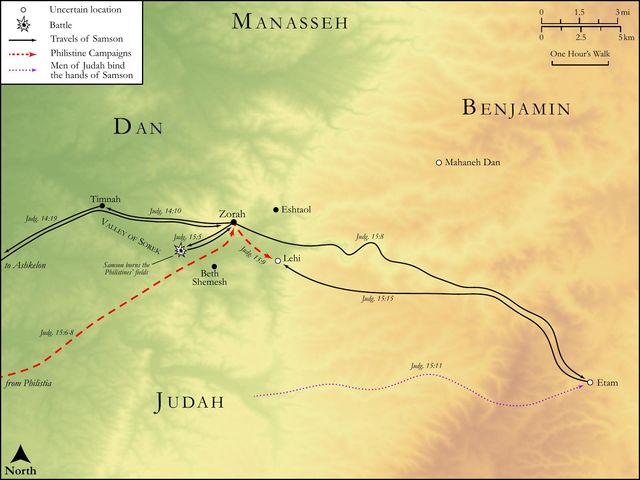
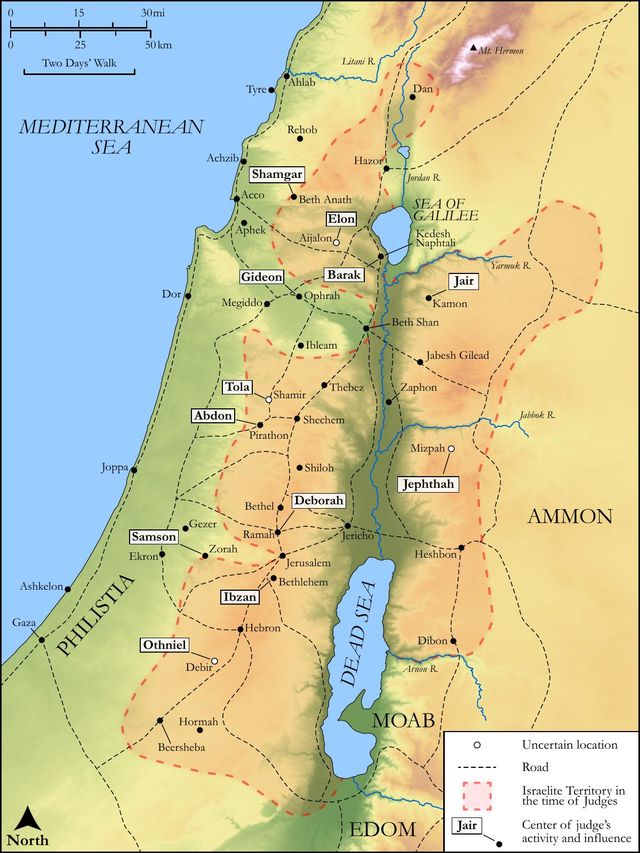
Study this verse
Public-domain commentary
Matthew Henry
From his Commentary on the Whole Bible. Henry comments on passages, not single verses — this entry covers Judges 13:24–25.
Here is, 1. Samson's birth. The woman that had been long barren bore a son, according to the promise; for no word of God shall fall to the ground. Hath he spoken, and shall he not make it good? 2. His name, Samson, has been derived by some, from Shemesh, the sun, turned into a diminutive, sol exiguus - the sun in miniature, perhaps because, being born like Moses to be a deliverer, he was like him exceedingly fair, his face shone like a little sun; or his parents so named him in remembrance of the shining countenance of that man of God who brought them the notice of him; though they knew not his name, yet thus, now that his sayings had come to pass, they did him honour. A little sun, because a Nazarite born (for the Nazarites were as rubies and sapphires, Lam 4:7, and because of his great strength. The sun is compared to a strong man Psa 19:5); why should not a strong man then be compared to the sun when he goes forth in his strength? A little sun, because the glory of, and a light to, his people Israel, a type of Christ, the Sun of righteousness. 3. His childhood. He grew more than is usual in strength and stature, far out-grew other children of his age; and not in that only, but in other instances, it appeared that the Lord blessed him, qualified him, both in body and mind, for something great and extraordinary. Children of promise shall have the blessing. 4. His youth. When he grew up a little the Spirit of the Lord began to move him, Jdg 13:25. This was an evidence that the Lord blessed him. Where God gives his blessing he gives his Spirit to qualify for the blessing. Those are blessed indeed in whom the Spirit of grace begins to work betimes, in the days of their childhood. If the Spirit be poured out upon our offspring, they will spring up as willows by the water courses, Isa 44:3, Isa 44:4. The Spirit of God moved Samson in the camp of Dan, that is, in the general muster of the trained bands of that tribe, who probably had formed a camp between Zorah and Eshtaol, near the place where he lived, to oppose the incursions of the Philistines; there Samson, when a child, appeared among them, and signalized himself by some very brave actions, excelling them all in manly exercises and trials of strength: and probably he showed himself more than ordinarily zealous against the enemies of his country, and discovered more of a public spirit than could be expected in a child. The Spirit moved him at times, not at all times, but as the wind blows, when he listed, to show that what he did was not from himself, for then he could have done it at any time. Strong men think themselves greatly animated by wine (Psa 78:65), but Samson drank no wine, and yet excelled in strength and courage, and every thing that was bold and brave, for he had the Spirit of God moving him; therefore be not drunk with wine, but be filled with the Spirit, who will come to those that are sober and temperate.
Continue studying Judges 13:24 across the web’s major study libraries — every link below opens this exact verse, chapter, or book on the destination site.
Read & Compare
 BibleGatewayThis verse in more than 200 translations and 70 languages.
 Bible.comThe YouVersion reader — hundreds of translations, reading plans, and highlights.
 ESV.orgCrossway's official English Standard Version reader.
 NET BibleThe NET translation with 60,000+ translators' notes on every rendering decision.
 STEP BibleTyndale House's free study tool — original text, vocabulary, and scholarly resources.
 BibliaLogos Bible Software's free web reader.
 USCCBThe New American Bible (Revised Edition) with the U.S. bishops' study notes.
Commentaries
 BibleHub CommentariesDozens of classic commentaries on this verse, gathered on one page.
 StudyLightMore than 100 commentary sets — the largest collection on the web.
 BibleRefPlain-English commentary on what this verse means, verse by verse.
 Enduring WordDavid Guzik's free commentary on this chapter, widely used by Bible teachers.
 Bible Study ToolsVerse commentary alongside Greek and Hebrew study aids.
Original Language & Research
- BibleHub InterlinearThe verse word by word — original language, transliteration, and English.
- BibleHub LexiconEvery word's original-language definition and Strong's entry.
 Blue Letter BibleDeep-study tools — Strong's numbers, concordance, and word studies.
 SefariaThe Hebrew text with Rashi and centuries of Jewish commentary.
Sermons, Hymns & Audio


TrulyRandomVerse is not affiliated with these sites and doesn’t control their content. They’re linked because they’re genuinely useful.
Summary
Judges 13:24 records the pivotal birth of Samson, the son promised by a divine messenger to a previously barren woman, fulfilling the angelic annunciation of a future deliverer for Israel. This verse concisely details his naming, signifying his unique identity and prophetic destiny, and highlights the immediate divine favor and blessing upon him, indicating God's sovereign hand in preparing him for his extraordinary, albeit complex, role as a judge.
Context
ShowHideLiterary Context
Judges 13:24 serves as the triumphant culmination of the miraculous annunciation narrative in Judges 13:2-23. The preceding verses meticulously detail the appearance of the Angel of the LORD to Manoah's barren wife, promising a son who would be a lifelong Nazirite and destined to "begin to deliver Israel from the hand of the Philistines" (Judges 13:5). This verse directly confirms the fulfillment of that divine promise, transitioning the narrative from the anticipation of a deliverer to the reality of his birth and early development. It is a crucial point in the cyclical pattern of the Book of Judges, where Israel's apostasy leads to oppression, prompting God's merciful intervention through a chosen leader.
Historical & Cultural Context
The period of the Judges (approximately 12th-11th centuries BC) was a turbulent era for Israel, marked by political fragmentation, moral decay, and recurrent oppression from surrounding nations due to their disobedience. The Philistines, a formidable "Sea Peoples" group who had settled along the southwestern coast of Canaan, were a dominant military and economic power, exerting significant control over Israelite territories. In this cultural context, barrenness was often perceived as a social stigma or even divine disfavor, making a miraculous birth, particularly to a previously childless woman, a profound demonstration of God's power and a sign of His active involvement in human affairs. The Nazirite vow, a special consecration to God involving specific ascetic disciplines, was a known, though uncommon, practice, especially for a lifelong commitment from birth. Samson's birth, therefore, was not merely a private family event but a public, divinely orchestrated sign of hope and impending deliverance for a nation suffering under Philistine subjugation.
Key Themes
ShowHideJudges 13:24 powerfully encapsulates several overarching themes central to the Book of Judges and the broader biblical narrative. Firstly, it highlights Divine Intervention and Miraculous Birth, underscoring God's sovereign ability to transcend human limitations (barrenness) to accomplish His redemptive purposes. This theme resonates with the births of other significant figures in salvation history, such as Isaac to Abraham and Sarah, and Samuel to Elkanah and Hannah. Secondly, the verse emphasizes God's Enduring Faithfulness to His covenant promises, even amidst Israel's persistent unfaithfulness. Despite the nation's repeated cycles of apostasy and oppression, God remains committed to their deliverance, raising up a leader in His perfect timing. Thirdly, the declaration that "the LORD blessed him" points to Divine Blessing and Purpose, signifying God's active endowment of Samson with favor, strength, and unique abilities, not for personal aggrandizement, but specifically for his divinely appointed mission as a judge and deliverer for Israel. This blessing foreshadows the extraordinary feats he would later perform, empowered by the Spirit of the LORD.
Exposition and Analysis
ShowHideKey Word Analysis
ShowHideDerived from the Hebrew word shemesh (שֶׁמֶשׁ), meaning "sun." This name is profoundly significant, alluding to his dazzling strength and radiant, though ultimately tragic, impact on Israel. It may also subtly counteract the prevalent pagan sun worship (e.g., Baal worship) by implicitly declaring that true light, power, and deliverance originate from the LORD, not from a deified sun. The name itself carries a sense of destiny, connecting him to a powerful, illuminating force, yet also hinting at the transient nature of his glory, much like the sun's daily cycle.
This primitive root means "to be (causatively make) large," encompassing growth in body, mind, estate, or honor. In Samson's context, it signifies his natural physical maturation, but more profoundly, it implies a divinely guided development and increase in strength and stature, preparing him for his extraordinary calling. This growth was not merely biological but a process under God's watchful eye, foreshadowing the immense physical capabilities he would later exhibit.
This Hebrew verb signifies the impartation of divine favor, prosperity, and empowerment. When God "blesses" someone, it implies an active endowment of strength, ability, and success for a specific purpose. In Samson's case, this blessing was not merely a general well-being but a specific equipping for his unique calling as a Nazirite judge, enabling him for the supernatural feats of strength that would characterize his ministry. It indicates God's active presence, provision, and consecration in his life from infancy, setting him apart for a divine task.
Verse Breakdown
ShowHide"And the woman bare a son"
This simple, declarative statement signifies the miraculous fulfillment of the Angel of the LORD's promise to Manoah's barren wife in Judges 13:3. It underscores the triumph of divine power over human barrenness, establishing the supernatural origin of Samson. The birth of a son was a source of immense joy and cultural significance, especially for a previously childless woman, and here it is imbued with national importance as the first step in Israel's promised deliverance.
"and called his name Samson"
The naming of the child by his mother (or parents, as per the broader narrative) is a direct act of obedience to the angelic instruction in Judges 13:3. The name "Samson" (Shimshon), derived from "sun," carries prophetic weight, hinting at his future strength, radiant impact, and perhaps even a connection to light and revelation in a dark time for Israel, serving as a symbol of hope.
"and the child grew, and the LORD blessed him"
This phrase describes Samson's early development under profound divine favor. "The child grew" indicates his natural physical maturation, while "the LORD blessed him" signifies a supernatural endowment of grace, strength, and divine favor. This blessing was not passive but an active empowerment, preparing him for his future role. It implies that from his earliest days, Samson was set apart and uniquely equipped by God, providing the foundational spiritual and physical resources for the extraordinary strength and deeds that would later manifest through the indwelling of the Spirit of the LORD.
Literary Devices
ShowHideJudges 13:24 employs several significant literary devices to convey its profound message. There is clear Foreshadowing, as the name "Samson" (meaning "sun") and the declaration that "the LORD blessed him" subtly hint at the extraordinary strength, radiant impact, and turbulent future of this divinely appointed child. The concise phrase "the child grew, and the LORD blessed him" serves as a powerful statement of Divine Providence, demonstrating God's active and nurturing hand in preparing Samson for his specific, divinely ordained purpose. The entire narrative surrounding Samson's birth, from the barrenness of his mother to the angelic annunciation, is steeped in Miracle, highlighting God's supernatural intervention in human affairs to initiate His redemptive plan. Furthermore, the passage carries a degree of Irony when viewed in light of Samson's later life; despite being divinely blessed and set apart from birth, his personal failings and moral compromises often overshadowed his divine calling, yet God still sovereignly used him to begin Israel's deliverance.
Theological and Thematic Connections
ShowHideJudges 13:24 connects deeply with the broader biblical narrative of God's sovereign election and miraculous intervention in human history. The birth of Samson, like that of Isaac, Samuel, and John the Baptist, demonstrates God's power to open barren wombs and raise up chosen vessels for His purposes, often at critical junctures in salvation history. It underscores God's unwavering faithfulness to His covenant promises, even when His people are mired in unfaithfulness and oppression. Samson's divine blessing from birth signifies that God equips those He calls, preparing them from their earliest days for the unique tasks He has ordained. This verse is a testament to God's initiative in deliverance, reminding us that salvation originates with Him, not with human effort or merit.
Reflection and Application
ShowHideJudges 13:24 offers profound insights for contemporary believers, reminding us that God often initiates His greatest works in quiet, seemingly ordinary beginnings, nurturing individuals through periods of growth and preparation before their public ministries or significant callings unfold. The divine blessing upon Samson from infancy highlights that God's equipping is foundational and often precedes our full understanding of our purpose. We are encouraged to trust in God's sovereign plan for our lives, recognizing that His hand is at work even in our formative years, shaping us for His glory. Moreover, Samson's story, beginning with such divine favor, serves as a poignant reminder that while God's blessing and calling are steadfast, human choices and obedience remain crucial. We are called to steward God's gifts and blessings responsibly, allowing His Spirit to guide us fully, even when our path seems unclear or fraught with challenges. God can indeed use imperfect vessels, but our cooperation with His grace is vital for the fullest expression of His purpose and for honoring the divine investment He has made in us.
Questions for Reflection
ShowHideFAQ
ShowHideWhy is Samson's birth so detailed compared to other judges?
ShowHideSamson's birth narrative is uniquely detailed because it emphasizes his extraordinary divine appointment and the miraculous nature of his conception. Unlike most other judges who are simply "raised up" by God, Samson's story begins with an angelic annunciation to barren parents, a specific Nazirite vow from birth, and a clear declaration of his purpose to "begin to deliver Israel from the hand of the Philistines" (Judges 13:5). This extensive introduction underscores that Samson was not a product of natural circumstances or human initiative, but a direct, sovereign act of God, highlighting the depth of Israel's need and the unique nature of the deliverer God was providing. It sets him apart as a figure of immense prophetic significance, a prefigurement of a greater deliverer to come.
What is the significance of the name Samson?
ShowHideThe name Samson (Hebrew: Shimshon) is derived from the Hebrew word shemesh, meaning "sun." This name carries multiple layers of significance. It could allude to his future strength and radiant, almost dazzling, impact, much like the sun's power. It might also subtly counteract the prevalent pagan sun worship of the time, suggesting that the true source of light, power, and deliverance for Israel is the LORD, not a deified sun. Furthermore, the name could imply that he would be a "little sun" or a "sun-like" figure, bringing a glimmer of hope and light to Israel during a dark period of Philistine oppression, even if his own life was marked by moral shadows and ultimately ended in a tragic self-sacrifice.
What does "the LORD blessed him" imply for Samson's future?
ShowHideThe phrase "the LORD blessed him" is a profound statement of divine favor and empowerment. It implies that from his earliest days, Samson was endowed with supernatural gifts and abilities specifically for his calling as a judge and deliverer. This blessing was not merely a general well-being but an active equipping for his unique mission. It foreshadows the extraordinary strength and feats that would characterize his life, such as tearing a lion apart with his bare hands (Judges 14:6) or breaking ropes like threads (Judges 15:14). It signifies that God's hand was upon him, preparing him to fulfill the divine purpose of beginning to deliver Israel from the Philistines, even before he fully understood or consistently embraced that calling, demonstrating God's sovereign initiation of His plan.
Christ-Centered Fulfillment
ShowHideJudges 13:24, detailing the miraculous birth and divine blessing of Samson, finds its ultimate and perfect fulfillment in Jesus Christ. Samson was a divinely appointed deliverer, born to a barren woman through supernatural intervention, set apart from birth by a vow, and empowered by the Spirit to bring deliverance to Israel from the Philistines. Yet, Samson's deliverance was partial and flawed, marked by his own moral failures and limited by his human weakness. In stark contrast, Jesus is the true and ultimate Deliverer, born of a virgin through the power of the Holy Spirit, perfectly consecrated to God, and fully "blessed" with divine power and authority. While Samson's name means "sun," Jesus is the very Sun of Righteousness who rises with healing in His wings, bringing ultimate light and salvation to a world shrouded in sin and darkness. Samson's strength was physical and temporary; Jesus's power is spiritual and eternal, overcoming sin and death through His perfect life, atoning sacrifice on the cross (John 19:30), and glorious resurrection (Romans 4:25). Where Samson's life ended in a final act of self-sacrifice that brought limited victory (Judges 16:30), Jesus's sacrifice ushered in complete and eternal deliverance for all who believe, establishing His kingdom and offering true freedom from the bondage of sin and death (Colossians 1:13-14). Thus, Samson serves as a type, a shadow pointing forward to the infinitely greater and perfect work of Christ, the Son of God, who truly takes away the sin of the world (John 1:29).