


Judges 14:20
- וַתְּהִיva·te·Hiand she belongedH1961Conj-w ¦ V-Qal-ConsecImperf-3fsVerb Qal Consecutive Imperfect 3rd Singular Feminineוַandתְּהִיshe belonged
- אֵשֶׁת'E·shet[the] wife ofH802N-fscNoun Singular Feminine Construct
- שִׁמְשׁוֹןshim·ShonSamsonH8123N-proper-mNoun Proper Masculine
- לְמֵרֵעֵהוּle·Me·re·'E·huto his companionH4828Prep-l ¦ N-msc ¦ 3msNoun Singular Masculine Constructלְtoמֵרֵעֵcompanionהוּhis
- אֲשֶׁר'a·SherwhoH834RelParticle Relative
- רֵעָהre·'Ahhe was a special friendH7462V-Piel-Perf-3msVerb Piel Perfect 3rd Singular Masculine
- לוֹloto <the> himPrep-l ¦ 3msSuffix Personal 3rd Singular Masculineלto <the>וֹhim
English is a literal word-by-word gloss of the Hebrew, not the KJV's wording. Why?
This is the original text the KJV's translators worked from — each Hebrew word with its own literal English meaning in this verse, prepared by scholars at Tyndale House, Cambridge. The KJV translates whole sentences, not word by word, so its wording differs: one Hebrew word can become several English words, and the KJV may choose “the LORD” where the gloss reads “Yahweh”. Both are faithful — they answer different questions. For the KJV's own rendering, switch to the KJV text.
Details
See on the biblical-era map
Study this verse
Public-domain commentary
Matthew Henry
From his Commentary on the Whole Bible. Henry comments on passages, not single verses — this entry covers Judges 14:10–20. His two-level outline is real structure in the source text, so it is rendered as structure.
We have here an account of Samson's wedding feast and the occasion it gave him to fall foul upon the Philistines.
I.Samson conformed to the custom of the country in making a festival of his nuptial solemnities, which continued seven days, Jdg 14:10.
Though he was a Nazarite, he did not affect, in a thing of this nature, to be singular, but did as the young men used to do upon such occasions. It is no part of religion to go contrary to the innocent usages of the places where we live: nay, it is a reproach to religion when those who profess it give just occasion to others to call them covetous, sneaking, and morose. A good man should strive to make himself, in the best sense, a good companion.
II.His wife's relations paid him the accustomed respect of the place upon that occasion, and brought him thirty young men to keep him company during the solemnity, and to attend him as his grooms-men (Jdg 14:11): When they saw him, what a comely man he was, and what an ingenuous graceful look he had, they brought him these to do him honour, and to improve by his conversation while he staid among them. Or, rather, when they saw him, what a strong stout man he was, they brought these, seemingly to be his companions, but really to be a guard upon him, or spies to observe him. Jealous enough they were of him, but would have been more so had they known of his victory over the lion, which therefore he had industriously concealed. The favours of Philistines have often some mischief or other designed in them.
III.Samson, to entertain the company, propounds a riddle to them, and lays a wager with them that they cannot find it out in seven days, Jdg 14:12-14. The usage, it seems, was very ancient upon such occasions, when friends were together, to be innocently merry, not to spend all the time in dull eating and drinking, as bishop Patrick expresses it, or in other gratifications of sense, as music, dancing, or shows, but to propose questions, by which their learning and ingenuity might be tried and improved. This becomes men, wise men, that value themselves by their reason; but very unlike to it are the infamous and worse than brutish entertainments of this degenerate age, which send nothing round but the glass and the health, till reason is drowned, and wisdom sunk. Now,
1.Samson's riddle was his own invention, for it was his own achievement that gave occasion for it: Out of the eater came forth meat, and out of the strong came forth sweetness. Read my riddle, what is this? Beasts of prey do not yield meat for man, yet food came from the devourer; and those creatures that are strong when they are alive commonly smell strong and are every way offensive when they are dead, as horses, and yet out of the strong, or out of the bitter, so the Syriac and Arabic read it, came sweetness. If they had but so much sense as to consider what eater is most strong, and what meat is most sweet, they would have found out the riddle, and neither lions nor honey were such strangers to their country that the thoughts of them needed to be out of the way; and the solving of the riddle would have given him occasion to tell them the entertaining story on which it was founded. This riddle is applicable to many of the methods of divine providence and grace. When God, by an over-ruling providence, brings good out of evil to his church and people, - when that which threatened their ruin turns to their advantage, - when their enemies are made serviceable to them, and the wrath of men turns to God's praise, - then comes meat out of the eater and sweetness out of the strong. See Phi 1:12.
2.His water was more considerable to him than to them, because he was one against thirty partners. It was not a wager laid upon God's providence, or upon the chance of a die or a card, but upon their ingenuity, and amounted to no more than an honorary recompence of wit and a disgrace upon stupidity.
IV.His companions, when they could not expound the riddle themselves, obliged his wife to get from him the exposition of it, Jdg 14:15.
Whether they were really of a dull capacity, or whether under a particular infatuation at this time, it was strange that none of the thirty could in all this time stumble upon so plain a thing as that, What is sweeter than honey and what stronger than a lion? It should seem that in wit, as well as manners, they were barbarous - barbarous indeed to threaten the bride that, if she would not use means with the bridegroom to let them into the meaning of it, they would burn her and her father's house with fire. Could any thing be more brutish? It was base enough to turn a jest into earnest, and those were unworthy of conversation that would grow so outrageous rather than confess their ignorance and lose so small a wager; nor would it save their credit at all to tell the riddle when they were told it. It was yet more villainous to engage Samson's wife to be a traitor to her own husband, and to pretend a greater interest in her than he had. Now that she was married she must forget her own people. Yet most inhuman of all was it to threaten, if she could not prevail, to burn her and all her relations with fire, and all for fear of losing each of them the value of a shirt and a coat: Have you called us to take what we have? Those must never lay wagers that cannot lose more tamely and easily than thus.
V.His wife, by unreasonable importunity, obtains from him a key to his riddle.
It was on the seventh day, that is, the seventh day of the week (as Dr. Lightfoot conjectures), but the fourth day of the feast, that they solicited her to entice her husband (Jdg 14:15), and she did it,
1.With great art and management (Jdg 14:16), resolving not to believe he loved her, unless he would gratify her in this thing. She knew he could not bear to have his love questioned, and therefore, if any thing would work upon him, that would: "Thou dost but hate me, and lovest me not, if thou deniest me;" whereas he had much more reason to say, "Thou dost but hate me, and lovest me not, if thou insistest on it." And, that she might not make this the test of his affection, he assures her he had not told his own parents, notwithstanding the confidence he reposed in them. If this prevail not, she will try the powerful eloquence of tears: she wept before him the rest of the days of the feast, choosing rather to mar the mirth, as the bride's tears must needs do, than not gain her point, and oblige her countrymen, Jdg 14:17.
2.With great success. At last, being quite wearied with her importunity, he told her what was the meaning of his riddle, and though we may suppose she promised secresy, and that if he would but let her know she would tell nobody, she immediately told it to the children of her people; nor could he expect better from a Philistine, especially when the interests of her country were ever so little concerned. See Mic 7:5, Mic 7:6. The riddle is at length unriddled (Jdg 14:18): What is sweeter than honey, or a better meat? Pro 24:13. What is stronger than a lion, or a greater devourer? Samson generously owns they had won the wager, though he had good reason to dispute it, because they had not declared the riddle, as the bargain was (Jdg 14:12), but it had been declared to them. But he only thought fit to tell them of it: If you had not ploughed with my heifer, made use of your interest with my wife, you would not have found out my riddle. Satan, in his temptations, could not do us the mischief he does if he did not plough with the heifer of our own corrupt nature.
VI.Samson pays his wager to these Philistines with the spoils of others of their countrymen, Jdg 14:19.
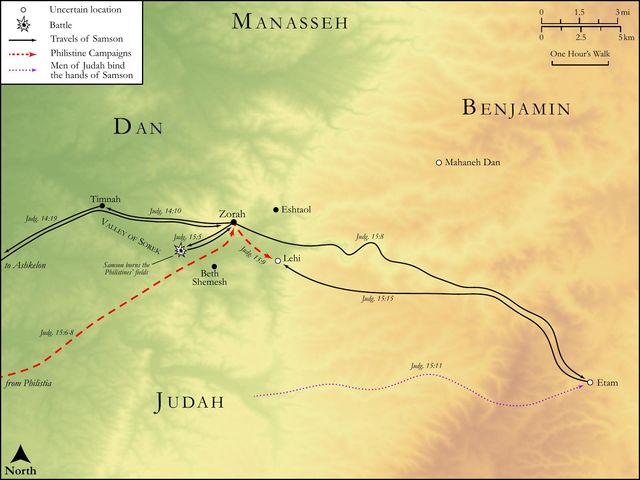
He took this occasion to quarrel with the Philistines, went down to Ashkelon, one of their cities, where probably he knew there was some great festival observed at this time, to which many flocked, out of whom he picked out thirty, slew them, and took their clothes, and gave them to those that had expounded the riddle; so that, in balancing the account, it appeared that the Philistines were the losers, for one of the lives they lost was worth all the suits of clothes they won: the body is more than raiment. The Spirit of the Lord came upon him, both to authorize and to enable him to do this.
VII.This proves a good occasion of weaning Samson from his new relations.
He found how his companions had abused him and how his wife had betrayed him, and therefore his anger was kindled, Jdg 14:19. Better be angry with Philistines than in love with them, because, when we join ourselves to them, we are most in danger of being ensnared by them. And, meeting with this ill usage among them, he went up to his father's house. It were well for us if the unkindnesses we meet with from the world, and our disappointments in it, had but this good effect upon us, to oblige us by faith and prayer to return to our heavenly Father's house and rest there. The inconveniences that occur in our way should make us love home and long to be there. No sooner had he gone than his wife was disposed of to another, Jdg 14:20. Instead of begging his pardon for the wrong she had done him, when he justly signified his resentment of it only by withdrawing in displeasure for a time, she immediately marries him that was the chief of the guests, the friend of the bridegroom, whom perhaps she loved too well, and was too willing to oblige, when she got her husband to tell her the riddle. See how little confidence is to be put in man, when those may prove our enemies whom we have used as our friends.
Continue studying Judges 14:20 across the web’s major study libraries — every link below opens this exact verse, chapter, or book on the destination site.
Read & Compare
 BibleGatewayThis verse in more than 200 translations and 70 languages.
 Bible.comThe YouVersion reader — hundreds of translations, reading plans, and highlights.
 ESV.orgCrossway's official English Standard Version reader.
 NET BibleThe NET translation with 60,000+ translators' notes on every rendering decision.
 STEP BibleTyndale House's free study tool — original text, vocabulary, and scholarly resources.
 BibliaLogos Bible Software's free web reader.
 USCCBThe New American Bible (Revised Edition) with the U.S. bishops' study notes.
Commentaries
 BibleHub CommentariesDozens of classic commentaries on this verse, gathered on one page.
 StudyLightMore than 100 commentary sets — the largest collection on the web.
 BibleRefPlain-English commentary on what this verse means, verse by verse.
 Enduring WordDavid Guzik's free commentary on this chapter, widely used by Bible teachers.
 Bible Study ToolsVerse commentary alongside Greek and Hebrew study aids.
Original Language & Research
- BibleHub InterlinearThe verse word by word — original language, transliteration, and English.
- BibleHub LexiconEvery word's original-language definition and Strong's entry.
 Blue Letter BibleDeep-study tools — Strong's numbers, concordance, and word studies.
 SefariaThe Hebrew text with Rashi and centuries of Jewish commentary.
Sermons, Hymns & Audio


TrulyRandomVerse is not affiliated with these sites and doesn’t control their content. They’re linked because they’re genuinely useful.
Summary
Judges 14:20 marks a deeply humiliating and pivotal moment in Samson's story, revealing that his Philistine wife, after her betrayal regarding the riddle, was given by her father to one of Samson's wedding companions, a man Samson had considered a friend. This profound act of reassigning his wife to another, particularly within his own wedding circle, was a public affront that transformed Samson's personal marital grievance into an intensified and vengeful conflict against the Philistines, serving as a direct catalyst for the escalating hostilities.
Context
ShowHideLiterary Context
This verse serves as the immediate and direct consequence of Samson's enraged departure from Timnah, following his Philistine wife's betrayal of his riddle's secret under duress (see Judges 14:15-18). After fulfilling his vow by killing thirty Philistines in Ashkelon to pay off the riddle's forfeit (as recounted in Judges 14:19), Samson returned to his father's house in Zorah, leaving his wife behind. Her father, likely interpreting Samson's departure as a definitive abandonment, then exercised his patriarchal right to give her to another man. The choice of a "companion" from Samson's own wedding feast elevates the insult, directly setting the stage for Samson's return in Judges 15:1 and the subsequent escalation of hostilities, thus forming a crucial narrative bridge between Samson's personal grievances and his God-ordained role as a judge against Israel's oppressors.
Historical & Cultural Context
In the ancient Near East, marriage was often a contractual agreement between families, involving the transfer of a dowry or bride-price from the groom's family to the bride's. If a husband abandoned his wife without a formal divorce, or if the marriage was deemed dissolved, the wife's father typically retained rights over her, including the authority to arrange her remarriage, sometimes to recover or replace the initial dowry. Samson's furious departure was almost certainly perceived as an abandonment, justifying the father's actions within their cultural framework. Furthermore, the selection of a "companion" (Hebrew: rēa') from the wedding feast—akin to a groomsman or close associate—was a calculated move. In the honor-shame culture prevalent in the region, this act was a profound public humiliation, designed to shame Samson and assert the Philistine family's control and honor over the situation, transforming a personal slight into a public declaration of contempt.
Key Themes
ShowHideJudges 14:20 powerfully underscores several key themes central to the book of Judges and Samson's narrative. Firstly, it highlights the destructive consequences of betrayal and unchecked anger. The wife's betrayal, born of fear, leads directly to her being given away, while Samson's rage results in the loss of his wife and a profound insult, fueling a cycle of violence. Secondly, the theme of humiliation and vengeance is paramount; the act of losing his wife to a former "friend" is a public degradation that directly fuels Samson's desire for retribution against the Philistines, as vividly portrayed in Judges 15:3-8. Thirdly, the verse subtly points to divine sovereignty at work, even amidst human sinfulness. Samson's flawed personal choices and the Philistines' provocative actions are ultimately woven into God's larger plan to begin delivering Israel from Philistine oppression, as prophesied in Judges 13:5. This personal grievance becomes a significant catalyst for the broader conflict that defines Samson's judgeship, demonstrating God's ability to use imperfect instruments and circumstances to advance His purposes.
Exposition and Analysis
ShowHideKey Word Analysis
ShowHideThis term signifies a close associate, friend, or neighbor. In the specific context of a wedding feast, it would denote someone Samson had chosen to be part of his intimate celebration, perhaps a "best man" or a member of his inner circle of attendants. The fact that his wife was given to such a person profoundly intensifies the betrayal and insult. It transforms a general affront into a deeply personal and humiliating act, implying a breach of trust not only by the wife but also by someone Samson had considered an ally and intimate.
This primitive root means "to tend a flock," but by extension, it signifies "to associate with (as a friend)" or "to use as a friend." The KJV's phrasing "whom he had used as his friend" captures this extended meaning perfectly. This emphasizes that the man who received Samson's wife was not merely an acquaintance but someone Samson had treated with familiarity, trust, and shared fellowship. This betrayal by a trusted associate adds a significant layer of pain, indignation, and personal provocation for Samson, making the act a direct catalyst for his subsequent acts of vengeance.
Verse Breakdown
ShowHide"But Samson's wife was [given]"
This initial clause immediately establishes the central, passive action of the verse. The phrasing indicates that the decision and execution of the transfer of Samson's wife were not her own, nor Samson's, but rather the prerogative of her father or family. This highlights her lack of agency and reinforces the patriarchal societal structure where women's marital status was often determined by male relatives, especially in matters of family honor and contract.
"to his companion"
This specifies the recipient of Samson's wife. The choice of a "companion"—someone who had been an invited guest and participant in Samson's wedding celebration—is crucial to understanding the depth of the insult. It elevates the affront from a mere loss of a wife to a profound personal betrayal and public humiliation. This was not a stranger, but someone with whom Samson had shared fellowship, making the act far more grievous and personally offensive.
"whom he had used as his friend"
This final phrase underscores the profound depth of the personal affront and betrayal. It emphasizes that the man who received Samson's wife was not just an acquaintance or a casual guest, but someone Samson had treated with intimacy and trust, considering him a "friend." This betrayal by a trusted associate adds another layer of pain and indignation for Samson, serving as the ultimate provocation that ignites his desire for retribution.
Literary Devices
ShowHideJudges 14:20 employs several potent Literary Devices to convey its dramatic impact and foreshadow future events. Irony is prominently displayed, as the "friend" Samson had chosen for his wedding feast becomes the very individual to whom his wife is given, transforming a bond of camaraderie into a source of profound betrayal and humiliation. This ironic twist deepens the personal nature of the conflict and underscores the deceptive appearances in Samson's life. The verse also functions as a powerful moment of Foreshadowing, directly setting the stage for Samson's subsequent acts of vengeance detailed in Judges 15. The personal insult described here is the direct catalyst for the escalating conflict between Samson and the Philistines, signaling that the narrative is moving towards greater violence and retribution. Furthermore, the verse serves as a crucial Turning Point in the immediate narrative arc, transforming Samson's personal marital dispute into an open and deeply personal vendetta against the Philistines, marking the end of any pretense of peaceful coexistence and ushering in a new, violent phase of direct confrontation.
Theological and Thematic Connections
ShowHideJudges 14:20 stands as a stark testament to the destructive ripple effects of betrayal, unchecked anger, and human sin. The narrative reveals how personal grievances, fueled by pride and a desire for vengeance, can rapidly escalate into broader conflicts, ensnaring not only individuals but entire communities. The Philistine father's action, while perhaps culturally permissible, was a profound insult designed to shame Samson, demonstrating the pervasive nature of an honor-shame culture where personal dignity was paramount. Theologically, the verse highlights the consequences of Samson's flawed choices, particularly his repeated disregard for the covenant by intermarrying with a Philistine, which ultimately brings him personal pain and fuels a cycle of violence, rather than a clear, God-ordained deliverance. Yet, even within this brokenness, God's sovereign hand is at work, using these very conflicts to begin the process of delivering Israel from the Philistines, albeit through Samson's often chaotic and self-serving actions.
Reflection and Application
ShowHideJudges 14:20 is a powerful reminder that our choices, especially those made in anger or in disregard of divine wisdom, carry far-reaching consequences that can ripple through our lives and the lives of others. Samson's story here is a cautionary tale about the perils of unchecked rage and the pain of betrayal. While his anger may have been justified given the circumstances, his response led to a cycle of vengeance rather than a path of reconciliation or true justice. For believers today, this verse underscores the critical importance of discerning relationships, recognizing that not all who appear as "friends" are trustworthy, and exercising wisdom in our associations. More profoundly, it challenges us to confront our own responses to betrayal and insult. Are we quick to seek personal retribution, or do we, by God's grace, choose the path of forgiveness, entrusting justice to the Lord? This passage calls us to break the cycle of escalating conflict by seeking God's wisdom and demonstrating restraint, even when deeply wronged, remembering that true strength is often found not in retaliation, but in humble submission to God's will and His timing for justice.
Questions for Reflection
ShowHideFAQ
ShowHideWhy was Samson's wife given to his companion, and was this customary?
ShowHideSamson's wife was given to his companion because her father likely interpreted Samson's furious departure in Judges 14:19 as a permanent abandonment of his daughter. In ancient Near Eastern societies, if a husband left his wife without a formal divorce or if the marriage was deemed dissolved, her family, particularly her father, often retained rights over her. This included the right to remarry her to another man, especially if a dowry had been paid and now needed to be returned or replaced. Giving her to one of Samson's wedding companions, a man already known to the family, would have been a culturally acceptable way to secure her future and maintain family honor, while also serving as a clear and public insult to Samson.
How did Samson react to this news, and what were the immediate consequences?
ShowHideSamson reacted with extreme fury and a desire for vengeance. Judges 15:1-8 details his response. When he later returned to Timnah to visit his wife, he was informed by her father that she had been given to his companion. This news ignited Samson's rage, leading him to capture 300 foxes, tie their tails together in pairs with torches, and release them into the Philistine fields, burning their standing grain, vineyards, and olive groves. This act of personal retribution directly escalated the conflict between Samson and the Philistines, setting the stage for further violent confrontations.
Does this story suggest God condones Samson's violent actions?
ShowHideThe book of Judges often presents Samson as a flawed hero whose actions, though violent and often driven by personal vendetta, are nonetheless used by God to begin the deliverance of Israel from the Philistines (Judges 13:5). While the text describes Samson's actions, it does not necessarily endorse them as morally perfect or exemplary. Instead, it portrays the complex reality of a judge operating within a fallen world, where God works through imperfect vessels. Samson's story highlights God's sovereign ability to achieve His purposes even amidst human sinfulness, brokenness, and violent impulses, rather than condoning the violence itself. His actions demonstrate the consequences of human sin and the chaotic nature of the period of the Judges, yet God's overarching plan for Israel's deliverance still unfolds.
Christ-Centered Fulfillment
ShowHideThe narrative of Samson's betrayal and the subsequent giving of his wife to a "friend" powerfully foreshadows the ultimate betrayal experienced by Christ, yet with a profound contrast in outcome and character. Samson, a judge and deliverer for Israel, was betrayed by his closest associates and rejected by those he sought to deliver, leading him to a path of personal vengeance. In stark contrast, Jesus, the true and ultimate Deliverer, also experienced profound betrayal, most notably by Judas, one of His chosen companions, who handed Him over to His enemies (Matthew 26:47-50). While Samson sought to reclaim what was "his" through destructive force, Christ willingly "gave" Himself, not to another, but as a sacrifice for the sins of the world (John 1:29). He was abandoned and "given over" to death, not out of personal insult or for vengeance, but as the Lamb of God who takes away the sin of the world (Acts 2:23). Unlike Samson, whose story ends in a final act of self-destructive vengeance, Christ's "giving over" led to resurrection and the ultimate triumph over sin and death, establishing a kingdom not built on retaliation but on grace, forgiveness, and eternal life for all who believe (John 18:36). He is the true friend who lays down His life for His friends (John 15:13), transforming betrayal into the path of salvation and offering reconciliation where Samson only found further conflict.