


2 Kings 10:7
Bible text: King James Version (1769 Blayney text) · Public domain
Bible text: King James Version with Strong's numbers · Public domain
Bible text: Berean Standard Bible · Public domain
Bible text: American Standard Version (1901) · Public domain
Bible text: World English Bible, Messianic edition · Public domain
Bible text: Geneva Bible (1599) · Public domain
Bible text: Young's Literal Translation · Public domain
- וַיְהִיvay·Hiand it wasH1961Conj-w ¦ V-Qal-ConsecImperf-3msVerb Qal Consecutive Imperfect 3rd Singular Masculineוַandיְהִיit was
- כְּבֹאke·Vo'when cameH935Prep-k ¦ V-Qal-InfVerb Qal Infinitive Constructכְּwhenבֹאcame
- הַסֵּפֶרha·Se·ferthe letterH5612Art ¦ N-msNoun Singular Masculine Absoluteהַtheסֵּפֶרletter
- אֲלֵיהֶם'a·lei·Hemto themH413Prep ¦ 3mpPrepositionאֲלֵיtoהֶםthem
- וַיִּקְחוּvai·yik·Chuand they tookH3947Conj-w ¦ V-Qal-ConsecImperf-3mpVerb Qal Consecutive Imperfect 3rd Plural Masculineוַandיִּקְחוּthey took
- אֶת'et<obj.>H853DirObjMParticle Object Indicator
- בְּנֵיbe·Nei[the] sons ofH1121N-mpcNoun Plural Masculine Construct
- הַמֶּלֶךְha·Me·lekhthe kingH4428Art ¦ N-msNoun Singular Masculine Absoluteהַtheמֶּלֶךְking
- וַיִּשְׁחֲטוּvai·yish·cha·Tuand they slaughteredH7819Conj-w ¦ V-Qal-ConsecImperf-3mpVerb Qal Consecutive Imperfect 3rd Plural Masculineוַandיִּשְׁחֲטוּthey slaughtered
- שִׁבְעִיםshiv·'ImseventyH7657N-mpNoun Plural Masculine Absolute
- אִישׁ'IshmanH376N-msNoun Singular Masculine Absolute
- וַיָּשִׂימוּvai·ya·Si·muand they putH7760Conj-w ¦ V-Qal-ConsecImperf-3mpVerb Qal Consecutive Imperfect 3rd Plural Masculineוַandיָּשִׂימוּthey put
- אֶת'et<obj.>H853DirObjMParticle Object Indicator
- רָאשֵׁיהֶםra·shei·Hemtheir headsH7218N-mpc ¦ 3mpNoun Plural Masculine Constructרָאשֵׁיheadsהֶםtheir
- בַּדּוּדִיםba·du·Dimin <the> basketsH1731Prep-b ¦ N-mpNoun Plural Masculine Absoluteבַּin <the>דּוּדִיםbaskets
- וַיִּשְׁלְחוּvai·yish·le·Chuand they sent [them]H7971Conj-w ¦ V-Qal-ConsecImperf-3mpVerb Qal Consecutive Imperfect 3rd Plural Masculineוַandיִּשְׁלְחוּthey sent [them]
- אֵלָיו'e·Lavto himH413Prep ¦ 3msPrepositionאֵלָיtoוhim
- יִזְרְעֶאלָהyiz·re·'E·lahJezreel towardsH3157N-proper ¦ SfxNoun Proper LocationיִזְרְעֶאלָJezreelהtowards
English is a literal word-by-word gloss of the Hebrew, not the KJV's wording. Why?
This is the original text the KJV's translators worked from — each Hebrew word with its own literal English meaning in this verse, prepared by scholars at Tyndale House, Cambridge. The KJV translates whole sentences, not word by word, so its wording differs: one Hebrew word can become several English words, and the KJV may choose “the LORD” where the gloss reads “Yahweh”. Both are faithful — they answer different questions. For the KJV's own rendering, switch to the KJV text.
Details
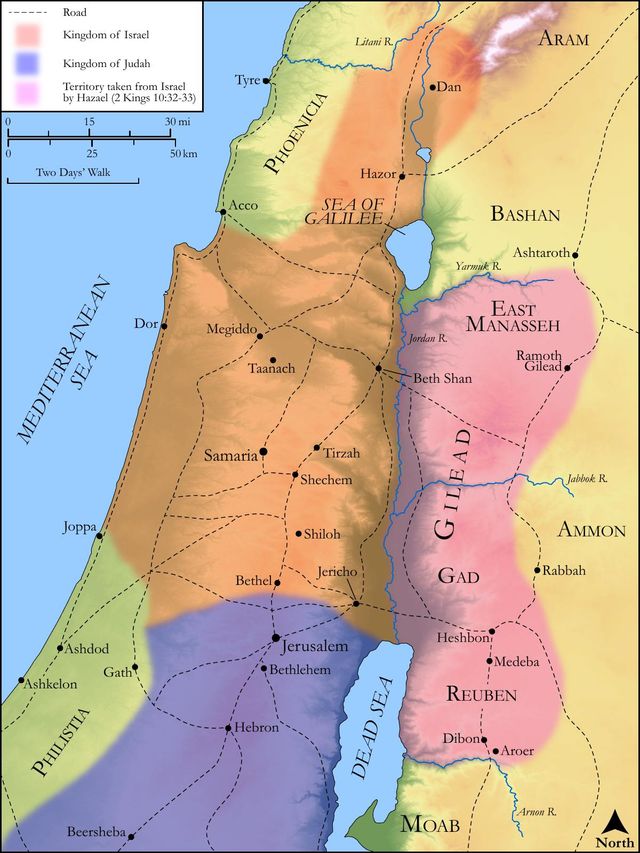
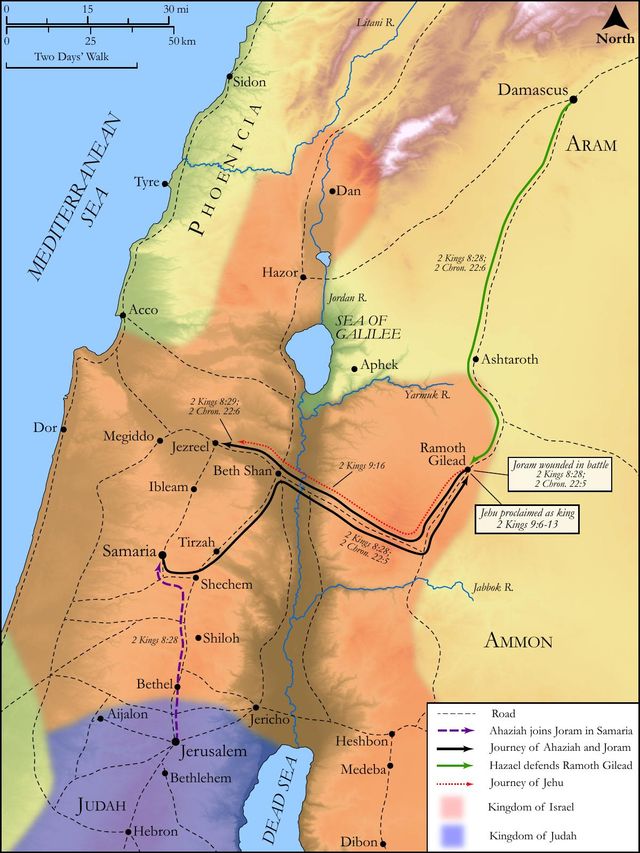
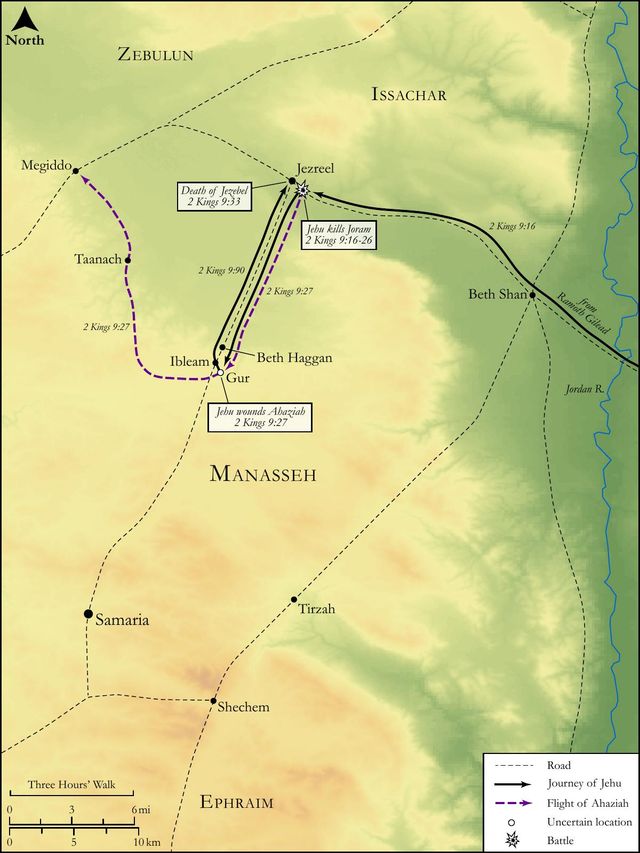
See on the biblical-era maps
Study this verse
Public-domain commentary
Matthew Henry
From his Commentary on the Whole Bible. Henry comments on passages, not single verses — this entry covers 2 Kings 10:1–14. His two-level outline is real structure in the source text, so it is rendered as structure.
We left Jehu in quiet possession of Jezreel, triumphing over Joram and Jezebel; and we must now attend his further motions. He knew the whole house of Ahab must be cut off, and therefore proceeded in this bloody work, and did not do it deceitfully, or by halves, Jer 48:10.
I.He got the heads of all the sons of Ahab cut off by their own guardians at Samaria.
Seventy sons (or grandsons) Ahab had, Gideon's number, Jdg 8:30. In such a number that bore his name his family was likely to be perpetuated, and yet it is extirpated all at once. Such a quiver full of arrows could not protect his house from divine vengeance. Numerous families, if vicious, must not expect to be long prosperous. These sons of Ahab were now at Samaria, a strong city, perhaps brought thither upon occasion of the war with Syria, as a place of safety, or upon notice of Jehu's insurrection; with them were the rulers of Jezreel, that is, the great officers of the court, who went to Samaria to secure themselves or to consult what was to be done. Those of them that were yet under tuition had their tutors with them, who were entrusted with their education in learning, agreeable to their birth and quality, but, it is to be feared, brought them up in the idolatries of their father's house and made them all worshippers of Baal. Jehu did not think fit to bring his forces to Samaria to destroy them, but, that the hand of God might appear the more remarkably in it, made their guardians their murderers.
1.He sent a challenge to their friends to stand by them, Kg2 10:2, Kg2 10:3. "You that are hearty well-wishers to the house of Ahab, and entirely in its interests, now is your time to appear for it. Samaria is a strong city; you are in possession of it; you have forces at command; you may choose out the likeliest person of all the royal family to head you; you know you are not tied to the eldest, unless he be the best and meetest of your master's sons. If you have any spirit in you, show it, and set one of them on his father's throne, and stand by him with your lives and fortunes." Not that he desired they should do this, or expected they would, but thus he upbraided them with their cowardice and utter inability to contest with the divine counsels. "Do if you dare, and see what will come of it." Those that have forsaken their religion have often, with it, lost both their sense and their courage, and deserve to be upbraided with it.
2.Hereby he gained from them a submission. They prudently reasoned with themselves: "Behold, two kings stood not before him, but fell as sacrifices to his rage; how then shall we stand?" Kg2 10:4. Therefore they sent him a surrender of themselves: "We are thy servants, thy subjects, and will do all that thou shalt bid us, right or wrong, and will set up nobody in competition with thee." They saw it was to no purpose to contend with him, and therefore it was their interest to submit to him. With much more reason may we thus argue ourselves into a subjection to the great God. Many kings and great men have fallen before his wrath, for their wickedness; and how then shall we stand? Do we provoke the Lord to jealousy? Are we stronger than he? No, we must either bend or break.
3.This was improved so far as to make them the executioners of those whom they had the tuition of (Kg2 10:6): If you be mine, bring me the heads of your master's sons by tomorrow at this time. Though he knew it must be done, and was loth to do it himself, one would think he could not expect they should do it. Could they betray such a trust? Could they be cruel to their master's sons? It seems, so low did they stoop in their adoration to the rising sun that they did it; they cut off the heads of those seventy princes, and sent them in baskets a present to Jehu, Kg2 10:7. Learn hence not to trust in a friend nor to put confidence in a guide not governed by conscience. One can scarcely expect that he who has been false to his God should ever be faithful to his prince. But observe God's righteousness in their unrighteousness. These elders of Jezreel had been wickedly obsequious to Jezebel's order for the murder of Naboth, Kg1 21:11. She gloried, it is likely, in the power she had over them; and now the same base spirit makes them as pliable to Jehu and as ready to obey his orders for the murder of Ahab's sons. Let none aim at arbitrary power, lest they be found rolling a stone which, some time or other, will return upon them. Princes that make their people slaves take the readiest way to make them rebels; and by forcing men's consciences, as Jezebel did, they lose their hold of them. When the separated heads were presented to Jehu, he slyly upbraided those that were the executioners of this vengeance. The heads were laid in two heaps at the gate, the proper place of judgment. There he acquitted the people before God and the world (Kg2 10:9, You are righteous), and, by what the rulers of Samaria had now done, comparatively acquitted himself: "I slew but one; they have slain all these: I did it by conspiracy and with design; they have done this merely in compliance and with an implicit obedience. Let not the people of Samaria, nor any of the friends of the house of Ahab, ever reproach me for what I have done, when their own elders, and the very guardians of the orphans, have done this." It is common for those who have done something base to attempt the mitigation of their own reproach by drawing others in to do something worse. But, (2.) He resolves all into the righteous judgment of God (Kg2 10:10): The Lord hath done that which he spoke by Elijah. God is not the author of any man's sin, but even by that which men do from bad principles God serves his own purposes and glorifies his own name; and he is righteous in that wherein men are unrighteous. When the Assyrian is made the rod of God's anger, and the instrument of his justice, he meaneth not so, neither does his heart think so, Isa 10:7.
II.He proceeded to destroy all that remained of the house of Ahab, not only those that descended from him, but those that were in any relation to him, all the officers of his household, ministers of state, and those in command under him, called here his great men (Kg2 10:11), all his kinsfolks and acquaintance, who had been partners with him in his wickedness, and his priests, or domestic chaplains, whom he employed in his idolatrous services and who strengthened his hand that he should not turn from his evil way. Having done this in Jezreel, he did the same in Samaria (Kg2 10:17), slew all that remained to Ahab in Samaria. This was bloody work, and is not now, in any case, to be drawn into a precedent. Let the guilty suffer, but not the guiltless for their sakes. Perhaps such terrible destructions as these were intended as types of the final destruction of all the ungodly. God has a sword, bathed in heaven, which will come down upon the people of his curse, and be filled with blood. Isa 34:5, Isa 34:6. Then his eye will not spare, neither will he pity.
III.Providence bringing the brethren of Ahaziah in his way, as he was going on with this execution, he slew them likewise, Kg2 10:12-14.
The brethren of Ahaziah were slain by the Arabians (Ch2 22:1), but these were the sons of his brethren, as it is there explained (Kg2 10:8), and they are said to be princes of Judah, and to minister to Ahaziah. Several things concurred to make them obnoxious to the vengeance Jehu was now executing.
1.They were branches of Ahab's house, being descended from Athaliah, and therefore fell within his commission.
2.They were tainted with the wickedness of the house of Ahab.
3.They were now going to make their court to the princes of the house of Ahab, to salute the children of the king and the queen, Joram and Jezebel, which showed that they were linked to them in affection as well as in affinity. These princes, forty-two in number, being appointed as sheep for the sacrifice, were slain with solemnity, at the pit of the shearing-house. The Lord is known by these judgments which he executeth.
Continue studying 2 Kings 10:7 across the web’s major study libraries — every link below opens this exact verse, chapter, or book on the destination site.
Read & Compare
 BibleGatewayThis verse in more than 200 translations and 70 languages.
 Bible.comThe YouVersion reader — hundreds of translations, reading plans, and highlights.
 ESV.orgCrossway's official English Standard Version reader.
 NET BibleThe NET translation with 60,000+ translators' notes on every rendering decision.
 STEP BibleTyndale House's free study tool — original text, vocabulary, and scholarly resources.
 BibliaLogos Bible Software's free web reader.
 USCCBThe New American Bible (Revised Edition) with the U.S. bishops' study notes.
Commentaries
 BibleHub CommentariesDozens of classic commentaries on this verse, gathered on one page.
 StudyLightMore than 100 commentary sets — the largest collection on the web.
 BibleRefPlain-English commentary on what this verse means, verse by verse.
 Enduring WordDavid Guzik's free commentary on this chapter, widely used by Bible teachers.
 Bible Study ToolsVerse commentary alongside Greek and Hebrew study aids.
Original Language & Research
- BibleHub InterlinearThe verse word by word — original language, transliteration, and English.
- BibleHub LexiconEvery word's original-language definition and Strong's entry.
 Blue Letter BibleDeep-study tools — Strong's numbers, concordance, and word studies.
 SefariaThe Hebrew text with Rashi and centuries of Jewish commentary.
Sermons, Hymns & Audio


TrulyRandomVerse is not affiliated with these sites and doesn’t control their content. They’re linked because they’re genuinely useful.
Summary
Second Kings 10:7 vividly recounts the brutal execution of King Ahab's seventy sons by the elders and guardians of Samaria, a direct and horrifying response to Jehu's challenging letter. This gruesome act, culminating in the delivery of their severed heads in baskets to Jehu at Jezreel, served as undeniable proof of the officials' allegiance to the new king, signified the complete and violent eradication of the Omride dynasty, and fulfilled divine prophecy, thereby consolidating Jehu's reign over Israel.
Context
ShowHideLiterary Context
This verse is a pivotal moment within the intensely dramatic and bloody narrative of Jehu's divinely ordained coup against the Omride dynasty in the Northern Kingdom of Israel. The preceding chapter details Jehu's anointing by a prophet of Elisha, empowering him to destroy the house of Ahab (2 Kings 9:1-10). Immediately following this, Jehu swiftly executed King Joram of Israel and King Ahaziah of Judah (2 Kings 9:21-27), and famously orchestrated the death of Jezebel (2 Kings 9:30-37). With the immediate royal presence eliminated, Jehu turned his attention to the remaining male heirs of Ahab, who were residing in Samaria. He shrewdly challenged the city's officials and elders, who were responsible for the royal children, to choose their allegiance. Their response, as detailed in this verse, was a gruesome demonstration of their submission, ensuring the complete annihilation of Ahab's lineage as commanded by God. The subsequent verses describe Jehu's arrival in Jezreel and his further actions to eradicate all remnants of Ahab's house and Baal worship, demonstrating the thoroughness of the purge.
Historical & Cultural Context
The period of Jehu's reign (c. 841-814 BCE) was a time of profound political instability and rampant religious apostasy in the Northern Kingdom of Israel. The Omride dynasty, initiated by Omri and continued by Ahab and Jezebel, had aggressively promoted Baal worship, leading the nation into deep idolatry and moral corruption, which provoked the severe judgment of Yahweh, articulated through prophets like Elijah (1 Kings 21:20-24). In Israel, coups d'état were frequently accompanied by the systematic elimination of the previous ruling family to prevent future claims to the throne and secure the new king's authority. The public display of severed heads was a common, albeit horrifying, method of demonstrating power, instilling fear, and confirming the complete overthrow of a regime. The "seventy sons" likely refers to all male descendants and close relatives of Ahab who could potentially lay claim to the throne, not necessarily all biological sons. Their residence in Samaria, the capital, under the care of city officials, was typical for royal children. Jehu's letter was a shrewd tactic, forcing the officials to implicate themselves in the purge, thereby cementing their loyalty and making them complicit in the bloody transition of power.
Key Themes
ShowHideThis verse powerfully contributes to several overarching themes within 2 Kings and the broader Deuteronomistic History. Foremost is the theme of Divine Judgment, illustrating God's unwavering commitment to punishing persistent idolatry and wickedness, particularly within leadership, as seen in the complete destruction of the Omride dynasty. It also highlights the Fulfillment of Prophecy, specifically the pronouncements made by Elijah against Ahab's house (1 Kings 21:21-22) and reiterated to Jehu (2 Kings 9:7-10). Jehu, despite his own flawed character, serves as God's Instrument of Justice, carrying out a divinely ordained purge. The ruthlessness of the act underscores the Consequences of Sin, demonstrating that the rebellion of one generation can have devastating repercussions for subsequent ones and the entire nation. Finally, it speaks to the Consolidation of Power through violent means, a common motif in the history of Israel's kings, yet here, it is framed within God's sovereign plan to cleanse Israel of Baal worship and restore a measure of fidelity to the covenant.
Exposition and Analysis
ShowHideKey Word Analysis
ShowHideFrom H5612 (סֵפֶר), meaning "writing (the art or a document); by implication, a book." In this context, it refers to the written correspondence sent by Jehu to the officials and elders in Samaria. This "letter" was not merely an informative note but a direct challenge and a test of loyalty, demanding a decisive response from those entrusted with the care of Ahab's descendants. Its arrival marked the point of no return for the Omride dynasty.
From H7819 (שָׁחַט), a primitive root meaning "to slaughter (in sacrifice or massacre)." This verb emphasizes a deliberate, violent, and systematic act of killing. It is a strong term that conveys the intentionality and finality of the execution, underscoring the brutal and calculated nature of the purge. The use of "slaughter" rather than a more general term for killing highlights the merciless efficiency with which the seventy persons were put to death.
From H1731 (דּוּד), meaning "a pot (for boiling); also (by resemblance of shape) a basket." The use of "baskets" here for carrying the severed heads is a grim detail that adds to the horror of the scene. These were likely large, robust containers, perhaps even cooking pots, repurposed for this gruesome task. The image of heads in baskets, rather than simply severed, emphasizes the public display and the calculated presentation of the evidence of the purge.
Verse Breakdown
ShowHide"And it came to pass, when the letter came to them,"
This opening clause establishes the pivotal moment of the narrative. The "letter" refers to Jehu's correspondence to the officials and elders of Samaria, challenging them to either choose one of Ahab's sons as king and fight him, or to submit by executing the royal heirs (2 Kings 10:1-6). The arrival of this letter forced the Samarian officials into a dire choice, setting the stage for the horrific events that follow.
"that they took the king's sons, and slew seventy persons,"
This clause describes the immediate and decisive action taken by the officials in Samaria. In a desperate act of self-preservation and submission to Jehu's authority, they rounded up "the king's sons"—a term encompassing male descendants, grandsons, and perhaps other close male relatives of Ahab who could pose a threat to Jehu's claim—and brutally executed them. The number "seventy persons" emphasizes the comprehensive nature of this slaughter, indicating that virtually all potential claimants from the Omride dynasty were eliminated, leaving no rival for Jehu.
"and put their heads in baskets,"
This gruesome detail underscores the barbarity and public nature of the act. Severing the heads and placing them in baskets was a common practice in the warfare and coups of that day to confirm kills, demonstrate power, and publicly humiliate the defeated. It served as undeniable, tangible proof to Jehu that his command had been carried out and that the Omride dynasty had been utterly annihilated.
"and sent him [them] to Jezreel."
The final action of the clause is the dispatch of the baskets of heads to Jezreel, where Jehu was residing. The KJV's "[them]" clarifies the pronoun "him" which, while singular in the Hebrew, refers collectively to the heads. Jezreel was a significant royal city for Ahab's dynasty, and the very place where Jezebel had recently met her end (2 Kings 9:30-37). Sending the heads to Jezreel was a highly symbolic act, completing the purge at the very heart of the Omride power base and publicly displaying the finality of their overthrow to Jehu and the populace.
Literary Devices
ShowHideThe narrative of 2 Kings 10:7 employs several powerful literary devices to convey its message and impact the reader. The most prominent is Graphic Imagery, as the verse spares no detail in describing the brutal execution and the subsequent display of the seventy heads. This visceral description is intended to shock the reader, emphasize the severity of the judgment, and underscore the ruthlessness of Jehu's purge, leaving an indelible impression of the violence inherent in this divine judgment. There is also strong Symbolism at play; the heads in baskets are not merely proof of death but symbolize the complete and utter eradication of the Omride dynasty, leaving no trace or potential for resurgence, signifying the finality of God's judgment against Ahab's house. Furthermore, the act itself is a form of Irony, as the very officials entrusted with the care and protection of the royal heirs become their executioners, forced by fear and pragmatism to betray their former loyalty. This highlights the precariousness of power and the swift, often brutal, shifts in allegiance during times of political upheaval.
Theological and Thematic Connections
ShowHideThis verse, while disturbing in its raw depiction of violence, is profoundly significant for understanding God's justice and the unwavering fulfillment of His word. It serves as a stark reminder that God is sovereign over human history and that He will ultimately bring judgment upon those who persistently defy Him and lead His people into idolatry. The complete eradication of Ahab's house, as prophesied by Elijah, demonstrates God's faithfulness to His pronouncements, even when their fulfillment involves shocking human actions. It underscores that God can use flawed human instruments, like Jehu, to accomplish His divine purposes, even if their methods are extreme and morally complex. The passage compels us to consider the far-reaching consequences of sin and rebellion, not only for individuals but for entire generations and nations. It is a powerful testament to the truth that God's patience has limits, and His justice, though sometimes slow, is always certain.
Reflection and Application
ShowHideThe grim reality of 2 Kings 10:7 challenges us to grapple with the severity of divine judgment and the devastating consequences of pervasive sin and idolatry. While the methods employed by Jehu are far removed from our contemporary ethical sensibilities and should not be emulated, the underlying principles remain profoundly relevant for all generations. This passage reminds us that God is not indifferent to injustice, idolatry, and the corruption of leadership. It underscores the truth that rebellion against God's commands, particularly the worship of false gods, carries devastating consequences, not only for the perpetrators but often for their descendants and the wider community. For believers, it should foster a deep reverence for God's holiness and His unwavering commitment to justice. It calls us to examine our own lives and societies for any form of idolatry or compromise that might provoke divine displeasure, encouraging repentance and a return to faithful obedience. It also prompts us to consider the weighty responsibility of leadership, both spiritual and secular, and the profound impact of our choices on those we influence, urging us to guide others in righteousness and truth.
Questions for Reflection
ShowHideFAQ
ShowHideWhy were there "seventy persons" identified as the king's sons? Were they all biological children of Ahab?
ShowHideIt is highly unlikely that all seventy were biological sons of King Ahab. In Hebrew usage, the term "sons" (Hebrew: בָּנִים, banim) could refer more broadly to male descendants, including grandsons, nephews, or even close male relatives and prominent members of the royal household who could potentially lay claim to the throne. The number seventy often signifies a complete or comprehensive group in biblical numerology (e.g., the seventy nations in Genesis 10, the seventy elders of Israel in Exodus 24:1), emphasizing the thoroughness of the purge. By eliminating "seventy persons," Jehu ensured that virtually all potential male heirs and rivals from the Omride dynasty were annihilated, leaving no one to challenge his newly established reign or to continue the legacy of Baal worship. This was a common, albeit brutal, tactic in ancient coups to secure absolute power and prevent future rebellions.
Christ-Centered Fulfillment
ShowHideWhile 2 Kings 10:7 depicts a brutal act of judgment and the violent end of a wicked dynasty, it points forward to Christ in profound ways, primarily through the themes of divine judgment, the eradication of sin's dominion, and the establishment of an eternal, righteous kingdom. The judgment against Ahab's house, though executed through Jehu's ruthless hand, foreshadows the ultimate and perfect judgment of God against sin and evil, fully realized in the person and work of Jesus Christ. On the cross, Jesus bore the full weight of God's wrath against sin, becoming the ultimate sacrifice that cleanses us from all unrighteousness (2 Corinthians 5:21). The violent end of Ahab's lineage, marked by pervasive idolatry and rebellion, anticipates the complete and final overthrow of spiritual wickedness and the powers of darkness through Christ's decisive victory (Colossians 2:15). Unlike Jehu, whose reign was still imperfect and eventually led to its own decline and the continued struggle with idolatry, Christ establishes a kingdom that is eternal, righteous, and unshakeable (Daniel 7:13-14; Hebrews 12:28). The fulfillment of prophecy against Ahab's house highlights God's unwavering faithfulness to His word, a faithfulness ultimately and perfectly demonstrated in the countless prophecies fulfilled in Jesus' life, death, and resurrection, confirming Him as the promised Messiah and the true King who reigns forever (Luke 24:44; Acts 3:18). Thus, the gruesome scene in Jezreel, while a testament to God's severe justice against sin, ultimately directs our gaze to the Lamb of God who takes away the sin of the world and establishes a kingdom of peace, righteousness, and eternal life (John 1:29; Revelation 11:15).