


2 Samuel 13:36
Bible text: King James Version (1769 Blayney text) · Public domain
Bible text: King James Version with Strong's numbers · Public domain
Bible text: Berean Standard Bible · Public domain
Bible text: American Standard Version (1901) · Public domain
Bible text: World English Bible, Messianic edition · Public domain
Bible text: Geneva Bible (1599) · Public domain
Bible text: Young's Literal Translation · Public domain
- וַיְהִיvay·Hiand it wasH1961Conj-w ¦ V-Qal-ConsecImperf-3msVerb Qal Consecutive Imperfect 3rd Singular Masculineוַandיְהִיit was
- כְּכַלֹּתוֹke·kha·lo·Towhen he finishedH3615Prep-k ¦ V-Piel-Inf ¦ 3msVerb Piel Infinitive Constructכְּwhenכַלֹּתfinishedוֹhe
- לְדַבֵּרle·da·Berto speakH1696Prep-l ¦ V-Piel-InfVerb Piel Infinitive Constructלְtoדַבֵּרspeak
- וְהִנֵּהve·hi·Nehand there!H2009Conj-w ¦ PrtParticle Interjectionוְandהִנֵּהthere!
- בְנֵיve·nei[the] sons ofH1121N-mpcNoun Plural Masculine Construct
- הַמֶּלֶךְha·Me·lekhthe kingH4428Art ¦ N-msNoun Singular Masculine Absoluteהַtheמֶּלֶךְking
- בָּאוּBa·'uthey cameH935V-Qal-Perf-3cpVerb Qal Perfect 3rd Plural common gender
- וַיִּשְׂאוּvai·yis·'Uand they lifted upH5375Conj-w ¦ V-Qal-ConsecImperf-3mpVerb Qal Consecutive Imperfect 3rd Plural Masculineוַandיִּשְׂאוּthey lifted up
- קוֹלָםko·Lamtheir voiceH6963N-msc ¦ 3mpNoun Singular Masculine Constructקוֹלָvoiceםtheir
- וַיִּבְכּוּvai·yiv·Kuand they weptH1058Conj-w ¦ V-Qal-ConsecImperf-3mpVerb Qal Consecutive Imperfect 3rd Plural Masculineוַandיִּבְכּוּthey wept
- וְגַםve·gamand alsoH1571Conj-w ¦ AdvAdverbוְandגַםalso
- הַמֶּלֶךְha·Me·lekhthe kingH4428Art ¦ N-msNoun Singular Masculine Absoluteהַtheמֶּלֶךְking
- וְכָלve·kholand allH3605Conj-w ¦ N-mscNoun Singular Masculine Constructוְandכָלall
- עֲבָדָיו'a·va·Davhis servantsH5650N-mpc ¦ 3msNoun Plural Masculine Constructעֲבָדָיservantsוhis
- בָּכוּba·Khuthey weptH1058V-Qal-Perf-3cpVerb Qal Perfect 3rd Plural common gender
- בְּכִיbe·Khia weepingH1065N-msNoun Singular Masculine Absolute
- גָּדוֹלga·Dola greatH1419Adj-msAdjective Singular Masculine Absolute
- מְאֹדme·'OdveryH3966Adj-msAdjective Numerical Singular Masculine Absolute
English is a literal word-by-word gloss of the Hebrew, not the KJV's wording. Why?
This is the original text the KJV's translators worked from — each Hebrew word with its own literal English meaning in this verse, prepared by scholars at Tyndale House, Cambridge. The KJV translates whole sentences, not word by word, so its wording differs: one Hebrew word can become several English words, and the KJV may choose “the LORD” where the gloss reads “Yahweh”. Both are faithful — they answer different questions. For the KJV's own rendering, switch to the KJV text.
Details
See on the biblical-era maps
Study this verse
Public-domain commentary
Matthew Henry
From his Commentary on the Whole Bible. Henry comments on passages, not single verses — this entry covers 2 Samuel 13:30–39.
Here is, I. The fright that David was put into by a false report brought to Jerusalem that Absalom had slain all the king's sons, Sa2 13:30. It is common for fame to make bad worse; and the first news of such a thing as this represents it as more dreadful than afterwards it proves. Let us not therefore be afraid of evil tidings, while they want confirmation, but, when we hear the worst, hope the best, at least hope better. However, this false news gave as much affliction to David, for the present, as if it had been true; he tore his garments, and lay on the earth, while as yet it was only a flying story, Sa2 13:31. It was well that David had grace; he had need enough of it, for he had strong passions.
II.The rectifying of the mistake in two ways:
- 1. By the sly suggestions of Jonadab, David's nephew, who could tell him, Amnon only is dead, and not all the king's sons (Sa2 13:32, Sa2 13:33), and could tell him too that it was done by the appointment of Absalom, and designed from the day Amnon forced his sister Tamar. What a wicked man was he, if he knew all this or had any cause to suspect it, that he did not make David acquainted with it sooner, that means might be used to make up the quarrel, or at least that David might not throw Amnon into the mouth of danger by letting him go to Absalom's house. If we do not our utmost to prevent mischief, we make ourselves accessory to it. If we say, Behold, we knew it not; doth not he that pondereth the heart consider whether we did or no? See Pro 24:11, Pro 24:12. It is well if Jonadab was not as guilty of Amnon's death as he was of his sin; such friends do those prove who are hearkened to as counsellors to do wickedly: he that would not be so kind as to prevent Amnon's sin would not be so kind as to prevent his ruin, when, it should seem, he might have done both. 2. By the safe return of all the king's sons except Amnon. They and their attendants were speedily discovered by the watch (Sa2 13:34, Sa2 13:35), and soon arrived, to show themselves alive, but to bring the certain sad news that Absalom had murdered their brother Amnon. The grief David had been in for that which was not made him the better able to bear that which was, by giving him a sensible occasion, when he was undeceived, to thank God that all his sons were not dead: yet that Amnon was dead, and slain by his own brother is such a treacherous barbarous manner, was enough to put the king and court, the king and kingdom, into real mourning. Sorrow is never more reasonable than when there is sin in the case.
III.Absalom's flight from justice:
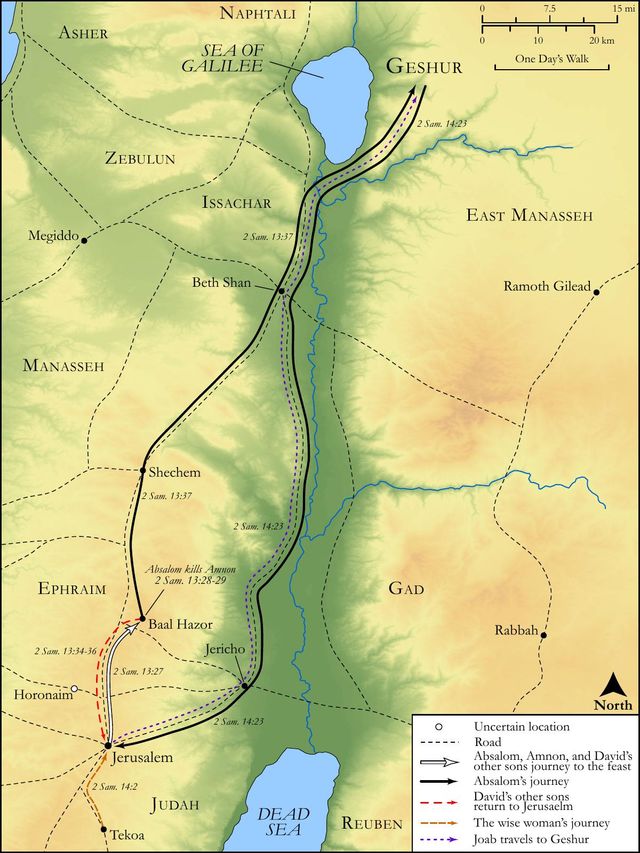
Absalom immediately fled, Sa2 13:34. He was now as much afraid of the king's sons as they were of him; they fled from his malice, he from their justice. No part of the land of Israel could shelter him. The cities of refuge gave no protection to a wilful murderer. Though David had let Amnon's incest go unpunished, Absalom could not promise himself his pardon for this murder; so express was the law in this case, and so well known David's justice, and his dread of blood-guiltiness. He therefore made the best of his way to his mother's relations, and was entertained by his grandfather Talmai, king of Geshur (Sa2 13:37), and there he was protected three years (Sa2 13:38), David not demanding him, and Talmai not thinking himself obliged to send him back unless he were demanded.
IV.David's uneasiness for his absence.
He mourned for Amnon a good while (Sa2 13:37), but, he being past recall, time wore off that grief: he was comforted concerning Amnon. It also wore off too much his detestation of Absalom's sin; instead of loathing him as a murderer, he longs to go forth to him, Sa2 13:39. At first he could not find in his heart to do justice on him; now he can almost find in his heart to take him into his favour again. This was David's infirmity. Something God saw in his heart that made a difference, else we should have thought that he, as much as Eli, honoured his sons more than God.
Historical interpretation
Historical reception
1 surviving comment on this verse from the historical church.
This is the first introduction of divine punishment; the first but not the only one. A long series of great tribulations followed, and an almost unending succession of misfortunes scarcely left his house. Tamar was corrupted by the madness of Amnon, and Amnon was slain by Absalom. A grave crime was committed by one brother, but it was avenged more grievously by the other. In this way David, the father, was punished for the crimes of both. Two sons sinned, but three suffered for the crime of two; Tamar lost her virginity, and the loss of Absalom was mourned in Amnon. Indeed, you cannot tell for which of these two sons the loving father mourned more grievously: for him who was slain in this world by his brother’s hand [Amnon] or for him who perished in the next because of killing by his own hand [Absalom].
Continue studying 2 Samuel 13:36 across the web’s major study libraries — every link below opens this exact verse, chapter, or book on the destination site.
Read & Compare
 BibleGatewayThis verse in more than 200 translations and 70 languages.
 Bible.comThe YouVersion reader — hundreds of translations, reading plans, and highlights.
 ESV.orgCrossway's official English Standard Version reader.
 NET BibleThe NET translation with 60,000+ translators' notes on every rendering decision.
 STEP BibleTyndale House's free study tool — original text, vocabulary, and scholarly resources.
 BibliaLogos Bible Software's free web reader.
 USCCBThe New American Bible (Revised Edition) with the U.S. bishops' study notes.
Commentaries
 BibleHub CommentariesDozens of classic commentaries on this verse, gathered on one page.
 StudyLightMore than 100 commentary sets — the largest collection on the web.
 BibleRefPlain-English commentary on what this verse means, verse by verse.
 Enduring WordDavid Guzik's free commentary on this chapter, widely used by Bible teachers.
 Bible Study ToolsVerse commentary alongside Greek and Hebrew study aids.
Original Language & Research
- BibleHub InterlinearThe verse word by word — original language, transliteration, and English.
- BibleHub LexiconEvery word's original-language definition and Strong's entry.
 Blue Letter BibleDeep-study tools — Strong's numbers, concordance, and word studies.
 SefariaThe Hebrew text with Rashi and centuries of Jewish commentary.
Sermons, Hymns & Audio


TrulyRandomVerse is not affiliated with these sites and doesn’t control their content. They’re linked because they’re genuinely useful.
Summary
2 Samuel 13:36 captures the devastating moment when King David's remaining sons return to Jerusalem, confirming the murder of their brother Amnon by Absalom's command. This scene is one of profound, collective grief, as the king, his sons, and all his servants are overcome with overwhelming sorrow, weeping bitterly. It marks a tragic culmination of unaddressed sin and escalating violence within David's royal household, vividly illustrating the painful consequences of moral failure and the shattering of familial peace and national stability.
Context
ShowHideLiterary Context
This verse serves as the climactic confirmation of a series of horrific events that have unfolded in David's household. It immediately follows Jonadab's clarification to David that only Amnon, not all his sons, had been killed 2 Samuel 13:32-35. The preceding narrative details Amnon's rape of his half-sister Tamar 2 Samuel 13:1-19, David's failure to administer justice despite his anger 2 Samuel 13:21-22, and Absalom's meticulously planned revenge, culminating in Amnon's assassination at a sheep-shearing feast 2 Samuel 13:23-29. Before the truth fully emerged, a false report had reached David, claiming all his sons were dead, plunging him into initial distress 2 Samuel 13:30-31. Verse 36 describes the physical arrival of the remaining sons, which provides irrefutable, visual, and auditory proof of the tragedy, solidifying the reality of Amnon's death and the deep fracture within the royal family.
Historical & Cultural Context
The setting is the royal court of King David in Jerusalem, during a period of Israelite history marked by significant political and military expansion, yet paradoxically, profound internal strife within the monarch's own family. Kingship in that day often involved a large harem and multiple sons, which frequently led to complex and often violent succession dynamics and rivalries. Sheep-shearing festivals were common agricultural events, typically occasions for feasting and celebration, making them an ideal and unsuspecting cover for Absalom's malicious plot. The cultural emphasis on honor and shame was paramount; Amnon's rape of Tamar brought deep shame upon her and her family, and David's subsequent failure to address this heinous injustice was a significant breach of his kingly and paternal duty. This inaction was perceived as a profound moral failing that Absalom felt compelled to rectify, albeit through extreme and violent means. The public display of grief, characterized by "lifting up their voice and wept," was a common and culturally expected expression of profound sorrow in ancient Israel, often involving loud lamentation, wailing, and even tearing of clothes, signifying the depth of the communal and familial tragedy.
Key Themes
ShowHide2 Samuel 13:36 vividly underscores several major themes prevalent throughout the book of 2 Samuel and the broader Deuteronomistic History. Foremost among these is the consequence of sin, particularly within leadership. David's own grievous sin with Bathsheba and Uriah 2 Samuel 11 and his subsequent failure to administer justice for Amnon's crime created a moral vacuum that led directly to a cycle of violence and retribution within his family. This tragic unfolding serves as a direct fulfillment of Nathan's prophecy that "the sword shall never depart from your house" 2 Samuel 12:10. The verse also highlights the brokenness of the royal family, demonstrating how internal moral decay and unaddressed injustice can shatter even the most powerful households from within. The profound, shared grief and sorrow expressed by all present underscores the immense human cost of sin and injustice, painting a vivid picture of a household consumed by despair rather than unity and joy. Finally, this scene sets the immediate stage for Absalom's subsequent flight and eventual rebellion, illustrating the destabilizing effect of unresolved conflict and vengeance on the kingdom itself, proving that a leader's personal failures can have national repercussions.
Exposition and Analysis
ShowHideKey Word Analysis
ShowHideA primitive root meaning "to weep; generally to bemoan." In this context, it signifies the raw, visceral expression of profound grief and sorrow by the king's sons, and subsequently by David and his entire court. This is not merely the shedding of tears, but a deep, audible lamentation, indicative of overwhelming anguish and despair.
Properly "vehemence," used as an intensive or superlative. Here, it functions as an adverbial intensifier for the weeping, indicating an extreme, overwhelming degree of sorrow. The KJV's "very sore" captures this intensified anguish, emphasizing that the lamentation was not merely present but profoundly intense, widespread, and all-consuming.
Meaning "a son (as a builder of the family name), in the widest sense." In this verse, "the king's sons" refers specifically to David's surviving male offspring who had been present at Absalom's sheep-shearing feast, excluding Amnon (who was murdered) and Absalom (who fled). Their arrival, marked by their own loud weeping, serves as the definitive, tragic confirmation of Amnon's death, highlighting the devastating impact of the family's internal strife on the royal lineage itself.
Verse Breakdown
ShowHide"And it came to pass, as soon as he had made an end of speaking"
This clause precisely timestamps the unfolding tragedy, indicating the immediate aftermath of Jonadab's revelation to King David. Jonadab had just finished clarifying that only Amnon was dead, not all of David's sons 2 Samuel 13:35. The phrase highlights the sudden, undeniable confirmation of the horrifying truth, leaving no room for further speculation or false hope. The cessation of Jonadab's words directly precedes the physical manifestation of the tragedy.
"that, behold, the king's sons came"
The interjection "behold" (Hebrew, hinneh) draws immediate and dramatic attention to the impactful arrival of David's remaining sons. Their physical presence, returning from the feast where Amnon was murdered, serves as the irrefutable, visual evidence that validates Jonadab's grim report. Their return transforms David's anxious uncertainty into a concrete, devastating reality, bringing the full weight of the tragedy into the royal court and confirming the worst of his fears.
"and lifted up their voice and wept"
This describes the immediate and profound reaction of the arriving sons. "Lifting up their voice" signifies a loud, unrestrained wailing, a culturally significant and common expression of deep sorrow and lament in ancient Israel. Their audible weeping is not merely a private display of grief but a public, communal outpouring of anguish over their brother's brutal murder and the traumatic events they had just witnessed, underscoring the depth of their shock, loss, and the shared horror within the royal family.
"and the king also and all his servants wept very sore"
This final clause expands the scope of the intense grief to encompass the entirety of the royal household. King David, who had already been distraught over the initial false report, now experiences the full, confirmed weight of Amnon's death. The inclusion of "all his servants" demonstrates the pervasive nature of the sorrow, indicating that the tragedy had reverberated throughout the entire court, signifying the profound disruption and communal anguish caused by the familial breakdown and the violent act. The repetition of the intensified "wept very sore" emphasizes the overwhelming and collective nature of the lamentation, a shared burden of despair that consumed everyone present.
Literary Devices
ShowHideThe verse employs several powerful literary devices to convey the depth of the tragedy and its overwhelming emotional impact. Dramatic Irony is subtly present, as the audience knows the truth of Amnon's death before David does, making his initial distress over the false report even more poignant when the true, equally devastating, news arrives. The phrase "wept very sore" utilizes Hyperbole to emphasize the extreme intensity and overwhelming nature of the grief, suggesting a lamentation beyond ordinary measure, almost to the point of physical agony. The Repetition of the verb "wept" (first by the sons, then by the king and servants) serves to underscore the pervasive and shared nature of the sorrow, creating a powerful emotional resonance and highlighting the widespread despair that has engulfed the royal household. The arrival of the sons acts as a Climax to the preceding narrative of uncertainty and false reports, bringing the horrific truth to an undeniable, visual, and auditory reality. This scene also functions as Foreshadowing, as the deep divisions and unresolved conflicts within David's family, vividly highlighted by this profound grief, will inevitably lead to Absalom's subsequent flight, rebellion, and further bloodshed, destabilizing the entire kingdom. Finally, the overwhelming display of raw emotion evokes profound Pathos, drawing the reader into the deep sorrow and despair of the royal household.
Theological and Thematic Connections
ShowHideThis verse stands as a stark reminder of the devastating ripple effects of sin, particularly when justice is neglected or delayed. It illustrates how personal moral failings, especially those of leaders, can unravel the very fabric of a family and a nation, bringing profound sorrow, division, and violence. The collective weeping signifies not only grief for Amnon but also a lament over the brokenness and moral decay that has infected David's house, a direct and painful fulfillment of God's judgment pronounced by Nathan 2 Samuel 12:10. This scene underscores the biblical principle that sin has consequences, often far-reaching and painful, impacting not only the perpetrator but also innocent bystanders, entire communities, and future generations. It calls us to recognize the gravity of unaddressed sin and the necessity of righteous judgment, repentance, and the pursuit of reconciliation.
Reflection and Application
ShowHideThe raw, collective grief depicted in 2 Samuel 13:36 serves as a powerful and sobering mirror for our own lives and communities. It compels us to confront the profound and often devastating consequences of unaddressed sin, particularly within our families and spheres of influence. David's failure to administer justice for Tamar's rape created a vacuum that Absalom filled with vengeance, leading to a cycle of violence and sorrow that consumed his household. This narrative urges us to be proactive in confronting injustice, seeking reconciliation, and pursuing righteousness, rather than allowing bitterness, resentment, or moral decay to fester. It reminds us that true leadership, whether in a household, a church, or a nation, requires moral courage and a steadfast commitment to justice, even when it is difficult, painful, or unpopular. Furthermore, the shared weeping highlights the human capacity for communal lament and empathy in the face of tragedy. In a world often quick to move on from pain, this passage invites us to sit with sorrow, to acknowledge the deep wounds caused by sin, and to allow grief to lead us toward genuine repentance, healing, and a renewed commitment to walking in God's righteous ways.
Questions for Reflection
ShowHideFAQ
ShowHideWhy did David not act sooner to punish Amnon for raping Tamar?
ShowHideDavid's inaction following Amnon's rape of Tamar is a complex and tragic aspect of this narrative. While the text explicitly states David was "very angry" 2 Samuel 13:21, he failed to take any punitive measures against Amnon, despite the clear Mosaic Law requiring such action. Several factors likely contributed to this: Amnon was David's firstborn son and heir apparent, making his punishment a politically sensitive issue that could destabilize the succession. David himself had recently committed grievous sins (adultery and murder) and may have been morally compromised or felt unable to administer justice effectively without hypocrisy. Some scholars suggest a parallel between David's leniency towards Amnon and God's patience with David, though this does not excuse David's failure to uphold the law and protect his daughter. His inaction created a vacuum of justice, which Absalom felt compelled to fill with his own violent retribution, leading to the escalating tragedy seen in 2 Samuel 13:36 and beyond.
What is the significance of "all his servants" weeping alongside the king and his sons?
ShowHideThe inclusion of "all his servants" in the collective weeping ("wept very sore") highlights the pervasive nature of the tragedy and its impact beyond the immediate royal family. It signifies that the brokenness and sorrow were not confined to David's private chambers but permeated the entire royal court and household. This communal lament underscores the gravity of the events—Amnon's rape, David's inaction, and Absalom's revenge—as a national crisis, not merely a private family affair. It also demonstrates the deep empathy and shared burden felt by those in service to the king, indicating that the stability and well-being of the kingdom were intimately tied to the moral and emotional state of its leadership. The widespread grief emphasizes the profound disruption and pain caused by sin at every level of society, from the king's inner circle to his entire administration.
Christ-Centered Fulfillment
ShowHideThe profound grief and brokenness depicted in 2 Samuel 13:36, born from unaddressed sin and its devastating consequences, find their ultimate answer and healing in Jesus Christ. The tears shed by David and his household, a lament over the destructive power of human rebellion, foreshadow the deep sorrow of a world alienated from God, burdened by the weight of sin and its pervasive effects. Unlike David, who failed to administer justice and allowed sin to fester within his family, Jesus, the true Son of David, did not come to perpetuate cycles of vengeance or to passively observe injustice, but to confront sin head-on. He is the Lamb of God who takes away the sin of the world, bearing the full weight of humanity's rebellion and its painful consequences on the cross Isaiah 53:4-5. While David's house was torn apart by sin and its bitter fruits, Christ's sacrifice brings profound reconciliation and peace, not just within human relationships but supremely between God and humanity Colossians 1:19-20. The grief in this passage is a lament for what is lost due to sin; in Christ, we find the promise of ultimate restoration, where every tear will one day be wiped away by God Himself Revelation 21:4. He is the King who truly heals the brokenhearted and binds up their wounds Psalm 147:3, offering comfort, forgiveness, and eternal hope where human sin had brought only despair. His kingdom is one of righteousness, peace, and joy in the Holy Spirit Romans 14:17, a stark contrast to the chaos and sorrow that plagued David's reign.