


2 Samuel 13:35
Bible text: King James Version (1769 Blayney text) · Public domain
Bible text: Berean Standard Bible · Public domain
Bible text: American Standard Version (1901) · Public domain
Bible text: World English Bible, Messianic edition · Public domain
Bible text: Geneva Bible (1599) · Public domain
Bible text: Young's Literal Translation · Public domain
- וַיֹּאמֶרvai·Yo·merand he saidH559Conj-w ¦ V-Qal-ConsecImperf-3msVerb Qal Consecutive Imperfect 3rd Singular Masculineוַandיֹּאמֶרhe said
- יוֹנָדָבyo·na·DavJonadabH3122N-proper-mNoun Proper Masculine
- אֶל'eltoH413PrepPreposition
- הַמֶּלֶךְha·Me·lekhthe kingH4428Art ¦ N-msNoun Singular Masculine Absoluteהַtheמֶּלֶךְking
- הִנֵּהhi·Nehthere!H2009PrtParticle Interjection
- בְנֵיve·nei[the] sons ofH1121N-mpcNoun Plural Masculine Construct
- הַמֶּלֶךְha·Me·lekhthe kingH4428Art ¦ N-msNoun Singular Masculine Absoluteהַtheמֶּלֶךְking
- בָּאוּBa·'uthey have comeH935V-Qal-Perf-3cpVerb Qal Perfect 3rd Plural common gender
- כִּדְבַרkid·Varaccording to [the] word ofH1697Prep-k ¦ N-mscNoun Singular Masculine Constructכִּaccording toדְבַר[the] word of
- עַבְדְּךָ'av·de·Khayour servantH5650N-msc ¦ 2msNoun Singular Masculine Constructעַבְדְּservantךָyour
- כֵּןkensoH3651AdvAdverb
- הָיָהha·Yahit has happenedH1961V-Qal-Perf-3msVerb Qal Perfect 3rd Singular Masculine
English is a literal word-by-word gloss of the Hebrew, not the KJV's wording. Why?
This is the original text the KJV's translators worked from — each Hebrew word with its own literal English meaning in this verse, prepared by scholars at Tyndale House, Cambridge. The KJV translates whole sentences, not word by word, so its wording differs: one Hebrew word can become several English words, and the KJV may choose “the LORD” where the gloss reads “Yahweh”. Both are faithful — they answer different questions. For the KJV's own rendering, switch to the KJV text.
Details
See on the biblical-era maps
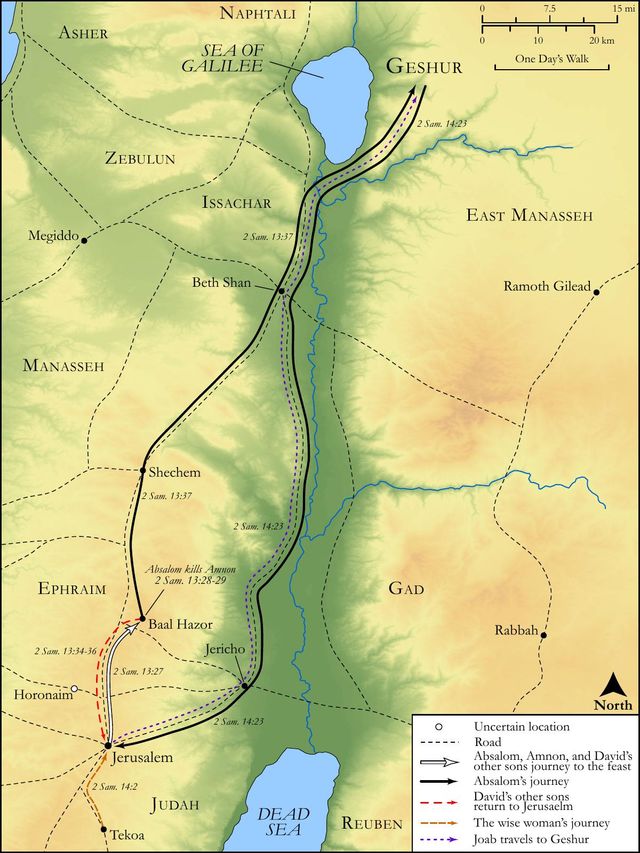
Study this verse
Public-domain commentary
Matthew Henry
From his Commentary on the Whole Bible. Henry comments on passages, not single verses — this entry covers 2 Samuel 13:30–39.
Here is, I. The fright that David was put into by a false report brought to Jerusalem that Absalom had slain all the king's sons, Sa2 13:30. It is common for fame to make bad worse; and the first news of such a thing as this represents it as more dreadful than afterwards it proves. Let us not therefore be afraid of evil tidings, while they want confirmation, but, when we hear the worst, hope the best, at least hope better. However, this false news gave as much affliction to David, for the present, as if it had been true; he tore his garments, and lay on the earth, while as yet it was only a flying story, Sa2 13:31. It was well that David had grace; he had need enough of it, for he had strong passions.
II.The rectifying of the mistake in two ways:
- 1. By the sly suggestions of Jonadab, David's nephew, who could tell him, Amnon only is dead, and not all the king's sons (Sa2 13:32, Sa2 13:33), and could tell him too that it was done by the appointment of Absalom, and designed from the day Amnon forced his sister Tamar. What a wicked man was he, if he knew all this or had any cause to suspect it, that he did not make David acquainted with it sooner, that means might be used to make up the quarrel, or at least that David might not throw Amnon into the mouth of danger by letting him go to Absalom's house. If we do not our utmost to prevent mischief, we make ourselves accessory to it. If we say, Behold, we knew it not; doth not he that pondereth the heart consider whether we did or no? See Pro 24:11, Pro 24:12. It is well if Jonadab was not as guilty of Amnon's death as he was of his sin; such friends do those prove who are hearkened to as counsellors to do wickedly: he that would not be so kind as to prevent Amnon's sin would not be so kind as to prevent his ruin, when, it should seem, he might have done both. 2. By the safe return of all the king's sons except Amnon. They and their attendants were speedily discovered by the watch (Sa2 13:34, Sa2 13:35), and soon arrived, to show themselves alive, but to bring the certain sad news that Absalom had murdered their brother Amnon. The grief David had been in for that which was not made him the better able to bear that which was, by giving him a sensible occasion, when he was undeceived, to thank God that all his sons were not dead: yet that Amnon was dead, and slain by his own brother is such a treacherous barbarous manner, was enough to put the king and court, the king and kingdom, into real mourning. Sorrow is never more reasonable than when there is sin in the case.
III.Absalom's flight from justice:
Absalom immediately fled, Sa2 13:34. He was now as much afraid of the king's sons as they were of him; they fled from his malice, he from their justice. No part of the land of Israel could shelter him. The cities of refuge gave no protection to a wilful murderer. Though David had let Amnon's incest go unpunished, Absalom could not promise himself his pardon for this murder; so express was the law in this case, and so well known David's justice, and his dread of blood-guiltiness. He therefore made the best of his way to his mother's relations, and was entertained by his grandfather Talmai, king of Geshur (Sa2 13:37), and there he was protected three years (Sa2 13:38), David not demanding him, and Talmai not thinking himself obliged to send him back unless he were demanded.
IV.David's uneasiness for his absence.
He mourned for Amnon a good while (Sa2 13:37), but, he being past recall, time wore off that grief: he was comforted concerning Amnon. It also wore off too much his detestation of Absalom's sin; instead of loathing him as a murderer, he longs to go forth to him, Sa2 13:39. At first he could not find in his heart to do justice on him; now he can almost find in his heart to take him into his favour again. This was David's infirmity. Something God saw in his heart that made a difference, else we should have thought that he, as much as Eli, honoured his sons more than God.
Continue studying 2 Samuel 13:35 across the web’s major study libraries — every link below opens this exact verse, chapter, or book on the destination site.
Read & Compare
 BibleGatewayThis verse in more than 200 translations and 70 languages.
 Bible.comThe YouVersion reader — hundreds of translations, reading plans, and highlights.
 ESV.orgCrossway's official English Standard Version reader.
 NET BibleThe NET translation with 60,000+ translators' notes on every rendering decision.
 STEP BibleTyndale House's free study tool — original text, vocabulary, and scholarly resources.
 BibliaLogos Bible Software's free web reader.
 USCCBThe New American Bible (Revised Edition) with the U.S. bishops' study notes.
Commentaries
 BibleHub CommentariesDozens of classic commentaries on this verse, gathered on one page.
 StudyLightMore than 100 commentary sets — the largest collection on the web.
 BibleRefPlain-English commentary on what this verse means, verse by verse.
 Enduring WordDavid Guzik's free commentary on this chapter, widely used by Bible teachers.
 Bible Study ToolsVerse commentary alongside Greek and Hebrew study aids.
Original Language & Research
- BibleHub InterlinearThe verse word by word — original language, transliteration, and English.
- BibleHub LexiconEvery word's original-language definition and Strong's entry.
 Blue Letter BibleDeep-study tools — Strong's numbers, concordance, and word studies.
 SefariaThe Hebrew text with Rashi and centuries of Jewish commentary.
Sermons, Hymns & Audio


TrulyRandomVerse is not affiliated with these sites and doesn’t control their content. They’re linked because they’re genuinely useful.
Summary
2 Samuel 13:35 marks a pivotal moment of partial clarity and profound relief within King David's court, as Jonadab, David's shrewd nephew, confirms his earlier assertion, dispelling the devastating rumor that all of David's sons had been slain by Absalom. This verse visually affirms that only Amnon, the perpetrator of a heinous act, has been killed, and the surviving princes are now returning, bringing a grim truth to the royal family amidst their deep grief and the escalating, tragic consequences of sin within David's own house.
Context
ShowHideLiterary Context
This verse serves as the dramatic culmination of a deeply tragic and volatile narrative arc in 2 Samuel 13. It immediately follows the horrifying account of Amnon's rape of his half-sister Tamar and the subsequent two years during which Tamar's full brother, Absalom, meticulously nursed a vengeful grudge. Absalom orchestrated a sheep-shearing feast as a pretext to execute Amnon, specifically commanding his servants to kill him (2 Samuel 13:28). News of Amnon's death reached King David, but it was amplified by a false, more devastating rumor that Absalom had killed all of David's sons (2 Samuel 13:30). In this moment of royal panic and despair, Jonadab, who had previously advised Amnon in his wicked scheme (2 Samuel 13:3), and who also had foreknowledge of Absalom's specific intent due to his close observation of the court (2 Samuel 13:32), assured David that only Amnon was targeted. Verse 35 provides the undeniable, visual confirmation of Jonadab's words, as the surviving princes arrive, bringing a measure of truth and a different, yet profound, sorrow to the royal family.
Historical & Cultural Context
The events of 2 Samuel 13 unfold within the patriarchal and monarchical structure of ancient Israel, where dynastic succession, family honor, and the king's authority were paramount. The sheep-shearing feast, while a common agricultural event, also served as a significant social gathering, providing a plausible cover for Absalom's deadly plot. The swift spread of rumors in the absence of immediate communication technology highlights the vulnerability of information in that day, especially within a royal court prone to intrigue and factionalism. The king's sons, as potential heirs and figures of political importance, would typically accompany the crown prince, making the rumor of their collective demise particularly credible and terrifying to David. Jonadab's role as a shrewd advisor, though morally ambiguous given his earlier counsel to Amnon, underscores the presence of influential, perceptive figures within the royal entourage who understood the intricate dynamics of power and personal relationships. The emphasis on honor and shame, particularly in the context of Tamar's rape, provides the underlying cultural motivation for Absalom's extreme act of vengeance, as he sought to restore his sister's honor and his family's reputation, albeit through violence.
Key Themes
ShowHideThe narrative of 2 Samuel 13, culminating in verse 35, powerfully illustrates several recurring themes within the Deuteronomistic History and the broader biblical narrative. Firstly, it highlights the unfolding consequences of sin, particularly within David's own household, serving as a direct and tragic fulfillment of the prophet Nathan's prophecy that "the sword shall never depart from your house" (2 Samuel 12:10). The violence, deception, and familial breakdown are direct outgrowths of David's own prior transgressions. Secondly, the passage emphasizes the importance of truth versus rumor in times of crisis. David's initial despair is based on false information, and Jonadab's accurate assessment, confirmed by the arrival of the princes, underscores the value of reliable intelligence. Thirdly, the complex and often morally ambiguous role of individuals like Jonadab is highlighted; though he facilitated Amnon's sin, he later provides crucial, accurate information that mitigates the king's distress. Finally, the profound theme of parental grief and the dysfunction of a royal family is evident, as David grapples with the tragic outcomes of his children's actions and the deep-seated divisions within his own house, setting the stage for further familial strife and rebellion in 2 Samuel 15.
Exposition and Analysis
ShowHideKey Word Analysis
ShowHideThis name, meaning "Yahweh is willing" or "Yahweh is generous," stands in stark contrast to the character's actions. Jonadab is introduced as "a very subtle man" (2 Samuel 13:3), highlighting his cunning and manipulative nature. His role in verse 35, confirming the truth, is paradoxical given his earlier complicity in Amnon's sin. He is a figure of shrewd observation and political acumen, understanding the dynamics of the royal family and Absalom's long-held grudge, which allows him to accurately predict events.
This word (H1121) refers to the male offspring, here specifically the royal princes, the direct descendants of David. As potential heirs to the throne, their collective demise, as initially rumored, would have been catastrophic for the stability of the kingdom and David's lineage. Their arrival confirms not only Jonadab's word but also the continuation of David's dynasty, albeit with one son tragically lost and another, Absalom, now a fugitive.
This word (H1697) refers to a "word" or "matter" and is used here for Jonadab's previous statement to David. It emphasizes the content and reliability of his communication. The phrase "as thy servant said" points back to Jonadab's earlier assurance to David in 2 Samuel 13:32, underscoring his unique insight into Absalom's intentions and the accuracy of his foresight.
Verse Breakdown
ShowHide"And Jonadab said unto the king"
This opening clause re-establishes Jonadab's position as a key informant and a figure with privileged insight into the unfolding tragedy. His direct address to David underscores the urgency and importance of the information he is about to impart, acting as a voice of reason and truth amidst the king's panic and the court's distress.
"Behold, the king's sons come"
This is the dramatic revelation, a visual confirmation that immediately dispels the most devastating part of the rumor. The word "Behold" (Hebrew, hinnēh') serves as an interjection, drawing immediate attention to the approaching princes. Their physical presence is the undeniable proof that not all of David's sons have been killed, bringing a moment of profound, albeit mixed, relief to the king.
"as thy servant said, so it is"
This concluding phrase is Jonadab's self-validation and the ultimate confirmation of his earlier words to David. It highlights his accurate prediction and deep understanding of Absalom's intentions. The phrase "so it is" (or "so it was," Hebrew kēn hāyāh) signifies the exact fulfillment of his prophecy, solidifying his credibility in this moment, despite his morally compromised past. It brings a definitive end to the period of agonizing uncertainty for David.
Literary Devices
ShowHideThe passage employs several literary devices to heighten its dramatic impact and convey its themes. Confirmation is central, as Jonadab's words and the arrival of the princes confirm the truth, dispelling the initial, more devastating rumor. There is a strong element of Juxtaposition between the widespread, terrifying rumor of all sons being killed and the grim but less catastrophic reality that only Amnon is dead. This creates a powerful emotional shift from utter despair to a more focused grief. The narrative also uses Dramatic Irony, as the reader is aware of Absalom's plot and Jonadab's prior knowledge, while David remains in the dark, experiencing intense anguish based on misinformation. Jonadab's repeated assertion, "as thy servant said, so it is," functions as a form of Repetition or Echo, reinforcing his earlier, accurate prediction and underscoring his unique, albeit morally ambiguous, role as a reliable source of information within the volatile court.
Theological and Thematic Connections
ShowHide2 Samuel 13:35, while a moment of confirmation, is deeply embedded in the larger theological narrative of consequences and divine justice. The events leading to this verse are a stark illustration of how unaddressed sin, particularly David's own adultery and murder, can ripple through generations, bringing chaos and violence into his own household. Jonadab's confirmation of the truth, though providing some relief, does not negate the profound sorrow or the ongoing fulfillment of Nathan's prophecy regarding the sword never departing from David's house. It highlights that while God is faithful to His covenant promises, human sin still carries devastating, tangible consequences, demonstrating the principle that "what a person sows, he will also reap." The partial truth revealed in this verse sets the stage for further familial strife and rebellion, underscoring the deep brokenness that sin introduces into human relationships and the divine order.
Reflection and Application
ShowHideThe scene in 2 Samuel 13:35 offers profound lessons for contemporary life. In an age saturated with information, often unverified and sensationalized, the narrative underscores the critical importance of seeking and confirming truth. David's initial despair, fueled by rumor, illustrates how quickly misinformation can lead to unnecessary anguish and misguided reactions. It challenges us to pause, verify, and discern before succumbing to panic or spreading unconfirmed reports. Furthermore, the broader context of this verse serves as a sobering reminder of the long-term, devastating consequences of unaddressed sin, both personal and familial. Just as Amnon's sin and David's inaction led to tragic outcomes, so too can unconfessed sin and unresolved conflict fester, leading to profound brokenness. The passage calls us to cultivate environments of truth, accountability, and swift, righteous dealing with injustice, recognizing that true peace and healing can only begin when reality, however painful, is confronted and acknowledged.
Questions for Reflection
ShowHideFAQ
ShowHideWho was Jonadab, and why was his word trusted by King David in this critical moment?
ShowHideJonadab was the son of Shimeah, David's brother, making him David's nephew and Absalom's cousin. He is described as "a very subtle man" (2 Samuel 13:3), indicating his shrewdness and cunning. While he previously advised Amnon in his wicked plot against Tamar, he was also a keen observer of court dynamics and Absalom's character. His word was trusted in this moment not primarily because of his moral standing, but because he had a demonstrated understanding of Absalom's long-held grudge and specific intentions. He had already assured David that Absalom's anger was directed solely at Amnon (2 Samuel 13:32), and the arrival of the princes visually confirmed his earlier, accurate assessment, validating his insight and making his current statement undeniable.
What is the significance of the phrase "as thy servant said, so it is" in this context?
ShowHideThis phrase, spoken by Jonadab, serves as a powerful confirmation of his earlier, accurate prediction to King David. It literally means "according to the word of your servant, so it was." Its significance lies in several aspects: firstly, it validates Jonadab's unique insight and credibility as a source of information within the volatile royal court. Secondly, it brings an end to David's agonizing uncertainty and despair, replacing a catastrophic rumor with a grim, but precise, truth. Thirdly, it underscores the theme of truth versus rumor, highlighting how crucial accurate information is in times of crisis, even when that truth is painful. It marks a definitive moment where reality breaks through the fog of misinformation.
Christ-Centered Fulfillment
ShowHideThe chaos, deception, and tragic consequences within David's household, culminating in the partial truth confirmed in 2 Samuel 13:35, powerfully foreshadow the ultimate need for a divine intervention that brings complete truth, reconciliation, and peace. While Jonadab's words bring a measure of relief by dispelling a worse rumor, they still confirm the painful reality of death and division, a direct result of sin's pervasive power. In contrast, Jesus Christ is the ultimate Truth-teller, the one who does not merely confirm a partial reality but embodies the fullness of truth, declaring, "I am the way, the truth, and the life" (John 14:6). He is the true "Lamb of God who takes away the sin of the world" (John 1:29), offering Himself as the perfect sacrifice to address the root cause of all familial and societal brokenness – sin itself. Unlike the temporary relief offered by Jonadab's confirmation, Christ brings eternal reconciliation, not just between brothers, but between humanity and God. He is the Prince of Peace (Isaiah 9:6), whose sacrifice and resurrection overcome the power of death and the divisive effects of sin, establishing a new covenant where true healing and restoration are possible, far beyond the fractured reality of David's kingdom.