


Jeremiah 9:3
Bible text: King James Version (1769 Blayney text) · Public domain
Bible text: King James Version with Strong's numbers · Public domain
Bible text: Berean Standard Bible · Public domain
Bible text: American Standard Version (1901) · Public domain
Bible text: World English Bible, Messianic edition · Public domain
Bible text: Geneva Bible (1599) · Public domain
Bible text: Young's Literal Translation · Public domain
- וַיַּדְרְכוּvai·yad·re·Khuand they have bentH1869Conj-w ¦ V-Hiphil-ConsecImperf-3mpVerb Hiphil Consecutive Imperfect 3rd Plural Masculineוַandיַּדְרְכוּthey have bent
- אֶת'et<obj.>H853DirObjMParticle Object Indicator
- לְשׁוֹנָםle·sho·Namtheir tongueH3956N-csc ¦ 3mpNoun Singular common gender Constructלְשׁוֹנָtongueםtheir
- קַשְׁתָּםkash·Tamtheir bow ofH7198N-fsc ¦ 3mpNoun Singular Feminine Constructקַשְׁתָּbow ofםtheir
- שֶׁקֶרShe·kerfalsehoodH8267N-msNoun Singular Masculine Absolute
- וְלֹאve·Lo'and notH3808Conj-w ¦ NegParticle Negativeוְandלֹאnot
- לֶאֱמוּנָהle·'e·mu·Nahto faithfulnessH530Prep-l ¦ N-fsNoun Singular Feminine Absoluteלֶtoאֱמוּנָהfaithfulness
- גָּבְרוּga·ve·Ruthey are strongH1396V-Qal-Perf-3cpVerb Qal Perfect 3rd Plural common gender
- בָאָרֶץva·'A·retzin the landH776Prep-b ¦ N-fsNoun Singular Feminine Absoluteבָin theאָרֶץland
- כִּיkiforH3588PrtParticle Conditional
- מֵרָעָהme·ra·'Ahfrom evilH7451Prep-m ¦ N-fsNoun Singular Feminine Absoluteמֵfromרָעָהevil
- אֶל'eltoH413PrepPreposition
- רָעָהra·'AhevilH7451N-fsNoun Singular Feminine Absolute
- יָצָאוּya·Tza·'uthey have gone outH3318V-Qal-Perf-3cpVerb Qal Perfect 3rd Plural common gender
- וְאֹתִיve·'o·Tiand <obj.> meH853Conj-w ¦ DirObjM ¦ 1csParticle Object Indicatorוְandאֹתִ<obj.>יme
- לֹאlo'notH3808NegParticle Negative
- יָדָעוּya·Da·'uthey knowH3045V-Qal-Perf-3cpVerb Qal Perfect 3rd Plural common gender
- נְאֻםne·'um[the] utterance ofH5002N-mscNoun Singular Masculine Construct
- יְהוָהYah·wehYahwehH3068N-properNoun Proper Title
English is a literal word-by-word gloss of the Hebrew, not the KJV's wording. Why?
This is the original text the KJV's translators worked from — each Hebrew word with its own literal English meaning in this verse, prepared by scholars at Tyndale House, Cambridge. The KJV translates whole sentences, not word by word, so its wording differs: one Hebrew word can become several English words, and the KJV may choose “the LORD” where the gloss reads “Yahweh”. Both are faithful — they answer different questions. For the KJV's own rendering, switch to the KJV text.
Details
See on the biblical-era map
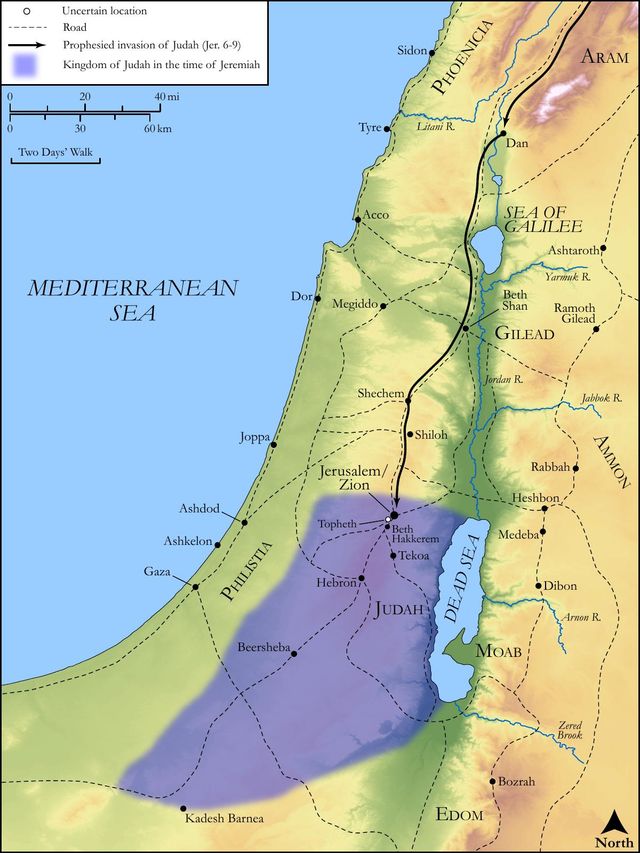
Study this verse
Public-domain commentary
Matthew Henry
From his Commentary on the Whole Bible. Henry comments on passages, not single verses — this entry covers Jeremiah 9:1–11. His four-level outline is real structure in the source text, so it is rendered as structure.
The prophet, being commissioned both to foretel the destruction coming upon Judah and Jerusalem and to point out the sin for which that destruction was brought upon them, here, as elsewhere, speaks of both very feelingly: what he said of both came from the heart, and therefore one would have thought it would reach to the heart.
I.He abandons himself to sorrow in consideration of the calamitous condition of his people, which he sadly laments, a one that preferred Jerusalem before his chief joy and her grievances before his chief sorrows.
1.He laments the slaughter of the persons, the blood shed and the lives lost (Jer 9:1): "O that my head were waters, quite melted and dissolved with grief, that so my eyes might be fountains of tears, weeping abundantly, continually, and without intermission, still sending forth fresh floods of tears as there still occur fresh occasions for them!" The same word in Hebrew signifies both the eye and a fountain, as if in this land of sorrows our eyes were designed rather for weeping than seeing. Jeremiah wept much, and yet wished he could weep more, that he might affect a stupid people and rouse them to a due sense of the hand of God gone out against them. Note, It becomes us, while we are here in this vale of tears, to conform to the temper of the climate and to sow in tears. Blessed are those that mourn, for they shall be comforted hereafter; but let them expect that while they are here the clouds will still return after the rain. While we find our hearts such fountains of sin, it is fit that our eyes should be fountains of tears. But Jeremiah's grief here is upon the public account: he would weep day and night, not so much for the death of his own near relations, but for the slain of the daughter of his people, the multitudes of his countrymen that fell by the sword of war. Note, When we hear of the numbers of the slain in great battles and sieges we ought to be much affected with the intelligence, and not to make a light matter of it; yea, though they be not of the daughter of our people, for, whatever people they are of, they are of the same human nature with us, and there are so many precious lives lost, as dear to them as ours to us, and so many precious souls gone into eternity.
2.He laments the desolations of the country. This he brings in (v. 10), for impassioned mourners are not often very methodical in their discourses: "Not only for the towns and cities, but for the mountains, will I take up a weeping and wailing" (not barren mountains, but the fruitful hills with which Judea abounded), and for the habitations of the wilderness, or rather the pastures of the plain, that used to be clothed with flocks or covered over with corn, and a goodly sight it was; but now they are burnt up by the Chaldean army (which, according to the custom of war, destroyed to the custom of war, destroyed the forage and carried off all the cattle), so that no one dares to pass through them, for fear of meeting with some parties of the enemy, no one cares to pass through them, every thing looks so melancholy and frightful, no one has any business to pass through them, for they hear not the voice of the cattle there as usual, the bleating of the sheep and the lowing of the oxen, that grateful music to the owners; nay, both the fowl of the heavens and the beasts have fled. either frightened away by the rude noises and terrible fires which the enemies make, or forced away because there is no subsistence for them. Note, God has many ways of turning a fruitful land into barrenness for the wickedness of those that dwell therein; and the havoc war makes in a country cannot but be for a lamentation to all tender spirits, for it is a tragedy which destroys the stage it is acted on.
II.He abandons himself to solitude, in consideration of the scandalous character and conduct of his people.
Though he dwells in Judah where God is known, in Salem where his tabernacle is, yet he is ready to cry out, Woe is me that I sojourn in Mesech! Psa 120:5. While all his neighbours are fleeing to the defenced cities, and Jerusalem especially, in dread of the enemies' rage (Jer 4:5, Jer 4:6) he is contriving to retire into some desert, in detestation of his people's sin (Jer 9:2): "O that I had in the wilderness a lodging-place of wayfaring men, such a lonely cottage to dwell in as they have in the deserts of Arabia, which are uninhabited, for travellers to repose themselves in, that I might leave my people and go from them!" Not only because of the ill usage they gave him (he would rather venture himself among the wild beasts of the desert than among such treacherous barbarous people), but principally because his righteous soul was vexed from day to day, as Lot's was in Sodom, with the wickedness of their conversation, Pe2 2:7, Pe2 2:8. This does not imply any intention or resolution that he had thus to retire. God had cut him out work among them, which he must not quit for his own ease. We must not go out of the world, bad as it is, before our time. If he could not reform them, he could bear a testimony against them; if he could not do good to many, yet he might to some. but it intimates the temptation he was in to leave them, involves a threatening that they should be deprived of his ministry, and especially expresses the holy indignation he had against their abominable wickedness, which continued notwithstanding all the pains he had taken with them to reclaim them. It made him even weary of his life to see them dishonouring God as they did and destroying themselves. Time was when the place which God had chosen to put his name there was the desire and delight of good men. David, in a wilderness, longed to be again in the courts of God's house; but now Jeremiah, in the courts of God's house (for there he was when he said this), wishes himself in a wilderness. Those have made themselves very miserable that have made God's people and ministers weary of them and willing to get from them. Now, to justify his willingness to leave them, he shows,
1.What he himself had observed among them.
(1.)He would not think of leaving them because they were poor and in distress, but because they were wicked.
[1.]They were filthy: They are all adulterers, that is, the generality of them are, Jer 5:8. They all either practised this sin or connived at those that did. Lewdness and uncleanness constituted that crying sin of Sodom at which righteous Lot was vexed in soul, and it is a sin that renders men loathsome in the eyes of God and all good men; it makes men an abomination.
[2.]They were false. This is the sin that is most enlarged upon here. Those that had been unfaithful to their God were so to one another, and it was a part of their punishment as well as their sin, for even those that love to cheat, yet hate to be cheated. First, Go into their solemn meetings for the exercises of religion, for the administration of justice, or for commerce - to church, to court, or to the exchange - and they are an assembly of treacherous men; they are so by consent, they strengthen one another's hands in doing any thing that is perfidious. There they will cheat deliberately and industriously, with design, with a malicious design, for (Jer 9:3) they bend their tongues, like their bow, for lies, with a great deal of craft; their tongues are fitted for lying, as a bow that is bent is for shooting, and are as constantly used for that purpose. Their tongue turns as naturally to a lie as the bow to the strong. But they are not valiant for the truth upon the earth. Their tongues are like a bow strung, with which they might do good service if they would use the art and resolution which they are so much masters of in the cause of truth; but they will not do so. They appear not in defence of the truths of God, which were delivered to them by the prophets; but even those that could not deny them to be truths were content to see them run down. In the administration of justice they have not courage to stand by an honest cause that has truth on its side, if greatness and power be on the other side. Those that will be faithful to the truth must be valiant for it, and not be daunted by the opposition given to it, nor fear the face of man. They are not valiant for the truth in the land, the land which has truth for the glory of it. Truth has fallen in the land, and they dare not lend a hand to help it up, Isa 59:14, Isa 59:15. We must answer, another day, not only for our enmity in opposing truth, but for our cowardice in defending it. Secondly, Go into their families, and you will find they will cheat their own brethren (every brother will utterly supplant); they will trip up one another's heels if they can, for they lie at the catch to seek all advantages against those they hope to make a hand of. Jacob had his name from supplanting; it is the word here used; they followed him in his name, but not in his true character, without guile. So very false are they that you cannot trust in a brother, but must stand as much upon your guard as if you were dealing with a stranger, with a Canaanite that has balances of deceit in his hand. Things have come to an ill pass indeed when a man cannot put confidence in his own brother. Thirdly, Go into company and observe both their commerce and their conversation, and you will find there is nothing of sincerity or common honesty among them. Nec hospes ab hospite tutus - The host and the guest are in danger from each other. The best advice a wise man can give you is to take heed every one of his neighbour, nay, of his friend (so some read it), of him whom he has befriended and who pretends friendship to him. No man thinks himself bound to be either grateful or sincere. Take them in their conversation and every neighbour will walk with slander; they care not what ill they say one of another, though ever so false; that way that the slander goes they will go; they will walk with it. They will walk about from house to house too, carrying slanders along with them, all the ill-natured stories they can pick up or invent to make mischief. Take them in their trading and bargaining, and they will deceive every one his neighbour, will say any thing, though they know it to be false, for their own advantage. Nay, they will lie for lying sake, to keep their tongues in use to it, for they will not speak the truth, but will tell a deliberate lie and laugh at it when they have done.
(2.)That which aggravates the sin on this false and lying generation is,
[1.]That they are ingenious to sin: They have taught their tongue to speak lies, implying that through the reluctances of natural conscience they found it difficult to bring themselves to it. Their tongue would have spoken truth, but they taught it to speak lies, and by degrees have made themselves masters of the art of lying, and have got such a habit of it that use has made it a second nature to them. They learnt it when they were young (for the wicked are estranged from the womb, speaking lies, Psa 58:3), and now they have grown dexterous at it.
[2.]That they are industrious to sin: They weary themselves to commit iniquity; they put a force upon their consciences to bring themselves to it; they tire out their convictions by offering them continual violence, and they take a great deal of pains, till they have even spent themselves in bringing about their malicious designs. They are wearied with their sinful pursuits and yet not weary of them. The service of sin is a perfect drudgery; men run themselves out of breath in it, and put themselves to a great deal of toil to damn their own souls.
[3.]That they grow worse and worse (Jer 9:3): They proceed from evil to evil, from one sin to another, from one degree of sin to another. They began with less sins. Nemo repente fit turpissimus - No one reaches the height of vice at once. They began with equivocating and bantering, but at last came to downright lying. And they are now proceeding to greater sins yet, for they know not me, saith the Lord; and where men have no knowledge of God, or no consideration of what they have known of him, what good can be expected from them? Men's ignorance of God is the cause of all their ill conduct one towards another.
2.The prophet shows what God had informed him of their wickedness, and what he had determined against them.
(1.)God had marked their sin. He could tell the prophet (and he speaks of it with compassion) what sort of people they were that he had to deal with. I know thy works, and where thou dwellest, Rev 2:13. So here (Jer 9:6): "Thy habitation is in the midst of deceit, all about thee are addicted to it; therefore stand upon thy guard." If all men are liars, it concerns us to beware of men,. and to be wise as serpents. They are deceitful men; therefore there is little hope of thy doing any good among them; for, make things ever so plain, they have some trick or other wherewith to shuffle off their convictions. This charge is enlarged upon, Jer 9:8. Their tongue was a bow bent (Jer 9:3), plotting and preparing mischief; here it is an arrow shot out, putting in execution what they had projected. It is as a slaying arrow (so some readings of the original have it); their tongue has been to many an instrument of death. They speak peaceably to their neighbours, against whom they are at the same time lying in wait; as Joab kissed Abner when he was about to kill him, and Cain, that he might not be suspected of any ill design, talked with his brother, freely and familiarly. Note, Fair words, when they are not attended with good intentions, are despicable, but, when they are intended as a cloak and cover for wicked intentions they are abominable. While they did all this injury to one another they put a great contempt upon God: "Not only they know not me, but (Jer 9:6) through deceit, through the delusions of the false prophets, they refuse to know me; they are so cheated into a good opinion of their own ways, the ways of their own heart, that they desire not the knowledge of my ways." Or, "They are so wedded to this sinful course which they are in, and so bewitched with that, and its gains, that they will by no means admit the knowledge of God, because that would be a check upon them in their sins." This is the ruin of sinners: they might be taught the good knowledge of the Lord and they will not learn it; and where no knowledge of God is, what good can be expected? Hos 4:1.
(2.)He had marked them for ruin, Jer 9:7, Jer 9:9, Jer 9:11. Those that will not know God as their lawgiver shall be made to know him as their judge. God determines here to bring his judgments upon them, for the refining of some and the ruining of the rest.
[1.]Some shall be refined (Jer 9:7): "Because they are thus corrupt, behold I will melt them and try them, will bring them into trouble and see what that will do towards bringing them to repentance, whether the furnace of affliction will purify them from their dross, and whether, when they are melted, they will be new-cast in a better mould." He will make trial of less afflictions before he brings upon them utter destruction; for he desires not the death of sinners. They shall not be rejected as reprobate silver till the founder has melted in vain, Jer 6:29, Jer 6:30. For how shall I do for the daughter of my people? He speaks as one consulting with himself what to do with them that might be for the best, and as one that could not find in his heart to cast them off and give them up to ruin till he had first tried all means likely to bring them to repentance. Or, "How else shall I do for them? They have grown so very corrupt that there is no other way with them but to put them into the furnace; what other course can I take with them? Isa 5:4, Isa 5:5. It is the daughter of my people, and I must do something to vindicate my own honour, which will be reflected upon if I connive at their wickedness. I must do something to reduce and reform them." A parent corrects his own children because they are his own. Note, When God afflicts his people, it is with a gracious design to mollify and reform them; it is but when need is and when he knows it is the best method he can use.
[2.]The rest shall be ruined (Jer 9:9): Shall I not visit for these things? Fraud and falsehood are sins which God hates and which he will reckon for. "Shall not my soul be avenged on such a nation as this, that is so universally corrupt, and, by its impudence in sin, even dares and defies divine vengeance? The sentence is passed, the decree has gone forth (Jer 9:11): I will make Jerusalem heaps of rubbish, and lay it in such ruins that it shall be fit for nothing but to be a den of dragons; and the cities of Judah shall be a desolation." God makes them so, for he gives the enemy warrant and power to do it: but why is the holy city made a heap? The answer is ready, Because it has become an unholy one?
Historical interpretation
Historical reception
3 surviving comments on this verse. Each one is dated, so this reads as a timeline rather than a list.
Select a marker to jump to its quote. Markers stagger vertically where authors wrote within a few decades of each other.
Let us collect ourselves, I exhort you. There are daily wars, submersions of towns, innumerable destructions all around us, and on every side the wrath of God is enclosing us as in a net. As though we were well-pleasing to him, we are secure. We all make our hands ready for unjust gains and not for helping others. We are all ready to plunder, but no one is ready to protect. Each one of us has much anxiety over how he may add to his wealth. No one has anxiety over how he may save his own soul. One fear possesses all, that we should not become poor. No one is in anguish and trembling out of fear that we should fall into hell. These things call for lamentation, these call for accusation, for eternal damnation. I do not wish to speak of these things, but I am constrained by my grief. Forgive me. I am forced by sorrow to utter many things, even those that I do not wish to say. I see that our wound is grievous, that our calamity is beyond comfort, that woes have overtaken us that exceed the consolation. We are undone. “O that my head were waters and mine eyes a fountain of tears,” that I might lament. Let us weep, beloved, let us groan.
(Verse 3.) Because they are all adulterers, a gathering of transgressors. And they have stretched out their tongue like a bow of falsehood and not of truth. They have grown strong in the land, for they have gone from evil to evil, and they have not known me, says the Lord. Sinners go from evil to evil, when they exchange idols for idols, and they go from sins to sins, or certainly from the evil of siege to captivity. And indeed, concerning the saints, it is said: They will go from strength to strength (Psalm 83:8). But concerning sinners: They have gone from evil to evil. And the cause of all miseries is that they did not acknowledge the Lord, and there is a gathering of transgressors and their tongues are armed like a drawn bow for blasphemy. And they are comforted on the earth so that they may deserve to hear: You are dust, and to dust you shall return (Gen. III).
They were fabricating deceit, engaging in blackmail, leveling false accusations against neighbors. For this is what he says, “Deceit, not faith, prevails over the land, for they proceed from evil to evil.” Because of this he exposes their evil, which never changes as they move “from evil to evil,” immediately adding the reason they neglect the divine law: because “they do not know me, says the Lord.”
Continue studying Jeremiah 9:3 across the web’s major study libraries — every link below opens this exact verse, chapter, or book on the destination site.
Read & Compare
 BibleGatewayThis verse in more than 200 translations and 70 languages.
 Bible.comThe YouVersion reader — hundreds of translations, reading plans, and highlights.
 ESV.orgCrossway's official English Standard Version reader.
 NET BibleThe NET translation with 60,000+ translators' notes on every rendering decision.
 STEP BibleTyndale House's free study tool — original text, vocabulary, and scholarly resources.
 BibliaLogos Bible Software's free web reader.
 USCCBThe New American Bible (Revised Edition) with the U.S. bishops' study notes.
Commentaries
 BibleHub CommentariesDozens of classic commentaries on this verse, gathered on one page.
 StudyLightMore than 100 commentary sets — the largest collection on the web.
 BibleRefPlain-English commentary on what this verse means, verse by verse.
 Enduring WordDavid Guzik's free commentary on this chapter, widely used by Bible teachers.
 Bible Study ToolsVerse commentary alongside Greek and Hebrew study aids.
Original Language & Research
- BibleHub InterlinearThe verse word by word — original language, transliteration, and English.
- BibleHub LexiconEvery word's original-language definition and Strong's entry.
 Blue Letter BibleDeep-study tools — Strong's numbers, concordance, and word studies.
 SefariaThe Hebrew text with Rashi and centuries of Jewish commentary.
Sermons, Hymns & Audio


TrulyRandomVerse is not affiliated with these sites and doesn’t control their content. They’re linked because they’re genuinely useful.
Summary
Jeremiah 9:3 presents a stark depiction of Judah's profound moral and spiritual decay, illustrating a people whose speech is deliberately weaponized for deceit. This verse unmasks their pervasive societal addiction to falsehood, demonstrating a profound lack of courage to uphold truth, and revealing a continuous descent into deeper wickedness. Ultimately, their depravity is attributed to a fundamental and relational ignorance of God Himself.
Context
ShowHideLiterary Context
This verse is deeply embedded within Jeremiah's poignant lament and prophetic indictment against Judah, often referred to as his "confessions" (chapters 8-9). Immediately preceding this passage, Jeremiah expresses profound sorrow over the spiritual blindness and incurable wound of his people, who obstinately cling to deceit and refuse to return to the Lord, as highlighted in passages like Jeremiah 8:5 and their embrace of false peace despite impending judgment (Jeremiah 8:11-12). Chapter 9 continues this mournful tone, with the prophet expressing a wish for a "head full of water" to weep over the slain, emphasizing the utter desolation and moral collapse that has engulfed Jerusalem and the towns of Judah. The narrative transitions from general lament to specific accusations of treachery and deceit, setting the stage for the powerful imagery of the tongue as a weapon of lies.
Historical & Cultural Context
Jeremiah prophesied during a tumultuous period in Judah's history, spanning the reigns of several kings (Josiah, Jehoiakim, Jehoiachin, Zedekiah) leading up to the devastating Babylonian exile (late 7th to early 6th century BCE). The nation was strategically caught between the declining Assyrian Empire and the rising powers of Egypt and Babylon. Despite King Josiah's earlier reforms, the people had largely reverted to idolatry and oppression, internalizing pagan practices and abandoning the covenant with Yahweh. Deceit, false prophecy, and corruption were rampant, eroding the societal fabric from within. The "earth" (H776, ʼerets) in this context refers specifically to the land of Judah, highlighting that this moral failure was endemic to their society, pervading all levels from leaders to common people. The imagery of the bow and arrow was deeply familiar in the warfare and hunting of that day, making the metaphor of the tongue as a weapon for lies particularly potent and culturally resonant to Jeremiah's audience.
Key Themes
ShowHideJeremiah 9:3 contributes significantly to several overarching themes woven throughout the book of Jeremiah. Firstly, it underscores the theme of Pervasive Sin and Rebellion, particularly the sin of deceit and false speech, which is a constant refrain throughout Jeremiah's prophecies, evident in passages like Jeremiah 5:27-28. Secondly, it highlights the Absence of Truth and Justice in Judah, demonstrating how the people have abandoned the very foundations of righteous living and covenant faithfulness, as lamented in Jeremiah 7:28. Thirdly, the phrase "proceed from evil to evil" speaks to the Progressive Nature of Sin, illustrating a downward spiritual spiral where one transgression inevitably leads to another, deepening their depravity and hardening their hearts. Finally, and most crucially, the verse emphasizes the theme of Ignorance and Rejection of God. The ultimate root cause of their moral failure is their failure to "know" (H3045, yâdaʻ) the Lord in a deep, relational, and obedient sense, a theme central to Jeremiah's message, powerfully articulated in Jeremiah 2:8 and Jeremiah 22:16.
Exposition and Analysis
ShowHideKey Word Analysis
ShowHideA primitive root meaning "to tread" or "to walk," but specifically "to string a bow (by treading on it in bending)." In Jeremiah 9:3, this word vividly describes the deliberate, active, and skilled effort applied to preparing the tongue for deceit. Just as an archer carefully treads on and bends a bow to ready it for shooting, so the people meticulously prepare their words to launch lies, indicating premeditation and proficiency in falsehood.
A primitive root meaning "to be strong," "to prevail," or "to be mighty." In this context, it implies a profound lack of strength, courage, or resolve. The people are "not valiant for the truth," meaning they lack the moral fortitude, conviction, or power to stand for, uphold, or live by truth. They are strong and skillful in deceit but utterly weak and cowardly when it comes to integrity and righteousness.
A primitive root with a vast semantic range, encompassing intellectual knowledge, but more profoundly, intimate, experiential, and relational knowledge. In the biblical sense, "to know God" implies a covenant relationship characterized by obedience, trust, and living in accordance with His character. Here, "they know not me" signifies not merely an intellectual unawareness, but a profound spiritual estrangement, a failure to acknowledge, obey, or relate to the Lord in a transformative way, which is presented as the ultimate source of their moral corruption.
Verse Breakdown
ShowHide"And they bend their tongues like their bow for lies:"
This opening clause immediately establishes the central, striking metaphor. The "tongue" (H3956, lâshôwn), the primary instrument of speech, is compared to a "bow" (H7198, qesheth), a weapon of war. The verb "bend" (H1869, dârak) implies deliberate preparation, skill, and an active intention. This vivid imagery portrays the people as actively and intentionally preparing their speech to unleash "lies" (H8267, sheqer), indicating that deceit is not accidental or impulsive but a practiced and potent weapon in their arsenal, wielded with precision.
"but they are not valiant for the truth upon the earth;"
In stark contrast to their readiness for falsehood, this clause highlights their profound moral deficiency. They lack "valor" (H1396, gâbar), courage, or strength for "truth" (H530, ʼĕmûwnâh), which signifies firmness, fidelity, and faithfulness. This reveals a deep moral cowardice: they are bold and proficient in deception but utterly weak and cowardly when it comes to integrity. The phrase "upon the earth" (H776, ʼerets) underscores that this moral bankruptcy is widespread and conspicuously evident in their daily lives and societal interactions throughout the land of Judah.
"for they proceed from evil to evil,"
This clause provides a consequence and further explanation of their behavior, illustrating the trajectory of their moral decline. The verb "proceed" (H3318, yâtsâʼ) suggests a continuous movement or progression. Their lack of commitment to truth and their embrace of deceit leads to a relentless descent "from evil" (H7451, raʻ) "to evil" (H7451, raʻ), indicating a spiraling moral decay where one sin begets another, deepening their depravity and hardening their hearts. There is no repentance or turning back, only a continuous downward trajectory into greater wickedness.
"and they know not me, saith the LORD."
This final, authoritative declaration from "the LORD" (H3068, Yᵉhôvâh) reveals the ultimate, foundational root cause of all their wickedness and moral corruption. Their failure to live truthfully, their progression into deeper sin, and their general societal collapse stem from a fundamental lack of relational "knowledge" (H3045, yâdaʻ) of God. It is not merely intellectual ignorance, but a profound spiritual estrangement, a failure to acknowledge, honor, obey, or relate to the One who is the source of all truth and righteousness. This divine pronouncement underscores the inseparable link between knowing God and living righteously.
Literary Devices
ShowHideJeremiah 9:3 is rich in literary devices that amplify its message of condemnation and despair. The most prominent is Metaphor, specifically the comparison of the tongue to a bow and lies to arrows ("they bend their tongues like their bow for lies"). This powerful image transforms speech into a weapon, emphasizing the destructive, intentional, and skilled nature of their deceit. The phrase "for lies" further specifies the toxic ammunition. Contrast is also central to the verse, juxtaposing their readiness and skill for lies with their utter lack of valor for truth. This highlights their perverse moral priorities and the inversion of righteousness within their society. The phrase "they proceed from evil to evil" employs Progression or Climax, illustrating a continuous, escalating deterioration of their moral state, suggesting an unstoppable downward spiral into deeper depravity. Finally, the concluding declaration, "saith the LORD," serves as an Authoritative Statement or Divine Pronouncement, lending ultimate weight, certainty, and solemnity to the diagnosis of their spiritual condition, particularly their fatal ignorance of God.
Theological and Thematic Connections
ShowHideJeremiah 9:3 stands as a profound theological statement on the nature of sin, the indispensable importance of truth, and the centrality of knowing God. It reveals that pervasive societal corruption, marked by deceit, treachery, and moral decay, is not merely a behavioral problem but a symptom of a deeper spiritual malady: a broken, estranged relationship with the divine. The people's inability to stand for truth and their continuous descent into evil are directly attributed to their failure to truly "know" the Lord, highlighting that authentic, relational knowledge of God is foundational for ethical living, societal well-being, and individual integrity. This verse underscores the biblical principle that a genuine, covenantal relationship with God cultivates a love for truth and righteousness, while its absence inevitably leads to spiritual blindness, moral depravity, and societal collapse.
Reflection and Application
ShowHideJeremiah 9:3 serves as a sobering mirror, inviting us to examine the condition of our own hearts, our communities, and the societies in which we live. In an age saturated with information, misinformation, and the rapid spread of narratives across digital platforms, the prophet's words resonate with striking power. We are challenged to consider: Are our "tongues" bent for truth, seeking to build up and clarify, or are they subtly or overtly "bent for lies," engaging in exaggeration, gossip, slander, or the deliberate distortion of facts? Do we possess the "valor" to stand for what is right, to rebuke the powerful, and to defend integrity, even when it is unpopular, costly, or uncomfortable? Or do we succumb to the pressure to conform to deceitful trends, to remain silent in the face of injustice, or to compromise our convictions for personal gain or social acceptance? This verse reminds us that a casual approach to truth, or a willingness to engage in half-truths, can signal a deeper spiritual issue. The progression "from evil to evil" warns against the insidious nature of unaddressed sin, illustrating how small compromises can lead to profound moral decay and a hardening of the heart. Ultimately, the verse directs us to the foundational relationship with God. Our ability to discern and uphold truth, and to resist the gravitational pull of evil, is inextricably linked to how deeply and genuinely we "know" the Lord. True knowledge of God transforms our character, instilling a love for integrity and the courage to live by it, enabling us to be agents of truth in a world often consumed by falsehood.
Questions for Reflection
ShowHideFAQ
ShowHideWhat does "bend their tongues like their bow for lies" mean?
ShowHideThis vivid metaphor describes the deliberate and skillful way the people of Judah prepared their speech for deception. Just as an archer carefully strings and bends a bow to shoot an arrow with precision, the people meticulously crafted their words to unleash falsehoods. It implies that lying was not accidental or occasional, but a practiced art, a weapon they wielded with precision and intent to harm, manipulate, or deceive others. It highlights the active, premeditated, and destructive nature of their deceit.
What is the significance of "they know not me"?
ShowHideThis phrase, spoken by the LORD, identifies the ultimate root cause of Judah's moral and spiritual collapse. In biblical terms, "to know" (H3045, yâdaʻ) God means far more than mere intellectual acquaintance; it signifies a deep, personal, covenantal relationship characterized by intimate fellowship, obedient trust, and living in accordance with His character and commands. Therefore, "they know not me" means they had abandoned their covenant relationship with God, rejected His authority, and failed to live out the implications of truly belonging to Him. This profound spiritual estrangement led directly to their moral depravity, their inability to discern or uphold truth, and their continuous descent into evil. It is a recurring, central theme in Jeremiah, emphasizing that true knowledge of God is foundational for righteousness, as powerfully seen in Jeremiah 22:16.
How does this verse apply to us today?
ShowHideJeremiah 9:3 remains profoundly relevant for contemporary society and individual believers. It challenges us to examine our own use of language in an age of rapid communication, social media, and often polarized discourse. It warns against the dangers of spreading misinformation, engaging in gossip, slander, or using words to manipulate or harm. The verse also calls us to cultivate courage for truth, urging us to speak and live with integrity even when it is difficult, unpopular, or counter-cultural. Fundamentally, it reminds us that our moral compass, our commitment to truth, and our resistance to the progression of evil are deeply rooted in our relationship with God. A genuine, transformative knowledge of Him is essential for discerning truth from falsehood, for resisting the temptations of deceit, and for walking in righteousness in a world that often celebrates lies.
Christ-Centered Fulfillment
ShowHideJeremiah 9:3, with its stark portrayal of a people steeped in lies and estranged from God, finds its ultimate answer and profound fulfillment in the person and work of Jesus Christ. The prophet laments a world where "truth has perished" and people "know not me," but Jesus declares, "I am the way, and the truth, and the life; no one comes to the Father except through me" (John 14:6). Where Judah bent their tongues for lies, Jesus's words were always pure truth, even when speaking that truth led to His unjust condemnation and crucifixion (John 18:37). The people's failure to be "valiant for the truth" is starkly contrasted by Christ's unwavering courage to speak God's truth, confronting hypocrisy and injustice relentlessly, even to the point of laying down His life. Their progression "from evil to evil" is broken by Christ, who "appeared to take away sins" (1 John 3:5) and whose sacrificial death provides the only path out of the relentless cycle of sin and moral decay. Most significantly, the lament "they know not me" is resolved in Jesus. He is the perfect revelation of God, the unique Son through whom we can truly "know" the Father intimately and savingly (John 1:18). Through faith in Him, we are not only forgiven of our deceit but are also given the Holy Spirit, who guides us into all truth (John 16:13) and empowers us to live lives of integrity. Thus, Christ reverses the spiritual decay depicted in Jeremiah, inaugurating a new covenant where hearts are transformed, truth is embraced, and genuine, saving knowledge of God becomes possible for all who believe.