


Jeremiah 9:8
- חֵץchetz[is] an arrowH2671N-msNoun Singular Masculine Absolute
- שָׁחוּטsho·chetbeatenH7819V-Qal-PassPrtcpl-msVerb Qal Participle Passive Singular Masculine Absolute
- לְשׁוֹנָםle·sho·Namtheir tongueH3956N-csc ¦ 3mpNoun Singular common gender Constructלְשׁוֹנָtongueםtheir
- מִרְמָהmir·MahdeceitH4820N-fsNoun Singular Feminine Absolute
- דִבֵּרdi·Berit speaksH1696V-Piel-Perf-3msVerb Piel Perfect 3rd Singular Masculine
- בְּפִיוbe·Fivwith his mouthH6310Prep-b ¦ N-msc ¦ 3msNoun Singular Masculine Constructבְּwithפִיmouthוhis
- שָׁלוֹםsha·LompeaceH7965N-msNoun Singular Masculine Absolute
- אֶת'etwithH854PrepPreposition
- רֵעֵהוּre·'E·huhis neighborH7453N-msc ¦ 3msNoun Singular Masculine Constructרֵעֵneighborהוּhis
- יְדַבֵּרye·da·Bersomeone speaksH1696V-Piel-Imperf-3msVerb Piel Imperfect 3rd Singular Masculine
- וּבְקִרְבּוֹu·ve·kir·Boand in his inner beingH7130Conj-w ¦ Prep-b ¦ N-msc ¦ 3msNoun Singular Masculine Constructוּandבְinקִרְבּinner beingוֹhis
- יָשִׂיםya·Simhe setsH7760V-Qal-Imperf-3msVerb Qal Imperfect 3rd Singular Masculine
- אָרְבּוֹ'a·re·Bohis ambushH696N-msc ¦ 3msNoun Singular Masculine Constructאָרְבּambushוֹhis
English is a literal word-by-word gloss of the Hebrew, not the KJV's wording. Why?
This is the original text the KJV's translators worked from — each Hebrew word with its own literal English meaning in this verse, prepared by scholars at Tyndale House, Cambridge. The KJV translates whole sentences, not word by word, so its wording differs: one Hebrew word can become several English words, and the KJV may choose “the LORD” where the gloss reads “Yahweh”. Both are faithful — they answer different questions. For the KJV's own rendering, switch to the KJV text.
Details
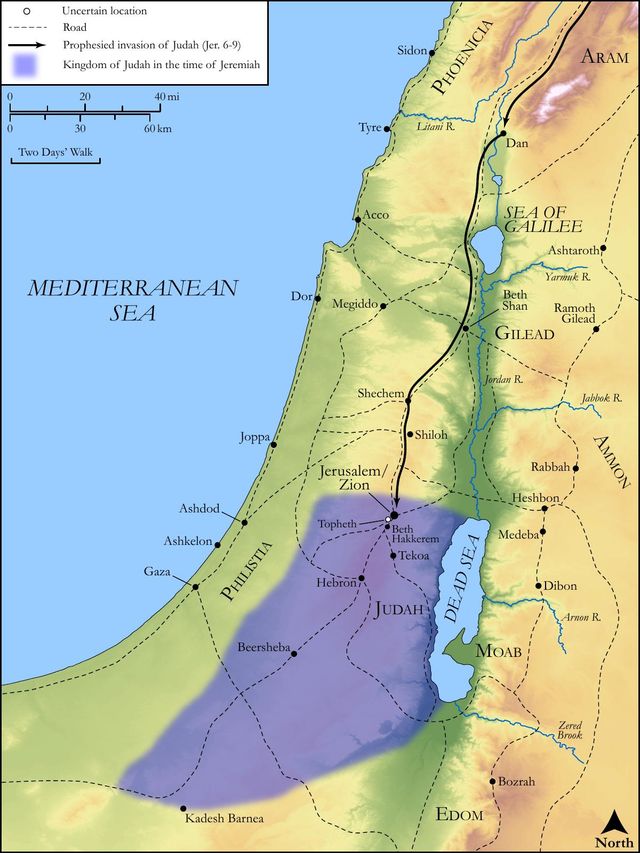
See on the biblical-era map
Study this verse
Public-domain commentary
Matthew Henry
From his Commentary on the Whole Bible. Henry comments on passages, not single verses — this entry covers Jeremiah 9:1–11. His four-level outline is real structure in the source text, so it is rendered as structure.
The prophet, being commissioned both to foretel the destruction coming upon Judah and Jerusalem and to point out the sin for which that destruction was brought upon them, here, as elsewhere, speaks of both very feelingly: what he said of both came from the heart, and therefore one would have thought it would reach to the heart.
I.He abandons himself to sorrow in consideration of the calamitous condition of his people, which he sadly laments, a one that preferred Jerusalem before his chief joy and her grievances before his chief sorrows.
1.He laments the slaughter of the persons, the blood shed and the lives lost (Jer 9:1): "O that my head were waters, quite melted and dissolved with grief, that so my eyes might be fountains of tears, weeping abundantly, continually, and without intermission, still sending forth fresh floods of tears as there still occur fresh occasions for them!" The same word in Hebrew signifies both the eye and a fountain, as if in this land of sorrows our eyes were designed rather for weeping than seeing. Jeremiah wept much, and yet wished he could weep more, that he might affect a stupid people and rouse them to a due sense of the hand of God gone out against them. Note, It becomes us, while we are here in this vale of tears, to conform to the temper of the climate and to sow in tears. Blessed are those that mourn, for they shall be comforted hereafter; but let them expect that while they are here the clouds will still return after the rain. While we find our hearts such fountains of sin, it is fit that our eyes should be fountains of tears. But Jeremiah's grief here is upon the public account: he would weep day and night, not so much for the death of his own near relations, but for the slain of the daughter of his people, the multitudes of his countrymen that fell by the sword of war. Note, When we hear of the numbers of the slain in great battles and sieges we ought to be much affected with the intelligence, and not to make a light matter of it; yea, though they be not of the daughter of our people, for, whatever people they are of, they are of the same human nature with us, and there are so many precious lives lost, as dear to them as ours to us, and so many precious souls gone into eternity.
2.He laments the desolations of the country. This he brings in (v. 10), for impassioned mourners are not often very methodical in their discourses: "Not only for the towns and cities, but for the mountains, will I take up a weeping and wailing" (not barren mountains, but the fruitful hills with which Judea abounded), and for the habitations of the wilderness, or rather the pastures of the plain, that used to be clothed with flocks or covered over with corn, and a goodly sight it was; but now they are burnt up by the Chaldean army (which, according to the custom of war, destroyed to the custom of war, destroyed the forage and carried off all the cattle), so that no one dares to pass through them, for fear of meeting with some parties of the enemy, no one cares to pass through them, every thing looks so melancholy and frightful, no one has any business to pass through them, for they hear not the voice of the cattle there as usual, the bleating of the sheep and the lowing of the oxen, that grateful music to the owners; nay, both the fowl of the heavens and the beasts have fled. either frightened away by the rude noises and terrible fires which the enemies make, or forced away because there is no subsistence for them. Note, God has many ways of turning a fruitful land into barrenness for the wickedness of those that dwell therein; and the havoc war makes in a country cannot but be for a lamentation to all tender spirits, for it is a tragedy which destroys the stage it is acted on.
II.He abandons himself to solitude, in consideration of the scandalous character and conduct of his people.
Though he dwells in Judah where God is known, in Salem where his tabernacle is, yet he is ready to cry out, Woe is me that I sojourn in Mesech! Psa 120:5. While all his neighbours are fleeing to the defenced cities, and Jerusalem especially, in dread of the enemies' rage (Jer 4:5, Jer 4:6) he is contriving to retire into some desert, in detestation of his people's sin (Jer 9:2): "O that I had in the wilderness a lodging-place of wayfaring men, such a lonely cottage to dwell in as they have in the deserts of Arabia, which are uninhabited, for travellers to repose themselves in, that I might leave my people and go from them!" Not only because of the ill usage they gave him (he would rather venture himself among the wild beasts of the desert than among such treacherous barbarous people), but principally because his righteous soul was vexed from day to day, as Lot's was in Sodom, with the wickedness of their conversation, Pe2 2:7, Pe2 2:8. This does not imply any intention or resolution that he had thus to retire. God had cut him out work among them, which he must not quit for his own ease. We must not go out of the world, bad as it is, before our time. If he could not reform them, he could bear a testimony against them; if he could not do good to many, yet he might to some. but it intimates the temptation he was in to leave them, involves a threatening that they should be deprived of his ministry, and especially expresses the holy indignation he had against their abominable wickedness, which continued notwithstanding all the pains he had taken with them to reclaim them. It made him even weary of his life to see them dishonouring God as they did and destroying themselves. Time was when the place which God had chosen to put his name there was the desire and delight of good men. David, in a wilderness, longed to be again in the courts of God's house; but now Jeremiah, in the courts of God's house (for there he was when he said this), wishes himself in a wilderness. Those have made themselves very miserable that have made God's people and ministers weary of them and willing to get from them. Now, to justify his willingness to leave them, he shows,
1.What he himself had observed among them.
(1.)He would not think of leaving them because they were poor and in distress, but because they were wicked.
[1.]They were filthy: They are all adulterers, that is, the generality of them are, Jer 5:8. They all either practised this sin or connived at those that did. Lewdness and uncleanness constituted that crying sin of Sodom at which righteous Lot was vexed in soul, and it is a sin that renders men loathsome in the eyes of God and all good men; it makes men an abomination.
[2.]They were false. This is the sin that is most enlarged upon here. Those that had been unfaithful to their God were so to one another, and it was a part of their punishment as well as their sin, for even those that love to cheat, yet hate to be cheated. First, Go into their solemn meetings for the exercises of religion, for the administration of justice, or for commerce - to church, to court, or to the exchange - and they are an assembly of treacherous men; they are so by consent, they strengthen one another's hands in doing any thing that is perfidious. There they will cheat deliberately and industriously, with design, with a malicious design, for (Jer 9:3) they bend their tongues, like their bow, for lies, with a great deal of craft; their tongues are fitted for lying, as a bow that is bent is for shooting, and are as constantly used for that purpose. Their tongue turns as naturally to a lie as the bow to the strong. But they are not valiant for the truth upon the earth. Their tongues are like a bow strung, with which they might do good service if they would use the art and resolution which they are so much masters of in the cause of truth; but they will not do so. They appear not in defence of the truths of God, which were delivered to them by the prophets; but even those that could not deny them to be truths were content to see them run down. In the administration of justice they have not courage to stand by an honest cause that has truth on its side, if greatness and power be on the other side. Those that will be faithful to the truth must be valiant for it, and not be daunted by the opposition given to it, nor fear the face of man. They are not valiant for the truth in the land, the land which has truth for the glory of it. Truth has fallen in the land, and they dare not lend a hand to help it up, Isa 59:14, Isa 59:15. We must answer, another day, not only for our enmity in opposing truth, but for our cowardice in defending it. Secondly, Go into their families, and you will find they will cheat their own brethren (every brother will utterly supplant); they will trip up one another's heels if they can, for they lie at the catch to seek all advantages against those they hope to make a hand of. Jacob had his name from supplanting; it is the word here used; they followed him in his name, but not in his true character, without guile. So very false are they that you cannot trust in a brother, but must stand as much upon your guard as if you were dealing with a stranger, with a Canaanite that has balances of deceit in his hand. Things have come to an ill pass indeed when a man cannot put confidence in his own brother. Thirdly, Go into company and observe both their commerce and their conversation, and you will find there is nothing of sincerity or common honesty among them. Nec hospes ab hospite tutus - The host and the guest are in danger from each other. The best advice a wise man can give you is to take heed every one of his neighbour, nay, of his friend (so some read it), of him whom he has befriended and who pretends friendship to him. No man thinks himself bound to be either grateful or sincere. Take them in their conversation and every neighbour will walk with slander; they care not what ill they say one of another, though ever so false; that way that the slander goes they will go; they will walk with it. They will walk about from house to house too, carrying slanders along with them, all the ill-natured stories they can pick up or invent to make mischief. Take them in their trading and bargaining, and they will deceive every one his neighbour, will say any thing, though they know it to be false, for their own advantage. Nay, they will lie for lying sake, to keep their tongues in use to it, for they will not speak the truth, but will tell a deliberate lie and laugh at it when they have done.
(2.)That which aggravates the sin on this false and lying generation is,
[1.]That they are ingenious to sin: They have taught their tongue to speak lies, implying that through the reluctances of natural conscience they found it difficult to bring themselves to it. Their tongue would have spoken truth, but they taught it to speak lies, and by degrees have made themselves masters of the art of lying, and have got such a habit of it that use has made it a second nature to them. They learnt it when they were young (for the wicked are estranged from the womb, speaking lies, Psa 58:3), and now they have grown dexterous at it.
[2.]That they are industrious to sin: They weary themselves to commit iniquity; they put a force upon their consciences to bring themselves to it; they tire out their convictions by offering them continual violence, and they take a great deal of pains, till they have even spent themselves in bringing about their malicious designs. They are wearied with their sinful pursuits and yet not weary of them. The service of sin is a perfect drudgery; men run themselves out of breath in it, and put themselves to a great deal of toil to damn their own souls.
[3.]That they grow worse and worse (Jer 9:3): They proceed from evil to evil, from one sin to another, from one degree of sin to another. They began with less sins. Nemo repente fit turpissimus - No one reaches the height of vice at once. They began with equivocating and bantering, but at last came to downright lying. And they are now proceeding to greater sins yet, for they know not me, saith the Lord; and where men have no knowledge of God, or no consideration of what they have known of him, what good can be expected from them? Men's ignorance of God is the cause of all their ill conduct one towards another.
2.The prophet shows what God had informed him of their wickedness, and what he had determined against them.
(1.)God had marked their sin. He could tell the prophet (and he speaks of it with compassion) what sort of people they were that he had to deal with. I know thy works, and where thou dwellest, Rev 2:13. So here (Jer 9:6): "Thy habitation is in the midst of deceit, all about thee are addicted to it; therefore stand upon thy guard." If all men are liars, it concerns us to beware of men,. and to be wise as serpents. They are deceitful men; therefore there is little hope of thy doing any good among them; for, make things ever so plain, they have some trick or other wherewith to shuffle off their convictions. This charge is enlarged upon, Jer 9:8. Their tongue was a bow bent (Jer 9:3), plotting and preparing mischief; here it is an arrow shot out, putting in execution what they had projected. It is as a slaying arrow (so some readings of the original have it); their tongue has been to many an instrument of death. They speak peaceably to their neighbours, against whom they are at the same time lying in wait; as Joab kissed Abner when he was about to kill him, and Cain, that he might not be suspected of any ill design, talked with his brother, freely and familiarly. Note, Fair words, when they are not attended with good intentions, are despicable, but, when they are intended as a cloak and cover for wicked intentions they are abominable. While they did all this injury to one another they put a great contempt upon God: "Not only they know not me, but (Jer 9:6) through deceit, through the delusions of the false prophets, they refuse to know me; they are so cheated into a good opinion of their own ways, the ways of their own heart, that they desire not the knowledge of my ways." Or, "They are so wedded to this sinful course which they are in, and so bewitched with that, and its gains, that they will by no means admit the knowledge of God, because that would be a check upon them in their sins." This is the ruin of sinners: they might be taught the good knowledge of the Lord and they will not learn it; and where no knowledge of God is, what good can be expected? Hos 4:1.
(2.)He had marked them for ruin, Jer 9:7, Jer 9:9, Jer 9:11. Those that will not know God as their lawgiver shall be made to know him as their judge. God determines here to bring his judgments upon them, for the refining of some and the ruining of the rest.
[1.]Some shall be refined (Jer 9:7): "Because they are thus corrupt, behold I will melt them and try them, will bring them into trouble and see what that will do towards bringing them to repentance, whether the furnace of affliction will purify them from their dross, and whether, when they are melted, they will be new-cast in a better mould." He will make trial of less afflictions before he brings upon them utter destruction; for he desires not the death of sinners. They shall not be rejected as reprobate silver till the founder has melted in vain, Jer 6:29, Jer 6:30. For how shall I do for the daughter of my people? He speaks as one consulting with himself what to do with them that might be for the best, and as one that could not find in his heart to cast them off and give them up to ruin till he had first tried all means likely to bring them to repentance. Or, "How else shall I do for them? They have grown so very corrupt that there is no other way with them but to put them into the furnace; what other course can I take with them? Isa 5:4, Isa 5:5. It is the daughter of my people, and I must do something to vindicate my own honour, which will be reflected upon if I connive at their wickedness. I must do something to reduce and reform them." A parent corrects his own children because they are his own. Note, When God afflicts his people, it is with a gracious design to mollify and reform them; it is but when need is and when he knows it is the best method he can use.
[2.]The rest shall be ruined (Jer 9:9): Shall I not visit for these things? Fraud and falsehood are sins which God hates and which he will reckon for. "Shall not my soul be avenged on such a nation as this, that is so universally corrupt, and, by its impudence in sin, even dares and defies divine vengeance? The sentence is passed, the decree has gone forth (Jer 9:11): I will make Jerusalem heaps of rubbish, and lay it in such ruins that it shall be fit for nothing but to be a den of dragons; and the cities of Judah shall be a desolation." God makes them so, for he gives the enemy warrant and power to do it: but why is the holy city made a heap? The answer is ready, Because it has become an unholy one?
Historical interpretation
Historical reception
3 surviving comments on this verse. Each one is dated, so this reads as a timeline rather than a list.
Select a marker to jump to its quote. Markers stagger vertically where authors wrote within a few decades of each other.
(Verse 8, 9.) The arrow that wounds their tongue speaks deceit: in their mouth they speak peace with their friend but hide traps for them secretly. Will I not visit them for these things, says the Lord, or will not my soul take revenge on a nation such as this? Every heretic who wounds the hearts of those who hear and do not understand the scripture possesses an arrow that wounds, and speaks in deceit. And when he promises peace to his neighbor with his mouth, he secretly sets traps. But in the following verses, in which he says: 'Will I not visit these things? says the Lord: or will not my soul be avenged on a nation like this?' he frequently abuses this as a Prophet, so that when he enumerates the individual works of evil, he may infer that he does what he does justly.
Matthew says that when the traitor drew near to Christ, our common Savior, he kissed him and added, "Hail, Master." How can you say "Hail" to him who by means of your word and deed is made the prey of death? How could such a word possibly be true? We thus see that, inasmuch as that false one, Satan, was within him, he used falsehood even in saying "Hail." Because of deeds like this, the prophet says, "Their tongue is a piercing spearhead. The words of their mouth are deceitful. To his neighbor he speaks things of peace, but in his soul there is enmity."
A most base pest, my beloved, is double dealing and hypocrisy in our actions and conduct, by which a person uses the pretense of pleasant-spoken words and of a tongue anointed, so to speak, with the honey of deception, while the heart is full of utter bitterness. Of such we say, in the words of one of the holy prophets, "Their tongue is a piercing arrow; the words of their mouth are deceitful. He speaks peacefully to his neighbor, and enmity is in his heart." And again, "Their words are smoother than oil, yet are they arrows." By which is meant that they have the force of darts falling violently and shot forth from bows.
Continue studying Jeremiah 9:8 across the web’s major study libraries — every link below opens this exact verse, chapter, or book on the destination site.
Read & Compare
 BibleGatewayThis verse in more than 200 translations and 70 languages.
 Bible.comThe YouVersion reader — hundreds of translations, reading plans, and highlights.
 ESV.orgCrossway's official English Standard Version reader.
 NET BibleThe NET translation with 60,000+ translators' notes on every rendering decision.
 STEP BibleTyndale House's free study tool — original text, vocabulary, and scholarly resources.
 BibliaLogos Bible Software's free web reader.
 USCCBThe New American Bible (Revised Edition) with the U.S. bishops' study notes.
Commentaries
 BibleHub CommentariesDozens of classic commentaries on this verse, gathered on one page.
 StudyLightMore than 100 commentary sets — the largest collection on the web.
 BibleRefPlain-English commentary on what this verse means, verse by verse.
 Enduring WordDavid Guzik's free commentary on this chapter, widely used by Bible teachers.
 Bible Study ToolsVerse commentary alongside Greek and Hebrew study aids.
Original Language & Research
- BibleHub InterlinearThe verse word by word — original language, transliteration, and English.
- BibleHub LexiconEvery word's original-language definition and Strong's entry.
 Blue Letter BibleDeep-study tools — Strong's numbers, concordance, and word studies.
 SefariaThe Hebrew text with Rashi and centuries of Jewish commentary.
Sermons, Hymns & Audio


TrulyRandomVerse is not affiliated with these sites and doesn’t control their content. They’re linked because they’re genuinely useful.
Summary
Jeremiah 9:8 profoundly exposes the moral decay and pervasive hypocrisy within ancient Judah, vividly portraying how deceitful words, like a hidden weapon, were used to betray neighbors, masking malicious intent with a façade of peace. This verse highlights the deep spiritual sickness of a people whose outward expressions contradicted their inner corruption, contributing significantly to the nation's impending judgment and downfall.
Context
ShowHideLiterary Context
Jeremiah 9:8 is embedded within a broader lament (Jeremiah 9:1-11) where the prophet expresses profound sorrow and anguish over the spiritual and moral corruption of his people. Immediately preceding this verse, Jeremiah mourns the pervasive treachery and lack of truth in the land, declaring that "they are all adulterers, an assembly of treacherous men" in Jeremiah 9:2. The verses following continue to describe the deceitful nature of Judah, emphasizing that "every brother will utterly supplant, and every neighbor will walk with slanders" as stated in Jeremiah 9:4. This particular verse serves as a chilling illustration of the specific manner in which this treachery manifested: through insidious, two-faced communication that destroyed trust and fostered a climate of suspicion. It underscores the depth of the nation's sin, which extended beyond outward acts to the very core of their interpersonal relationships and inner intentions, paving the way for divine judgment.
Historical & Cultural Context
Jeremiah's ministry spanned a tumultuous period in Judah's history, from the late 7th to the early 6th century BCE, leading up to the Babylonian exile. During this time, Judah was caught between competing world powers (Egypt and Babylon), and its internal religious and social fabric was severely compromised. Despite outward adherence to religious rituals, the people had largely abandoned the covenant with Yahweh, engaging in widespread idolatry, oppression, and moral depravity. The cultural norm of hospitality and neighborly trust, which was foundational to ancient Near Eastern societies, was severely violated. Jeremiah 9:8 specifically targets this breach of trust, depicting a society where the very bonds of community were poisoned by deceit. The prophet's message was a stark warning that such moral decay, coupled with their spiritual apostasy, would inevitably lead to divine judgment and the destruction of Jerusalem, as foretold throughout the entire book of Jeremiah.
Key Themes
ShowHideThe central themes illuminated by Jeremiah 9:8 are deceit, hypocrisy, and the erosion of trust. The verse highlights the destructive power of the tongue when wielded as a weapon of falsehood, directly contributing to the nation's spiritual sickness. It underscores the stark contrast between outward appearance and inward reality, a recurring theme in prophetic literature that condemns superficial religiosity and moral pretense. This disjunction between "mouth" and "heart" reveals a profound lack of integrity, which is antithetical to the covenant relationship with God. The pervasive nature of this deceit, as described in Jeremiah 9, led to a complete breakdown of genuine community and made true peace impossible. Ultimately, this moral decline served as a primary justification for God's impending judgment upon Judah, demonstrating that the nation's sin was not merely external but deeply rooted in the heart of its people.
Exposition and Analysis
ShowHideKey Word Analysis
ShowHideThis word refers literally to the anatomical tongue, but here it is used figuratively to represent speech itself, the primary instrument of communication. In this context, it underscores the destructive capacity of words, transforming a tool meant for connection and truth into a weapon of harm, highlighting its active role in perpetrating falsehood.
Meaning a piercer or dart, this term vividly portrays the swift, silent, and often unseen nature of the damage inflicted by deceitful words. Like an arrow, a lie or slander can be launched from a distance, hitting its target with precision and causing deep, lasting wounds that undermine trust and relationships.
This term signifies fraud, guile, or treachery. It is the very essence of the destructive speech described, indicating that the words spoken are intentionally false, designed to mislead, betray, or harm. It points to a deliberate perversion of truth, where communication is used for manipulation rather than honest interaction.
Verse Breakdown
ShowHide"Their tongue [is] as an arrow shot out;"
This striking simile immediately establishes the destructive and weapon-like nature of the people's speech. The tongue, typically an instrument of communication and connection, is here likened to a projectile weapon, suggesting that words are launched with malicious intent to wound, swiftly and often unexpectedly, without direct confrontation.
"it speaketh deceit:"
This clause clarifies the specific payload of the "arrow." The words spoken are not merely idle chatter but are imbued with falsehood, treachery, and guile. This highlights the intentional perversion of truth, where communication is used not to convey reality or build up, but to manipulate, betray, and tear down.
"[one] speaketh peaceably to his neighbour with his mouth,"
This phrase describes the outward façade. Individuals present themselves as friendly and benevolent, using their mouths to utter words of "peace" (shâlôwm), which implies well-being, harmony, and security. This is a deliberate act of dissimulation, creating an illusion of goodwill and safety for the unsuspecting neighbor.
"but in heart he layeth his wait."
This final clause exposes the profound hypocrisy. Despite the peaceful words, the true intention, residing in the "heart" (the inner core of one's being, thoughts, and will), is one of ambush and betrayal. The phrase "layeth his wait" (or "ambush") signifies a hidden, premeditated plot to harm or ensnare the unsuspecting neighbor, revealing a deep-seated malice that utterly contradicts the outward display of peace.
Literary Devices
ShowHideJeremiah 9:8 is rich in Simile and Metaphor, most notably in "Their tongue is as an arrow shot out," where the tongue is directly compared to a weapon, emphasizing its swift, piercing, and destructive power. This is further developed into a Metaphor where the tongue is a weapon, and its "payload" is deceit. The verse masterfully employs Antithesis or Contrast by juxtaposing the "mouth" (outward expression of peace) with the "heart" (inward intention of malice and ambush). This stark opposition highlights the profound hypocrisy of the people. Furthermore, the phrase "it speaketh deceit" can be seen as a form of Personification, attributing the human action of speaking to the tongue, thereby emphasizing its active and deliberate role in perpetrating falsehood. The overall structure also exhibits a form of Parallelism, contrasting the visible action with the hidden motive, reinforcing the pervasive theme of duplicity.
Theological and Thematic Connections
ShowHideJeremiah 9:8 serves as a stark theological commentary on the nature of sin, particularly as it manifests in interpersonal relationships and the corruption of communication. It reveals that sin is not merely external action but originates from the heart, the wellspring of human intent and character. The prophet exposes the insidious nature of hypocrisy, where outward piety or civility masks deep-seated malice and treachery. This disjunction between mouth and heart is a profound affront to God, who desires truth in the inward parts and genuine love among His people. The verse underscores the biblical truth that unchecked deceit and hypocrisy inevitably lead to the breakdown of trust, community, and ultimately, invite divine judgment upon a society that has abandoned integrity. This passage resonates with other biblical warnings about the destructive power of the tongue and the importance of heart integrity.
Reflection and Application
ShowHideJeremiah 9:8 offers a timeless and piercing challenge to examine the authenticity of our own words and intentions. In a world often characterized by superficiality and strategic communication, this verse calls us to profound introspection, urging us to consider whether our outward expressions of peace and goodwill are genuinely aligned with the true motives of our hearts. It compels us to confront any tendencies toward hypocrisy, where we might present a façade of kindness while harboring resentment, envy, or ill will. The passage reminds us of the immense power of our words – to build up or to tear down, to bring truth or to spread deceit. Therefore, we are called to guard our tongues, recognizing their potential as lethal weapons when wielded carelessly or maliciously. Cultivating discernment is also crucial, enabling us to recognize when others might be speaking peaceably with their mouths but harboring hidden agendas in their hearts. Ultimately, this verse challenges believers to pursue radical integrity, striving for a congruence between their inner character and their outward conduct, reflecting the very nature of God, who is truth and light.
Questions for Reflection
ShowHideFAQ
ShowHideWhat does it mean for the tongue to be "as an arrow shot out"?
ShowHideThis vivid simile means that the words spoken by the tongue are like a weapon, specifically an arrow, which is launched swiftly, often silently, and with the intent to strike and wound. Just as an arrow can inflict severe, sometimes unseen, damage, so too can deceitful words. They are not merely idle chatter but carry a destructive force, capable of piercing relationships, reputations, and trust. The phrase emphasizes the deliberate and harmful nature of the speech, highlighting its capacity for precise and devastating impact, much like a carefully aimed projectile. The subsequent phrase, "it speaketh deceit," clarifies that the "payload" of this arrow is falsehood and treachery, making the words themselves the instrument of harm.
Why is hypocrisy so strongly condemned in Jeremiah 9:8 and throughout the Bible?
ShowHideHypocrisy is strongly condemned because it fundamentally undermines truth, trust, and the very nature of God. In Jeremiah 9:8, the contrast between speaking "peaceably to his neighbour with his mouth" and laying "his wait" in "heart" exposes a profound disjunction between outward appearance and inward reality. This is an affront to God, who "desires truth in the inward parts" as stated in Psalm 51:6. Hypocrisy destroys genuine community by eroding trust, making authentic relationships impossible. It is a form of spiritual deception, pretending to be righteous or benevolent while harboring malice or selfish motives. Jesus Himself vehemently condemned the hypocrisy of the Pharisees, calling them "whitewashed tombs, which outwardly appear beautiful, but within are full of dead people's bones and all uncleanness" in Matthew 23:27. Ultimately, hypocrisy is a denial of God's character, who is truth and light, and a perversion of true worship and righteous living.
Christ-Centered Fulfillment
ShowHideJeremiah 9:8, with its stark portrayal of deceitful tongues and hypocritical hearts, finds its ultimate fulfillment and resolution in the person and work of Jesus Christ. While the verse exposes humanity's pervasive sinfulness, particularly the corruption of communication and the duplicity of the heart, Christ stands as the embodiment of perfect truth and integrity. Jesus consistently condemned hypocrisy, particularly among the religious leaders of His day, exposing their outward piety as a mask for inner corruption, as seen in His woes against the Pharisees throughout Matthew 23. He taught that true defilement comes not from what goes into the mouth, but from what comes out of the heart, for "out of the heart come evil thoughts, murder, adultery, sexual immorality, theft, false witness, slander" as recorded in Matthew 15:18-19. Jesus is the "way, and the truth, and the life" John 14:6, whose words were always pure and whose heart was never deceitful. His life perfectly modeled the integrity that Jeremiah's generation lacked. Furthermore, Christ's atoning sacrifice on the cross addresses the very root of the problem: the sinful heart. Through His Spirit, believers are given a new heart and empowered to speak truth in love, to live with integrity, and to pursue genuine peace, reflecting the character of the One who "committed no sin, neither was deceit found in his mouth" 1 Peter 2:22. He is the ultimate judge who will expose all hidden deceit Luke 12:2 and the source of true reconciliation and peace, not through outward pretense, but through inner transformation.