


1 Samuel 17:27
Bible text: King James Version (1769 Blayney text) · Public domain
Bible text: Berean Standard Bible · Public domain
Bible text: American Standard Version (1901) · Public domain
Bible text: World English Bible, Messianic edition · Public domain
Bible text: Geneva Bible (1599) · Public domain
Bible text: Young's Literal Translation · Public domain
- וַיֹּאמֶרvai·Yo·merand it saidH559Conj-w ¦ V-Qal-ConsecImperf-3msVerb Qal Consecutive Imperfect 3rd Singular Masculineוַandיֹּאמֶרit said
- לוֹloto <the> himPrep-l ¦ 3msSuffix Personal 3rd Singular Masculineלto <the>וֹhim
- הָעָםha·'Amthe peopleH5971Art ¦ N-msNoun Singular Masculine Absoluteהָtheעָםpeople
- כַּדָּבָרka·da·Varaccording to the mannerH1697Prep-k ¦ N-msNoun Singular Masculine Absoluteכַּaccording to theדָּבָרmanner
- הַזֶּהha·Zeh<the> thisH2088Art ¦ PrtParticle Demonstrativeהַ<the>זֶּהthis
- לֵאמֹרle·Mor<to> sayingH559Prep-l ¦ V-Qal-InfVerb Qal Infinitive Constructלֵ<to>אמֹרsaying
- כֹּהkohthusH3541AdvAdverb
- יֵעָשֶׂהye·'a·Sehit will be doneH6213V-Niphal-Imperf-3msVerb Niphal Imperfect 3rd Singular Masculine
- לָאִישׁla·'Ishfor the manH376Prep-l ¦ N-msNoun Singular Masculine Absoluteלָfor theאִישׁman
- אֲשֶׁר'a·SherwhoH834RelParticle Relative
- יַכֶּנּוּya·Ke·nuhe will strike down himH5221V-Hiphil-Imperf-3ms ¦ 3msVerb Hiphil Imperfect 3rd Singular Masculineיַכֶּhe will strike downנּוּhim
English is a literal word-by-word gloss of the Hebrew, not the KJV's wording. Why?
This is the original text the KJV's translators worked from — each Hebrew word with its own literal English meaning in this verse, prepared by scholars at Tyndale House, Cambridge. The KJV translates whole sentences, not word by word, so its wording differs: one Hebrew word can become several English words, and the KJV may choose “the LORD” where the gloss reads “Yahweh”. Both are faithful — they answer different questions. For the KJV's own rendering, switch to the KJV text.
Details
See on the biblical-era map
Study this verse
Public-domain commentary
Matthew Henry
From his Commentary on the Whole Bible. Henry comments on passages, not single verses — this entry covers 1 Samuel 17:12–30. His four-level outline is real structure in the source text, so it is rendered as structure.
Forty days the two armies lay encamped facing one another, each advantageously posted, but neither forward to engage. Either they were parleying and treating of an accommodation or they were waiting for recruits; and perhaps there were frequent skirmishes between small detached parties. All this while, twice a day, morning and evening, did the insulting champion appear in the field and repeat his challenge, his own heart growing more and more proud for his not being answered and the people of Israel more and more timorous, while God designed hereby to ripen him for destruction and to make Israel's deliverance the more illustrious. All this while David is keeping his father's sheep, but at the end of forty days Providence brings him to the field to win and wear the laurel which no other Israelite dares venture for. We have in these verses,
I.The present state of his family.
His father was old (Sa1 17:12): He went among men for an old man, was taken notice of for his great age, above what was usual at that time, and therefore was excused from pubic services, and went not in person to the wars, but sent his sons; he had the honours paid him that were due his age, his hoary head was a crown of glory to him. David's three elder brethren, who perhaps envied his place at the court, got their father to send for him home, and let them go to the camp, where they hoped to signalize themselves and eclipse him (Sa1 17:13, Sa1 17:14), while David himself was so far from being proud of the services he had done his prince, or ambitious of further preferment, that he not only returned from court to the obscurity of his father's house, but to care, and toil, and (as it proved, Sa1 17:34) the peril, of keeping his father's sheep. It was the praise of this humility that it came after he had the honour of a courtier, and the reward of it that it came before the honour of a conqueror. Before honour is humility. Now he had that opportunity of mediation and prayer, and other acts of devotion, which fitted him for what he was destined to more than all the military exercises of that inglorious camp could do.
II.The orders his father gave him to go and visit his brethren in the camp.
He did not himself ask leave to go, to satisfy his curiosity, or to gain experience and make observations; but his father sent him on a mean and homely errand, on which any of his servants might have gone. He must carry some bread and cheese to his brethren, ten loaves with some parched corn for themselves (Sa1 17:17) and ten cheeses (which, it seems, he thought too good for them) for a present to their colonel, Sa1 17:18. David must still be the drudge of the family, though he was to be the greatest ornament of it. He had not so much as an ass at command to carry his load, but must take it on his back, and yet run to the camp. Jesse, we thought, was privy to his being anointed, and yet industriously kept him thus mean and obscure, probably to hide him from the eye of suspicion and envy, knowing that he was anointed to a crown in reversion. He must observe how his brethren fared, whether they were not reduced to short allowance, now that the encampment continued so long, that, if need were, he might send them more provisions. And he must take their pledge, that is, if they had pawned any thing, he must redeem it; take notice of their company, so some observe, whom they associate with, and what sort of life they lead. Perhaps David, like Joseph, had formerly brought to his father their evil report, and now he sends him to enquire concerning their manners. See the care the pious parents about their children when they are abroad from them, especially in places of temptation; they are solicitous how they conduct themselves, and particularly what company they keep. Let children think of this, and conduct themselves accordingly, remembering that, when they are from under their parents' eye, they are still under God's eye.
III.David's dutiful obedience to his father's command.
His prudence and care made him be up early (Sa1 17:20), and yet not to leave his sheep without a keeper, so faithful was he in a few things and therefore the fitter to be made ruler over many things, and so well had he learnt to obey before he pretended to command. God's providence brought him to the camp very seasonably, when both sides had set the battle in array, and, as it should seem, were more likely to come to an engagement than they had yet been during all the forty days, Sa1 17:21. Both sides were now preparing to fight. Jesse little thought of sending his son to the army just at that critical juncture, but the wise God orders the time and all the circumstances of actions and affairs so as to serve his designs of securing the interests of Israel and advancing the men after his own heart. Now observe here,
1.How brisk and lively David was, Sa1 17:22. What articles he brought he honestly took care of, and left them with those that had the charge of the bag and baggage; but, though he had come a long journey with a great load, he ran into the army, to see what was doing there, and to pay his respects to his brethren. Seest thou a man thus diligent in his business, he is in the way of preferment, he shall stand before kings.
2.How bold and daring the Philistine was, Sa1 17:23. Now that the armies were drawn out into a line of battle he appeared first to renew his challenge, vainly imagining that he was in the eager chase of his own glory and triumph, whereas really he was but courting his own destruction.
3.How timorous and faint-hearted the men of Israel were. Though they had, for forty days together, been used to his haughty looks and threatening language, and, having seen no execution done by either, might have learned to despise both, yet, upon his approach, they fled from him and were greatly afraid, Sa1 17:24. One Philistine could never thus have chased 1000 Israelites, and put 10,000 to flight, unless their Rock, being treacherously forsaken by them, had justly sold them, and shut them up, Deu 32:30.
4.How high Saul bid for a champion. Though he was the tallest of all the men of Israel, and, if he had not been so, while he kept close to God might himself have safely taken up the gauntlet which this insolent Philistine threw down, yet, the Spirit of the Lord having departed from him, he durst not do it, nor press Jonathan to do it; but whoever will do it shall have as good preferment as he can give him, Sa1 17:25. If the hope of wealth and honour will prevail with any man to expose himself so far, it is proclaimed that the bold adventurer, if he come off, shall marry the king's daughter and have a good portion with her; but, as it should seem, whether he come off or no, his father's house shall be free in Israel, from all toll, tribute, custom, and services to the crown, or shall be ennobled and advanced to the peerage.
5.How much concerned David was to assert the honour of God and Israel against the impudent challenges of this champion. He asked what reward was promised to him that should slay this Philistine (Sa1 17:26), though he knew already, not because he was ambitious of the honour, but because he would have it taken notice of, and reported to Saul, how much he resented the indignity hereby done to Israel and Israel's God. He might have presumed so far upon his acquaintance and interest at court as to go himself to Saul to offer his service; but his modesty would not let him do this. It was one of his own rules, before it was one of his son's proverbs, Put not forth thyself in the presence of the king, and stand not in the place of great men (Pro 25:6); yet his zeal put him upon that method which he hoped would bring him into this great engagement. Two considerations, it seems, fired David with a holy indignation: - (1.) That the challenger was one that was uncircumcised, a stranger to God and out of covenant with him. (2.) That the challenged were the armies of the living God, devoted to him, employed by him and for him, so that the affronts offered to them reflected upon the living God himself, and that he could not bear. When therefore some had told him what was the reward proposed for killing the Philistine (Sa1 17:27) he asked others (Sa1 17:30), with the same resentment, which he expected would at length come to Saul's ear.
6.How he was brow-beaten and discouraged by his eldest brother Eliab, who, taking notice of his forwardness, fell into a passion upon it, and gave David very abusive language, Sa1 17:28. Consider this,
(1.)As the fruit of Eliab's jealousy. He was the eldest brother, and David the youngest, and perhaps it had been customary with him (as it is with too many elder brothers) to trample upon him and take every occasion to chide him. But those who thus exalt themselves over their juniors may perhaps live to see themselves, by a righteous providence, abased, and those to whom they are abusive exalted. Time may come when the elder may serve the younger. But Eliab was now vexed that his younger brother should speak those bold words against the Philistine which he himself durst not say. He knew what honour David had already had in the court, and, if he should now get honour in the camp (from which he thought he had found means effectually to seclude him, Sa1 17:15), the glory of his elder brethren would be eclipsed and stained; and therefore (such is the nature of jealousy) he would rather that Goliath should triumph over Israel than that David should be the man that should triumph over him. Wrath is cruel and anger is outrageous, but who can stand before envy, especially the envy of a brother, the keenness of which Jacob, and Joseph, and David experienced? See Pro 18:19. It is very ill-favoured language that Eliab here gives him; not only unjust and unkind, but, at this time, basely ungrateful; for David was now sent by his father, as Joseph by his, on a kind of visit to his brethren. Eliab intended, in what he said, not only to grieve and discourage David himself, and quench that noble fire which he perceived glowing in his breast, but to represent him to those about him as an idle proud lad, not fit to be taken notice of. He gives them to understand that his business was only to keep sheep, and falsely insinuates that he was a careless unfaithful shepherd; though he had left his charge in good hands (Sa1 17:20), yet he must tauntingly be asked, With whom hast thou left those few sheep? Though he came down now to the camp in disobedience to his father and kindness to his brethren, and Eliab knew this, yet his coming is turned to his reproach: "Thou hast come down, not to do any service, but to gratify thy own curiosity, and only to look about thee;" and thence he will infer the pride and naughtiness of his heart, and pretends to know it as certainly as if he were in his bosom. David could appeal to God concerning his humility and sincerity (Psa 17:3; Psa 131:1) and at this time gave proofs of both, and yet could not escape this hard character from his own brother. See the folly, absurdity, and wickedness, of a proud and envious passion; how groundless its jealousies are, how unjust its censures, how unfair its representations, how bitter its invectives, and how indecent its language. God, by his grace, keep us from such a spirit!
(2.)As a trial of David's meekness, patience and constancy. A short trial it was, and he approved himself well in it; for,
[1.]He bore the provocation with admirable temper (Sa1 17:29): "What have I now done? What fault have I committed, for which I should thus be chidden? Is there not a cause for my coming to the camp, when my father sent me? Is there not a cause for my resenting the injury done to Israel's honour by Goliath's challenges?" He had right and reason on his side, and knew it, and therefore did not render railing for railing, but with a soft answer turned away his brother's wrath. This conquest of his own passion was in some respects more honourable than his conquest of Goliath. He that hath rule over his own spirit is better than the mighty. It was no time for David to quarrel with his brother when the Philistines were upon them. The more threatening the church's enemies are the more forbearing her friends should be with one another.
[2.]He broke through the discouragement with admirable resolution. He would not be driven off from his thoughts of engaging the Philistine by the ill-will of his brother. Those that undertake great and public services must not think it strange if they be discountenanced and opposed by those from whom they had reason to expect support and assistance; but must humbly go on with their work, in the face not only of their enemies' threats, but of their friends' slights and suspicions.
Historical interpretation
Three Centuries of Reception
3 surviving comments on this verse. Each one is dated, so this reads as a timeline rather than a list.
Select a marker to jump to its quote. Markers stagger vertically where authors wrote within a few decades of each other.
If you don’t mind, however, let us refer to a theme in our preaching earlier, so that by bringing the whole story to mind we may learn that nothing is stronger than the person protected by help from on high, and nothing is more vulnerable than the person deprived of this help, surrounded though he may be with countless armies. So this man David, quite young though he was and living in his father’s house on account of his immaturity, heard the call of destiny for his virtue to become conspicuous; he was urged by his father to observe his brothers; he obeyed and was sent off to them. So, after coming on the scene to observe them, he saw the battle line drawn against the foreigner Goliath and the whole people of Saul’s company withdrawing in fright and the king himself placed in particular danger. For a while he was happy to be an onlooker and went to see the strange and unusual sight of one person pitted against so many thousands. But his brothers could not tolerate the manliness of his bearing; they were moved to hatred and said to him, “Have you come for no other reason than to see the war.” You haven’t really come to observe us.Notice, however, his good sense and great restraint. Instead of saying anything rash to them, anything harsh, he extinguished the flame of their hatred; he mollified their hatred by saying, “Isn’t it only a word?” I mean, surely you haven’t observed me taking position in the ranks? I simply wanted to watch and find out the source of this man’s extraordinary frenzy. “After all, who is this foreigner who reproaches the ranks of the living God?” Then, on hearing the man’s awful arrogance and the unspeakable cowardice of those who had gone with Saul, he said, “What will be given to the man who cuts off his head?” He showed great boldness of spirit through these words and caused amazement in every one. Realizing this, Saul sent for the young man, who had experience of nothing other than shepherding, and when he saw his age he made fun of him. Then he learned from him how he dealt with bears when they raided his flocks; you see, this remarkable young man was obliged to describe this, not out of a wish to blow his own trumpet but because he had no choice if the king was to be inspired with courage and to have regard not for the poor impression he gave but for the faith concealed within him and the assistance from on high that made the young man stronger than the grown-ups, the unarmed stronger than the armed men, the shepherd than the soldiers.
Now when David came, one of his brothers rebuked him, saying, “Why did you leave those few sheep and come to the battle?” This elder brother, maliciously chiding David who typified our Lord, signified the Jewish people who jealously slandered Christ the Lord even though he had come for the salvation of the human race, for they frequently chastised him with many insults. “Why did you leave the sheep and come to the battle?” Does it not seem to you as though through his lips the devil is speaking in envy of the salvation of humankind? It is as though he said to Christ: “Why did you leave the ninety-nine sheep who had strayed and come looking for the one which was lost, in order that you might call him back to your sheepfold, after freeing him with the staff of the cross from the hand of the spiritual Goliath, that is, from the power of the devil?” “Why did you leave those few sheep?” He spoke the truth, although in a wicked and haughty spirit. Jesus intended to leave the ninety-nine sheep, as was already said, in order to seek the one and to bring it back to his sheepfold, that is, to the company of the angels.
The people, however, reported to him the same word, etc. With the Lord clearly teaching, and proclaiming the ejection and downfall of the prince of the world, all the people indeed, as the evangelist recalls, were amazed, hearing him: but the envious lawyers and chief priests, inquiring how they might quench his saving deeds, or even destroy him, marking him with the note of pride and fury, because he revealed himself as the author of sobriety and humility.
Continue studying 1 Samuel 17:27 across the web’s major study libraries — every link below opens this exact verse, chapter, or book on the destination site.
Read & Compare
 BibleGatewayThis verse in more than 200 translations and 70 languages.
 Bible.comThe YouVersion reader — hundreds of translations, reading plans, and highlights.
 ESV.orgCrossway's official English Standard Version reader.
 NET BibleThe NET translation with 60,000+ translators' notes on every rendering decision.
 STEP BibleTyndale House's free study tool — original text, vocabulary, and scholarly resources.
 BibliaLogos Bible Software's free web reader.
 USCCBThe New American Bible (Revised Edition) with the U.S. bishops' study notes.
Commentaries
 BibleHub CommentariesDozens of classic commentaries on this verse, gathered on one page.
 StudyLightMore than 100 commentary sets — the largest collection on the web.
 BibleRefPlain-English commentary on what this verse means, verse by verse.
 Enduring WordDavid Guzik's free commentary on this chapter, widely used by Bible teachers.
 Bible Study ToolsVerse commentary alongside Greek and Hebrew study aids.
Original Language & Research
- BibleHub InterlinearThe verse word by word — original language, transliteration, and English.
- BibleHub LexiconEvery word's original-language definition and Strong's entry.
 Blue Letter BibleDeep-study tools — Strong's numbers, concordance, and word studies.
 SefariaThe Hebrew text with Rashi and centuries of Jewish commentary.
Sermons, Hymns & Audio


TrulyRandomVerse is not affiliated with these sites and doesn’t control their content. They’re linked because they’re genuinely useful.
Summary
1 Samuel 17:27 records the definitive confirmation given by the Israelite soldiers to David regarding King Saul's extraordinary promises for anyone who would defeat the Philistine giant, Goliath. This pivotal exchange underscores the profound desperation gripping Israel in the face of Goliath's daily defiance, highlighting the immense value placed upon a deliverer and setting the immediate stage for David's courageous, faith-driven intervention that would dramatically alter the course of the battle and the nation's history.
Context
ShowHideLiterary Context
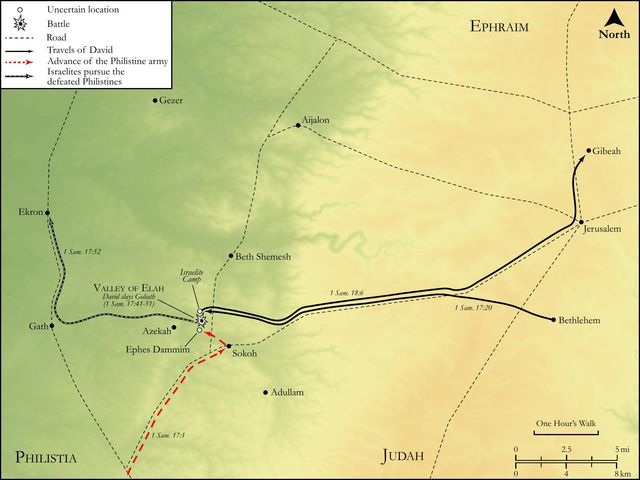
This verse is situated at a critical juncture within the dramatic narrative of David and Goliath, found in 1 Samuel 17. David, a young shepherd, has just arrived at the battlefield in the Valley of Elah, sent by his father Jesse to deliver provisions to his older brothers serving in Saul's army. For forty days, the Philistine champion Goliath of Gath has taunted Israel, paralyzing their army with fear and blaspheming the God of Israel. David, witnessing this national disgrace and hearing Goliath's challenge to the armies of the living God, begins to inquire among the soldiers about the situation and, crucially, about the reward for defeating the giant. Verse 27 serves as the direct, collective answer to David's repeated questions, confirming the king's promise outlined in 1 Samuel 17:25. This confirmation solidifies the immense stakes and motivates David's subsequent actions, contrasting sharply with the fear and inaction of the rest of the Israelite army and King Saul himself, as seen in 1 Samuel 17:11.
Historical & Cultural Context
The narrative unfolds during the early monarchy of Israel, a period characterized by frequent conflicts with surrounding nations, particularly the Philistines. The Philistines, a formidable Aegean people who had settled on the coastal plain of Canaan, possessed superior iron technology and military organization, often posing a significant existential threat to Israel's nascent kingdom. The practice of "champion warfare," where two armies would select a single warrior to fight on behalf of their respective nations, was a known, though not exclusive, custom among the nations of that day, intended to minimize casualties and determine the outcome of a conflict. The rewards offered by King Saul—great wealth, marriage into the royal family (which would grant immense status and potential succession rights), and exemption from taxes for the deliverer's family—were exceptionally high. Such lavish promises were a common way for monarchs to incentivize extraordinary acts of valor, especially when the kingdom's very existence seemed to hang in the balance, as was the case here. The pervasive fear gripping the Israelite army underscores the Philistines' military prowess and Goliath's terrifying reputation.
Key Themes
ShowHideThis verse, while brief, contributes significantly to several key themes within 1 Samuel 17 and the broader book of Samuel. Firstly, it highlights the theme of Divine Sovereignty vs. Human Inadequacy. While the human king offers a substantial reward, it is David's faith in God, not the reward itself, that ultimately propels him to action, contrasting with the human fear that paralyzes Saul and his army. Secondly, the verse emphasizes Motivation and Reward. It reveals the earthly incentives that were on offer, which, while not David's primary motivation, served as a public declaration of the king's commitment and the magnitude of the challenge. This sets up a contrast with David's deeper concern for God's honor, as expressed in 1 Samuel 17:26. Thirdly, it underscores the theme of Courage and Faith. In a context of widespread fear and paralysis, David's repeated inquiries about the reward demonstrate a unique readiness to act, a spirit that sees opportunity where others see only insurmountable obstacles. This foreshadows his remarkable faith and courage in 1 Samuel 17:32-37.
Exposition and Analysis
ShowHideKey Word Analysis
ShowHideThis word refers to "a people (as a congregated unit); specifically, a tribe (as those of Israel); hence (collectively) troops or attendants; figuratively, a flock; folk, men, nation, people." In this context, it signifies the collective body of Israelite soldiers, indicating that the answer David received was not from a single individual but represented the general consensus or official declaration among the troops. It emphasizes the communal nature of the confirmation and the widespread knowledge of the king's desperate offer.
This term means "a word; by implication, a matter (as spoken of) or thing; adverbially, a cause; act, advice, affair... manner..." Here, "after this manner" suggests a specific, perhaps formal or established, way of conveying the information. It implies that the details of the king's promise were well-known and consistently communicated, reinforcing the certainty and legitimacy of the rewards being described to David. It's not a casual comment but a definitive statement.
This primitive root means "to strike (lightly or severely, literally or figuratively); beat... kill... slaughter, slay..." This verb directly addresses the decisive action required to defeat Goliath. It highlights the violent and final nature of the task at hand—the literal slaying of the giant. The use of this strong verb underscores the gravity of the challenge and the ultimate, life-or-death stakes involved in confronting Goliath.
Verse Breakdown
ShowHide"And the people answered him after this manner, saying"
This introductory clause sets the scene for the direct response David receives from the Israelite soldiers. It signifies that David's inquiries about the reward were not merely casual questions but were met with a collective, perhaps even official, confirmation from the assembled troops. The phrase "after this manner" suggests a specific, perhaps pre-arranged or well-understood, way of conveying the information, emphasizing its authoritative and certain nature within the military camp.
"So shall it be done to the man that killeth him"
This is the emphatic core of the people's confirmation. The word "So" (כֵּן, kēn) acts as a strong affirmation, leaving no doubt that the extraordinary rewards promised by King Saul would absolutely be bestowed upon the one who defeats Goliath. This statement directly validates the king's decree, reinforcing the immense stakes and the desperate hope that someone, anyone, would rise to the challenge. It is a public and binding affirmation of the royal promise, communicating the certainty of the reward for the one who accomplishes the seemingly impossible task.
Literary Devices
ShowHideThe verse primarily employs Direct Speech, presenting the exact words of the people, which lends immediacy and authenticity to the narrative, allowing the reader to experience the scene as David did. The succinctness and emphatic nature of their reply, "So shall it be done," functions as a powerful Confirmation, solidifying the reality and binding nature of the king's extravagant promise. This confirmation, in turn, acts as a pivotal Catalyst for David's subsequent actions, clearly distinguishing him from the fearful and paralyzed Israelite army. The stark contrast between the people's desperate confirmation of a material reward and David's underlying motivation (his zeal for God's honor) creates a subtle Foreshadowing of David's unique character and divine calling, positioning him as a hero driven by faith rather than mere earthly gain.
Theological and Thematic Connections
ShowHide1 Samuel 17:27, while outwardly focused on earthly rewards, subtly introduces the profound theological theme of divine enablement and the principle that God often chooses and empowers unexpected individuals to accomplish His grand purposes. While the people confirm a human king's promise, the broader narrative ultimately reveals that David's true strength and success come not from the promise of wealth or status, but from his unwavering faith in the living God. This verse therefore serves as a crucial setup, highlighting the human response to a national crisis (offering great incentives out of desperation) before revealing the divine solution (God empowering a humble shepherd). It reminds us that while human motivations and incentives exist, God's ultimate plan transcends them, often working through those who prioritize His glory and honor above all else, demonstrating that victory comes "not by might nor by power, but by my Spirit," says the Lord.
Reflection and Application
ShowHideThis verse invites us to consider the nature of motivation and the certainty of promises in our own lives. The desperation of the Israelite army, reflected in their eager confirmation of the king's reward, speaks to the immense value placed on a deliverer in a moment of crisis. For us, it prompts reflection on what truly drives our actions, especially when faced with daunting challenges or seemingly insurmountable obstacles. Are we primarily motivated by earthly rewards, recognition, or personal gain, or by a deeper conviction rooted in faith and purpose? While David was clearly aware of the king's promises, his ultimate drive stemmed from his passionate zeal for God's honor and his people's dignity. This passage encourages us to cultivate a spirit that looks beyond immediate, tangible incentives, seeking instead to honor God in all circumstances, trusting that His promises are far more certain, enduring, and eternally significant than any human decree or temporary reward. It challenges us to step out in faith when others are paralyzed by fear, knowing that God often uses the seemingly insignificant and ill-equipped to accomplish the extraordinary, demonstrating His power through our weakness.
Questions for Reflection
ShowHideFAQ
ShowHideWas David primarily motivated by the rewards offered by King Saul?
ShowHideWhile 1 Samuel 17:27 confirms the substantial rewards offered by King Saul—great wealth, marriage to the king's daughter, and tax exemption for his family—it's crucial to understand David's primary motivation from the broader narrative of 1 Samuel 17. David's initial inquiry about the reward (as seen in 1 Samuel 17:26 and the preceding verses) might seem self-serving at first glance. However, his subsequent confrontation with Goliath reveals a deeper, spiritual motivation. David expresses outrage that an uncircumcised Philistine would defy "the armies of the living God" (1 Samuel 17:26). His confidence is rooted not in his own strength or the king's promises, but in the Lord, who delivered him from lions and bears (1 Samuel 17:37). Therefore, while the rewards were a known incentive, David's ultimate drive was zeal for God's honor and the deliverance of Israel, demonstrating a faith that transcended material gain.
Christ-Centered Fulfillment
ShowHide1 Samuel 17:27, confirming the extraordinary rewards for a deliverer, finds its ultimate and profound fulfillment in the person and work of Jesus Christ. Just as Israel desperately sought a champion to face an insurmountable foe, humanity was lost and enslaved by sin and death, facing an enemy far more formidable than Goliath. No human effort or earthly reward could procure true deliverance from this spiritual enemy. It is in this context that God Himself provided the ultimate Champion, His Son, Jesus Christ. Unlike David, who sought clarification on an earthly king's promise, Jesus did not come for earthly rewards or recognition, but out of divine love and perfect obedience to His Father's will (as seen in John 6:38). He faced the true giants of sin, death, and the devil, not with a sling and stone, but through His sacrificial death on the cross (Hebrews 2:14-15). The "reward" for His victory is not for Himself, but for all who believe: eternal life, reconciliation with God, and liberation from the power of sin. The "great wealth" and "royal marriage" promised by Saul are eclipsed by the spiritual riches in Christ (Ephesians 1:7) and the church's identity as the glorious bride of Christ (Revelation 19:7). Jesus, the Lamb of God who takes away the sin of the world (John 1:29), is the true Deliverer, whose victory secures for us an inheritance far beyond any earthly king's promise, an inheritance that is imperishable, undefiled, and unfading, kept in heaven for us (1 Peter 1:4).