


Judges 1:2
Bible text: King James Version (1769 Blayney text) · Public domain
Bible text: Berean Standard Bible · Public domain
Bible text: American Standard Version (1901) · Public domain
Bible text: World English Bible, Messianic edition · Public domain
Bible text: Geneva Bible (1599) · Public domain
Bible text: Young's Literal Translation · Public domain
- וַיֹּאמֶרvai·Yo·merand he saidH559Conj-w ¦ V-Qal-ConsecImperf-3msVerb Qal Consecutive Imperfect 3rd Singular Masculineוַandיֹּאמֶרhe said
- יְהוָהYah·wehYahwehH3068N-properNoun Proper Title
- יְהוּדָהye·hu·DahJudahH3063N-properNoun Proper Location
- יַעֲלֶהya·'a·Lehhe will go upH5927V-Qal-Imperf-3msVerb Qal Imperfect 3rd Singular Masculine
- הִנֵּהhi·Nehhere!H2009PrtParticle Interjection
- נָתַתִּיna·Ta·tiI have givenH5414V-Qal-Perf-1csVerb Qal Perfect 1st Singular common gender
- אֶת'et<obj.>H853DirObjMParticle Object Indicator
- הָאָרֶץha·'A·retzthe landH776Art ¦ N-fsNoun Singular Feminine Absoluteהָtheאָרֶץland
- בְּיָדוֹbe·ya·Doin his handH3027Prep-b ¦ N-csc ¦ 3msNoun Singular common gender Constructבְּinיָדhandוֹhis
English is a literal word-by-word gloss of the Hebrew, not the KJV's wording. Why?
This is the original text the KJV's translators worked from — each Hebrew word with its own literal English meaning in this verse, prepared by scholars at Tyndale House, Cambridge. The KJV translates whole sentences, not word by word, so its wording differs: one Hebrew word can become several English words, and the KJV may choose “the LORD” where the gloss reads “Yahweh”. Both are faithful — they answer different questions. For the KJV's own rendering, switch to the KJV text.
Details
See on the biblical-era maps
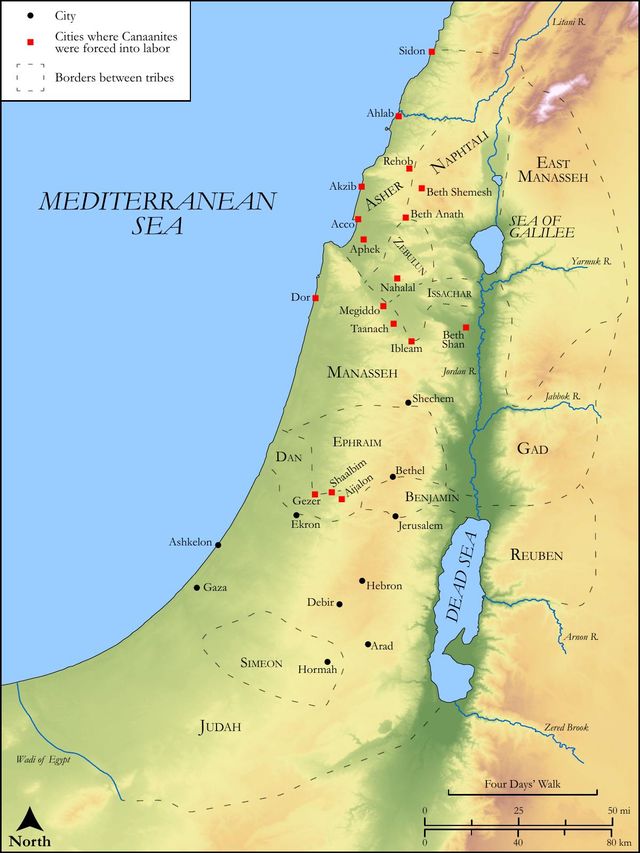
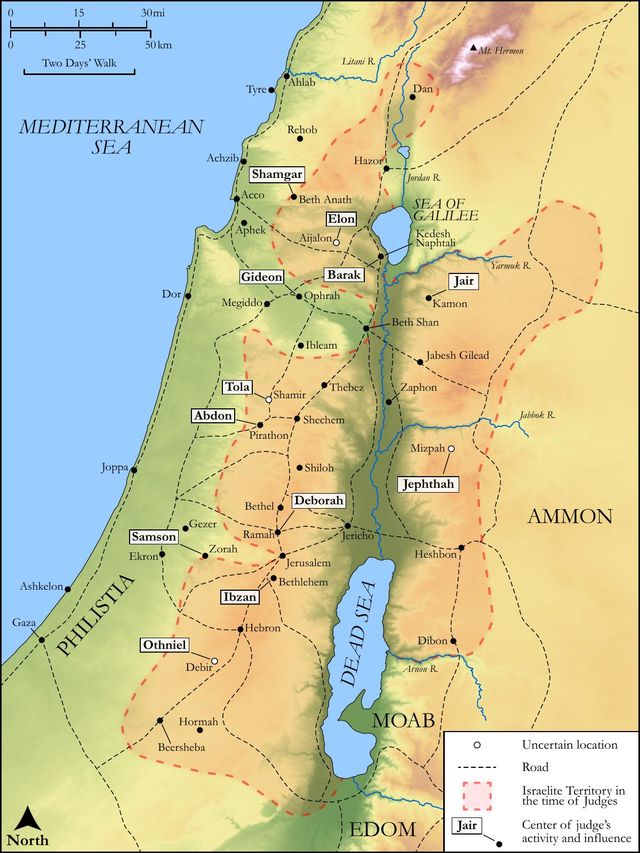
Study this verse
Public-domain commentary
Matthew Henry
From his Commentary on the Whole Bible. Henry comments on passages, not single verses — this entry covers Judges 1:1–8. His three-level outline is real structure in the source text, so it is rendered as structure.
Here, I. The children of Israel consult the oracle of God for direction which of all the tribes should first attempt to clear their country of the Canaanites, and to animate and encourage the rest. It was after the death of Joshua. While he lived he directed them, and all the tribes were obedient to him, but when he died he left no successor in the same authority that he had; but the people must consult the breast-plate of judgment, and thence receive the word of command; for God himself, as he was their King, so he was the Lord of their hosts. The question they ask is, Who shall go up first? Jdg 1:1. By this time, we may suppose, they were so multiplied that the places they were in possession of began to be too strait for them, and they must thrust out the enemy to make room; now they enquire who should first take up arms. Whether each tribe was ambitious of being first, and so strove for the honour of it, or whether each was afraid of being first, and so strove to decline it, does not appear; but by common consent the matter was referred to God himself, who is the fittest both to dispose of honours and to cut out work.
II.God appointed that Judah should go up first, and promised him success (Jdg 1:2):
"I have delivered the land into his hand, to be possessed, and therefore will deliver the enemy into his hand, that keeps him out of possession, to be destroyed." And why must Judah be first in this undertaking?
1.Judah was the most numerous and powerful tribe, and therefore let Judah venture first. Note, God appoints service according to the strength he has given. Those that are most able, from them most work is expected.
2.Judah was first in dignity, and therefore must be first in duty. He it is whom his brethren must praise, and therefore he it is who must lead in perilous services. Let the burden of honour and the burden of work go together.
3.Judah was first served; the lot came up for Judah first, and therefore Judah must first fight.
4.Judah was the tribe out of which our Lord was to spring: so that in Judah, Christ, the Lion of the tribe of Judah, went before them. Christ engaged the powers of darkness first, and foiled them, which animates us for our conflicts; and it is in him that we are more than conquerors. Observe, The service and the success are put together: "Judah shall go up; let him do his part, and then he shall find that I have delivered the land into his hand." His service will not avail unless God give the success; but God will not give the success unless he vigorously apply himself to the service.
III.Judah hereupon prepares to go up, but courts his brother and neighbour the tribe of Simeon (the lot of which tribe fell within that of Judah and was assigned out of it) to join forces with him, Jdg 1:3. Observe here,
1.That the strongest should not despise but desire the assistance even of those that are weaker. Judah was the most considerable of all the tribes, and Simeon the least considerable, and yet Judah begs Simeon's friendship, and prays an aid from him; the head cannot say to the foot, I have no need of thee, for we are members one of another.
2.Those that crave assistance must be ready to give assistance: Come with me into my lot, and then I will go with thee into thine. It becomes Israelites to help one another against Canaanites; and all Christians, even those of different tribes, should strengthen one another's hands against the common interests of Satan's kingdom. Those who thus help one another in love have reason to hope that God will graciously help them both.
IV.The confederate forces of Judah and Simeon take the field:
Judah went up (Jdg 1:4), and Simeon with him, Jdg 1:3. Caleb, it is probable, was commander-in-chief of this expedition; for who so fit as he who had both an old man's head and a young man's hand, the experience of age and the vigour of youth? Jos 14:10, Jos 14:11. It should seem too, by what follows (Jdg 1:10, Jdg 1:11), that he was not yet in possession of his own allotment. It was happy for them that they had such a general as, according to his name, was all heart. Some think that the Canaanites had got together into a body, a formidable body, when Israel consulted who should go and fight against them, and that they then began to stir when they heard of the death of Joshua, whose name had been so dreadful to them; but, if so, it proved they did but meddle to their own hurt.
V.God gave them great success.
Whether they invaded the enemy, or the enemy first gave them the alarm, the Lord delivered them into their hand, Jdg 1:4. Though the army of Judah was strong and bold, yet the victory is attributed to God: he delivered the Canaanites into their hand; having given them authority, he here gives them ability to destroy them - put it in their power, and so tried their obedience to his command, which was utterly to cut them off. Bishop Patrick observes upon this that we meet not with such religious expressions in the heathen writers, concerning the success of their arms, as we have here and elsewhere in this sacred history. I wish such pious acknowledgments of the divine providence had not grown into disuse at this time with many that are called Christians. Now,
1.We are told how the army of the Canaanites was routed in the field, in or near Bezek, the place where they drew up, which afterwards Saul made the place of a general rendezvous (Sa1 11:8); they slew 10,000 men, which blow, if followed, could not but be a very great weakening to those that were already brought so very low.
2.How their king was taken and mortified. His name was Adoni-bezek, which signifies, lord of Bezek. There have been those that called their lands by their own names (Psa 49:11), but here was one (and there has been many another) that called himself by his land's name. He was taken prisoner after the battle, and we are here told how they used him; they cut off his thumbs, to disfit him for fighting, and his great toes, that he might not be able to run away, Jdg 1:6. It had been barbarous thus to triumph over a man in misery, and that lay at their mercy, but that he was a devoted Canaanite, and one that had in like manner abused others, which probably they had heard of. Josephus says, "They cut off his hands and his feet," probably supposing those more likely to be mortal wounds than only the cutting off of his thumbs and his great toes. But this indignity which they did him extorted from him an acknowledgment of the righteousness of God, Jdg 1:7. Here observe,
(1.)What a great man this Adoni-bezek had been, how great in the field, where armies fled before him, how great at home, where kings were set with the dogs of his flock; and yet now himself a prisoner, and reduced to the extremity of meanness and disgrace. See how changeable this world is, and how slippery its high places are. Let not the highest be proud, nor the strongest secure, for they know not how low they may be brought before they die.
(2.)What desolations he had made among his neighbours: he had wholly subdued seventy kings, to such a degree as to have them his prisoners; he that was the chief person in a city was then called a king, and the greatness of their title did but aggravate their disgrace, and fired the pride of him that insulted over them. We cannot suppose that Adoni-bezek had seventy of these petty princes at once his slaves; but first and last, in the course of his reign, he had thus deposed and abused so many, who perhaps were many of them kings of the same cities that successively opposed him, and whom he thus treated to please his own imperious barbarous fancy, and for a terror to others. It seems the Canaanites had been wasted by civil wars, and those bloody ones, among themselves, which would very much facilitate the conquest of them by Israel. "Judah," says Dr. Lightfoot, "in conquering Adoni-bezek, did, in effect, conquer seventy kings." (3.) How justly he was teated as he had treated others. Thus the righteous God sometimes, in his providence, makes the punishment to answer the sin, and observes an equality in his judgments; the spoiler shall be spoiled, and the treacherous dealer dealt treacherously with, Isa 33:1. And those that showed no mercy shall have no mercy shown them, Jam 2:13. See Rev 13:10; Rev 18:6. (4.) How honestly he owned the righteousness of God herein: As I have done, so God has requited me. See the power of conscience, when God by his judgments awakens it, how it brings sin to remembrance, and subscribes to the justice of God. He that in his pride had set God at defiance now yields to him, and reflects with as much regret upon the kings under his table as ever he had looked upon them with pleasure when he had them there. He seems to own that he was better dealt with than he had dealt with his prisoners; for though the Israelites maimed him (according to the law of retaliation, an eye for an eye, so a thumb for a thumb), yet they did not put him under the table to be fed with the crumbs there, because, though the other might well be looked upon as an act of justice, this would have savoured more of pride and haughtiness than did become an Israelite.
VI.Particular notice is taken of the conquest of Jerusalem, Jdg 1:8.
Our translators judge it spoken of here as done formerly in Joshua's time, and only repeated on occasion of Adoni-bezek's dying there, and therefore read it, "they had fought against Jerusalem," and put this verse in a parenthesis; but the original speaks of it as a thing now done, and this seems most probable because it is said to be done by the children of Judah in particular, not by all Israel in general, whom Joshua commanded. Joshua indeed conquered and slew Adoni-zedec, king of Jerusalem (Jos. 10), but we read not there of his taking the city; probably, while he was pursing his conquests elsewhere, this Adoni-bezek, a neighbouring prince, got possession of it, whom Israel having conquered in the field, the city fell into their hands, and they slew the inhabitants, except those who retreated into the castle and held out there till David's time, and they set the city on fire, in token of their detestation of the idolatry wherewith it had been deeply infected, yet probably not so utterly as to consume it, but to leave convenient habitations for as many as they had to put into the possession of it.
Historical interpretation
Historical reception
1 surviving comment on this verse from the historical church.
And in the book of Joshua, son of Nave [Nun], when the land of promise was divided by lot among the other tribes, the tribe of Judah took its own portion of the land without casting lots, and first of all. And, moreover, “After the death of Joshua the children of Israel inquired of the Lord, saying, who shall go up for us against the Canaanite, leading our fighting against him? And the Lord said, Judah shall go up. Behold, I have given the land into his hands.” These words, then, make it clear that God ordained the tribe of Judah to be the head of all Israel, and the account goes on … And in the book of Judges, when different persons at different times were at the head of the people, though individually the judges were of different tribes, yet speaking generally the tribe of Judah was head of the whole people; and much more so in the times of David and his successors, who belonged to the tribe of Judah and continued to rule until the Babylonian captivity, after which the leader of those who returned from Babylon to their own land was Zerubbabel, the son of Salathiel, of the tribe of Judah, who also built the temple. Hence, too, the book of Chronicles, when giving the genealogies of the twelve tribes of Israel, begins with Judah. And you will see it follows from this that in the days that succeeded, the same tribe had the headship, although different individuals had temporary leadership, whose tribes it is impossible to decide with accuracy, because there is no sacred book handed down to give the history of the period from then to the time of our Savior.
Continue studying Judges 1:2 across the web’s major study libraries — every link below opens this exact verse, chapter, or book on the destination site.
Read & Compare
 BibleGatewayThis verse in more than 200 translations and 70 languages.
 Bible.comThe YouVersion reader — hundreds of translations, reading plans, and highlights.
 ESV.orgCrossway's official English Standard Version reader.
 NET BibleThe NET translation with 60,000+ translators' notes on every rendering decision.
 STEP BibleTyndale House's free study tool — original text, vocabulary, and scholarly resources.
 BibliaLogos Bible Software's free web reader.
 USCCBThe New American Bible (Revised Edition) with the U.S. bishops' study notes.
Commentaries
 BibleHub CommentariesDozens of classic commentaries on this verse, gathered on one page.
 StudyLightMore than 100 commentary sets — the largest collection on the web.
 BibleRefPlain-English commentary on what this verse means, verse by verse.
 Enduring WordDavid Guzik's free commentary on this chapter, widely used by Bible teachers.
 Bible Study ToolsVerse commentary alongside Greek and Hebrew study aids.
Original Language & Research
- BibleHub InterlinearThe verse word by word — original language, transliteration, and English.
- BibleHub LexiconEvery word's original-language definition and Strong's entry.
 Blue Letter BibleDeep-study tools — Strong's numbers, concordance, and word studies.
 SefariaThe Hebrew text with Rashi and centuries of Jewish commentary.
Sermons, Hymns & Audio


TrulyRandomVerse is not affiliated with these sites and doesn’t control their content. They’re linked because they’re genuinely useful.
Summary
Judges 1:2 serves as a pivotal divine declaration at the dawn of Israel's post-Joshua era, establishing God's unwavering initiative and commitment to His covenant promises. In direct response to Israel's inquiry regarding the next phase of conquest, the LORD authoritatively designates the tribe of Judah to lead the charge, assuring them of a victory already secured in His sovereign purpose. This verse powerfully lays the theological groundwork for the entire Book of Judges, emphasizing divine guidance, the absolute certainty of God's word, and the crucial, yet often challenging, role of human obedience in actualizing God's predetermined will.
Context
ShowHideLiterary Context
Judges 1:2 immediately follows a period of significant transition and uncertainty for Israel. The opening verses of Judges describe the aftermath of Joshua's death and the passing of the generation that had personally witnessed the LORD's miraculous works in the wilderness and during the initial conquest. This created a leadership vacuum and a decentralized tribal structure. The Israelites, facing the incomplete task of dispossessing the remaining Canaanite inhabitants from their divinely allotted territories, wisely seek divine counsel. Judges 1:1 records their collective inquiry: "Who shall go up first for us against the Canaanites, to fight against them?" Judges 1:2 is God's direct, authoritative, and immediate response to this crucial question. It sets the foundational theological premise for the subsequent narrative of the book, highlighting the ongoing tension between God's clear commands and promises, and Israel's subsequent struggles with obedience, incomplete conquest, and cycles of apostasy and deliverance.
Historical & Cultural Context
The period of the Judges, spanning roughly from the 14th to the 11th centuries BC, was a transitional and often tumultuous era for ancient Israel. Having conquered the central highlands under Joshua, significant pockets of Canaanite resistance persisted, particularly in the fertile valleys and coastal plains where the indigenous populations possessed superior military technology, notably iron chariots, as mentioned later in Judges 1:19. The phrase "go up" (Hebrew: ʻâlâh) carried significant military and geographical implications, often referring to an ascent from lower plains or valleys to the higher, more defensible hill country where Israelite settlements were concentrated. Culturally, seeking divine counsel through the High Priest, likely utilizing the Urim and Thummim (though not explicitly stated in this verse), was the established and expected practice for major national decisions in ancient Israel, underscoring their theological dependence on God's direct guidance in all matters of national import.
Key Themes
ShowHideJudges 1:2 introduces and reinforces several pivotal themes that permeate the Book of Judges and are central to the broader biblical narrative. Foremost is the theme of Divine Initiative and Sovereignty: God is not a passive observer but actively directs His people, issuing precise commands and unwavering assurances. This is inextricably linked to Covenant Faithfulness: God reiterates His promise to deliver the land, echoing the foundational assurances given to Abraham and reaffirmed to Joshua. The verse also powerfully highlights Human Responsibility and Obedience: While God promises victory, Israel must actively "go up" and engage in battle. The specific selection of Judah underscores the theme of Tribal Leadership and Preeminence, foreshadowing its future significance in Israel's history, particularly as the royal tribe from which the Davidic monarchy and ultimately the Messiah would emerge, as prophesied by Jacob in Genesis 49:10.
Exposition and Analysis
ShowHideKey Word Analysis
ShowHideThis is the sacred covenant name of God, H3068 (Yᵉhôvâh), often rendered "the LORD" in English translations. Its use here is profoundly significant, emphasizing that the speaker is not a generic deity but the personal, self-existent, and covenant-keeping God of Israel. This is the same God who revealed Himself to Moses (H3068 from H1961 meaning "to be") and faithfully led Israel through the wilderness and into the Promised Land. His authority and active involvement in the affairs of His people are paramount, underscoring His faithfulness to His promises.
The verb H559 (ʼâmar) denotes a direct, authoritative, and intentional pronouncement. It is not a suggestion or a mere observation, but a divine decree, a definitive word from God. The LORD's word carries the weight of absolute truth and certainty, initiating action and guaranteeing its outcome. This highlights the power and efficacy of divine speech.
This is the root verb H5414 (nâthan), meaning "to give" or "to place." The form used in Judges 1:2 is a Qal perfect, which functions as a "prophetic perfect." While the full dispossessing of the land is still a future event from Israel's perspective, God speaks of it as already accomplished. This grammatical nuance emphasizes the absolute certainty, completeness, and irrevocability of God's promise. It is not "I will deliver," but "I have delivered," signifying that the victory is already secured in God's divine counsel and will, awaiting their faithful appropriation.
The noun H3027 (yâd) refers to the physical hand, but it is used idiomatically here to signify power, control, possession, and dominion. When God declares He has delivered the land "into his hand," it means He has granted complete authority, means, and effective control to Judah for the task of conquest. It's a vivid image conveying absolute victory and ownership.
Verse Breakdown
ShowHide"And the LORD said,"
This opening clause immediately establishes the divine origin and supreme authority of the subsequent declaration. It signifies that the initiative for the continued conquest comes directly from God, not from human strategy, tribal consensus, or military might. It underscores Israel's absolute dependence on divine revelation and guidance for their national success and spiritual well-being.
"Judah shall go up:"
This is God's specific command and designation. The selection of "Judah" is highly significant, highlighting its prominent position among the tribes, likely due to its size, strength, and the prophetic blessing given by Jacob in Genesis 49:8-12. The phrase "shall go up" (Hebrew: ya'aleh) is a divine imperative, a clear call to military action and the physical act of advancing into enemy territory to engage in battle. It is a command requiring immediate and obedient response.
"behold, I have delivered the land into his hand."
This is the divine assurance that accompanies and undergirds the command. The interjection "behold" (Hebrew: hinneh) draws immediate attention to the certainty and weight of the declaration. As noted in the Key Word Analysis, "I have delivered" uses the prophetic perfect, emphasizing that the victory is already a settled fact in God's eyes, a completed act in His divine plan. "The land" refers to the entire Promised Land, the inheritance God covenanted to give Israel. "Into his hand" is a powerful idiom signifying complete possession, control, and assured victory. It means the land is effectively within Judah's grasp, awaiting their faithful and obedient appropriation.
Literary Devices
ShowHideJudges 1:2 is rich in literary devices that amplify its theological weight and rhetorical impact. The most prominent is the Divine Oracle, as the verse opens with "And the LORD said," immediately establishing the authoritative, supernatural origin of the message. This sets a tone of divine sovereignty and direct intervention in human affairs, asserting God's ultimate control over Israel's destiny. The use of the Prophetic Perfect in "I have delivered" is a powerful rhetorical device, presenting a future event (the complete conquest) as if it has already occurred. This technique emphasizes the absolute certainty and inevitability of God's promise from His perspective, instilling confidence and underscoring His unwavering faithfulness. Furthermore, the phrase "delivered the land into his hand" employs Metonymy, where "hand" represents power, control, and possession. It is a vivid and concise image that conveys complete victory and ownership. Finally, the specific selection of Judah serves as Foreshadowing, hinting at the tribe's enduring significance in Israelite history, particularly its destined role as the royal tribe and the lineage from which the Messiah would ultimately emerge.
Theological and Thematic Connections
ShowHideJudges 1:2 stands as a profound testament to God's enduring faithfulness to His covenant promises, even as Israel enters a period marked by wavering obedience and spiritual decline. It reiterates the fundamental truth that the land of Canaan was a divine gift, not something earned by human strength or military prowess alone. The declaration "I have delivered the land" underscores God's absolute sovereignty and His pre-eminence in the ongoing conquest. However, the accompanying command "Judah shall go up" simultaneously highlights the indispensable role of human responsibility and active faith. God's promises are certain and immutable, but their realization in human experience often requires obedient action, courage, and perseverance. This dynamic tension between divine sovereignty and human responsibility is a recurring theme throughout the biblical narrative, emphasizing that God's people are called to partner with Him in faith, trusting in His assured victory while actively engaging in the tasks He sets before them.
Reflection and Application
ShowHideJudges 1:2 offers profound and enduring lessons for believers navigating life's myriad challenges today. In moments of uncertainty, when we feel a lack of clear leadership, direction, or overwhelming obstacles, this verse powerfully reminds us to seek the LORD's counsel above all else. Just as God designated Judah to "go up" and assured them of victory, He calls us to step out in faith into the "lands" He has already "delivered" into our hands—whether those are spiritual battles, ministry opportunities, personal growth challenges, or vocational callings. The "prophetic perfect" of God's promise ("I have delivered") encourages us to live with a deep-seated, unshakable confidence, knowing that the ultimate victory is already secured in Christ. Our role is not to achieve victory through our own strength, but to appropriate it through obedient action, trusting in the One who has already accomplished it. This verse challenges us to identify the "Canaanites" in our lives—the obstacles, fears, strongholds of sin, or spiritual opposition—and, empowered by God's certain promise, to "go up" against them, trusting that He has already given us the victory and the means to possess it.
Questions for Reflection
ShowHideFAQ
ShowHideWhy was Judah chosen to go up first among the tribes?
ShowHideJudah's selection was multifaceted and deeply significant. Theologically, it aligns perfectly with Jacob's prophetic blessing in Genesis 49:8-12, which designated Judah as the tribe from which kingship, leadership, and the scepter would emerge, indicating its preeminent role in Israel's future. Practically, Judah was likely the largest and most powerful tribe numerically at this time, possessing the greatest manpower and military strength, making them a natural and strategic choice for leading the initial military effort. Furthermore, their tribal territory bordered significant Canaanite strongholds in the south, making their immediate action strategically vital for securing the southern frontier. This initial leadership role in Judges 1:2 powerfully foreshadows their continued prominence in Israel's history, culminating in the establishment of the Davidic monarchy and the lineage of the Messiah.
If God had "delivered" the land, why did Israel still have to fight?
ShowHideThis question highlights a profound and recurring biblical tension between divine sovereignty and human responsibility. God's declaration, "I have delivered the land," signifies that the victory was already decreed and secured in His divine plan and purpose; from His perspective, it was an accomplished fact. However, God's promises often require human cooperation, faith, and obedience to be actualized and experienced in the physical realm. Israel's fighting was not to earn the land, but to possess and appropriate what God had already sovereignly given. Their active participation was an essential act of faith and obedience, demonstrating their trust in God's word and their willingness to partner with Him in His redemptive purposes. The subsequent failures of Israel throughout the Book of Judges often stem not from God's inability to deliver, but from their unwillingness or incomplete obedience to fully "go up" and dispossess the inhabitants, despite God's assured victory. This teaches us that while God provides the power and the promise, His people must still walk in faith and obedience to experience the fullness of His blessings.
Christ-Centered Fulfillment
ShowHideJudges 1:2, with its declaration of divine initiative, assured victory, and the designation of a chosen leader, finds its ultimate and most glorious fulfillment in the person and work of Jesus Christ. Just as the LORD commanded Judah to "go up" and promised them the land, God the Father sent His Son, Jesus, as the ultimate leader, conqueror, and King. Jesus, the Lion of the Tribe of Judah (Revelation 5:5), did not merely "go up" to a physical battle, but "went up" to the cross, where He decisively defeated the ultimate enemies of humanity: sin, death, and the powers of darkness (Hebrews 2:14-15). The "land" that God "delivered into His hand" is not merely a geographical territory, but the spiritual kingdom, the new creation, and the complete dominion over all things, having disarmed principalities and powers (Colossians 2:15). Through His resurrection and ascension, Christ has already secured the definitive victory, and we, as His followers, are called to "go up" with Him, not to earn salvation, but to appropriate the victory He has already won. We are blessed with every spiritual blessing in the heavenly places in Christ (Ephesians 1:3), and our mission is to live out the reality of this accomplished triumph, trusting that the ultimate "land" of eternal life, spiritual freedom, and intimate fellowship with God has been definitively "delivered" into the hand of our conquering King.