


1 Chronicles 15:11
Bible text: King James Version (1769 Blayney text) · Public domain
Bible text: Berean Standard Bible · Public domain
Bible text: American Standard Version (1901) · Public domain
Bible text: World English Bible, Messianic edition · Public domain
Bible text: Geneva Bible (1599) · Public domain
Bible text: Young's Literal Translation · Public domain
- וַיִּקְרָאvai·yik·Ra'and he summonedH7121Conj-w ¦ V-Qal-ConsecImperf-3msVerb Qal Consecutive Imperfect 3rd Singular Masculineוַandיִּקְרָאhe summoned
- דָוִידda·VidDavidH1732N-proper-mNoun Proper Masculine
- לְצָדוֹקle·tza·Dok<to> ZadokH6659Prep-l ¦ N-proper-mNoun Proper Masculineלְ<to>צָדוֹקZadok
- וּלְאֶבְיָתָרu·le·'ev·ya·Tarand <to> AbiatharH54Conj-w ¦ Prep-l ¦ N-proper-mNoun Proper Masculineוּandלְ<to>אֶבְיָתָרAbiathar
- הַכֹּהֲנִיםha·ko·ha·Nimthe priestsH3548Art ¦ N-mpNoun Plural Masculine Absoluteהַtheכֹּהֲנִיםpriests
- וְלַלְוִיִּםve·lal·vi·Yimand <to> the LevitesH3881Conj-w ¦ Prep-l ¦ N-mpNoun Gentilic Plural Masculine Absoluteוְandלַ<to> theלְוִיִּםLevites
- לְאוּרִיאֵלle·'u·ri·'El<to> UrielH222Prep-l ¦ N-proper-mNoun Proper Masculineלְ<to>אוּרִיאֵלUriel
- עֲשָׂיָה'a·sa·YahAsaiahH6222N-proper-mNoun Proper Masculine
- וְיוֹאֵלve·yo·'Eland JoelH3100Conj-w ¦ N-proper-mNoun Proper MasculineוְandיוֹאֵלJoel
- שְׁמַעְיָהshe·ma'·YahShemaiahH8098N-proper-mNoun Proper Masculine
- וֶאֱלִיאֵלve·'e·li·'Eland ElielH447Conj-w ¦ N-proper-mNoun Proper MasculineוֶandאֱלִיאֵלEliel
- וְעַמִּינָדָבve·'a·mi·na·Davand AmminadabH5992Conj-w ¦ N-proper-mNoun Proper MasculineוְandעַמִּינָדָבAmminadab
English is a literal word-by-word gloss of the Hebrew, not the KJV's wording. Why?
This is the original text the KJV's translators worked from — each Hebrew word with its own literal English meaning in this verse, prepared by scholars at Tyndale House, Cambridge. The KJV translates whole sentences, not word by word, so its wording differs: one Hebrew word can become several English words, and the KJV may choose “the LORD” where the gloss reads “Yahweh”. Both are faithful — they answer different questions. For the KJV's own rendering, switch to the KJV text.
Details
See on the biblical-era map
Study this verse
Public-domain commentary
Matthew Henry
From his Commentary on the Whole Bible. Henry comments on passages, not single verses — this entry covers 1 Chronicles 15:1–24.
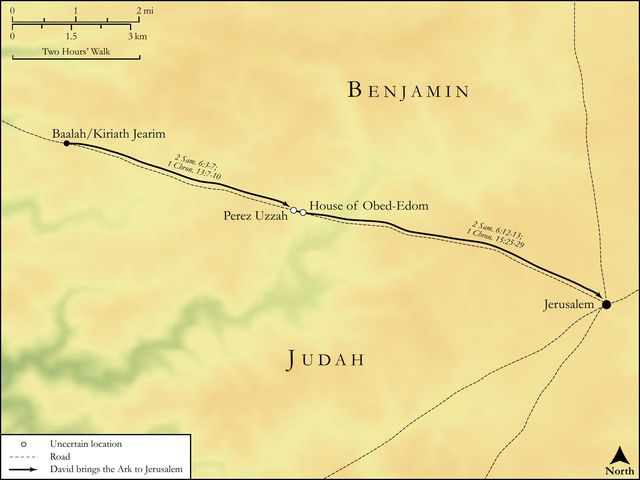
Preparation is here made for the bringing of the ark home to the city of David from the house of Obed-edom. It is here owned that in the former attempt, though it was a very good work and in it they sought God, yet they sought him, not after the due order, Ch1 15:13. "We did not go about our work considerately; and therefore we sped so ill." Note, It is not enough that we do that which is good, but we must do it well - not enough that we seek God in a due ordinance, but we must seek after him, in a due order. Note, also, When we have suffered for our irregularities we must learn thereby to be more regular; then we answer the end of chastisement. Let us see how the matter was mended. 1. David now prepared a place for the reception of the ark, before he brought it to him; and thus he sought in the due order. He had not time to build a house, but he pitched a tent for it (Ch1 15:1), probably according to the pattern shown to Moses in the mount, or as near it as might be, of curtains and boards. Observe, When he made houses for himself in the city of David he prepared a place for the ark. Note, Wherever we build for ourselves, we must be sure to make room for God's ark, for a church in the house. 2. David now ordered that the Levites or priests should carry the ark upon their shoulders. Now he bethought himself of that which he could not but know before, that, none ought to carry the ark but the Levites, Ch1 15:2. The Kohathites carried it in their ordinary marches, and therefore had no wagons allotted them, because their work was to bear upon their shoulders, Num 7:9. But upon extraordinary occasions, as when they passed Jordan and compassed Jericho, the priests carried it. This rule was express, and yet David himself forgot it, and put the ark upon a cart. Note, Even those that are very knowing in the word of God, yet have it not always so ready to them as were to be wished when they have occasion to use it. Wise and good men may be guilty of an oversight, which, as soon as they are aware of, they will correct. David did not go about to justify what had been done amiss, nor to lay the blame on others, but owned himself guilty, with others, of not seeking God in a due order, and now took care not only to summon the Levites to the solemnity, as he did all Israel (Ch1 15:3), and had done before (Ch1 13:2), but to see that they assembled (Ch1 15:4), especially the sons of Aaron, Ch1 15:11. To them he gives the solemn charge (Ch1 15:12): You are the chief of the fathers of the Levites, therefore do you bring up the ark of the Lord. It is expected that those who are advanced above others in dignity should go before others in duty. "You are the chief, and therefore more is expected from you than from others, both by way of service yourselves and influence on the rest. You did it not at first, neither did your duty yourselves nor took care to instruct us, and we smarted for it: The Lord made a breach upon us; we have all smarted for your neglect; this has been by your means (see Mal 1:9): therefore sanctify yourselves, and mind your business." When those that have suffered for doing ill thus learn to do better the correction is well bestowed. 3. The Levites and priests sanctified themselves (Ch1 15:14) and were ready to carry the ark on their shoulders, according to the law, Ch1 15:15. Note, Many that are very remiss in their duty, if they were but faithfully told of it, would reform and do better. The breach upon Uzza made the priests more careful to sanctify themselves, that is, to cleanse themselves from all ceremonial pollution and to compose themselves for the solemn service of God, so as to strike a reverence upon the people. Some are made examples, that others may be made exemplary and very cautious. 4. Officers were appointed to be ready to bid the ark welcome, with every possible expression of joy, Ch1 15:16. David ordered the chief of the Levites to nominate those that they knew to be proficients for this service. Heman, Asaph, and Ethan, were now first appointed, Ch1 15:17. They undertook to sound with symbols (Ch1 15:19), others with psalteries (Ch1 15:20), others with harps, on the Sheminith, or eighth, eight notes higher or lower than the rest, according to the rules of the concert, Ch1 15:21. Some that were priests blew with the trumpet (Ch1 15:24), as was usual at the removal of the ark (Num 10:8) and at solemn feasts, Psa 81:3. And one was appointed for song (Ch1 15:22), for he was skilful in it, could sing well himself and instruct others. Note, As every man has received the gift, so he ought to minister the same, Pe1 4:10. And those that excel in any endowment should not only use it for the common good themselves, but teach others also, and not grudge to make others as wise as themselves. This way of praising God by musical instruments had not hitherto been in use. But David, being a prophet, instituted it by divine direction, and added it to the other carnal ordinances of that dispensation, as the apostle calls them, Heb 9:10. The New Testament keeps up singing of psalms, but has not appointed church-music. Some were appointed to be porters (Ch1 15:18), others door-keepers for the ark (Ch1 15:23, Ch1 15:24), and one of these was Obed-edom, who reckoned it no doubt a place of honour, and accepted it as recompence for the entertainment he had given to the ark. He had been for three months housekeeper to the ark, and indeed its landlord. But, when he might not be so any longer, such an affection had he for it that he was glad to be its door-keeper.
Continue studying 1 Chronicles 15:11 across the web’s major study libraries — every link below opens this exact verse, chapter, or book on the destination site.
Read & Compare
 BibleGatewayThis verse in more than 200 translations and 70 languages.
 Bible.comThe YouVersion reader — hundreds of translations, reading plans, and highlights.
 ESV.orgCrossway's official English Standard Version reader.
 NET BibleThe NET translation with 60,000+ translators' notes on every rendering decision.
 STEP BibleTyndale House's free study tool — original text, vocabulary, and scholarly resources.
 BibliaLogos Bible Software's free web reader.
 USCCBThe New American Bible (Revised Edition) with the U.S. bishops' study notes.
Commentaries
 BibleHub CommentariesDozens of classic commentaries on this verse, gathered on one page.
 StudyLightMore than 100 commentary sets — the largest collection on the web.
 BibleRefPlain-English commentary on what this verse means, verse by verse.
 Enduring WordDavid Guzik's free commentary on this chapter, widely used by Bible teachers.
 Bible Study ToolsVerse commentary alongside Greek and Hebrew study aids.
Original Language & Research
- BibleHub InterlinearThe verse word by word — original language, transliteration, and English.
- BibleHub LexiconEvery word's original-language definition and Strong's entry.
 Blue Letter BibleDeep-study tools — Strong's numbers, concordance, and word studies.
 SefariaThe Hebrew text with Rashi and centuries of Jewish commentary.
Sermons, Hymns & Audio


TrulyRandomVerse is not affiliated with these sites and doesn’t control their content. They’re linked because they’re genuinely useful.
Summary
King David, demonstrating a profound commitment to divine instruction and a corrective response to a previous tragic attempt, meticulously prepares for the relocation of the Ark of the Covenant to Jerusalem in 1 Chronicles 15:11. This verse details his formal summoning of the divinely appointed spiritual leaders: the chief priests Zadok and Abiathar, alongside specific Levite family heads. This deliberate selection of personnel underscores David's renewed reverence for God's sacred commands and his understanding that good intentions must be coupled with strict adherence to God's revealed will concerning worship and the handling of holy objects.
Context
ShowHideLiterary Context
This verse serves as a pivotal moment in the narrative of the Ark's relocation to Jerusalem, immediately following the disastrous first attempt detailed in 1 Chronicles 13. After Uzzah's death for improperly touching the Ark, David paused the transfer, recognizing the critical need for divine instruction and proper protocol. 1 Chronicles 15 opens with David's renewed efforts, explicitly stating his preparation of a dedicated place for the Ark and his profound realization that "none ought to carry the ark of God but the Levites" (1 Chronicles 15:2). Verse 11, therefore, marks the practical implementation of this newfound understanding, detailing the specific individuals David summons to ensure the task is performed precisely according to the Law. It meticulously sets the stage for the successful and joyous procession that unfolds throughout the remainder of the chapter.
Historical & Cultural Context
The Ark of the Covenant was the most sacred object in ancient Israel, symbolizing God's tangible presence and covenantal relationship with His people. Its handling was strictly prescribed by Mosaic Law, particularly in Numbers 4:15 and Exodus 25:14-15. Only Kohathite Levites were permitted to carry it, and then only by poles inserted into its rings, never by direct touch or on a cart. David's initial failure, recounted in 2 Samuel 6 and 1 Chronicles 13, stemmed from adopting a Philistine method of transport (a new cart) rather than the divinely ordained Israelite method. By calling the priests and specific Levite clan heads, David was correcting this grave error, demonstrating a profound shift from pragmatic convenience to reverent obedience—a vital lesson for a king leading a covenant nation.
Key Themes
ShowHideThe central theme vividly highlighted in this verse is Obedience to Divine Command. David's previous failure underscored that good intentions, while commendable, are utterly insufficient; God's specific instructions for worship and sacred service must be meticulously followed. This leads directly to the theme of Proper Leadership and Preparation, as David, in his role as king, takes direct, personal responsibility for ensuring the Ark is handled with the utmost reverence and precisely according to the Law. His summoning of the correct personnel—the priests and the designated Levites—demonstrates responsible spiritual leadership. Furthermore, the verse implicitly emphasizes The Distinct Roles of Priests and Levites within Israel's divinely ordained worship system. These roles were divinely appointed and essential for maintaining ritual purity, order, and the sanctity of God's presence, as outlined in Numbers 3. The priests (Zadok and Abiathar) served in sacrificial and intercessory capacities, while specific Levite families, like those named, were entrusted with the transport and care of the Tabernacle's holy furnishings.
Exposition and Analysis
ShowHideKey Word Analysis
ShowHideRarely (fully); דָּוִיד; from the same as דּוֹד; loving; David, the youngest son of Jesse. The mention of David by name underscores his personal initiative and the profound shift in his understanding of divine protocol. As king, his leadership in this sacred undertaking was paramount, and his act of "calling" signifies his direct, authoritative involvement in ensuring the Ark was moved according to God's precise instructions, a stark contrast to his earlier, less careful approach.
A primitive root (rather identical with קָרָא through the idea of accosting a person met); to call out to (i.e. properly, address by name, but used in a wide variety of applications). The Hebrew verb qârâʼ here signifies more than a casual invitation; it implies a formal summons, an authoritative directive from King David. This act of "calling" highlights David's decisive leadership and his deliberate, purposeful action to gather the appropriate individuals for a sacred task, reflecting a profound shift from his earlier, less careful approach. It emphasizes the king's responsibility to ensure divine protocols are observed.
Active participle of כָּהַן; literally one officiating, a priest; also (by courtesy) an acting priest (although a layman). The term kôhên refers specifically to those of the Aaronic lineage, set apart by God for sacred service, including offering sacrifices, mediating between God and Israel, and teaching the Law. Zadok and Abiathar were the two prominent high priests during David's reign, representing different priestly lines. Their inclusion signifies the highest level of religious authority and the absolute necessity of their oversight in such a holy undertaking.
Or לֵוִי; patronymically from לֵוִי; a Levite or descendant of Levi. The Lêvîyîy were members of the tribe of Levi, consecrated for service to the tabernacle and later the temple. While distinct from the Aaronic priests, they were essential for the proper functioning of Israel's worship. In this context, the Levites were specifically commanded to carry the Ark on their shoulders using poles (Numbers 4:15). The naming of specific Levite family heads (Uriel, Asaiah, Joel, Shemaiah, Eliel, Amminadab) indicates David's meticulous attention to detail, ensuring that only those designated by God for this precise duty were involved.
Verse Breakdown
ShowHide"And David called for Zadok and Abiathar the priests"
This phrase establishes David's initiative and his recognition of the supreme religious authority required for the task. By summoning Zadok and Abiathar, the chief priests, David acknowledges the spiritual gravity of moving the Ark and seeks their guidance and participation, ensuring the highest level of religious sanction and adherence to priestly protocol. It signifies a king humbly submitting to divine order.
"and for the Levites"
This general designation distinguishes the Levites from the priests, highlighting their tribal role as the divinely designated custodians and transporters of the tabernacle furnishings. It signals David's understanding that the task required not just priestly oversight but also the specific, consecrated service of the Levites, who alone were permitted to physically bear the Ark.
"for Uriel, Asaiah, and Joel, Shemaiah, and Eliel, and Amminadab"
The precise enumeration of these six Levite family heads (who are identified in 1 Chronicles 15:5-10 as those who had consecrated themselves for this very purpose) underscores David's meticulous adherence to divine instruction. It demonstrates that David was not merely calling for "some Levites" but specifically those who were prepared, consecrated, and authorized by God for this sacred duty, reflecting a profound commitment to order and obedience after the previous, tragic failure.
Literary Devices
ShowHideThe primary literary device employed in this verse is Enumeration or Listing, specifically the detailed naming of the two chief priests and the six Levite family heads. This precise listing serves to emphasize the meticulous planning and the newfound adherence to divine protocol that David now undertakes. Unlike the previous, hasty, and ultimately disastrous attempt to move the Ark, this time every individual involved is explicitly identified, underscoring the gravity and sacredness of the task. The Specificity of the names, particularly the six Levite leaders, highlights David's commitment to ensuring that only the divinely appointed personnel were involved, a stark contrast to the general lack of adherence that led to Uzzah's death. This detailed enumeration also lends an air of Authority and Legitimacy to the proceedings, reinforcing that this second attempt was conducted "decently and in order," according to God's revealed will, and with the full backing of the spiritual leadership.
Theological and Thematic Connections
ShowHide1 Chronicles 15:11 powerfully illustrates the theological principle that obedience to God's revealed will, particularly in matters of worship and sacred service, is paramount. David's previous failure to move the Ark demonstrated that good intentions, while noble, are insufficient if they do not align with divine commands. This verse marks a crucial turning point where David, having learned from tragedy and sought divine counsel, meticulously adheres to the Law, recognizing that God's holiness demands reverence and strict observance of His prescribed ways. It underscores that God is not to be approached on human terms or with human ingenuity, but solely on His terms, as revealed in His Word. This principle of reverent obedience is a consistent theme throughout Scripture, emphasizing that true worship is not merely an outward act but an inward disposition of submission to God's authority and wisdom, flowing from a heart that fears and honors Him.
Reflection and Application
ShowHide1 Chronicles 15:11 offers a profound and timeless lesson for contemporary believers: our approach to God and our service in His kingdom must be characterized by deep reverence, intentionality, and a diligent adherence to His revealed will. Just as David learned through painful experience that good intentions alone are insufficient, we are reminded that our zeal for God must be tempered and guided by His Word. This means not relying on our own wisdom, convenience, or cultural norms when it comes to spiritual matters, but instead seeking to understand and obey God's principles as revealed in Scripture. Whether in personal devotion, corporate worship, or ministry, the call is to do things "decently and in order" (1 Corinthians 14:40), honoring God by following His established ways. This verse challenges us to examine our own lives and ministries: are we truly seeking to align with God's commands, or are we, like David in his first attempt, prioritizing efficiency, personal preference, or popular methods over divine instruction? It calls us to a posture of humility and teachability before God's Word.
Questions for Reflection
ShowHideFAQ
ShowHideWhy was it so important for specific priests and Levites to carry the Ark, and not just anyone?
ShowHideIt was critically important because the Ark of the Covenant represented the very presence and holiness of God among His people. God had given explicit instructions in the Mosaic Law, particularly in Numbers 4:15, that only the Kohathite clan of the Levites were permitted to carry the sacred objects of the Tabernacle, including the Ark. Furthermore, they were to do so using poles inserted into its rings, never touching the Ark directly (Exodus 25:14-15). The priests (of the Aaronic lineage, like Zadok and Abiathar) had specific duties related to the Ark, such as covering it before transport, but the physical carrying was reserved for the Levites. This strict protocol underscored God's absolute holiness, the seriousness of approaching Him, and the non-negotiable need for obedience to His divine order. Disregarding these commands, as tragically seen in Uzzah's death in 1 Chronicles 13:9-10, resulted in severe consequences, emphasizing that God's ways are not to be trifled with or adapted to human convenience.
Christ-Centered Fulfillment
ShowHideThe meticulous obedience displayed by David in 1 Chronicles 15:11, particularly in his reliance on divinely appointed personnel and methods for handling the Ark, finds its ultimate and perfect fulfillment in Jesus Christ. The Ark, as the dwelling place of God's tangible presence among His people, powerfully foreshadowed the incarnate Christ, who is truly "God with us" (Matthew 1:23). Just as the Old Testament priests and Levites were consecrated and appointed for specific service to God's presence, so too is Jesus the perfectly consecrated and eternally appointed one. He is the ultimate High Priest, not of the Aaronic order, but "after the order of Melchizedek" (Hebrews 7:17), who perfectly mediates between God and humanity through His own sacrifice. Furthermore, while the Old Covenant demanded strict adherence to ritual and the Law for access to God's holy presence, Christ's perfect obedience to the Father's will—even to death on a cross—fulfilled the Law entirely (Matthew 5:17) and opened a new and living way for all believers to approach God directly through Him (Hebrews 10:19-22). In Christ, the need for specific human carriers and elaborate rituals for God's presence is transcended, as He Himself is the true Ark, the embodiment of God's presence, and through Him, all believers are made a "royal priesthood" (1 Peter 2:9), called to offer spiritual sacrifices of worship and service in spirit and truth (John 4:23-24).