


1 Chronicles 15:21
- וּמַתִּתְיָהוּu·ma·tit·Ya·huand MattithiahH4993Conj-w ¦ N-proper-mNoun Proper MasculineוּandמַתִּתְיָהוּMattithiah
- וֶאֱלִיפְלֵהוּve·'e·li·fe·Le·huand EliphelehuH466Conj-w ¦ N-proper-mNoun Proper MasculineוֶandאֱלִיפְלֵהוּEliphelehu
- וּמִקְנֵיָהוּu·mik·ne·Ya·huand MikneiahH4737Conj-w ¦ N-proper-mNoun Proper MasculineוּandמִקְנֵיָהוּMikneiah
- וְעֹבֵדve·'o·Vedand Obed-H5654Conj-w ¦ N-proper-mNoun Proper MasculineוְandעֹבֵדObed-
- אֱדֹם'e·DomEdomH5654N-proper-mNoun Proper Masculine
- וִיעִיאֵלvi·'i·'Eland JeielH3273Conj-w ¦ N-proper-mNoun Proper MasculineוִandיעִיאֵלJeiel
- וַעֲזַזְיָהוּva·'a·zaz·Ya·huand AzaziahH5812Conj-w ¦ N-proper-mNoun Proper MasculineוַandעֲזַזְיָהוּAzaziah
- בְּכִנֹּרוֹתbe·khi·no·Rotwith harpsH3658Prep-b ¦ N-fpNoun Plural Feminine Absoluteבְּwithכִנֹּרוֹתharps
- עַל'alonH5921PrepPreposition
- הַשְּׁמִינִיתha·she·mi·Nitthe sheminithH8067Art ¦ Adj-fsAdjective Numerical Position Singular Feminine Absoluteהַtheשְּׁמִינִיתsheminith
- לְנַצֵּחַle·na·Tze·achto act as overseersH5329Prep-l ¦ V-Piel-InfVerb Piel Infinitive Constructלְtoנַצֵּחַact as overseers
English is a literal word-by-word gloss of the Hebrew, not the KJV's wording. Why?
This is the original text the KJV's translators worked from — each Hebrew word with its own literal English meaning in this verse, prepared by scholars at Tyndale House, Cambridge. The KJV translates whole sentences, not word by word, so its wording differs: one Hebrew word can become several English words, and the KJV may choose “the LORD” where the gloss reads “Yahweh”. Both are faithful — they answer different questions. For the KJV's own rendering, switch to the KJV text.
Details
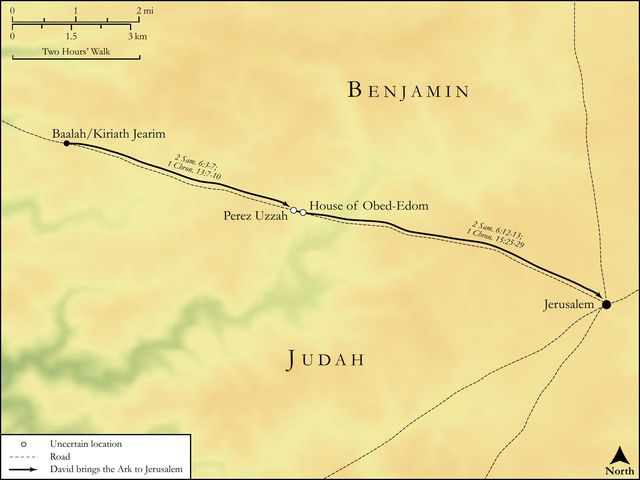
See on the biblical-era map
Study this verse
Public-domain commentary
Matthew Henry
From his Commentary on the Whole Bible. Henry comments on passages, not single verses — this entry covers 1 Chronicles 15:1–24.
Preparation is here made for the bringing of the ark home to the city of David from the house of Obed-edom. It is here owned that in the former attempt, though it was a very good work and in it they sought God, yet they sought him, not after the due order, Ch1 15:13. "We did not go about our work considerately; and therefore we sped so ill." Note, It is not enough that we do that which is good, but we must do it well - not enough that we seek God in a due ordinance, but we must seek after him, in a due order. Note, also, When we have suffered for our irregularities we must learn thereby to be more regular; then we answer the end of chastisement. Let us see how the matter was mended. 1. David now prepared a place for the reception of the ark, before he brought it to him; and thus he sought in the due order. He had not time to build a house, but he pitched a tent for it (Ch1 15:1), probably according to the pattern shown to Moses in the mount, or as near it as might be, of curtains and boards. Observe, When he made houses for himself in the city of David he prepared a place for the ark. Note, Wherever we build for ourselves, we must be sure to make room for God's ark, for a church in the house. 2. David now ordered that the Levites or priests should carry the ark upon their shoulders. Now he bethought himself of that which he could not but know before, that, none ought to carry the ark but the Levites, Ch1 15:2. The Kohathites carried it in their ordinary marches, and therefore had no wagons allotted them, because their work was to bear upon their shoulders, Num 7:9. But upon extraordinary occasions, as when they passed Jordan and compassed Jericho, the priests carried it. This rule was express, and yet David himself forgot it, and put the ark upon a cart. Note, Even those that are very knowing in the word of God, yet have it not always so ready to them as were to be wished when they have occasion to use it. Wise and good men may be guilty of an oversight, which, as soon as they are aware of, they will correct. David did not go about to justify what had been done amiss, nor to lay the blame on others, but owned himself guilty, with others, of not seeking God in a due order, and now took care not only to summon the Levites to the solemnity, as he did all Israel (Ch1 15:3), and had done before (Ch1 13:2), but to see that they assembled (Ch1 15:4), especially the sons of Aaron, Ch1 15:11. To them he gives the solemn charge (Ch1 15:12): You are the chief of the fathers of the Levites, therefore do you bring up the ark of the Lord. It is expected that those who are advanced above others in dignity should go before others in duty. "You are the chief, and therefore more is expected from you than from others, both by way of service yourselves and influence on the rest. You did it not at first, neither did your duty yourselves nor took care to instruct us, and we smarted for it: The Lord made a breach upon us; we have all smarted for your neglect; this has been by your means (see Mal 1:9): therefore sanctify yourselves, and mind your business." When those that have suffered for doing ill thus learn to do better the correction is well bestowed. 3. The Levites and priests sanctified themselves (Ch1 15:14) and were ready to carry the ark on their shoulders, according to the law, Ch1 15:15. Note, Many that are very remiss in their duty, if they were but faithfully told of it, would reform and do better. The breach upon Uzza made the priests more careful to sanctify themselves, that is, to cleanse themselves from all ceremonial pollution and to compose themselves for the solemn service of God, so as to strike a reverence upon the people. Some are made examples, that others may be made exemplary and very cautious. 4. Officers were appointed to be ready to bid the ark welcome, with every possible expression of joy, Ch1 15:16. David ordered the chief of the Levites to nominate those that they knew to be proficients for this service. Heman, Asaph, and Ethan, were now first appointed, Ch1 15:17. They undertook to sound with symbols (Ch1 15:19), others with psalteries (Ch1 15:20), others with harps, on the Sheminith, or eighth, eight notes higher or lower than the rest, according to the rules of the concert, Ch1 15:21. Some that were priests blew with the trumpet (Ch1 15:24), as was usual at the removal of the ark (Num 10:8) and at solemn feasts, Psa 81:3. And one was appointed for song (Ch1 15:22), for he was skilful in it, could sing well himself and instruct others. Note, As every man has received the gift, so he ought to minister the same, Pe1 4:10. And those that excel in any endowment should not only use it for the common good themselves, but teach others also, and not grudge to make others as wise as themselves. This way of praising God by musical instruments had not hitherto been in use. But David, being a prophet, instituted it by divine direction, and added it to the other carnal ordinances of that dispensation, as the apostle calls them, Heb 9:10. The New Testament keeps up singing of psalms, but has not appointed church-music. Some were appointed to be porters (Ch1 15:18), others door-keepers for the ark (Ch1 15:23, Ch1 15:24), and one of these was Obed-edom, who reckoned it no doubt a place of honour, and accepted it as recompence for the entertainment he had given to the ark. He had been for three months housekeeper to the ark, and indeed its landlord. But, when he might not be so any longer, such an affection had he for it that he was glad to be its door-keeper.
Continue studying 1 Chronicles 15:21 across the web’s major study libraries — every link below opens this exact verse, chapter, or book on the destination site.
Read & Compare
 BibleGatewayThis verse in more than 200 translations and 70 languages.
 Bible.comThe YouVersion reader — hundreds of translations, reading plans, and highlights.
 ESV.orgCrossway's official English Standard Version reader.
 NET BibleThe NET translation with 60,000+ translators' notes on every rendering decision.
 STEP BibleTyndale House's free study tool — original text, vocabulary, and scholarly resources.
 BibliaLogos Bible Software's free web reader.
 USCCBThe New American Bible (Revised Edition) with the U.S. bishops' study notes.
Commentaries
 BibleHub CommentariesDozens of classic commentaries on this verse, gathered on one page.
 StudyLightMore than 100 commentary sets — the largest collection on the web.
 BibleRefPlain-English commentary on what this verse means, verse by verse.
 Enduring WordDavid Guzik's free commentary on this chapter, widely used by Bible teachers.
 Bible Study ToolsVerse commentary alongside Greek and Hebrew study aids.
Original Language & Research
- BibleHub InterlinearThe verse word by word — original language, transliteration, and English.
- BibleHub LexiconEvery word's original-language definition and Strong's entry.
 Blue Letter BibleDeep-study tools — Strong's numbers, concordance, and word studies.
 SefariaThe Hebrew text with Rashi and centuries of Jewish commentary.
Sermons, Hymns & Audio


TrulyRandomVerse is not affiliated with these sites and doesn’t control their content. They’re linked because they’re genuinely useful.
Summary
1 Chronicles 15:21 meticulously details the appointment of specific Levite musicians—Mattithiah, Elipheleh, Mikneiah, Obededom, Jeiel, and Azaziah—who were tasked with playing harps on the "Sheminith" during the sacred procession of the Ark of the Covenant to Jerusalem. This verse underscores King David's profound commitment to highly organized, skilled, and intentional worship, highlighting the importance of musical excellence and the specialized roles of the Levites in the spiritual and national life of Israel. It portrays a scene of reverent joy and professional dedication in the service of God.
Context
ShowHideLiterary Context
This verse is situated within the pivotal narrative of King David's second, successful attempt to bring the Ark of the Covenant to Jerusalem. This endeavor follows the tragic failure of the first attempt, recounted in 1 Chronicles 13, which resulted in Uzzah's death due to improper handling of the Ark. Having learned from this devastating error, David meticulously consults with the Levites and priests, ensuring that the Ark is carried according to the precise instructions of Mosaic law, emphasizing the sanctity of God's commands (as highlighted in 1 Chronicles 15:2). Chapter 15 provides a detailed account of the careful selection and assignment of various Levite families to specific roles, including gatekeepers, singers, and instrumentalists. Verse 21 specifically names six individuals chosen for their musical prowess, emphasizing their contribution to the joyful and reverent atmosphere surrounding the Ark's arrival, which culminates in a grand celebration described in 1 Chronicles 15:25-29, marking a new era of centralized worship in Jerusalem.
Historical & Cultural Context
The Ark of the Covenant was the most sacred object in ancient Israel, symbolizing God's tangible presence among His people and serving as the focal point of their worship and national identity. Its proper handling and veneration were paramount, reflecting the covenant relationship between Yahweh and Israel. In ancient Near Eastern cultures, music played a vital role in religious ceremonies, royal processions, and communal celebrations, often involving large ensembles and specialized musicians. David, himself a skilled musician and composer (as evidenced in 1 Samuel 16:18 and numerous Psalms), initiated significant reforms in Israelite worship. He established a highly organized musical ministry for the tabernacle and, prophetically, for the future temple. The Levites, as the priestly tribe, were divinely appointed for specific duties related to the tabernacle and temple service, including the sacred task of transporting the Ark and leading worship. The detailed listing of names and instruments reflects the professionalization and high esteem given to sacred music during this period of Israel's history under David's leadership, underscoring the importance of offering God the very best in every aspect of worship.
Key Themes
ShowHide1 Chronicles 15:21 significantly contributes to several overarching themes within the book of Chronicles, which frequently emphasizes proper worship and the Davidic covenant. Firstly, it underscores the theme of Organized and Intentional Worship, demonstrating David's commitment to establishing a structured and divinely ordered system of worship that honored God with precision and reverence. The meticulous selection of personnel and instruments highlights that worship was not haphazard but a carefully planned and executed endeavor, reflecting God's own orderliness. Secondly, the phrase "to excel" points to the theme of Excellence in Service, emphasizing the high standard expected of those serving God. This pursuit of offering one's very best in spiritual duties is a recurring motif throughout Chronicles, reflecting the belief that God deserves nothing less than the highest quality of devotion and skill, as seen in the broader descriptions of temple service and the dedication of resources (e.g., 1 Chronicles 29:1-9). Lastly, the verse illuminates the Specialized Role of the Levites in Israel's spiritual life, particularly their function as custodians of sacred objects and leaders in musical worship. Their lineage, training, and specific assignments, as detailed in this chapter and elsewhere (e.g., 1 Chronicles 23), were crucial for maintaining the purity and order of Israel's covenant relationship with God, ensuring that the sacred duties were performed by those consecrated for the task.
Exposition and Analysis
ShowHideKey Word Analysis
ShowHideThis term literally means "the eighth" and is a musical designation. In the context of harps, it is widely understood to refer to an instrument played in a lower register, perhaps an octave lower, or a specific musical mode or tuning that produced a deeper, richer sound. Its mention here suggests a sophisticated musical arrangement, indicating that different instruments were employed to create a full and harmonious soundscape for the procession, with distinct parts for various registers. This detail points to a highly developed musical tradition in Israelite worship, where specific instrumentation and tunings were employed for sacred occasions.
This primitive root means "to glitter from afar," "to be eminent," "to be permanent," or "to oversee." In a musical context, as used here, it implies performing with exceptional skill, mastery, and leadership. The form in the verse, לְנַצֵּחַ (lenatseach), is an infinitive construct, meaning "to oversee" or "to lead," often translated as "to excel" or "to be preeminent." This suggests that these Levites were not merely playing instruments but were chosen for their outstanding ability to lead and enhance the worship, offering their very best in service to God, ensuring the music was not just present but powerfully effective and well-executed.
Verse Breakdown
ShowHide"And Mattithiah, and Elipheleh, and Mikneiah, and Obededom, and Jeiel, and Azaziah"
This opening clause lists six specific Levite musicians by name. The inclusion of their names emphasizes the meticulous organization of David's worship reforms and highlights the personal accountability and skill of each individual chosen for this sacred task. Obededom is particularly notable, having previously hosted the Ark and received blessings for doing so (1 Chronicles 13:14). His continued involvement, now as a musician, underscores the enduring nature of his dedication and the blessing upon his service.
"with harps"
This specifies the instrument these particular Levites were assigned to play. Harps (Hebrew: kinnôwr) were stringed instruments commonly used in Israelite worship, known for their melodious and often soothing sounds. Their presence indicates a deliberate choice for instruments that could contribute to a joyful yet reverent atmosphere during the Ark's procession, providing a rich sonic texture to the celebration.
"on the Sheminith"
This musical direction further refines the type of harp or the manner in which it was to be played. As discussed in "Key Word Analysis," "Sheminith" indicates a lower register or a specific musical mode, suggesting a structured and nuanced musical composition where different instruments played distinct parts to create a rich, layered sound. This detail speaks to the sophistication of the musical arrangements for this significant event, demonstrating a high level of musical artistry dedicated to God's glory.
"to excel"
This final phrase defines the standard and purpose of their musical performance. It conveys that these musicians were chosen not just for their presence but for their ability to perform with a high degree of skill, leadership, and dedication. This implies that their offering was of the highest quality—an act of worship performed with excellence for the glory of God, setting a benchmark for all who serve in sacred capacities.
Literary Devices
ShowHide1 Chronicles 15:21 employs several literary devices to convey its message with precision and emphasis. The most prominent is Listing/Cataloging, where the specific names of the Levite musicians are enumerated. This detailed list serves to underscore the meticulous organization and personal involvement in David's worship reforms, emphasizing that each individual had a distinct and vital role. The act of naming these individuals also lends a sense of historical authenticity and importance to their contribution to such a significant national and religious event. Furthermore, there is a strong element of Emphasis on skill and dedication, particularly through the concluding phrase "to excel." This phrase highlights the high standard of performance expected in sacred service, elevating the musical ministry from mere performance to an act of profound worship requiring mastery and preeminence. The verse also subtly uses Symbolism, where the harps and the "Sheminith" setting symbolize the beauty, order, and joy intended for the worship of God. Music itself is a symbolic expression of praise and devotion, and its careful orchestration here points to the reverence due to the divine presence embodied by the Ark.
Theological and Thematic Connections
ShowHide1 Chronicles 15:21 offers profound theological insights into the nature of worship and service to God. It teaches us that God values not only our presence in worship but also the quality and intentionality of our offerings. The meticulous preparation, the specific assignment of roles, and the emphasis on "excelling" demonstrate that worship is not a casual endeavor but a sacred act demanding our best. This principle extends beyond musical ministry to all forms of service within the community of faith, reminding believers that every gift and talent, when consecrated to God, should be exercised with diligence and a spirit of excellence. The joy and reverence associated with the Ark's return, facilitated by such organized and skilled worship, illustrate that true worship is a holistic response to God's presence, engaging both our hearts and our highest abilities in a manner worthy of His glory.
Reflection and Application
ShowHideThe detailed account in 1 Chronicles 15:21 serves as a powerful reminder for contemporary believers about the nature of our worship and service. Just as King David ensured the Levites offered their best in skill and dedication for the sacred task of bringing the Ark, we too are called to approach our spiritual duties with intentionality and excellence. This isn't about human performance for its own sake, but about honoring God, who is worthy of our utmost. Whether in our corporate worship, our personal devotions, our service within the church, or our daily vocations, we are encouraged to use our unique gifts and talents—be they musical, administrative, teaching, compassionate, or otherwise—with a heart that desires to "excel" for His glory. This verse challenges us to move beyond perfunctory engagement to a place of thoughtful preparation, joyful participation, and wholehearted offering, recognizing that our best efforts, empowered by the Holy Spirit, contribute meaningfully to the spiritual vitality of God's people and the advancement of His kingdom. Our excellence in service becomes a tangible expression of our love and reverence for the One who has given us everything.
Questions for Reflection
ShowHideFAQ
ShowHideWhat is "Sheminith" and why is it important?
ShowHide"Sheminith" (שְׁמִינִית) literally means "the eighth" in Hebrew. In a musical context, it is widely interpreted as a musical term referring to a lower octave or a specific musical mode/tuning that produced a deeper, bass-like sound. Its importance lies in demonstrating the sophistication of Israelite musical worship during David's time. It indicates that the musical arrangements for the Ark's procession were not simplistic but carefully orchestrated, with different instruments playing in various registers to create a rich, full, and harmonious sound. This detail highlights the intentionality and artistry dedicated to praising God, ensuring the music was as excellent as possible for such a sacred event.
Who were Mattithiah, Elipheleh, Mikneiah, Obededom, Jeiel, and Azaziah?
ShowHideThese were specific Levite musicians chosen by King David to play harps during the procession of the Ark of the Covenant. As Levites, they belonged to the tribe designated for priestly and sanctuary duties, including musical service. Their individual names being listed underscores the personal selection process and the high regard for their particular skills. Obededom, in particular, is mentioned elsewhere in Chronicles as the man whose household was blessed by hosting the Ark for three months after the first failed attempt to move it (1 Chronicles 13:14). His inclusion here as a musician shows his continued and blessed involvement in the sacred service.
Why was music so prominent in the Ark's procession and David's worship reforms?
ShowHideMusic was deeply integral to ancient Israelite worship and celebration, and David, himself a skilled musician (1 Samuel 16:18), understood its power to express devotion, joy, and reverence. The prominence of music in the Ark's procession (as detailed in 1 Chronicles 15) reflects David's comprehensive reforms to establish a highly organized and joyful system of worship for the nation. Music served to enhance the atmosphere of celebration and awe, helping the people express their praise and acknowledge God's presence among them. It was a vital component of the communal expression of faith, designed to engage the emotions and spirits of the worshippers, making the sacred event a truly vibrant and memorable experience.
Christ-Centered Fulfillment
ShowHideThe meticulous organization, skilled musicianship, and pursuit of excellence in 1 Chronicles 15:21, all focused on bringing the Ark of the Covenant—the tangible symbol of God's presence—into Jerusalem, find their ultimate fulfillment in Jesus Christ. The Old Covenant worship, with its physical instruments, designated Levites, and tangible Ark, pointed forward to a greater reality. Christ is the true and ultimate High Priest, who has entered the heavenly sanctuary not with the blood of animals or the sound of harps, but with His own blood, securing an eternal redemption for all who believe (Hebrews 9:11-12). He is the very presence of God among us, the true "Ark" in whom the fullness of God dwells bodily (Colossians 2:9). Under the New Covenant, the emphasis shifts from external rituals and physical instruments to worship "in spirit and truth" (John 4:23-24), where believers themselves become living instruments of praise. We, as a "royal priesthood," are called to offer spiritual sacrifices (1 Peter 2:9), not just with harps, but with our lives, our voices, and our every action, making melody in our hearts to the Lord (Ephesians 5:19). The excellence sought in the Old Testament musicians is now an internal disposition, a desire to offer our redeemed selves as a wholehearted response to the perfect and complete work of Christ, who enables us to truly "excel" in worship that is pleasing to God, for His glory alone (Philippians 1:9-11).