


1 Chronicles 15:22
Bible text: King James Version (1769 Blayney text) · Public domain
Bible text: Berean Standard Bible · Public domain
Bible text: American Standard Version (1901) · Public domain
Bible text: World English Bible, Messianic edition · Public domain
Bible text: Geneva Bible (1599) · Public domain
Bible text: Young's Literal Translation · Public domain
- וּכְנַנְיָהוּu·khe·nan·Ya·huand KenaniahH3663Conj-w ¦ N-proper-mNoun Proper MasculineוּandכְנַנְיָהוּKenaniah
- שַׂרsar[the] leader ofH8269N-mscNoun Singular Masculine Construct
- הַלְוִיִּםhal·vi·Yimthe LevitesH3881Art ¦ N-mpNoun Gentilic Plural Masculine AbsoluteהַtheלְוִיִּםLevites
- בְּמַשָּׂאbe·ma·Sa'in a lifting upH4853Prep-b ¦ N-msNoun Singular Masculine Absoluteבְּinמַשָּׂאa lifting up
- יָסֹרya·Soran instructorH3256V-Qal-InfAbsVerb Qal Infinitive Absolute
- בַּמַּשָּׂאba·ma·Sa'in the lifting upH4853Prep-b ¦ N-msNoun Singular Masculine Absoluteבַּin theמַּשָּׂאlifting up
- כִּיkiforH3588PrtParticle Conditional
- מֵבִיןme·Vin[was] a teacherH995V-Hiphil-Prtcpl-msVerb Hiphil Participle Singular Masculine Absolute
- הוּאHu'heH1931Pro-3msPronoun Personal 3rd Singular Masculine
English is a literal word-by-word gloss of the Hebrew, not the KJV's wording. Why?
This is the original text the KJV's translators worked from — each Hebrew word with its own literal English meaning in this verse, prepared by scholars at Tyndale House, Cambridge. The KJV translates whole sentences, not word by word, so its wording differs: one Hebrew word can become several English words, and the KJV may choose “the LORD” where the gloss reads “Yahweh”. Both are faithful — they answer different questions. For the KJV's own rendering, switch to the KJV text.
Details
See on the biblical-era map
Study this verse
Public-domain commentary
Matthew Henry
From his Commentary on the Whole Bible. Henry comments on passages, not single verses — this entry covers 1 Chronicles 15:1–24.
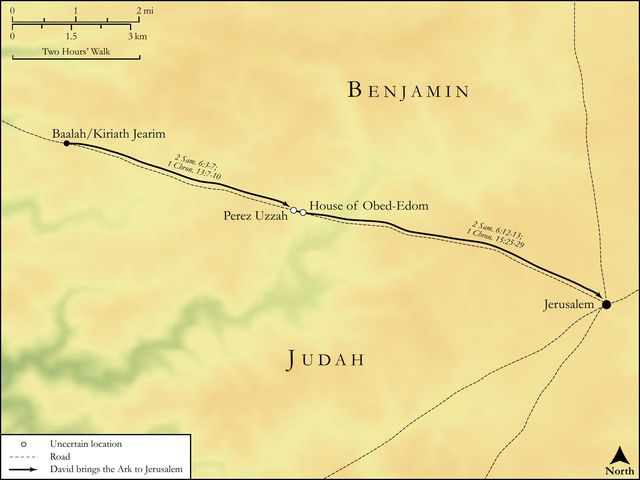
Preparation is here made for the bringing of the ark home to the city of David from the house of Obed-edom. It is here owned that in the former attempt, though it was a very good work and in it they sought God, yet they sought him, not after the due order, Ch1 15:13. "We did not go about our work considerately; and therefore we sped so ill." Note, It is not enough that we do that which is good, but we must do it well - not enough that we seek God in a due ordinance, but we must seek after him, in a due order. Note, also, When we have suffered for our irregularities we must learn thereby to be more regular; then we answer the end of chastisement. Let us see how the matter was mended. 1. David now prepared a place for the reception of the ark, before he brought it to him; and thus he sought in the due order. He had not time to build a house, but he pitched a tent for it (Ch1 15:1), probably according to the pattern shown to Moses in the mount, or as near it as might be, of curtains and boards. Observe, When he made houses for himself in the city of David he prepared a place for the ark. Note, Wherever we build for ourselves, we must be sure to make room for God's ark, for a church in the house. 2. David now ordered that the Levites or priests should carry the ark upon their shoulders. Now he bethought himself of that which he could not but know before, that, none ought to carry the ark but the Levites, Ch1 15:2. The Kohathites carried it in their ordinary marches, and therefore had no wagons allotted them, because their work was to bear upon their shoulders, Num 7:9. But upon extraordinary occasions, as when they passed Jordan and compassed Jericho, the priests carried it. This rule was express, and yet David himself forgot it, and put the ark upon a cart. Note, Even those that are very knowing in the word of God, yet have it not always so ready to them as were to be wished when they have occasion to use it. Wise and good men may be guilty of an oversight, which, as soon as they are aware of, they will correct. David did not go about to justify what had been done amiss, nor to lay the blame on others, but owned himself guilty, with others, of not seeking God in a due order, and now took care not only to summon the Levites to the solemnity, as he did all Israel (Ch1 15:3), and had done before (Ch1 13:2), but to see that they assembled (Ch1 15:4), especially the sons of Aaron, Ch1 15:11. To them he gives the solemn charge (Ch1 15:12): You are the chief of the fathers of the Levites, therefore do you bring up the ark of the Lord. It is expected that those who are advanced above others in dignity should go before others in duty. "You are the chief, and therefore more is expected from you than from others, both by way of service yourselves and influence on the rest. You did it not at first, neither did your duty yourselves nor took care to instruct us, and we smarted for it: The Lord made a breach upon us; we have all smarted for your neglect; this has been by your means (see Mal 1:9): therefore sanctify yourselves, and mind your business." When those that have suffered for doing ill thus learn to do better the correction is well bestowed. 3. The Levites and priests sanctified themselves (Ch1 15:14) and were ready to carry the ark on their shoulders, according to the law, Ch1 15:15. Note, Many that are very remiss in their duty, if they were but faithfully told of it, would reform and do better. The breach upon Uzza made the priests more careful to sanctify themselves, that is, to cleanse themselves from all ceremonial pollution and to compose themselves for the solemn service of God, so as to strike a reverence upon the people. Some are made examples, that others may be made exemplary and very cautious. 4. Officers were appointed to be ready to bid the ark welcome, with every possible expression of joy, Ch1 15:16. David ordered the chief of the Levites to nominate those that they knew to be proficients for this service. Heman, Asaph, and Ethan, were now first appointed, Ch1 15:17. They undertook to sound with symbols (Ch1 15:19), others with psalteries (Ch1 15:20), others with harps, on the Sheminith, or eighth, eight notes higher or lower than the rest, according to the rules of the concert, Ch1 15:21. Some that were priests blew with the trumpet (Ch1 15:24), as was usual at the removal of the ark (Num 10:8) and at solemn feasts, Psa 81:3. And one was appointed for song (Ch1 15:22), for he was skilful in it, could sing well himself and instruct others. Note, As every man has received the gift, so he ought to minister the same, Pe1 4:10. And those that excel in any endowment should not only use it for the common good themselves, but teach others also, and not grudge to make others as wise as themselves. This way of praising God by musical instruments had not hitherto been in use. But David, being a prophet, instituted it by divine direction, and added it to the other carnal ordinances of that dispensation, as the apostle calls them, Heb 9:10. The New Testament keeps up singing of psalms, but has not appointed church-music. Some were appointed to be porters (Ch1 15:18), others door-keepers for the ark (Ch1 15:23, Ch1 15:24), and one of these was Obed-edom, who reckoned it no doubt a place of honour, and accepted it as recompence for the entertainment he had given to the ark. He had been for three months housekeeper to the ark, and indeed its landlord. But, when he might not be so any longer, such an affection had he for it that he was glad to be its door-keeper.
Historical interpretation
Historical reception
1 surviving comment on this verse from the historical church.
The prophecy, to give out the tunes: Singing praises to God is here called prophecy: the more, because these singers were often inspired men.
Continue studying 1 Chronicles 15:22 across the web’s major study libraries — every link below opens this exact verse, chapter, or book on the destination site.
Read & Compare
 BibleGatewayThis verse in more than 200 translations and 70 languages.
 Bible.comThe YouVersion reader — hundreds of translations, reading plans, and highlights.
 ESV.orgCrossway's official English Standard Version reader.
 NET BibleThe NET translation with 60,000+ translators' notes on every rendering decision.
 STEP BibleTyndale House's free study tool — original text, vocabulary, and scholarly resources.
 BibliaLogos Bible Software's free web reader.
 USCCBThe New American Bible (Revised Edition) with the U.S. bishops' study notes.
Commentaries
 BibleHub CommentariesDozens of classic commentaries on this verse, gathered on one page.
 StudyLightMore than 100 commentary sets — the largest collection on the web.
 BibleRefPlain-English commentary on what this verse means, verse by verse.
 Enduring WordDavid Guzik's free commentary on this chapter, widely used by Bible teachers.
 Bible Study ToolsVerse commentary alongside Greek and Hebrew study aids.
Original Language & Research
- BibleHub InterlinearThe verse word by word — original language, transliteration, and English.
- BibleHub LexiconEvery word's original-language definition and Strong's entry.
 Blue Letter BibleDeep-study tools — Strong's numbers, concordance, and word studies.
 SefariaThe Hebrew text with Rashi and centuries of Jewish commentary.
Sermons, Hymns & Audio


TrulyRandomVerse is not affiliated with these sites and doesn’t control their content. They’re linked because they’re genuinely useful.
Summary
1 Chronicles 15:22 introduces Chenaniah, a prominent Levite, during King David's meticulous preparations to bring the Ark of the Covenant to Jerusalem. This verse highlights Chenaniah's specialized role as the chief and instructor of song, underscoring the critical importance of skilled leadership and dedicated training in the musical aspects of Israel's worship. It reveals God's profound value for excellence, order, and deep understanding in sacred service, establishing proficiency and pedagogical ability as prerequisites for those entrusted with leading and teaching others in the sacred art of worship.
Context
ShowHideLiterary Context
This verse is strategically placed within King David's second, successful attempt to transport the Ark of the Covenant to Jerusalem. This endeavor follows the tragic failure of the first attempt, detailed in 2 Samuel 6:6-8 and 1 Chronicles 13:9-11, where Uzzah's death resulted from improper handling of the Ark. Having learned a severe lesson, David now meticulously ensures that all preparations are carried out "according to the due order" or "as prescribed" (1 Chronicles 15:13). Chapter 15 elaborates on the careful selection, sanctification, and specific duties of the Levites, who alone were authorized to carry the Ark and lead the sacred worship. Chenaniah's specific role as chief of song and instructor is thus presented as an indispensable component of this divinely ordained and carefully orchestrated process, emphasizing the holistic and highly organized nature of worship.
Historical & Cultural Context
Historically, the Levites were divinely appointed to serve in the tabernacle and later the temple, with duties encompassing the care and transport of sacred objects, as outlined in the Mosaic Law (Numbers 3:6-9). Culturally, music was not merely an ancillary element but a profoundly integral and powerful medium in ancient Israelite worship, serving as a vehicle for praise, lament, instruction, and prophecy. King David, himself a gifted musician and prolific psalmist, significantly expanded and formalized the musical component of worship, establishing numerous choirs and instrumentalists among the Levites (1 Chronicles 23:5). Chenaniah's elevated position reflects this emphasis on professional, dedicated, and well-trained musicianship within the sacred sphere, underscoring the high value placed on excellence, precision, and spiritual depth in service to God, particularly in the public expression of worship.
Key Themes
ShowHideSeveral crucial themes emerge from this verse and its surrounding narrative. Firstly, it emphatically highlights Organized and Intentional Worship, demonstrating David's unwavering commitment to order, thorough preparation, and profound reverence in approaching God's holy presence. Worship was not to be a chaotic or casual affair, but a meticulously orchestrated act of devotion, reflecting God's own character of order. Secondly, the explicit emphasis on Chenaniah's "skillful" ability underscores the theme of Skilled Service and Excellence in worship. God desires the very best from His people, and proficiency in sacred duties is presented not merely as a talent but as a vital qualification for service. This resonates with other biblical injunctions to "play skillfully with a loud noise" (Psalm 33:3) and the diverse, robust musical praise enjoined in Psalm 150. Thirdly, the phrase "he instructed about the song" points directly to the importance of Instruction and Mentorship. It reveals a structured, pedagogical approach to training, ensuring the continuity, quality, and theological integrity of worship leadership by faithfully passing down knowledge, expertise, and spiritual understanding. Finally, the verse reinforces The Specific Role of the Levites in Israel's worship, particularly their central and indispensable function in the musical dimension of their sacred duties, underscoring their unique divine appointment.
Exposition and Analysis
ShowHideKey Word Analysis
ShowHideFrom כָּנַן and יָהּ, meaning "Jah has planted" or "Yahweh establishes." This name itself carries theological weight, suggesting divine appointment and stability in his role. His prominence as "chief of the Levites" for song indicates a divinely sanctioned and recognized leadership position within the highly organized Levitical worship structure. The name implies that his appointment was not arbitrary but rooted in God's design for orderly and established worship.
A primitive root meaning "to chastise, literally (with blows) or figuratively (with words); hence, to instruct." This verb implies more than just conveying information; it signifies guiding, shaping, and training through systematic instruction, often involving discipline or correction. Chenaniah's role was active and formative, involving the systematic training of other musicians, ensuring that the musical offerings were not only technically proficient but also spiritually appropriate and aligned with the sacred purpose of worship. This highlights the pedagogical and formative aspect of his leadership.
A primitive root meaning "to separate mentally (or distinguish), i.e., (generally) understand." This word signifies more than just technical aptitude or musical talent. It denotes a deep comprehension, an insightful understanding of the principles, purpose, and spiritual significance of sacred music. Chenaniah's skill was rooted in discernment, enabling him to teach others not just how to perform, but why and what to express through song in the context of divine worship, making him an authority in both practice and theory.
Verse Breakdown
ShowHide"And Chenaniah, chief of the Levites, [was] for song:"
This opening clause immediately identifies Chenaniah by name and title, establishing his authority and specific area of responsibility within the Levitical order. As "chief of the Levites" in this context, he held a supervisory and leading role over the musical aspect of the Ark's procession and subsequent worship. The concise phrase "for song" precisely defines his primary function, indicating that his expertise and leadership were dedicated to the vocal and instrumental components of the worship service, setting the stage for his unique and vital contribution to the sacred proceedings.
"he instructed about the song,"
This second clause elaborates on Chenaniah's specific and crucial activity. His role was not merely to perform or compose, but fundamentally, to teach, train, and guide others. The Hebrew verb implies a process of discipline, guidance, and imparting comprehensive knowledge and practical skill. This highlights the paramount importance of mentorship, discipleship, and the systematic transmission of skills and understanding within the Levitical community, ensuring a high standard of musical excellence, theological integrity, and continuity in their worship practices.
"because he [was] skilful."
This final clause provides the foundational reason and justification for Chenaniah's prominent position and his exceptional ability to instruct. His "skillfulness" (Hebrew bîyn) signifies a profound understanding, discerning intelligence, and practical mastery regarding music and its integral role in worship. It implies not just technical prowess or natural talent, but a deep spiritual and practical grasp of how music serves to honor God, making him uniquely qualified and authoritative to lead, educate, and inspire others in this sacred art.
Literary Devices
ShowHideThe verse employs several literary devices to convey its message with clarity and emphasis. Characterization is immediately evident in the precise introduction of Chenaniah, whose identity and specialized role are clearly defined, underscoring his unique and essential contribution to the worship proceedings. The descriptive phrase "chief of the Levites" immediately establishes his authority and prominence within the highly organized worship structure. Emphasis is placed on the importance of both skill and instruction in worship through the direct causal statement: Chenaniah "instructed about the song, because he was skilful." This explicit cause-and-effect relationship highlights that competence, deep understanding, and the ability to impart knowledge are fundamental prerequisites for effective leadership and teaching in sacred service. Furthermore, the subtle Repetition of the concept of "song" ("was for song" and "instructed about the song") underscores the central focus of Chenaniah's ministry and the profound significance of music in the Ark's procession and Israelite worship. The verse's concise and declarative style lends it an air of factual authority, reinforcing the meticulously planned and divinely ordered nature of the events described.
Theological and Thematic Connections
ShowHide1 Chronicles 15:22 offers profound theological insights into the nature of worship and dedicated service to God. It teaches us that God values not only the sincerity of our devotion but also the excellence and thorough preparation of our offerings. The meticulous organization of the Levites, including the appointment of highly skilled instructors like Chenaniah, underscores that worship is not a casual endeavor but a sacred, intentional act requiring our very best. It highlights that spiritual gifts and natural talents, when consecrated to God, are to be diligently honed, cultivated, and utilized for His glory. Furthermore, the verse emphasizes that the transmission of knowledge, skill, and spiritual understanding through faithful instruction is vital for the continuity, integrity, and vibrancy of spiritual service across generations. This passage affirms that God delights in both the heart of the worshipper and the quality of the offering presented to Him.
Reflection and Application
ShowHideThe account of Chenaniah in 1 Chronicles 15:22 serves as a powerful and enduring reminder for believers today regarding our approach to service and worship within the body of Christ. It challenges us to critically examine the quality of our offerings to God, whether expressed through our spiritual gifts, our vocational work, our financial stewardship, or our active participation in corporate worship. Just as Chenaniah's cultivated skill and dedicated teaching were indispensable for the integrity and reverence of Israel's worship, so too are our developed abilities and our willingness to instruct and mentor others vital for the health, growth, and spiritual vibrancy of the contemporary church. This verse profoundly encourages us to pursue excellence in all that we do for the Lord, recognizing that our best efforts, when offered with a heart of sincere devotion and a spirit of humility, bring Him immense glory. It also calls us to value, participate in, and commit ourselves to the ongoing process of discipleship and mentorship, ensuring that wisdom, practical skill, and profound spiritual understanding are faithfully passed down to future generations of worshippers, leaders, and servants, thereby building up the body of Christ in maturity and effectiveness.
Questions for Reflection
ShowHideFAQ
ShowHideWhy was "skill" so important in ancient Israelite worship?
ShowHideSkill in ancient Israelite worship was paramount because it reflected the profound reverence, honor, and holiness due to God. It was not merely about human performance for its own sake, but about offering the very best to the Divine, a tangible expression of valuing God above all else. The meticulous and detailed instructions for the construction of the tabernacle and later the temple, including the divine inspiration and craftsmanship of artisans like Bezalel and Oholiab (Exodus 31:3-5), demonstrate unequivocally that God inspires, enables, and values excellence in sacred service. For musicians like Chenaniah, skill (Hebrew bîyn, implying deep understanding and discernment) ensured that the music was not only technically proficient but also theologically sound, spiritually impactful, and truly conducive to facilitating an authentic encounter with God's holy presence, as passionately called for in passages like Psalm 33:3. This unwavering commitment to excellence underscored the absolute holiness of God and the profound seriousness of approaching Him in worship.
What can we learn from Chenaniah's role as an "instructor"?
ShowHideChenaniah's specific role as an "instructor about the song" highlights the vital and enduring importance of mentorship, discipleship, and the intentional transmission of knowledge and practical skills within the community of faith. It teaches us that those who possess spiritual gifts, skills, and profound understanding have a sacred responsibility to teach, train, and equip others, thereby ensuring the continuity, quality, and theological integrity of service across generations. This principle extends far beyond the realm of music to encompass all areas of spiritual life, ministry, and leadership within the church, emphasizing the critical need for intentional training and development. This echoes the New Testament's call for believers to "teach and admonish one another with all wisdom, singing psalms and hymns and spiritual songs with thankfulness in your hearts to God" (Colossians 3:16). It profoundly underscores that spiritual gifts and abilities are not meant to be hoarded but are designed to be shared, multiplied, and faithfully passed on for the edification and building up of the entire body of Christ, preparing future generations of faithful servants.
Christ-Centered Fulfillment
ShowHideWhile Chenaniah's dedication to skill and instruction was crucial for the Old Covenant worship, his role ultimately points to the perfect worship and divine instruction found supremely in Jesus Christ. Jesus is the ultimate "chief of the Levites," the great High Priest who perfectly ministered before God, not with earthly songs and sacrifices, but with His very life and atoning sacrifice on the cross (Hebrews 4:14 and Hebrews 9:11-14). He is the one who truly "instructs about the song" of redemption, teaching His disciples the nature of true worship "in spirit and truth" (John 4:23-24), a worship that transcends mere ritual and is rooted in a transformed heart and renewed mind. Through His finished work, believers are now made "a royal priesthood" and "a holy nation" (1 Peter 2:9), empowered by the Holy Spirit to offer spiritual sacrifices of praise and thanksgiving that are eternally acceptable to God (Hebrews 13:15). Thus, Chenaniah's dedication to excellence in song and his role as an instructor foreshadow the perfect, eternal, and redemptive worship initiated by Christ, in whom all our offerings are made acceptable to God, and through whom we are enabled to worship with true skill, profound understanding, and Spirit-filled devotion.