


Joshua 10:4
Bible text: King James Version (1769 Blayney text) · Public domain
Bible text: Berean Standard Bible · Public domain
Bible text: American Standard Version (1901) · Public domain
Bible text: World English Bible, Messianic edition · Public domain
Bible text: Geneva Bible (1599) · Public domain
Bible text: Young's Literal Translation · Public domain
- עֲלוּ'a·lucome upH5927V-Qal-Imp-2mpVerb Qal Imperative 2nd Plural Masculine
- אֵלַי'e·Laito meH413Prep ¦ 1csPreposition Definiteאֵלַtoיme
- וְעִזְרֻנִיve·'iz·Ru·niand help meH5826Conj-w ¦ V-Qal-Imp-2mp ¦ 1csVerb Qal Imperative 2nd Plural Masculineוְandעִזְרֻhelpנִיme
- וְנַכֶּהve·na·Kehso we may attackH5221Conj-w ¦ V-Hiphil-ConjImperf-1cpVerb Hiphil Conjunction+Imperfect 1st Plural common genderוְsoנַכֶּהwe may attack
- אֶת'et<obj.>H853DirObjMParticle Object Indicator
- גִּבְעוֹןgiv·'onGibeonH1391N-properNoun Proper Location
- כִּיkiforH3588PrtParticle Conditional
- הִשְׁלִימָהhish·Li·mahit has made peaceH7999V-Hiphil-Perf-3fsVerb Hiphil Perfect 3rd Singular Feminine
- אֶת'etwithH854PrepPreposition
- יְהוֹשֻׁעַye·ho·Shu·a'JoshuaH3091N-proper-mNoun Proper Masculine
- וְאֶתve·'Etand withH854Conj-w ¦ PrepPrepositionוְandאֶתwith
- בְּנֵיbe·Nei[the] people ofH1121N-mpcNoun Plural Masculine Construct
- יִשְׂרָאֵלYis·ra·'ElIsraelH3478N-properNoun Proper Location
English is a literal word-by-word gloss of the Hebrew, not the KJV's wording. Why?
This is the original text the KJV's translators worked from — each Hebrew word with its own literal English meaning in this verse, prepared by scholars at Tyndale House, Cambridge. The KJV translates whole sentences, not word by word, so its wording differs: one Hebrew word can become several English words, and the KJV may choose “the LORD” where the gloss reads “Yahweh”. Both are faithful — they answer different questions. For the KJV's own rendering, switch to the KJV text.
Details
See on the biblical-era maps
Study this verse
Public-domain commentary
Matthew Henry
From his Commentary on the Whole Bible. Henry comments on passages, not single verses — this entry covers Joshua 10:1–6.
Joshua and the hosts of Israel had now been a good while in the land of Canaan, and no great matters were effected; they were made masters of Jericho by a miracle, of Ai by stratagem, and of Gibeon by surrender, and that was all; hitherto the progress of their victories had not seemed proportionable to the magnificence of their entry and the glory of their beginnings. Those among them that were impatient of delays, it is probable, complained of Joshua's slowness, and asked why they did not immediately penetrate into the heart of the country, before the enemy could rally their forces to make head against them, why they stood trifling, while they were so confident both of their title and of their success. Thus Joshua's prudence, perhaps, was censured as slothfulness, cowardice, and want of spirit. But, 1. Canaan was not to be conquered in a day. God had said that by little and little he would drive out the Canaanites, Exo 23:30. He that believeth will not make haste, or conclude that the promise will never be performed because it is not performed so soon as he expected. 2. Joshua waited for the Canaanites to be the aggressors; let them first make an onset upon Israel, or the allies of Israel, and then their destruction will be, or at least will appear to be, the more just and more justifiable. Joshua had warrant sufficient to set upon them, yet he stays till they strike the first stroke, that he might provide for honest things in the sight, not only of God, but of men; and they would be the more inexcusable in their resistance, now that they had seen what favour the Gibeonites found with Israel. 3. It was for the advantage of Israel to sit still awhile, that the forces of these little kings might unite in one body, and so might the more easily be cut off at one blow. This God had in his eye when he put it into their hearts to combine against Israel; though they designed thereby to strengthen one another, that which he intended was to gather them as sheaves into the floor, to fall together under the flail, Mic 4:12. Thus oftentimes that seeming paradox proves wholesome counsel, Stay awhile, and we shall have done the sooner.
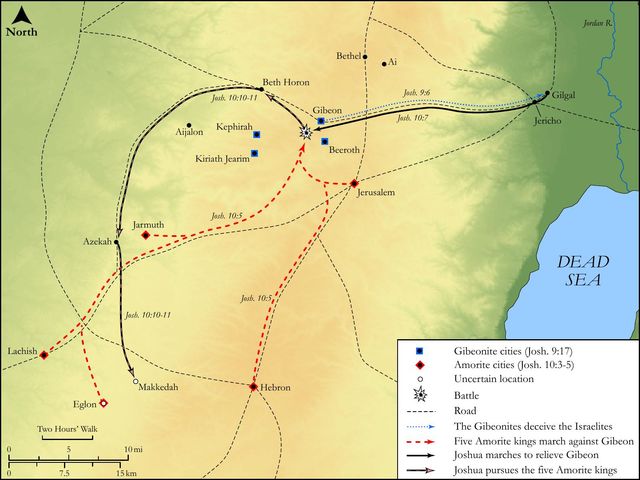
After Israel had waited awhile for an occasion to make war upon the Canaanites, a fair one offers itself. 1. Five kings combine against the Gibeonites. Adoni-zedec king of Jerusalem was the first mover and ring-leader of this confederacy. He had a good name (it signifies lord of righteousness), being a descendant perhaps from Melchizedek, king of righteousness; but, notwithstanding the goodness of his name and family, it seems he was a bad man, and an implacable enemy to the posterity of that Abraham to whom his predecessor, Melchizedek, was such a faithful friend. He called upon his neighbours to join against Israel either because he was the most honourable prince, and had the precedency among these kings (perhaps they had some dependence upon him, at least they paid a deference to him, as the most public, powerful, and active man they had among them), or because he was first or most apprehensive of the danger his country was in, not only by the conquest of Jericho and Ai, but the surrender of Gibeon, which, it seems, was the chief thing that alarmed him, it being one of the most considerable frontier towns they had. Against Gibeon therefore all the force he would raise must be leveled. Come, says he, and help me, that we may smite Gibeon. This he resolves to do, either, (1.) In policy, that he might retake the city, because it was a strong city, and of great consequence to this country in whose hands it was; or, (2.) In passion, that he might chastise the citizens for making peace with Joshua, pretending that they had perfidiously betrayed their country and strengthened the common enemy, whereas they had really done the greatest kindness imaginable to their country, by setting them a good example, if they would have followed it. Thus Satan and his instruments make war upon those that make peace with God. Marvel not if the world hate you, and treat those as deserters who are converts to Christ. 2. The Gibeonites send notice to Joshua of the distress and danger they are in, Jos 10:6. Now they expect benefit from the league they had made with Israel, because, though it was obtained by deceit, it was afterwards confirmed when the truth came out. They think Joshua obliged to help them, (1.) In conscience, because they were his servants; not in compliment, as they had said in their first address (Jos 9:8), We are thy servants, but in reality made servants to the congregation; and it is the duty of masters to take care of the poorest and meanest of their servants, and not to see them wronged when it is in the power of their hand to right them. Those that pay allegiance may reasonably expect protection. Thus David pleads with God (Psa 119:94), I am thine, save me; and so may we, if indeed we be his. (2.) In honour, because the ground of their enemies' quarrel with them was the respect they had shown to Israel, and the confidence they had in a covenant with them. Joshua cannot refuse to help them when it is for their affection to him, and to the name of his God, that they are attacked. David thinks it a good plea with God (Psa 69:7), For thy sake I have borne reproach. When our spiritual enemies set themselves in array against us, and threaten to swallow us up, let us, by faith and prayer, apply to Christ, our Joshua, for strength and succour, as Paul did, and we shall receive the same answer of peace, My grace is sufficient for thee, Co2 12:8, Co2 12:9.
Historical interpretation
Historical reception
1 surviving comment on this verse from the historical church.
There is no doubt that when a human soul associates itself with the Word of God, it is immediately going to have enemies, and that those it once considered friends will be changed into adversaries. The soul should not only expect to suffer this from humans, but it should also know that such will likewise be forthcoming from opposing powers and spiritual iniquities. Thus it happens that whoever longs for friendship with Jesus knows he must tolerate the hostilities of many.…Even now, therefore, the Gibeonites, such as they are, are assaulted because of friendship with Jesus [Joshua], even though they are “hewers of wood and carriers of water.” That is, although you are the least worthy in the church, nevertheless, because you belong to Jesus, you will be assailed by five kings.
The Gibeonites, however, are not abandoned or scorned by Jesus [Joshua] or by the leaders and elders of the Israelites; instead they offer help for their weakness.
Continue studying Joshua 10:4 across the web’s major study libraries — every link below opens this exact verse, chapter, or book on the destination site.
Read & Compare
 BibleGatewayThis verse in more than 200 translations and 70 languages.
 Bible.comThe YouVersion reader — hundreds of translations, reading plans, and highlights.
 ESV.orgCrossway's official English Standard Version reader.
 NET BibleThe NET translation with 60,000+ translators' notes on every rendering decision.
 STEP BibleTyndale House's free study tool — original text, vocabulary, and scholarly resources.
 BibliaLogos Bible Software's free web reader.
 USCCBThe New American Bible (Revised Edition) with the U.S. bishops' study notes.
Commentaries
 BibleHub CommentariesDozens of classic commentaries on this verse, gathered on one page.
 StudyLightMore than 100 commentary sets — the largest collection on the web.
 BibleRefPlain-English commentary on what this verse means, verse by verse.
 Enduring WordDavid Guzik's free commentary on this chapter, widely used by Bible teachers.
 Bible Study ToolsVerse commentary alongside Greek and Hebrew study aids.
Original Language & Research
- BibleHub InterlinearThe verse word by word — original language, transliteration, and English.
- BibleHub LexiconEvery word's original-language definition and Strong's entry.
 Blue Letter BibleDeep-study tools — Strong's numbers, concordance, and word studies.
 SefariaThe Hebrew text with Rashi and centuries of Jewish commentary.
Sermons, Hymns & Audio


TrulyRandomVerse is not affiliated with these sites and doesn’t control their content. They’re linked because they’re genuinely useful.
Summary
Joshua 10:4 captures the urgent and fearful appeal of Adoni-zedek, the king of Jerusalem, to four allied Amorite kings—Hoham of Hebron, Piram of Jarmuth, Japhia of Lachish, and Debir of Eglon. His desperate plea is for immediate military intervention to attack the city of Gibeon. This desperate call to arms is precipitated by Gibeon's unexpected and strategically significant peace treaty with Joshua and the children of Israel, an alliance perceived as a profound act of betrayal against the broader Canaanite resistance and a direct, existential threat to the remaining independent city-states. This verse marks a pivotal moment, initiating the formation of a powerful five-king coalition that directly confronts Israel, thereby setting the stage for one of the most decisive battles in the conquest of Canaan.
Context
ShowHideLiterary Context
This verse is intricately woven into the unfolding narrative of Israel's conquest of Canaan, serving as a direct consequence and critical turning point following the Gibeonite deception. It immediately follows the account in Joshua 9, where the Gibeonites, through cunning and misrepresentation, secured a binding peace treaty with Israel, despite God's explicit command to utterly destroy the inhabitants of the land. Joshua 10:4 reveals the immediate ripple effect of this covenant across the Canaanite kingdoms, demonstrating how a localized agreement could ignite a regional conflict. It acts as the inciting incident for the major military engagement that dominates the remainder of Joshua 10, culminating in the miraculous divine intervention where the sun and moon stood still. Thus, the verse functions as the crucial narrative link between the Gibeonite covenant and the decisive battle that significantly consolidates Israel's control over the southern Canaanite highlands.
Historical & Cultural Context
Ancient Canaan was characterized by a fragmented political landscape, comprising numerous independent city-states, each governed by its own king. While these entities often engaged in rivalries, they frequently formed temporary alliances or coalitions when confronted by a formidable common external threat, such as the invading Israelites. The palpable fear among these kings was intensified by Israel's recent, devastating victories at strategic strongholds like Jericho and Ai. In Canaan and in Israel alike, a peace treaty or covenant was considered a sacred and inviolable agreement, often consecrated by solemn oaths and rituals. Gibeon's decision to "make peace" with Israel, rather than joining the collective resistance, was unequivocally perceived as an act of treason and defection from the broader Canaanite cause. This betrayal represented not only a significant strategic loss but also a profound psychological blow, signaling a dangerous crack in the unified front against Israel and potentially encouraging other cities to seek similar terms. Adoni-zedek's urgent summons reflects the desperate attempt of the remaining southern kings to reassert dominance, punish the perceived traitor, and halt Israel's inexorable advance.
Key Themes
ShowHideJoshua 10:4 powerfully contributes to several overarching theological and narrative themes within the book of Joshua. Firstly, it vividly illustrates the escalating opposition Israel faced as they advanced into the land, demonstrating that the conquest was not a simple march but involved significant resistance from formidable coalitions. Secondly, the verse underscores the profound sovereignty of God in orchestrating events; even the fear, outrage, and hostile reactions of Israel's enemies inadvertently served God's larger purpose by drawing the kings into a single, decisive confrontation where God could display His unmatched power. This aligns seamlessly with the theme of God fighting for Israel, as emphatically declared in passages like Joshua 10:14. Thirdly, the verse highlights the intricate consequences of covenants and alliances, whether entered into deceptively (by Gibeon) or out of fear and aggression (by the Amorite coalition). Gibeon's peace treaty, though born of deceit, was honored by Israel, leading to their defense, while the Amorite kings' alliance, born of fear and aggression, inexorably led to their ultimate and catastrophic defeat.
Exposition and Analysis
ShowHideKey Word Analysis
ShowHideThis verb literally means "to ascend," "to go up," or "to rise." In a military context, as used here, it signifies an advance, an attack, or the initiation of a military expedition. Adoni-zedek's use of the imperative "Come up" conveys an urgent summons for immediate military action, indicating the critical nature of the situation and his perceived need for a collective, overwhelming force. It implies a strategic movement towards battle, likely against a fortified position or into a region that might require an uphill journey, emphasizing the direct and aggressive nature of the proposed action.
This is a powerful and versatile primitive root meaning "to strike," "to beat," "to hit," or "to kill." In a military context, it almost invariably implies a decisive, destructive blow aimed at defeat, injury, or annihilation. Adoni-zedek's intent to "smite Gibeon" leaves no ambiguity about his desire for a punitive, violent assault designed to crush Gibeon's power, inflict severe damage, and make a severe example of them for their perceived betrayal and defection.
Derived from the root shalom, meaning "peace," "completeness," "safety," or "well-being." In this specific context, it refers to the formal establishment of a covenant or treaty that brings an end to hostilities and establishes a state of non-aggression or alliance. For the Amorite kings, Gibeon's act of "making peace" with Israel was far more than a mere cessation of conflict; it was a profound act of defection and a grievous breach of the unspoken, yet deeply ingrained, solidarity among the Canaanite city-states against the common Israelite threat. It signified a shift in allegiance that was intolerable.
Verse Breakdown
ShowHide"Come up unto me, and help me,"
This opening clause is an urgent, direct, and desperate appeal from Adoni-zedek to his fellow kings. The imperative "Come up" emphasizes the immediate and critical need for action, conveying a sense of crisis from his perspective. The subsequent plea "and help me" underscores his vulnerability and the perceived inadequacy of his own forces to deal with the Gibeonite "problem" alone. It is a clear call for a joint military venture, highlighting the perceived shared threat and the absolute necessity of a united front to address it.
"that we may smite Gibeon:"
This clause explicitly states the objective of the proposed alliance: a swift and decisive military strike against Gibeon. The use of the plural pronoun "we" indicates the desired collective action, while the verb "smite" conveys the intent for a destructive and punitive blow. The purpose of this attack was multifaceted: to punish Gibeon for its perceived treachery and defection, to re-establish the dominance of the Canaanite coalition, and to send an unequivocal message to any other Canaanite city contemplating a similar alliance with the invading Israelites.
"for it hath made peace with Joshua and with the children of Israel."
This final clause provides the fundamental justification and the underlying reason for Adoni-zedek's desperate plea. Gibeon's peace treaty with Israel was viewed as an unforgivable act of treachery and a profound breach of trust. This alliance not only shattered the unspoken solidarity of the Canaanite kings but also granted Israel a significant strategic foothold deep within the land, posing an immediate and direct threat to the remaining independent city-states. This perceived betrayal fundamentally undermined the entire Canaanite resistance movement and necessitated a swift, brutal response.
Literary Devices
ShowHideThe verse effectively employs several literary devices to convey its urgency and profound significance within the biblical narrative. The primary device is Urgency, powerfully conveyed through Adoni-zedek's imperative "Come up" and his direct plea for "help," immediately signaling a crisis of paramount importance. There is also a strong sense of Conflict, as the verse explicitly sets the stage for a major military confrontation by clearly defining the aggressors (the Amorite coalition) and their immediate target (Gibeon, and by extension, the newly allied Israel). The situation also presents a subtle yet potent Irony: Gibeon's act of seeking peace to preserve itself inadvertently triggers a war against it from its former allies, ultimately leading to Israel's miraculous and divinely orchestrated intervention on their behalf. Finally, the verse functions as a powerful Foreshadowing, directly setting up the dramatic and divinely controlled events of the rest of Joshua 10, where the Amorite kings' aggression leads directly to their decisive defeat and God's spectacular demonstration of His omnipotence.
Theological and Thematic Connections
ShowHideJoshua 10:4 stands as a profound testament to the sovereign hand of God actively at work, even amidst the complex machinations, fear, and hostilities of human kingdoms. The fear and outrage of the Amorite kings, culminating in their decision to attack Gibeon, were not outside of God's control; rather, they were precisely the divinely orchestrated means by which God brought about a decisive confrontation that would further His grand plan for Israel's conquest of the promised land. This verse powerfully demonstrates how God can strategically use the very opposition to His purposes to bring about His desired outcome, effectively consolidating the enemy forces into one place for a definitive and overwhelming defeat. It highlights the profound principle of divine providence, where seemingly independent human actions and decisions ultimately contribute to a larger, divinely ordained narrative, serving to fulfill God's unfailing promises to His chosen people.
Reflection and Application
ShowHideThe desperate plea of Adoni-zedek in Joshua 10:4 offers timeless insights into the nature of opposition to God's work and the steadfastness of His divine plan. Just as the Canaanite kings reacted with fear, hostility, and a desire for retribution to the advancement of God's people and their new alliance, so too does the world often respond with resistance, conspiracy, or outright aggression to the kingdom of God today. This verse serves as a powerful reminder that such opposition is not a sign of God's absence or weakness, but often a prelude to His greater display of power, faithfulness, and ultimate victory. It challenges believers to cultivate a deep trust in God's overarching sovereignty, even when faced with formidable alliances or seemingly insurmountable obstacles in their personal lives or in the broader mission of the church. We are called to discern how God might be working through, or even using, the very resistance and challenges we encounter to bring about His perfect purposes. Furthermore, the Gibeonite situation reminds us of the complex and far-reaching consequences of our own alliances and decisions, urging us to seek true peace and alignment with God's will rather than engaging in deceptive or self-serving agreements that may lead to unforeseen complications.
Questions for Reflection
ShowHideFAQ
ShowHideWhy was Adoni-zedek so afraid of Gibeon's peace treaty with Israel?
ShowHideAdoni-zedek's fear was multi-faceted and deeply rooted in the significant strategic and psychological implications of Gibeon's defection. Gibeon was not a minor settlement; it was a large, powerful city, explicitly described as "like one of the royal cities" and "greater than Ai" Joshua 10:2. Its alliance with Israel represented a substantial loss of Canaanite military strength and a dangerous gain for Israel, providing them with a crucial foothold in the central highlands. This peace treaty shattered the unified front of Canaanite resistance, fostering a profound sense of betrayal and potentially encouraging other cities to seek similar terms with Israel, thereby weakening the collective defense. Adoni-zedek, as king of Jerusalem, a prominent city, likely perceived this as a direct and immediate threat to his own domain and the broader southern coalition, making it imperative to punish Gibeon swiftly and reassert Canaanite dominance and solidarity.
Did Gibeon's deception ultimately benefit them?
ShowHideFrom a pragmatic, short-term perspective, Gibeon's deception undeniably benefited them by saving their lives and their city from immediate destruction at the hands of the Israelites. While they were condemned to a perpetual role as "hewers of wood and drawers of water" for the congregation and the altar of the Lord Joshua 9:27, this servitude was certainly preferable to annihilation. However, their deception also directly led to the Amorite coalition's attack on them, necessitating Israel's defense. Ultimately, their survival, albeit in a subservient role, allowed them to remain in the land and later played a notable role in Israelite history (e.g., [2 Samuel 21:1-9 "2 Samuel 21:1-9 - Gibeonites and Saul's house"]). Theologically, God sovereignly used their deceptive act to further His divine plan, drawing out the remaining major opposition for a decisive and comprehensive victory for Israel.
Christ-Centered Fulfillment
ShowHideJoshua 10:4, with its vivid depiction of a fearful and hostile world uniting against those aligned with God, powerfully foreshadows the ultimate opposition faced by Christ and His followers throughout history. Just as the Amorite kings conspired to "smite Gibeon" because it "made peace" with Joshua and Israel, so too did the powers of this world conspire against the one who truly brought and embodied peace. The world's inherent hostility towards the Lamb of God, Jesus Christ, who came to establish a new and eternal covenant of peace with humanity, is strikingly evident throughout the Gospels. From the moment of His birth, King Herod sought to destroy Him Matthew 2:13, and ultimately, the religious and political authorities of His day formed a coalition, much like the kings in Joshua, to crucify Him Acts 4:27-28. Yet, in a profound Christ-centered fulfillment, this ultimate act of opposition—the crucifixion—was precisely God's ordained means of bringing about the greatest victory: the decisive defeat of sin and death, and the establishment of true and lasting peace between God and humanity ([Colossians 2:15 "Colossians 2:15 - Triumph over powers"]; [Ephesians 2:14-16 "Ephesians 2:14-16 - Christ Our Peace"]). The fear and hostility of the world, then and now, serve only to highlight the sovereign and redemptive power of God, who masterfully turns even the darkest conspiracies and acts of rebellion into instruments of His glorious redemptive plan, ensuring the triumph of His kingdom and the ultimate peace found in Christ Jesus.