


Isaiah 43:5
Bible text: King James Version (1769 Blayney text) · Public domain
Bible text: Berean Standard Bible · Public domain
Bible text: American Standard Version (1901) · Public domain
Bible text: World English Bible, Messianic edition · Public domain
Bible text: Geneva Bible (1599) · Public domain
Bible text: Young's Literal Translation · Public domain
- אַל'almay notH408NegParticle Negative
- תִּירָאti·Ra'you be afraidH3372V-Qal-Imperf-2msVerb Qal Imperfect 2nd Singular Masculine
- כִּיkiforH3588PrtParticle Conditional
- אִתְּךָ'i·te·kha[am] with youH854Prep ¦ 2msPrepositionאִתְּ[am] withךָyou
- אָנִי'A·niIH589Pro-1csPronoun Personal 1st Singular common gender
- מִמִּזְרָחmi·miz·Rachfrom [the] eastH4217Prep-m ¦ N-msNoun Singular Masculine Absoluteמִfromמִּזְרָח[the] east
- אָבִיא'a·Vi'I will bringH935V-Hiphil-Imperf-1csVerb Hiphil Imperfect 1st Singular common gender
- זַרְעֶךָzar·'E·khayour offspringH2233N-msc ¦ 2msNoun Singular Masculine Constructזַרְעֶoffspringךָyour
- וּמִמַּעֲרָבu·mi·ma·'a·Ravand from [the] westH4628Conj-w ¦ Prep-m ¦ N-msNoun Singular Masculine Absoluteוּandמִfromמַּעֲרָב[the] west
- אֲקַבְּצֶךָּ'a·ka·be·Tze·kaI will gather youH6908V-Piel-Imperf-1cs ¦ 2msVerb Piel Imperfect 1st Singular common genderאֲקַבְּצֶI will gatherךָּyou
English is a literal word-by-word gloss of the Hebrew, not the KJV's wording. Why?
This is the original text the KJV's translators worked from — each Hebrew word with its own literal English meaning in this verse, prepared by scholars at Tyndale House, Cambridge. The KJV translates whole sentences, not word by word, so its wording differs: one Hebrew word can become several English words, and the KJV may choose “the LORD” where the gloss reads “Yahweh”. Both are faithful — they answer different questions. For the KJV's own rendering, switch to the KJV text.
Details
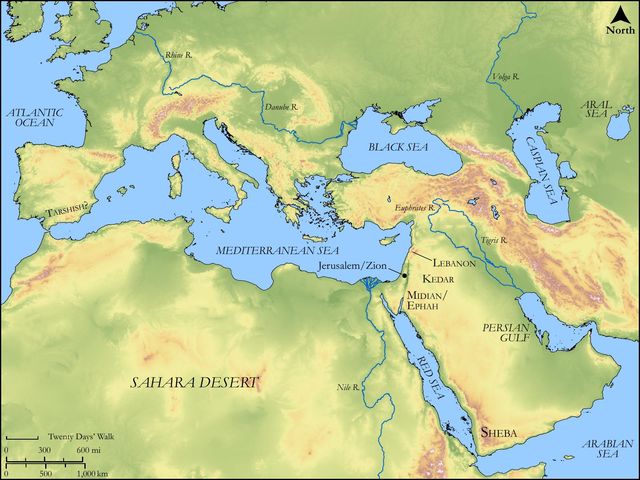
See on the biblical-era map
Study this verse
Public-domain commentary
Matthew Henry
From his Commentary on the Whole Bible. Henry comments on passages, not single verses — this entry covers Isaiah 43:1–7. His two-level outline is real structure in the source text, so it is rendered as structure.
This chapter has a plain connexion with the close of the foregoing chapter, but a very surprising one. It was there said that Jacob and Israel would not walk in God's ways, and that when he corrected them for their disobedience they were stubborn and laid it not to heart; and now one would think it should have followed that God would utterly abandon and destroy them; but no, the next words are, But now, fear not, O Jacob! O Israel! I have redeemed thee, and thou art mine. Though many among them were untractable and incorrigible, yet God would continue his love and care for his people, and the body of that nation should still be reserved for mercy. God's goodness takes occasion from man's badness to appear so much the more illustrious. Where sin abounded, grace did much more abound (Rom 5:20), and mercy rejoices against judgment, as having prevailed and carried the day, Jam 2:13. Now the sun, breaking out thus of a sudden from behind a thick and dark cloud, shines the brighter, and with a pleasing surprise. The expressions of God's favour and good-will to his people here are very high, and speak abundance of comfort to all the spiritual seed of upright Jacob and praying Israel; for to us is this gospel preached as well as unto those that were captives in Babylon, Heb 4:2. Here we have,
I.The grounds of God's care and concern for his people and the interests of his church and kingdom among men.
Jacob and Israel, though in a sinful miserable condition, shall be looked after; for,
1.They are God's workmanship, created by him unto good works, Eph 2:10. He has created them and formed them, not only given them a being, but this being, formed them into a people, constituted their government, and incorporated them by the charter of his covenant. The new creature, wherever it is, is of God's forming, and he will not forsake the work of his own hands.
2.They are the people of his purchase: he has redeemed them. Out of the land of Egypt he first redeemed them, and out of many another bondage, in his love, and in his pity (Isa 63:9); much more will he take care of those who are redeemed with the blood of his Son.
3.They are his peculiar people, whom he has distinguished from others, and set apart for himself: he has called them by name, as those he has a particular intimacy with and concern for, and they are his, are appropriated to him and he has a special interest in them.
4.He is their God in covenant (Isa 43:3): I am the Lord thy God, worshipped by thee and engaged by promise to thee, the Holy One of Israel, the God of Israel; for the true God is a holy one, and holiness becomes his house. And upon all these accounts he might justly say, Fear not (Isa 43:1), and again Isa 43:5, Fear not. Those that have God for them need not fear who or what can be against them.
II.The former instances of this care.
1.God has purchased them dearly: I gave Egypt for thy ransom; for Egypt was quite laid waste by one plague after another, all their first-born were slain and all their men of war drowned; and all this to force a way for Israel's deliverance from them. Egypt shall be sacrificed rather than Israel shall continue in slavery, when the time has come for their release. The Ethiopians had invaded them in Asa's time; but they shall be destroyed rather than Israel shall be disturbed. And if this was reckoned so great a thing, to give Egypt for their ransom, what reason have we to admire God's love to us in giving his own Son to be a ransom for us! Jo1 4:10. What are Ethiopia and Seba, all their lives and all their treasures, compared with the blood of Christ?
2.He had prized them accordingly, and they were very dear to him (Isa 43:4): Since thou hast been precious in my sight thou hast been honourable. Note, True believers are precious in God's sight; they are his jewels, his peculiar treasure (Exo 19:5); he loves them, his delight is in them, above any people. His church is his vineyard. And this makes God's people truly honourable, and their name great; for men are really what they are in God's eye. When the forces of Sennacherib, that they might be diverted from falling upon Israel, were directed by Providence to fall upon Egypt, Ethiopia, and Seba, then God gave those countries for Israel, and showed how precious his people were in his sight. So some understand it.
III.The further instances God would yet give them of his care and kindness.
1. He would be present with them in their greatest difficulties and dangers (Isa 43:2): "When thou passest through the waters and the rivers, through the fire and the flame, I will be with thee, and that shall be thy security; when dangers are very imminent and threatening, thou shalt be delivered out of them." Did they, in their journey, pass through deep water? They should not perish in them: "The rivers shall not overflow thee." Should they by their persecutors be cast into a fiery furnace, for their constant adherence to their God, yet then the flame should not kindle upon them, which was fulfilled in the letter in the wonderful preservation of the three children, Dan. 3. Though they went through fire and water, which would be to them as the valley of the shadow of death, yet, while they had God with them, they need fear no evil, they should be borne up, and brought out into a wealthy place, Psa 66:12. 2. He would still, when there was occasion, make all the interests of the children of men give way to the interests of his own children: "I will give men for thee, great men, mighty men, and men of war, and people (men by wholesale) for thy life. Nations shall be sacrificed to thy welfare." All shall be cut off rather than God's Israel shall, so precious are they in his sight. The affairs of the world shall all be ordered and directed so as to be most for the good of the church, Ch2 16:9. 3. Those of them that were scattered and dispersed in other nations should all be gathered in and share in the blessings of the public, Isa 43:5-7. Some of the seed of Israel were dispersed into all countries, east, west, north, and south, or into all the parts of the country of Babylon; but those whose spirits God stirred up to go to Jerusalem should be fetched in from all parts; divine grace should reach those that lay most remote, and at the greatest distance from each other; and, when the time should come, nothing should prevent their coming together to return in a body, in answer to that prayer (Psa 106:47), Gather us from among the heathen, and in performance of that promise (Deu 30:4), If any of thine be driven to the utmost parts of heaven, thence will the Lord thy God gather thee, which we find pleaded on behalf of the children of the captivity, Neh 1:9. But who are the seed of Israel that shall be thus carefully gathered in? He tells us (Isa 43:7) they are such as God has marked for mercy; for, (1.) They are called by his name; they make profession of religion, and are distinguished from the rest of the world by their covenant-relation to God and denomination from him. (2.) They are created for his glory; the spirit of Israelites is created in them, and they are formed according to the will of God, and these shall be gathered in. Note, Those only are fit to be called by the name of God that are created by his grace for his glory; and those whom God has created and called shall be gathered in now to Christ as their head and hereafter to heaven as their home. He shall gather in his elect from the four winds. This promise points at the gathering in of the dispersed of the Gentiles, and the strangers scattered, by the gospel of Christ, who died to gather together in one the children of God that were scattered abroad; for the promise was to all that were afar off, even as many as the Lord our God shall call and create. God is with the church, and therefore let her not fear; none that belong to her shall be lost.
Historical interpretation
Historical reception
3 surviving comments on this verse. Each one is dated, so this reads as a timeline rather than a list.
Select a marker to jump to its quote. Markers stagger vertically where authors wrote within a few decades of each other.
(Chapter 43, Verse 1 and following) And now, thus says the Lord, the one who created you, Jacob, and the one who formed you, Israel: Do not fear, for I have redeemed you; I have called you by name, you are mine. When you pass through the water, I will be with you, and the rivers will not overwhelm you. When you walk through fire, you shall not be burned, and the flame shall not consume you. For I am the Lord your God, the Holy One of Israel, your Savior; I have given Egypt as your ransom, Ethiopia and Seba in exchange for you. From the moment you became honorable and glorious in my eyes: I loved you, and I will give men for you, and peoples for your soul. Do not fear, for I am with you: I will bring your descendants from the East, and gather you from the West. I will say to the North, give up: and to the South, do not withhold: bring my sons from afar, and my daughters from the ends of the earth. And everyone who calls upon my name, I have created him for my glory, and I have formed him and made him. Bring out the blind people who have eyes, and the deaf who have ears. Let all the nations gather together, and let the peoples be assembled. Who among you will declare this, and show us former things? Let them bring their witnesses to justify them, and let them hear and say, 'It is true.' You are my witnesses, says the Lord, and my servant whom I have chosen, that you may know and believe me, and understand that I am he. Before me no god was formed, nor shall there be any after me. I am, I am the Lord, and there is no savior without me. I have declared and saved; I have made known, and there was no strange one among you. You are my witnesses, says the Lord, and I am God, and from the beginning I am myself, and there is no one who can rescue from my hand. I will work, and who can turn it aside? LXX; And now thus says the Lord who made you, Jacob, and formed you, Israel: Do not fear, for I have redeemed you; I have called you by your name, you are mine. If you pass through water, I am with you, and rivers will not cover you. And if you pass through fire, you will not be burned: the flame will not burn you: for I am the Lord your God, the Holy One of Israel, your Savior. I have made your exchange for Egypt, and Ethiopia, and Seba for you. Since you have been honorable and glorified in my sight: and I have loved you, I will give men for you, and princes for your life. Do not be afraid, for I am with you: I will bring your offspring from the East, and gather you from the West. I will say to the north, give up; and to the south, do not withhold: bring my sons from afar, and my daughters from the ends of the earth, everyone who is called by my name, whom I created for my glory, whom I formed and made. Bring out the people who are blind, yet have eyes, who are deaf, yet have ears. All the nations gather together, and the peoples assemble. Who among them can declare this, and show us the former things? Let them bring their witnesses to prove them right, and let them hear and say, 'It is true.' Let them bring their witnesses, and let them be justified, and let them hear and speak the truth. Be my witnesses, and I am a witness, says the Lord God, and my servant whom I have chosen, so that you may know and believe and understand that I am: Before me there was no other God and after me there will be none. I am God, and there is no Savior besides me. I have declared and saved: I have rebuked and there was no stranger among you. You are my witnesses, and I am the Lord God from the beginning, and there is no one who can deliver from my hand. I will do it, and who will turn it away? The Hebrews interpret this as the second coming of the Savior, when after the fullness of the Gentiles, all of Israel will be saved. But we do not think that the promise will be fulfilled for them, as it has been said: Who is blind, but my children? And who are deaf, but those who rule over them? And the servants of God have become blind. And again: The people have been devastated and plundered, and similar things. Finally he brought upon him the outpouring of his furious indignation, and perhaps war, and consumed him all around, and did not recognize, and set him ablaze, and did not understand. Therefore, what we have said above, there are two Jacobs and two Israels, one carnal and the other spiritual, those who did not want to believe in the Savior and those who received the Son of God. This should also be understood now, that the chorus of the Apostles and the first Church of Christ, gathered from the Jewish people, may understand their Creator and Maker, who is both the creator of their soul and body. And let him not fear persecutors, because he has been redeemed by the blood of Christ, who has called him by his name, and let him specifically call his people because of their special relationship; but let him preach fearlessly, and let him not fear any dangers. And what he implies: he describes the attack and fury of persecutors as waters and rivers, and fire and flames, who envy the salvation of the Gentiles and do not want the gospel message to be preached. Although the Jews want the Egyptians to be understood as waters, the Babylonians as rivers, the Macedonians as fire, and the Romans as flames. Therefore, He commands them not to fear, because the Lord their God, the Savior, and the holy one of Israel will be with them, who made them known in Egypt, Ethiopia, and Syene, and even to the ends of the earth to proclaim. Regarding Syene, the remaining interpreters have placed it in Saba (), where the queen of the South came to hear the wisdom of Solomon (III Kings 10). Therefore, the chorus of the Apostles became honorable in the sight of God, and beloved by Him; and they are the salvation of all people and nations who are called to the Gospel through them, and they will be considered for the salvation of their souls. And he joins and says: Do not be afraid, I am with you, who speak to you in the Gospel: Behold, I am with you all days even to the consummation of the world (Matt. 28:20). For I will bring your sons from the East and from the West, who will rest in the bosom of Abraham, and from all parts of the world the people of my sons and daughters will be gathered, who will either invoke my name or be called by my name, so that they may be called Christians to the glory of their creator. And what follows: Educate the blind people, who have eyes; the deaf, who have ears; many people think that it is said about the Gentile people, who began to hear and see through the teaching of the Apostles. But we should also understand this about the dispersed Israel, who was called by the Apostles and believed first; to whom Paul also speaks: It was necessary for the word of God to be preached to you first (Acts 13:46). And the Lord Himself in the Gospel: Go to the lost sheep of the house of Israel (Matthew 10:6). Finally, it follows: all the nations are gathered together, and the tribes are assembled, that is, with the people who believed from the Jews, so that there may be a dual calling, of circumcision and of uncircumcision. But what is said, 'Bring forth, O Lord, the word is spoken to the Son.' Or, according to the Septuagint, the Father speaks to the Son, that He may bring forth His blind and deaf people, and join them to the nations, and make many leaders of the Church from them. And the prophet marvels that no one among the nations could have known these things in advance, nor could they have known the plans of God; but only His people who have received the Law and had prophets: For God is known in Judea, His name is great in Israel (Ps. LXX, 1). Whether he himself is the witness of his own words, both the doer and the boy and servant whom he has chosen. There is no doubt that it signifies Christ, to whom he also says above: It is great for you to be called my servant. And all these things will happen, so that the truth may be preached to the world, and they may know, and believe, and understand, whose minds were previously brutish and insensible, that besides one God, there is no other God, neither before nor after. For the creator of times never has a beginning, since time itself sometimes exists. And how did He speak: I am a witness, says the Lord God; and the boy whom I have chosen, saying this very thing to the Lord in the Gospel: The testimony of two men is true. I am the one who testifies about myself, and the one who sent me is the Father (John 8:17-18). Thus, we must understand the divinity of Him, that there is no God except Himself who speaks, and His chosen boy. Besides God the Father, there is no other God: because Christ is the power of God and the wisdom of God (1 Corinthians 1), who speaks in the Gospel: I am in the Father, and the Father is in Me (John 14:11). For just as the one Lord Christ does not take away from the Father so that he may not be Lord, so the one God the Father does not take away from the Son so that he may not be God: who in the beginning was the Word, and the Word was with God, and the Word was God: this was in the beginning with God (John 1:1-2). And what follows: And there is no Savior without me, shows that the Son saves all things in the Father. Concerning whom the same prophet testifies: And the Lord will send them a Savior, who will make them safe (Isaiah 9). For indeed, God is wise and strong, and His wisdom and virtue cannot exist without Him. So when I foretell these things from the beginning, there will be no one who rejects my will: indeed, what I have done, they could make void. These things are indeed said to Jacob and Israel, but they refer to the apostolic choir and all who want to believe in Christ and be saved from the Jewish people.
These predictions received their fulfillment after the defeat of the Babylonians, for Cyrus commanded [the Jews] to return to Judea. At the time the latter made [their] return from the east, those who had taken flight during the war and reached the west then [also] returned to the land, probably because they recognized the peace that had come on Judea. In any case, it is with truth and precision that the text clearly indicates the people that the holy apostles have called from the entire world and who have obtained salvation. For in every city the Jews were the first to whom the apostles offered the divine teachings.
“I will destroy those warring with you on account of the gospel, both people and leaders.” He encourages them in this way. “And your children, which you have sown by God and which you have begotten throughout the world, I will gather to my heavenly city, raising up those airborne, through the air, like birds made light by the winds,” that is, the angelic forces. “I shall raise up your offspring to be my children through their being reborn in the church, and all those called by my name Christians are welcomed.” For Christ prophesied these things through the godly prophet.
Continue studying Isaiah 43:5 across the web’s major study libraries — every link below opens this exact verse, chapter, or book on the destination site.
Read & Compare
 BibleGatewayThis verse in more than 200 translations and 70 languages.
 Bible.comThe YouVersion reader — hundreds of translations, reading plans, and highlights.
 ESV.orgCrossway's official English Standard Version reader.
 NET BibleThe NET translation with 60,000+ translators' notes on every rendering decision.
 STEP BibleTyndale House's free study tool — original text, vocabulary, and scholarly resources.
 BibliaLogos Bible Software's free web reader.
 USCCBThe New American Bible (Revised Edition) with the U.S. bishops' study notes.
Commentaries
 BibleHub CommentariesDozens of classic commentaries on this verse, gathered on one page.
 StudyLightMore than 100 commentary sets — the largest collection on the web.
 BibleRefPlain-English commentary on what this verse means, verse by verse.
 Enduring WordDavid Guzik's free commentary on this chapter, widely used by Bible teachers.
 Bible Study ToolsVerse commentary alongside Greek and Hebrew study aids.
Original Language & Research
- BibleHub InterlinearThe verse word by word — original language, transliteration, and English.
- BibleHub LexiconEvery word's original-language definition and Strong's entry.
 Blue Letter BibleDeep-study tools — Strong's numbers, concordance, and word studies.
 SefariaThe Hebrew text with Rashi and centuries of Jewish commentary.
Sermons, Hymns & Audio


TrulyRandomVerse is not affiliated with these sites and doesn’t control their content. They’re linked because they’re genuinely useful.
Summary
Isaiah 43:5 delivers a profound divine assurance to God's people, Israel, declaring His unwavering presence and sovereign commitment to their global restoration. Amidst the looming threat of exile and dispersion, the Lord commands them to "Fear not" because He is intimately "with thee," promising to actively "bring thy seed from the east, and gather thee from the west." This verse encapsulates God's faithfulness to His covenant, His omnipotent power to redeem, and His ultimate purpose to reassemble His scattered chosen ones from every corner of the earth, demonstrating His absolute control over human history and geography.
Context
ShowHideLiterary Context
Isaiah 43 is strategically placed within the "Book of Comfort" (chapters 40-55), a pivotal section of Isaiah that transitions from prophecies of judgment to a resounding message of hope, redemption, and restoration for Israel. This chapter specifically follows God's powerful affirmations of His unique, covenantal relationship with Israel, emphasizing His role as their Creator, Former, and Redeemer, as seen in passages like Isaiah 43:1-4. The preceding verses highlight God's proprietorship over Israel, His protective presence through trials, and His willingness to ransom nations for their sake. Verse 5, therefore, flows naturally as a direct consequence of this divine commitment, extending the promise of secure presence to a global gathering, reinforcing the overarching theme of God's active, redemptive involvement in their destiny and His unwavering faithfulness to His chosen people.
Historical & Cultural Context
The prophecies in Isaiah, particularly chapters 40-55, are addressed to a people either facing or actively experiencing the Babylonian exile (6th century BCE), a period of profound national crisis, displacement, and dispersion. The Judeans were forcibly uprooted from their homeland, scattered across the vast Babylonian empire, and likely felt abandoned by their God. In this context of despair and subjugation, the divine command "Fear not" was a radical, counter-cultural message, directly challenging the pervasive anxiety and hopelessness of a dispossessed people. The mention of "east" and "west" reflects the geographical realities of the diaspora, encompassing the vast regions where the exiles would be scattered, from Mesopotamia to potentially even further west to the isles of the sea. The promise of "gathering" would have resonated deeply with a people whose identity, worship, and national life were intrinsically tied to their land and collective assembly.
Key Themes
ShowHideThis verse powerfully articulates several foundational biblical themes. Firstly, it highlights Divine Presence and Assurance, encapsulated in the declaration "I am with thee," a recurring motif throughout Scripture that offers profound comfort and strength in times of fear and uncertainty, as seen in God's promises to patriarchs and leaders (e.g., Genesis 28:15 or Joshua 1:9). Secondly, it underscores God's Sovereignty and Faithfulness to His covenant promises, demonstrating His ability to transcend human limitations, political realities, and geographical dispersion to accomplish His redemptive purposes. The promise to "bring thy seed from the east, and gather thee from the west" speaks directly to God's Global Gathering and Restoration of His people, not only from the Babylonian captivity but also anticipating a broader, ultimate ingathering of Israel from all corners of the earth, a theme prevalent in prophetic literature (e.g., Jeremiah 31:10 and Ezekiel 37:21). This promise is a testament to God's unchanging character and His ultimate triumph over dispersion and despair.
Exposition and Analysis
ShowHideKey Word Analysis
ShowHideMeaning "to fear; morally, to revere; caus. to frighten." In this context, the imperative "Fear not" (אַל־תִּירָא, al-tira) is a divine command to cease being afraid or terrified. It implies that any object of fear (e.g., exile, dispersion, enemies, or even the vastness of the world) is rendered powerless in the face of God's active presence and sovereign power. It's not merely an absence of fear but a positive call to trust and a reverential awe for the Lord who is intimately with them.
Meaning "seed; figuratively, fruit, plant, sowing-time, posterity." Here, "thy seed" refers to the descendants or offspring of Israel. This term emphasizes the continuity of God's covenant promises across generations, extending the assurance of restoration beyond the immediate exiles to all future generations of the nation, ensuring the preservation of the covenant people and their lineage.
A primitive root meaning "to go or come (in a wide variety of applications); to bring (forth, in, into, to pass)." In this verse, "I will bring" signifies God's active, intentional, and powerful initiative in leading His people back. It's not a passive return dependent on human effort or political shifts, but a divinely orchestrated movement, highlighting God's direct, sovereign involvement in their physical and spiritual restoration.
Meaning "to grasp, i.e. collect; assemble (selves)." This word reinforces the active, deliberate, and comprehensive role of God in collecting His scattered people. It implies a purposeful ingathering from all directions, emphasizing the completeness of the restoration and the re-establishment of the community, much like a shepherd meticulously gathers his dispersed flock.
Meaning "sunrise, i.e. the east."
Meaning "the west (as a region of the evening sun)." These two terms, "east" and "west," function as a merism, representing the entirety of the known world or all directions. They signify the global extent of Israel's dispersion and, conversely, the comprehensive scope of God's power to gather them from every conceivable location, leaving no one behind, demonstrating His omnipresence and omnipotence.
Verse Breakdown
ShowHide"Fear not"
This is a direct, emphatic divine imperative, a command from God to His people to relinquish their anxieties and fears. It serves as an immediate comfort and sets the tone for the profound declaration that follows, implying that any reason for fear is nullified by God's subsequent promise and presence.
"for I [am] with thee"
This clause provides the foundational, irrefutable reason for the command "Fear not." It is a profound declaration of God's active, personal, and abiding presence with His people. This presence is not passive but implies divine protection, strength, active companionship, and unwavering support, assuring them that they are never alone in their trials or dispersion.
"I will bring thy seed from the east"
This is the first part of God's specific promise of restoration. "Thy seed" refers to Israel's descendants, emphasizing the generational scope of God's covenant. "From the east" identifies one major geographical direction from which the scattered exiles would be brought back, primarily referring to Babylon and other eastern lands of their dispersion. It highlights God's sovereign initiative in their physical return.
"and gather thee from the west"
This second part of the promise complements and completes the geographical scope of the ingathering. "From the west" indicates other distant lands where Israelites might have been scattered, emphasizing the totality of the dispersion and the comprehensiveness of God's redemptive work. The use of "thee" (singular) alongside "thy seed" (plural) emphasizes both the collective nation and the individual within it, highlighting the intimate and personal nature of God's promise to each person.
Literary Devices
ShowHideIsaiah 43:5 employs several powerful literary devices to convey its message of comfort and assurance. The opening phrase, "Imperative," "Fear not," is a direct command from God, characteristic of divine pronouncements that demand immediate and absolute obedience, yet here it is coupled with a promise, making it a command rooted in profound comfort and divine care. The declaration "I am with thee" is a powerful statement of divine Presence and Immanence, a personal assurance from the Creator to His creation, echoing similar declarations throughout biblical history. The use of "east" and "west" is a classic example of Merism, a figure of speech in which two contrasting parts represent a whole, signifying that God will gather His people from every conceivable direction, leaving no corner of the earth unsearched. This also creates a strong sense of Parallelism, specifically synonymous parallelism, where the second clause ("and gather thee from the west") reiterates and reinforces the meaning of the first ("I will bring thy seed from the east"), emphasizing the comprehensive and complete nature of God's restorative work. The entire verse functions as a divine Oracle or Pronouncement, a direct, authoritative, and comforting word from God to His people.
Theological and Thematic Connections
ShowHideIsaiah 43:5 stands as a profound testament to God's enduring covenant faithfulness and His sovereign power over all creation and human history. The promise "I am with thee" echoes through the entire biblical narrative, from God's initial promise to Jacob at Bethel (Genesis 28:15) to His assurance to Joshua as he prepared to lead Israel into the promised land (Joshua 1:9). It underscores the foundational truth of God's omnipresence and His unwavering commitment to His people, regardless of their circumstances or the vastness of their dispersion. Furthermore, the declaration of gathering "from the east, and... from the west" connects to the broader prophetic theme of the "New Exodus," where God would perform an even greater act of redemption and restoration than the original exodus from Egypt. This promise of global ingathering speaks to God's ultimate plan for His people, a theme that finds its eschatological fulfillment in the gathering of all nations into His kingdom, culminating in the person and work of Christ.
Reflection and Application
ShowHideFor believers today, Isaiah 43:5 offers profound comfort and a robust foundation for faith in a world often characterized by fear, uncertainty, and feelings of isolation. The divine command "Fear not" is not a dismissive platitude but a powerful injunction rooted in the unshakeable reality of God's active, personal, and sovereign presence. In moments of personal anxiety, professional challenge, relational brokenness, or global upheaval, this verse reminds us that we are never truly alone; the sovereign God who orchestrates the gathering of nations is intimately "with thee." This assurance empowers us to face our fears with courage, knowing that His protective hand is upon us and His purposes for our lives and for the world will ultimately prevail. Just as He promised to restore His scattered people, He continues to work in our lives, gathering broken pieces, restoring lost hope, and bringing us into fuller communion with Him and His global family. Our response should be one of profound trust and active participation in His ongoing work of gathering people from every "east" and "west" into His glorious kingdom, sharing the good news that dispels fear.
Questions for Reflection
ShowHideFAQ
ShowHideIs this promise only for ancient Israel, or does it apply to believers today?
ShowHideWhile the immediate historical context of Isaiah 43:5 is God's promise to the nation of Israel regarding their return from Babylonian exile and future dispersion, the theological principles embedded within it are timeless and apply broadly to all believers. The core assurance, "Fear not: for I am with thee," is a universal promise of God's abiding presence and protection extended to all who are in Christ. The theme of God gathering His people, initially referring to the physical restoration of Israel, finds its spiritual fulfillment in the New Testament as God gathers believers from "every tribe and language and people and nation" into His church, the body of Christ (Revelation 7:9). Thus, while the literal fulfillment has specific implications for Israel, the spiritual and thematic application of divine presence and global gathering extends to all who trust in God through Christ.
What does "seed" refer to in this context?
ShowHideIn Isaiah 43:5, "seed" (Hebrew: zeraʻ) primarily refers to the physical descendants or offspring of Israel. It emphasizes the continuity of the covenant people across generations. God's promise of restoration is not just for the generation experiencing exile but for all future generations, ensuring the preservation and re-establishment of the nation. The term "seed" is crucial in biblical theology, particularly in the Abrahamic covenant, where God promises Abraham that his "seed" would be numerous and a blessing to all nations (Genesis 12:2-3). In the New Testament, this concept is further developed to refer to Christ as the ultimate "seed" through whom the promises are fulfilled and extended to all believers (Galatians 3:16).
How does God "gather" His people today?
ShowHideGod continues to "gather" His people today in multiple, profound ways. Spiritually, He gathers individuals from all nations into His kingdom through faith in Jesus Christ, bringing them out of spiritual darkness into His marvelous light and into His family (1 Peter 2:9). This is the global mission of the church, as commanded by Jesus to "make disciples of all nations" (Matthew 28:19). Additionally, there is an ongoing prophetic expectation regarding the future physical gathering of the Jewish people to their homeland, a process observable in modern history. Ultimately, at the end of time, Christ will return to gather His elect from the four winds, from one end of heaven to the other (Matthew 24:31), bringing all His redeemed people into His eternal presence and perfect communion.
Christ-Centered Fulfillment
ShowHideIsaiah 43:5 finds its ultimate and most profound fulfillment in Jesus Christ, the very embodiment of God's promised presence and the great gatherer of His people. The central promise, "Fear not: for I am with thee," resonates deeply with the New Testament revelation of Jesus as Immanuel, "God with us" (Matthew 1:23). Through His incarnation, sacrificial death, and victorious resurrection, Christ perfectly fulfilled God's promise to be intimately present with humanity, overcoming the greatest fear—that of eternal separation from God due to sin. He is the one who promises His disciples, "I am with you always, to the end of the age" (Matthew 28:20), extending the divine assurance to all who believe in Him across all generations. Furthermore, the promise to "bring thy seed from the east, and gather thee from the west" is fulfilled in Christ's universal redemptive work. He is the true "seed" of Abraham through whom all the families of the earth are blessed (Galatians 3:16). Through His atoning sacrifice, Jesus breaks down the dividing wall of hostility, gathering both Jew and Gentile into one new humanity, the Church, His body (Ephesians 2:14-16). He is the Good Shepherd who lays down His life for the sheep, actively gathering them from every nation, tribe, people, and language into His unified fold (John 10:16). Ultimately, the eschatological gathering of all the elect from the "four winds" at His glorious return (Matthew 24:31) signifies the complete and final fulfillment of God's promise to gather His people, perfectly accomplished in and through Christ, the Lord of all.