


Ezekiel 39:25
- לָכֵןla·Khen<to> thereforeH3651Prep-l ¦ AdvAdverbלָ<to>כֵןtherefore
- כֹּהkohthusH3541AdvAdverb
- אָמַר'a·Marhe saysH559V-Qal-Perf-3msVerb Qal Perfect 3rd Singular Masculine
- אֲדֹנָי'a·do·Nai[the] LordH136N-properNoun Proper Title
- יְהוִהYah·wehYahwehH3069N-properNoun Proper Title
- עַתָּה'a·TahnowH6258AdvAdverb
- אָשִׁיב'a·ShivI will turn backH7725V-Hiphil-Imperf-1csVerb Hiphil Imperfect 1st Singular common gender
- אֶת'et<obj.>H853DirObjMParticle Object Indicator
- שְׁבוּתshe·vit[the] captivity ofH7622N-fscNoun Singular Feminine Construct
- יַעֲקֹבya·'a·KoJacobH3290N-proper-mNoun Proper Masculine
- וְרִחַמְתִּיve·ri·cham·Tiand I will have compassion onH7355Conj-w ¦ V-Piel-ConsecPerf-1csVerb Piel Consecutive Perfect 1st Singular common genderוְandרִחַמְתִּיI will have compassion on
- כָּלkolallH3605N-mscNoun Singular Masculine Construct
- בֵּיתbeit[the] house ofH1004N-mscNoun Singular Masculine Construct
- יִשְׂרָאֵלYis·ra·'ElIsraelH3478N-properNoun Proper Location
- וְקִנֵּאתִיve·ki·ne·Tiand I will be zealousH7065Conj-w ¦ V-Piel-ConsecPerf-1csVerb Piel Consecutive Perfect 1st Singular common genderוְandקִנֵּאתִיI will be zealous
- לְשֵׁםle·Shemfor [the] name ofH8034Prep-l ¦ N-mscNoun Singular Masculine Constructלְforשֵׁם[the] name of
- קָדְשִׁיkod·shimy holinessH6944N-msc ¦ 1csNoun Singular Masculine Constructקָדְשִׁholinessיmy
English is a literal word-by-word gloss of the Hebrew, not the KJV's wording. Why?
This is the original text the KJV's translators worked from — each Hebrew word with its own literal English meaning in this verse, prepared by scholars at Tyndale House, Cambridge. The KJV translates whole sentences, not word by word, so its wording differs: one Hebrew word can become several English words, and the KJV may choose “the LORD” where the gloss reads “Yahweh”. Both are faithful — they answer different questions. For the KJV's own rendering, switch to the KJV text.
Details
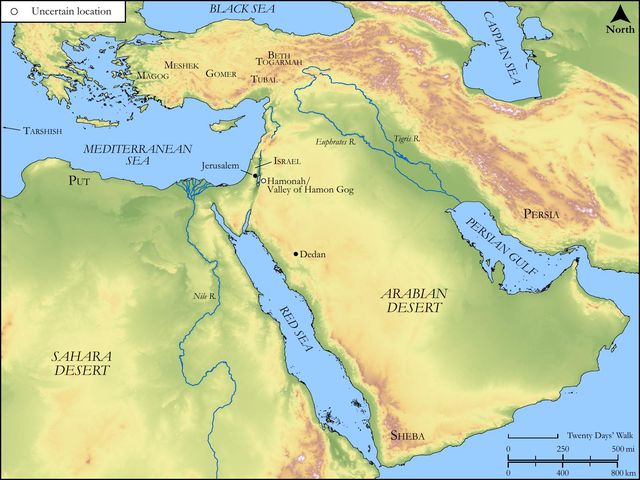
See on the biblical-era map
Study this verse
Public-domain commentary
Matthew Henry
From his Commentary on the Whole Bible. Henry comments on passages, not single verses — this entry covers Ezekiel 39:23–29. His four-level outline is real structure in the source text, so it is rendered as structure.
This is the conclusion of the whole matter going before, and has reference not only to the predictions concerning Gog and Magog, but to all the prophecies of this book concerning the captivity of the house of Israel, and then concerning their restoration and return out of their captivity.
I.God will let the heathen know the meaning of his people's troubles, and rectify the mistake of those concerning them who took occasion from the troubles of Israel to reproach the God of Israel, as unable to protect them and untrue to his covenant with them. When God, upon their reformation and return to him, turned again their captivity, and brought them back to their own land, and, upon their perseverance in their reformation, wrought such great salvations for them as that from the attempts of Gog upon them, then it would be made to appear, even to the heathen that would but consider and compare things, that there was no ground at all for their reflection, that Israel went into captivity, not because God could not protect them, but because they had by sin forfeited his favour and thrown themselves out of his protection (Eze 39:23, Eze 39:24): The heathen shall know that the house of Israel went into captivity for their iniquity, that iniquity which they learned from the heathen their neighbours, because they trespassed against God. That was the true reason why God hid his face from them and gave them into the hand of their enemies. It was according to their uncleanness and according to their transgressions. Now the evincing of this will not only silence their reflections on God, but will redound greatly to his honour; when the troubles of God's people are over, and we see the end of them, we shall better understand them than we did at first. And it will appear much for the glory of God when the world is made to know,
1.That God punishes sin even in his own people, because he hates it most in those that are nearest and dearest to him, Amo 3:2. It is the praise of justice to be impartial.
2.That, when God gives up his people for a prey, it is to correct them and reform them, not to gratify their enemies, Isa 10:7; Isa 42:24. Let not them therefore exalt themselves.
3.That no sooner do God's people humble themselves under the rod than he returns in mercy to them.
II.God will give his own people to know what great favour he has in store for them notwithstanding the troubles he had brought them into (Eze 39:25, Eze 39:26): Now will I bring again the captivity of Jacob.
1.Why now? Now God will have mercy upon the whole house of Israel,
(1.)Because it is time for him to stand up for his own glory, which suffers in their sufferings: Now will I be jealous for my holy name, that that may no longer be reproached.
(2.)Because now they repent of their sins: They have borne their shame, and all their trespasses. When sinners repent, and take shame to themselves, God will be reconciled and put honour upon them. It is particularly pleasing to God that these penitents look a great way back in their penitential reflections, and are ashamed of all their trespasses which they were guilty of when they dwelt safely in their land and none made them afraid. The remembrance of the mercies they enjoyed in their own land, and the divine protection they were under there, shall be improved as an aggravation of the sins they committed in that land; they dwelt safely, and might have continued to dwell so, and none should have given them any disquiet or disturbance if they had continued in the way of their duty. Nay, therefore they trespassed because they dwelt safely. Outward safety is often a cause of inward security, and that is an inlet to all sin, Ps. 73. Now this they are willing to bear the shame of, and acknowledge that God has justly brought them into a land of trouble, where every one makes them afraid, because they had trespassed against him in a land of peace, where none made them afraid. And, when they thus humble themselves under humbling providences, God will bring again their captivity: and,
2.What then? When God has gathered them out of their enemies' hands, and brought them home again,
(1.)Then God will have the praise of it: I will be sanctified in them in the sight of many nations, Eze 39:27. As God was reproached in the reproach they were under during their captivity, so he will be sanctified in their reformation and the making of them a holy people again, and will be glorified in their restoration and the making of them a happy glorious people again.
(2.)Then they shall have the benefit of it (Eze 39:28): They shall know that I am the Lord their God. Note, The providences of God concerning his people, that are designed for their good, have the grace of God going along with them to teach them to eye God as the Lord, and their God, in all; and then they do them good. They shall eye him as the Lord and their God,
[1.]In their calamities, that it was he who caused them to be led into captivity; and therefore they must not only submit to his will, but endeavour to answer his end in it.
[2.]In their comfort, that it is he who has gathered them to their own land, and left none of them among the heathen. Note, By the variety of events that befal us, if we look up to God in all, we may come to acquaint ourselves better with his various attributes and designs.
(3.)Then God and they will never part, Eze 39:29.
[1.]God will pour out his Spirit upon them, to prevent their departures from him and returns to folly again, and to keep them close to their duty. And then,
[2.]He will never hide his face any more from them, will never suspend his favour as he had done; he will never turn from doing them good, and, in order to that, he will effectually provide that they shall never turn from doing him service. Note, The indwelling of the Spirit is an infallible pledge of the continuance of God's favour. He will hide his face no more from those on whom he has poured out his Spirit. When therefore we pray that God would never cast us away from his presence we must as earnestly pray that, in order to that, he would never take his Holy Spirit away from us, Psa 51:11.
Historical interpretation
Historical reception
1 surviving comment on this verse from the historical church.
(Verse 17 and following) 'Therefore, son of man, thus says the Lord God: Speak to every winged creature, to all the birds, and to all the beasts of the field or the countryside: Come together and hasten, gather from all around to my sacrifice that I have offered to you, a great sacrifice upon the mountains of Israel, so that you may eat flesh and drink blood. You shall eat the meat of the mighty or giants, and you shall drink the blood of the rulers of the land: of rams, lambs, goats, and of bulls, as well as of all the fatted ones.' And you shall eat the fat in abundance, and drink the blood to the full, of the offering that I have sacrificed for you. And you shall be filled at my table with horses and chariots, with mighty men and all kinds of warriors, says the Lord God. And I will display my glory among the nations, and all the nations shall see my judgment that I have executed, and my hand that I have laid upon them. And the house of Israel shall know that I am the Lord their God from that day forward. And all the nations shall know that the house of Israel were taken captive because of their iniquities, because they had forsaken me and I had hidden my face from them and given them into the hand of their enemies, and they all fell by the sword. According to their uncleanness and their transgressions, I dealt with them and hid my face from them. Therefore thus says the Lord God: Now I will bring back the captivity of Jacob, and have mercy on the whole house of Israel: and I will be zealous for my holy name. And they shall bear their confusion (or disgrace), and all their transgressions, whereby they have transgressed against me, when they dwelt confidently (or securely) in their own land, fearing no one. And I will bring them back from the peoples (or nations), and gather them out of the countries of their enemies (or from the regions of the nations), and I will be sanctified in them in the sight (or presence) of many nations. And they shall know that I am the Lord their God, when I have caused them to be carried away among the nations (or when I have appeared to them in the Gentiles), and have gathered them together upon their own land, and have not left any one of them there. Neither will I hide my face any more from them, for I have poured out my spirit (or fury) upon the house of Israel, saith the Lord God.' This which we have translated according to the Hebrew, and I will gather them together upon their own land, and will not leave any one of them there, is not found in the LXX. And again, what is placed at the end according to the Hebrews for a blessing, because I have poured out my spirit, the Septuagint translated as fury, which pertains to anger, especially since in Hebrew it is written as Ruhi, which properly means my spirit, and by no means my fury. However, everything up to that point, where the construction of the temple follows, those whom we have mentioned above, the Jews, and our Judaizing brethren, refer to the ultimate time: that Gog and all his army may be fattened like the choicest sacrifices of birds and beasts, and that Israel may be restored to its former state, and no longer be conquered by the nations, but that God may pour out his spirit upon them, so that they may dwell in their land: not all nations, but specifically the house of Israel. But following the initiated tropology, we will say this, that the Lord summons all birds and all beasts to devour the leaders of heretics as the fattest victims. Birds and beasts, however, are called so either because of their swiftness in running everywhere or because of their fierceness and cruelty, to which adversaries are handed over to be destroyed in the flesh, so that the spirit may be saved and they may learn not to blaspheme (I Tim. I). However, they will eat a large and fattest victim; not elsewhere, but on the mountains of Israel, which we ought to understand as the prophets and apostles, and holy men. For in them the teachers of contrary doctrines fall, and they perish wounded by themselves, upon whom the Church is built: and to speak more truly, upon the mountain of mountains, about which Isaiah and Micah speak: Come, let us go up to the mountain of the Lord, and to the house of the God of Jacob, and he will show us his ways (Isa. II, 3; Mic. IV, 2). But those birds and those animals, swift and cruel, will eat flesh and drink blood, which cannot possess the kingdom of God: the flesh of the mighty, or giants, who rebelled against the knowledge of God, and the blood of princes, not of heaven, but of the earth, they will drink, who have savored all earthly things: the blood of rams, and lambs, and goats, or according to the Septuagint, the blood of rams, calves, and goats, to signify the three animals that are sacrificed in the offerings to God. For heretics imitate the gentleness of the Church, but their offering does not profit for the worship of God, but for the food of demons, which is their fattest host, and they are satisfied with fatness and drink the blood of deceivers to the point of drunkenness. But God sacrifices this victim through ecclesiastical men, so that the guests of the worst kind may be satisfied with the multitude of deceivers, and they may drink to the point of vomiting and drunkenness. When you see holy men, instructed in divine Scriptures, cut down the horses of heretics and charioteers, of whom it is written: He threw the horse and its rider into the sea (Exodus XV, 1), and cut down all rebels and giants with his sword, and shed the blood of all warriors of false-named knowledge, then know that the table of the Lord has been prepared, that he may put his glory in all nations that believe in his name, and that they may understand the judgment of the Church of his holy ones, which they have performed against their adversaries, and the strong hand with which they have struck them; and let the house of Israel know and understand that he is their Lord God, who spoke: I am your Lord God, from the day of the Lord's victory until eternity; and let them recall that the house of Israel was once captured by heretics and scattered throughout the entire world of perverse doctrines, because they had abandoned him who had hidden momentarily or turned his face away from them, and delivered them into the hands of heretics, and they fell, pierced by their swords, because of their impurities and iniquities; and this was the reason why he hid and turned his face away from them. But after presenting the arguments, according to what is written: There must be heresies so that those who are approved may become manifest (I Cor. XI, 19), the captivity of Israel, namely the Church, in which those who see God dwell: now it promises that it will restore the captivity of Jacob to the Church, who had supplanted the Jewish people, and was later supplanted by the tricks of the heretics: and it will have mercy on the whole house of Israel, not according to the flesh, but according to the spirit. And I will take up my zeal for my holy name, which was blasphemed among the nations because of heretics: so that once I have delivered them, they may be ashamed and confounded, for why have they forsaken the faith of the Church, and transgressed against me. But let them be confounded and ashamed very quickly, when they have dwelt in their land, the land of the meek, and the land of the saints, and have dwelt confidently, whether in peace, not fearing the snares of heretics. Then they will be brought back from the peoples, and will be gathered from the lands of their enemies into their own land. And the Lord will be sanctified in them in the sight of many nations, who themselves will also believe in the Lord. And the end of blessedness will be to know and recognize that he is their Lord God, because he has appeared to them among the nations, or has brought them over from the nations, and has gathered them onto his own land, the land of Judah, the land of confession, the land of gentleness, and the land of the living, and he will not even leave a trace of heretical wickedness. And he will no longer hide his face from them, nor turn away from them, because he has poured out the spirit of his grace, of which the prophet Joel also speaks: 'In the last days, I will pour out from my spirit upon all flesh' (Joel 2:28), and he will pour it out upon all the house of Israel. But if we read 'fury' according to the Septuagint, which is not found in the Hebrew, it should be understood that he will no longer hide his face from those on whom he had previously poured out his fury. Up to this point in the prophet Ezekiel, with God aiding and opening our mouth, we have spoken: not destroying the opinion of others, if anyone has written, or in the future, if they are to write, but asserting whatever is ours. But in the construction of the temple, and the order of the priests, and the division of the holy land, and the river flowing out of the temple, and the trees on both banks always green, and the fruit brought forth every month, and all the rest that is contained in the prophetic volume until the end, we frankly confess our ignorance, deeming it better to say nothing than to say too little.
Continue studying Ezekiel 39:25 across the web’s major study libraries — every link below opens this exact verse, chapter, or book on the destination site.
Read & Compare
 BibleGatewayThis verse in more than 200 translations and 70 languages.
 Bible.comThe YouVersion reader — hundreds of translations, reading plans, and highlights.
 ESV.orgCrossway's official English Standard Version reader.
 NET BibleThe NET translation with 60,000+ translators' notes on every rendering decision.
 STEP BibleTyndale House's free study tool — original text, vocabulary, and scholarly resources.
 BibliaLogos Bible Software's free web reader.
 USCCBThe New American Bible (Revised Edition) with the U.S. bishops' study notes.
Commentaries
 BibleHub CommentariesDozens of classic commentaries on this verse, gathered on one page.
 StudyLightMore than 100 commentary sets — the largest collection on the web.
 BibleRefPlain-English commentary on what this verse means, verse by verse.
 Enduring WordDavid Guzik's free commentary on this chapter, widely used by Bible teachers.
 Bible Study ToolsVerse commentary alongside Greek and Hebrew study aids.
Original Language & Research
- BibleHub InterlinearThe verse word by word — original language, transliteration, and English.
- BibleHub LexiconEvery word's original-language definition and Strong's entry.
 Blue Letter BibleDeep-study tools — Strong's numbers, concordance, and word studies.
 SefariaThe Hebrew text with Rashi and centuries of Jewish commentary.
Sermons, Hymns & Audio


TrulyRandomVerse is not affiliated with these sites and doesn’t control their content. They’re linked because they’re genuinely useful.
Summary
Ezekiel 39:25 stands as a pivotal declaration in the prophetic book, immediately following the dramatic and decisive defeat of Gog and his confederacy. This verse unveils the Lord GOD's unwavering resolve to reverse the fortunes of His people, promising to restore Israel from their captivity. This profound act of restoration is portrayed as being motivated by God's boundless mercy and an intense, righteous zeal for the vindication and sanctification of His own holy name before all nations. It marks a significant transition from divine judgment on the nations to a renewed focus on God's covenant faithfulness and the ultimate display of His character through the restoration of His chosen people.
Context
ShowHideLiterary Context
This verse is strategically positioned at the culmination of the extensive Gog-Magog prophecy, spanning Ezekiel 38 and Ezekiel 39. These chapters vividly describe a cataclysmic, supernatural intervention by God to utterly annihilate a vast coalition of nations that dares to attack His people. The preceding verses (Ezekiel 39:21-24) emphasize that this overwhelming victory serves to reveal God's glory and righteousness to both Israel and the surrounding nations, unequivocally demonstrating that Israel's prior exile was a direct consequence of their unfaithfulness. Ezekiel 39:25 then pivots sharply from this global display of judgment to an intimate and profound declaration of God's restorative purpose for His people, laying the theological groundwork for the glorious visions of a renewed temple, land, and covenant relationship detailed in Ezekiel 40-48.
Historical & Cultural Context
Ezekiel delivered his prophecies to the Jewish exiles in Babylon during a period of profound national humiliation and despair (approximately 593-571 BC). The Babylonian exile was not merely a political defeat but was perceived as an immense disgrace, not only for the nation of Israel but, more significantly, for their God, whose power and faithfulness appeared to be called into question by the pagan nations surrounding them. The concept of "captivity" (Hebrew: shᵉbûwth) was a deeply felt reality for these exiles, who yearned for their return to the promised land. God's declaration of "jealousy for my holy name" directly addresses this sensitive cultural context, asserting that His actions, both in judgment and in the promised restoration, are ultimately for the vindication of His own reputation, honor, and unwavering covenant faithfulness, which had been profaned by Israel's apostasy and subsequent exile among the Gentiles, as powerfully articulated in Ezekiel 36:20-23.
Key Themes
ShowHideEzekiel 39:25 encapsulates several pervasive and interconnected themes central to the book of Ezekiel and broader biblical theology. The theme of Divine Restoration is paramount, promising a complete reversal of Israel's fortunes and a comprehensive return from exile, encompassing not only physical resettlement but also profound spiritual renewal, as foreshadowed by God's promise to gather Israel from among the nations in Ezekiel 36:24. This promised restoration is deeply rooted in God's Sovereign Mercy, emphasizing that it is not predicated on Israel's merit or repentance but flows purely from God's inherent compassionate character and steadfast covenant love, despite their historical unfaithfulness. Crucially, the verse highlights God's Zeal for His Holy Name as the ultimate and overarching motivation. This "jealousy" is understood as a righteous, passionate, and protective commitment to His own reputation, honor, and covenant promises, ensuring that His name is sanctified, revered, and recognized as supreme among all nations, a motif powerfully and repeatedly articulated throughout Ezekiel, particularly in Ezekiel 36:22-23.
Exposition and Analysis
ShowHideKey Word Analysis
ShowHideThis term, derived from the root for "to take captive," refers concretely to exile or prisoners. However, in idiomatic phrases like "bring again the captivity" (shûwb shᵉbûwth), it transcends mere physical return. It signifies a complete and comprehensive reversal of fortune, a restoration to a former state of prosperity, dignity, and covenant favor, implying a profound national and spiritual renewal beyond simply coming home.
This primitive root means "to fondle" and, by implication, "to love," especially "to compassionate." It conveys a deep, visceral, and tender compassion, akin to the profound love a parent has for a child. In this context, it profoundly underscores that God's act of restoring Israel is not a response to their worthiness or earned merit but flows purely from His inherent character of tender, unwavering compassion, grace, and covenant faithfulness.
This root signifies "to be (causatively, make) zealous," which in human terms can manifest as negative jealousy or envy. However, when applied to God, it describes His intense, protective zeal for His own honor, reputation, and covenant. It is a righteous and holy attribute, demonstrating His passionate commitment to uphold His holiness, vindicate His character, and ensure His promises are fulfilled and recognized as supreme by all creation. This divine jealousy guarantees His active intervention to protect His glory.
Verse Breakdown
ShowHide"Therefore thus saith the Lord GOD;"
This opening phrase functions as a powerful and emphatic divine oracle formula. It serves to declare the absolute authority, certainty, and unalterable nature of the pronouncement that immediately follows. It signals that the subsequent statement is a direct, sovereign, and binding word from the Creator and Covenant Lord, YHWH (represented by "Lord GOD," combining H136 ʼĂdônây and H3069 Yᵉhôvih).
"Now will I bring again the captivity of Jacob,"
This clause expresses God's immediate, decisive, and active intention to reverse the exiled state of His people. "Jacob" (H3290 Yaʻăqôb) here represents the entire nation of Israel (H3478 Yisrâʼêl), encompassing all twelve tribes, emphasizing the comprehensive and universal nature of the promised restoration. The idiomatic phrase "bring again the captivity" (shûwb shᵉbûwth, using H7725 shûwb and H7622 shᵉbûwth) implies a full and complete reversal of their fortunes, restoring them not only to their land but also to their dignity, prosperity, and renewed covenant relationship with God.
"and have mercy upon the whole house of Israel,"
This reveals the profound and compassionate motivation behind God's restorative action. His sovereign decision to bring Israel back is not contingent upon their deservingness or prior repentance, but rather flows as a spontaneous and unmerited outflow of His divine compassion (H7355 râcham) and steadfast love. "The whole house of Israel" (H1004 bayith of H3478 Yisrâʼêl) underscores the universality of this mercy, encompassing all the descendants of Jacob, uniting both the northern and southern kingdoms in this promised, comprehensive restoration.
"and will be jealous for my holy name;"
This concluding clause articulates the ultimate and overarching purpose of God's actions. His "jealousy" (H7065 qânâʼ) is a righteous, protective zeal for His own honor and reputation (H8034 shêm). The exile of Israel had inadvertently caused God's name (H6944 qôdesh name) to be profaned and questioned among the nations, who misconstrued His power and faithfulness. By initiating this magnificent restoration, God decisively vindicates His character, demonstrates His unwavering commitment to His covenant promises, and ensures that His holiness and glory are recognized, revered, and sanctified by all creation.
Literary Devices
ShowHideEzekiel 39:25 masterfully employs several literary devices to convey its powerful and profound message. The most prominent is the Divine Oracle Formula, "Therefore thus saith the Lord GOD," which immediately establishes the divine origin, absolute authority, and unchallengeable certainty of the prophecy. This formula imbues the declaration with immense weight and solemnity. Another significant device is Anthropomorphism, evident in the phrase "will be jealous for my holy name." While "jealousy" in human terms often carries negative connotations of insecurity or envy, here it attributes a human emotion to God to powerfully convey His intense, protective zeal and passionate commitment to His own honor, reputation, and covenant. It is a righteous and holy jealousy, distinct from any human failing. Furthermore, the verse exhibits a form of Climactic Parallelism or a progression of ideas, where the three main declarations—"bring again the captivity," "have mercy," and "be jealous for my holy name"—build upon each other. They move from the specific action (restoration) to the immediate, inherent motivation (divine mercy) to the ultimate, overarching purpose (the glorification and vindication of God's holy name), creating a powerful, comprehensive, and divinely purposeful statement of intent.
Theological and Thematic Connections
ShowHideEzekiel 39:25 profoundly illustrates the unwavering faithfulness of God, the boundless nature of His sovereign mercy, and the absolute centrality of His glory in all His dealings with humanity. It reveals that even in the face of profound human failure, rebellion, and national disgrace, God's covenant promises remain steadfast, and His ultimate purpose is the vindication and sanctification of His own name before all nations. This verse teaches us a fundamental theological truth: God's redemptive acts are not primarily for the benefit of His people as an end in themselves, but rather as a means to demonstrate His character, power, and holiness to the entire world, ensuring that His glory is recognized and His name revered. It offers a powerful assurance that God's plans for restoration, whether for a nation or for an individual, are immutably rooted in His unchanging nature and His passionate commitment to His own glory and the fulfillment of His promises.
Reflection and Application
ShowHideEzekiel 39:25 offers profound encouragement and practical guidance for believers navigating life's challenges today. It serves as a powerful reminder that God's faithfulness is not contingent on our perfect obedience or worthiness, but flows eternally from His unchanging character and His unwavering commitment to His own glory. Just as God promised to reverse Israel's "captivity," He extends this same hope and offers release from various forms of spiritual, emotional, or circumstantial "captivity" that we may experience in our own lives. This verse calls us to cultivate a deep trust in His sovereign mercy, knowing that His compassion is boundless, limitless, and His plans for restoration are absolutely sure. Ultimately, it directs our gaze to God's ultimate purpose in all things: the glorification and sanctification of His holy name. This profound truth should inspire us to live lives that authentically reflect His holiness, pursue righteousness, and intentionally bring honor to Him in every sphere of our existence, understanding that our personal redemption and restoration are integral parts of a grander, cosmic narrative where God's magnificent character is vindicated and His glory displayed before a watching world.
Questions for Reflection
ShowHideFAQ
ShowHideWhat does "bring again the captivity of Jacob" mean in this context?
ShowHideThis idiomatic Hebrew phrase, shûwb shᵉbûwth, signifies much more than a simple physical return from exile. While it certainly encompasses the literal return of the Jewish people to their homeland after the Babylonian exile, it primarily denotes a complete and comprehensive reversal of fortune, a restoration to a former state of prosperity, dignity, and covenant favor. It implies a holistic renewal—physical, national, and profoundly spiritual—where God fully restores what was lost due to sin and judgment. This restoration is a powerful and undeniable demonstration of God's faithfulness and power to the nations, as further elaborated in Ezekiel 36:24-28.
Why is God described as "jealous" for His holy name? Is this a positive attribute?
ShowHideWhen the Bible describes God as "jealous" (qânâʼ), it is always presented as a divine attribute, fundamentally distinct from human envy, insecurity, or selfishness. God's jealousy is a righteous, protective zeal for His own honor, reputation, and covenant. His "holy name" (H6944 qôdesh H8034 shêm) represents His entire character, His inherent power, and His inviolable promises. Because Israel's exile had caused God's name to be profaned and questioned among the nations (as powerfully stated in Ezekiel 36:20-23), God's jealousy means He is passionately committed to vindicating His character, demonstrating His unwavering faithfulness, and ensuring that His holiness is recognized, revered, and sanctified by all creation. Therefore, it is indeed a profoundly positive and necessary attribute that guarantees His justice will prevail and His covenant promises will be upheld.
Christ-Centered Fulfillment
ShowHideEzekiel 39:25, with its profound declaration of God's merciful restoration and zealous commitment to His holy name, finds its ultimate and most profound fulfillment in the person and work of Jesus Christ. While the verse speaks of a physical return from Babylonian captivity and a future national restoration for Israel, it also powerfully foreshadows the deeper, spiritual "captivity" from which all humanity desperately needs deliverance—the universal bondage of sin, death, and separation from God. Jesus, the Lamb of God who takes away the sin of the world, perfectly embodies God's boundless mercy (râcham) in its fullest and most redemptive expression, offering complete forgiveness, spiritual liberation, and new life to all who place their faith in Him. He came to fulfill the prophetic hope of liberation, proclaiming release to the captives and recovery of sight to the blind (Luke 4:18-19). Furthermore, Jesus' entire life of perfect obedience, His atoning death on the cross, and His glorious resurrection supremely glorified God's holy name, demonstrating His justice, His unfathomable love, and His sovereign power over sin and death. Through His sacrificial work, God's name was supremely vindicated, His holiness perfectly upheld, and a new way of reconciliation was opened. The future restoration of Israel, as promised in passages like Romans 11:26, will also be accomplished through Christ, ultimately bringing all things under His glorious reign and ensuring that every knee will bow and every tongue confess that Jesus Christ is Lord, to the glory of God the Father.