


Colossians 3:6
Bible text: King James Version (1769 Blayney text) · Public domain
Bible text: Berean Standard Bible · Public domain
Bible text: American Standard Version (1901) · Public domain
Bible text: World English Bible, Messianic edition · Public domain
Bible text: Geneva Bible (1599) · Public domain
Bible text: Young's Literal Translation · Public domain
- δι᾽di᾽because ofG1223PREPPreposition
- ἃhawhich thingsG3739R-APNRelative pronoun Accusative Plural Neuter
- ἔρχεταιerchetaiis comingG2064V-PNI-3SVerb Present Middle Or Passive Deponent Indicative 3rd Singular
- ἡhētheG3588T-NSFDefinite article Nominative Singular Feminine
- ὀργὴorgēwrathG3709N-NSFNoun Nominative Singular Feminine
- τοῦtou<the>G3588T-GSMDefinite article Genitive Singular Masculine
- θεοῦtheouof GodG2316N-GSM-TNoun Genitive Singular Masculine Title
- ἐπὶepionG1909PREPPreposition
- τοὺςtoustheG3588T-APMDefinite article Accusative Plural Masculine
- υἱοὺςhuioussonsG5207N-APMNoun Accusative Plural Masculine
- τῆςtēs<the>G3588T-GSFDefinite article Genitive Singular Feminine
- ἀπειθείας·apeitheiasof disobedienceG543N-GSFNoun Genitive Singular Feminine
English is a literal word-by-word gloss of the Greek, not the KJV's wording. Why?
This is the original text the KJV's translators worked from — each Greek word with its own literal English meaning in this verse, prepared by scholars at Tyndale House, Cambridge. The KJV translates whole sentences, not word by word, so its wording differs: one Greek word can become several English words, and the KJV may choose “charity” where the gloss reads “love”. Both are faithful — they answer different questions. For the KJV's own rendering, switch to the KJV text.
Details
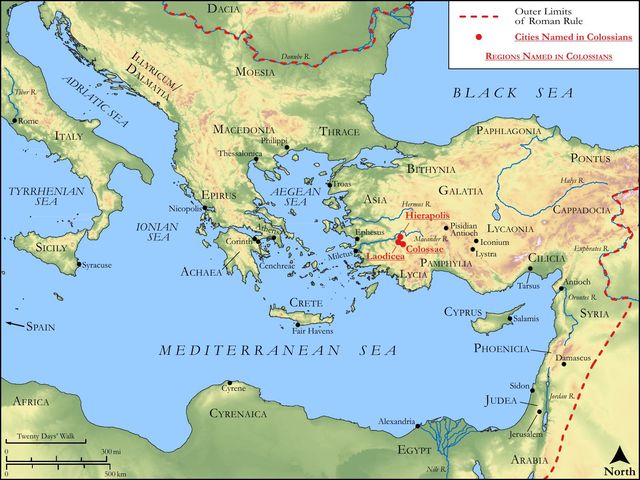
See on the biblical-era maps

Study this verse
Public-domain commentary
Matthew Henry
From his Commentary on the Whole Bible. Henry comments on passages, not single verses — this entry covers Colossians 3:5–7. His two-level outline is real structure in the source text, so it is rendered as structure.
The apostle exhorts the Colossians to the mortification of sin, the great hindrance to seeking the things which are above. Since it is our duty to set our affections upon heavenly things, it is our duty to mortify our members which are upon the earth, and which naturally incline us to the things of the world: "Mortify them, that is, subdue the vicious habits of mind which prevailed in your Gentile state. Kill them, suppress them, as you do weeds or vermin which spread and destroy all about them, or as you kill an enemy who fights against you and wounds you." - Your members which are upon the earth; either the members of the body, which are the earthly part of us, and were curiously wrought in the lower parts of the earth (Psa 139:15), or the corrupt affections of the mind, which lead us to earthly things, the members of the body of death, Rom 7:24. He specifies,
I.The lusts of the flesh, for which they were before so very remarkable:
Fornication, uncleanness, inordinate affection, evil concupiscence - the various workings of the carnal appetites and fleshly impurities, which they indulged in their former course of life, and which were so contrary to the Christian state and the heavenly hope.
II.The love of the world:
And covetousness, which is idolatry; that is, an inordinate love of present good and outward enjoyments, which proceeds from too high a value in the mind, puts upon too eager a pursuit, hinders the proper use and enjoyment of them, and creates anxious fear and immoderate sorrow for the loss of them. Observe, Covetousness is spiritual idolatry: it is the giving of that love and regard to worldly wealth which are due to God only, and carries a greater degree of malignity in it, and is more highly provoking to God, than is commonly thought. And it is very observable that among all the instances of sin which good men are recorded in the scripture to have fallen into (and there is scarcely any but some or other, in one or other part of their life, have fallen into) there is no instance in all the scripture of any good man charged with covetousness. He proceeds to show how necessary it is to mortify sins, Col 3:6, Col 3:7.
1.Because, if we do not kill them, they will kill us: For which things' sake the wrath of God cometh on the children of disobedience, Col 3:6. See what we are all by nature more or less: we are children of disobedience: not only disobedient children, but under the power of sin and naturally prone to disobey. The wicked are estranged from the womb; they go astray as soon as they are born, speaking lies, Psa 58:3. And, being children of disobedience, we are children of wrath, Eph 2:3. The wrath of God comes upon all the children of disobedience. Those who do not obey the precepts of the law incur the penalties of it. The sins he mentions were their sins in their heathen and idolatrous state, and they were then especially the children of disobedience; and yet these sins brought judgments upon them, and exposed them to the wrath of God.
2.We should mortify these sins because they have lived in us: In which you also walked some time, when you lived in them, Col 3:7. Observe, The consideration that we have formerly lived in sin is a good argument why we should now forsake it. We have walked in by-paths, therefore let us walk in them no more. If I have done iniquity, I will do no more, Job 34:32. The time past our lives may suffice us to have wrought the will of the Gentiles, when we walked in lasciviousness, Pe1 4:3. - When you lived among those who did such things (so some understand it), then you walked in those evil practices. It is a hard thing to live among those who do the works of darkness and not have fellowship with them, as it is to walk in the mire and contract no soil. Let us keep out of the way of evil-doers.
Historical interpretation
Historical reception
2 surviving comments on this verse. Each one is dated, so this reads as a timeline rather than a list.
"For which things' sake cometh the wrath of God upon the sons of disobedience."
By many things he had been withdrawing them; by the benefits which are already given, by the evils to come from which we had been delivered, being who, and wherefore; and all those considerations, as, for instance, who we were, and in what circumstances, and that we were delivered therefrom, how, and in what manner, and on what terms. These were enough to turn one away, but this one is of greater force than all; unpleasant indeed to speak of, not however to disservice, but even serviceable. "For which things' sake cometh," he saith, "the wrath of God upon the sons of disobedience." He said not, "upon you," but, "upon the sons of disobedience."
"For which things' sake cometh," he saith, "the wrath of God upon the sons of disobedience." Sons of disobedience, he calls them, to deprive them of excuse, and to show that it was because they would not be obedient, that they were in that condition.
Continue studying Colossians 3:6 across the web’s major study libraries — every link below opens this exact verse, chapter, or book on the destination site.
Read & Compare
 BibleGatewayThis verse in more than 200 translations and 70 languages.
 Bible.comThe YouVersion reader — hundreds of translations, reading plans, and highlights.
 ESV.orgCrossway's official English Standard Version reader.
 NET BibleThe NET translation with 60,000+ translators' notes on every rendering decision.
 STEP BibleTyndale House's free study tool — original text, vocabulary, and scholarly resources.
 BibliaLogos Bible Software's free web reader.
 USCCBThe New American Bible (Revised Edition) with the U.S. bishops' study notes.
Commentaries
 BibleHub CommentariesDozens of classic commentaries on this verse, gathered on one page.
 StudyLightMore than 100 commentary sets — the largest collection on the web.
 BibleRefPlain-English commentary on what this verse means, verse by verse.
 Enduring WordDavid Guzik's free commentary on this chapter, widely used by Bible teachers.
 Bible Study ToolsVerse commentary alongside Greek and Hebrew study aids.
Original Language & Research
- BibleHub InterlinearThe verse word by word — original language, transliteration, and English.
- BibleHub LexiconEvery word's original-language definition and Strong's entry.
 Blue Letter BibleDeep-study tools — Strong's numbers, concordance, and word studies.
 CNTR CollationThe earliest Greek manuscripts of this verse, collated letter by letter.
Sermons, Hymns & Audio


TrulyRandomVerse is not affiliated with these sites and doesn’t control their content. They’re linked because they’re genuinely useful.
Summary
Colossians 3:6 delivers a profound warning regarding the divine consequences of a life characterized by the vices previously enumerated by Paul. It asserts that God's righteous wrath is actively directed towards those whose nature and behavior are defined by disobedience, serving as a stark reminder of the gravity of sin and the necessity for believers to fully embrace their new identity in Christ by putting off the old, sinful self.
Context
ShowHideLiterary Context
This verse is a pivotal point in Paul's letter, transitioning from theological exposition to practical exhortation. It directly follows the list of specific sins—"fornication, uncleanness, inordinate affection, evil concupiscence, and covetousness, which is idolatry"—in Colossians 3:5. Paul's command to "mortify therefore your members which are upon the earth" in Colossians 3:5 is immediately reinforced by the solemn warning of Colossians 3:6. This juxtaposition highlights the urgent need for believers, who have been risen with Christ, to actively shed these behaviors, which are characteristic of their former, unregenerate lives. The warning serves as a powerful motivation to truly put off the old man with his deeds and put on the new man, which is renewed in knowledge after the image of its Creator.
Historical & Cultural Context
The city of Colossae, located in Phrygia, was a melting pot of various philosophical and religious influences. The church there faced challenges from syncretistic teachings, including elements of Jewish legalism, Gnosticism, and local pagan cults, which often promoted asceticism or, conversely, moral laxity under the guise of spiritual enlightenment. Paul's letter combats these false teachings by emphasizing the supremacy and sufficiency of Christ. The vices listed in Colossians 3:5 were prevalent among the Gentiles, reflecting common pagan practices. The concept of divine wrath was familiar in both Jewish and Hellenistic thought, but Paul recontextualizes it within the framework of God's righteous judgment against sin, particularly against those who persist in rebellion against Him, rather than a capricious act of a deity. This warning was crucial for a community tempted to compromise their Christian walk with worldly practices.
Key Themes
ShowHideThe overarching theme of Colossians 3 is the believer's new identity in Christ and the practical implications of this spiritual reality. Colossians 3:6 contributes to several key themes:
Divine Justice and Wrath
The phrase "the wrath of God" underscores God's holy and settled indignation against sin and unrighteousness. It is not an arbitrary outburst but a just and consistent response to rebellion against His holy character and moral law. This theme is foundational to understanding God's nature, as revealed throughout Scripture, particularly in passages like Romans 1:18.
Consequences of Disobedience
The verse highlights that persistent, habitual sin leads to divine judgment. While believers are ultimately saved from God's eschatological wrath through Christ, Paul emphasizes that a life characterized by the specified vices aligns with those who are subject to God's active displeasure and temporal consequences. It serves as a warning against spiritual complacency and compromise.
Children of Disobedience
This idiomatic expression, a Hebraism, describes those whose very nature or characteristic behavior is defined by rebellion against God. It signifies not merely occasional sin, but a pattern of life lived in willful opposition to God's will and truth. This concept is paralleled in Ephesians 5:6, reinforcing the consistent New Testament teaching on this matter.
Exposition and Analysis
ShowHideKey Word Analysis
ShowHideFrom ὀρέγομαι, properly denoting a strong desire or excitement of the mind. In this context, it signifies violent passion, ire, or a justifiable abhorrence. It implies God's settled, righteous indignation against sin, rather than a sudden, uncontrolled outburst of anger. It speaks to God's inherent opposition to evil and His holy character.
A primary verb meaning "to come or go" in a wide variety of applications, both literally and figuratively. Here, it denotes an active, present reality or an impending certainty. The wrath of God is not merely a future event but is already in motion, actively manifesting against unrighteousness.
From ἀπειθής, meaning "disbelief (obstinate and rebellious)." This term describes not just a lack of obedience, but an active, willful refusal to believe or comply, indicative of a hardened heart and a rebellious disposition against God's truth and authority.
Verse Breakdown
ShowHide"For which things' sake"
This phrase directly links the consequence (God's wrath) to the preceding list of vices in Colossians 3:5. It emphasizes that these specific sinful behaviors are the direct cause or occasion for the divine judgment. The "things" are not abstract concepts but concrete actions and attitudes that are antithetical to God's holiness.
"the wrath of God"
This refers to God's righteous and holy indignation against sin. It is a settled, consistent aspect of His character, expressing His absolute opposition to all that is unholy and rebellious. This wrath is not arbitrary but is a just response to human sin and rebellion, demonstrating God's moral perfection and commitment to justice.
"cometh"
The present tense of the verb (ἔρχεται) indicates that God's wrath is not merely a future eschatological event, but an ongoing reality. It is actively manifesting in various forms against sin, and it is certain to culminate in final judgment. This conveys a sense of immediacy and inevitability regarding the consequences of persistent sin.
"on the children of disobedience"
This is a Hebraic idiom, meaning "those who are characterized by disobedience" or "those whose nature is disobedience." It refers to individuals whose lives are defined by a pattern of willful rebellion against God's commands and truth. It's not about isolated acts of sin but a pervasive disposition of unbelief and defiance, marking them as belonging to a category of people who are inherently rebellious.
Literary Devices
ShowHidePaul employs several significant literary devices in Colossians 3:6. The most prominent is Metonymy, where "the wrath of God" stands for the consequences or judgment that God brings upon sin. This is not merely an emotion but an active, judicial response. Furthermore, the phrase "children of disobedience" is a powerful Hebraism or Idiom, common in Semitic languages, where "children of X" denotes those characterized by X or belonging to a class defined by X. This idiom vividly portrays those whose very nature or habitual conduct is marked by rebellion against God. The passage also utilizes Contrast by implicitly setting the "children of disobedience" against the "children of light" or those who have been "risen with Christ," emphasizing the stark difference in their ultimate destiny and the divine response to their way of life. This serves to underscore the urgency of the call to holiness for believers.
Theological and Thematic Connections
ShowHideColossians 3:6 powerfully articulates a fundamental biblical truth: God's holiness demands a response to sin. The "wrath of God" is not an arbitrary outburst but a settled, righteous indignation against all ungodliness and unrighteousness. This verse serves as a crucial reminder that while God is love, He is also perfectly just, and His character cannot tolerate sin. For those who persist in a life characterized by the "earthly members" listed in Colossians 3:5, their path leads directly to divine judgment. This truth motivates believers not out of fear of losing salvation, but out of reverence for God's holiness and a desire to live consistently with their new identity in Christ, understanding that even for believers, a life of unrepentant sin invites God's disciplinary hand and hinders spiritual growth.
Reflection and Application
ShowHideColossians 3:6 is a sobering reminder that our actions have eternal weight and that God is not indifferent to sin. For those who have placed their faith in Christ, this verse should not evoke fear of eternal condemnation, for Christ has borne the wrath for us. Instead, it should cultivate a profound reverence for God's holiness and a deep gratitude for the salvation we have received. It challenges us to honestly examine our lives: are there "earthly members" (vices like covetousness, impurity, or malice) that we are still tolerating or even embracing? This verse calls us to an active, daily process of "mortification"—putting to death the old sinful habits and desires that are incompatible with our new life in Christ. It motivates us to pursue holiness not as a means to earn salvation, but as a loving response to the One who saved us from wrath, and as a demonstration of our transformed nature. Our pursuit of holiness is a testament to our union with Christ and a vital aspect of living out our identity as God's beloved children, reflecting His character in a world that desperately needs to see it.
Questions for Reflection
ShowHideFAQ
ShowHideDoes "the wrath of God cometh" mean believers can still experience God's wrath?
ShowHideFor those who are genuinely in Christ, the ultimate, eternal wrath of God for sin has been fully satisfied by Jesus' sacrifice on the cross. Romans 5:9 clearly states that we "shall be saved from wrath through him." However, Colossians 3:6 speaks to the active, ongoing displeasure of God against sin, which can manifest in various ways in this life, even for believers. It can involve the natural consequences of sin, God's disciplinary hand (as a loving Father, Hebrews 12:6), or a removal of His blessing and presence in certain areas of life. The warning in Colossians is not about losing salvation, but about the serious implications and lack of spiritual fruit that come from living a life characterized by disobedience, which aligns one with "the children of disobedience" who are truly under God's condemnation.
Christ-Centered Fulfillment
ShowHideColossians 3:6, with its solemn declaration of God's wrath coming upon the children of disobedience, finds its ultimate and profound fulfillment in Jesus Christ. The very wrath that is justly poured out upon those characterized by rebellion was fully absorbed and appeased by Christ on the cross. He, the sinless Son of God, became the object of divine wrath, taking upon Himself the judgment due to humanity's disobedience. Isaiah 53:5 prophesied that "he was wounded for our transgressions," and 2 Corinthians 5:21 reveals that God "made him to be sin for us, who knew no sin; that we might be made the righteousness of God in him." Therefore, for those who are "in Christ," the wrath described in Colossians 3:6 has been perfectly satisfied, and they are now "children of obedience" (1 Peter 1:14). Our freedom from this condemning wrath is entirely a gift purchased by His blood, transforming us from those upon whom wrath comes to those who are recipients of God's boundless grace and mercy, empowering us to live lives that reflect His holiness rather than the disobedience of the world.