


Ezekiel 16:46
- וַאֲחוֹתֵךְva·'a·cho·Tekhand your sisterH269Conj-w ¦ N-fsc ¦ 2fsNoun Singular Feminine Constructוַandאֲחוֹתֵsisterךְyour
- הַגְּדוֹלָהha·ge·do·Lah<the> oldH1419Art ¦ Adj-fsAdjective Singular Feminine Absoluteהַ<the>גְּדוֹלָהold
- שֹׁמְרוֹןsho·me·rOn[was] SamariaH8111N-properNoun Proper Location
- הִיאhi'sheH1931Pro-3fsPronoun Personal 3rd Singular Feminine
- וּבְנוֹתֶיהָu·ve·no·Tei·haand her daughtersH1323Conj-w ¦ N-fpc ¦ 3fsNoun Plural Feminine Constructוּandבְנוֹתֶיdaughtersהָher
- הַיּוֹשֶׁבֶתhai·yo·She·vetwho dweltH3427Art ¦ V-Qal-Prtcpl-fsVerb Qal Participle Singular Feminine Absoluteהַwhoיּוֹשֶׁבֶתdwelt
- עַל'alonH5921PrepPreposition
- שְׂמֹאולֵךְse·mo·Lekhyour northH8040N-msc ¦ 2fsNoun Singular Masculine Constructשְׂמֹאולֵnorthךְyour
- וַאֲחוֹתֵךְva·'a·cho·Tekhand your sisterH269Conj-w ¦ N-fsc ¦ 2fsNoun Singular Feminine Constructוַandאֲחוֹתֵsisterךְyour
- הַקְּטַנָּהha·ke·ta·Nah<the> youngH6996Art ¦ Adj-fsAdjective Singular Feminine Absoluteהַ<the>קְּטַנָּהyoung
- מִמֵּךְmi·Mekhmore than youH4480Prep ¦ 2fsPrepositionמִמֵּmore thanךְyou
- הַיּוֹשֶׁבֶתhai·yo·She·vetwho dweltH3427Art ¦ V-Qal-Prtcpl-fsVerb Qal Participle Singular Feminine Absoluteהַwhoיּוֹשֶׁבֶתdwelt
- מִימִינֵךְmi·mi·Nekhfrom your southH3225Prep-m ¦ N-fsc ¦ 2fsNoun Singular Feminine Constructמִfromימִינֵsouthךְyour
- סְדֹםse·Dom[was] SodomH5467N-properNoun Proper Location
- וּבְנוֹתֶיהָu·ve·no·Tei·haand her daughtersH1323Conj-w ¦ N-fpc ¦ 3fsNoun Plural Feminine Constructוּandבְנוֹתֶיdaughtersהָher
English is a literal word-by-word gloss of the Hebrew, not the KJV's wording. Why?
This is the original text the KJV's translators worked from — each Hebrew word with its own literal English meaning in this verse, prepared by scholars at Tyndale House, Cambridge. The KJV translates whole sentences, not word by word, so its wording differs: one Hebrew word can become several English words, and the KJV may choose “the LORD” where the gloss reads “Yahweh”. Both are faithful — they answer different questions. For the KJV's own rendering, switch to the KJV text.
Details
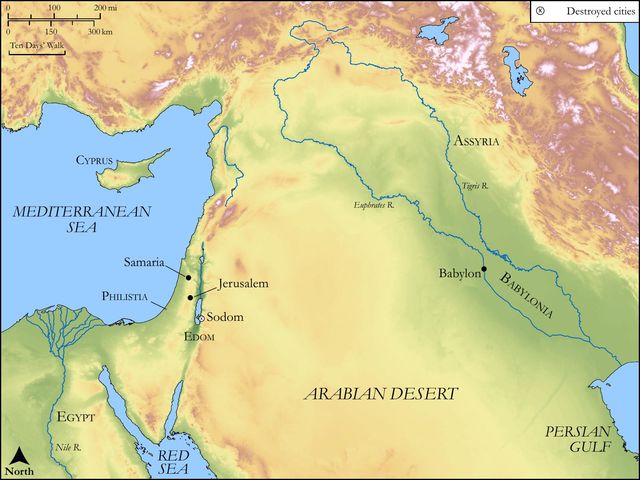
See on the biblical-era map
Study this verse
Public-domain commentary
Matthew Henry
From his Commentary on the Whole Bible. Henry comments on passages, not single verses — this entry covers Ezekiel 16:44–59. His three-level outline is real structure in the source text, so it is rendered as structure.
The prophet here further shows Jerusalem her abominations, by comparing her with those places that had gone before her, and showing that she was worse than any of them, and therefore should, like them, be utterly and irreparably ruined. We are all apt to judge of ourselves by comparison, and to imagine that we are sufficiently good if we are but as good as such and such, who are thought passable; or that we are not dangerously bad if we are no worse than such and such, who, though bad, are not of the worst. Now God by the prophet shows Jerusalem,
I.That she was as bad as her mother, that is, as the accursed devoted Canaanites that were the possessors of this land before her.
Those that use proverbs, as most people do, shall apply that proverb to Jerusalem, As is the mother, so is her daughter, Eze 16:44. She is her mother's own child. The Jews are as like the Canaanites in temper and inclination as if they had been their own children. The character of the mother was that she loathed her husband and her children, she had all the marks of an adulteress; and that is the character of the daughter: she forsakes the guide of her youth, and is barbarous to the children of her own bowels. When God brought Israel into Canaan he particularly warned them not to do according to the abominations of the men of that land, who went before them (for which it had spued them out, Lev 18:27, Lev 18:28), the monuments of whose idolatry, with the remains of the idolaters themselves, would be a continual temptation to them; but they learned their way, and trod in their steps, and were as well affected to the idols of Canaan as ever they were (Psa 106:38), and thus, in respect of imitation, it might truly be said that their mother was a Hittite and their father an Amorite (Eze 16:45), for they resembled them more than Abraham and Sarah.
II.That she was worse than her sisters Sodom and Samaria, that were adulteresses too, that loathed their husbands and their children, that were weary of the gods of their fathers, and were for introducing new gods, a-la-mode - quite in style, that came newly up, and new fashions in religion, and were given to change. On this comparison between Jerusalem and her sisters the prophet here enlarges, that he might either shame them into repentance or justify God in their ruin. Observe,
1.Who Jerusalem's sisters were, Eze 16:45. Samaria and Sodom. Samaria is called the elder sister, or rather the greater, because it was a much larger city and kingdom, richer and more considerable, and more nearly allied to Israel. If Jerusalem look northward, this is partly on her left hand. This city of Samaria, and the towns and villages, that were as daughters to that mother-city, these had been lately destroyed for their spiritual whoredom. Sodom, and the adjacent towns and villages that were her daughters, dwelt at Jerusalem's right hand, and was her less sister, less than Jerusalem, less than Samaria, and these were of old destroyed for their corporeal whoredom, Jde 1:7.
2.Wherein Jerusalem's sins resembled her sisters', particularly Sodom's (v. 49): This was the iniquity of Sodom (it is implied, and this is thy iniquity too), pride, fulness of bread, and abundance of idleness. Their going after strange flesh, which was Sodom's most flagrant wickedness, is not mentioned, because notoriously known, but those sins which did not look so black, but opened the door and led the way to these more enormous crimes, and began to fill that measure of her sins, which was filled up at length by their unnatural filthiness. Now these initiating sins were,
(1.)Pride, in which the heart lifts up itself above and against both God and man. Pride was the first sin that turned angels into devils, and the garden of the Lord into a hell upon earth. It was the pride of the Sodomites that they despised righteous Lot, and would not bear to be reproved by him; and this ripened them for ruin.
(2.)Gluttony, here called fulness of bread. It was God's great mercy that they had plenty, but their great sin that they abused it, glutted themselves with it, ate to excess and drank to excess, and made that the gratification of their lusts which was given them to be the support of their lives.
(3.)Idleness, abundance of idleness, a dread of labour and a love of ease. Their country was fruitful, and the abundance they had they came easily by, which was a temptation to them to indulge themselves in sloth, which disposed them to all that abominable filthiness which kindled their flames. Note, Idleness is an inlet to much sin. The men of Sodom, who were idle, were wicked, and sinners before the Lord exceedingly, Gen 13:13. The standing waters gather filth and the sitting bird is the fowler's mark. When David arose from off his bed at evening he saw Bathsheba. Quaeritur, Aegisthus quare sit factus adulter? In promptu causa est; desidiosus erat - What made Aegisthus an adulterer? Indolence.
(4.)Oppression: Neither did she strengthen the hands of the poor and needy; probably it is implied that she weakened their hands and broke their arms; however, it was bad enough that, when she had so much wealth, and consequently power and interest and leisure, she did nothing for the relief of the poor, in providing for whose wants those that themselves are full of bread may employ their time well; they need not be so abundantly idle as too often they are. These were the sins of the Sodomites, and these were Jerusalem's sins. Their pride, the cause of their sins, is mentioned again (Eze 16:50): They were haughty, with the horrid effects of their sins, their abominations which they committed before God. Men arrive gradually at the height of impiety and wickedness. Nemo repente fit turpissimus - No man reaches the height of vice at once. But, where pride has got the ascendant in a man, he is in the high road to all abominations.
3.How much the sins of Jerusalem exceeded those of Sodom and Samaria; they were more heinous in the sight of God, either in themselves or by reason of several aggravations: "Thou hast not only walked after their ways, and trod in their steps, but hast quite outdone them in wickedness, Eze 16:47. Thou thoughtest it a very little thing to do as they did; didst laugh at them as sneaking sinners and silly ones; thou wouldst be more cunning, more daring, in wickedness, wouldst triumph more boldly over thy convictions, and bid more open defiance to God and religion: 'if a man will break, let him break for something.' Thus thou wast corrupted more than they in all thy ways." Jerusalem was more polite, and therefore sinned with more wit, more art and ingenuity, than Sodom and Samaria could. Jerusalem had more wealth and power, and its government was more absolute and arbitrary, and therefore had the more opportunity of oppressing the poor, and shedding malignant influences around her, than Sodom and Samaria had. Jerusalem had the temple, and the ark, and the priesthood, and kings of the house of David; and therefore the wickedness of that holy city, that was so dignified, so near, so dear to God, was more provoking to him than the wickedness of Sodom and Samaria, that had not Jerusalem's privileges and means of grace. Sodom has not done as thou hast done, Eze 16:48. This agrees with what Christ says. Mat 11:24, It shall be more tolerable for the land of Sodom in the day of judgment than for thee. The kingdom of the ten tribes had been very wicked; and yet Samaria has not committed half thy sins (Eze 16:51), has not worshipped half so many idols, nor slain half so many prophets. It was bad enough that those of Jerusalem were guilty of Sodom's sins, Sodomy itself not excepted, Kg1 14:24; Kg2 23:7. And though the Dead Sea, the standing monument of Sodom's sin and ruin, bordered upon their country (Num 34:12), and that sulphureous lake was always under their nose (God having taken away Sodom and her daughters in such way and manner as he saw good, as he says here, Eze 16:50, so as that one thing should effectually make their overthrow an example to those that afterwards should live ungodly, Pe2 2:6), yet they did not take warning, but multiplied their abominations more than they; and,
(1.)By this they justified Sodom and Samaria, Eze 16:51. They pretended, in their haughtiness and superciliousness, to judge them, and in the days of old, when they retained their integrity, they did judge them, Eze 16:52. But now they justify them comparatively: Sodom and Samaria are more righteous than thou, that is, less wicked. It will look like some extenuation of their sins that, bad as they were, Jerusalem was worse, though it was God's own city. Not that it will serve for a plea to justify Sodom, but it condemns Jerusalem, against which Sodom and Samaria will rise up in judgment.
(2.)For this they ought themselves to be greatly ashamed: "Thou who hast judged thy sisters, and cried out shame on them, now bear thy own shame, for thy sins which thou hast committed, which, though of the same kind with theirs, yet, being committed by thee, are more abominable than theirs," Eze 16:52. This may be taken either as foretelling their ruin (Thou shalt bear thy shame) or as inviting them to repentance: "Be thou confounded and bear thy shame; take the shame to thyself that is due to thee." It may be hoped that sinners will forsake their sins when they begin to be heartily ashamed of them. And therefore they shall go into captivity, and there they shall lie, that they may be confounded in all that they have done, because they had been a comfort and encouragement to Sodom and Samaria, Eze 16:54. Note, There is nothing in sin which we have more reason to be ashamed of than this, that by our sin we have encouraged others in sin, and comforted them in that for which they must be grieved or they are undone. Another reason why they must now be ashamed is because in the day of their prosperity they had looked with so much disdain upon their neighbours: Thy sister Sodom was not mentioned by thee in the day of they pride, Eze 16:56. They thought Sodom not worthy to be named the same day with Jerusalem, little dreaming that Jerusalem would at length lie under a worse and more scandalous character than Sodom herself. Those that are high may perhaps come to stand upon a level with those they contemn. Or "Sodom was not mentioned, that is, the warning designed to be given to thee by Sodom's ruin was not regarded." If the Jews had but talked more frequently and seriously to one another, and to their children, concerning the wrath of God revealed from heaven against Sodom's ungodliness and unrighteousness, it might have kept them in awe, and prevented their treading in their steps; but they kept the thought of it at a distance, would not bear the mention of it, and (as the ancients say) put Isaiah to death for putting them in mind of it, when he called them rulers of Sodom and people of Gomorrah, Isa 1:10. Note, Those are but preparing judgments for themselves that will not take notice of God's judgments upon others.
4.What desolations God had brought and was bringing upon Jerusalem for these wickednesses, wherein they had exceeded Sodom and Samaria.
(1.)She has already long ago been disgraced, and has fallen into contempt, among her neighbours (Eze 16:57): Before her wickedness was discovered, before she came to be so grossly and openly flagitious, she bore the just punishment of her secret and more concealed lewdness, when she fell under the reproach of the daughters of Syria, of the Philistines, who were said to despise her and be ashamed of her (Eze 16:27), and under the reproach of all that were round about her, which seems to refer to the descent made upon Judah by the Syrians in the days of Ahaz, and soon after another by the Philistines, Ch2 28:5, Ch2 28:18. Note, Those that disgrace themselves by yielding to their lusts will justly be brought into disgrace by being made to yield to their enemies; and it is observable that before God brought potent enemies upon them, for their destruction, he brought enemies upon them that were less formidable, for their reproach. If less judgments would do the work, God would not send greater. In this thou hast borne thy lewdness, Eze 16:58. Those that will not cast off their sins by repentance and reformation shall be made to bear their sins to their confusion.
(2.)She is now in captivity, or hastening into captivity, and therein is reckoned with, not only for her lewdness (Eze 16:58), but for her perfidiousness and covenant-breaking (Eze 16:59): "I will deal with thee as thou hast done; I will forsake thee as thou hast forsaken me, and cast thee off as thou hast cast me off, for thou hast despised the oath, in breaking the covenant." This seems to be meant of the covenant God made with their fathers at Mount Sinai, whereby he took them and theirs to be a peculiar people to himself. They flattered themselves with a conceit that because God had hitherto continued his favour to them, notwithstanding their provocations, he would do so still. "No," says God, "you have broken covenant with me, have despised both the promises of the covenant and the obligations of it, and therefore I will deal with thee as thou hast done." Note, Those that will not adhere to God as their God have no reason to expect that he should continue to own them as his people.
(3.)The captivity of the wicked Jews, and their ruin, shall be as irrevocable as that of Sodom and Samaria. In this sense, as a threatening, most interpreters take Eze 16:53, Eze 16:55. "When I shall bring again the captivity of Sodom and Samaria, and when they shall return to their former estate, then I will bring again the captivity of thy captives in the midst of them, and as it were for their sakes, and under their shadow and protection, because they are more righteous than thou, and then thou shalt return to thy former estate," But Sodom and Samaria were never brought back, nor ever returned to their former estate, and therefore let not Jerusalem expect it, that is, those who now remained there, whom God would deliver to be removed into all the kingdoms of the earth for their hurt, Jer 24:9, Jer 24:10. Sooner shall the Sodomites arise out of the salt sea, and the Samaritans return out of the land of Assyria, than they enjoy their peace and prosperity again; for, to their shame be it spoken, it is a comfort to those of the ten tribes, who are dispersed and in captivity, to see those of the two tribes who had been as bad as they, or worse, in like manner dispersed and in captivity; and therefore they shall live and die, shall stand and fall, together. The bad ones of both shall perish together; the good ones of both shall return together. Note, Those who do as the worst of sinners do must expect to fare as they fare. Let my enemy be as the wicked.
Historical interpretation
Two Centuries of Reception
4 surviving comments on this verse. Each one is dated, so this reads as a timeline rather than a list.
Select a marker to jump to its quote. Markers stagger vertically where authors wrote within a few decades of each other.
Virtue makes me to have Christ as my brother, so that I may be both good and well-mannered.
This is to despise Zion and to trust in the mountain of Samaria. For if we ecclesiastics sin, heretics are certainly not strangers to us in the perversion of their teaching.
What are these two sisters of Jerusalem the sinner? Schism and division of the people created Samaria.
(Verse. 45 seqq.) Your mother Hethaea (also spelled Chethaea), and your father Amorrhaeus, and your older sister Samaria: she and her daughters who live on your left. But your younger sister, who lives on your right, is Sodom and her daughters. But you did not walk in their ways, nor did you commit crimes like theirs, but rather, you committed even more wicked things in all your ways. LXX: Your mother Chethaea, and your father Amorrhaeus, your older sister Samaria: she and her daughters who live on your left, and your younger sister, who lives on your right, is Sodom and her daughters: and even so, you did not walk in her ways, nor did you act according to her wickedness, but rather, you transgressed against them in all your ways. He had said above: your father is Amorrhæan, and your mother Chethæan; here with the order and number changed: Your mother is Chethæan, and your father is Amorrhæan. For when they have advanced in wickedness, they are divided into parts; and deserted unity, they make progress into a tumult and multitude, which is not able to ascend to the mountains with Jesus. But Jerusalem is the sister of Samaria, and Sodom, of which one is on the left, the other on the right, even according to the carnal understanding, if you look from the temple at Jerusalem towards the East, you will approve. Majorca is said to be Samaria, because it sinned first and was led into captivity by the Assyrians; and Minor and younger Sodom, which is related to a multitude of nations. Otherwise, at that time Sodom was not there, which we read about before in the Scriptures, with Gomorrah, Admah, and Zeboiim, it was destroyed by divine fire (Gen. 19). However, in between the two sisters, Jerusalem, which is also called Judah, was led into Babylon by the Chaldeans; and Jerusalem sinned much more wickedly than Samaria and Sodom, worshipping the idol of Baal in the temple, and later killing the Son of God. Furthermore, according to tropology, Samaria and Sodom, that is, heretics and the Gentiles, often commit less serious sins than those who are considered Jerusalem, that is, the Ecclesiastics. Therefore, it is said to the Corinthians, who indeed believed in Christ but were oppressed by evil works: Certainly there is heard among you fornication, and such fornication that not even among the Gentiles, so that one has his father's wife (I Cor. V, 1), and so on. The heretics, however, who still accept the old Testament, understand three natures from this place: spiritual, animal, and earthly. And they refer the spiritual to Jerusalem; the animal to Samaria; the earthly to Sodom. Let us briefly ask them how the three natures, spiritual, animal, and earthly, which are certainly distinct from each other, are said to have one mother and one father? This does not correspond to their fabrication. And how will the animal and earthly nature be restored to their original state, that is, the spiritual state, according to this same prophet? This is contrary to their own reasoning. Moreover, the understanding that Samaria refers to heresies is confirmed in the prophet Hosea and many other places, especially by this testimony: Woe to those who despise Zion and trust in the mountain of Samaria, they have taken the firstfruits of the nations (Amos 6:1). For all heretics despise Zion, which is interpreted as a watchtower, and is referred to the Church; and they trust in themselves on the mountain of Samaria, namely in the pride of perverse doctrines, which they think are sublime, and through these fraudulent preachings, they plunder and pillage the beginnings of nations, so that, through the wonder of teachings, they may draw even the powerful ones of the Gentiles into heretical error.
Continue studying Ezekiel 16:46 across the web’s major study libraries — every link below opens this exact verse, chapter, or book on the destination site.
Read & Compare
 BibleGatewayThis verse in more than 200 translations and 70 languages.
 Bible.comThe YouVersion reader — hundreds of translations, reading plans, and highlights.
 ESV.orgCrossway's official English Standard Version reader.
 NET BibleThe NET translation with 60,000+ translators' notes on every rendering decision.
 STEP BibleTyndale House's free study tool — original text, vocabulary, and scholarly resources.
 BibliaLogos Bible Software's free web reader.
 USCCBThe New American Bible (Revised Edition) with the U.S. bishops' study notes.
Commentaries
 BibleHub CommentariesDozens of classic commentaries on this verse, gathered on one page.
 StudyLightMore than 100 commentary sets — the largest collection on the web.
 BibleRefPlain-English commentary on what this verse means, verse by verse.
 Enduring WordDavid Guzik's free commentary on this chapter, widely used by Bible teachers.
 Bible Study ToolsVerse commentary alongside Greek and Hebrew study aids.
Original Language & Research
- BibleHub InterlinearThe verse word by word — original language, transliteration, and English.
- BibleHub LexiconEvery word's original-language definition and Strong's entry.
 Blue Letter BibleDeep-study tools — Strong's numbers, concordance, and word studies.
 SefariaThe Hebrew text with Rashi and centuries of Jewish commentary.
Sermons, Hymns & Audio


TrulyRandomVerse is not affiliated with these sites and doesn’t control their content. They’re linked because they’re genuinely useful.
Summary
Ezekiel 16:46 delivers a shocking and profoundly indicting declaration within God's extended allegory of Jerusalem as an unfaithful bride, revealing the unparalleled depth of her spiritual apostasy. In this verse, the Lord identifies Jerusalem's "elder sister" as Samaria (representing the Northern Kingdom of Israel) and her "younger sister" as Sodom, thereby establishing a lineage of sin and asserting that Jerusalem's wickedness had surpassed even that of these notoriously sinful entities, making her guilt all the more profound in the eyes of God and justifying the severity of impending divine judgment.
Context
ShowHideLiterary Context
Ezekiel 16 is one of the most vivid and extended allegories in the prophetic literature, where God meticulously traces Jerusalem's history from its humble, abandoned origins (depicted as an unwashed infant in Ezekiel 16:3-7) to its lavish adornment by Yahweh, symbolizing His covenantal grace, provision, and intimate relationship. The chapter then graphically details Jerusalem's subsequent betrayal through idolatry, illicit alliances with foreign nations, and even child sacrifice, portraying these acts as spiritual prostitution and harlotry against her divine Husband. Verse 46 marks a critical and shocking turning point, as God introduces the unprecedented comparison of Jerusalem's sin to that of Samaria and Sodom. This comparison sets the stage for the even more astounding assertion in Ezekiel 16:47 that Jerusalem's abominations were worse than theirs, intensifying the indictment and foreshadowing the severity of the impending divine judgment and exile.
Historical & Cultural Context
Samaria, the capital of the Northern Kingdom of Israel, serves as the "elder sister" in this allegory because the Northern Kingdom had already fallen to Assyria in 722 BC due to its persistent idolatry, syncretism, and rejection of God's covenant (2 Kings 17). Its location "at thy left hand" refers to its geographical position north of Judah, as one faces east. Sodom, infamous for its egregious wickedness and cataclysmic destruction by fire and brimstone in Genesis 19, is paradoxically called the "younger sister." While historically much older, her inclusion here serves to highlight the shocking moral depravity Jerusalem had reached, making even Sodom's historical wickedness seem less egregious by comparison. Sodom's position "at thy right hand" refers to its location to the south of Judah, near the Dead Sea. The "daughters" in both cases refer to the surrounding towns and dependencies that participated in the central city's sins, implying a widespread corruption that emanated from these spiritual capitals, affecting their entire spheres of influence.
Key Themes
ShowHideThe overarching theme of Ezekiel 16, powerfully encapsulated in verse 46, is the unparalleled sin and spiritual apostasy of Jerusalem. By comparing her to Samaria and Sodom, God emphasizes that Jerusalem's sins were not only comparable but, in some respects, even worse than those of famously wicked cities, underscoring the profound depth of her rebellion against a covenant-keeping God. This leads directly to the theme of divine judgment, as the severe condemnation in this chapter foreshadows the inevitable destruction of Jerusalem and the Babylonian exile, a direct consequence of breaking the covenant. Furthermore, the entire chapter employs the pervasive metaphor of spiritual adultery and unfaithfulness, depicting Jerusalem as a bride who betrayed her covenant husband (Yahweh) through idolatry and reliance on foreign powers. This imagery highlights the intimate and personal nature of God's relationship with His people and the grievous offense of their betrayal. The concept of God's righteous indignation is also prominent, as His fury is a just response to such profound and persistent unfaithfulness, demonstrating His holiness and commitment to the sanctity of His covenant.
Exposition and Analysis
ShowHideKey Word Analysis
ShowHideFrom the root meaning "great," this term signifies greatness in any sense, including age, size, or importance. Here, it specifically refers to "older" or "eldest," indicating Samaria's chronological precedence in falling into deep apostasy and judgment among the Israelite kingdoms. It underscores a historical progression of spiritual decline and serves as a warning of what awaits Judah.
This word, derived from a root meaning "to build" (as feminine of "son"), literally means "daughter." However, in a wider sense, as used here, it refers to the dependent towns, villages, or even inhabitants associated with a central city. It implies that the pervasive sin of Samaria and Sodom had spread its corrupting influence to their surrounding territories, making them complicit in the central city's wickedness and thus deserving of shared judgment.
This term means "small," "diminutive," or "younger." While Sodom was historically much older than Jerusalem, its designation as "younger" here is a deliberate rhetorical device. It highlights the shocking paradox that Jerusalem, despite her privileged covenant relationship, had descended to a level of depravity that made even Sodom's notorious wickedness seem less significant or "smaller" in comparison to Jerusalem's current state, thereby magnifying Jerusalem's guilt.
Verse Breakdown
ShowHide"And thine elder sister [is] Samaria, she and her daughters that dwell at thy left hand:"
God directly identifies Samaria, the capital of the Northern Kingdom of Israel, as Jerusalem's "elder sister." This designation is both geographical (Samaria being to the north, or "left hand," from Jerusalem's perspective facing east) and chronological, as the Northern Kingdom had already succumbed to idolatry and divine judgment. The inclusion of "her daughters" signifies the surrounding towns and villages that shared in Samaria's widespread spiritual corruption and apostasy, indicating a pervasive unfaithfulness that extended beyond the capital city.
"and thy younger sister, that dwelleth at thy right hand, [is] Sodom and her daughters."
This clause introduces Sodom as Jerusalem's "younger sister." Geographically, Sodom was to the south, or "right hand," of Jerusalem. The "younger" designation is a profound rhetorical irony, as Sodom was destroyed centuries before Jerusalem's current state. This comparison serves to magnify Jerusalem's sin, implying that her wickedness had reached such a heinous degree that it eclipsed even the infamous depravity of Sodom, which was annihilated for its egregious sins against God and humanity. The "daughters" here similarly represent the surrounding settlements that participated in Sodom's moral decay, emphasizing the widespread nature of their depravity.
Literary Devices
ShowHideEzekiel 16:46 is rich in literary devices that amplify its powerful message. The entire chapter is an extended Allegory, where Jerusalem is personified as an unfaithful foundling-turned-bride who descends into spiritual prostitution, and her actions are depicted through the metaphor of harlotry. Within this specific verse, Personification is evident as Samaria and Sodom are given familial relationships ("sister") to Jerusalem, treating entire cities as individuals within a sinful family lineage. There is profound Irony in Sodom being called the "younger sister," as it was destroyed long before Jerusalem's current state of sin; this serves to underscore the shocking extent of Jerusalem's depravity, suggesting that her wickedness has made even Sodom's seem comparatively "younger" or lesser. The Juxtaposition of Samaria and Sodom, two cities notorious for their wickedness, immediately sets a low standard against which Jerusalem's sin is measured, only to reveal that Jerusalem has surpassed even them. This comparison also employs Hyperbole, exaggerating Jerusalem's sin by claiming it exceeded that of Sodom, not necessarily in every single act, but in the context of her greater privilege and covenant relationship with God, thereby intensifying the indictment.
Theological and Thematic Connections
ShowHideEzekiel 16:46 powerfully articulates the principle that divine judgment is proportional to divine privilege. Jerusalem, having received unparalleled grace, covenant, and revelation from God, was held to a higher standard than nations like Samaria (who also had a covenant but rejected it) or Sodom (who had no such covenant). Her sin was not merely a transgression but a profound betrayal of a sacred marital bond with Yahweh, a covenant sworn with an oath. This verse underscores the gravity of spiritual unfaithfulness and idolatry, revealing that God views the abandonment of His covenant and the pursuit of other gods or worldly alliances as the ultimate affront. It demonstrates God's unwavering justice, reminding us that He will not tolerate persistent rebellion, especially from those He has chosen and blessed. The comparison serves as a stark warning against spiritual complacency and the deceptive nature of sin, which can lead even the most privileged to depths of depravity that shock even the ungodly.
Reflection and Application
ShowHideEzekiel 16:46 serves as a sobering mirror, inviting us to critically examine our own spiritual lives and communities. Just as Jerusalem, despite her unique covenant relationship with God, descended into a depravity that surpassed even notorious sinners, we too, as recipients of God's grace in Christ, are susceptible to spiritual complacency and subtle forms of idolatry. This verse challenges us to confront the insidious nature of sin, which often begins with small compromises and gradually leads to profound unfaithfulness. It reminds us that spiritual privilege—whether it be a rich theological heritage, a vibrant church community, or personal knowledge of the Scriptures—does not inoculate us against sin, but rather increases our accountability. Our "sisters" today might be the overtly godless cultures or individuals we are quick to condemn, while our own hearts or churches may harbor hidden idols of comfort, success, or self-righteousness. This passage calls us to a deep self-examination, urging us to guard against hypocrisy and to live out our faith with integrity, mindful that God holds His people to a higher standard, expecting a faithfulness commensurate with the grace received.
Questions for Reflection
ShowHideFAQ
ShowHideWhy is Samaria called the "elder sister" and Sodom the "younger sister" when Sodom was destroyed much earlier?
ShowHideThis is a deliberate rhetorical device used by God to emphasize Jerusalem's profound guilt, rather than a strict historical chronology. Samaria is the "elder sister" because the Northern Kingdom of Israel (whose capital was Samaria) had already fallen into deep apostasy and judgment before Judah, serving as a historical precedent and warning. Geographically, Samaria was to Jerusalem's north ("left hand" when facing east). Sodom, while indeed historically much older and destroyed in ancient times, is called the "younger sister" to highlight the shocking irony that Jerusalem's current moral depravity had become so extreme it made even Sodom's infamous wickedness seem "younger" or less significant by comparison. Geographically, Sodom was to Jerusalem's south ("right hand"). The primary point is not historical sequence but a shocking indictment of Jerusalem's unparalleled sin, implying that her abominations had surpassed even those of these notoriously wicked cities, making her guilt all the more egregious.
What does "her daughters" refer to in this verse?
ShowHideIn biblical language, particularly when referring to a city, "daughters" (Hebrew, bath') often denotes the surrounding towns, villages, or dependent settlements that are associated with or influenced by the main city. Thus, "Samaria and her daughters" refers to the capital of the Northern Kingdom and its surrounding towns, all of which participated in the widespread idolatry, syncretism, and unfaithfulness that led to their downfall. Similarly, "Sodom and her daughters" refers to Sodom and the cities of the plain (like Gomorrah, Admah, Zeboiim, as mentioned in Deuteronomy 29:23), which shared in its notorious wickedness and subsequent destruction. It signifies the pervasive nature of the sin emanating from these central locations, indicating that the corruption was widespread and entrenched.
Christ-Centered Fulfillment
ShowHideEzekiel 16:46, with its harsh indictment of Jerusalem's unparalleled sin and spiritual harlotry, finds profound Christ-centered fulfillment not in a direct prophecy, but in the ultimate solution to humanity's deep-seated unfaithfulness. The allegorical portrayal of Jerusalem as an unfaithful bride foreshadows the universal human condition of spiritual adultery against a holy God, a condition from which no one is exempt (Romans 3:23). Just as Jerusalem's sin was magnified by her covenant privilege, so too is the sin of all humanity revealed in the light of God's perfect righteousness and His gracious pursuit. The judgment pronounced upon Jerusalem points forward to the necessary divine judgment against all sin. However, this judgment is ultimately borne by Christ on the cross. He became the Lamb of God who takes away the sin of the world, enduring the full wrath of God for our spiritual infidelity and rebellion. In Christ, the new covenant is established, not based on human faithfulness, but on His perfect obedience and atoning sacrifice (Hebrews 8:6-13). Through Him, a new people, the Church, is being prepared as a pure and spotless bride, cleansed by His blood and made righteous by His Spirit, ultimately to be presented to Him without blemish at the marriage supper of the Lamb. Thus, Ezekiel's lament over Jerusalem's unfaithfulness ultimately magnifies the astonishing grace of God in providing a perfect Bridegroom who redeems and purifies His people, transforming spiritual harlots into a holy bride.