


Ezekiel 16:48
- חַיchai[by] [the] lifeH2416Adj-msAdjective Singular Masculine Absolute
- אָנִי'A·niof meH589Pro-1csPronoun Personal 1st Singular common gender
- נְאֻםne·'Um[the] utterance ofH5002N-mscNoun Singular Masculine Construct
- אֲדֹנָי'a·do·Nai[the] LordH136N-properNoun Proper Title
- יְהוִהYah·wehYahwehH3069N-properNoun Proper Title
- אִם'imifH518PrtParticle Conditional
- עָשְׂתָה'a·se·Tahshe didH6213V-Qal-Perf-3fsVerb Qal Perfect 3rd Singular Feminine
- סְדֹםse·DomSodomH5467N-properNoun Proper Location
- אֲחוֹתֵךְ'a·cho·Tekhyour sisterH269N-fsc ¦ 2fsNoun Singular Feminine Constructאֲחוֹתֵsisterךְyour
- הִיאhi'sheH1931Pro-3fsPronoun Personal 3rd Singular Feminine
- וּבְנוֹתֶיהָu·ve·no·Tei·haand her daughtersH1323Conj-w ¦ N-fpc ¦ 3fsNoun Plural Feminine Constructוּandבְנוֹתֶיdaughtersהָher
- כַּאֲשֶׁרka·'a·Sherjust asH834Prep-k ¦ RelParticle Relativeכַּjustאֲשֶׁרas
- עָשִׂית'a·Sityou have doneH6213V-Qal-Perf-2fsVerb Qal Perfect 2nd Singular Feminine
- אַתְּ'atyouH859Pro-2fsPronoun Personal 2nd Singular Feminine
- וּבְנוֹתָיִךְu·ve·no·Ta·yikhand your daughtersH1323Conj-w ¦ N-fpc ¦ 2fsNoun Plural Feminine Constructוּandבְנוֹתָיִdaughtersךְyour
English is a literal word-by-word gloss of the Hebrew, not the KJV's wording. Why?
This is the original text the KJV's translators worked from — each Hebrew word with its own literal English meaning in this verse, prepared by scholars at Tyndale House, Cambridge. The KJV translates whole sentences, not word by word, so its wording differs: one Hebrew word can become several English words, and the KJV may choose “the LORD” where the gloss reads “Yahweh”. Both are faithful — they answer different questions. For the KJV's own rendering, switch to the KJV text.
Details
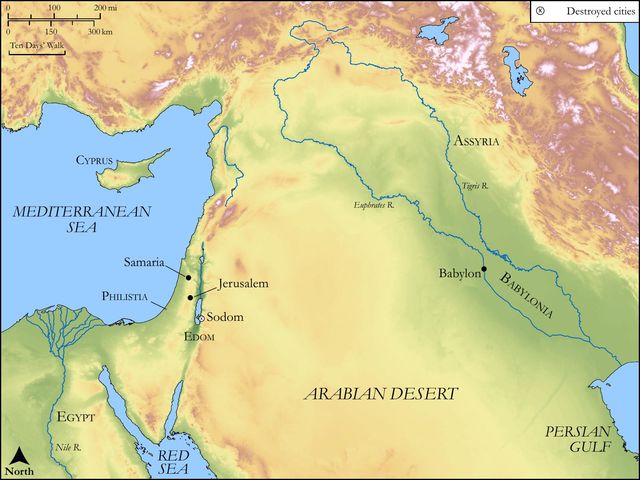
See on the biblical-era map
Study this verse
Public-domain commentary
Matthew Henry
From his Commentary on the Whole Bible. Henry comments on passages, not single verses — this entry covers Ezekiel 16:44–59. His three-level outline is real structure in the source text, so it is rendered as structure.
The prophet here further shows Jerusalem her abominations, by comparing her with those places that had gone before her, and showing that she was worse than any of them, and therefore should, like them, be utterly and irreparably ruined. We are all apt to judge of ourselves by comparison, and to imagine that we are sufficiently good if we are but as good as such and such, who are thought passable; or that we are not dangerously bad if we are no worse than such and such, who, though bad, are not of the worst. Now God by the prophet shows Jerusalem,
I.That she was as bad as her mother, that is, as the accursed devoted Canaanites that were the possessors of this land before her.
Those that use proverbs, as most people do, shall apply that proverb to Jerusalem, As is the mother, so is her daughter, Eze 16:44. She is her mother's own child. The Jews are as like the Canaanites in temper and inclination as if they had been their own children. The character of the mother was that she loathed her husband and her children, she had all the marks of an adulteress; and that is the character of the daughter: she forsakes the guide of her youth, and is barbarous to the children of her own bowels. When God brought Israel into Canaan he particularly warned them not to do according to the abominations of the men of that land, who went before them (for which it had spued them out, Lev 18:27, Lev 18:28), the monuments of whose idolatry, with the remains of the idolaters themselves, would be a continual temptation to them; but they learned their way, and trod in their steps, and were as well affected to the idols of Canaan as ever they were (Psa 106:38), and thus, in respect of imitation, it might truly be said that their mother was a Hittite and their father an Amorite (Eze 16:45), for they resembled them more than Abraham and Sarah.
II.That she was worse than her sisters Sodom and Samaria, that were adulteresses too, that loathed their husbands and their children, that were weary of the gods of their fathers, and were for introducing new gods, a-la-mode - quite in style, that came newly up, and new fashions in religion, and were given to change. On this comparison between Jerusalem and her sisters the prophet here enlarges, that he might either shame them into repentance or justify God in their ruin. Observe,
1.Who Jerusalem's sisters were, Eze 16:45. Samaria and Sodom. Samaria is called the elder sister, or rather the greater, because it was a much larger city and kingdom, richer and more considerable, and more nearly allied to Israel. If Jerusalem look northward, this is partly on her left hand. This city of Samaria, and the towns and villages, that were as daughters to that mother-city, these had been lately destroyed for their spiritual whoredom. Sodom, and the adjacent towns and villages that were her daughters, dwelt at Jerusalem's right hand, and was her less sister, less than Jerusalem, less than Samaria, and these were of old destroyed for their corporeal whoredom, Jde 1:7.
2.Wherein Jerusalem's sins resembled her sisters', particularly Sodom's (v. 49): This was the iniquity of Sodom (it is implied, and this is thy iniquity too), pride, fulness of bread, and abundance of idleness. Their going after strange flesh, which was Sodom's most flagrant wickedness, is not mentioned, because notoriously known, but those sins which did not look so black, but opened the door and led the way to these more enormous crimes, and began to fill that measure of her sins, which was filled up at length by their unnatural filthiness. Now these initiating sins were,
(1.)Pride, in which the heart lifts up itself above and against both God and man. Pride was the first sin that turned angels into devils, and the garden of the Lord into a hell upon earth. It was the pride of the Sodomites that they despised righteous Lot, and would not bear to be reproved by him; and this ripened them for ruin.
(2.)Gluttony, here called fulness of bread. It was God's great mercy that they had plenty, but their great sin that they abused it, glutted themselves with it, ate to excess and drank to excess, and made that the gratification of their lusts which was given them to be the support of their lives.
(3.)Idleness, abundance of idleness, a dread of labour and a love of ease. Their country was fruitful, and the abundance they had they came easily by, which was a temptation to them to indulge themselves in sloth, which disposed them to all that abominable filthiness which kindled their flames. Note, Idleness is an inlet to much sin. The men of Sodom, who were idle, were wicked, and sinners before the Lord exceedingly, Gen 13:13. The standing waters gather filth and the sitting bird is the fowler's mark. When David arose from off his bed at evening he saw Bathsheba. Quaeritur, Aegisthus quare sit factus adulter? In promptu causa est; desidiosus erat - What made Aegisthus an adulterer? Indolence.
(4.)Oppression: Neither did she strengthen the hands of the poor and needy; probably it is implied that she weakened their hands and broke their arms; however, it was bad enough that, when she had so much wealth, and consequently power and interest and leisure, she did nothing for the relief of the poor, in providing for whose wants those that themselves are full of bread may employ their time well; they need not be so abundantly idle as too often they are. These were the sins of the Sodomites, and these were Jerusalem's sins. Their pride, the cause of their sins, is mentioned again (Eze 16:50): They were haughty, with the horrid effects of their sins, their abominations which they committed before God. Men arrive gradually at the height of impiety and wickedness. Nemo repente fit turpissimus - No man reaches the height of vice at once. But, where pride has got the ascendant in a man, he is in the high road to all abominations.
3.How much the sins of Jerusalem exceeded those of Sodom and Samaria; they were more heinous in the sight of God, either in themselves or by reason of several aggravations: "Thou hast not only walked after their ways, and trod in their steps, but hast quite outdone them in wickedness, Eze 16:47. Thou thoughtest it a very little thing to do as they did; didst laugh at them as sneaking sinners and silly ones; thou wouldst be more cunning, more daring, in wickedness, wouldst triumph more boldly over thy convictions, and bid more open defiance to God and religion: 'if a man will break, let him break for something.' Thus thou wast corrupted more than they in all thy ways." Jerusalem was more polite, and therefore sinned with more wit, more art and ingenuity, than Sodom and Samaria could. Jerusalem had more wealth and power, and its government was more absolute and arbitrary, and therefore had the more opportunity of oppressing the poor, and shedding malignant influences around her, than Sodom and Samaria had. Jerusalem had the temple, and the ark, and the priesthood, and kings of the house of David; and therefore the wickedness of that holy city, that was so dignified, so near, so dear to God, was more provoking to him than the wickedness of Sodom and Samaria, that had not Jerusalem's privileges and means of grace. Sodom has not done as thou hast done, Eze 16:48. This agrees with what Christ says. Mat 11:24, It shall be more tolerable for the land of Sodom in the day of judgment than for thee. The kingdom of the ten tribes had been very wicked; and yet Samaria has not committed half thy sins (Eze 16:51), has not worshipped half so many idols, nor slain half so many prophets. It was bad enough that those of Jerusalem were guilty of Sodom's sins, Sodomy itself not excepted, Kg1 14:24; Kg2 23:7. And though the Dead Sea, the standing monument of Sodom's sin and ruin, bordered upon their country (Num 34:12), and that sulphureous lake was always under their nose (God having taken away Sodom and her daughters in such way and manner as he saw good, as he says here, Eze 16:50, so as that one thing should effectually make their overthrow an example to those that afterwards should live ungodly, Pe2 2:6), yet they did not take warning, but multiplied their abominations more than they; and,
(1.)By this they justified Sodom and Samaria, Eze 16:51. They pretended, in their haughtiness and superciliousness, to judge them, and in the days of old, when they retained their integrity, they did judge them, Eze 16:52. But now they justify them comparatively: Sodom and Samaria are more righteous than thou, that is, less wicked. It will look like some extenuation of their sins that, bad as they were, Jerusalem was worse, though it was God's own city. Not that it will serve for a plea to justify Sodom, but it condemns Jerusalem, against which Sodom and Samaria will rise up in judgment.
(2.)For this they ought themselves to be greatly ashamed: "Thou who hast judged thy sisters, and cried out shame on them, now bear thy own shame, for thy sins which thou hast committed, which, though of the same kind with theirs, yet, being committed by thee, are more abominable than theirs," Eze 16:52. This may be taken either as foretelling their ruin (Thou shalt bear thy shame) or as inviting them to repentance: "Be thou confounded and bear thy shame; take the shame to thyself that is due to thee." It may be hoped that sinners will forsake their sins when they begin to be heartily ashamed of them. And therefore they shall go into captivity, and there they shall lie, that they may be confounded in all that they have done, because they had been a comfort and encouragement to Sodom and Samaria, Eze 16:54. Note, There is nothing in sin which we have more reason to be ashamed of than this, that by our sin we have encouraged others in sin, and comforted them in that for which they must be grieved or they are undone. Another reason why they must now be ashamed is because in the day of their prosperity they had looked with so much disdain upon their neighbours: Thy sister Sodom was not mentioned by thee in the day of they pride, Eze 16:56. They thought Sodom not worthy to be named the same day with Jerusalem, little dreaming that Jerusalem would at length lie under a worse and more scandalous character than Sodom herself. Those that are high may perhaps come to stand upon a level with those they contemn. Or "Sodom was not mentioned, that is, the warning designed to be given to thee by Sodom's ruin was not regarded." If the Jews had but talked more frequently and seriously to one another, and to their children, concerning the wrath of God revealed from heaven against Sodom's ungodliness and unrighteousness, it might have kept them in awe, and prevented their treading in their steps; but they kept the thought of it at a distance, would not bear the mention of it, and (as the ancients say) put Isaiah to death for putting them in mind of it, when he called them rulers of Sodom and people of Gomorrah, Isa 1:10. Note, Those are but preparing judgments for themselves that will not take notice of God's judgments upon others.
4.What desolations God had brought and was bringing upon Jerusalem for these wickednesses, wherein they had exceeded Sodom and Samaria.
(1.)She has already long ago been disgraced, and has fallen into contempt, among her neighbours (Eze 16:57): Before her wickedness was discovered, before she came to be so grossly and openly flagitious, she bore the just punishment of her secret and more concealed lewdness, when she fell under the reproach of the daughters of Syria, of the Philistines, who were said to despise her and be ashamed of her (Eze 16:27), and under the reproach of all that were round about her, which seems to refer to the descent made upon Judah by the Syrians in the days of Ahaz, and soon after another by the Philistines, Ch2 28:5, Ch2 28:18. Note, Those that disgrace themselves by yielding to their lusts will justly be brought into disgrace by being made to yield to their enemies; and it is observable that before God brought potent enemies upon them, for their destruction, he brought enemies upon them that were less formidable, for their reproach. If less judgments would do the work, God would not send greater. In this thou hast borne thy lewdness, Eze 16:58. Those that will not cast off their sins by repentance and reformation shall be made to bear their sins to their confusion.
(2.)She is now in captivity, or hastening into captivity, and therein is reckoned with, not only for her lewdness (Eze 16:58), but for her perfidiousness and covenant-breaking (Eze 16:59): "I will deal with thee as thou hast done; I will forsake thee as thou hast forsaken me, and cast thee off as thou hast cast me off, for thou hast despised the oath, in breaking the covenant." This seems to be meant of the covenant God made with their fathers at Mount Sinai, whereby he took them and theirs to be a peculiar people to himself. They flattered themselves with a conceit that because God had hitherto continued his favour to them, notwithstanding their provocations, he would do so still. "No," says God, "you have broken covenant with me, have despised both the promises of the covenant and the obligations of it, and therefore I will deal with thee as thou hast done." Note, Those that will not adhere to God as their God have no reason to expect that he should continue to own them as his people.
(3.)The captivity of the wicked Jews, and their ruin, shall be as irrevocable as that of Sodom and Samaria. In this sense, as a threatening, most interpreters take Eze 16:53, Eze 16:55. "When I shall bring again the captivity of Sodom and Samaria, and when they shall return to their former estate, then I will bring again the captivity of thy captives in the midst of them, and as it were for their sakes, and under their shadow and protection, because they are more righteous than thou, and then thou shalt return to thy former estate," But Sodom and Samaria were never brought back, nor ever returned to their former estate, and therefore let not Jerusalem expect it, that is, those who now remained there, whom God would deliver to be removed into all the kingdoms of the earth for their hurt, Jer 24:9, Jer 24:10. Sooner shall the Sodomites arise out of the salt sea, and the Samaritans return out of the land of Assyria, than they enjoy their peace and prosperity again; for, to their shame be it spoken, it is a comfort to those of the ten tribes, who are dispersed and in captivity, to see those of the two tribes who had been as bad as they, or worse, in like manner dispersed and in captivity; and therefore they shall live and die, shall stand and fall, together. The bad ones of both shall perish together; the good ones of both shall return together. Note, Those who do as the worst of sinners do must expect to fare as they fare. Let my enemy be as the wicked.
Historical interpretation
Historical reception
1 surviving comment on this verse from the historical church.
(Verse 48, 49) I live, says the Lord, that Sodom, your sister herself and her daughters did not do as you and your daughters have done. Look, this was the iniquity of your sister Sodom: pride, fullness of bread, abundance, and idleness of herself and her daughters; and they did not strengthen the hand of the poor and needy. And they were haughty and committed abominations before me, and I took them away as you saw. And Samaria did not commit half of your sins; but you surpassed her in your wickedness, and you have justified your sisters in all your abominations that you have done. LXX: I live, says the Lord Adonai: this is what your sister Sodom did, and her daughters did the same as you and your daughters. However, the wickedness of your sister Sodom was pride, fullness of bread, and abundance. She and her daughters lived in luxury and had an abundance, but they did not support the poor and needy. They were proud and committed iniquities in my sight, so I took them away as you have seen. And Samaria has not sinned half as much as your sins, and you have multiplied your iniquities upon them; you have justified your sisters in all your iniquities which you have done. What the LXX has placed, she and her daughters also have, but it is not found in Hebrew. In the Old Testament, there is the oath of God: As I live, says the Lord (Num. XIV, 21). But in the New Testament: Truly, truly, I say to you (John XIII, 16). But if this is common with others: God of Abraham, God of Isaac, and God of Jacob, He is not the God of the dead, but of the living (Mark XII, 16, 27). And in another place: I will please the Lord in the land of the living (Ps. CXIV, 9): we seek to understand how the common term properly belongs to God. But how is it said, a good tree, and a good man, and a good shepherd, and a good servant (Luke XVIII); for no one is absolutely good, except God alone: so when the angels and other virtues, as well as patriarchs and prophets, and even the apostles, are called living in comparison to almighty God, they are called dead. For what is the man who lives, and does not see death? (Psalm LXXXVIII, 49). Hence, the apostle Paul also said about God: He alone, he said, has immortality and dwells in inaccessible light (I Timothy VI, 16). And about the fountain of life: Our life, he says, is hidden with Christ in God (Colossians III, 3). Therefore, this person who swears and says: As I live, says the Lord, describing the crimes of Sodom and its daughters, established the first pride, the very own of the devil, and the first sin. Wherefore as the same Apostle says: 'Lest being inflated with pride, he fall into the judgment of the devil' (1 Timothy 3:6), on account of which he says: 'And his pride fell from heaven' (Isaiah 14:12). For he had said: 'I will do it in the strength of my hand, and by wisdom of my understanding I will take away the bounds of the people, and I will rob their strength, and I will make their cities desolate: and I will break them asunder, and they shall not be able to stand, nor shall they be able to resist my force' (Isaiah 10:13-14). And: 'God resisteth the proud, and giveth grace to the humble' (James 4:6). We also read in another place: 'Why do you boast, O earth and ashes?' And the Gospel tells of the Pharisee's pride overcome by the humility of the tax collector (Luke 18): whose seedbed is the abundance of bread and all things, and leisure; or as the Septuagint translated, the luxury and opulence of delights. That rich man in the Gospel, dressed in purple (Luke 16), is reported to have had no other fault except that, being abundant in wealth and riches, he had burst forth with such pride that he did not reach out his hand to the needy and poor Lazarus: and thus he had forgotten his own condition, to the point that he did not even give this miserable man what was to be thrown away. For what reason and in another place it is written: Everyone who exalts himself will be humbled, and he who humbles himself will be exalted (Luke XIV, 11). Pride, gluttony, abundance of all things, leisure and indulgence, are sins of Sodom, and because of this, the forgetfulness of God follows, which considers present goods to be perpetual and never in need of necessities. Therefore, it is also commanded by the law: Take care lest, while eating and drinking and being satisfied, you build good houses and possess sheep and oxen, silver and gold, you forget the Lord your God (Deuteronomy VIII, 11). And in another place it is written about Israel: 'He ate and drank, and was satisfied, and grew fat, and kicked' (Deut. XXXII, 15). Knowing this, the wisest of all, Solomon, prays in Proverbs: 'Give me what is necessary and sufficient, so that I may not become full and deny you, saying: Who will see me? Or becoming poor, steal and profane the name of my God' (Prov. XXX, 8, 9). And what follows: 'And you justified your sisters in all your abominations, which you have done, not simply judging Sodom and Samaria to be wicked, but with a comparison to the worse: as the Publican, of whom we have spoken above, is not called absolutely righteous, but in comparison to the worse.' And yet even though Sodom and Samaria were such, they did not even sin half as much as Jerusalem. For the servant who knows his master's will and does not do it, shall be beaten with many stripes (Luke XII, 47). And: The mighty shall suffer torments mightily (Wisdom VI, 7). Furthermore, that which is contained in Hebrew for luxury (or wealth), should be understood to refer to this meaning: In desires is the entire soul idle; that is, that there should always be something to do: lest the field of our heart, with the hand resting, be occupied by the thorns of evil thoughts.
Continue studying Ezekiel 16:48 across the web’s major study libraries — every link below opens this exact verse, chapter, or book on the destination site.
Read & Compare
 BibleGatewayThis verse in more than 200 translations and 70 languages.
 Bible.comThe YouVersion reader — hundreds of translations, reading plans, and highlights.
 ESV.orgCrossway's official English Standard Version reader.
 NET BibleThe NET translation with 60,000+ translators' notes on every rendering decision.
 STEP BibleTyndale House's free study tool — original text, vocabulary, and scholarly resources.
 BibliaLogos Bible Software's free web reader.
 USCCBThe New American Bible (Revised Edition) with the U.S. bishops' study notes.
Commentaries
 BibleHub CommentariesDozens of classic commentaries on this verse, gathered on one page.
 StudyLightMore than 100 commentary sets — the largest collection on the web.
 BibleRefPlain-English commentary on what this verse means, verse by verse.
 Enduring WordDavid Guzik's free commentary on this chapter, widely used by Bible teachers.
 Bible Study ToolsVerse commentary alongside Greek and Hebrew study aids.
Original Language & Research
- BibleHub InterlinearThe verse word by word — original language, transliteration, and English.
- BibleHub LexiconEvery word's original-language definition and Strong's entry.
 Blue Letter BibleDeep-study tools — Strong's numbers, concordance, and word studies.
 SefariaThe Hebrew text with Rashi and centuries of Jewish commentary.
Sermons, Hymns & Audio


TrulyRandomVerse is not affiliated with these sites and doesn’t control their content. They’re linked because they’re genuinely useful.
Summary
Ezekiel 16:48 presents a profoundly unsettling divine declaration, asserting with the certainty of a divine oath that Jerusalem's spiritual depravity and covenant unfaithfulness had plummeted to depths even more egregious than the notorious wickedness of Sodom. Through this shocking comparison, the Lord God reveals that the sins committed by His chosen people, despite their unique privileges, intimate relationship with Him, and abundant blessings, were quantitatively and qualitatively more offensive than those of a city synonymous with ultimate moral corruption and divine judgment. This verse serves as a stark and severe indictment, underscoring the heightened accountability that accompanies greater spiritual light and the dire consequences of betraying divine grace.
Context
ShowHideLiterary Context
Ezekiel 16 is a lengthy, vivid, and deeply allegorical chapter that meticulously chronicles God's relationship with Jerusalem, personified as an unfaithful bride. The narrative begins with God finding Jerusalem as an abandoned, helpless infant, rescuing her, cleansing her, adorning her with splendor, and entering into a sacred covenant with her, elevating her to a position of unparalleled beauty and prominence, as seen in passages like Ezekiel 16:8. However, Jerusalem then shamefully prostituted her blessings, using God's gifts for idolatry, engaging in abominable practices with surrounding nations and their gods, and even sacrificing her own children, as detailed in Ezekiel 16:20-21. Verse 48 falls within a section (Ezekiel 16:44-59) where Jerusalem's guilt is explicitly compared and contrasted with that of her "sisters," Samaria (representing the Northern Kingdom of Israel) and Sodom. This comparison is designed to highlight the unimaginable depth of Jerusalem's unfaithfulness, as she is deemed more wicked than both, leading to a declaration of inevitable and severe divine judgment.
Historical & Cultural Context
The prophecy of Ezekiel was delivered to the Jewish exiles in Babylon, a people struggling to comprehend the devastation of Jerusalem and the Temple. Historically, Judah (represented by Jerusalem) had repeatedly turned away from the Mosaic covenant, engaging in syncretism and idolatry despite numerous warnings from prophets. Culturally, Sodom was universally understood as the epitome of human depravity and divine wrath, its destruction recorded in Genesis 19. To declare Jerusalem's sin worse than Sodom's was an exceptionally provocative and shocking statement, designed to shatter any lingering sense of nationalistic pride or presumed immunity from judgment. It highlighted that God's covenant people were held to a higher standard due to their unique knowledge of His law and His intimate relationship with them, making their betrayal particularly heinous and deserving of a more severe judgment.
Key Themes
ShowHideThis verse powerfully contributes to several overarching themes in Ezekiel and the broader prophetic literature. The most prominent is Unparalleled Guilt, where Jerusalem's sin is not merely comparable to Sodom's but fundamentally more grievous, a staggering claim given Sodom's infamy and direct divine judgment, as recounted in Genesis 19:24-25. This intensified guilt stems from Covenant Unfaithfulness, as Jerusalem's spiritual adultery represented a profound betrayal of her sacred covenant relationship with Yahweh, a betrayal far more offensive than the sins of nations who did not know God in the same intimate way. Consequently, the verse underscores the theme of Divine Judgment and Justice, with God's solemn oath ("As I live, saith the Lord GOD") emphasizing the certainty and immutability of His righteous judgment. It reveals God's perfect justice, where sin committed against greater light and privilege incurs greater condemnation. Furthermore, the broader context of Ezekiel 16 clarifies The Nature of Sodom's Sin, which, while often associated primarily with sexual immorality, is expanded in Ezekiel 16:49-50 to include "pride, fulness of bread, and abundance of idleness, and of her daughters; neither did she strengthen the hand of the poor and needy." Jerusalem's heightened guilt implies that she exhibited these and worse sins, despite God's abundant grace and blessings.
Exposition and Analysis
ShowHideKey Word Analysis
ShowHideMeaning "alive" or "life." In the phrase "As I live," it functions as a solemn divine oath, signifying God swearing by His very existence, life, and active being. This underscores the absolute certainty, truthfulness, and immutability of the declaration that follows. It is an affirmation of God's eternal nature as the guarantor of His word, emphasizing that what He is about to declare is irrevocably true and will come to pass.
Meaning "an oracle" or "divine utterance." When used in conjunction with "the Lord GOD," this word specifically marks the following statement as a direct, authoritative pronouncement from God Himself, not merely the prophet's words or an interpretation. It lends immense weight and divine authority to the shocking comparison being made, asserting that this judgment originates directly from the sovereign Creator.
A primitive root meaning "to do or make, in the broadest sense and widest application." Here, it refers to the actions, deeds, or practices of Sodom and Jerusalem. The repetition of "hath not done... as thou hast done" emphasizes the comparative nature of their actions, highlighting the extent of Jerusalem's wicked deeds in stark contrast to Sodom's. It encompasses the full scope of their moral, spiritual, and social behavior, signifying the totality of their transgressions.
Verse Breakdown
ShowHide"As I live, saith the Lord GOD,"
This opening phrase functions as a divine oath, the strongest possible affirmation of truth and certainty in the biblical idiom. God swears by His own existence, signifying that the declaration to follow is absolutely immutable and guaranteed to be true. It immediately establishes the gravity and solemnity of the pronouncement, demanding the audience's full attention and belief in the divine word.
"Sodom thy sister hath not done,"
Here, Sodom is shockingly personified as Jerusalem's "sister," implying a shared, albeit distant, lineage or perhaps a common human condition. The declaration that Sodom "hath not done" implies that even Sodom, a byword for extreme wickedness and a recipient of direct, fiery divine judgment, did not commit the same level or type of transgressions as Jerusalem. This sets up the shocking reversal of expectations.
"she nor her daughters,"
This phrase extends the comparison to the entire populace and subsequent generations of Sodom, indicating that the collective and historical wickedness of Sodom and its associated towns or inhabitants did not reach the depths of Jerusalem's sin. "Daughters" here refers to the towns and villages associated with Sodom, or metaphorically, its inhabitants, emphasizing the pervasive nature of their collective actions.
"as thou hast done, thou and thy daughters."
This climactic comparison directly indicts Jerusalem (representing Judah and Israel). The phrase "thou and thy daughters" refers to Jerusalem and its surrounding towns or its inhabitants. The shocking assertion is that Jerusalem's actions—her idolatry, covenant breaking, moral corruption, and neglect of justice—were quantitatively and qualitatively worse than those of Sodom, despite Jerusalem's unique covenant relationship with God and the abundant blessings she had received.
Literary Devices
ShowHideEzekiel 16:48 is rich in literary devices that amplify its shocking and condemnatory message. The most prominent is Divine Oath, signaled by "As I live, saith the Lord GOD," which lends absolute certainty and gravity to the pronouncement, emphasizing God's unwavering commitment to His word and impending judgment. Personification is central, as Jerusalem and Sodom are depicted as "sisters" with "daughters," transforming abstract entities into relatable familial figures whose actions can be intimately compared. This device makes the indictment more personal, intimate, and impactful. The entire verse functions as a powerful Comparison and Contrast, where the infamous wickedness of Sodom is used as a benchmark to highlight Jerusalem's even greater depravity. This is achieved through a profound sense of Irony and Hyperbole (or exaggeration for emphasis), as the claim that Jerusalem is worse than Sodom is designed to shock the audience into recognizing the profound depth of their sin, challenging their nationalistic pride and presumed righteousness. The repetition of "hath not done... as thou hast done" creates a stark Antithesis, underscoring the profound difference in their actions despite the shared "sister" metaphor, powerfully emphasizing Jerusalem's unparalleled guilt.
Theological and Thematic Connections
ShowHideEzekiel 16:48 powerfully articulates a core biblical principle: greater privilege brings greater accountability. Jerusalem, as God's chosen people, had received unparalleled revelation, covenant blessings, and divine presence, yet she willfully chose to engage in spiritual harlotry and moral abominations that surpassed even the most notorious Gentile city. This verse underscores the gravity of covenant unfaithfulness, revealing that sin committed against the light of God's truth is more grievous in His sight. It highlights God's unwavering justice, demonstrating that His judgment is not arbitrary but perfectly calibrated to the degree of revelation and opportunity rejected. The shocking comparison serves as a sober reminder that spiritual arrogance and complacency in the face of divine grace lead to a more severe condemnation, as God holds His own people to a higher standard due to their intimate knowledge of His character and commands.
Reflection and Application
ShowHideEzekiel 16:48 stands as a profound warning to all who have received God's grace and truth, serving as a mirror for self-examination in every generation. It challenges any presumption of divine favor that might lead to spiritual complacency or a diminished view of sin. For believers today, this verse underscores that our accountability before God is directly proportional to the light we have received. If we, who have the fullness of God's revelation in Christ, engage in spiritual idolatry—allowing anything to usurp God's rightful place in our hearts—or neglect justice and mercy, our guilt may be greater than those who have never known Him. This calls us to a radical faithfulness, to cherish God's covenant, and to live lives that reflect the transforming power of His grace, actively pursuing holiness and righteousness, and extending compassion to the poor and needy, lest our own spiritual apathy or hidden sins prove more offensive than the overt wickedness of the world. It compels us to a deeper humility and a more fervent commitment to living out the implications of God's grace in every facet of our lives.
Questions for Reflection
ShowHideFAQ
ShowHideWhat specific sins made Jerusalem worse than Sodom according to Ezekiel?
ShowHideWhile Ezekiel 16:48 states Jerusalem's actions were worse than Sodom's, the subsequent verses (Ezekiel 16:49-50) clarify Sodom's sins: "Behold, this was the iniquity of thy sister Sodom, pride, fulness of bread, and abundance of idleness, and of her daughters; neither did she strengthen the hand of the poor and needy. And they were haughty, and committed abomination before me: therefore I took them away as I saw good." Jerusalem's "worse" status stemmed from committing these same sins—pride, gluttony, idleness, and neglect of the poor—but doing so despite having received God's covenant, His law, His prophets, and His abundant blessings. Her sin was compounded by spiritual harlotry, sacrificing her children to idols, and using God's own gifts to fund her idolatry, as detailed in Ezekiel 16:20-21. This betrayal of a sacred, intimate relationship made her actions more reprehensible than those of a city that never knew God in the same profound way.
Does this mean God is unfair in His judgment, judging some more harshly than others?
ShowHideNo, this does not indicate unfairness but rather perfect justice. The principle articulated here, and echoed by Jesus in the New Testament (e.g., Luke 12:48), is that accountability is proportionate to revelation and privilege. Those who have received more light, truth, and blessings from God are held to a higher standard because their rejection of Him is a more deliberate and egregious act of rebellion against known truth and grace. God's judgment is always righteous, taking into account the full context of knowledge and opportunity. Jerusalem's unique covenant relationship with God meant her unfaithfulness was a profound betrayal, not merely a transgression of universal moral law, thus incurring a greater measure of divine displeasure and a more severe condemnation.
Christ-Centered Fulfillment
ShowHideEzekiel 16:48, with its shocking indictment of Jerusalem's unparalleled sin, finds its ultimate Christ-centered fulfillment in the person and work of Jesus Christ. The verse highlights humanity's profound capacity for unfaithfulness and the severity of sin, particularly when committed against the backdrop of divine grace. While Jerusalem, the unfaithful bride, earned the just condemnation of God, Christ emerges as the perfectly faithful Son and the true Israel, embodying perfect obedience where humanity utterly failed. He willingly bore the full weight of this unparalleled sin and judgment, becoming sin for us who knew no sin, so that in Him we might become the righteousness of God, as proclaimed in 2 Corinthians 5:21. The divine oath, "As I live, saith the Lord GOD," which sealed Jerusalem's judgment, also undergirds the certainty of God's redemptive plan in Christ. Through His atoning sacrifice, Jesus fulfilled the righteous demands of God's law and justice, offering a new covenant established in His blood, as declared in Luke 22:20, that transforms unfaithful humanity into a pure and spotless bride, the Church, which Christ loved and gave Himself up for, to make her holy and blameless, as described in Ephesians 5:25-27. This redeemed bride eagerly awaits the marriage supper of the Lamb, a glorious future revealed in Revelation 19:7-9. Thus, the terrifying reality of Jerusalem's sin in Ezekiel 16:48 ultimately points to the glorious, redemptive work of Christ, who alone can make us faithful and righteous before God, transforming our profound unfaithfulness into His perfect righteousness.