


Luke 7:18
- ΚαὶKaiAndG2532CONJConjunction
- ἀπήγγειλανapēngeilanbrought wordG518V-AAI-3PVerb Aorist Active Indicative 3rd Plural
- ἸωάννῃIōannēto JohnG2491N-DSM-PNoun Dative Singular Masculine Individual
- οἱhoitheG3588T-NPMDefinite article Nominative Plural Masculine
- μαθηταὶmathētaidisciplesG3101N-NPMNoun Nominative Plural Masculine
- αὐτοῦautouof himG846P-GSMPersonal pronoun Genitive Singular Masculine
- περὶpericoncerningG4012PREPPreposition
- πάντωνpantōnallG3956A-GPNAdjective Genitive Plural Neuter
- τούτωνtoutōnthese thingsG3778D-GPNDemonstrative pronoun Genitive Plural Neuter
English is a literal word-by-word gloss of the Greek, not the KJV's wording. Why?
This is the original text the KJV's translators worked from — each Greek word with its own literal English meaning in this verse, prepared by scholars at Tyndale House, Cambridge. The KJV translates whole sentences, not word by word, so its wording differs: one Greek word can become several English words, and the KJV may choose “charity” where the gloss reads “love”. Both are faithful — they answer different questions. For the KJV's own rendering, switch to the KJV text.
Details
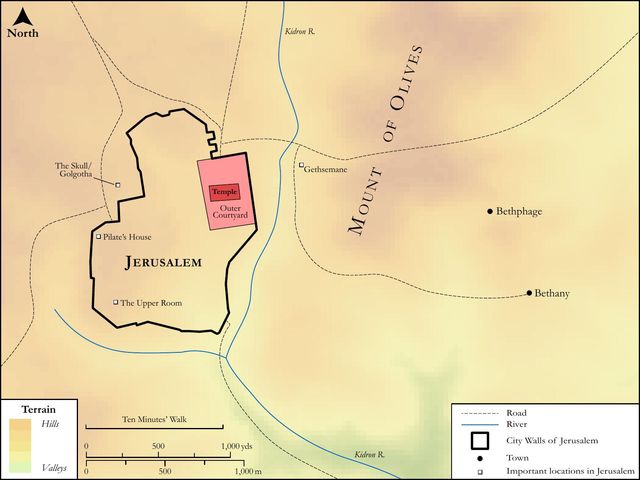
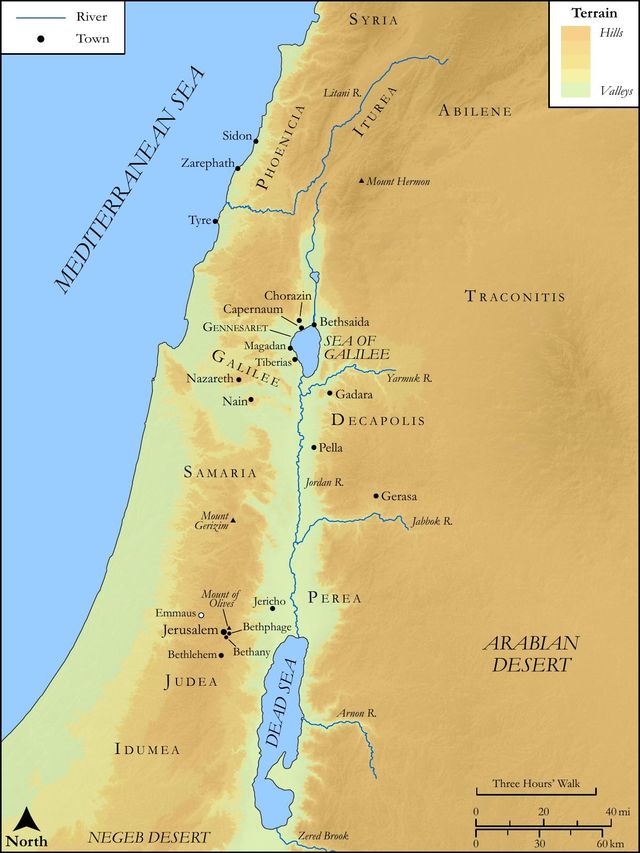
See on the biblical-era map

Study this verse
Public-domain commentary
Matthew Henry
From his Commentary on the Whole Bible. Henry comments on passages, not single verses — this entry covers Luke 7:11–18. His three-level outline is real structure in the source text, so it is rendered as structure.
We have here the story of Christ's raising to life a widow's son at Nain, that was dead and in the carrying out to be buried, which Matthew and Mark had made no mention of; only, in the general, Matthew had recorded it, in Christ's answer to the disciples of John, that the dead were raised up, Mat 11:5. Observe,
I.Where, and when, this miracle was wrought.
It was the next day after he had cured the centurion's servant, Luk 7:11. Christ was doing good every day, and never had cause to complain that he had lost a day. It was done at the gate of a small city, or town, called Nain, not far from Capernaum, probably the same with a city called Nais, which Jerome speaks of.
II.Who were the witnesses of it.
It is as well attested as can be, for it was done in the sight of two crowds that met in or near the gate of the city. There was a crowd of disciples and other people attending Christ (Luk 7:11), and a crowd of relations and neighbours attending the funeral of the young man, Luk 7:12. Thus there was a sufficient number to attest the truth of this miracle, which furnished greater proof of Christ's divine authority than his healing diseases; for by no power of nature, or any means, can the dead be raised.
III.How it was wrought by our Lord Jesus.
1.The person raised to life was a young man, cut off by death in the beginning of his days - a common case; man comes forth like a flower and is cut down. That he was really dead was universally agreed. There could be no collusion in the case; for Christ was entering into the town, and had not seen him till now that he met him upon the bier. He was carried out of the city; for the Jews' burying-places were without their cities, and at some distance from them. This young man was the only son of his mother, and she a widow. She depended upon him to be the staff of her old age, but he proves a broken reed; every man at his best estate is so. How numerous, how various, how very calamitous, are the afflictions of the afflicted in this world! What a vale of tears is it! What a Bochim, a place of weepers! We may well think how deep the sorrow of this poor mother was for her only son (such sorrowing is referred to as expressive of the greatest grief, - Zac 12:10), and it was the deeper in that she was a widow, broken with breach upon breach, and a full end made of her comforts. Much people of the city was with her, condoling with her loss, to comfort her.
2.Christ showed both his pity and his power in raising him to life, that he might give a specimen of both, which shine so brightly in man's redemption.
(1.)See how tender his compassions are towards the afflicted (Luk 7:13): When the Lord saw the poor widow following her son to the grave, he had compassion on her. Here was not application made to him for her, not so much as that he would speak some words of comfort to her, but, ex mero motu - purely from the goodness of his nature, he was troubled for her. The case was piteous, and he looked upon it with pity. His eye affected his heart; and he said unto her, Weep not. Note, Christ has a concern for the mourners, for the miserable, and often prevents them with the blessing of his goodness. He undertook the work of our redemption and salvation, in his love and in his pity, Isa 63:9. What a pleasing idea does this give us of the compassions of the Lord Jesus, and the multitude of his tender mercies, which may be very comfortable to us when at any time we are in sorrow! Let poor widows comfort themselves in their sorrows with this, that Christ pities them and knows their souls in adversity; and, if others despise their grief, he does not. Christ said, Weep not; and he could give her a reason for it which no one else could: "Weep not for a dead son, for he shall presently become a living one." This was a reason peculiar to her case; yet there is a reason common to all that sleep in Jesus, which is of equal force against inordinate and excessive grief for their death - that they shall rise again, shall rise in glory; and therefore we must not sorrow as those that have no hope, Th1 4:13. Let Rachel, that weeps for her children, refrain her eyes from tears, for there is hope in thine end, saith the Lord, that thy children shall come again to their own border, Jer 31:17. And let our passion at such a time be checked and claimed by the consideration of Christ's compassion.
(2.)See how triumphant his commands are over even death itself (Luk 7:14): He came, and touched the bier, or coffin, in or upon which the dead body lay; for to him it would be no pollution. Hereby he intimated to the bearers that they should not proceed; he had something to say to the dead young man. Deliver him from going down to the pit; I have found a ransom, Job 33:24. Hereupon they that bore him stood still, and probably let down the bier from their shoulders to the ground, and opened the coffin, it if was closed up; and then with solemnity, as one that had authority, and to whom belonged the issues from death, he said, Young man, I say unto thee, Arise. The young man was dead, and could not arise by any power of his own (no more can those that are spiritually dead in trespasses and sins); yet it was no absurdity at all for Christ to bid him arise, when a power went along with that word to put life into him. The gospel call to all people, to young people particularly, is, "Arise, arise from the dead, and Christ shall give you light and life." Christ's dominion over death was evidenced by the immediate effect of his word (Luk 7:15): He that was dead sat up. Have we grace from Christ? Let us show it. Another evidence of life was that he began to speak; for whenever Christ gives us spiritual life he opens the lips in prayer and praise. And, lastly, he would not oblige this young man, to whom he had given a new life, to go along with him as his disciple, to minister to him (though he owed him even his own self), much less as a trophy or show to get honour by him, but delivered him to his mother, to attend her as became a dutiful son; for Christ's miracles were miracles of mercy, and a great act of mercy this was to this widow; now she was comforted, according to the time in which she had been afflicted and much more, for she could now look upon this son as a particular favourite of Heaven, with more pleasure than if he had not died.
IV.What influence it had upon the people (Luk 7:16):
There came a fear on all; it frightened them all, to see a dead man start up alive out of his coffin in the open street, at the command of a man; they were all struck with wonder at his miracle, and glorified God. The Lord and his goodness, as well as the Lord and his greatness, are to be feared. The inference they drew from it was, "A great prophet is risen up among us, the great prophet that we have been long looking for; doubtless, he is one divinely inspired who can thus breathe life into the dead, and in him God hath visited his people, to redeem them, as was expected," Luk 1:68. This would be life from the dead indeed to all them that waited for the consolation of Israel. When dead souls are thus raised to spiritual life, by a divine power going along with the gospel, we must glorify God, and look upon it as a gracious visit to his people. The report of this miracle was carried,
1.In general, all the country over (Luk 7:17): This rumour of him, that he was the great prophet, went forth upon the wings of fame through all Judea, which lay a great way off, and throughout all Galilee, which was the region round about. Most had this notice of him, yet few believed in him, and gave up themselves to him. Many have the rumour of Christ's gospel in their ears that have not the savour and relish of it in their souls.
2.In particular, it was carefully brought to John Baptist, who was now in prison (Luk 7:18): His disciples came, and gave him an account of all things, that he might know that though he was bound yet the word of the Lord was not bound; God's work was going on, though he was laid aside.
Historical interpretation
Nine Centuries of Reception
12 surviving comments on this verse. Each one is dated, so this reads as a timeline rather than a list.
Select a marker to jump to its quote. Markers stagger vertically where authors wrote within a few decades of each other.
That, then, was no celestial thing which furnished no celestial (endowments): whereas the very thing which was celestial in John-the Spirit of prophecy-so completely failed, after the transfer of the whole Spirit to the Lord, that he presently sent to inquire whether He whom he had himself preached, whom he had pointed out when coming to him, were "HE." And so "the baptism of repentance" was dealt with as if it were a candidate for the remission and sanctification shortly about to follow in Christ: for in that John used to preach "baptism for the remission of sins," the declaration was made with reference to future remission; if it be true, (as it is, ) that repentance is antecedent, remission subsequent; and this is "preparing the way.
John sent them to him not to interrogate him, but rather that the Lord might confirm those former things that John had proclaimed to them. John was directing the minds of his disciples toward the Lord.… He sent them out in such a way that, having seen Jesus’ miracles, they might be confirmed in their faith in him.
But how could it come to pass, that Him of whom he said, Behold him who taketh away the sins of the world, he should still not believe to be the Son of God? For either it is presumption to attribute to Christ a divine action ignorantly, or it is unbelief to have doubted concerning the Son of God. But some suppose of John himself that he was indeed so great a prophet as to acknowledge Christ, but still as not a doubting, but pious, prophet disbelieved that He would die, whom he believed was about to come. Not therefore in his faith but in his piety, he doubted; as Peter also, when he said, Be it far from thee, Lord; this shall not be unto thee. (Mat 16:22.)
An ample testimony surely by which the Prophet might recognise the Lord. For of the, Lord Himself it was prophesied, that the Lord giveth food to the hungry, raiseth up them that are bowed down, looseth the prisoners, openeth the eyes of the blind, and that he who doeth these things shall reign for ever. (Ps. 146:7-10.) Such then are not the tokens of human, but divine power. But these are found seldom or not at all before the Gospel. Tobias alone received sight, and this was the cure of an Angel, not of a man. (Tob. 11.) Elias raised the dead, but he prayed and wept, our Lord commanded. (1 Kings 17) Elisha caused the cleansing of a leper: yet then the cause was not so much in the authority of the command as in the figure of the mystery. (2 Kings 5.)
But still these are but slight examples of the testimony to the Lord. The full assurance of faith is the cross of the Lord, His death and burial. Hence He adds, And blessed is he who shall not be offended in me. For the cross may cause offence, even to the elect. But there is no greater testimony than this of a divine person. For there is nothing which seems to be more surpassing the nature of man than that one should offer Himself for the whole world.
But we have before said, that mystically John was the type of the Law, which was the forerunner of Christ. John then sends his disciples to Christ, that they might obtain the filling up of their knowledge, for Christ is the fulfilling of the Law. And perhaps those disciples are the two nations, of whom the one of the Jews believed, the other of the Gentiles believed because they heard. They wished then to see, because blessed are the eyes that see. But when they shall have come to the Gospel, and found that the blind receive their sight, the lame walk, then shall they say, "We have seen with our eyes," for we seem to ourselves to see Him whom we read of. Or perhaps through the instrumentality (operatrice) of a certain part of our Body a we all seem to have traced out the course of our Lord's passion; for faith comes through the few to the many. The Law then announces that Christ will come, the writings of the Gospel prove that He has come.
And because we have already said above (in Luke, chapter 3) that John is a type of the Law, which was a precursor of Christ, it is right that the Law, which held captive the hearts of the faithless as if in eternal prisons, was physically enclosed, with its fertile entrails of punishments and doors of madness restrained, would not be able to bring about the complete fulfillment of the testimony of the Lord's dispensation without the consent of the Gospel. Indeed, the Law prophesied the grace of baptism through the cloud and the sea in Exodus; it foreshadowed spiritual food in the lamb (Exodus 12:3); it designated an everlasting fountain in the rock (Exodus 17:6); it revealed the forgiveness of sins in Leviticus (Leviticus 25:10); it announced the kingdom of heaven in the Psalms; it most clearly declared the promised land in Joshua.
But we are then most raised up to Him when we are fallen into straits. John therefore, being cast into prison, takes the opportunity, when his disciples were most in need of Jesus, to send them to Christ. For it follows, And John calling two of his disciples sent them to Jesus, saying, Art thou he that should come, &c.
Christ would work miracles and teach as soon as he came to well-known sections of his own country, and this had been foretold.Isaiah went on to tell of other marvels and showed how Christ cured the lame, and how he made the blind to see and the mute to speak. “Then the eyes of the blind shall be opened, and the ears of the deaf unstopped.” After that he spoke of the other marvels: “Then shall the lame man leap like a hart, and the tongue of the dumb sing for joy.” This did not happen until his coming.
“In that same hour he healed many of sicknesses and of scourges, and of evil spirits; and gave sight to many that were blind.” He made them spectators and eyewitnesses of his greatness and gathered into them a great admiration of his power and ability. They then bring forward the question and beg in John’s name to be informed whether he is “he who comes.” Here see, I ask, the beautiful art of the Savior’s management. He does not simply say, “I am.” If he had spoken this, it would have been true. He leads them to the proof given by the works themselves. In order that having accepted faith in him on good grounds and being furnished with knowledge from what had been done, they may return to him who sent them. “Go,” he says, “tell John the things that you have seen and heard.” “For you have heard indeed,” he says, “that I have raised the dead by the all-powerful word and by the touch of the hand. While you stood by, you have also seen that those things that were spoken of old time by the holy prophets are accomplished: the blind see, the lame walk, the lepers are cleansed, the dumb hear, the dead rise, and the poor are preached to. The blessed prophets had announced all these things before, as about in due time to be accomplish by my hands. I bring to pass those things that were prophesied long before, and you are yourselves spectators of them. Return and tell those things that you have seen with your own eyes accomplished by my might and ability, and which at various times the blessed prophets foretold.”
Certain of His disciples relate to the holy Baptist the miracle which was known to all the inhabitants of Judæa and Galilee, as it follows, And they told John, &c.
But we must altogether disallow such an opinion. For no where do we find the Holy Scriptures stating that John the Baptist foretold to those souls in hell the coming of our Saviour. It is also true to say, that the Baptist was not ignorant of the wonderful mystery of the incarnation of the Only-Begotten, and so also along with the other things had known this, that our Lord was about to preach the Gospel to those who were in hell, after He had tasted death for all living as well as dead. But since the word of holy Scripture indeed declared that Christ would come as the Lord and Chief, but the others were sent as servants before Him, therefore was the Lord and Saviour of all called by the prophets, He who cometh, or Who is to come; according to that, Blessed is he who cometh in the name of the Lord; (Ps. 118:26.) and, A little while, and he who is to come shall come, and will not tarry. (Hab. 2:3.) The blessed Baptist therefore, receiving as it were this name from Holy Scripture, sent certain of his disciples to seek whether it was indeed He who cometh, or, Who is to come.
(Thes. lib. 11. c. 4.) Or he asks the question by economy. For as the forerunner he knew the mystery of Christ's passion, but that his disciples might be convinced how great was the excellence of the Saviour, he sent the more understanding of them, instructing them to enquire and learn from the very words of the Saviour, whether it was He who was expected; as it is added, But when the men were come unto him, they said, John the Baptist hath sent us unto thee, saying, Art thou He, &c. But He knowing as God with what intention John had sent them, and the cause of their coming, was at the time performing many miracles, as it follows, And in the same hour he healed many of their infirmities, &c. He said not positively to them I am he, but rather leads them to the certainty of the fact, in order that receiving their faith in Him, with their reason agreeing thereto, they might return to him who sent them. Hence He made not answer to the words, but to the intention of him who sent them; as it follows, And Jesus answering said unto them, Go your way, and tell John what things you have seen and heard: as if He said, Go and tell John the things which ye have heard indeed through the Prophets, but have seen accomplished by Me. For He was then performing those things which the Prophets prophesied He would do; that is of which it is added, For the blind see, the lame walk.
Or else, He wished by this to show that whatever was passing in their hearts, could not be hid from His sight. For they were those who were offended at Him.
We must inquire, dearly beloved brethren, why John—a prophet and more than a prophet, who pointed out the Lord coming to the baptism at the Jordan, saying: "Behold the Lamb of God, behold him who takes away the sin of the world"; who, considering both his own humility and the power of Christ's divinity, says: "He who is of the earth speaks of the earth, but he who comes from heaven is above all"—why, when placed in prison and sending his disciples, he asks: "Are you he who is to come, or do we look for another?" As if he did not know the one he had pointed out, and did not know whether he was the one whom he had proclaimed by prophesying, baptizing, and pointing him out. But this question is quickly resolved if the time and order of events is considered. For standing at the waters of the Jordan, he declared that this was the Redeemer of the world; but sent to prison, he asks whether he himself is coming—not because he doubts that he is the Redeemer of the world, but he asks in order to know whether he who had come into the world by himself would also descend by himself to the prison of hell. For he whom John had announced to the world as his forerunner, he was now preceding to hell by dying. Therefore he says: "Are you he who is to come, or do we look for another?" As if he were openly saying: Just as you deigned to be born for mankind, indicate whether you also deign to die for mankind, so that I who have been the forerunner of your birth may also become the forerunner of your death, and may announce to hell that you are coming, whom I have already announced as having come to the world.
Not, as it seems to me, in simpleness of heart, but provoked by envy. For in another place also they complain, Rabbi, he that was with thee beyond Jordan, behold the same baptizeth, and all men come unto him. (John 3:26.)
He says not, Art thou He that hast come, but, Art thou he that should come. The sense is, Tell me who am to be slain by Herod, and about to descend into hell, (ad inferna) whether I should announce Thee to the souls below as I have announced Thee to those above? or is this not befitting the Son of God, and Thou art going to send another for these sacraments?
And what is not less than these, the poor have the Gospel preached to them, that is, the poor are enlightened by the Spirit, or hidden treasures, that there might be no difference between the rich and the poor. These things prove the faith of the Master, when all who can be saved by Him are equal.
And his disciples reported to John concerning all these things. Not with a sincere heart, I think, but driven by envy, John's disciples reported to him the virtues and miracles of Christ. For elsewhere they are found complaining to him thus: Rabbi, he who was with you across the Jordan, to whom you bore witness, behold, he is baptizing, and all are coming to him (John III). To which John then replied: A man cannot receive anything unless it has been given to him from heaven, etc. And he clearly declares both that he is a mere man and that Christ is the Son of God. But since envy and jealousy remained, and could not be expelled, observe what the excellent teacher still did to correct them.
By the widow also you may understand a soul that has lost her husband in the divine word. Her son is the understanding, which is carried out beyond the city of the living. Its coffin is the body, which some indeed have called the tomb. But the Lord touching him raises him up, causing him to become young, and rising from sin he begins to speak and teach others. For before he would not have been believed.
These are also the words of Elias, saying, The Lord himself shall come and save us. Then the eyes of the blind shall be opened, and the ears of the deaf shall be unstopped. Then shall the lame man leap as an hart. (Isa. 35:4-6.)
Continue studying Luke 7:18 across the web’s major study libraries — every link below opens this exact verse, chapter, or book on the destination site.
Read & Compare
 BibleGatewayThis verse in more than 200 translations and 70 languages.
 Bible.comThe YouVersion reader — hundreds of translations, reading plans, and highlights.
 ESV.orgCrossway's official English Standard Version reader.
 NET BibleThe NET translation with 60,000+ translators' notes on every rendering decision.
 STEP BibleTyndale House's free study tool — original text, vocabulary, and scholarly resources.
 BibliaLogos Bible Software's free web reader.
 USCCBThe New American Bible (Revised Edition) with the U.S. bishops' study notes.
Commentaries
 BibleHub CommentariesDozens of classic commentaries on this verse, gathered on one page.
 StudyLightMore than 100 commentary sets — the largest collection on the web.
 BibleRefPlain-English commentary on what this verse means, verse by verse.
 Enduring WordDavid Guzik's free commentary on this chapter, widely used by Bible teachers.
 Bible Study ToolsVerse commentary alongside Greek and Hebrew study aids.
Original Language & Research
- BibleHub InterlinearThe verse word by word — original language, transliteration, and English.
- BibleHub LexiconEvery word's original-language definition and Strong's entry.
 Blue Letter BibleDeep-study tools — Strong's numbers, concordance, and word studies.
 CNTR CollationThe earliest Greek manuscripts of this verse, collated letter by letter.
Sermons, Hymns & Audio


TrulyRandomVerse is not affiliated with these sites and doesn’t control their content. They’re linked because they’re genuinely useful.
Summary
Luke 7:18 serves as a crucial narrative bridge, detailing how the disciples of John the Baptist brought him comprehensive reports of Jesus' burgeoning ministry, including His miraculous healings and teachings. This verse sets the immediate stage for John's pivotal inquiry concerning Jesus' identity as the long-awaited Messiah, highlighting the widespread impact of Jesus' works and the critical juncture in the unfolding divine plan.
Context
ShowHideLiterary Context
This verse immediately follows two powerful demonstrations of Jesus' authority and compassion: the healing of the Roman centurion's servant in Capernaum and the astonishing raising of the widow's son from the dead in Nain. These miracles, particularly the latter, generated immense awe and widespread discussion, leading people to declare that "a great prophet has risen among us!" and that "God has visited his people!" (Luke 7:16). The news of these events, and Jesus' growing fame, spread throughout Judea and the surrounding region. It is this widespread report of "all these things" that John's disciples convey to him, directly preceding John's critical question to Jesus in Luke 7:19.
Historical & Cultural Context
At this point in the narrative, John the Baptist was imprisoned, likely by Herod Antipas in the fortress of Machaerus, due to his outspoken condemnation of Herod's unlawful marriage (Luke 3:19-20). Despite his incarceration, John maintained a loyal following of disciples who continued to visit him and keep him informed of current events, especially those pertaining to the spiritual landscape of Israel. The act of disciples reporting to their master was a common and expected practice in the ancient world, reflecting the deep bond and hierarchical structure of rabbinic schools and prophetic movements. The news of a new, powerful prophet performing signs and wonders would have been of paramount interest, particularly to John, who had dedicated his life to preparing the way for the Messiah.
Key Themes
ShowHideLuke 7:18 contributes to several significant themes within the Gospel. Firstly, it underscores the irresistible spread of Jesus' fame and the undeniable nature of His miraculous works, which were so profound they reached even those in confinement. Secondly, it highlights John the Baptist's continued relevance and his unique role as the forerunner, even as his ministry was waning and Jesus' was ascending. His awareness, though indirect, sets the stage for his genuine inquiry, revealing a human side to the prophet who had previously declared Jesus to be the Lamb of God. Finally, the verse subtly emphasizes the intersection of two divine movements—John's preparatory ministry and Jesus' messianic ministry—showing how God orchestrates events and uses various individuals, including loyal disciples, to advance His sovereign plan, as seen in the broader narrative of Luke 7.
Exposition and Analysis
ShowHideKey Word Analysis
ShowHideDerived from a word meaning "to learn," this term refers to a "learner" or "pupil." In this context, John's disciples were not merely followers but committed students who adhered to his teachings and ministry, demonstrated by their active role in bringing him news. Their loyalty to John is evident, yet their engagement with Jesus' ministry also suggests a fluidity and openness to new revelation.
This verb means "to announce," "to report," or "to bring word." It implies a detailed and intentional communication, not just casual gossip. The disciples were actively conveying specific information about Jesus' deeds, indicating the profound impact these events had and their understanding of their significance for John. This word underscores the deliberate nature of the report.
This comprehensive adjective means "all," "every," or "the whole." When combined with "these things," it emphasizes the extensive and varied nature of the reports. It wasn't just one miracle, but the cumulative effect of Jesus' entire ministry, encompassing His teachings, healings, and the raising of the dead, that was being conveyed to John.
Verse Breakdown
ShowHide"And the disciples of John"
This phrase identifies the messengers as those closely associated with John the Baptist, indicating their loyalty and their direct access to him even in his imprisonment. Their identity immediately signals the importance of the message, as it comes from John's inner circle.
"shewed him"
This signifies the act of reporting or announcing. It highlights the active role of the disciples in conveying information to John, who, due to his incarceration, was reliant on others for news of the outside world. The verb suggests a deliberate and perhaps urgent communication.
"of all these things"
This refers to the entirety of Jesus' recent activities and growing reputation. Specifically, it encompasses the powerful miracles of healing the centurion's servant and raising the widow's son, as well as the broader impact of Jesus' teaching and ministry that had captivated the region. The comprehensive nature of "all these things" underscores the compelling evidence of Jesus' divine authority.
Literary Devices
ShowHideLuke 7:18 functions primarily as a Narrative Bridge, seamlessly connecting the preceding accounts of Jesus' miracles with John the Baptist's subsequent inquiry. It provides the crucial link that explains how John, despite his imprisonment, became aware of Jesus' powerful ministry. The verse also employs Foreshadowing, as the report of "all these things" directly sets the stage for John's profound question in the following verses, hinting at the theological tension and spiritual discernment required even by a great prophet. Furthermore, there is an element of Dramatic Irony at play; John, who had previously identified Jesus as the Messiah, now requires a report from his disciples to understand the full scope of Jesus' work, suggesting a human struggle with faith amidst difficult circumstances.
Theological and Thematic Connections
ShowHideThis verse, though brief, is rich with theological significance. It demonstrates God's providential working even through human agents and challenging circumstances. The news of Jesus' powerful works, reaching John in prison, underscores the undeniable manifestation of God's Kingdom breaking into the world through Christ. It also highlights the reality that even those divinely appointed for specific roles, like John the Baptist, can experience moments of human doubt or a need for confirmation amidst the unfolding of God's mysterious plan. The disciples' faithful reporting serves as a model for how God's people are called to bear witness to His works, ensuring that the truth of His Son's ministry is proclaimed and understood, even in the most unlikely places.
Reflection and Application
ShowHideLuke 7:18 offers profound insights for contemporary believers. Just as John's disciples diligently reported Jesus' deeds, we are called to be attentive witnesses to God's ongoing work in the world and in our lives. This involves not only observing but also actively sharing the testimonies of His grace, power, and truth with others, especially those who may be spiritually confined or struggling with doubt. The fact that John, the great forerunner, sought confirmation reminds us that questioning and seeking deeper understanding are not antithetical to faith but can be integral parts of a maturing spiritual journey. It is a reminder that God often uses human messengers to convey divine truth and that staying connected to the community of faith, where news of God's activity is shared, is vital for spiritual nourishment and discernment. We are encouraged to be both diligent reporters of God's work and humble seekers of His truth, recognizing that even in moments of uncertainty, God's plan continues to unfold.
Questions for Reflection
ShowHideFAQ
ShowHideWhy did John the Baptist need to be informed of Jesus' works if he was the forerunner?
ShowHideDespite being divinely appointed as the forerunner who baptized Jesus and declared Him the Lamb of God, John was still a human being subject to human limitations and circumstances. At this point, John was imprisoned (Luke 3:19-20), cut off from direct observation of Jesus' public ministry. Therefore, he relied on his loyal disciples to bring him news. Furthermore, John's subsequent question in Luke 7:19 suggests that his imprisonment and the unexpected nature of Jesus' ministry (not immediately ushering in a kingdom of judgment as John might have anticipated) may have led to some human doubt or a need for confirmation regarding Jesus' messianic identity. This highlights the reality of faith even for great prophets, who, in their humanity, may seek reassurance amidst challenging circumstances.
What was the nature of "all these things" that John's disciples reported?
ShowHide"All these things" refers to the comprehensive and widely publicized aspects of Jesus' ministry that had been unfolding, particularly the powerful miracles and authoritative teachings He had performed. Immediately preceding this verse, Luke records the healing of the centurion's servant and the raising of the widow's son from the dead. These events, especially the resurrection of the widow's son, caused great fear and led people to proclaim that God had "visited his people" (Luke 7:16). The disciples' report would have encompassed not just these specific miracles but the overall reputation and impact of Jesus' ministry, which was spreading throughout Judea and the surrounding regions (Luke 7:17).
Christ-Centered Fulfillment
ShowHideLuke 7:18, though seemingly a simple narrative detail, profoundly contributes to the Christ-centered understanding of the Gospel. The report brought to John by his disciples is not merely news of a great man, but of the very works that fulfill ancient prophecies concerning the Messiah. Jesus' miracles—healing the sick, casting out demons, and even raising the dead—were the very signs that Isaiah foretold would accompany the coming of God's anointed one (Isaiah 35:5-6; Isaiah 61:1). When John's disciples convey "all these things," they are, in essence, presenting the undeniable evidence of Jesus' messianic identity. Jesus Himself later points to these very works as proof of His divine commission (Luke 7:22). Thus, this verse underscores that Jesus is not just a prophet, but the one whom John was sent to announce, the one who brings the Kingdom of God with power and authority. The works of Christ speak for themselves, serving as the ultimate testimony to His unique person and mission as the Son of God, fulfilling God's redemptive plan for humanity, a truth proclaimed throughout the New Testament, such as in John 14:11.