


Matthew 11:2
- ὉHo<the>G3588T-NSMDefinite article Nominative Singular Masculine
- δὲdeAndG1161CONJConjunction
- ἸωάννηςIōannēsJohnG2491N-NSM-PNoun Nominative Singular Masculine Individual
- ἀκούσαςakousashaving heardG191V-AAP-NSMVerb Aorist Active Participle Nominative Singular Masculine
- ἐνeninG1722PREPPreposition
- τῷtōtheG3588T-DSNDefinite article Dative Singular Neuter
- δεσμωτηρίῳdesmōtēriōprisonG1201N-DSNNoun Dative Singular Neuter
- τὰtatheG3588T-APNDefinite article Accusative Plural Neuter
- ἔργαergaworksG2041N-APNNoun Accusative Plural Neuter
- τοῦtouof theG3588T-GSMDefinite article Genitive Singular Masculine
- ΧριστοῦChristouChristG5547N-GSM-TNoun Genitive Singular Masculine Title
- πέμψαςpempsashaving sentG3992V-AAP-NSMVerb Aorist Active Participle Nominative Singular Masculine
- διὰdiaon account ofG1223PREPPreposition
- τῶνtōnof theG3588T-GPMDefinite article Genitive Plural Masculine
- μαθητῶνmathētōndisciplesG3101N-GPMNoun Genitive Plural Masculine
- αὐτοῦautouof himG846P-GSMPersonal pronoun Genitive Singular Masculine
English is a literal word-by-word gloss of the Greek, not the KJV's wording. Why?
This is the original text the KJV's translators worked from — each Greek word with its own literal English meaning in this verse, prepared by scholars at Tyndale House, Cambridge. The KJV translates whole sentences, not word by word, so its wording differs: one Greek word can become several English words, and the KJV may choose “charity” where the gloss reads “love”. Both are faithful — they answer different questions. For the KJV's own rendering, switch to the KJV text.
Details
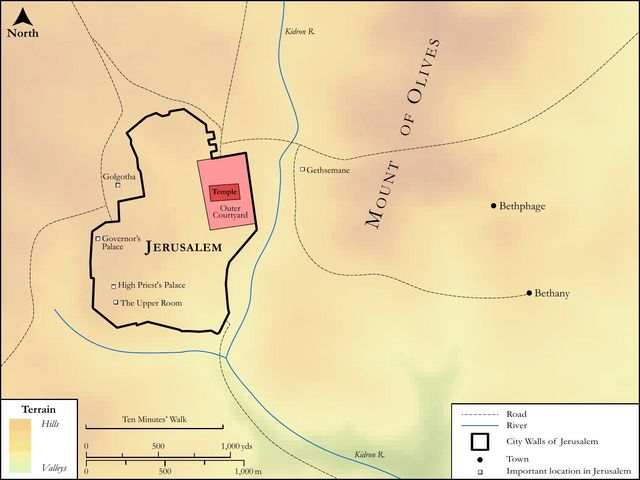
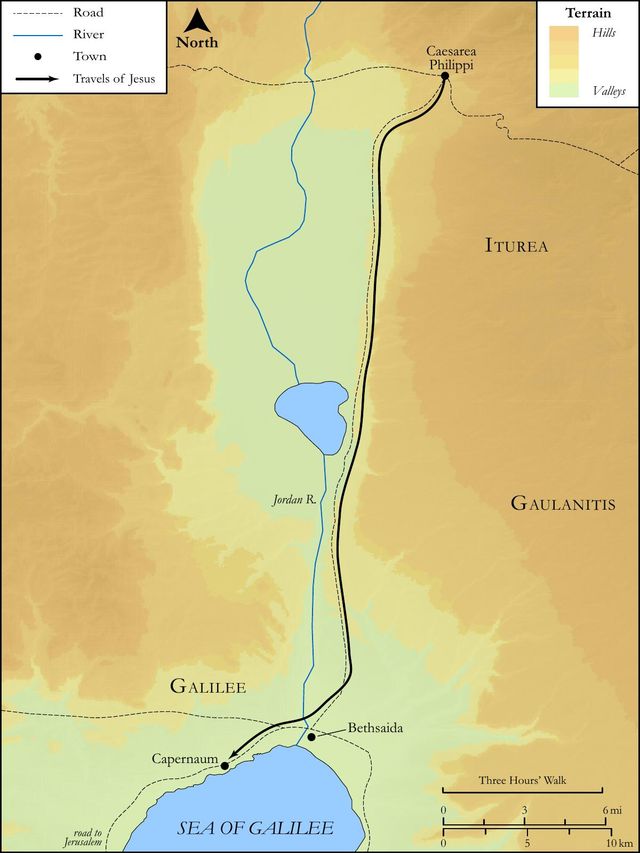
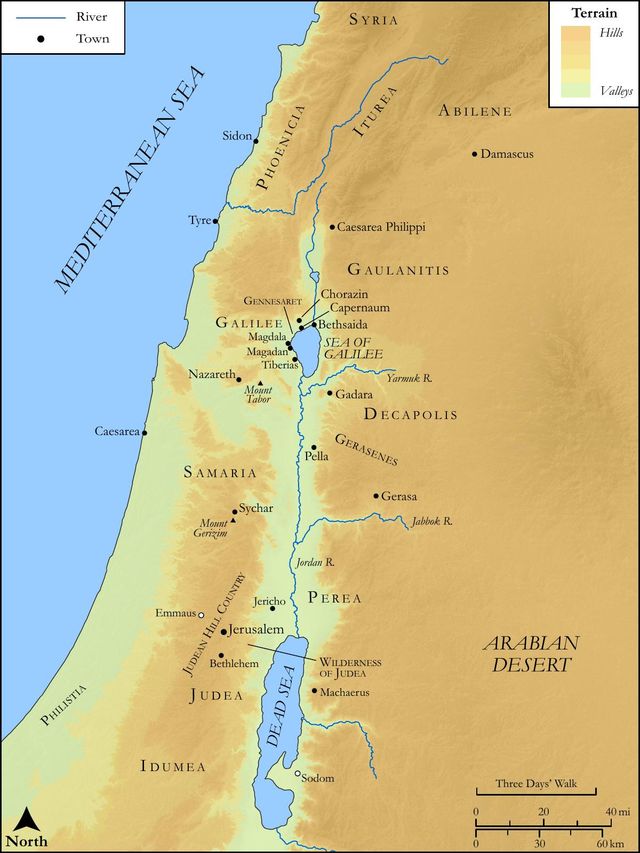
See on the biblical-era map
Study this verse
Public-domain commentary
Matthew Henry
From his Commentary on the Whole Bible. Henry comments on passages, not single verses — this entry covers Matthew 11:1–6. His four-level outline is real structure in the source text, so it is rendered as structure.
The first verse of this chapter some join to the foregoing chapter, and make it (not unfitly) the close of that.
1.The ordination sermon which Christ preached to his disciples in the foregoing chapter is here called his commanding them. Note, Christ's commissions imply commands. Their preaching of the gospel was not only permitted them, but it was enjoined them. It was not a thing respecting which they were left at their liberty, but necessity was laid upon them, Co1 9:16. The promises he made them are included in these commands, for the covenant of grace is a word which he hath commanded, Psa 105:8. He made an end of commanding, etelesendiatassōn. Note, The instructions Christ gives are full instructions. He goes through with his work.
2.When Christ had said what he had to say to his disciples, he departed thence. It should seem they were very loth to leave their Master, till he departed and separated himself from them; as the nurse withdraws the hand, that the child may learn to go by itself. Christ would now teach them how to live, and how to work, without his bodily presence. It was expedient for them, that Christ should thus go away for awhile, that they might be prepared for his long departure, and that, by the help of the Spirit, their own hands might be sufficient for them (Deu 33:7), and they might not be always children. We have little account of what they did now pursuant to their commission. They went abroad, no doubt; probably into Judea (for in Galilee the gospel had been mostly preached hitherto), publishing the doctrine of Christ, and working miracles in his name: but still in a more immediate dependence upon him, and not being long from him; and thus they were trained up, by degrees, for their great work.
3.Christ departed, to teach and preach in the cities whither he sent his disciples before him to work miracles (Mat 10:1-8), and so to raise people's expectations, and to make way for his entertainment. Thus was the way of the Lord prepared; John prepared it by bringing people to repentance, but he did no miracles. The disciples go further, they work miracles for confirmation. Note, Repentance and faith prepare people for the blessings of the kingdom of heaven, which Christ gives. Observe, When Christ empowered them to work miracles, he employed himself in teaching and preaching, as if that were the more honourable of the two. That was but in order to do this. Healing the sick was the saving of bodies, but preaching the gospel was to the saving of souls. Christ had directed his disciples to preach (Mat 10:7), yet he did not leave off preaching himself. He set them to work, not for his own ease, but for the ease of the country, and was not the less busy for employing them. How unlike are they to Christ, who yoke others only that they may themselves be idle! Note, the increase and multitude of labourers in the Lord's work should be made not an excuse for our negligence, but an encouragement to our diligence. The more busy others are, the more busy we should be, and all little enough, so much work is there to be done. Observe, he went to preach in their cities, which were populous places; he cast the net of the gospel where there were most fish to be enclosed. Wisdom cries in the cities (Pro 1:21), at the entry of the city (Pro 8:3), in the cities of the Jews, even of them who made light of him, who notwithstanding had the first offer.
What he preached we are not told, but it was probably to the same purpose with his sermon on the mount. But here is next recorded a message which John Baptist sent to Christ, and his return to it, Mat 11:2-6. We heard before that Jesus heard of John's sufferings, Mat 4:12. Now we are told that John, in prison, hears of Christ's doings. He heard in the prison the works of Christ; and no doubt he was glad to hear of them, for he was a true friend of the Bridegroom, Joh 3:29. Note, When one useful instrument is laid aside, God knows how to raise up many others in the stead of it. The work went on, though John was in prison, and it added no affliction, but a great deal of consolation, to his bonds. Nothing more comfortable to God's people in distress, than to hear of the works of Christ; especially to experience them in their own souls. This turns a prison into a palace. Some way or other Christ will convey the notices of his love to those that are in trouble for conscience sake. John could not see the works of Christ, but he heard of them with pleasure. And blessed are they who have not seen, but only heard, and yet have believed.
Now John Baptist, hearing of Christ's works, sent two of his disciples to him; and what passed between them and him we have here an account of. Here is,
I.The question they had to propose to him:
Art thou he that should come, or do we look for another? This was a serious and important question; Art thou the Messiah promised, or not? Art thou the Christ? Tell us.
1.It is taken for granted that the Messiah should come. It was one of the names by which he was known to the Old Testament saints, he that cometh or shall come, Psa 118:26. He is now come, but there is another coming of his which we still expect.
2.They intimate, that if this be not he, they would look for another. Note, We must not be weary of looking for him that is to come, nor ever say, we will not more expect him till we come to enjoy him. Though he tarry, wait for him, for he that shall come will come, though not in our time.
3.They intimate likewise, that if they be convinced that this is he, they will not be sceptics, they will be satisfied, and will look for no other.
4.They therefore ask, Art thou he? John had said for his part, I am not the Christ, Joh 1:20. Now,
(1.)Some think that John sent this question for his own satisfaction. It is true he had borne a noble testimony to Christ; he had declared him to be the Son of God (Joh 1:34), the Lamb of God (Joh 1:29), and he that should baptize with the Holy Ghost (Joh 1:33), and sent of God (Joh 3:34), which were great things. But he desired to be further and more fully assured, that he was the Messiah that had been so long promised and expected. Note, In matters relating to Christ and our salvation by him, it is good to be sure. Christ appeared not in that external pomp and power in which it was expected he should appear; his own disciples stumbled at this, and perhaps John did so; Christ saw something of this at the bottom of this enquiry, when he said, blessed is he who shall not be offended in me. Note, It is hard, even for good men, to bear up against vulgar errors.
(2.)John's doubt might arise from his own present circumstances. He was a prisoner, and might be tempted to think, if Jesus be indeed the Messiah, whence is it that I, his friend and forerunner, am brought into this trouble, and am left to be so long in it, and he never looks after me, never visits me, nor sends to me, enquires not after me, does nothing either to sweeten my imprisonment or hasten my enlargement? Doubtless there was a good reason why our Lord Jesus did not go to John in prison, lest there should seem to have been a compact between them: but John construed it into a neglect, and it was perhaps a shock to his faith in Christ. Note,
[1.]Where there is true faith, yet there may be a mixture of unbelief. The best are not always alike strong.
[2.]Troubles for Christ, especially when they continue long unrelieved, are such trials of faith as sometimes prove too hard to be borne up against.
[3.]The remaining unbelief of good men may sometimes, in an hour of temptation, strike at the root, and call in question the most fundamental truths which were thought to be well settled. Will the Lord cast off for ever? But we will hope that John's faith did not fail in this matter, only he desired to have it strengthened and confirmed. Note, The best saints have need of the best helps they can get for the strengthening of their faith, and the arming of themselves against temptations to infidelity. Abraham believed, and yet desired a sign (Gen 15:6, Gen 15:8), so did Gideon, Jdg 6:36. But,
(3.)Others think that John sent his disciples to Christ with this question, not so much for his own satisfaction as for theirs. Observe, Though he was a prisoner they adhered to him, attended on him, and were ready to receive instructions from him; they loved him, and would not leave him. Now,
[1.]They were weak in knowledge, and wavering in their faith, and needed instruction and confirmation; and in this matter they were somewhat prejudiced; being jealous for their master, they were jealous of our Master; they were loth to acknowledge Jesus to be the Messiah, because he eclipsed John, and are loth to believe their own master when they think he speaks against himself and them. Good men are apt to have their judgments blessed by their interest. Now John would have their mistakes rectified, and wished them to be as well satisfied as he himself was. Note, The strong ought to consider the infirmities of the weak, and to do what they can to help them: and such as we cannot help ourselves we should send to those that can. When thou art converted, strengthen thy brethren.
[2.]John was all along industrious to turn over his disciples to Christ, as from the grammar-school to the academy. Perhaps he foresaw his death approaching, and therefore would bring his disciples to be better acquainted with Christ, under whose guardianship he must leave them. Note, Ministers' business is to direct every body to Christ. And those who would know the certainty of the doctrine of Christ, must apply themselves to him, who is come to give an understanding. They who would grow in grace must be inquisitive.
II.Here is Christ's answer to this question, Mat 11:4-6.
It was not so direct and express, as when he said, I that speak unto thee am he; but it was a real answer, an answer in fact. Christ will have us to spell out the convincing evidences of gospel truths, and to take pains in digging for knowledge.
1.He points them to what they heard and saw, which they must tell John, that he might from thence take occasion the more fully to instruct and convince them out of their own mouths. Go and tell him what you hear and see. Note, Our senses may and ought to be appealed to in those things that are their proper objects. Therefore the popish doctrine of the real presence agrees not with the truth as it is in Jesus; for Christ refers us to the things we hear and see. Go and tell John,
(1.)What you see of the power of Christ's miracles; you see how, by the word of Jesus, the blind receive their sight, the lame walk, etc. Christ's miracles were done openly, and in the view of all; for they feared not the strongest and most impartial scrutiny. Veritas no quaerit angulos - Truth seeks not concealment. They are to be considered,
[1.]As the acts of a divine power. None but the God of nature could thus overrule and outdo the power of nature. It is particularly spoken of as God's prerogative to open the eyes of the blind, Psa 146:8. Miracles are therefore the broad seal of heaven, and the doctrine they are affixed to must be of God, for his power will never contradict his truth; nor can it be imagined that he should set his seal to a lie; however lying wonders may be vouched for in proof of false doctrines, true miracles evince a divine commission; such Christ's were, and they leave no room to doubt that he was sent of God, and that his doctrine was his that sent him.
[2.]As the accomplishment of a divine prediction. It was foretold (Isa 35:5, Isa 35:6), that our God should come, and that then the eyes of the blind should be opened. Now if the works of Christ agree with the words of the prophet, as it is plain they do, then no doubt but this is our God whom we have waited for, who shall come with a recompence; this is he who is so much wanted.
(2.)Tell him what you hear of the preaching of his gospel, which accompanies his miracles. Faith, though confirmed by seeing, comes by hearing. Tell him,
[1.]That the poor preach the gospel; so some read it. It proves Christ's divine mission, that those whom he employed in founding his kingdom were poor men, destitute of all secular advantages, who, therefore, could never have carried their point, if they had not been carried on by a divine power.
[2.]That the poor have the gospel preached to them. Christ's auditory is made up of such as the scribes and Pharisees despised, and looked upon with contempt, and the rabbies would not instruct, because they were notable to pay them. The Old Testament prophets were sent mostly to kings and princes, but Christ preached to the congregations of the poor. It was foretold that the poor of the flock should wait upon him, Zac 11:11. Note, Christ's gracious condescensions and compassions to the poor, are an evidence that it was he that should bring to the world the tender mercies of our God. It was foretold that the Son of David should be the poor man's King, Psa 72:2, Psa 72:4, Psa 72:12, Psa 72:13. Or we may understand it, not so much of the poor of the world, as the poor in spirit, and so that scripture is fulfilled, Isa 61:1, He hath anointed me to preach glad tidings to the meek. Note, It is a proof of Christ's divine mission that his doctrine is gospel indeed; good news to those who are truly humbled in sorrow for their sins, and truly humble in the denial of self; to them it is accommodated, for whom God always declared he had mercy in store.
[3.]That the poor receive the gospel, and are wrought upon by it, they are evangelized, they receive and entertain the gospel, are leavened by it, and delivered into it as into a mould. Note, The wonderful efficacy of the gospel is a proof of its divine original. The poor are wrought upon by it. The prophets complained of the poor, that they knew not the way of the Lord, Jer 5:4. They could do no good upon them; but the gospel of Christ made its way into their untutored minds.
2.He pronounces a blessing on those that were not offended in him, Mat 11:6. So clear are these evidences of Christ's mission, that they who are not wilfully prejudiced against him, and scandalized in him (so the word is), cannot but receive his doctrine, and so be blessed in him. Note,
(1.)There are many things in Christ which they who are ignorant and unthinking are apt to be offended at, some circumstances for the sake of which they reject the substance of his gospel. The meanness of his appearance, his education at Nazareth, the poverty of his life, the despicableness of his followers, the slights which the great men put upon him, the strictness of his doctrine, the contradiction it gives to flesh and blood, and the sufferings that attend the profession of his name; these are things that keep many from him, who otherwise cannot but see much of God in him. Thus he is set for the fall of many, even in Israel (Luk 2:34), a Rock of offence, Pe1 2:8.
(2.)They are happy who get over these offences. Blessed are they. The expression intimates, that it is a difficult thing to conquer these prejudices, and a dangerous thing not to conquer them; but as to those, who, notwithstanding this opposition, to believe in Christ, their faith will be found so much the more, to praise, and honour, and glory.
Historical interpretation
Nine Centuries of Reception
14 surviving comments on this verse. Each one is dated, so this reads as a timeline rather than a list.
Select a marker to jump to its quote. Markers stagger vertically where authors wrote within a few decades of each other.
It is indeed certain, that he who as forerunner proclaimed Christ's coming, as prophet knew Him when He stood before him, and worshipped Him as Confessor when He came to him, could not fall into error from such abundant knowledge. Nor can it be believed that the grace of the Holy Spirit failed him when thrown into prison, seeing He should hereafter minister the light of His power to the Apostles when they were in prison.
John then is providing not for his own, but his disciples' ignorance; that they might know that it was no other whom he had proclaimed, he sent them to see His works, that the works might establish what John had spoken; and that they should not look for any other Christ, than Him to whom His works had borne testimony.
This saying, that they were blessed from whom there should be no offence in Him, showed them what it was that John had provided against in sending them. For John, through fear of this very thing, had sent his disciples that they might hear Christ.
In these things which were done concerning John, there is a deep store of mystic meaning. The very condition and circumstances of a prophet are themselves a prophecy. John signifies the Law; for the Law proclaimed Christ, preaching remission of sins, and giving promise of the kingdom of heaven. Also when the Law was on the point of expiring, (having been, through the sins of the people, which hindered them from understanding what it spake of Christ, as it were shut up in bonds and in prison,) it sends men to the contemplation of the Gospel, that unbelief might see the truth of its words established by deeds.
A fuller spiritual meaning is to be found in these actions, which were being accomplished in and through John. Here we behold the efficient power of John’s embodied action and also the grace manifest in John. As announced in prophecy: the law rose up and took shape in John. For the law announced Christ, predicted the forgiveness of sins and promised the kingdom of heaven. John thoroughly accomplished all this work that belonged to the law. Therefore when the law (i.e., John) was inactive, oppressed as it was by the sins of the common people and held in chains by the vicious habits of the nation, so that Christ could not be perceived, the law (represented by John) was confined by chains and the prison. But the law (i.e., John) sent others to behold the good news. In this way unbelief would be confronted with the accomplished truth of what had been prophesied. By this means the part of the law that had been chained by the misdeeds of sinners would now be freed through the understanding of the good news freely expressed.
(in Luc. 7. 19.) Some understand it thus; That it was a great thing that John should be so far a prophet, as to acknowledge Christ, and to preach remission of sin; but that like a pious prophet, he could not think that He whom he had believed to be He that should come, was to suffer death; he doubted therefore though not in faith, yet in love. So Peter also doubted, saying, This be far from thee, Lord; this shall not be unto thee. (Mat. 16:22.)
And perhaps the two disciples sent are the two people; those of the Jews, and those of the Gentiles who believed.
(Hom. xxxvi.) Having sent them forth, He withdrew Himself, giving them opportunity and time to do the things that He had enjoined; for while He was present and ready to heal, no man would come to His disciples.
But this seems hardly reasonable. For John was not in ignorance of His death, but was the first to preach it, saying, Behold the Lamb of God, that taketh away the sins of the world. For thus calling Him the Lamb, he plainly shows forth the Cross; and no otherwise than by the Cross did He take away the sins of the world. Also how is he a greater prophet than these, if he knew not those things which all the prophets knew, for Isaiah says, He was led as a sheep to the slaughter. (Is. 53:7.)
But is this a more reasonable explanation than the other? for why then did he not say, Art Thou Ho that is coming to the world beneath? and not simply, Art thou he that is to come? And the reason of his seeking to know, namely, that he might preach Him there, is even ridiculous. For the present life is the time of grace, and after death the judgment and punishment; therefore there was no need of a forerunner thither. Again, if the unbelievers who should believe after death should be saved, then none would perish; all would then repent and worship; for every knee shall bow, both of things in heaven, and things on earth, and things under the earth. (Phil. 2:10)
Yet whilst John was with them he held them rightly convinced concerning Christ. But when he was going to die, he was more concerned on their behalf. For he feared that he might leave his disciples a prey to some pernicious doctrine, and that they should remain separate from Christ, to whom it had been his care to bring all his followers from the beginning. Had he said to them, Depart from me, for He is better than me, he would not have prevailed with them, as they would have supposed that he spoke this in humility, which opinion would have drawn them more closely to him. What then does he? He waits to hear through them that Christ works miracles. Nor did he send all, but two only, (whom perhaps he chose as more ready to believe than the rest,) that the reason of his enquiry might be unsuspected, and that from the things themselves which they should see they might understand the difference between him and Jesus.
So also Christ as knowing the mind of John, said not, I am He; for thus He would have put an obstacle in the way of those that heard Him, who would have at least thought within themselves, if they did not say, what the Jews did say to Christ, Thou bearest witness of thyself. (John 8:13.) Therefore He would have them learn from His miracles, and so presented His doctrine to them more clear, and without suspicion. For the testimony of deeds is stronger than the testimony of words. Therefore He straightway healed a number of blind, and lame, and many other, for the sake not of John who had knowledge, but of others who doubted; as it follows, And Jesus answered and said unto them, Go and tell John what ye have heard and scen; The blind see, the lame walk, the lepers are cleansed, the deaf hear, the dead are raised, the poor have the Gospel preached to them.
And blessed is he who shall not be offended in me, is directed against the messengers; they were offended in Him. But He not publishing their doubts, and leaving it to their conscience alone, thus privately introduced a refutation of them.
For what intent then did he send to ask? John's disciples were starting aside from Jesus, and this surely any one may see, and they had always a jealous feeling towards Him. And it is plain, from what they said to their master: "He that was with thee," it is said, "beyond Jordan, to whom thou barest witness, behold, the same baptizeth, and all men come unto Him." And again, "There arose a question between John's disciples and the Jews about purifying." And again they came unto Him, and said, "Why do we and the Pharisees fast oft, but Thy disciples fast not?" For as yet they knew not who Christ was, but imagining Jesus to be a mere man, but John greater than after the manner of man, were vexed at seeing the former held in estimation, but the latter, as he had said, now ceasing. And this hindered them from coming unto Him, their jealousy quite blocking up the access. Now so long as John was with them, he was exhorting them continually and instructing them, and not even so did he persuade them; but when he was now on the point of dying, he uses the more diligence: fearing as he did lest he might leave a foundation for bad doctrine, and they continue broken off from Christ. For as he was diligent even at first to bring to Christ all that pertained to himself; so on his failing to persuade them, now towards his end he does but exert the more zeal.
Now if he had said, "Go ye away unto Him, He is better than I," he would not have persuaded them, minded as they were not easily to be separated from him, but rather he would have been thought to say it out of modesty, and they would have been the more rivetted to him; or if he had held his peace, then again nothing was gained. What then doth he? He waits to hear from them that Christ is working miracles, and not even so doth he admonish them, nor doth he send all, but some two (whom he perhaps knew to be more teachable than the rest); that the inquiry might be made without suspicion, in order that from His acts they might learn the difference between Jesus and himself. And he saith, Go ye, and say, "Art thou He that should come, or do we look for another?"
But what follows is completely among the controverted points. Of what nature then is this? Their saying, "Art Thou He that should come, or do we look for another?" That is, he that knew Him before His miracles, he that had learned it of the Spirit, he who had heard it of the Father, he who had proclaimed Him before all men; doth he now send to learn of Him, whether it be Himself or no? And if yet thou didst not know that it is surely He, how thinkest thou thyself credible, affirming as thou dost concerning things, whereof thou art ignorant? For he that is to bear witness to others, must be first worthy of credit himself. Didst thou not say, "I am not meet to loose the latchet of His shoe?" Didst thou not say, "I knew Him not, but He that sent me to baptize with water, the same said unto me, Upon whom thou shalt see the Spirit descending and resting upon Him, the same is He which baptizeth with the Holy Ghost?" Didst thou not see the Spirit in form of a dove? didst thou not hear the voice? Didst thou not utterly forbid Him, saying, "I have need to be baptized of Thee?" Didst thou not say even to thy disciples, "He must increase, I must decrease?" Didst thou not teach all the people, that "He should baptize them with the Holy Ghost and with fire?" and that He "is the Lamb of God that taketh away the sin of the world?" Didst thou not before His signs and miracles proclaim all these things? How then now, when He hath been made manifest to all, and the fame of Him hath gone out everywhere, and dead men have been raised, and devils driven away, and a display made of so great miracles, dost thou after this send to learn of Him?
What then is the fact? Were all these sayings a kind of fraud: a stage play and fables? Nay, who that hath any understanding would say so? I say not, John, who leaped in the womb, who before his own birth proclaimed Him, the citizen of the wilderness, the exhibitor of the conversation of angels; but even though he were one of the common sort, and of them that are utterly outcast, he would not have hesitated, after so many testimonies, both on his own part and on the part of others.
Whence it is evident, that neither did he send as being himself in doubt, nor did he ask in ignorance. Since no one surely could say this, that though he knew it fully, yet on account of his prison he was become rather timid: for neither was he looking to be delivered therefrom, nor if he did look for it, would he have betrayed his duty to God, armed as he was against various kinds of death. For unless he had been prepared for this, he would not have evinced so great courage towards a whole people, practised in shedding blood of prophets; nor would he have rebuked that savage tyrant with so much boldness in the midst of the city and the forum, severely chiding him, as though he were a little child, in hearing of all men. And even if he were grown more timid, how was he not ashamed before his own disciples, in whose presence he had so often borne witness unto Him, but asked his question by them, which he should have done by others? And yet surely he knew full well, that they too were jealous of Christ, and desired to find some handle against Him. And how could he but be abashed before the Jewish people, in whose presence he had proclaimed such high things? Or what advantage accrued to him thereby, towards deliverance from his bonds? For not for Christ's sake had he been cast into prison, nor for having proclaimed His power, but for his own rebuke touching the unlawful marriage.
Hence he frames his question thus, Art thou he that is to come? Not, Art Thou he that hast come? And the sense is, Direct me, since I am about to go down into the lower parts of the earth, whether I shall announce Thee to the spirits beneath also; or whether Thou as the Son of God may not taste death, but will send another to this sacrament?
Therefore he does not ask as being himself ignorant. But as the Saviour asks where Lazarus is buried (John 11:34.), in order that they who shewed. Him the sepulchre might be so far prepared for faith, and believe that the dead was verily raised again—so John, about to be put to death by Herod, sends his disciples to Christ, that by this opportunity of seeing His signs and wonders they might believe on Him, and so might learn through their master's enquiry. But John's disciples had somewhat of bitterness and jealousy towards the Lord, as their former enquiry showed, Why do we and the Pharisees fast oft, but thy disciples fast not?
This last is no less than the first. And understand it as if it had been said, Even the poor; that so between noble and mean, rich and poor, there may be no difference in preaching. This approves the strictness of the master, this the truth of the teacher, that in His sight every one who can be saved is equal.
Chapter 11, Verses 1-2. And it came to pass, when Jesus had finished instructing His twelve disciples, that He departed from there to teach and preach in their cities. It is not as if He was unaware and asking; for He had already shown the others who were unaware, saying: Behold, the Lamb of God, behold Him who takes away the sins of the world (John 1:29), and He had heard the voice of the Father, thundering: This is my beloved Son, in whom I am well pleased (Matthew 3:17). But the Savior asks where Lazarus has been laid, so that those who were indicating the place of the tomb would at least be prepared to see the dead man rising again, and the disciples would be sent to Christ to witness the signs and miracles, so that through this opportunity they would believe in Him and learn from their Master. But the disciples of John, through their pride against the Lord, and their envy and malicious opposition, also revealed their thoughts in a superior manner, as the Evangelist reports: Then the disciples of John approached him, saying: Why do we and the Pharisees fast often, but your disciples do not fast (Ibid., IX, 14)? And in another place: Master, to whom you gave testimony at the Jordan, look, his disciples are baptizing and everyone is coming to him (John III, 26), as if to say: We are being abandoned, there is a scarcity here, while a crowd gathers around him.
About this text, some will argue, “When John sent his disciples, he was neither ignorant himself nor did he mean for them to learn, which seems clear to anyone who has entered to a certain extent into the meaning of the holy Scriptures.” But this is foolish, because when John was about to die and join the departed, he sent them to ask whether he was the one who was to come and free those who had been vanquished by death. In this way the good news was delivered to his disciples as well. John had already said, “Behold, the Lamb of God, who takes away the sin of the world.” He already knew very well that the Messiah would offer his suffering up to God for the sake of all humanity. Certainly, if John indeed knew that Jesus was the Christ, he was not ignorant of the Christ. On the contrary, he knew exactly what benefits were to come to humanity through him. John might seem to be telling different people different things in different contexts. Isn’t it true that John had so much knowledge about Christ that he said a great deal about him to various people? Isn’t it true that in accordance with the greater part of what John had said in his own testimony, he recognized Jesus as the deliverer of good news? It is hardly conceivable that John was ignorant about the Christ but now was guessing and wanted to find out for sure from him. That would be inconsistent. And who would, in the attempt to discover something so great, send along his disciples as if they were competent in themselves to teach and witness?There is another point being made here. The present life is the time when we must conduct ourselves responsibly. After death there is judgment and punishment. However, Christ’s death did not universally redeem the sins of all those who had already died. For when it is said that the bronze gates and iron bars were shattered, this is said because the body of Christ then appeared immortal for the first time and death was shown to be defeated. What does this mean, then? Were all people unrighteous before the coming of Christ? Not at all. Before Christ it was enough to refrain from idolatry and to worship the one true God in order to be saved. But now that alone is not enough. We must also know Christ personally. And so we must not imagine that someone will confess to Christ in hell, where even if all repent, no one is comforted.
He well passes from the special teaching which He had delivered to His disciples, to the general which He preached in the cities; passing therein as it were from heaven to earth, that He might give light to all. By this deed of the Lord, all holy preachers are admonished that they should study to benefit all.
We must inquire, dearly beloved brethren, why John—a prophet and more than a prophet, who pointed out the Lord coming to the baptism at the Jordan, saying: "Behold the Lamb of God, behold him who takes away the sin of the world"; who, considering both his own humility and the power of Christ's divinity, says: "He who is of the earth speaks of the earth, but he who comes from heaven is above all"—why, when placed in prison and sending his disciples, he asks: "Are you he who is to come, or do we look for another?" As if he did not know the one he had pointed out, and did not know whether he was the one whom he had proclaimed by prophesying, baptizing, and pointing him out. But this question is quickly resolved if the time and order of events is considered. For standing at the waters of the Jordan, he declared that this was the Redeemer of the world; but sent to prison, he asks whether he himself is coming—not because he doubts that he is the Redeemer of the world, but he asks in order to know whether he who had come into the world by himself would also descend by himself to the prison of hell. For he whom John had announced to the world as his forerunner, he was now preceding to hell by dying. Therefore he says: "Are you he who is to come, or do we look for another?" As if he were openly saying: Just as you deigned to be born for mankind, indicate whether you also deign to die for mankind, so that I who have been the forerunner of your birth may also become the forerunner of your death, and may announce to hell that you are coming, whom I have already announced as having come to the world.
(Hom. in Ev. vi. 1.) We must enquire how John, who is a prophet and more than a prophet, who made known the Lord when He came to be baptized, saying, Behold the Lamb of God, that taketh away the sins of the world!—why, when he was afterwards cast into prison, he should send his disciples to ask, Art thou he that should come, or look we for another? Did he not know Him whom he had pointed out to others; or was he uncertain whether this was He, whom by foretelling, by baptizing, and by making known, he had proclaimed to be He?
(Aug, ubi sup) But this question may be answered in a better way if we attend to the order of time. At the waters of Jordan he had affirmed that this was the Redeemer of the world after he was thrown into prison, he enquires if this was He that should come—not that he doubted that this was the Redeemer of the world, but he asks that he may know whether He who in His own person had come into the world, would in His own person descend also to the world below.
(Hom. in Ev. vi. 1.) Otherwise; The mind of unbelievers was greatly offended concerning Christ, because after many miracles done, they saw Him at length put to death; whence Paul speaks, We preach Christ crucified, to the Jews a stumbling-block. (1 Cor. 1:23.) What then does that mean, Blessed is he who shall not be offended in me, but a direct allusion to the humiliation of His death; as much as to say, I do indeed wonderful works, but do not disdain to suffer humble things. Because then I follow you in death, men must be careful not to despise in Me My death, while they reverence My wonderful works.
The Lord having sent out His disciples to preach with the foregoing instructions, Himself now fulfils in action what He had taught in words, offering His preaching first to the Jews; And it came to pass when Jesus had ended all these sayings, he passed thence.
(non occ.) The Evangelist had shown above how by Christ's miracles and teaching, both His disciples and the multitudes had been instructed; he now shows how this instruction had reached even to John's disciples, so that they seemed to have some jealousy towards Christ; John, when he had heard in his bonds the works of Christ, sent two of his disciples to say unto him, Art thou he that should come, or look we for another?
(non occ.) But it ought to be observed, that Jerome and Gregory did not say that John was to proclaim Christ's coming to the world beneath, to the end that the unbelievers there might be converted to the faith, but that the righteous who abode in expectation of Christ, should be comforted by His near approach.
Continue studying Matthew 11:2 across the web’s major study libraries — every link below opens this exact verse, chapter, or book on the destination site.
Read & Compare
 BibleGatewayThis verse in more than 200 translations and 70 languages.
 Bible.comThe YouVersion reader — hundreds of translations, reading plans, and highlights.
 ESV.orgCrossway's official English Standard Version reader.
 NET BibleThe NET translation with 60,000+ translators' notes on every rendering decision.
 STEP BibleTyndale House's free study tool — original text, vocabulary, and scholarly resources.
 BibliaLogos Bible Software's free web reader.
 USCCBThe New American Bible (Revised Edition) with the U.S. bishops' study notes.
Commentaries
 BibleHub CommentariesDozens of classic commentaries on this verse, gathered on one page.
 StudyLightMore than 100 commentary sets — the largest collection on the web.
 BibleRefPlain-English commentary on what this verse means, verse by verse.
 Enduring WordDavid Guzik's free commentary on this chapter, widely used by Bible teachers.
 Bible Study ToolsVerse commentary alongside Greek and Hebrew study aids.
Original Language & Research
- BibleHub InterlinearThe verse word by word — original language, transliteration, and English.
- BibleHub LexiconEvery word's original-language definition and Strong's entry.
 Blue Letter BibleDeep-study tools — Strong's numbers, concordance, and word studies.
 CNTR CollationThe earliest Greek manuscripts of this verse, collated letter by letter.
Sermons, Hymns & Audio


TrulyRandomVerse is not affiliated with these sites and doesn’t control their content. They’re linked because they’re genuinely useful.
Summary
Matthew 11:2 serves as a pivotal moment in the Gospel narrative, capturing John the Baptist's state of imprisonment and his subsequent inquiry regarding Jesus' messianic identity. Having heard compelling reports of Jesus' miraculous "works," John dispatches two of his disciples to directly question whether Jesus is indeed the long-awaited Messiah or if they should anticipate another. This verse not only highlights John's human vulnerability and desire for confirmation amidst his confinement but also sets the stage for Jesus' profound self-revelation, emphasizing the nature of His Kingdom ministry as the fulfillment of Old Testament prophecy.
Context
ShowHideLiterary Context
Matthew 11:2 marks a significant transition within Matthew's Gospel. Chapters 8-10 detail Jesus' extensive healing ministry, His authoritative teaching, and the commissioning of the twelve disciples, demonstrating His power and the inauguration of the Kingdom of Heaven. Immediately preceding this verse, Jesus has just finished giving instructions to His disciples for their mission, and He Himself has departed to teach and preach in the cities of Galilee (Matthew 11:1). The narrative then shifts abruptly to John the Baptist, who, despite being Jesus' prophetic forerunner and baptizer (Matthew 3:1-17), is now in prison. This abrupt shift underscores the precarious situation of John and introduces a moment of apparent doubt, which Jesus addresses directly in the subsequent verses (Matthew 11:3-6).
Historical & Cultural Context
John the Baptist's imprisonment, mentioned here and detailed further in Matthew 14:3-4, was a consequence of his courageous condemnation of Herod Antipas's unlawful marriage to Herodias, his brother Philip's wife. This act placed John in direct conflict with the ruling political power, a dangerous stance for any prophet. In the first century, imprisonment often meant harsh conditions, isolation, and an uncertain fate, which could understandably lead to a crisis of expectation. Furthermore, Jewish messianic expectations were diverse, often anticipating a political or military deliverer who would overthrow Roman rule, not necessarily a suffering servant or a healer. John, though a prophet, might have wrestled with how Jesus' ministry, characterized by healing and teaching rather than immediate political deliverance, aligned with his understanding of the Messiah's role.
Key Themes
ShowHideThis verse introduces several crucial themes. Firstly, it highlights the challenge of understanding God's work when circumstances contradict expectations. John, the one who prepared the way for the Messiah (Matthew 3:3), now faces a personal trial that prompts a re-evaluation of Jesus' identity. Secondly, it emphasizes confirmation through deeds, as John's inquiry is prompted by "the works of Christ." Jesus' response in Matthew 11:4-5 directly points to His miracles as the fulfillment of Old Testament prophecies concerning the Messiah's ministry (Isaiah 35:5-6 and Isaiah 61:1). Finally, the verse subtly introduces the transition of discipleship, as John sends his own followers to Jesus, potentially preparing them to shift their allegiance and witness Jesus' messianic credentials firsthand.
Exposition and Analysis
ShowHideKey Word Analysis
ShowHideMeaning "to hear (in various senses)." In this context, it signifies not merely passive reception of sound but active apprehension and understanding of the reports concerning Jesus' ministry. John "heard" the substance and impact of Jesus' actions, which were significant enough to provoke his inquiry from prison.
Meaning "a place of bondage, i.e., a dungeon." This word vividly portrays John's physical confinement. It emphasizes the stark contrast between John's restricted state and Jesus' expansive, active ministry, providing a crucial backdrop for John's question. His hearing of Jesus' works is filtered through the lens of his suffering and isolation.
Meaning "toil (as an effort or occupation); by implication, an act." Here, "works" refers specifically to the powerful, often miraculous, deeds performed by Jesus—His healings, exorcisms, and authoritative teachings. These "works" were not just random acts but tangible manifestations of God's power and the signs that authenticated Jesus' messianic claims.
Verse Breakdown
ShowHide"Now when John had heard in the prison"
This opening clause immediately establishes the setting and the protagonist's state. John, the prophetic forerunner of Jesus, is not freely ministering but confined. The phrase "had heard" indicates that reports of Jesus' activities had reached him even within the confines of his "prison" (dungeon), suggesting the widespread nature and undeniable impact of Jesus' ministry. This detail underscores John's physical limitation but also his continued spiritual engagement and awareness.
"the works of Christ,"
This phrase specifies what John heard: the powerful "works" (ἔργα, erga) performed by Jesus. These were not just teachings or pronouncements but tangible, miraculous deeds—healings, exorcisms, and other demonstrations of divine authority. The designation "Christ" (Χριστός, Christos) here is significant, as it refers to Jesus as the Anointed One, the Messiah. John's inquiry is therefore directly related to whether these "works" align with his understanding of the Messiah's expected actions and the nature of His Kingdom.
"he sent two of his disciples,"
Faced with these reports and his own circumstances, John takes action. He dispatches "two of his disciples," indicating a deliberate and formal inquiry. The choice to send disciples, rather than going himself (which he could not), also serves a pedagogical purpose: it allows his disciples to witness Jesus firsthand, potentially resolving their own uncertainties and preparing them to transition their allegiance to Jesus. This act reveals John's pastoral concern for his followers and his earnest desire for clarity regarding Jesus' identity.
Literary Devices
ShowHideMatthew 11:2 employs several literary devices to enhance its meaning and impact. Irony is prominent, as John, who had previously affirmed Jesus as the "Lamb of God" (John 1:29) and the one who would baptize with the Holy Spirit (Matthew 3:11), now sends a query that suggests doubt or a need for confirmation. This highlights the human element of faith, even for a great prophet. The setting of John "in the prison" creates a powerful contrast between his physical confinement and the expansive, liberating ministry of Jesus, whose "works" are being heard even within the dungeon walls. This contrast underscores the distinct nature of Jesus' messianic work, which was not primarily about political deliverance from Roman oppression, but spiritual liberation and healing. Finally, the "works of Christ" function as symbolism, representing the tangible evidence of God's active presence and power, serving as divine credentials for Jesus' messianic claims.
Theological and Thematic Connections
ShowHideMatthew 11:2 initiates a profound theological discussion about the nature of messianic identity and the Kingdom of God. John's question, born from his harsh reality in prison and perhaps a misunderstanding of the Messiah's immediate role, underscores that even those with deep faith can experience moments of doubt or a need for clearer understanding when God's plans unfold differently than expected. Jesus' response in the subsequent verses, pointing to His "works" as fulfillment of prophecy, affirms that His ministry, characterized by healing, teaching, and bringing good news to the poor, is precisely the sign of the Messiah's arrival, even if it doesn't align with popular expectations of a conquering king. This passage thus teaches us to look for God's activity not always in grand, overt political movements, but often in acts of compassion, healing, and spiritual transformation.
Reflection and Application
ShowHideMatthew 11:2 offers profound reassurance and guidance for believers navigating their own faith journeys. John the Baptist, a man whom Jesus later praises as the greatest born of women (Matthew 11:11), experienced a moment of questioning. This reminds us that doubt is not necessarily a sign of weak faith but can be a natural human response to circumstances that challenge our understanding of God's ways. When our reality—like John's imprisonment—seems to contradict our expectations of God's intervention, it is permissible and even healthy to bring our honest questions to Jesus. His response to John's disciples, pointing to His "works," encourages us to look at the tangible evidence of His power and faithfulness, both in Scripture and in our own lives. We are called to trust in His character and His ongoing work, even when the path is unclear or painful, knowing that His Kingdom unfolds according to His perfect plan, not always ours.
Questions for Reflection
ShowHideFAQ
ShowHideWhy did John the Baptist, who had previously affirmed Jesus, send his disciples to ask this question?
ShowHideJohn's question in Matthew 11:3 is often interpreted in several ways, none of which necessarily imply a complete loss of faith. Firstly, John's imprisonment was a harsh and unexpected turn for a prophet who had anticipated the immediate coming of God's judgment and Kingdom. From his dungeon, Jesus' ministry, characterized by healing and teaching rather than immediate political or judicial action, might have seemed different from what John expected of the Messiah. John's question could have been a genuine search for clarity, seeking confirmation that Jesus was indeed the one, despite the apparent delay in the full manifestation of the Kingdom as he understood it. Secondly, and perhaps more significantly, John may have sent his disciples not primarily for his own sake, but for theirs. By directing them to Jesus, he was giving them the opportunity to witness Jesus' "works" firsthand and hear His words, thereby solidifying their own faith and preparing them to transition their allegiance from John to Jesus. This act would have served as a final, powerful lesson from their mentor, ensuring they followed the true Messiah.
Christ-Centered Fulfillment
ShowHideMatthew 11:2, though seemingly a moment of doubt, profoundly points to Christ's unique messianic fulfillment. John, the last of the Old Testament prophets, finds himself in a prison, a symbol of the old covenant's limitations and the world's resistance to God's truth. His question, "Are you the one who is to come, or shall we look for another?" (Matthew 11:3), highlights the tension between prophetic expectation and the unexpected nature of Christ's Kingdom. Jesus' response, not with a direct "yes," but by pointing to His "works"—the blind receiving sight, the lame walking, lepers being cleansed, the deaf hearing, the dead being raised, and the poor having good news preached to them (Matthew 11:4-5)—reveals the true nature of His messianic identity. These "works" are direct fulfillments of Old Testament prophecies concerning the Messiah (Isaiah 35:5-6 and Isaiah 61:1), demonstrating that the Kingdom of God had indeed arrived, not with political revolution, but with divine power bringing healing, restoration, and spiritual liberation. Thus, John's inquiry, born from a place of human limitation, ultimately serves to underscore Jesus as the promised Christ, whose ministry perfectly embodies God's redemptive plan, transcending all human expectations and inaugurating a new era of grace and truth (John 1:17).