


Zechariah 11:11
Bible text: King James Version (1769 Blayney text) · Public domain
Bible text: Berean Standard Bible · Public domain
Bible text: American Standard Version (1901) · Public domain
Bible text: World English Bible, Messianic edition · Public domain
Bible text: Geneva Bible (1599) · Public domain
Bible text: Young's Literal Translation · Public domain
- וַתֻּפַרva·tu·Farand it was brokenH6565Conj-w ¦ V-Hophal-ConsecImperf-3fsVerb Hophal Consecutive Imperfect 3rd Singular Feminineוַandתֻּפַרit was broken
- בַּיּוֹםbai·Yomon the dayH3117Prep-b ¦ N-msNoun Singular Masculine Absoluteבַּon theיּוֹםday
- הַהוּאha·Hu'<the> thatH1931Art ¦ Pro-3msPronoun Personal 3rd Singular Masculineהַ<the>הוּאthat
- וַיֵּדְעוּvai·ye·de·'Uand they knewH3045Conj-w ¦ V-Qal-ConsecImperf-3mpVerb Qal Consecutive Imperfect 3rd Plural Masculineוַandיֵּדְעוּthey knew
- כֵןkhenthusH3651AdvAdverb
- עֲנִיֵּי'a·ni·Yei[the] afflicted [ones] ofH6041Adj-mpcAdjective Plural Masculine Construct
- הַצֹּאןha·tzoNthe flockH6629Art ¦ N-csNoun Singular common gender Absoluteהַtheצֹּאןflock
- הַשֹּׁמְרִיםha·sho·me·Rimwho were watchingH8104Art ¦ V-Qal-Prtcpl-mpVerb Qal Participle Plural Masculine Absoluteהַwhoשֹּׁמְרִיםwere watching
- אֹתִי'o·Ti<obj.> meH853DirObjM ¦ 1csParticle Object Indicatorאֹתִ<obj.>יme
- כִּיkithatH3588PrtParticle Conditional
- דְבַרde·var[was] [the] word ofH1697N-mscNoun Singular Masculine Construct
- יְהוָהYah·wehYahwehH3068N-properNoun Proper Title
- הוּאHu'itH1931Pro-3msPronoun Personal 3rd Singular Masculine
English is a literal word-by-word gloss of the Hebrew, not the KJV's wording. Why?
This is the original text the KJV's translators worked from — each Hebrew word with its own literal English meaning in this verse, prepared by scholars at Tyndale House, Cambridge. The KJV translates whole sentences, not word by word, so its wording differs: one Hebrew word can become several English words, and the KJV may choose “the LORD” where the gloss reads “Yahweh”. Both are faithful — they answer different questions. For the KJV's own rendering, switch to the KJV text.
Details
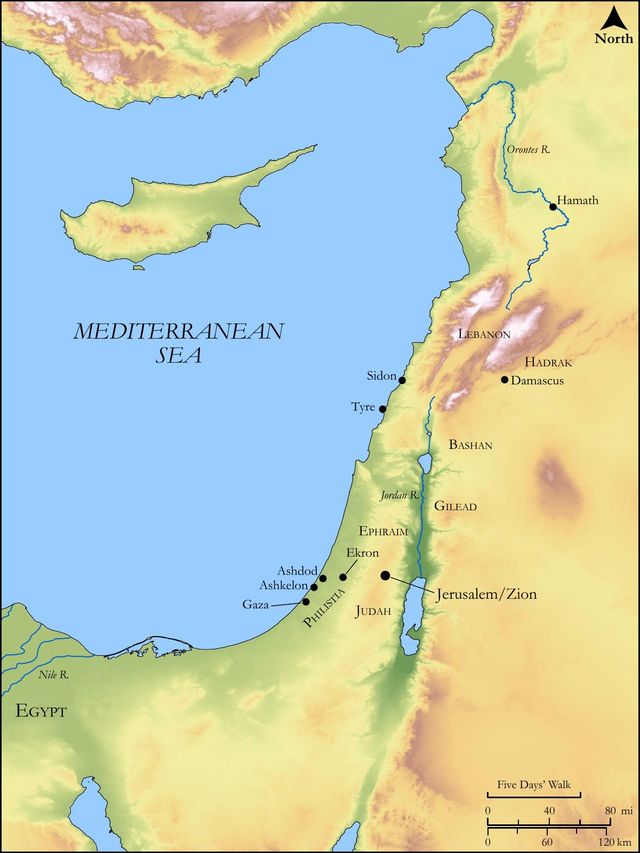
See on the biblical-era map
Study this verse
Public-domain commentary
Matthew Henry
From his Commentary on the Whole Bible. Henry comments on passages, not single verses — this entry covers Zechariah 11:4–14. His three-level outline is real structure in the source text, so it is rendered as structure.
The prophet here is made a type of Christ, as the prophet Isaiah sometimes was; and the scope of these verses is to show that for judgment Christ came into this world (Joh 9:39), for judgment to the Jewish church and nation, which were, about the time of his coming, wretchedly corrupted and degenerated by the worldliness and hypocrisy of their rulers. Christ would have healed them, but they would not be healed; they are therefore left desolate, and abandoned to ruin. Observe here,
I.The desperate case of the Jewish church, under the tyranny of their own governors.
Their slavery in their own country made them as miserable as their captivity in strange countries had done: Their possessors slay them and sell them, Zac 11:5. In Zechariah's time we find the rulers and the nobles justly rebuked for exacting usury of their brethren; and the governors, even by their servants, oppressive to the people, Neh 5:7, Neh 5:15. In Christ's time the chief priests and the elders, who were the possessors of the flock, by their traditions, the commandments of men, and their impositions on the consciences of the people, became perfect tyrants, devoured their houses, engrossed their wealth, and fleeced the flock instead of feeding it. The Sadducees, who were deists, corrupted their judgments. The Pharisees, who were bigots for superstition, corrupted their morals, by making void the commandments of God, Mat 15:16. Thus they slew the sheep of the flock, thus they sold them. They cared not what became of them so they could but gain their own ends and serve their own interests. And,
1.In this they justified themselves: They slay them and hold themselves not guilty. They think that there is no harm in it, and that they shall never be called to an account for it by the chief Shepherd; as if their power were given them for destruction, which was designed only for edification, and as if, because they sat in Moses's seat, they were not under the obligation of Moses's law, but might dispense with it, and with themselves in the breach of it, at their pleasure. Note, Those have their minds woefully blinded indeed who do ill and justify themselves in doing it; but God will not hold those guiltless who hold themselves so.
2.In this they affronted God, by giving him thanks for the gain of their oppression: They said, Blessed be the Lord, for I am rich, as if, because they prospered in their wickedness, got money by it, and raised estates, God had made himself patron of their unjust practices, and Providence had become particeps criminis - the associate of their guilt. What is got honestly we ought to give God thanks for, and to bless him whose blessing makes rich and adds no sorrow with it. But with what face can we go to God either to beg a blessing upon the unlawful methods of getting wealth or to return him thanks for success in them? They should rather have gone to God to confess the sin, to take shame to themselves for it, and to vow restitution, than thus to mock him by making the gains of sin the gift of God, who hates robbery for burnt-offerings, and reckons not himself praised by the thanksgiving if he be dishonoured either in the getting or the using of that which we give him thanks for.
3.In this they put contempt upon the people of God, as unworthy their regard or compassionate consideration: Their own shepherds pity them not; they make them miserable, and then do not commiserate them. Christ had compassion on the multitude because they fainted and were scattered abroad, as if they had no shepherd (as really they had worse than none); but their own shepherds pitied them not, nor showed any concern for them. Note, It is ill for a church when its pastors have no tenderness, no compassion for precious souls, when they can look upon the ignorant, the foolish, the wicked, the weak, without pity.
II.The sentence of God's wrath passed upon them for their senselessness and stupidity in this condition.
There was a general decay, nay, a destruction, of religion among them, and it was all one to them; they regarded it not. My people love to have it so, Jer 5:31. Though they were oppressed and broken in judgment, yet they willingly walked after the commandment, Hos 5:11. And, as their shepherds pitied them not, so they did not bemoan themselves; therefore God says (Zac 11:6), "I will no more pity the inhabitants of the land. They have courted their own destruction, and so let their doom be." But those are truly miserable whom the God of mercy himself will no more have compassion upon. Those who are willing to have their consciences oppressed by those who teach for doctrines the commandments of men (as the Jews were, who called those Rabbi, Rabbi, that did so, Mat 15:9; Mat 23:7), are often punished by oppression in their civil interests, and justly, for those forfeit their own rights who tamely give up God's rights. The Jews did so; the Papists do so; and who can pity them if they be ruled with rigour? God here threatens them,
1.That he will deliver them into the hand of oppressors, every one into his neighbour's hand, so that they shall use one another barbarously. The several parties in Jerusalem did so; the zealots, the seditious, as they were called, committed greater outrages than the common enemy did, as Josephus relates in his history of the wars of the Jews. They shall be delivered every one into the hand of his king, that is, the Roman emperor, whom they chose to submit to rather than to Christ, saying, We have no king but Caesar. Thus they thought to ingratiate themselves with their lords and masters. But for this God brought the Romans upon them, who took away their place and nation.
2.That he will not deliver them out of their hands: They shall smite the land, the whole land, and out of their hand I will not deliver them; and, if the Lord do not help them, none else can, nor can they help themselves.
III.A trial yet made whether their ruin might be prevented by sending Christ among them as a shepherd; God had sent his servants to them in vain, but last of all he sent unto them his Son, saying, They will reverence my Son, Mat 21:37. Divers of the prophets had spoken of him as the Shepherd of Israel, Isa 40:11; Eze 34:23. he himself told the Pharisees that he was the Shepherd of the sheep, and that those who pretended to be shepherds were thieves and robbers (Joh 10:1, Joh 10:2, Joh 10:11), apparently referring to this passage, where we have,
1.The charge he received from his Father to try what might be done with this flock (Zac 11:4): Thus saith the Lord my God (Christ called his Father his God because he acted in compliance with his will and with an eye to his glory in his whole undertaking), Feed the flock of the slaughter. The Jews were God's flock, but they were the flock of slaughter, for their enemies had killed them all the day long and accounted them as sheep for the slaughter; their own possessors slew them, and God himself had doomed them to the slaughter. Yet "feed them by reproof instruction, and comfort; provide wholesome food for those who have so long been soured with the leaven of the scribes and Pharisees." Other sheep he had, which were not of this fold, and which afterwards must be brought; but he is first sent to the lost sheep of the house of Israel, Mat 15:24.
2.His acceptance of this charge, and his undertaking pursuant to it, Zac 11:7. He does as it were say, Lo, I come to do thy will, O my God! and, since this is thy will, it is mine: I will feed the flock of slaughter. Christ will care for these lost sheep; he will go about among them, teaching and healing even you, O poor of the flock! Christ did not neglect the meanest, nor overlook them for their meanness. The shepherds that made a prey of them regarded not the poor; they were conversant with those only that they could get by; but Christ preached his gospel to the poor, Mat 11:5. It was an instance of his humiliation that his converse was mostly with the inferior sort of people; his disciples, who were his constant attendants, were of the poor of the flock.
3.His furnishing himself with tools proper for the charge he had undertaken: I took unto me two staves, pastoral staves; other shepherds have but one crook, but Christ had two, denoting the double care he took of his flock, and what he did both for the souls and for the bodies of men. David speaks of God's rod and his staff (Psa 23:4), a correcting rod and a supporting staff. One of these staves was called Beauty, denoting the temple, which is called the beauty of holiness and one of its gates beautiful, which Christ called his Father's house, and for which he showed a great zeal when he cleared it of the buyers and sellers; the other he called Bands, denoting their civil state, and the incorporate society of that nation, which Christ also took care of by preaching love and peace among them. Christ, in his gospel, and in all he did among them, consulted the advancement both of their civil and of their sacred interests.
4.His execution of his office, as the chief Shepherd. He fed the flock (Zac 11:7), and he displaced those under-shepherds that were false to their trust (Zac 11:8): Three shepherds I cut off in one month. Through the deficiency and uncertainty of the history of the Jewish church, in its latter ages, we know not what particular event this had its accomplishment in; in general, it seems to be an act of power and justice for the punishment of the sinful shepherds and the redress of the grievances of the abused flock. Some understand it of the three orders of princes, priests, and scribes or prophets, who, when Christ had finished his work, were laid aside for their unfaithfulness. Others understand it of the three sects among the Jews, of Pharisees, Sadducees, and Herodians, all whom Christ silenced in dispute (Mt. 22) and soon after cut off, all in a little time.
IV.Their enmity to Christ, and making themselves odious to him.
He came to his own, the sheep of his own pasture; it might have been expected that between them and him there would be an entire affection, as between the shepherd and his sheep; but they conducted themselves so ill that his soul loathed them, was straitened towards them (so it may be read); he intended them kindness, but could not do them the kindness he intended them, because of their unbelief, Mat 13:58. He was disappointed in them, discouraged concerning them, grieved for them, not only for the shepherds, whom he cut off, but for the people, whom Christ often looked upon with grief in his heart and tears in his eyes. Their provocations even wore out his patience, and he was weary of that faithless and perverse generation. Their soul also it abhorred me; and therefore it was that his soul loathed them; for, whatever estrangement there is between God and man, it begins on man's side. The Jewish shepherds rejected this chief Shepherd, as the Jewish builders rejected this chief corner stone. They had indignation at Christ's doctrine and miracles, and his interest in the people, to whom they did all they could to render him odious, as they had made themselves odious to him. Note, There is a mutual enmity between God and wicked people; they are hateful to God and haters of God. Nothing speaks more the sinfulness and misery of an unregenerate state than this does. The carnal mind, the friendship of the world, are enmity to God, and God hates all the workers of iniquity; and it is easy to foresee what this will end in, if the quarrel be not taken up in time, Isa 27:4, Isa 27:5.
V.Christ's rejecting them as incurable, and leaving them their house desolate, Mat 23:38.
The things of their peace are now hidden from their eyes, because they knew not the day of their visitation. Here we have,
1.The sentence of their rejection passed (Zac 11:9): "Then said I, I will not feed you. I will take no further care of you; you shall not see me again; take your own course. As I will not feed you, so I will not cure you; that that dieth, let it die (the Shepherd will do nothing to save its forfeited life); that that is to be cut off, let it be cut off; that which will make itself a prey to the wolf, let it be a prey, and let the rest so far forget their own mild and gentle nature as to eat the flesh of one another; let these sheep fight like dogs." Those that reject Christ will be certainly and justly rejected by him, and then are miserable of course.
2.A sign of it given (Zac 11:10): I took my staff, even Beauty, and cut it asunder, in token of this, that he would be no longer a shepherd to them, as the lord high steward determines his commission by breaking his white staff, and as Moses's breaking the tables of the law put a stop, for the present, to the treaty between God and Israel. The breaking of this staff signified the breaking of God's covenant which he had made with all the people, the covenant of peculiarity made with all the tribes of Israel, and all other people who, by being proselyted to their religion, were incorporated into their nation. The Jewish church was now stripped of all its glory; its crown was profaned and cast to the ground, and all its honour laid in the dust; for God departed from it, and would no more own it for his. When Christ told them plainly that the kingdom of God should be taken from them, and given to another people, then be broke the staff of Beauty, Mat 21:43. And it was broken in that day, though Jerusalem and the Jewish nation held up forty years longer, yet from that day we may reckon the staff of Beauty broken, Zac 11:11. And though the great men did not, or would not, understand it as a divine sentence, but thought to put it by with a cold God forbid (Luk 20:16), yet the poor of the flock, the disciples of Christ, that waited on him, and understood with what authority he spoke, and could distinguish the voice of their Shepherd from that of a stranger, knew that it was the word of the Lord, and trembled at it, and were confident that it should not fall to the ground. Note, Christ is waited on by the poor of the flock; he chose them to be with him, to be his pupils, to be his witnesses; the poor received him and his gospel, when those that had great possessions turned their backs upon him. And those that wait upon Christ, that sit at his feet, to hear and receive his words, shall know of the doctrine whether it be of God, Joh 7:17.
3.A further reason given for their rejection. It was said before, Their souls abhorred him; and here we have an instance of it, their buying and selling him for thirty pieces of silver, either thirty Roman pence, or rather thirty Jewish shekels; this is here foretold in somewhat obscure expressions, as it is fit that such particular prophecies should be delivered, lest otherwise the plainness of the prophecy might prevent the accomplishment of it. Here,
(1.)The Shepherd comes to them for his wages (Zac 11:12): "If you think good, give me my price; you are weary of me, pay me off and discharge me; and, if not, forbear; if you be willing to continue me longer in your service, I will continue, or, if to turn me off without wages, I am content." Christ was no hireling, and yet the labourer is worthy of his hire. Compare with this what Christ said to Judas when he was going to sell him, "What thou doest do quickly; be at a word with the chief priests; let them either take the bargain or leave it," Joh 13:27. Those that betray Christ are not forced to it; they might have chosen.
(2.)They value him at thirty pieces of silver. Many years' service he had done them as a Shepherd, yet this is all they will now turn him off with - "A goodly price that I with all my care and pains was valued at by them." If Judas fixed this sum in his demand, it is observable that his name was Judah, the same name with that of the body of the people, for it was a national act; or, if (as it rather seems) the chief priests pitched upon this sum in their proffers, they were the representatives of the people; it was part of the priest's office to put a value upon the devoted things (Lev 27:8), and thus they valued the Lord Jesus. it was the ordinary price of a slave, Exo 21:32. Making light of Christ, and undervaluing the love of that great and good Shepherd, are the ruin of multitudes, and justly so.
(3.)The silver being no way proportionable to his worth, it is thrown to the potter with disdain: "Let him take it to buy clay with, or for any use that a little money will serve to, for it is not worth hoarding; it may be enough for a potter's stock, but not for the pay of such a shepherd, much less for his purchase." So the prophet cast the thirty pieces of silver to the potter in the house of the Lord: "Let him take them, and do what he will with them." Now we find a particular accomplishment of this in the history of Christ's sufferings, and reference is had to this prophecy, Mat 27:9, Mat 27:10. Thirty pieces of silver was the very sum for which Christ was sold to the chief priests; the money, when Judas would not keep it, and the chief priests would not take it back was laid out in the purchase of the potter's field. Even that sudden resolve of the chief priests was according to an ancient prophecy and the more ancient counsel and foreknowledge of God.
4.The completing of their rejection in the cutting asunder of the other staff, Zac 11:14. The former denoted the ruin of their church, by breaking the covenant between God and them - that defaced their beauty; this denotes the ruin of their state, by breaking the brotherhood between Judah and Israel, by reviving animosities and contention among them, such as were of old between Judah and Israel, the writing of whom as one stick in the hand of the Lord was one of the blessings promised after their return out of captivity, Eze 37:19. But that union shall now be dissolved; they shall be crumbled into parties and factions, exasperated one against another; and their kingdom, being thus divided, shall be brought to desolation.
(1.)Nothing ruins a people so certainly, so inevitably, as the breaking of the staff of Bands, and the weakening of the brotherhood among them; for hereby they become an easy prey to the common enemy.
(2.)This follows upon the dissolving of the covenant between God and them, and the decay of religion among them. When iniquity abounds love waxes cold. No wonder if those fall out among themselves that have provoked God to fall out with them. When the staff of Beauty is broken the staff of Bands will not hold long. An unchurched people will soon be an undone people.
Historical interpretation
Historical reception
1 surviving comment on this verse from the historical church.
(Vers. 10, 11.) And I took my staff, which was called Beauty, and I cut it in two to break the covenant that I had made with all the peoples. And it was broken on that day, so the poor of the flock, who were watching me, knew that it was the word of the Lord. LXX: And I will take my beautiful staff and throw it away, to break the covenant that I had made with all the peoples, and it will be broken on that day, and the Canaanites will know that the sheep, which are being watched, are the word of the Lord. After the calling of the Israelites and the assumption of the second rod, which was called a cord, the Lord took the first rod, called "glory," and cut them off from his worship, because they worshipped idols, and all turned aside, becoming useless together (Psalm 14). And in order to make it more clear what this rod was, he added: "So that I might nullify my covenant which I made with all the people: For as soon as Israel was assumed, the multitude of the nations was cast aside: and as the daughter of the Archisynagogue was born, who is later narrated in the Gospel to be twelve years old, she began to bleed and suffer from a permanent illness (Mark 5; Matthew 9). And it was rendered null and void, he said, the covenant which I had made with all the nations. And the poor of the flock, that is, the people of Israel who keep my commandments, understood that the word of the Lord, that is, the will of the Lord, is to reject the nations that deny Him and to accept the Israelites in the line of Abraham. Because we have interpreted it, and the poor of the flock understood it thus, the Seventy translated it, and the Canaanites will know, the sheep that are entrusted to me, that some have explained: The people of the Jews will know, to whom it was said: The seed of Canaan, and not of Judah (Dan. XIII, 56); who now keep my ceremonies: whether because the Canaanites interpret it as being ready for humility, they will know those who were once ready to be humbled by the Lord and be left behind. But why they insulted us, poor people, for what we have interpreted, the reason is clear: among the Hebrews, thus, Chen () is said: Anie (), poor people; they connect those two words together, for what it is, thus poor people, that is, Chen Anie (, the name of the Canaanite people has been interpreted.
Continue studying Zechariah 11:11 across the web’s major study libraries — every link below opens this exact verse, chapter, or book on the destination site.
Read & Compare
 BibleGatewayThis verse in more than 200 translations and 70 languages.
 Bible.comThe YouVersion reader — hundreds of translations, reading plans, and highlights.
 ESV.orgCrossway's official English Standard Version reader.
 NET BibleThe NET translation with 60,000+ translators' notes on every rendering decision.
 STEP BibleTyndale House's free study tool — original text, vocabulary, and scholarly resources.
 BibliaLogos Bible Software's free web reader.
 USCCBThe New American Bible (Revised Edition) with the U.S. bishops' study notes.
Commentaries
 BibleHub CommentariesDozens of classic commentaries on this verse, gathered on one page.
 StudyLightMore than 100 commentary sets — the largest collection on the web.
 BibleRefPlain-English commentary on what this verse means, verse by verse.
 Enduring WordDavid Guzik's free commentary on this chapter, widely used by Bible teachers.
 Bible Study ToolsVerse commentary alongside Greek and Hebrew study aids.
Original Language & Research
- BibleHub InterlinearThe verse word by word — original language, transliteration, and English.
- BibleHub LexiconEvery word's original-language definition and Strong's entry.
 Blue Letter BibleDeep-study tools — Strong's numbers, concordance, and word studies.
 SefariaThe Hebrew text with Rashi and centuries of Jewish commentary.
Sermons, Hymns & Audio


TrulyRandomVerse is not affiliated with these sites and doesn’t control their content. They’re linked because they’re genuinely useful.
Summary
Zechariah 11:11 marks a critical turning point in the prophetic oracle concerning the shepherd and the flock, signifying the breaking of God's covenant of grace with His people. This verse highlights the immediate consequence of this divine act: while the nation as a whole remained largely oblivious, a humble and spiritually discerning remnant, described as "the poor of the flock," recognized this profound event as the direct fulfillment of the Lord's authoritative word and sovereign plan. It underscores the distinction between those who are spiritually attentive and those who are not, even in the midst of divine judgment.
Context
ShowHideLiterary Context
Zechariah 11:11 is situated within a dramatic and complex prophetic oracle spanning Zechariah chapters 10-11. This section shifts from earlier visions of future restoration to a somber portrayal of God's impending judgment on His people, Israel, due to their rejection of His true leadership. The prophet Zechariah himself acts out a symbolic parable, assuming the role of a shepherd tending a flock destined for slaughter. He carries two staffs: "Beauty" (or "Graciousness") and "Bands" (or "Union"). The preceding verse, Zechariah 11:10, describes the breaking of the staff "Beauty," symbolizing the termination of God's covenant of grace and protection with His people. Verse 11 directly follows this pivotal action, detailing its immediate spiritual impact on a specific segment of the flock, setting the stage for further prophetic acts concerning the rejection of the shepherd and the subsequent judgment.
Historical & Cultural Context
The book of Zechariah was written during the post-exilic period, likely around 520-518 BC, as the Jewish people were returning from Babylonian captivity and rebuilding the temple in Jerusalem. This was a time of renewed hope but also significant spiritual and political challenges. The imagery of a shepherd and flock was deeply resonant in ancient Israel, as it was an agrarian society where shepherding was a common and vital profession. Kings and leaders were often referred to as shepherds, and God Himself was frequently depicted as the Shepherd of Israel (e.g., Psalm 23:1). The concept of a "covenant" was central to Israelite identity, defining their relationship with Yahweh. The breaking of such a covenant, especially one of grace, would have signified a profound shift in divine favor and protection, leading to national distress. The "poor of the flock" would have been understood as those who were overlooked or humble, contrasting with the powerful but corrupt leaders of the time.
Key Themes
ShowHideThis verse powerfully contributes to several major theological and narrative themes within Zechariah and the broader prophetic tradition. Firstly, it underscores the theme of Broken Covenant and Divine Judgment. The breaking of the staff "Beauty" and its immediate recognition by the remnant signifies God's withdrawal of His gracious covenant and protection due to Israel's persistent disobedience and rejection of His true leadership, foreshadowing a period of severe national distress and dispersion. Secondly, it highlights the Discernment of the Faithful Remnant. The phrase "the poor of the flock that waited upon me knew that it was the word of the LORD" is crucial. It reveals that not everyone understood the profound significance of these prophetic actions. Only the humble, spiritually attentive, and genuinely believing remnant—those who "waited upon" or paid close attention to the Lord—were able to discern that these events were not random occurrences but were indeed the fulfillment of God's spoken word and His sovereign plan. This group represents those who possessed spiritual insight despite widespread national apostasy, a theme seen throughout the Old Testament (e.g., Isaiah 6:13). Lastly, the entire chapter, including this verse, prophetically prefigures the Rejection of the True Shepherd. The events described here, leading into the "selling" of the shepherd for thirty pieces of silver in Zechariah 11:12-13, are widely interpreted as a prophecy concerning the ultimate rejection of the Messiah, the true Good Shepherd, as seen in John 10:11.
Exposition and Analysis
ShowHideKey Word Analysis
ShowHideThis root means "to break up" or "to violate," often used figuratively to mean "to frustrate," "to disannul," "to make of none effect," or "to bring to nought." In Zechariah 11:11, it specifically refers to the breaking of the staff "Beauty" (mentioned in the preceding verse), symbolizing the annulment or dissolution of God's covenant of grace. It signifies a divine act of judgment, rendering void the previous relationship of favor and protection.
Derived from a root meaning "to be depressed" or "afflicted," this term refers not only to material poverty but carries a strong spiritual connotation. It describes those who are humble, meek, afflicted, or oppressed, and crucially, those who are spiritually dependent on God. These are the ones who, due to their humility and reliance on the Lord, are receptive to divine truth and capable of discerning God's hand in unfolding events, contrasting with the proud or self-sufficient.
This is a broad and significant Hebrew verb meaning "to know," encompassing a wide range of understanding from simple ascertainment to deep, intimate recognition. It implies not just intellectual knowledge but experiential understanding, recognition, and often, acknowledgment. In this context, the "poor of the flock" didn't just hear about the event; they understood its profound spiritual significance and recognized it as a divine act, confirming its origin as "the word of the LORD."
Verse Breakdown
ShowHide"And it was broken in that day:"
This clause refers directly to the symbolic act performed by Zechariah in the previous verse (Zechariah 11:10), where the staff named "Beauty" (or "Graciousness") was broken. "That day" points to the specific time of this prophetic action and, by extension, the historical period it represents—a day of divine judgment and the termination of God's gracious covenant with Israel. This breaking signifies the cessation of divine favor and the withdrawal of God's protective hand, leading to a period of distress and dispersion for the nation.
"and so the poor of the flock"
This phrase identifies a specific group within the larger "flock" (Israel). As discussed in the key word analysis, "the poor" (Hebrew: ʻânîy) refers to the humble, the afflicted, and those who are spiritually dependent on God, contrasting with the proud or self-sufficient leaders and populace. This group represents the faithful remnant within Israel who possessed spiritual sensitivity.
"that waited upon me"
This further describes the "poor of the flock." To "wait upon" the Lord (Hebrew: shâmar) implies attentive observation, diligent watching, and faithful adherence to God and His word. It suggests a posture of humility, expectation, and obedience, indicating that this remnant was actively seeking and listening for God's voice and discerning His actions in the world.
"knew that it [was] the word of the LORD."
This is the climactic realization of the verse. The humble and attentive remnant understood, with spiritual insight, that the breaking of the staff was not a random event or mere human action, but a direct fulfillment of God's authoritative and sovereign "word" (Hebrew: dâbâr). They recognized the divine origin and purpose behind the unfolding judgment, affirming God's faithfulness to His pronouncements, even those concerning discipline.
Literary Devices
ShowHideZechariah 11:11 employs several powerful literary devices. The primary device is Symbolism, where the prophet Zechariah acts out a parable using concrete objects to represent abstract spiritual realities. The "shepherd" symbolizes God's divine leadership and later, the Messiah; the "flock" represents the people of Israel; and the "staff Beauty" symbolizes God's gracious covenant and protection. The breaking of this staff is a symbolic act signifying the termination of this covenant. This symbolic action is also a form of Prophetic Action, a common device in Old Testament prophecy where the prophet's physical deeds serve as a living sermon or a visual representation of God's message (e.g., Jeremiah wearing a yoke). Furthermore, there is a clear Contrast drawn between the "poor of the flock" and the rest of the nation. This highlights the spiritual discernment of the humble remnant against the spiritual blindness of the majority, emphasizing that true understanding of God's ways is often granted to those who are spiritually receptive rather than those in positions of power or privilege.
Theological and Thematic Connections
ShowHideZechariah 11:11 profoundly illustrates God's unwavering sovereignty and the consequences of rejecting His covenant. Even in judgment, God's actions are purposeful and part of His divine plan, recognized by those with spiritual discernment. It underscores the biblical truth that God's word is always fulfilled, whether in blessing or in discipline. The "poor of the flock" represent the enduring principle of a faithful remnant, a group consistently highlighted throughout Scripture as those who remain loyal to God amidst widespread apostasy and who possess the spiritual insight to understand His dealings. Their recognition that the breaking of the covenant was "the word of the LORD" affirms God's justice and His ultimate control over history, even when His actions appear devastating from a human perspective. This verse serves as a sober reminder that God holds nations accountable for their choices, yet always preserves a people for Himself who will recognize His hand.
Reflection and Application
ShowHideZechariah 11:11 offers timeless lessons for believers today, emphasizing the critical importance of spiritual discernment and humility in navigating life's challenges. In a world often marked by confusion, uncertainty, and seemingly inexplicable events, this verse calls us to cultivate a heart that "waits upon" the Lord—a posture of attentive listening, humble submission, and earnest seeking of His will. It reminds us that God's hand is at work even in circumstances that appear chaotic or painful, and that true understanding often comes not to the proud or self-sufficient, but to those who acknowledge their spiritual poverty and depend wholly on Him. When we face personal trials, national crises, or global upheavals, our ability to recognize God's sovereign purposes and the fulfillment of His word will depend on our spiritual attentiveness and our willingness to embrace humility. This verse challenges us to ask whether we are among "the poor of the flock" who genuinely seek to know and understand God's word in all its manifestations, or if we are prone to spiritual blindness.
Questions for Reflection
ShowHideFAQ
ShowHideWhat does "broken in that day" specifically refer to?
ShowHide"Broken in that day" refers to the symbolic act performed by the prophet Zechariah in the preceding verse, Zechariah 11:10, where he breaks the staff named "Beauty" (or "Graciousness"). This act symbolizes the termination of God's covenant of grace and protection with His people, Israel. It signifies the withdrawal of divine favor due to their unfaithfulness and rejection of His true leadership, foreshadowing a period of severe national distress and dispersion.
Who are "the poor of the flock" mentioned in this verse?
ShowHide"The poor of the flock" (Hebrew: ʻânîy ha-tsôʼn) does not primarily refer to material poverty, but to a spiritual condition. It describes the humble, the meek, the afflicted, and those who are spiritually dependent on God. This group represents the faithful remnant within Israel who, unlike the proud or self-sufficient leaders and populace, possessed spiritual sensitivity and were receptive to God's truth. They were the ones who truly "waited upon" the Lord and recognized His hand in the unfolding events. This concept of a humble remnant is a recurring theme throughout biblical prophecy, highlighting those who remain faithful amidst widespread apostasy.
How does Zechariah 11:11 relate to the coming of the Messiah?
ShowHideZechariah 11, including verse 11, is widely understood as a profound messianic prophecy, particularly concerning the first coming and rejection of Jesus Christ. The "shepherd" in this chapter prophetically represents the Messiah, the true Good Shepherd. The breaking of the staff "Beauty" and the subsequent events, such as the shepherd being "sold" for thirty pieces of silver in Zechariah 11:12-13, are seen as direct foreshadowing of Jesus' rejection by His own people, His betrayal for a specific sum, and His crucifixion. The "poor of the flock" who discerned God's word in this breaking can be seen as a type of the humble disciples and early believers who recognized Jesus as the Messiah, even when He was rejected by the religious establishment and the majority of the nation.
Christ-Centered Fulfillment
ShowHideZechariah 11:11 finds its ultimate and profound fulfillment in the person and work of Jesus Christ, the true Good Shepherd. The prophetic drama enacted by Zechariah, particularly the breaking of the staff "Beauty," prefigures the termination of an old covenant order and the rejection of God's ultimate shepherd, Jesus. When Jesus came, He presented Himself as the Shepherd of Israel, but He was largely rejected by the nation's leaders and many of its people, who preferred their own ways and false shepherds (John 10:1-18). Just as the "poor of the flock" in Zechariah's day recognized the divine hand in the breaking of the covenant, so too did a humble remnant in Jesus' time—the disciples, the lowly, and those "poor in spirit" (Matthew 5:3)—recognize Him as the promised Messiah and His words as "the word of the LORD." Their spiritual discernment allowed them to see God's sovereign plan unfolding in Jesus' life, ministry, and ultimately, His sacrificial death. His crucifixion, though a human act of rejection and betrayal (foreshadowed by the thirty pieces of silver in Zechariah 11:12), was simultaneously the divine breaking of an old covenant and the establishment of a new, better covenant through His blood (Hebrews 8:6-13). Thus, Zechariah 11:11 points to the critical moment when God's gracious dealings with Israel, under the old covenant, reached a climax in their rejection of Christ, leading to a new era where spiritual discernment, rather than national privilege, became the key to recognizing God's ongoing work of salvation.