


Nehemiah 5:7
Bible text: King James Version (1769 Blayney text) · Public domain
Bible text: King James Version with Strong's numbers · Public domain
Bible text: Berean Standard Bible · Public domain
Bible text: American Standard Version (1901) · Public domain
Bible text: World English Bible, Messianic edition · Public domain
Bible text: Geneva Bible (1599) · Public domain
Bible text: Young's Literal Translation · Public domain
- וַיִּמָּלֵךְvai·yi·ma·Lekhand it consideredH4427Conj-w ¦ V-Niphal-ConsecImperf-3msVerb Niphal Consecutive Imperfect 3rd Singular Masculineוַandיִּמָּלֵךְit considered
- לִבִּיli·Bimy heartH3820N-msc ¦ 1csNoun Singular Masculine Constructלִבִּheartיmy
- עָלַי'a·Laiwith meH5921Prep ¦ 1csPrepositionעָלַwithיme
- וָאָרִיבָהva·'a·Ri·vahand I contended !H7378Conj-w ¦ V-Qal-ConsecImperf-1cs ¦ SfxVerb Qal Consecutive Imperfect 1st Singular common genderוָandאָרִיבָI contendedה!
- אֶת'etwithH854PrepPreposition
- הַחֹרִיםha·cho·Rimthe noblesH2715Art ¦ N-mpNoun Plural Masculine Absoluteהַtheחֹרִיםnobles
- וְאֶתve·'Etand withH854Conj-w ¦ PrepPrepositionוְandאֶתwith
- הַסְּגָנִיםha·se·ga·Nimthe officialsH5461Art ¦ N-mpNoun Plural Masculine Absoluteהַtheסְּגָנִיםofficials
- וָאֹמְרָהva·'o·me·Rahand I said !H559Conj-w ¦ V-Qal-ConsecImperf-1cs ¦ SfxVerb Qal Consecutive Imperfect 1st Singular common genderוָandאֹמְרָI saidה!
- לָהֶםla·Hemto themPrep-l ¦ 3mpSuffix Personal 3rd Plural Masculineלָtoהֶםthem
- מַשָּׁאma·Sha'usuryH4855N-msNoun Singular Masculine Absolute
- אִישׁ'isheachH376N-msNoun Singular Masculine Absolute
- בְּאָחִיוbe·'a·Chivon his brotherH251Prep-b ¦ N-msc ¦ 3msNoun Singular Masculine Constructבְּonאָחִיbrotherוhis
- אַתֶּם'a·TemyouH859Pro-2mpPronoun Personal 2nd Plural Masculine
- נֹשְׂאִיםno·Sim[are] lendingH5375V-Qal-Prtcpl-mpVerb Qal Participle Plural Masculine Absolute
- וָאֶתֵּןva·'e·Tenand I madeH5414Conj-w ¦ V-Qal-ConsecImperf-1csVerb Qal Consecutive Imperfect 1st Singular common genderוָandאֶתֵּןI made
- עֲלֵיהֶם'a·lei·Hemon themH5921Prep ¦ 3mpPrepositionעֲלֵיonהֶםthem
- קְהִלָּהke·hi·Lahan assemblyH6952N-fsNoun Singular Feminine Absolute
- גְדוֹלָהge·do·LahgreatH1419Adj-fsAdjective Singular Feminine Absolute
English is a literal word-by-word gloss of the Hebrew, not the KJV's wording. Why?
This is the original text the KJV's translators worked from — each Hebrew word with its own literal English meaning in this verse, prepared by scholars at Tyndale House, Cambridge. The KJV translates whole sentences, not word by word, so its wording differs: one Hebrew word can become several English words, and the KJV may choose “the LORD” where the gloss reads “Yahweh”. Both are faithful — they answer different questions. For the KJV's own rendering, switch to the KJV text.
Details
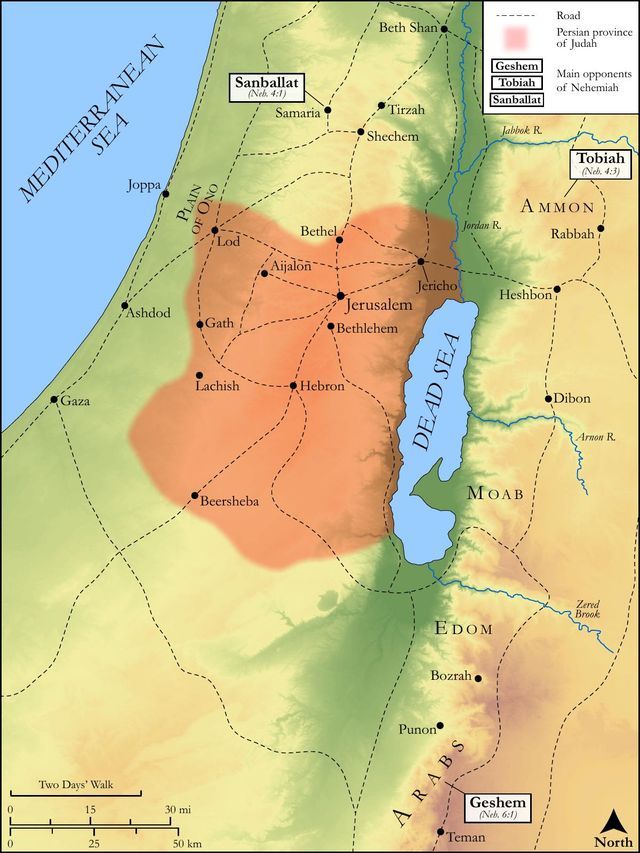
See on the biblical-era map
Study this verse
Public-domain commentary
Matthew Henry
From his Commentary on the Whole Bible. Henry comments on passages, not single verses — this entry covers Nehemiah 5:6–13. His three-level outline is real structure in the source text, so it is rendered as structure.
It should seem the foregoing complaint was made to Nehemiah at the time when he had his head and hands as full as possible of the public business about building the wall; yet, perceiving it to be just, he did not reject it because it was unseasonable; he did not chide the petitioners, nor fall into a passion with them, for disturbing him when they saw how much he had to do, a fault which men of business are too often guilty of; nor did he so much as adjourn the hearing of the cause or proceedings upon it till he had more leisure. The case called for speedy interposition, and therefore he applied himself immediately to the consideration of it, knowing that, let him build Jerusalem's walls ever so high, so thick, so strong, the city could not be safe while such abuses as these were tolerated. Now observe, What method he took for the redress of this grievance which was so threatening to the public.
I.He was very angry (Neh 5:6); he expressed a great displeasure at it, as a very bad thing.
Note, It well becomes rulers to show themselves angry at sin, that by the anger itself they may be excited to their duty, and by the expressions of it others may be deterred from evil.
II.He consulted with himself, Neh 5:7.
By this it appears that his anger was not excessive, but kept within bounds, that, though his spirit was provoked, he did not say or do any thing unadvisedly. Before he rebuked the nobles, he consulted with himself what to say, and when, and how. Note, Reproofs must be given with great consideration, that what is well meant may not come short of its end for want of being well managed. It is the reproof of instruction that giveth life. Even wise men lose the benefit of their wisdom sometimes for want of consulting with themselves and taking time to deliberate.
III.He rebuked the nobles and rulers, who were the monied men, and whose power perhaps made them the more bold to oppress.
Note, Even nobles and rulers, if they do that which is evil, ought to be told of it by proper persons. Let no man imagine that his dignity sets him above reproof.
IV.He set a great assembly against them.
He called the people together to be witnesses of what he said, and to bear their testimony (which the people will generally be forward to do) against the oppressions and extortions their rulers were guilty of, Neh 5:12. Ezra and Nehemiah were both of them very wise, good, useful men, yet, in cases not unlike, there was a great deal of difference between their management: when Ezra was told of the sin of the rulers in marrying strange wives he rent his clothes, and wept, and prayed, and was hardly persuaded to attempt a reformation, fearing it to be impracticable, for he was a man of a mild tender spirit; when Nehemiah was told of as bad a thing he kindled immediately, reproached the delinquents, incensed the people against them, and never rested till, by all the rough methods he could use, he forced them to reform; for he was a man of a hot and eager spirit. Note,
1.Very holy men may differ much from each other in their natural temper and in other things that result from it.
2.God's work may be done, well done, and successfully, and yet different methods taken in the doing of it, which is a good reason why we should neither arraign the management of others nor make our own a standard. There are diversities of operation, but the same Spirit.
V.He fairly reasoned the case with them, and showed them the evil of what they did.
The regular way of reforming men's lives is to endeavour, in the first place, to convince their consciences. Several things he offered to their consideration, which are so pertinent and just that it appeared he had consulted with himself. He lays it before them,
1.That those whom they oppressed were their brethren: You exact every one of his brother. It was bad enough to oppress strangers, but much worse to oppress their poor brethren, from whom the divine law did not allow them to take any usury, Deu 23:19, Deu 23:20.
2.That they were but lately redeemed out of the hand of the heathen. The body of the people were so by the wonderful providence of God; some particular persons among them were so, who, besides their share in the general captivity, were in servitude to heathen masters, and ransomed at the charge of Nehemiah and other pious and well-disposed persons. "Now," says he, "have we taken all this pains to get their liberty out of the hands of the heathen, and shall their own rulers enslave them? What an absurd thing is this! Must we be at the same trouble and expense to redeem them from you as we were to redeem them from Babylon?" Neh 5:8. Those whom God by his grace has made free ought not to be again brought under a yoke of bondage, Gal 5:1; Co1 7:23.
3.That it was a great sin thus to oppress the poor (Neh 5:9): "It is not good that you do; though you get money by it, you contract guilt by it, and ought you not to walk in the fear of God? Certainly you ought, for you profess religion, and relation to him; and, if you do walk in the fear of God, you will not be either covetous of worldly gain or cruel towards your brethren." Those that walk in the fear of God will not dare to do a wicked thing, Job 31:13, Job 31:14, Job 31:23.
4.That it was a great scandal, and a reproach to their profession. "Consider the reproach of the heathen our enemies, enemies to us, to our God, and to our holy religion. They will be glad of any occasion to speak against us, and this will give them great occasion; they will say, These Jews, that profess so much devotion to God, see how barbarous they are one to another." Note,
(1.)All that profess religion should be very careful that they do nothing to expose themselves to the reproach of those that are without, lest religion be wounded through their sides.
(2.)Nothing exposes religion more to the reproach of its enemies than the worldliness and hard-heartedness of the professors of it.
5.That he himself had set them a better example (Neh 5:10), which he enlarges upon afterwards, Neh 5:14, etc. Those that rigorously insist upon their right themselves will with a very ill grace persuade others to recede from theirs.
VI.He earnestly pressed them not only not to make their poor neighbours any more such hard bargains, but to restore that which they had got into their hands, Neh 5:11. See how familiarly he speaks to them: Let us leave off this usury, putting himself in, as becomes reprovers, though far from being any way guilty of the crime. See how earnestly, and yet humbly, he persuades them: I pray you leave off; and I pray you restore. Though he had authority to command, yet, for love's sake, he rather beseeches. See how particularly he presses them to be kind to the poor, to give them up their mortgages, put them again in possession of their estates, remit the interest, and give them time to pay in the principal. He urged them to their loss, yet, urging them to their duty, it would be, at length, to their advantage. What we charitably forgive will be remembered and recompensed, as well as what we charitably give.
VII.He laid them under all the obligations possible to do what he pressed them to.
1.He got a promise from them (Neh 5:12): We will restore them.
2.He sent for the priests to give them their oath that they would perform this promise; now that their convictions were strong, and they seemed resolved, he would keep them to it.
3.He bound them by a solemn curse or execration, hoping that would strike some awe upon them: So let God shake out every man that performeth not this promise, Neh 5:13. This was a threatening that he would certainly do so, to which the people said Amen, as to those curses at Mount Ebal (Deu. 27), that their throats might be cut with their own tongues if they should falsify their engagement, and that by the dread of that they might be kept to their promise. With this Amen the people praised the Lord; so far were they from promising with regret that they promised with all possible expressions of joy and thankfulness. Thus David, when he took God's vows upon him, sang and gave praise, Psa 56:12. This cheerfulness in promising was well, but that which follows was better: They did according to this promise, and adhered to what they had done, not as their ancestors in a like case, who re-enslaved those whom a little before they had released, Jer 34:10, Jer 34:11. Good promises are good things, but good performances are all in all.
Historical interpretation
Historical reception
1 surviving comment on this verse from the historical church.
And he rebuked the nobles and magistrates, etc. As the best leader of the heavenly army, and a wise architect of the city of God, what he wanted the nobles and magistrates of the people to do, he first declared that he himself had done; namely, giving alms to the poor, and seeking nothing from them except the observance of the law of God and the edification of his city. In this reading, it is not appropriate for us to seek the sense through allegory, but rather to diligently observe the very text of the letter; that is to say, apart from the daily fruits of alms, we should be concerned, when a general time of famine and poverty afflicts the people, to lend to the needy whatever we can, and also to remit the tributes which we used to demand from our subjects as if justly, to the extent that our Father may also forgive us our debts. A very terrible conclusion is imposed on this reading, when it is said:
Continue studying Nehemiah 5:7 across the web’s major study libraries — every link below opens this exact verse, chapter, or book on the destination site.
Read & Compare
 BibleGatewayThis verse in more than 200 translations and 70 languages.
 Bible.comThe YouVersion reader — hundreds of translations, reading plans, and highlights.
 ESV.orgCrossway's official English Standard Version reader.
 NET BibleThe NET translation with 60,000+ translators' notes on every rendering decision.
 STEP BibleTyndale House's free study tool — original text, vocabulary, and scholarly resources.
 BibliaLogos Bible Software's free web reader.
 USCCBThe New American Bible (Revised Edition) with the U.S. bishops' study notes.
Commentaries
 BibleHub CommentariesDozens of classic commentaries on this verse, gathered on one page.
 StudyLightMore than 100 commentary sets — the largest collection on the web.
 BibleRefPlain-English commentary on what this verse means, verse by verse.
 Enduring WordDavid Guzik's free commentary on this chapter, widely used by Bible teachers.
 Bible Study ToolsVerse commentary alongside Greek and Hebrew study aids.
Original Language & Research
- BibleHub InterlinearThe verse word by word — original language, transliteration, and English.
- BibleHub LexiconEvery word's original-language definition and Strong's entry.
 Blue Letter BibleDeep-study tools — Strong's numbers, concordance, and word studies.
 SefariaThe Hebrew text with Rashi and centuries of Jewish commentary.
Sermons, Hymns & Audio


TrulyRandomVerse is not affiliated with these sites and doesn’t control their content. They’re linked because they’re genuinely useful.
Summary
Nehemiah 5:7 encapsulates a pivotal moment in the post-exilic restoration of Jerusalem, where Nehemiah, after profound personal deliberation, courageously confronts the Jewish nobles and rulers. These powerful figures were exploiting their fellow Israelites through the unlawful practice of usury, forcing them into debt and servitude. This verse vividly portrays Nehemiah's decisive and righteous leadership, his unwavering commitment to justice, and his willingness to publicly challenge the community's elite to uphold God's covenant standards and restore moral integrity.
Context
ShowHideLiterary Context
Nehemiah 5:7 marks a critical turning point in the book, shifting the narrative focus from external opposition to insidious internal corruption. The preceding chapters (Nehemiah 1-4) detail the formidable challenges of rebuilding Jerusalem's walls, highlighting the constant ridicule, threats, and sabotage attempts from surrounding adversaries like Sanballat and Tobiah. However, chapter 5 unveils an even more devastating threat: economic exploitation within the Jewish community itself. Verses 1-5 paint a stark picture of the people's distress, recounting how famine, heavy Persian taxation, and the immense cost of rebuilding forced the poor to mortgage their lands, vineyards, and even sell their children into slavery to their wealthier brethren. Nehemiah's visceral reaction in verse 6, where he expresses "great anger," directly precedes his personal reflection and subsequent public confrontation in verse 7. This sequence underscores the theological truth that true restoration encompasses not only physical reconstruction but, more fundamentally, moral rectitude and justice within God's people.
Historical & Cultural Context
The period of the Second Temple, following the return from Babylonian exile, was characterized by immense hardship for the Jewish community. They grappled with economic scarcity, the burden of Persian imperial taxes, and the monumental labor of rebuilding their devastated city and temple. Within this challenging environment, the practice of charging interest (usury) on loans to fellow Israelites was a direct and egregious violation of the Mosaic Law. Explicitly forbidden in passages such as Exodus 22:25 and Deuteronomy 23:19-20, interest could be charged to foreigners but was strictly prohibited among covenant members. This prohibition was not merely an economic regulation but a theological principle rooted in the concept of brotherhood and mutual support within God's covenant people. Charging interest to a "brother," especially the poor, was considered an act of profound oppression, often leading to perpetual debt and even debt slavery, thereby undermining the very fabric of Israelite society and the principles of the Mosaic covenant. Nehemiah's actions demonstrate a deep understanding of these laws and the devastating social and spiritual consequences of their violation.
Key Themes
ShowHideNehemiah 5:7 profoundly contributes to several overarching themes central to the book of Nehemiah and the broader biblical narrative. Firstly, it powerfully illustrates the theme of Righteous Leadership and Discernment. Nehemiah's initial act of "consulting with myself" (verse 7) reveals his personal integrity and a disciplined process of internal reflection and prayer before taking decisive action against injustice. His leadership is not merely administrative or politically expedient but deeply spiritual and ethical, consistently prioritizing the welfare of the community and fidelity to God's law over personal gain or popular opinion. Secondly, the verse highlights Justice and Covenant Fidelity, emphasizing God's unwavering concern for the poor and oppressed. The exploitation of the vulnerable by the powerful is presented as a grave sin, a direct affront to the covenant principles that bound Israel together as God's people. This echoes the consistent prophetic calls for justice found throughout the Old Testament, such as the impassioned cry for righteousness in Amos 5:24. Finally, Nehemiah's confrontation in this verse reinforces the theme of Community Unity and Holiness. It demonstrates that internal strife, moral compromise, and economic exploitation can be as destructive to God's work as external opposition. Nehemiah's public rebuke and the subsequent assembly aim to restore the community's moral integrity and ensure that the rebuilding efforts are founded on principles of righteousness, mutual support, and communal solidarity, vital for a people called to be holy unto the Lord, as outlined in Leviticus 19:2.
Exposition and Analysis
ShowHideKey Word Analysis
ShowHideMeaning "to reign;... to take counsel; consult." In the context of "consulted with myself" (which includes H3820, lêb for "myself" or "heart"), this word signifies a deep, internal process of deliberation. It implies that Nehemiah did not react impulsively but engaged in careful, thoughtful consideration, likely seeking divine wisdom and understanding the full implications of the injustice before taking action. This reflects a leader's spiritual maturity and strategic approach.
Meaning "to toss, i.e. grapple; mostly figuratively, to wrangle, i.e. hold a controversy; (by implication) to defend." This term indicates a formal, confrontational challenge, often carrying legal or judicial overtones. Nehemiah is not merely expressing displeasure but is bringing a direct accusation, effectively putting the nobles and rulers on trial for their actions. It signifies a strong, authoritative correction demanding accountability for their violation of God's law and ethical standards.
Meaning "a loan; by implication, interest on a debt; exaction." This term specifically refers to the practice of charging interest on a loan, particularly among fellow Israelites. The root of a related term (nâshak) means "to bite" or "to sting," vividly portraying the oppressive and painful nature of such interest, which metaphorically "bites" or "stings" the borrower, gradually consuming their resources and leading to destitution. It underscores the exploitative and morally reprehensible character of the practice, which Nehemiah so vehemently opposes.
Verse Breakdown
ShowHide"Then I consulted with myself"
This opening phrase offers a crucial insight into Nehemiah's leadership. Before confronting the powerful, he engages in deep internal reflection and discernment. This deliberate pause, likely involving prayer and a careful weighing of the facts against God's law, demonstrates his personal integrity and strategic wisdom. It ensures his subsequent actions are grounded in conviction rather than mere emotion.
"and I rebuked the nobles, and the rulers, and said unto them"
This clause highlights Nehemiah's courageous and direct confrontation. He does not shy away from challenging the most influential and authoritative members of the community who are perpetrating injustice. The act of "rebuking" implies a strong, authoritative correction, holding them accountable for their actions and clearly articulating the wrong they have committed.
"Ye exact usury, every one of his brother"
This is the precise and damning accusation. Nehemiah identifies the specific sin: charging interest on loans to fellow Israelites. The phrase "every one of his brother" powerfully emphasizes the violation of covenantal solidarity and brotherhood, underscoring that this was not merely an economic transaction but a profound betrayal of communal trust and divine law. It highlights the moral gravity of exploiting one's own people, especially the vulnerable.
"And I set a great assembly against them"
This final clause reveals the public and official nature of Nehemiah's response. He does not merely admonish them privately; he convenes a large, public gathering. This public forum serves multiple vital purposes: it ensures transparency, applies significant public pressure on the offenders, establishes clear accountability, and sends an unequivocal message to the entire community that such exploitative practices are unacceptable and will be addressed with communal resolve. It transforms a private grievance into a matter of public justice and communal responsibility.
Literary Devices
ShowHideNehemiah 5:7 masterfully employs several potent literary devices to convey its message. The most evident is Direct Discourse, as Nehemiah's precise words of rebuke ("Ye exact usury, every one of his brother") are quoted, lending an immediate and authentic voice to the confrontation and emphasizing its gravity. There is a compelling sense of Juxtaposition between Nehemiah's quiet, internal deliberation ("Then I consulted with myself") and his bold, public action ("I rebuked the nobles... And I set a great assembly against them"), highlighting the crucial transition from personal conviction and prayerful discernment to courageous public leadership. The very term "usury" (Hebrew mashshâʼ), particularly when considered with its related root nâshak ("to bite"), carries an implied Metaphor or Imagery, evoking the painful and destructive "bite" or "sting" of exploitation, vividly conveying the insidious nature of the practice. Finally, the verse presents a clear Antithesis between the divinely ordained ideal of covenantal brotherhood and mutual support within Israel and the harsh, sinful reality of economic exploitation and oppression perpetrated by those who should have been protectors.
Theological and Thematic Connections
ShowHideNehemiah 5:7 stands as a powerful theological statement, asserting that genuine spiritual revival and national restoration are inextricably linked to justice and ethical conduct within the community of faith. Nehemiah's righteous indignation and decisive action against economic exploitation reflect God's own character, which consistently champions the cause of the poor and condemns the oppression of the vulnerable. The sin of usury, as exposed here, was not merely an economic misstep but a profound violation of the covenant relationship, undermining the very principles of love for neighbor and communal solidarity that God established for Israel. This passage teaches that true worship and faithfulness to God must manifest in practical righteousness and a commitment to equitable dealings among believers, ensuring that no one is exploited for another's gain. It underscores that God's people are called to be a distinct community, reflecting His justice and compassion to the world, starting from within their own ranks.
Reflection and Application
ShowHideNehemiah 5:7 provides a timeless blueprint for courageous and compassionate leadership, challenging believers in every era to not only be aware of injustice but to act decisively against it, even when it involves confronting those in positions of power or influence within our own communities. Nehemiah first consulted with himself, then rebuked the nobles and rulers to their face, for they were exacting usury every one of his brother, against the Law's plain command to take no increase of a poor brother but to fear God. Like Nehemiah, we are called to cultivate a deep sense of discernment and righteous indignation, allowing God's heart for justice to shape our responses. This means moving beyond passive observation to faithful rebuke, given openly and under God's Word, wherever brother wrongs brother or any oppression undermines the dignity of those created in God's image. The passage also reminds us that the true health and vitality of a spiritual community are measured not just by its outward activities or numerical growth but by the ethical integrity of its internal relationships and its unwavering care for the poor among its members. We are urged to examine our own dealings to ensure they reflect biblical principles of fairness, generosity, and compassion, rather than profiting from a brother's need.
Questions for Reflection
ShowHideFAQ
ShowHideWhy was Nehemiah's internal consultation important before he acted?
ShowHideNehemiah's act of "consulting with myself" (Hebrew: mâlak with lêb, meaning "to consult in one's heart/mind") signifies deep, thoughtful, and likely prayerful consideration. This was crucial because he was about to confront powerful individuals—the nobles and rulers—who were exploiting the vulnerable. A rash or emotional reaction could have backfired, leading to greater division, undermining his authority, or even jeopardizing the rebuilding efforts. His deliberate process demonstrates wise leadership, strategic thinking, and a reliance on divine wisdom, ensuring his actions were grounded in conviction and principle rather than impulsivity. It sets an example for leaders to seek discernment and spiritual guidance before taking on complex and sensitive issues.
What was wrong with "usury" (charging interest) in ancient Israel, and how does it apply today?
ShowHideIn ancient Israel, the Mosaic Law strictly prohibited charging interest on loans to fellow Israelites, especially the poor (e.g., Exodus 22:25, Leviticus 25:36-37, Deuteronomy 23:19-20). This prohibition was rooted in the covenantal understanding of brotherhood and communal solidarity. Charging interest to a "brother" was seen as exploiting their distress, leading to perpetual debt, poverty, and even debt slavery, which undermined the social fabric and God's design for a just society. While modern financial systems are complex and charging interest is common, the underlying principle remains: God condemns exploitative financial practices that oppress the poor and vulnerable. This applies today to predatory lending, exorbitant interest rates that trap people in debt, and any economic system that prioritizes profit over human dignity and justice, particularly within the community of faith. Believers are called to practice generosity and equity, especially towards those in need, reflecting God's compassionate character.
Christ-Centered Fulfillment
ShowHideNehemiah's righteous indignation and courageous confrontation of injustice in Nehemiah 5:7 powerfully foreshadow the ministry of Jesus Christ, the ultimate righteous leader and champion of the oppressed. Just as Nehemiah rebuked those who exploited their "brothers" and violated God's law, Jesus consistently challenged the religious and political establishments of His day for their hypocrisy, legalism, and oppression of the vulnerable. His dramatic cleansing of the Temple, where He overturned the tables of money-changers and those selling doves, was a direct and forceful act of confronting economic exploitation and the perversion of true worship, declaring, "My house shall be called a house of prayer, but you make it a den of robbers" (Matthew 21:13). Furthermore, Nehemiah's deep concern for the poor and the oppressed reflects the very heart of God, which is supremely revealed in Christ's incarnate ministry. Jesus proclaimed His mission to "preach good news to the poor... to proclaim liberty to the captives and recovering of sight to the blind, to set at liberty those who are oppressed" (Luke 4:18). Ultimately, while Nehemiah could only rebuke and set an assembly to address sin, Jesus not only confronted sin but bore its full weight on the cross, providing the perfect and complete solution to humanity's brokenness and injustice. Through His atoning sacrifice, He establishes a new covenant community, the Church, called to embody true justice and righteousness, empowered by the Holy Spirit to live out the principles of love, equity, and compassion that Nehemiah championed, anticipating the full realization of God's just kingdom where all exploitation, sorrow, and pain will cease (Revelation 21:4).