


Judges 16:25
Bible text: King James Version (1769 Blayney text) · Public domain
Bible text: King James Version with Strong's numbers · Public domain
Bible text: Berean Standard Bible · Public domain
Bible text: American Standard Version (1901) · Public domain
Bible text: World English Bible, Messianic edition · Public domain
Bible text: Geneva Bible (1599) · Public domain
Bible text: Young's Literal Translation · Public domain
- וַיְהִיvay·Hiand it wasH1961Conj-w ¦ V-Qal-ConsecImperf-3msVerb Qal Consecutive Imperfect 3rd Singular Masculineוַandיְהִיit was
- כְּטוֹבke·tovlike goodH2895Prep-k ¦ V-Qal-InfVerb Qal Infinitive Constructכְּlikeטוֹבgood
- לִבָּםli·Bamtheir heartH3820N-msc ¦ 3mpNoun Singular Masculine Constructלִבָּheartםtheir
- וַיֹּאמְרוּvai·Yo·me·Ruand they saidH559Conj-w ¦ V-Qal-ConsecImperf-3mpVerb Qal Consecutive Imperfect 3rd Plural Masculineוַandיֹּאמְרוּthey said
- קִרְאוּkir·'UsummonH7121V-Qal-Imp-2mpVerb Qal Imperative 2nd Plural Masculine
- לְשִׁמְשׁוֹןle·shim·Shon<to> SamsonH8123Prep-l ¦ N-proper-mNoun Proper Masculineלְ<to>שִׁמְשׁוֹןSamson
- וִישַׂחֶקvi·sa·chekso he may make sportH7832Conj-w ¦ V-Piel-ConjImperf-3msVerb Piel Conjunction+Imperfect 3rd Singular Masculineוִsoישַׂחֶקhe may make sport
- לָנוּLa·nufor <the> usPrep-l ¦ 1cpSuffix Personal 1st Plural common genderלָfor <the>נוּus
- וַיִּקְרְאוּvai·yik·re·'Uand they summonedH7121Conj-w ¦ V-Qal-ConsecImperf-3mpVerb Qal Consecutive Imperfect 3rd Plural Masculineוַandיִּקְרְאוּthey summoned
- לְשִׁמְשׁוֹןle·shim·Shon<to> SamsonH8123Prep-l ¦ N-proper-mNoun Proper Masculineלְ<to>שִׁמְשׁוֹןSamson
- מִבֵּיתmi·Beitfrom [the] house ofH1004Prep-m ¦ N-mscNoun Singular Masculine Constructמִfromבֵּית[the] house of
- הָאֲסוּרִיםha·'a·si·rimthose imprisonedH631Art ¦ V-Qal-PassPrtcpl-mpVerb Qal Participle Passive Plural Masculine Absoluteהָthoseאֲסוּרִיםimprisoned
- וַיְצַחֵקvay·tza·Chekand he made sportH6711Conj-w ¦ V-Piel-ConsecImperf-3msVerb Piel Consecutive Imperfect 3rd Singular Masculineוַandיְצַחֵקhe made sport
- לִפְנֵיהֶםlif·nei·Hem<to> before themH6440Prep-l ¦ N-mpc ¦ 3mpNoun Plural Masculine Constructלִ<to>פְנֵיbeforeהֶםthem
- וַיַּעֲמִידוּvai·ya·'a·Mi·duand they made standH5975Conj-w ¦ V-Hiphil-ConsecImperf-3mpVerb Hiphil Consecutive Imperfect 3rd Plural Masculineוַandיַּעֲמִידוּthey made stand
- אוֹתוֹ'o·To<obj.> himH853DirObjM ¦ 3msParticle Object Indicatorאוֹת<obj.>וֹhim
- בֵּיןbeinbetweenH996Adj-mscAdjective Numerical Singular Masculine Construct
- הָעַמּוּדִיםha·'a·mu·Dimthe pillarsH5982Art ¦ N-mpNoun Plural Masculine Absoluteהָtheעַמּוּדִיםpillars
English is a literal word-by-word gloss of the Hebrew, not the KJV's wording. Why?
This is the original text the KJV's translators worked from — each Hebrew word with its own literal English meaning in this verse, prepared by scholars at Tyndale House, Cambridge. The KJV translates whole sentences, not word by word, so its wording differs: one Hebrew word can become several English words, and the KJV may choose “the LORD” where the gloss reads “Yahweh”. Both are faithful — they answer different questions. For the KJV's own rendering, switch to the KJV text.
Details
See on the biblical-era maps

Study this verse
Public-domain commentary
Matthew Henry
From his Commentary on the Whole Bible. Henry comments on passages, not single verses — this entry covers Judges 16:22–31. His four-level outline is real structure in the source text, so it is rendered as structure.
Though the last stage of Samson's life was inglorious, and one could wish there were a veil drawn over it, yet this account here given of his death may be allowed to lessen, though it does not quite roll away, the reproach of it; for there was honour in his death. No doubt he greatly repented of his sin, the dishonour he had by it done to God and his forfeiture of the honour God had put upon him; for that God was reconciled to him appears, 1. By the return of the sign of his Nazariteship (Jdg 16:22): His hair began to grow again, as when he was shaven, that is, to be as thick and as long as when it was cut off. It is probable that their general thanksgiving to Dagon was not long deferred, before which Samson's hair had thus grown, by which, and the particular notice taken of it, it seems to have been extraordinary, and designed for a special indication of the return of God's favour to him upon his repentance. For the growth of his hair was neither the cause nor the sign of the return of his strength further than as it was the badge of his consecration, and a token that God accepted him as a Nazarite again, after the interruption, without those ceremonies which were appointed for the restoration of a lapsed Nazarite, which he had not now the opportunity of performing, Num 6:9. It is strange that the Philistines in whose hands he was were not jealous of the growth of his hair again, and did not cut it; but perhaps they were willing his great strength should return to him, that they might have so much the more work out of him, and now that he was blind they were in no fear of any hurt from him. 2. By the use God made of him for the destruction of the enemies of his people, and that at a time when it would be most for the vindication of the honour of God, and not immediately for the defence and deliverance of Israel. Observe,
I.How insolently the Philistines affronted the God of Israel,
1.By the sacrifices they offered to Dagon, his rival. This Dagon they call their god, a god of their own making, represented by an image, the upper part of which was in the shape of a man, the lower part of a fish, purely the creature of fancy; yet it served them to set up in opposition to the true and living God. To this pretended deity they ascribe their success (Jdg 16:23, Jdg 16:24): Our god has delivered Samson our enemy, and the destroyer of our country, into our hands. So they dreamed, though he could do neither good nor evil. They knew Delilah had betrayed him, and they had paid her for doing it, yet they attribute it to their god, and are confirmed by it in their belief of his power to protect them. All people will thus walk in the name of their gods: they will give them the praise of their achievements; and shall not we pay this tribute to our God whose kingdom ruleth over all? Yet, considering what wicked arts they used to get Samson into their hands, it must be confessed it was only such a dunghill-deity as Dagon that was fit to be made a patron of the villany. Sacrifices were offered, and songs of praise sung, on the general thanksgiving day, for this victory obtained over one man; there were great expressions of joy, and all to the honour of Dagon. Much more reason have we to give the praise of all our successes to our God. Thanks be to him who causeth us to triumph in Christ Jesus!
2.By the sport they made with Samson, God's champion, they reflected on God himself. When they were merry with wine, to make them more merry Samson must be fetched to make sport for them (Jdg 16:25, Jdg 16:27), that is, for them to make sport with. Having sacrificed to their god, and eaten and drunk upon the sacrifice, they rose up to play, according to the usage of idolaters (Co1 10:7), and Samson must be the fool in the play. They made themselves and one another laugh to see how, being blind, he stumbled and blundered. It is likely they smote this judge of Israel upon the cheek (Mic 5:1), and said, Prophesy who smote thee. It was an instance of their barbarity to trample thus upon a man in misery, at the sight of whom awhile ago they would have trembled. It put Samson into the depth of misery, and as a sword in his bones were their reproaches, when they said, Where is now they God? Nothing could be more grievous to so great a spirit; yet, being a penitent, his godly sorrow makes him patient, and he accepts the indignity as the punishment of his iniquity. How unrighteous soever the Philistines were, he could not but own that God was righteous. He had sported himself in his own deceivings and with his own deceivers, and justly are the Philistines let loose upon him to make sport with him. Uncleanness is a sin that makes men vile, and exposes them to contempt. A wound and dishonour shall he get whose heart is deceived by a woman, and his reproach shall not be wiped away. Everlasting shame and contempt will be the portion of those that are blinded and bound by their own lusts. The devil that deceived them will insult over them.
II.How justly the God of Israel brought sudden destruction upon them by the hands of Samson.
Thousands of the Philistines had got together, to attend their lords in the sacrifices and joys of this day, and to be the spectators of this comedy; but it proved to them a fatal tragedy, for they were all slain, and buried in the ruins of the house: whether it was a temple or a theatre, or whether it was some slight building run up for the purpose, is uncertain. Observe,
1.Who were destroyed: All the lords of the Philistines (Jdg 16:27), who had by bribes corrupted Delilah to betray Samson to them. Evil pursued those sinners. Many of the people likewise, to the number of 3000, and among them a great many women, one of whom, it is likely, was that harlot of Gaza mentioned, Jdg 16:1. Samson had been drawn into sin by the Philistine women, and now a great slaughter is made among them, as was by Moses's order among the women of Midian, because it was they that caused the children of Israel to trespass against the Lord in the matter of Peor, Num 31:16.
2.When they were destroyed.
(1.)When they were merry, secure, and jovial, and far from apprehending themselves in any danger. When they saw Samson lay hold of the pillars, we may suppose, his doing so served them for a jest, and they made sport with that too: What will this feeble Jew do? How are sinners brought to desolation in a moment! They are lifted up in pride and mirth, that their fall may be the more dreadful. Let us never envy the mirth of wicked people, but infer from this instance that their triumphing is short and their joy but for a moment.
(2.)It was when they were praising Dagon their god, and giving that honour to him which is due to God only, which is no less than treason against the King of kings, his crown and dignity. Justly therefore is the blood of these traitors mingled with their sacrifices. Belshazzar was cut off when he was praising his man-made gods, Dan 5:4.
(3.)It was when they were making sport with an Israelite, a Nazarite, and insulting over him, persecuting him whom God had smitten. Nothing fills the measure of the iniquity of any person or people faster than mocking and misusing the servants of God, yea, though it is by their own folly that they are brought low. Those know not what they do, nor whom they affront, that make sport with a good man.
3.How they were destroyed. Samson pulled the house down upon them, God no doubt putting it into his heart, as a public person, thus to avenge God's quarrel with them, Israel's, and his own.
(1.)He gained strength to do it by prayer, Jdg 16:28. That strength which he had lost by sin he, like a true penitent, recovers by prayer; as David, who, when he had provoked the Spirit of grace to withdraw, prayed (Psa 51:12), Restore unto me the joy of thy salvation, and uphold me with thy free Spirit. We may suppose that this was only a mental prayer, and that his voice was not heard (for it was made in a noisy clamorous crowd of Philistines); but, though his voice was not heard of men, yet his prayer was heard of God and graciously answered, and though he lived not to give an account himself of this his prayer, as Nehemiah did of his, yet God not only accepted it in heaven, but, by revealing it to the inspired penmen, provided for the registering of it in his church. He prayed to God to remember him and strengthen him this once, thereby owning that his strength for what he had already done he had from God, and begged it might be afforded to him once more, to give them a parting blow. That it was not from a principle of passion or personal revenge, but from a holy zeal for the glory of God and Israel, that he desired to do this, appears from God's accepting and answering the prayer. Samson died praying, so did our blessed Saviour; but Samson prayed for vengeance, Christ for forgiveness.
(2.)He gained opportunity to do it by leaning on the two pillars which were the chief supports of the building, and were, it seems, so near together that he could take hold of them both at one time, v. 26, 29. Having hold of them, he bore them down with all his might, crying aloud, Let me die with the Philistines, v. 30. Animamque in vulnere ponit - While inflicting the wound he dies. The vast concourse of people that were upon the roof looking down through it to see the sport, we may suppose, contributed to the fall of it. A weight so much greater than ever it was designed to carry might perhaps have sunk of itself, at least it made the fall more fatal to those within: and indeed few of either could escape being either stifled or crushed to death. This was done, not by any natural strength of Samson, but by the almighty power of God, and is not only marvellous, but miraculous, in our eyes. Now in this,
[1.]The Philistines were greatly mortified. All their lords and great men were killed, and abundance of their people, and this in the midst of their triumph; the temple of Dagon (as many think the house was) was pulled down, and Dagon buried in it. This would give a great check to the insolence of the survivors, and, if Israel had but had so much sense and spirit left them as to improve the advantages of this juncture, they might now have thrown off the Philistines' yoke.
[2.]Samson may very well be justified, and brought in not guilty of any sinful murder either of himself or the Philistines. He was a public person, a declared enemy to the Philistines, against whom he might therefore take all advantages. They were now in the most barbarous manner making war upon him; all present were aiding and abetting, and justly die with him. Nor was he felo de se, or a self-murderer, in it; for it was not his own life that he aimed at, though he had too much reason to be weary of it, but the lives of Israel's enemies, for the reaching of which he bravely resigned his own, not counting it dear to him, so that he might finish his course with honour.
[3.]God was very much glorified in pardoning Samson's great transgressions, of which this was an evidence. It has been said that the prince's giving a commission to one convicted amounts to a pardon. Yet, though he was a God that forgave him, he took vengeance of his inventions (Psa 99:8), and, by suffering his champion to die in fetters, warned all to take heed of those lusts which war against the soul. However, we have good reason to hope that though Samson died with the Philistines he had not his everlasting portion with them. The Lord knows those that are his.
[4.]Christ was plainly typified. He pulled down the devil's kingdom, as Samson did Dagon's temple; and, when he died, he obtained the most glorious victory over the powers of darkness. Then when his arms were stretched out upon the cross, as Samson's to the two pillars, he gave a fatal shake to the gates of hell, and, through death, destroyed him that had the power of death, that is, the devil (Heb 2:14, Heb 2:15), and herein exceeded Samson, that he not only died with the Philistines, but rose again to triumph over them.
Lastly, The story of Samson concludes, 1. With an account of his burial. His own relations, animated by the glories that attended his death, came and found out his body among the slain, brought it honourably to his own country, and buried it in the place of his fathers' sepulchres, the Philistines being in such a consternation that they durst not oppose it. 2. With the repetition of the account we had before of the continuance of his government: He judged Israel twenty years; and, if they had not been as mean and sneaking as he was brave and daring, he would have left them clear of the Philistines' yoke. They might have been easy, safe, and happy, if they would but have given God and their judges leave to make them so.
Historical interpretation
Historical reception
4 surviving comments on this verse. Each one is dated, so this reads as a timeline rather than a list.
Select a marker to jump to its quote. Markers stagger vertically where authors wrote within a few decades of each other.
But in process of time his hair began to grow again; and on the occasion of a great feast Samson is brought out of prison to the assembly of the Philistines, and set in sight of the people. There were nearly three thousand in number, men and women; and they insulted him with bitter reproaches, and carried him about in mockery, a trial harder to be borne than the very reality of captivity by a man conscious of innate power. For to live and die is natural, to be a laughing stock is counted a disgrace. Desirous therefore either of consoling himself by avenging so great an indignity, or of forestalling it for the future by death, he pretended that from the weakness of his limbs and the weight of his fetters he could not support himself, and desired the boy who guided his steps to bring him to the nearest pillars by which the whole house was supported. Being brought near, he grasped with both hands the props of the building, and while the Philistines were intent on the sacrificial feast which they were offering to Dagon their god, by whose help they deemed their adversary had been delivered into their power, reckoning a woman's perfidy as a gift from above, he called unto the Lord, and said, "O Lord God, remember me I pray Thee this once, that I may be avenged of the heathen for my two eyes, and that they give not glory to their gods as if by their help they had gotten me into their power. Let me die with the Philistines, that they may find my weakness to have been no less fatal to them than my strength."
Then he shook the columns with great force, and broke them in pieces, whereon followed the downfall of the upper roof, crushing Samson himself and casting down all those who were looking on from above. Thus were a great number of men and women slain together, and by an end not unworthy or disgraceful, but excelling all his former victories, the dying Samson obtained a triumph. For although to that point and thenceforward he was invincible, and incomparable during life among men versed in war, yet in death he conquered himself, and shewed an unconquerable soul, so as to despise and count for nothing that end of life which all men fear.
Thus it was through his valour that the last day of his life was also the sum of his victories, and that he met not a captive but a triumphant end. But to have been entrapped by a woman is to be ascribed to nature rather than to the man, because it was by the condition of his humanity more than through his own fault that he fell; for this is wont to be overcome, and yield to the allurements of wickedness. Wherefore, since Scripture bears witness that he slew more in his death than while in the light of life, it would seem that his captivity happened rather for the destruction of his adversaries than for his own fall and humiliation. For he whose burial was more efficacious than his living strength cannot be said to have found himself inferior. Lastly, he was overwhelmed and buried not by the weapons but by the bodies of his enemies, and thus, covered by his own triumph, he left a glorious memorial to posterity. For he judged his countrymen, whom he found enslaved, twenty years, and buried in his native soil, left them inheritors of liberty.
By this example then it is plain that alliances with strangers should be avoided, lest through love for our wife the snares of treachery should be successful.
Furthermore, the fact that after Samson’s hair grew again he recovered his former strength and seizing the pillars destroyed the house of his enemies together with its builders, is also seen today in the case of some sinners. If they destroy their vices by repentance and provide a place for virtue, the likeness and figure of Samson is fulfilled in them. Then is accomplished in them what is written concerning Samson: “Those he killed at his death were more than those he had killed during his lifetime.” It is true, brothers. A greater number of sins is destroyed by repentance than is known to be overcome at a time when one seems to be free from offenses. Now we should not notice with indifference that at the death of Samson all his enemies were killed. Thus, may our adversaries also be destroyed at our death. Brothers, the apostle says, “Mortify your members, which are on earth: lust, evil desire and covetousness (which is a form of idol worship).” Let drunkenness and pride die in us, envy be extinguished, anger appeased and malice rejected. If we endeavor to kill all these things with God’s help, like Samson we can destroy our adversaries by dying to sins and vices.
“Therefore his enemies brought him to play the buffoon before them.” Notice here an image of the cross. Samson extends his hands spread out to the two columns as to the two beams of the cross. Moreover, by his death he overcame his adversaries, because his sufferings became the death of his persecutors. For this reason Scripture concludes as follows: “Those he killed at his death were more than those he had killed during his lifetime.” This mystery was clearly fulfilled in our Lord Jesus Christ, for at his death he completed our redemption which he had by no means publicly announced during his life: who lives and reigns forever and ever. Amen.
Now that splendor which was restored in Samson and was covered at his death I think fits every servant of Christ. If someone is overtaken by some sin and in a salutary manner has recourse to the remedies of repentance, with the restoration of grace there returns the face of a good conscience, like the hair which grew again. Thus, it becomes possible for the merits of faith like very strong muscles of courage to attack and overthrow the enemy’s pillars which support the hostile house. What are these pillars of the enemy’s house except our sins upon which the house of the devil rests, where he feasts as victor and mocks our minds if they have been captivated? Therefore, we eject this enemy from his house by the destruction and death of our flesh. Our enemy is enclosed within us; he daily wages an internal war inside. As long as we sometimes assent to him, in accord with the evil agreement of our will he gains power over us. With our vices against us as his accomplices within, he attacks our exterior ministry, so that when we hand over to him our members for works of iniquity we are killed by our own sword, as is usually said. However, we ought to remember the agreement which we promised in return for the grace of baptism, when we were buried together with Christ in the mystery of the cross: that we would renounce the devil, his ostentatious displays and his works. Let us no longer live in this world as we have been; in fact, let us no longer live to ourselves but let Christ live in us. When he has been restored to the honor of the head, the house of the devil will fall, and all our enemies will die with our sins in eternal destruction.
Continue studying Judges 16:25 across the web’s major study libraries — every link below opens this exact verse, chapter, or book on the destination site.
Read & Compare
 BibleGatewayThis verse in more than 200 translations and 70 languages.
 Bible.comThe YouVersion reader — hundreds of translations, reading plans, and highlights.
 ESV.orgCrossway's official English Standard Version reader.
 NET BibleThe NET translation with 60,000+ translators' notes on every rendering decision.
 STEP BibleTyndale House's free study tool — original text, vocabulary, and scholarly resources.
 BibliaLogos Bible Software's free web reader.
 USCCBThe New American Bible (Revised Edition) with the U.S. bishops' study notes.
Commentaries
 BibleHub CommentariesDozens of classic commentaries on this verse, gathered on one page.
 StudyLightMore than 100 commentary sets — the largest collection on the web.
 BibleRefPlain-English commentary on what this verse means, verse by verse.
 Enduring WordDavid Guzik's free commentary on this chapter, widely used by Bible teachers.
 Bible Study ToolsVerse commentary alongside Greek and Hebrew study aids.
Original Language & Research
- BibleHub InterlinearThe verse word by word — original language, transliteration, and English.
- BibleHub LexiconEvery word's original-language definition and Strong's entry.
 Blue Letter BibleDeep-study tools — Strong's numbers, concordance, and word studies.
 SefariaThe Hebrew text with Rashi and centuries of Jewish commentary.
Sermons, Hymns & Audio


TrulyRandomVerse is not affiliated with these sites and doesn’t control their content. They’re linked because they’re genuinely useful.
Summary
Judges 16:25 marks the dramatic zenith of Samson's public humiliation, portraying the Philistines' jubilant revelry in the temple of Dagon as they summon the blinded Israelite champion from prison to be their object of derision and entertainment. This moment, characterized by Philistine pride and perceived triumph over God's anointed, ironically becomes the pivotal stage for Samson's final, divinely empowered act of judgment, exposing the profound folly of human arrogance pitted against divine sovereignty and setting the scene for a catastrophic reversal.
Context
ShowHideLiterary Context
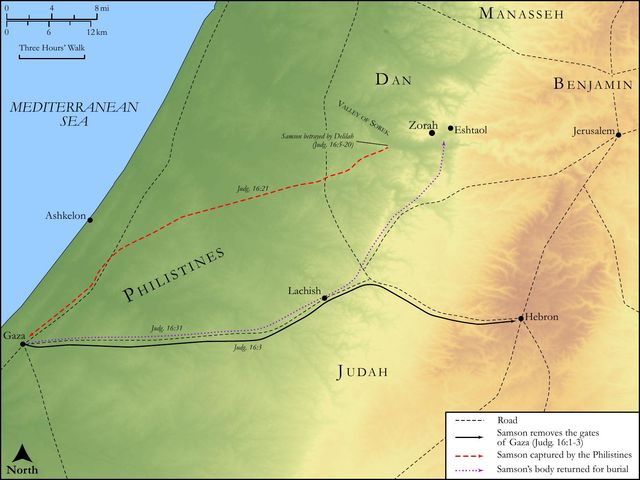
This verse is strategically placed within the climactic final chapter of Samson's narrative, immediately following his betrayal by Delilah, the loss of his strength, his capture, blinding, and forced labor in the Philistine prison at Gaza, as detailed in Judges 16:20-21. The preceding verses (specifically Judges 16:23-24) establish the grand festival in honor of Dagon, where the Philistine lords and a vast multitude gather to celebrate their supposed victory over Samson, attributing it to their deity. Judges 16:25 serves as the dramatic turning point, transitioning from Samson's personal degradation to a public spectacle that directly precipitates his final, redemptive, and self-sacrificial act of vengeance, culminating in the destruction of the temple and his own death, as recounted in Judges 16:26-31. It is the precise moment where Philistine hubris reaches its peak, unwittingly providing Samson with the opportunity for his most impactful, albeit tragic, contribution to Israel's deliverance.
Historical & Cultural Context
The Philistines were one of Israel's most formidable and persistent adversaries during the period of the Judges, a powerful "Sea Peoples" group who settled in the coastal plain of Canaan. Their advanced iron technology and organized military posed a constant threat to the nascent Israelite tribal confederacy. Their pantheon included prominent deities like Dagon, an agricultural god often depicted with a human torso and a fish-like lower body, worshipped in grand temples. Public humiliation of defeated enemies was a common and potent practice among the nations of that day, as Adoni-bezek confessed of the seventy kings whose thumbs and great toes he had cut off, serving not only to assert dominance and demoralize the vanquished but also to demonstrate the superiority of the victor's god. Forcing Samson, a Nazirite dedicated to God from birth and a former judge of Israel, to grind grain in prison (a task typically reserved for women or slaves) and then parading him as a blind spectacle in their god's temple was the ultimate act of subjugation, mockery, and religious blasphemy. Their "merry" hearts reflect not merely general revelry but a profound sense of religious and military triumph, believing Dagon had decisively defeated the God of Israel and His champion.
Key Themes
ShowHideJudges 16:25 powerfully illustrates several key themes prevalent throughout the book of Judges and Samson's narrative. Firstly, it highlights Divine Sovereignty Amidst Human Folly, demonstrating that even in moments of profound human degradation and arrogant celebration, God's overarching plan remains in motion. The Philistines' "victory" is fleeting, and their pride ultimately leads to their destruction, echoing the recurring cycle of sin, oppression, and deliverance that defines the book of Judges (e.g., Judges 2:16-19). Secondly, the verse underscores the theme of Humiliation and Mockery, as Samson, once a mighty deliverer whose strength was a clear sign of God's empowering Spirit (Judges 14:6), is reduced to a blind jester. This humiliation, however, paradoxically becomes the catalyst for his repentance and final, most impactful act. Lastly, it exemplifies False Triumph, where the Philistines' "merry" hearts and celebration are built on a foundation of hubris and a grave miscalculation of God's enduring power, foreshadowing their impending doom and serving as a stark warning against boasting in human strength or pagan deities.
Exposition and Analysis
ShowHideKey Word Analysis
ShowHideThis adjective, often translated as "good," "pleasant," or "joyful," here describes the Philistines' state of mind—one of contentment, satisfaction, and festive exhilaration. It signifies their sense of well-being and triumph, believing they had finally subdued their formidable enemy, Samson, and by extension, the God of Israel whom he served. Their "merry hearts" underscore the depth of their celebration and their perceived security in Dagon's power, highlighting their hubris.
The root sâchaq carries a range of meanings, from "to laugh" or "to play" to "to mock" or "to make sport of." In this context, particularly as Samson is brought out from prison, it clearly denotes derision, entertainment at another's expense, and public humiliation. The Philistines' demand was not merely for a performance, but for Samson to be an object of their ridicule and amusement, further emphasizing his fallen state and their contempt for him and his God.
This noun refers to a column or a stand, a structural support. In this specific narrative, the "pillars" are the central architectural elements of the Dagon temple, crucial for its stability. The seemingly innocuous detail of Samson being placed "between the pillars" is profoundly significant, as it positions him precisely for the destructive act that follows, highlighting the Philistines' unwitting role in their own demise and God's sovereign orchestration of events.
Verse Breakdown
ShowHide"And it came to pass, when their hearts were merry"
This opening clause vividly sets the scene, emphasizing the Philistines' state of joyful and confident celebration. Their "merry hearts" signify a profound sense of victory and security, as they believe they have definitively conquered Samson and, by extension, the God of Israel. This revelry is rooted in hubris, overconfidence, and a misattribution of victory to their pagan deity, Dagon.
"that they said, Call for Samson, that he may make us sport."
This is the direct command issued by the Philistine lords, revealing their cruel intent to publicly humiliate Samson. The demand for him to "make us sport" underscores their desire for entertainment at his expense, a brutal display of power over their once-feared enemy, now reduced to a blind, shorn captive. It is a moment of ultimate degradation for Samson and a blasphemous act against Yahweh.
"And they called for Samson out of the prison house; and he made them sport:"
This clause describes the immediate and literal execution of the command. Samson is brought from the darkness and confinement of the prison into the public spectacle of the Dagon temple. The repetition of "he made them sport" confirms that he was indeed subjected to their mockery and entertainment, a profound degradation for a former judge and Nazirite, highlighting the depth of his fall.
"and they set him between the pillars."
This seemingly minor detail is critically important and laden with dramatic irony. Placing Samson "between the pillars" positions him strategically for his final, devastating act. It highlights the Philistines' ignorance of God's ongoing plan and their unwitting participation in setting the stage for their own destruction. This specific placement is the literal and metaphorical fulcrum of the narrative, preparing the reader for the impending climax.
Literary Devices
ShowHideJudges 16:25 is rich with several powerful literary devices. The most prominent is Irony. The Philistines' "merry" celebration of their perceived triumph over Samson and his God is deeply ironic, as this very moment of their greatest pride directly precipitates their catastrophic downfall. They believe they are demonstrating Dagon's superiority, but they are unwittingly setting the stage for the ultimate demonstration of Yahweh's power and judgment. The verse also employs potent Foreshadowing, subtly hinting at the impending climax. The seemingly incidental detail that Samson was "set him between the pillars" is not random; it precisely positions him for the destructive act that follows, building dramatic tension and anticipation. Furthermore, there is profound Symbolism at play. Samson's physical blindness and his being paraded as a spectacle symbolize his earlier spiritual blindness and moral failures that led to his capture, while his public humiliation symbolizes Israel's subjugation under Philistine rule due to their own spiritual compromises. The pillars themselves become powerful symbols of both Philistine power and their ultimate vulnerability, representing the very foundation of their false security.
Theological and Thematic Connections
ShowHideJudges 16:25 serves as a powerful theological statement about the nature of divine sovereignty, even in the face of human sin, apparent defeat, and the arrogant boasting of God's enemies. While the Philistines celebrate their victory and mock God's chosen servant, their revelry is a testament to human hubris that ultimately precedes a fall. God orchestrates events, even through the failures of His people and the malice of their adversaries, to fulfill His purposes. Samson's humiliation, far from being the end of his story, becomes the necessary catalyst for his final, redemptive act, demonstrating that God can use imperfect vessels and dire circumstances to bring about His justice and deliver His people. This moment underscores that true victory belongs to God, not to those who boast in their own power or the power of false gods, and that divine judgment can arise from the very center of human pride.
Reflection and Application
ShowHideJudges 16:25 offers profound lessons for contemporary believers, reminding us that moments of deep humiliation, perceived failure, or public mockery in our lives do not necessarily signify the end of God's purpose for us. Like Samson, we may find ourselves in circumstances where we feel exposed, mocked, or utterly defeated, perhaps due to our own sin, poor choices, or the malice of others. Yet, it is precisely in such weakness and desperation that God's strength can be most powerfully manifested, provided we turn back to Him in repentance, humility, and faith. This verse also serves as a stark warning against pride and overconfidence, whether in personal achievements, worldly success, or in mocking the struggles of others. The Philistines' "merry" hearts quickly turned to lamentation and destruction, illustrating that human triumph built on arrogance and contempt for God or His people is fleeting and ultimately leads to ruin. We are called to cultivate humility, recognizing that all true strength, wisdom, and victory come from God, and to trust in His sovereign plan even when circumstances seem bleak or when we find ourselves in the lowest valleys of life. Our ultimate hope and vindication rest not in our own abilities or the world's approval, but in God's unfailing power and perfect timing.
Questions for Reflection
ShowHideFAQ
ShowHideWhat was the significance of the Philistines wanting Samson to "make them sport"?
ShowHideThe Philistines' demand for Samson to "make them sport" was a profound act of public humiliation and mockery, designed to assert their dominance and celebrate their perceived victory over both Samson and his God. Having blinded him and forced him into servile labor (as described in Judges 16:21), bringing him out for public entertainment in the temple of Dagon was the ultimate degradation. It was intended to demonstrate that their god, Dagon, had triumphed over Yahweh, the God of Israel, by defeating His champion. For Samson, a Nazirite dedicated to God from birth and once a formidable judge, being reduced to a blind jester for pagan amusement was the lowest point of his life, a stark contrast to his former strength and divine empowerment. This act of "sport" was not benign entertainment but a cruel, ritualistic display of power and contempt, aiming to utterly break Samson's spirit and publicly discredit the God of Israel before a vast assembly (Judges 16:24).
Christ-Centered Fulfillment
ShowHideJudges 16:25, while depicting Samson's profound humiliation, powerfully foreshadows the ultimate humiliation and triumph of Christ. Samson, though deeply flawed and brought low by his own sin, is mocked, made a spectacle, and seemingly defeated by his enemies. Yet, it is precisely in this moment of apparent weakness and impending death that he achieves his greatest victory, bringing down the enemy and fulfilling God's purpose. This trajectory profoundly mirrors the path of Jesus, the true and perfect Son of God. He, too, was brought low, not by His own sin, but by taking on the sin of the world. He was mocked, spat upon, stripped naked, and crucified, becoming a public spectacle of shame and weakness (Philippians 2:7-8). From a human perspective, His crucifixion appeared to be the ultimate defeat, a moment of triumph for the powers of darkness and those who opposed Him. However, just as Samson's death brought about a greater victory than his life, Christ's death on the cross, the ultimate act of self-humiliation and obedience, was the very means by which He triumphed over sin, death, and the devil, securing eternal redemption for humanity (Colossians 2:15). The Philistines' "merry" hearts in Judges 16:25 find their parallel in the misguided joy of those who celebrated Christ's crucifixion, unaware that their apparent victory was God's ordained path to ultimate glory and the decisive defeat of His enemies (Acts 2:23-24). Thus, Samson's story, particularly this verse, serves as a poignant type, pointing to the paradoxical truth that God's greatest strength and ultimate victory are often revealed through apparent weakness, suffering, and self-sacrifice, perfectly fulfilled in the person and redemptive work of Jesus Christ.