


1 Samuel 17:51
Bible text: King James Version (1769 Blayney text) · Public domain
Bible text: King James Version with Strong's numbers · Public domain
Bible text: Berean Standard Bible · Public domain
Bible text: American Standard Version (1901) · Public domain
Bible text: World English Bible, Messianic edition · Public domain
Bible text: Geneva Bible (1599) · Public domain
Bible text: Young's Literal Translation · Public domain
- וַיָּרָץvai·Ya·rotzand he ranH7323Conj-w ¦ V-Qal-ConsecImperf-3msVerb Qal Consecutive Imperfect 3rd Singular Masculineוַandיָּרָץhe ran
- דָּוִדDa·vidDavidH1732N-proper-mNoun Proper Masculine
- וַיַּעֲמֹדvai·ya·'a·Modand he stoodH5975Conj-w ¦ V-Qal-ConsecImperf-3msVerb Qal Consecutive Imperfect 3rd Singular Masculineוַandיַּעֲמֹדhe stood
- אֶל'eltoH413PrepPreposition
- הַפְּלִשְׁתִּיha·pe·lish·Tithe PhilistineH6430Art ¦ N-msNoun Gentilic Singular Masculine AbsoluteהַtheפְּלִשְׁתִּיPhilistine
- וַיִּקַּחvai·yi·Kachand he tookH3947Conj-w ¦ V-Qal-ConsecImperf-3msVerb Qal Consecutive Imperfect 3rd Singular Masculineוַandיִּקַּחhe took
- אֶת'et<obj.>H853DirObjMParticle Object Indicator
- חַרְבּוֹchar·bohis swordH2719N-fsc ¦ 3msNoun Singular Feminine Constructחַרְבּswordוֹhis
- וַיִּשְׁלְפָהּvai·yish·le·Fahand he drew out itH8025Conj-w ¦ V-Qal-ConsecImperf-3ms ¦ 3fsVerb Qal Consecutive Imperfect 3rd Singular Masculineוַandיִּשְׁלְפָhe drew outהּit
- מִתַּעְרָהּmi·ta'·Rahfrom its sheathH8593Prep-m ¦ N-csc ¦ 3fsNoun Singular common gender Constructמִfromתַּעְרָsheathהּits
- וַיְמֹתְתֵהוּvay·Mo·te·Te·huand he killed himH4191Conj-w ¦ V-Piel-ConsecImperf-3ms ¦ 3msVerb Piel Consecutive Imperfect 3rd Singular Masculineוַandיְמֹתְתֵhe killedהוּhim
- וַיִּכְרָתvai·yikh·rotand he cut offH3772Conj-w ¦ V-Qal-ConsecImperf-3msVerb Qal Consecutive Imperfect 3rd Singular Masculineוַandיִּכְרָתhe cut off
- בָּהּbahwith <the> itPrep-b ¦ 3fsSuffix Personal 3rd Singular Feminineבָּwith <the>הּit
- אֶת'et<obj.>H853DirObjMParticle Object Indicator
- רֹאשׁוֹro·Shohis headH7218N-msc ¦ 3msNoun Singular Masculine Constructרֹאשׁheadוֹhis
- וַיִּרְאוּvai·yir·'Uand they sawH7200Conj-w ¦ V-Qal-ConsecImperf-3mpVerb Qal Consecutive Imperfect 3rd Plural Masculineוַandיִּרְאוּthey saw
- הַפְּלִשְׁתִּיםha·pe·lish·Timthe PhilistinesH6430Art ¦ N-mpNoun Gentilic Plural Masculine AbsoluteהַtheפְּלִשְׁתִּיםPhilistines
- כִּיkithatH3588PrtParticle Conditional
- מֵתmethe had diedH4191V-Qal-Perf-3msVerb Qal Perfect 3rd Singular Masculine
- גִּבּוֹרָםgi·bo·Ramtheir mighty [man]H1368N-msc ¦ 3mpNoun Singular Masculine Constructגִּבּוֹרָmighty [man]םtheir
- וַיָּנֻסוּvai·ya·Nu·suand they fledH5127Conj-w ¦ V-Qal-ConsecImperf-3mpVerb Qal Consecutive Imperfect 3rd Plural Masculineוַandיָּנֻסוּthey fled
English is a literal word-by-word gloss of the Hebrew, not the KJV's wording. Why?
This is the original text the KJV's translators worked from — each Hebrew word with its own literal English meaning in this verse, prepared by scholars at Tyndale House, Cambridge. The KJV translates whole sentences, not word by word, so its wording differs: one Hebrew word can become several English words, and the KJV may choose “the LORD” where the gloss reads “Yahweh”. Both are faithful — they answer different questions. For the KJV's own rendering, switch to the KJV text.
Details
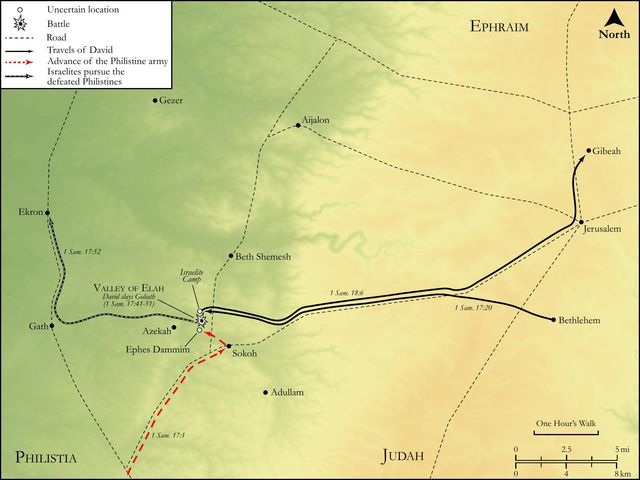
See on the biblical-era map
Study this verse
Public-domain commentary
Matthew Henry
From his Commentary on the Whole Bible. Henry comments on passages, not single verses — this entry covers 1 Samuel 17:48–58.
Here is 1. The engagement between the two champions, Sa1 17:48. To this engagement the Philistine advanced with a great deal of state and gravity; if he must encounter a pigmy, yet it shall be with the magnificence of a giant and a grandee. This is intimated in the manner of expression: He arose, and came, and drew nigh, like a stalking mountain, overlaid with brass and iron, to meet David. David advanced with no less activity and cheerfulness, as one that aimed more to do execution than to make a figure: He hasted, and ran, being lightly clad, to meet the Philistine. We may imagine with what tenderness and compassion the Israelites saw such a pleasing youth as this throwing himself into the mouth of destruction, but he knew whom he had believed and for whom he acted. 2. The fall of Goliath in this engagement. He was in no haste, because in no fear, but confident that he should soon at one stroke cleave his adversary's head; but, while he was preparing to do it solemnly, David did his business effectually, without any parade: he slang a stone which hit him in the forehead, and, in the twinkling of an eye, fetched him to the ground, Sa1 17:49. Goliath knew there were famous slingers in Israel (Jdg 20:16), yet was either so forgetful or presumptuous as to go with the beaver of his helmet open, and thither, to the only part left exposed, not so much David's art as God's providence directed the stone, and brought it with such force that it sunk into his head, notwithstanding the impudence with which his forehead was brazened. See how frail and uncertain life is, even when it thinks itself best fortified, and how quickly, how easily, and with how small a matter, the passage may be opened for life to go out and death to enter. Goliath himself has not power over the spirit to retain the spirit, Ecc 8:8. Let not the strong man glory in his strength, nor the armed man in his armour. See how God resists the proud and pours contempt upon those that bid defiance to him and his people. None ever hardened his heart against God and prospered. One of the Rabbin thinks that when Goliath said to David, Come, and I will give thy flesh to the fowls of the air, he threw up his head so hastily that his helmet fell off, and so left his broad forehead a fair mark for David. To complete the execution, David drew Goliath's own sword, a two-handed weapon for David, and with it cut off his head, Sa1 17:51. What need had David to take a sword of his own? his enemy's sword shall serve his purpose, when he has occasion for one. God is greatly glorified when his proud enemies are cut off with their own sword and he makes their own tongues to fall upon them, Psa 64:8. David's victory over Goliath was typical of the triumphs of the son of David over Satan and all the powers of darkness, whom he spoiled, and made a show of them openly (Col 2:15), and we through him are more than conquerors. 3. The defeat of the Philistines' army hereupon. They relied wholly upon the strength of their champion, and therefore, when they saw him slain, they did not, as Goliath had offered, throw down their arms and surrender themselves servants to Israel (Sa1 17:9), but took to their heels, being wholly dispirited, and thinking it to no purpose to oppose one before whom such a mighty man had fallen: They fled (Sa1 17:51), and this put life into the Israelites, who shouted and pursued them (David, it is probable, leading them on in the pursuit) even to the gates of their own cities, Sa1 17:52. In their return from the chase they seized all the baggage, plundered the tents (Sa1 17:53), and enriched themselves with the spoil. 4. David's disposal of his trophies, Sa1 17:54. He brought the head of the Philistine to Jerusalem, to be a terror to the Jebusites, who held the strong-hold of Sion: it is probable that he carried it in triumph to other cities. His armour he laid up in his tent; only the sword was preserved behind the ephod in the tabernacle, as consecrated to God, and a memorial of the victory to his honour, Sa1 21:9. 5. The notice that was taken of David. Though he had been at court formerly, yet, having been for some time absent (Sa1 17:15), Saul had forgotten him, being melancholy and mindless, and little thinking that his musician would have spirit enough to be his champion; and therefore, as if he had never seen him before, he asked whose son he was. Abner was a stranger to him, but brought him to Saul (Sa1 17:57), and he gave a modest account of himself, Sa1 17:58. And now he was introduced to the court with much greater advantages than before, in which he owned God's hand performing all things for him.
Historical interpretation
Three Centuries of Reception
2 surviving comments on this verse. Each one is dated, so this reads as a timeline rather than a list.
Select a marker to jump to its quote. Markers stagger vertically where authors wrote within a few decades of each other.
But our armor is Christ; it is that which the apostle Paul prescribes when, writing to the Ephesians, he says, "Take unto you the whole armor of God, that you may be able to withstand in the evil day;" and again, "Stand, therefore, having your loins gird about with truth, and having on the breastplate of righteousness; and your feet shod with the preparation of the gospel of peace; above all, taking the shield of faith, wherewith you shall be able to quench all the fiery darts of the wicked: and take the helmet of salvation, and the sword of the Spirit, which is the word of God." Armed with these weapons, king David went forth in his day to battle. Taking from the torrent's bed five smooth rounded stones, he proved that, even amidst all the eddying currents of the world, his feelings were free both from roughness and from defilement. Drinking of the brook by the way, and therefore lifted up in spirit, he cut off the head of Goliath, using the proud enemy's own sword as the fittest instrument of death, smiting the profane boaster on the forehead and wounding him in the same place in which Uzziah was smitten with leprosy when he presumed to usurp the priestly office; the very place also in which shines the glory that makes the saints rejoice in the Lord, saying, "The light of your countenance is sealed upon us, O Lord." Let us therefore also say, "My heart is fixed, O God, my heart is fixed: I will sing and give praise: awake up, my glory; awake, psaltery and harp; I myself will awake early"; that in us may be fulfilled that word, "Open thy mouth wide, and I will fill it"; and, "The Lord shall give the word with great power to them that publish it." I am well assured that your prayer as well as mine is that in our contending, the victory may remain with the truth. For you seek Christ's glory, not your own: if you are victorious, I also gain a victory if I discover my error.
Seeing that their strongest man had died, etc. Seeing that the unclean spirits were defeated and prostrated by the incarnation and passion of the Lord, they fled from the hearts of the believers. And all the strong ones in the Church, gathered from both the circumcised and the uncircumcised, arose and lifted up a voice terrifying to the wicked of divine preaching and praise, and pursued them until they recognized that they were to be humbled by Christ, and as it were submerged in the valley of dejection, who had previously boasted of setting up their camp on the mountain of pride against Him; and the fugitives might withdraw to the hearts, which they had previously inhabited evilly, plundering completely every fruit of piety and faith. For the gates of Accaron, that is, of barrenness, the fleeing Philistines reached, when the malignant spirits, repelled from the minds of the faithful, once again referred to their teachers. They entered the walls of the city of vanity and falsehood itself, when they also compelled the ignorant crowd to increase their unfruitful work worthy of fire. But they also reached Geth, that is, the press, when they drew out the hearts of the deceived to torment the good ones with unjust persecution. All these can also be understood in the same order even about perverse humans.
Continue studying 1 Samuel 17:51 across the web’s major study libraries — every link below opens this exact verse, chapter, or book on the destination site.
Read & Compare
 BibleGatewayThis verse in more than 200 translations and 70 languages.
 Bible.comThe YouVersion reader — hundreds of translations, reading plans, and highlights.
 ESV.orgCrossway's official English Standard Version reader.
 NET BibleThe NET translation with 60,000+ translators' notes on every rendering decision.
 STEP BibleTyndale House's free study tool — original text, vocabulary, and scholarly resources.
 BibliaLogos Bible Software's free web reader.
 USCCBThe New American Bible (Revised Edition) with the U.S. bishops' study notes.
Commentaries
 BibleHub CommentariesDozens of classic commentaries on this verse, gathered on one page.
 StudyLightMore than 100 commentary sets — the largest collection on the web.
 BibleRefPlain-English commentary on what this verse means, verse by verse.
 Enduring WordDavid Guzik's free commentary on this chapter, widely used by Bible teachers.
 Bible Study ToolsVerse commentary alongside Greek and Hebrew study aids.
Original Language & Research
- BibleHub InterlinearThe verse word by word — original language, transliteration, and English.
- BibleHub LexiconEvery word's original-language definition and Strong's entry.
 Blue Letter BibleDeep-study tools — Strong's numbers, concordance, and word studies.
 SefariaThe Hebrew text with Rashi and centuries of Jewish commentary.
Sermons, Hymns & Audio


TrulyRandomVerse is not affiliated with these sites and doesn’t control their content. They’re linked because they’re genuinely useful.
Summary
1 Samuel 17:51 captures the electrifying and definitive climax of the legendary confrontation between David and Goliath. Following David's miraculous felling of the Philistine giant with a single sling stone, this verse vividly portrays David's swift and resolute action of seizing Goliath's own sword, drawing it, and then decapitating the colossal champion. This act served not only as undeniable proof of Goliath's death but also as a profound, ironic symbol of divine victory and the utter humiliation of God's enemies. The immediate and overwhelming consequence was the demoralization and chaotic flight of the entire Philistine army, turning what had been a prolonged stalemate into a decisive and miraculous triumph for Israel.
Context
ShowHideLiterary Context
This verse serves as the dramatic culmination of the pivotal narrative in 1 Samuel 17, which details the epic encounter between David and Goliath. For forty days, the formidable Philistine champion, Goliath, had terrorized and openly defied the armies of Israel, issuing a challenge for single combat that struck fear into the hearts of King Saul and his soldiers, as recorded in 1 Samuel 17:10. David, a young shepherd boy, arrived at the battlefield and, witnessing this profound national disgrace, boldly declared his unwavering faith in the living God. Despite King Saul's skepticism and his offer of traditional armor, David chose to confront Goliath with only his simple shepherd's tools. Having already incapacitated Goliath with a precisely aimed stone to the forehead, described in 1 Samuel 17:49, verse 51 meticulously details David's final, decisive act to ensure the giant's complete defeat. This pivotal moment not only seals Goliath's fate but also triggers the immediate and widespread rout of the Philistine forces, setting the stage for Israel's triumphant pursuit and comprehensive victory.
Historical & Cultural Context
The confrontation unfolds in the Valley of Elah, a strategically vital border region that served as a frequent battleground between the Philistines and the Israelites. The warfare of the nations frequently featured "champion combat," where designated warriors from opposing armies would engage in a duel, with the outcome often determining the broader battle's victor and preventing large-scale casualties. Goliath's challenge was a classic example of this practice. The act of decapitation, as performed by David, was far more than a mere means of ensuring death; it was a potent and common symbol of absolute victory, profound humiliation, and a highly prized war trophy. Displaying the head of a defeated enemy was a widespread practice intended to shatter the morale of the opposing army and unequivocally celebrate triumph. Given that the Philistines were a formidable and long-standing adversary of Israel, this victory held immense significance for Israel's collective morale, national identity, and theological understanding, powerfully underscoring God's direct and active involvement in their historical destiny.
Key Themes
ShowHide1 Samuel 17:51 profoundly encapsulates several overarching themes prevalent throughout the book of Samuel and the broader Old Testament narrative. Firstly, it powerfully illustrates Divine Victory and Empowerment, demonstrating unequivocally that God's strength is perfected in human weakness, not through reliance on human might, impressive weaponry, or overwhelming numbers, a principle echoed in 2 Corinthians 12:9. David's triumph is a clear and undeniable testament to God's miraculous intervention through an unlikely and seemingly unqualified servant. Secondly, the verse exemplifies Faith in Action, as David's immediate, confident, and unhesitating movement towards the fallen giant underscores his unwavering trust in God's prior deliverance and his decisive follow-through on the victory that God had already secured. This aligns perfectly with the biblical principle that genuine faith is not passive but leads to bold, obedient, and courageous action, as highlighted in Hebrews 11:6. Thirdly, the Humiliation of the Enemy is starkly portrayed; Goliath, who had audaciously defied the armies of the living God, is not only slain but is ironically decapitated by his own sword, symbolizing the complete and utter defeat of those who oppose God's purposes. Finally, the verse powerfully illustrates the Flight of Adversaries, demonstrating how a decisive act of faith, supernaturally empowered by God, can utterly demoralize and scatter opposing forces, thereby turning the tide of an entire conflict with overwhelming psychological impact.
Exposition and Analysis
ShowHideKey Word Analysis
ShowHideThis verb, signifying a rapid movement, emphasizes David's extraordinary eagerness, determination, and lack of hesitation. It portrays not a cautious approach but a swift, purposeful dash towards the fallen giant. This action dramatically underscores David's unwavering confidence in God's victory and his immediate, decisive follow-through, contrasting sharply with the fearful paralysis that had gripped the entire Israelite army for weeks.
While literally meaning "to stand," when combined with the preposition "upon the Philistine," this verb denotes far more than mere proximity. It signifies David's complete dominance, mastery, and triumphant posture over his defeated foe. In ancient warfare, to stand "upon" a conquered enemy was a powerful gesture of utter subjugation, triumph, and profound humiliation, visually communicating David's absolute victory and Goliath's complete and irreversible defeat.
This primitive root means "to cut (off, down or asunder)," and by implication, "to destroy or consume." In this context, it precisely describes the decisive act of decapitation. This verb emphasizes the finality and brutality of David's action, ensuring Goliath's death was undeniable. The choice of this verb highlights the complete and irreversible nature of the victory God granted through David, utterly severing the threat Goliath posed.
Verse Breakdown
ShowHide"Therefore David ran, and stood upon the Philistine,"
This opening clause immediately establishes David's proactive and courageous response to Goliath's fall. The conjunction "therefore" directly links David's actions to the preceding event of Goliath being struck down, indicating a logical and immediate consequence. David's act of running towards the giant, rather than away, powerfully demonstrates his unwavering courage and conviction in God's victory. His subsequent action of standing "upon" Goliath signifies complete subjugation and triumph, serving as a visual declaration of absolute dominance over the defeated foe, a gesture of profound symbolic weight, as when Joshua's captains set their feet upon the necks of the five kings of the Amorites.
"and took his sword, and drew it out of the sheath thereof, and slew him, and cut off his head therewith."
This is the core action sequence of the verse, detailing David's decisive and final blows. David, who arrived on the battlefield unarmed with a sword of his own, seizes Goliath's massive, imposing weapon. The specific detail of drawing it from its sheath indicates a deliberate, unhurried, and powerful action, underscoring David's calm resolve even in this intense moment. The phrase "slew him, and cut off his head therewith" functions as a hendiadys, emphasizing the finality, brutality, and completeness of the act. Goliath, who had defiantly challenged God and Israel, is not only killed but is utterly shamed by being decapitated with his own weapon, a profound act of poetic justice and divine reversal.
"And when the Philistines saw their champion was dead, they fled."
This concluding clause describes the immediate, widespread, and profound consequence of David's decisive act. Goliath was the Philistines' champion, their symbol of strength, invincibility, and defiance against Israel's God. His definitive defeat and public decapitation shattered their morale, leading to a swift, chaotic, and widespread retreat. This demonstrates the overwhelming psychological impact of God's decisive victory, effectively scattering the enemy without further direct combat from the main Israelite army, highlighting the power of a single, God-empowered act.
Literary Devices
ShowHide1 Samuel 17:51 is richly imbued with literary devices that significantly amplify its theological and narrative impact. Irony is profoundly evident, as David, a seemingly insignificant shepherd boy, not only defeats the mighty Goliath with a humble stone but then uses Goliath's own massive sword to complete the victory. This dramatic reversal exemplifies Poetic Justice, where the instrument of the oppressor becomes the means of his demise, a powerful demonstration of divine reversal. The scene functions as the narrative Climax of the entire chapter, providing the decisive turning point after days of stalemate and fear. The act of David standing upon Goliath and cutting off his head is highly Symbolic, representing the complete subjugation of God's enemies and the triumph of divine power over mere human might. This pivotal act also serves as a form of Foreshadowing, hinting at David's future as Israel's mighty warrior-king, chosen by God to lead His people to victory against their numerous adversaries. The vivid, action-packed description creates a palpable sense of Dramatic Tension and Release, culminating in the immediate and widespread flight of the Philistines, underscoring the overwhelming and undeniable nature of God's intervention.
Theological and Thematic Connections
ShowHideThe dramatic events of 1 Samuel 17:51 resonate deeply with core theological truths about God's character and His interaction with humanity. This verse powerfully illustrates that true victory in life's battles, whether physical or spiritual, comes not from human strength, impressive armaments, or overwhelming numbers, but from unwavering faith in the living God. David's decisive act, supernaturally empowered by divine strength, demonstrates God's absolute sovereignty over all circumstances and His unwavering commitment to delivering His people. It teaches us that God delights in using the weak, the unlikely, and the overlooked to achieve His grand purposes, thereby ensuring that all glory redounds solely to Him. The immediate flight of the Philistines underscores the profound demoralizing effect of God's intervention on opposing forces, signaling that when God acts decisively, the enemy's power is broken, and their resistance crumbles. This narrative provides an enduring paradigm for understanding spiritual warfare: our confidence is never in our own might, but always in the God who fights for us and powerfully works through us.
Reflection and Application
ShowHide1 Samuel 17:51 offers profound and enduring lessons for believers navigating the complex challenges of life. Just as David faced a formidable physical giant, we frequently encounter "giants" in our spiritual, emotional, and circumstantial landscapes—overwhelming fears, persistent temptations, seemingly insurmountable obstacles, or oppressive practices that seek to intimidate and paralyze us. This verse calls us to remember that our ultimate battles are not primarily against flesh and blood, but against spiritual forces, and that victory is ultimately God's to grant. It challenges us to move beyond passive faith to decisive, courageous action, trusting that when God has given us the means to overcome (like David's stone), we must follow through with conviction, using whatever "sword" He provides, even if it appears to be the enemy's own weapon turned against them. Our confidence should never be in our own limited abilities or resources, but in the limitless power of God working through us. When we confront our "Goliaths" in His strength and with His leading, we can expect to see them fall, and their definitive defeat will often demoralize and scatter the broader forces of opposition in our lives, leading to a profound sense of peace, triumph, and freedom.
Questions for Reflection
ShowHideFAQ
ShowHideWhy did David cut off Goliath's head after he was already dead?
ShowHideWhile Goliath was indeed incapacitated by the stone, David's act of cutting off his head served multiple crucial purposes, deeply rooted in the military practices of the nations of that day. Firstly, it was undeniable and definitive proof of Goliath's death, which was absolutely essential for the complete demoralization of the Philistine army and the assurance of Israel's victory. In ancient warfare, the head of a champion was frequently taken as a trophy to be publicly displayed, confirming the kill and celebrating the triumph. Secondly, it was an act of profound humiliation for Goliath and his people. Goliath had audaciously defied the armies of the living God, and his public decapitation, especially with his own massive sword, symbolized the utter reversal of his boastful threats and the complete subjugation of the enemy. It was a powerful visual statement of God's justice and sovereignty, demonstrating that the one who defied God would be utterly undone.
What is the significance of David using Goliath's own sword?
ShowHideThe detail of David using Goliath's own sword is rich with symbolic meaning, representing a powerful act of poetic justice and divine reversal. Goliath, who had relied on his massive weaponry, imposing armor, and physical strength to intimidate and dominate Israel, is ultimately defeated and decapitated by the very instrument of his own power. This highlights a profound biblical principle: the wicked often fall into the very pit they dig for others, and God can turn the enemy's own tools, strategies, and even their perceived strengths against them. It underscores that the victory was unequivocally God's, demonstrating His ability to use the most unlikely means and even the enemy's resources to achieve His righteous purposes, thereby ensuring that no human being may glory in His presence, as articulated in 1 Corinthians 1:27-29). This act serves as a powerful testament to God's sovereignty and His ability to humble the proud.
Christ-Centered Fulfillment
ShowHideThe dramatic victory of David over Goliath, culminating in the decisive act described in 1 Samuel 17:51, serves as a powerful Old Testament type and shadow pointing to the ultimate, decisive victory of Jesus Christ. David, the humble shepherd chosen by God, stands as a prototype of Christ, who, though appearing weak and unassuming in His earthly ministry, confronted and utterly defeated the great spiritual enemy. Goliath, the seemingly invincible champion who taunted God's people and held them in fear and bondage, represents Satan, sin, and death—the spiritual "giants" that humanity, in its own strength, could never overcome. Just as David, by a single, divinely empowered blow, incapacitated Goliath, so Jesus, through His perfect life, sacrificial death on the cross, and glorious resurrection, delivered the decisive and fatal blow against the powers of darkness. His resurrection was the ultimate "decapitation" of death and the devil, disarming them and leading them captive in triumph, as powerfully declared in Colossians 2:15). The Philistines' immediate flight upon seeing their champion dead vividly foreshadows the ultimate scattering of all spiritual enemies and the triumphant establishment of God's eternal kingdom through Christ's finished work. Through Christ, we are not merely conquerors, but "more than conquerors" Romans 8:37, sharing in His triumph over every foe, for He has, by His death, destroyed the one who has the power of death, that is, the devil, and delivered all those who through fear of death were subject to lifelong slavery Hebrews 2:14-15). The victory won by our greater David ensures that death is swallowed up in victory, and the sting of death and the power of sin are eternally vanquished 1 Corinthians 15:54-57).