


2 Samuel 23:21
Bible text: King James Version (1769 Blayney text) · Public domain
Bible text: King James Version with Strong's numbers · Public domain
Bible text: Berean Standard Bible · Public domain
Bible text: American Standard Version (1901) · Public domain
Bible text: World English Bible, Messianic edition · Public domain
Bible text: Geneva Bible (1599) · Public domain
Bible text: Young's Literal Translation · Public domain
- וְהוּאve·hu'and heH1931Conj-w ¦ Pro-3msPronoun Personal 3rd Singular Masculineוְandהוּאhe
- הִכָּהhi·Kahhe struck downH5221V-Hiphil-Perf-3msVerb Hiphil Perfect 3rd Singular Masculine
- אֶת'et<obj.>H853DirObjMParticle Object Indicator
- אִישׁ'isha manH376N-mscNoun Singular Masculine Construct
- מִצְרִיmitz·RiEgyptianH4713N-msNoun Gentilic Singular Masculine Absolute
- אִישׁ'a·Shera man ofH376N-mscNoun Singular Masculine Construct
- מַרְאֶהmar·'EhappearanceH4758N-msNoun Singular Masculine Absolute
- וּבְיַדu·ve·Yadand [was] in [the] hand ofH3027Conj-w ¦ Prep-b ¦ N-cscNoun Singular common gender Constructוּandבְ[was] inיַד[the] hand of
- הַמִּצְרִיha·mitz·Rithe EgyptianH4713Art ¦ N-msNoun Gentilic Singular Masculine AbsoluteהַtheמִּצְרִיEgyptian
- חֲנִיתcha·Nita spearH2595N-fsNoun Singular Feminine Absolute
- וַיֵּרֶדvai·Ye·redand he went downH3381Conj-w ¦ V-Qal-ConsecImperf-3msVerb Qal Consecutive Imperfect 3rd Singular Masculineוַandיֵּרֶדhe went down
- אֵלָיו'e·Lavto himH413Prep ¦ 3msPreposition Definiteאֵלָיtoוhim
- בַּשָּׁבֶטba·Sha·vetwith the staffH7626Prep-b ¦ N-msNoun Singular Masculine Absoluteבַּwith theשָּׁבֶטstaff
- וַיִּגְזֹלvai·yig·Zoland he seizedH1497Conj-w ¦ V-Qal-ConsecImperf-3msVerb Qal Consecutive Imperfect 3rd Singular Masculineוַandיִּגְזֹלhe seized
- אֶת'et<obj.>H853DirObjMParticle Object Indicator
- הַחֲנִיתha·cha·Nitthe spearH2595Art ¦ N-fsNoun Singular Feminine Absoluteהַtheחֲנִיתspear
- מִיַּדmi·Yadfrom [the] hand ofH3027Prep-m ¦ N-cscNoun Singular common gender Constructמִfromיַּד[the] hand of
- הַמִּצְרִיha·mitz·Rithe EgyptianH4713Art ¦ N-msNoun Gentilic Singular Masculine AbsoluteהַtheמִּצְרִיEgyptian
- וַיַּהַרְגֵהוּvai·ya·har·Ge·huand he killed himH2026Conj-w ¦ V-Qal-ConsecImperf-3ms ¦ 3msVerb Qal Consecutive Imperfect 3rd Singular Masculineוַandיַּהַרְגֵhe killedהוּhim
- בַּחֲנִיתוֹba·cha·ni·Towith his own spearH2595Prep-b ¦ N-fsc ¦ 3msNoun Singular Feminine Constructבַּwithחֲנִיתown spearוֹhis
English is a literal word-by-word gloss of the Hebrew, not the KJV's wording. Why?
This is the original text the KJV's translators worked from — each Hebrew word with its own literal English meaning in this verse, prepared by scholars at Tyndale House, Cambridge. The KJV translates whole sentences, not word by word, so its wording differs: one Hebrew word can become several English words, and the KJV may choose “the LORD” where the gloss reads “Yahweh”. Both are faithful — they answer different questions. For the KJV's own rendering, switch to the KJV text.
Details
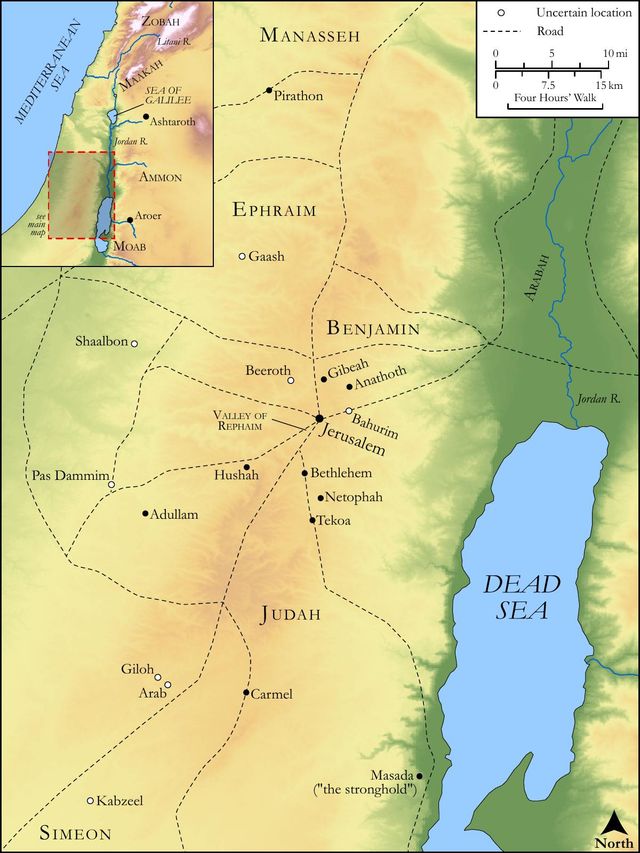
See on the biblical-era maps

Study this verse
Continue studying 2 Samuel 23:21 across the web’s major study libraries — every link below opens this exact verse, chapter, or book on the destination site.
Read & Compare
 BibleGatewayThis verse in more than 200 translations and 70 languages.
 Bible.comThe YouVersion reader — hundreds of translations, reading plans, and highlights.
 ESV.orgCrossway's official English Standard Version reader.
 NET BibleThe NET translation with 60,000+ translators' notes on every rendering decision.
 STEP BibleTyndale House's free study tool — original text, vocabulary, and scholarly resources.
 BibliaLogos Bible Software's free web reader.
 USCCBThe New American Bible (Revised Edition) with the U.S. bishops' study notes.
Commentaries
 BibleHub CommentariesDozens of classic commentaries on this verse, gathered on one page.
 StudyLightMore than 100 commentary sets — the largest collection on the web.
 BibleRefPlain-English commentary on what this verse means, verse by verse.
 Enduring WordDavid Guzik's free commentary on this chapter, widely used by Bible teachers.
 Bible Study ToolsVerse commentary alongside Greek and Hebrew study aids.
Original Language & Research
- BibleHub InterlinearThe verse word by word — original language, transliteration, and English.
- BibleHub LexiconEvery word's original-language definition and Strong's entry.
 Blue Letter BibleDeep-study tools — Strong's numbers, concordance, and word studies.
 SefariaThe Hebrew text with Rashi and centuries of Jewish commentary.
Sermons, Hymns & Audio


TrulyRandomVerse is not affiliated with these sites and doesn’t control their content. They’re linked because they’re genuinely useful.
Summary
2 Samuel 23:21 vividly recounts a singular heroic feat of Benaiah, son of Jehoiada, one of King David's elite "mighty men." This verse showcases Benaiah's exceptional courage and tactical brilliance as he confronts a formidable Egyptian warrior. Despite being armed only with a staff against the Egyptian's spear, Benaiah demonstrates remarkable ingenuity and strength, disarming his opponent and ultimately defeating him with the Egyptian's own weapon. This exploit highlights Benaiah's prowess and resourcefulness, contributing to the broader narrative of the extraordinary individuals who served and strengthened David's divinely-favored kingdom.
Context
ShowHideLiterary Context
This verse is situated within an appendix to the book of 2 Samuel, specifically in a section (2 Samuel 23:8-39) that meticulously lists and describes the heroic deeds of David's most valiant warriors, known as "the mighty men." This compilation serves a crucial purpose beyond mere historical record; it acts as a testament to the caliber of individuals who supported David's reign, underscoring the strength, loyalty, and divine favor that characterized his kingdom. Benaiah is introduced as one of the "three mighty men" of the "thirty," a distinct and highly honored group whose exploits are detailed to demonstrate their exceptional prowess and unwavering loyalty. The narrative here is not simply a chronicle of battles but functions to glorify David's reign through the valor of his loyal subjects, often echoing themes of divine enablement seen in David's own early victories, such as his famous confrontation with Goliath in 1 Samuel 17.
Historical & Cultural Context
Among the kings of that day, military prowess and individual heroism were paramount virtues, particularly in the establishment and maintenance of kingdoms. Kings frequently surrounded themselves with elite warriors whose loyalty, skill, and formidable reputation were essential for both defense and expansion. David's "mighty men" were more than just ordinary soldiers; they constituted a professional fighting force, distinct from the general levy, serving as a personal guard and special operations unit. Their feats, like Benaiah's, would have been recounted as legendary tales, reinforcing the king's authority, inspiring awe among allies, and striking fear into enemies. The "Egyptian" mentioned likely refers to a warrior of significant stature, possibly a mercenary or a champion from a rival force, making Benaiah's victory even more impressive. The stark contrast between a staff and a spear highlights the disparity in conventional weaponry, emphasizing Benaiah's daring and ingenuity in a culture where personal combat often determined the outcome of skirmishes or duels.
Key Themes
ShowHideThe account of Benaiah's victory over the Egyptian encapsulates several key themes prevalent throughout the book of 2 Samuel and the broader biblical narrative. Firstly, it powerfully illustrates Courage and Daring Faith, portraying Benaiah's willingness to face overwhelming odds with seemingly inadequate resources, a motif reminiscent of David's own reliance on God against Goliath. Secondly, it exemplifies the theme of Overcoming Superior Odds, where divine enablement allows an individual to triumph against a physically or militarily superior foe. This motif is recurrent throughout Scripture, from Gideon's victory with a small, unconventional army in Judges 7 to the ultimate victory of Christ achieved through humble means. Lastly, the narrative highlights Resourcefulness and Strategic Prowess, as Benaiah's clever tactic of disarming his opponent and using the enemy's own weapon signifies not just brute strength but also tactical brilliance and adaptability in the face of adversity, pointing to the wisdom that often accompanies God-given strength and courage.
Exposition and Analysis
ShowHideKey Word Analysis
ShowHidemarʼeh refers to an "appearance" or "sight," often implying something "handsome" or "comely." In this military context, when applied to a "man" (H376, ʼîysh), it signifies a person of imposing presence, impressive stature, or formidable appearance. The Egyptian was not merely physically attractive but possessed a presence that commanded respect or instilled fear, amplifying Benaiah's courage and the significance of his victory against such a formidable opponent.
shêbeṭ denotes a "stick," "rod," "sceptre," or "staff." Unlike a spear, a shêbeṭ is a much simpler, less specialized weapon, often used by shepherds for guidance or defense against animals, or by travelers for support. Its use by Benaiah against a spear-wielding warrior emphasizes the vast disparity in conventional weaponry, highlighting Benaiah's audacious courage and skill in close-quarters combat, turning a seemingly inferior tool into an effective means of victory.
gâzal is a primitive root meaning "to pluck off," "to snatch away," "to seize," or "to rob" by force. This word conveys a sudden, forceful, and decisive action. Benaiah didn't merely deflect or parry; he violently seized the spear from the Egyptian's hand, demonstrating immense strength, agility, and quick thinking. This act of disarming is the pivotal moment, turning the tide of the battle and allowing Benaiah to use the enemy's own strength against him.
Verse Breakdown
ShowHide"And he slew an Egyptian, a goodly man:"
This opening clause immediately establishes the dramatic encounter and the formidable nature of Benaiah's opponent. The "Egyptian" is identified as a "goodly man," signifying his impressive stature, appearance, or reputation, making him a truly challenging adversary. The act of "slew" (H2026, hârag) indicates a decisive and fatal victory.
"and the Egyptian had a spear in his hand;"
This detail highlights the conventional advantage held by the Egyptian. A "spear" (H2595, chănîyth) was a primary weapon of war, offering reach and lethal force, signifying that the Egyptian was well-equipped and prepared for combat. This sets up the stark contrast with Benaiah's own weapon.
"but he went down to him with a staff,"
The conjunction "but" introduces the dramatic turn. Benaiah's choice to approach (H3381, yârad, "went down") a spear-wielding warrior with only a "staff" (H7626, shêbeṭ) underscores his extraordinary courage and daring. The phrase "went down to him" might suggest a direct, perhaps even aggressive, closing of the distance to negate the spear's advantage.
"and plucked the spear out of the Egyptian's hand,"
This is the climax of the encounter, demonstrating Benaiah's incredible skill, strength, and agility. He did not merely defend himself but took the initiative, disarming his opponent with a swift, forceful maneuver (H1497, gâzal, "plucked"). This act is a testament to his tactical brilliance and physical prowess.
"and slew him with his own spear."
The ultimate irony and triumph. Benaiah not only defeated his enemy but did so by turning the Egyptian's own weapon against him. This final act emphasizes Benaiah's complete mastery of the situation and the decisive nature of his victory (H5221, nâkâh, "slew"), transforming the symbol of the enemy's strength into the instrument of his downfall.
Literary Devices
ShowHideThe narrative of Benaiah's encounter with the Egyptian is rich with Dramatic Irony and Contrast. The Contrast is starkly drawn between the formidable, well-armed Egyptian, described as a "goodly man" wielding a lethal "spear," and Benaiah, initially equipped only with a humble "staff." This immediate disparity heightens the tension and makes Benaiah's eventual victory all the more remarkable. The Dramatic Irony culminates in Benaiah slaying the Egyptian "with his own spear," turning the symbol of the enemy's strength into the instrument of his defeat. This unexpected reversal of fortune serves to emphasize Benaiah's ingenuity and prowess, suggesting a triumph of skill and courage over brute force and conventional advantage. The concise, action-oriented language also contributes to the Pacing, building quickly to the decisive moment of disarming and the ultimate, ironic victory. Furthermore, the account employs subtle Hyperbole in its depiction of the "goodly man" and the daring act, elevating Benaiah's feat to legendary status within the list of David's mighty men.
Theological and Thematic Connections
ShowHideBenaiah's extraordinary feat against the Egyptian warrior serves as a powerful testament to the themes of divine enablement, the triumph of the seemingly weak over the strong, and the strategic use of unconventional means. His courage in facing a superior foe with only a staff, and his ingenuity in turning the enemy's weapon against him, echoes a broader biblical principle: that God often works through unexpected instruments and empowers individuals to achieve what seems impossible by human standards. This narrative not only highlights Benaiah's personal valor but also implicitly points to the divine favor that rested upon David's kingdom, enabling his chosen warriors to accomplish remarkable deeds. It reminds believers that true strength and victory are not always found in conventional power or resources, but in courageous faith and resourceful action, often facilitated by divine wisdom and enablement.
Reflection and Application
ShowHideThe account of Benaiah's victory over the Egyptian offers profound lessons for contemporary believers. We often face "giants" in our own lives—whether they are overwhelming challenges, personal weaknesses, spiritual battles, or societal pressures—that seem to wield "spears" against our humble "staffs." Benaiah's example calls us to cultivate a spirit of audacious courage, refusing to be intimidated by the apparent superiority of our adversaries. It encourages us to lean into resourcefulness, recognizing that God can empower us to find innovative solutions and even turn the very instruments of opposition into means of victory. This narrative is a powerful reminder that our ultimate reliance should not be on our own strength or conventional advantages, but on the God who equips the humble and enables the faithful to overcome seemingly insurmountable odds. It challenges us to step forward in faith, trusting that divine wisdom and strength can transform our perceived weaknesses into conduits of triumph, demonstrating God's power through our yieldedness and obedience.
Questions for Reflection
ShowHideFAQ
ShowHideWho was Benaiah, and why were his deeds recorded?
ShowHideBenaiah, son of Jehoiada, was one of King David's most celebrated and loyal warriors, specifically listed among the "three mighty men" of the "thirty." His deeds, like the slaying of the Egyptian, two lion-like men of Moab, and a lion in a pit (2 Samuel 23:20), were recorded to highlight the exceptional valor and skill of the men who served David. These accounts not only glorified the warriors themselves but also underscored the strength and divine favor that characterized David's kingdom, demonstrating the caliber of the individuals who helped establish and maintain his reign. Benaiah later became commander of David's bodyguard and, under Solomon, became commander of the entire army (1 Kings 2:35).
What is the significance of Benaiah using a "staff" against a "spear"?
ShowHideThe contrast between Benaiah's staff and the Egyptian's spear is highly significant. A spear was a formidable military weapon, offering reach and lethal force, while a staff was a common, less specialized tool, often used for walking or rudimentary defense. This disparity highlights Benaiah's extraordinary courage and daring in facing a well-armed opponent with seemingly inferior weaponry. The narrative emphasizes that Benaiah's victory was not due to superior equipment but to his exceptional skill, agility, and, implicitly, divine enablement. It underscores a recurring biblical theme where God empowers the seemingly weak or ill-equipped to triumph over the strong, as seen in David's victory over Goliath with a sling and stone (1 Samuel 17:40-50).
Christ-Centered Fulfillment
ShowHideBenaiah's audacious victory over the formidable Egyptian, disarming him and slaying him with his own spear, serves as a powerful Old Testament foreshadowing of Christ's ultimate triumph over sin, death, and the powers of darkness. Just as Benaiah faced a seemingly superior foe with humble means (a staff), Jesus, in His earthly ministry, appeared in humility, without worldly power or military might, yet confronted the ultimate enemy. The "spear" of the Egyptian can be seen as a type of the power of sin and death, which held humanity captive. Christ "went down" into the very domain of death, not with a weapon of war, but with the "staff" of His divine authority and perfect obedience. Through His crucifixion, which appeared to be a defeat, Jesus effectively "plucked the spear" of death from the enemy's hand, disarming Satan and stripping him of his power (Colossians 2:15). The ultimate fulfillment is that Christ "slew him with his own spear"—He conquered death by dying, and through His resurrection, He used death itself to defeat the one who held the power of death, that is, the devil (Hebrews 2:14). Thus, Benaiah's physical triumph points to the spiritual and eternal victory of the Lamb of God, who, through His apparent weakness, utterly defeated the enemy with the very weapon intended for our destruction, securing eternal life and freedom for all who believe (Romans 6:9-10).