


2 Samuel 23:20
Bible text: King James Version (1769 Blayney text) · Public domain
Bible text: King James Version with Strong's numbers · Public domain
Bible text: Berean Standard Bible · Public domain
Bible text: American Standard Version (1901) · Public domain
Bible text: World English Bible, Messianic edition · Public domain
Bible text: Geneva Bible (1599) · Public domain
Bible text: Young's Literal Translation · Public domain
- וּבְנָיָהוּu·ve·na·Ya·huand BenaiahH1141Conj-w ¦ N-proper-mNoun Proper MasculineוּandבְנָיָהוּBenaiah
- בֶןven[the] son ofH1121N-mscNoun Singular Masculine Construct
- יְהוֹיָדָעye·ho·ya·Da'JehoiadaH3077N-proper-mNoun Proper Masculine
- בֶּןben[was] a son ofH1121N-mscNoun Singular Masculine Construct
- אִישׁ'isha manH376N-mscNoun Singular Masculine Construct
- חַיִלchaiof strengthH2428N-msNoun Singular Masculine Absolute
- רַבravgreat ofH7227Adj-mscAdjective Singular Masculine Construct
- פְּעָלִיםpe·'a·LimdeedsH6467N-mpNoun Plural Masculine Absolute
- מִקַּבְצְאֵלmi·kav·tze·'Elfrom KabzeelH6909Prep-m ¦ N-properNoun Proper LocationמִfromקַּבְצְאֵלKabzeel
- הוּאhu'heH1931Pro-3msPronoun Personal 3rd Singular Masculine
- הִכָּהhi·Kahhe struck downH5221V-Hiphil-Perf-3msVerb Hiphil Perfect 3rd Singular Masculine
- אֵת'et<obj.>H853DirObjMParticle Object Indicator
- שְׁנֵיshe·Nei[the] twoH8147N-cdcNoun Dual common gender Construct
- אֲרִאֵל'a·ri·'El[the] lion-like men ofH739N-proper-mNoun Proper Masculine
- מוֹאָבmo·'AvMoabH4124N-properNoun Proper Location
- וְהוּאVe·hu'and heH1931Conj-w ¦ Pro-3msPronoun Personal 3rd Singular Masculineוְandהוּאhe
- יָרַדya·Radhe went downH3381V-Qal-Perf-3msVerb Qal Perfect 3rd Singular Masculine
- וְהִכָּהve·hi·Kahand he struck downH5221Conj-w ¦ V-Hiphil-Perf-3msVerb Hiphil Perfect 3rd Singular Masculineוְandהִכָּהhe struck down
- אֶת'et<obj.>H853DirObjMParticle Object Indicator
- הָאֲרִיha·'a·ri·yahthe lionH738Art ¦ N-msNoun Singular Masculine Absoluteהָtheאֲרִיlion
- בְּתוֹךְbe·Tokhin [the] midst ofH8432Prep-b ¦ N-mscNoun Singular Masculine Constructבְּinתוֹךְ[the] midst of
- הַבֹּארha·Borthe pitH953Art ¦ N-msNoun Singular Masculine Absoluteהַtheבֹּארpit
- בְּיוֹםbe·Yomon [the] day ofH3117Prep-b ¦ N-mscNoun Singular Masculine Constructבְּonיוֹם[the] day of
- הַשָּׁלֶגha·Sha·legthe snowH7950Art ¦ N-msNoun Singular Masculine Absoluteהַtheשָּׁלֶגsnow
English is a literal word-by-word gloss of the Hebrew, not the KJV's wording. Why?
This is the original text the KJV's translators worked from — each Hebrew word with its own literal English meaning in this verse, prepared by scholars at Tyndale House, Cambridge. The KJV translates whole sentences, not word by word, so its wording differs: one Hebrew word can become several English words, and the KJV may choose “the LORD” where the gloss reads “Yahweh”. Both are faithful — they answer different questions. For the KJV's own rendering, switch to the KJV text.
Details
See on the biblical-era maps
Study this verse
Historical interpretation
Historical reception
1 surviving comment on this verse from the historical church.
"He went down and struck the lion in the middle of the cistern." [2 Samuel 23:20] As it is said of Benaiah: And he went down and struck the lion in the middle of the cistern on a snowy day (Book VII, Antiquities, ch. 12), how this was done, Josephus recounts more clearly, because the cistern was indeed very deep, which in the wintertime, when everything was filled with snow, it too was leveled with an excessive heap of snow. When the lion, unbeknownst to danger, happened upon it and fell in, and being trapped there roared greatly, people ran to see what it was. And when Benaiah came with others to such a spectacle, he immediately jumped into the cistern, and attacked and killed the lion in the midst of the snow.
Continue studying 2 Samuel 23:20 across the web’s major study libraries — every link below opens this exact verse, chapter, or book on the destination site.
Read & Compare
 BibleGatewayThis verse in more than 200 translations and 70 languages.
 Bible.comThe YouVersion reader — hundreds of translations, reading plans, and highlights.
 ESV.orgCrossway's official English Standard Version reader.
 NET BibleThe NET translation with 60,000+ translators' notes on every rendering decision.
 STEP BibleTyndale House's free study tool — original text, vocabulary, and scholarly resources.
 BibliaLogos Bible Software's free web reader.
 USCCBThe New American Bible (Revised Edition) with the U.S. bishops' study notes.
Commentaries
 BibleHub CommentariesDozens of classic commentaries on this verse, gathered on one page.
 StudyLightMore than 100 commentary sets — the largest collection on the web.
 BibleRefPlain-English commentary on what this verse means, verse by verse.
 Enduring WordDavid Guzik's free commentary on this chapter, widely used by Bible teachers.
 Bible Study ToolsVerse commentary alongside Greek and Hebrew study aids.
Original Language & Research
- BibleHub InterlinearThe verse word by word — original language, transliteration, and English.
- BibleHub LexiconEvery word's original-language definition and Strong's entry.
 Blue Letter BibleDeep-study tools — Strong's numbers, concordance, and word studies.
 SefariaThe Hebrew text with Rashi and centuries of Jewish commentary.
Sermons, Hymns & Audio


TrulyRandomVerse is not affiliated with these sites and doesn’t control their content. They’re linked because they’re genuinely useful.
Summary
2 Samuel 23:20 introduces Benaiah, the son of Jehoiada from Kabzeel, as one of King David's most distinguished and courageous "mighty men." This verse vividly recounts two extraordinary demonstrations of his valor: his triumph over two formidable "lionlike men" of Moab, and his solitary, perilous act of descending into a snow-filled pit to slay a lion. These feats not only highlight Benaiah's exceptional physical prowess and unwavering bravery but also underscore his vital contribution to the strength and security of David's kingdom.
Context
ShowHideLiterary Context
This verse is strategically placed within 2 Samuel 23, immediately following David's profound "last words" (2 Samuel 23:1-7). The chapter then transitions into a celebrated roster of David's elite warriors, famously known as his "mighty men" (2 Samuel 23:8-39). This detailed list serves as a testament to the exceptional courage, unwavering loyalty, and military acumen of the individuals who were instrumental in establishing and maintaining David's kingdom. Benaiah's inclusion, accompanied by specific and dramatic anecdotes of his valor, elevates him beyond a mere name on a list, vividly illustrating the caliber of men who served David and, by extension, implicitly affirming the divine favor upon David's reign. His remarkable exploits are presented as compelling evidence of the monarchy's divinely-backed strength and stability.
Historical & Cultural Context
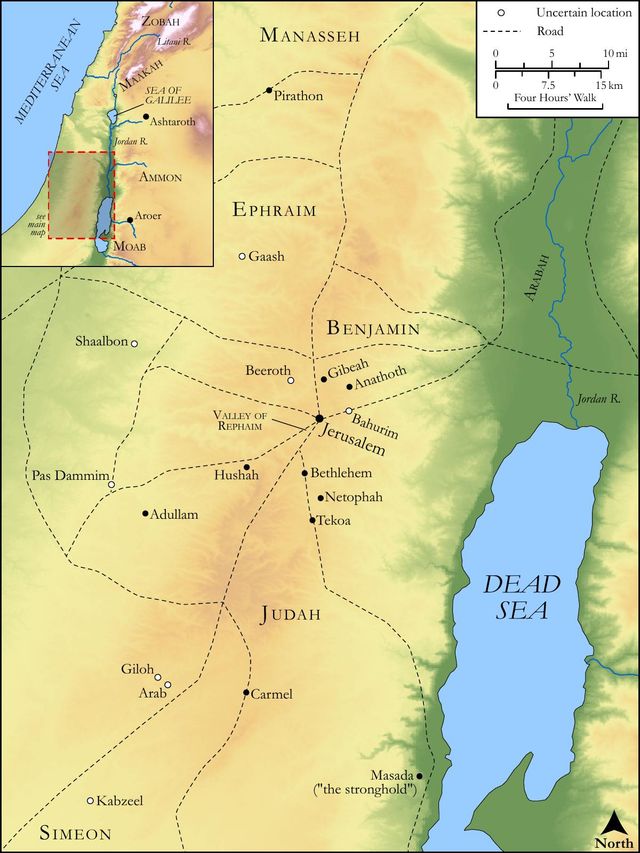
The historical backdrop for this verse is the zenith of the united monarchy of Israel under King David, a period characterized by significant military expansion, strategic consolidation of power, and ongoing conflicts with surrounding nations. Moab was a perennial adversary of Israel, frequently engaged in hostilities, making Benaiah's victory over the "lionlike men of Moab" a triumph of national significance. In Scripture, the lion was a pervasive and potent symbol, embodying strength, royalty, ferocity, and danger, as in Jacob's blessing, "Judah is a lion's whelp." The act of slaying a lion, particularly in a confined, perilous setting like a pit during the harsh conditions of winter, was an extraordinary feat. Such an act was universally recognized as an unparalleled display of bravery and skill, often associated with heroic figures or even those perceived to be divinely empowered. Kabzeel, identified as Benaiah's hometown, was a town situated in the southernmost region of Judah, as noted in Joshua 15:21, firmly rooting Benaiah within a specific tribal and geographical heritage known for its ruggedness and resilience.
Key Themes
ShowHideBenaiah's exploits profoundly contribute to several overarching themes woven throughout 2 Samuel. Foremost among these is the theme of Exceptional Valor and Strength, which vividly showcases the physical prowess and moral courage indispensable for defending the nascent kingdom. His actions also underscore the theme of Unwavering Loyalty and Service to King David, a characteristic consistently lauded among the mighty men, thereby reinforcing the paramount importance of dedicated service to the divinely appointed monarch. Implicitly, the narrative subtly touches upon Divine Empowerment, as such seemingly superhuman feats were often understood within biblical thought as being enabled by God's guiding hand, ensuring the success and enduring stability of the Davidic dynasty. These individual acts of heroism collectively serve to highlight the Establishment and Security of the Davidic Kingdom, demonstrating the formidable force that protected God's chosen ruler and his people. The narrative of David's mighty men, including Benaiah's account, serves to illustrate the strength and divine backing of the monarchy, reinforcing the divine covenant with David found in 2 Samuel 7.
Exposition and Analysis
ShowHideKey Word Analysis
ShowHideThis term signifies "force," whether of men, means, or other resources, encompassing concepts like an army, wealth, virtue, valor, or strength. When applied to a "man of valor" or "valiant man" (as in "the son of a valiant man"), it denotes someone possessing exceptional strength, courage, and capability, particularly in a military context. This highlights that Benaiah inherited or was raised in an environment that fostered such formidable qualities, indicating a lineage of strength and courage.
This compound term literally translates to "lion of God" or "hero of God." In this context, it refers not to literal lions but to exceptionally fierce, strong, or heroic warriors. It serves as a descriptive title for elite Moabite soldiers, or potentially even as a proper name for two specific, renowned figures, emphasizing their formidable nature and making Benaiah's victory over them all the more impressive. The use of "lionlike" underscores their ferocity and power, elevating the significance of Benaiah's triumph.
This word refers to a cistern, a dungeon, or generally a deep hole. It typically describes a deep, narrow, often dry well used for water storage or as a prison. The context of "in time of snow" suggests a confined, treacherous, and potentially slippery space where a cornered lion would be exceptionally dangerous. Benaiah's willingness to "go down" into such a perilous, enclosed environment to confront a beast underscores his extraordinary courage, demonstrating an act of deliberate, almost suicidal bravery that sets him apart.
Verse Breakdown
ShowHide"And Benaiah the son of Jehoiada, the son of a valiant man, of Kabzeel"
This opening clause meticulously establishes Benaiah's identity and distinguished lineage. He is not merely Benaiah, but specifically "the son of Jehoiada," implying a father of significant standing. The subsequent phrase, "the son of a valiant man," further emphasizes that valor was a deeply ingrained family trait, a heritage of courage and strength passed down through generations. His origin "of Kabzeel" grounds him geographically, connecting him to a specific, likely rugged, locale in Judah, perhaps hinting at the hardy nature of its inhabitants.
"who had done many acts"
This general commendation serves as a powerful introduction to Benaiah's established character. It indicates that the extraordinary feats about to be detailed are not isolated incidents but rather representative examples of a consistent pattern of remarkable accomplishments, setting the stage for the specific illustrations of his unparalleled prowess.
"he slew two lionlike men of Moab"
This is the first specific and striking feat recounted, highlighting Benaiah's exceptional military might and his capacity to overcome formidable human adversaries. The description of these men as "lionlike" vividly emphasizes their immense strength, ferocity, and perhaps their status as champions, making Benaiah's decisive victory over them a profound testament to his superior skill, courage, and effectiveness against national enemies.
"he went down also and slew a lion in the midst of a pit in time of snow"
This second, highly vivid, and singular feat further underscores Benaiah's unique and almost mythical bravery. It describes a solitary, desperate encounter with a wild, apex predator in the most challenging and confined circumstances—a "pit" where the animal was cornered and likely exceptionally aggressive, compounded by the harsh winter weather ("time of snow"). This act transcends typical military valor, demonstrating an almost superhuman level of courage, physical capability, and an unwavering resolve in the face of extreme, life-threatening danger.
Literary Devices
ShowHideThe verse employs several powerful Literary Devices to convey Benaiah's exceptional character and the magnitude of his feats. Hyperbole is evident in the description of the "lionlike men of Moab," which, while potentially referring to literal warriors, uses the imagery of lions to exaggerate their ferocity and power, thereby making Benaiah's victory over them even more impressive and dramatic. Symbolism is central, with the lion representing ultimate strength, untamed danger, and even royal power; Benaiah's slaying of it symbolizes his ability to conquer the most formidable threats, both human and natural. The verse also uses Juxtaposition by presenting two distinct types of challenges—human adversaries (the "lionlike men") and a wild beast (the literal lion)—thereby broadening the scope of Benaiah's valor and demonstrating his versatility and readiness to face any threat. The phrase "in the midst of a pit in time of snow" creates vivid Imagery, painting a clear, perilous, and chilling scene that enhances the dramatic impact of Benaiah's solitary act, appealing powerfully to the reader's senses and imagination. The overall structure of listing his accomplishments provides a form of Parallelism, showcasing his consistent pattern of extraordinary deeds and reinforcing his reputation as a man of unparalleled courage.
Theological and Thematic Connections
ShowHideBenaiah's remarkable acts of valor, while seemingly focused on physical strength and military prowess, carry profound theological significance within the broader biblical narrative. His courage, skill, and effectiveness are not merely human attributes but implicitly point to the divine enablement that frequently accompanies those called to serve God's purposes, especially in the establishment and defense of His kingdom. Benaiah, like other mighty men, served as an instrumental figure in God's sovereign plan for David, demonstrating that God empowers His servants to overcome seemingly insurmountable obstacles, whether human adversaries or natural dangers, for the advancement of His divine will and the protection of His people. His unwavering loyalty to David, the anointed king, foreshadows the ultimate faithfulness and dedication required of those who serve the true King, God Himself, and His ultimate Messiah.
Reflection and Application
ShowHideBenaiah's story stands as a powerful testament to courage, determination, and unwavering loyalty in the face of daunting challenges. For believers today, his exploits offer a compelling model for navigating the "lionlike" adversaries and "pits in time of snow" that we inevitably encounter in our spiritual, personal, and professional lives. Just as Benaiah confronted literal threats, we are called to face our own formidable obstacles—whether they be spiritual attacks, difficult circumstances, moral compromises, or personal fears—with boldness and an unwavering reliance on God's strength. His commitment to David's kingdom reminds us of our call to be faithful and dedicated to God's kingdom, using our unique gifts and strengths, not for personal glory, but for His divine purposes and the flourishing of His people. Benaiah's willingness to enter a dangerous pit alone teaches us the profound lesson of stepping into uncomfortable or perilous situations when called by God, trusting implicitly that He will equip us for the task and empower us to overcome.
Questions for Reflection
ShowHideFAQ
ShowHideWho were the "lionlike men of Moab"?
ShowHideThe "lionlike men of Moab" (Hebrew: 'ari'el') were not literal lions, but exceptionally fierce and formidable warriors from Moab, a neighboring kingdom often in conflict with Israel. The term "lionlike" is a powerful descriptor, emphasizing their immense strength, courage, and ferocity, likening them to the most powerful predators. Some scholars suggest that "Ariel" could have been a specific title for elite Moabite champions, or even the proper names of two particularly renowned figures. Benaiah's victory over them highlights his superior prowess and courage, as he overcame the most fearsome of Israel's national enemies, demonstrating his vital role in securing David's kingdom against external threats, as detailed in 2 Samuel 8:2.
Why is slaying a lion in a pit during snow significant?
ShowHideThis act is particularly significant because it demonstrates Benaiah's extraordinary bravery, physical skill, and unwavering resolve in the most perilous and challenging of circumstances. A "pit" (Hebrew: bowr) would have been a confined, dark, and dangerous space, likely a cistern or a natural crevice. When a lion is cornered, especially in harsh weather like "time of snow" (making conditions slippery and visibility poor), it becomes incredibly aggressive, desperate, and unpredictable. For Benaiah to descend alone into such a confined space to confront and kill a cornered, enraged lion speaks volumes about his fearless determination, immense physical strength, and mastery over extreme danger. This feat transcends typical military valor, setting him apart as a truly exceptional warrior, capable of overcoming both human and animal threats in the most challenging and life-threatening environments, much like Samson's encounter with a lion in Judges 14:5-6.
Christ-Centered Fulfillment
ShowHideWhile Benaiah's valor was directed towards establishing and defending King David's earthly kingdom, his acts powerfully prefigure the ultimate courage and triumph of Jesus Christ, the true "Lion of the tribe of Judah" (Revelation 5:5). Benaiah confronted physical "lionlike men" and a literal lion in a pit; Christ faced and definitively defeated far greater spiritual adversaries: sin, death, and the devil. His descent into the "pit" of death on the cross was the ultimate act of courage and self-sacrifice, where He confronted the powers of darkness in their very stronghold. Just as Benaiah secured David's reign through his might, Christ, through His sacrificial death and glorious resurrection, utterly triumphed over the spiritual forces that held humanity captive (Colossians 2:15). He destroyed the one who had the power of death, the devil, and delivered those who were held in slavery by their fear of death (Hebrews 2:14-15). With a triumphant cry, "It is finished!" (John 19:30), He secured eternal victory for His people. Benaiah's strength was for a temporary, earthly kingdom; Christ's strength established an everlasting, spiritual kingdom, offering true freedom, resurrection life, and an ultimate victory over death to all who believe (1 Corinthians 15:54-57).